
Study Guides
OxfordAQA International A-level Sociology (9690): What is meant by globalisation?
Study guide to OxfordAQA 9690 section 3.2.1.2: defining globalisation, its cultural, political and economic forms, how far it has gone and the global and local.
- Subject
- Sociology
- Level
- A LEVEL
- Topic
- Unit 3 – People and Development
- Author
- Marlbridge Academic Team
- Updated
- Reviewed by
- Naqiya Yousaf (what this means)
Aligned to OxfordAQA A Level Sociology (9690), Version 1.1. Official specification .
Syllabus page (what it covers and how it is assessed): OxfordAQA A Level Sociology.
Syllabus points this page covers
9690 (A Level)
- 3.2.1.2 What is meant by globalisation?
Found an error? Report a correction.
Need help with this topic? Request a free trial class for A Level Sociology (9690).
This guide goes deeper into one content point of the OxfordAQA International A-level Sociology (9690) specification, Version 1.1: 3.2.1.2 What is meant by globalisation?, part of Unit 3 People and development. The specification lists different types of globalisation (cultural, political and economic), the extent to which each has happened, three theoretical views (neo-liberal or positive globalist, negative globalist and transformationalist), who has benefited or been harmed, and “the global and the local, including how the local survives; glocalisation”.
The Unit 3 People and development study guide gives the overview of the whole unit. This page adds definitions, further thinkers and the debate about extent. Condense it with the globalisation revision notes and test yourself with the globalisation practice questions.
Defining globalisation precisely
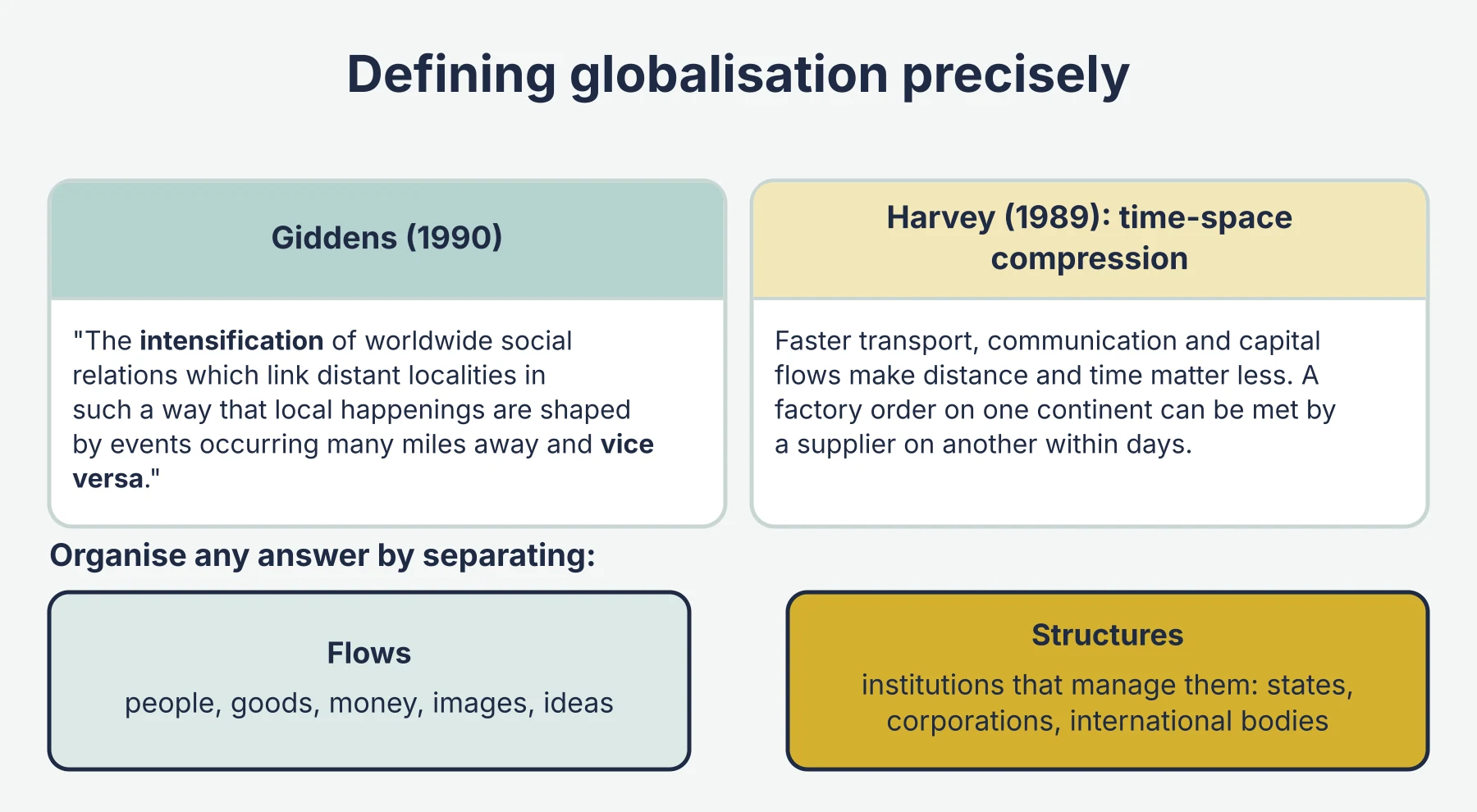
Examiners reward a definition that says what changes, not just “the world getting smaller”. Two definitions are worth learning.
- Anthony Giddens (The Consequences of Modernity, 1990) defined globalisation as “the intensification of worldwide social relations which link distant localities in such a way that local happenings are shaped by events occurring many miles away and vice versa”. The key words are intensification (a matter of degree, not a new world overnight) and vice versa (influence runs both ways).
- David Harvey (The Condition of Postmodernity, 1989) described time-space compression: faster transport, communication and capital flows make distance and time matter less in social and economic life. A factory order placed in one continent can be met by a supplier in another within days.
A useful way to organise any answer is to separate flows (people, goods, money, images, ideas) from structures (the institutions that manage them, such as states, corporations and international bodies). The specification’s three types map onto these flows.
Cultural globalisation in more depth
The specification names languages, religious beliefs, popular culture, the internet and global communication, the global village and cultural imperialism.
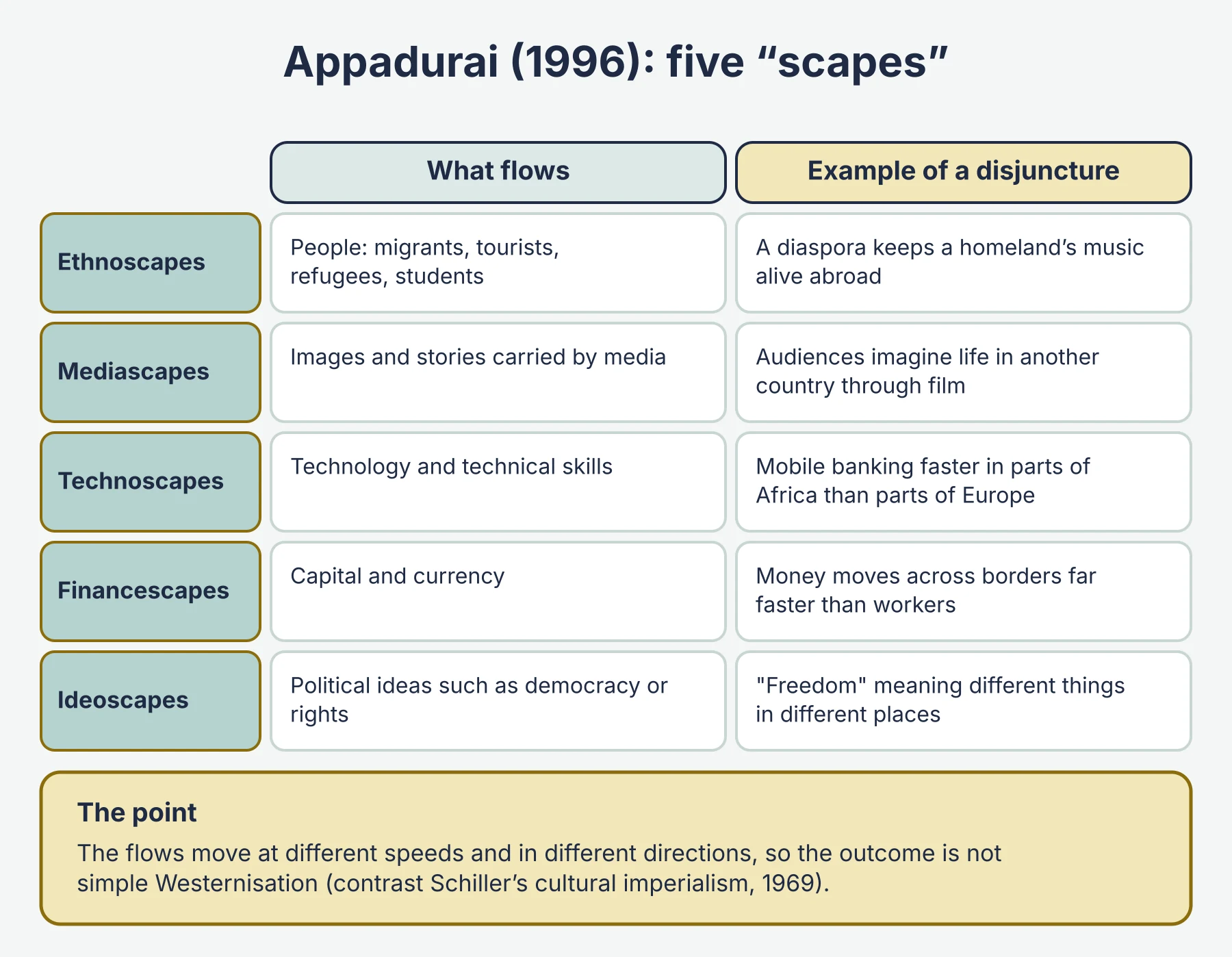
Arjun Appadurai’s “scapes”. In Modernity at Large (1996), Appadurai argued that global culture is not one flow from the West but five overlapping, uneven ones:
| Scape | What flows | Example of a disjuncture |
|---|---|---|
| Ethnoscapes | People: migrants, tourists, refugees, students | A diaspora keeps a homeland’s music alive abroad |
| Mediascapes | Images and stories carried by media | Audiences in one country imagine life in another through film |
| Technoscapes | Technology and technical skills | Mobile banking spreading faster in parts of Africa than in parts of Europe |
| Financescapes | Capital and currency | Money moving across borders far faster than workers can |
| Ideoscapes | Political ideas such as democracy or rights | A term such as “freedom” meaning different things in different places |
His point is that these flows move at different speeds and in different directions, so the outcome is not simple Westernisation.
Cultural imperialism. Herbert Schiller (Mass Communications and American Empire, 1969) argued that US media corporations exported commercial values along with programmes, so that poorer countries absorbed American consumer culture. This is the strongest version of the claim; the Unit 3 overview already pairs it with Ritzer’s McDonaldization.
Religion. Globalisation spreads religious movements across borders through migration, satellite television and online preaching, so congregations can follow a teacher in another continent. Giddens (Runaway World, 1999) argued that fundamentalism is itself a product of globalisation: when traditions are challenged by global flows, some groups defend them in a rigid, uncompromising form.
Language. English has become a common language of business, science and the internet. Linguists warn that many smaller languages are endangered as young people switch to national or global languages. Yet digital media also allow minority-language communities to publish and broadcast cheaply.
Political globalisation in more depth
The specification lists democracy, human rights and gender equality.
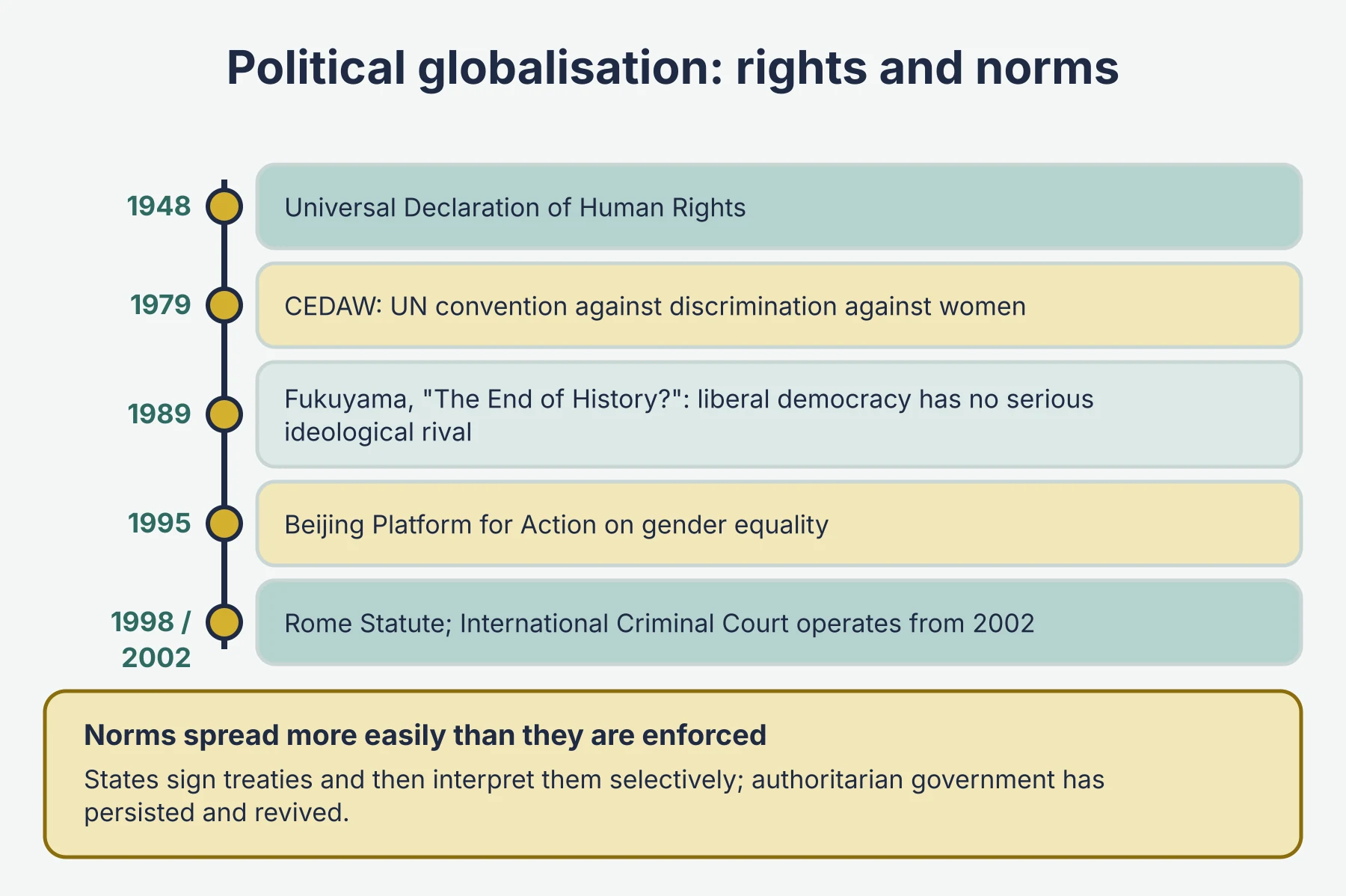
- Human rights: the Universal Declaration of Human Rights (1948) set out rights claimed for all people. The International Criminal Court, created by the Rome Statute (1998) and operating from 2002, can try individuals for genocide, crimes against humanity and war crimes.
- Gender equality: the UN Convention on the Elimination of All Forms of Discrimination against Women (CEDAW, 1979) and the Beijing Platform for Action (1995) turned gender equality into a global policy norm.
- Democracy: after the end of the Cold War, Francis Fukuyama (“The End of History?”, 1989) argued that liberal democracy had no serious ideological rival left. Critics point to the persistence and revival of authoritarian government, which suggests political globalisation is far from complete.
Political globalisation spreads norms more easily than it enforces them: states sign treaties and then interpret them selectively.
Economic globalisation in more depth
The specification lists the global spread of capitalism and global trade, transnational corporations and global activism.
- Spread of capitalism: China’s market reforms from 1978, the collapse of the Soviet bloc after 1989 and China’s entry to the World Trade Organization in 2001 brought most of the world’s population into global markets.
- Global trade and supply chains: a single product is often designed, assembled and sold in different countries.
- Global activism: protests at the World Trade Organization meeting in Seattle in 1999, and the World Social Forum (first held in Porto Alegre, Brazil, in 2001) under the slogan “another world is possible”, show that opposition also organises globally.
How far has globalisation gone? The extent debate
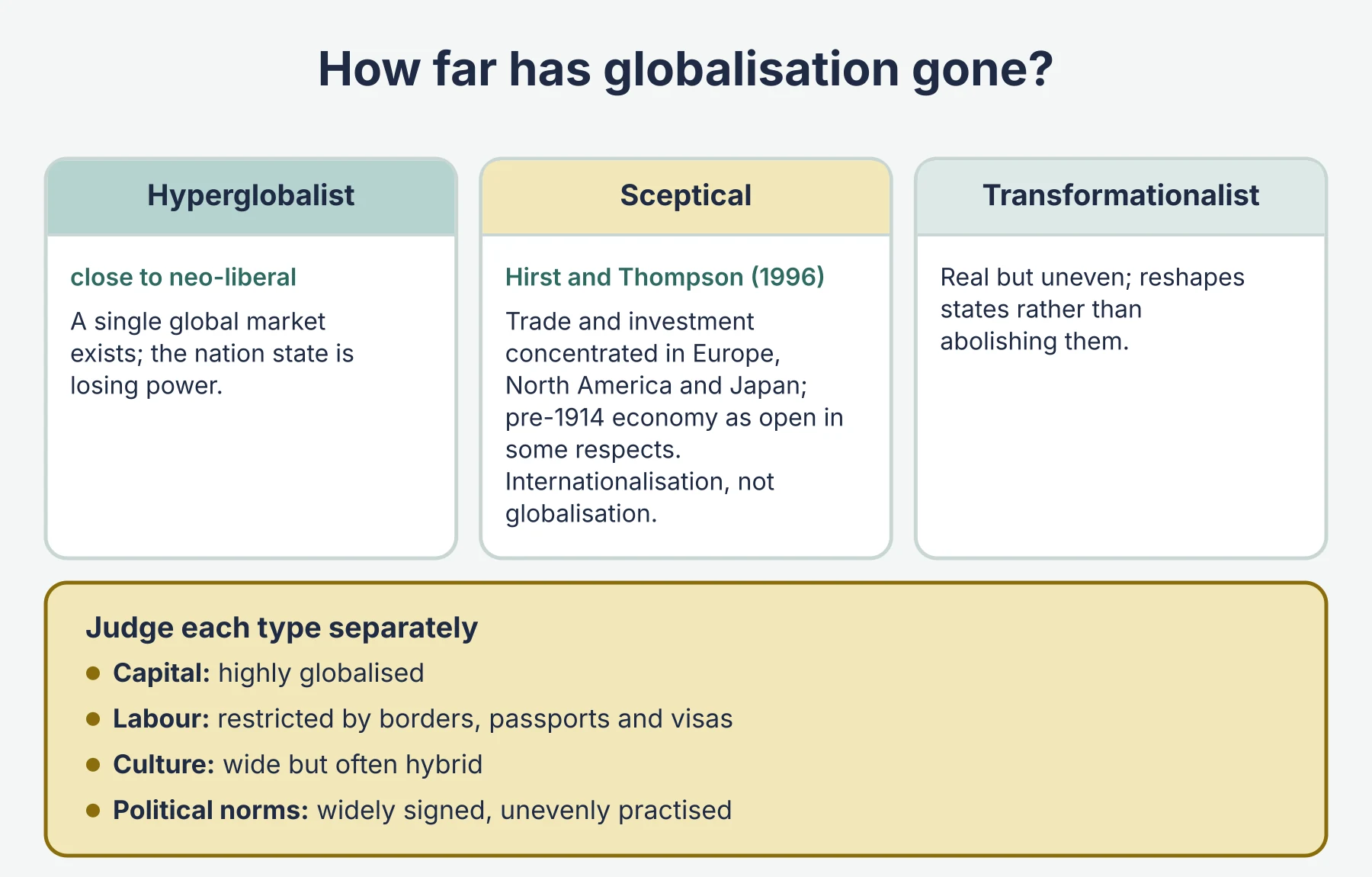
The specification asks you to judge “the extent to which different types of globalisation have happened and are happening”. Three positions help.
- Hyperglobalist (close to the neo-liberal view): a single global market now exists and the nation state is losing its power.
- Sceptical: Paul Hirst and Grahame Thompson (Globalization in Question, 1996) argued that most trade and investment is concentrated among a few rich regions (Europe, North America and Japan in their analysis), and that the world economy before 1914 was in some respects as open as in the 1990s. What exists is internationalisation between strong states, not true globalisation.
- Transformationalist: globalisation is real but uneven and reshapes states rather than abolishing them.
A strong answer judges each type separately. Economic flows of capital are highly globalised; labour is not, because borders, passports and visas restrict people far more than money. Cultural flows are wide but often hybrid. Political norms are widely signed but unevenly practised.
Who has gained and who has lost?
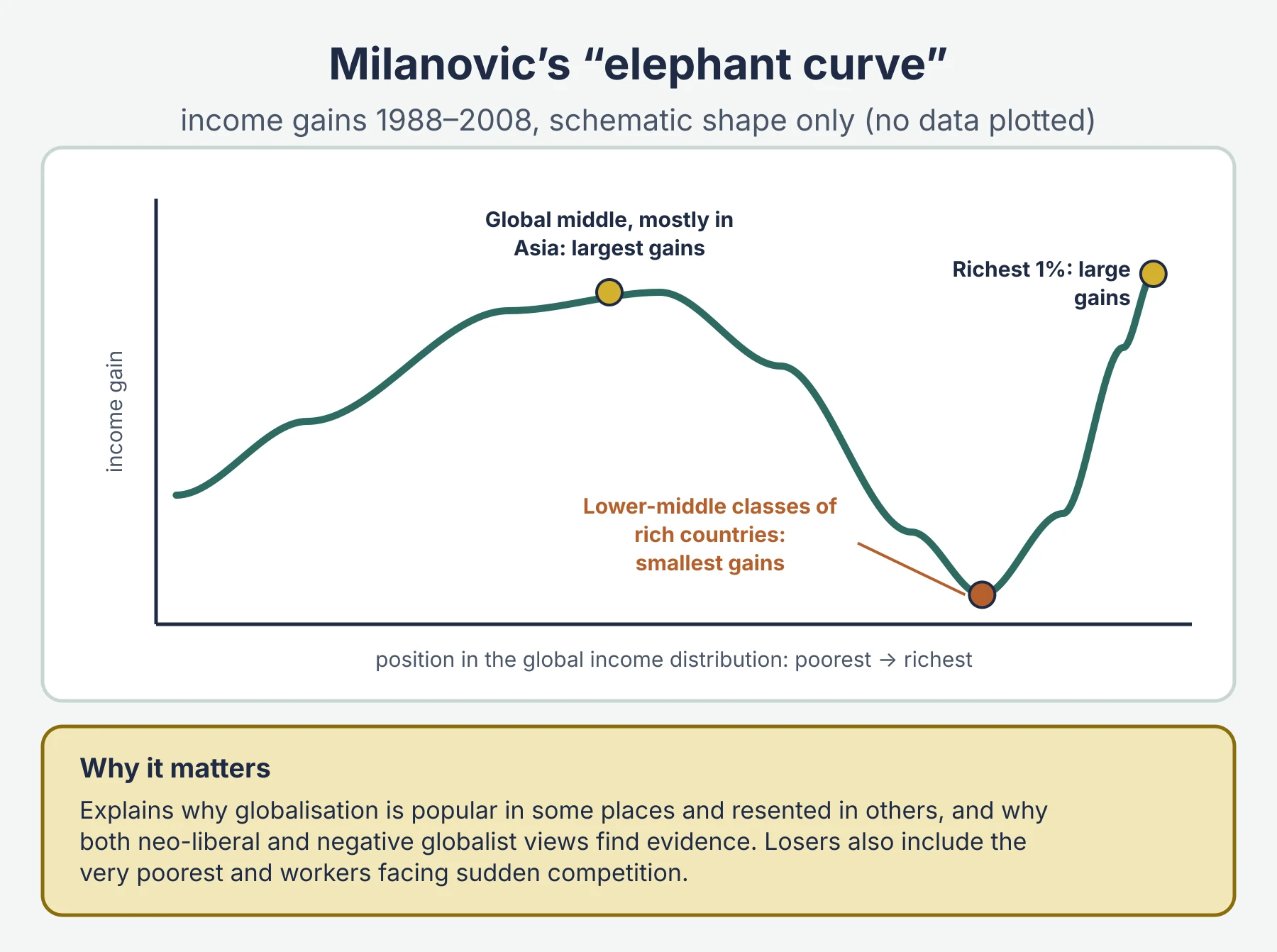
Branko Milanovic (Global Inequality, 2016) summarised research on world incomes between 1988 and 2008 as an “elephant curve”. The largest income gains went to the middle of the global distribution, mostly in Asia, and to the richest 1 per cent worldwide; the smallest gains went to the lower-middle classes of rich countries. This helps explain why globalisation is popular in some places and resented in others, and why both neo-liberal and negative globalist views can find supporting evidence.
Losers also include the very poorest, who lack the infrastructure or skills to join global markets, and workers in industries exposed to sudden competition.
The global and the local: how the local survives
The Unit 3 overview introduces Robertson’s glocalisation. Three further ideas add depth.
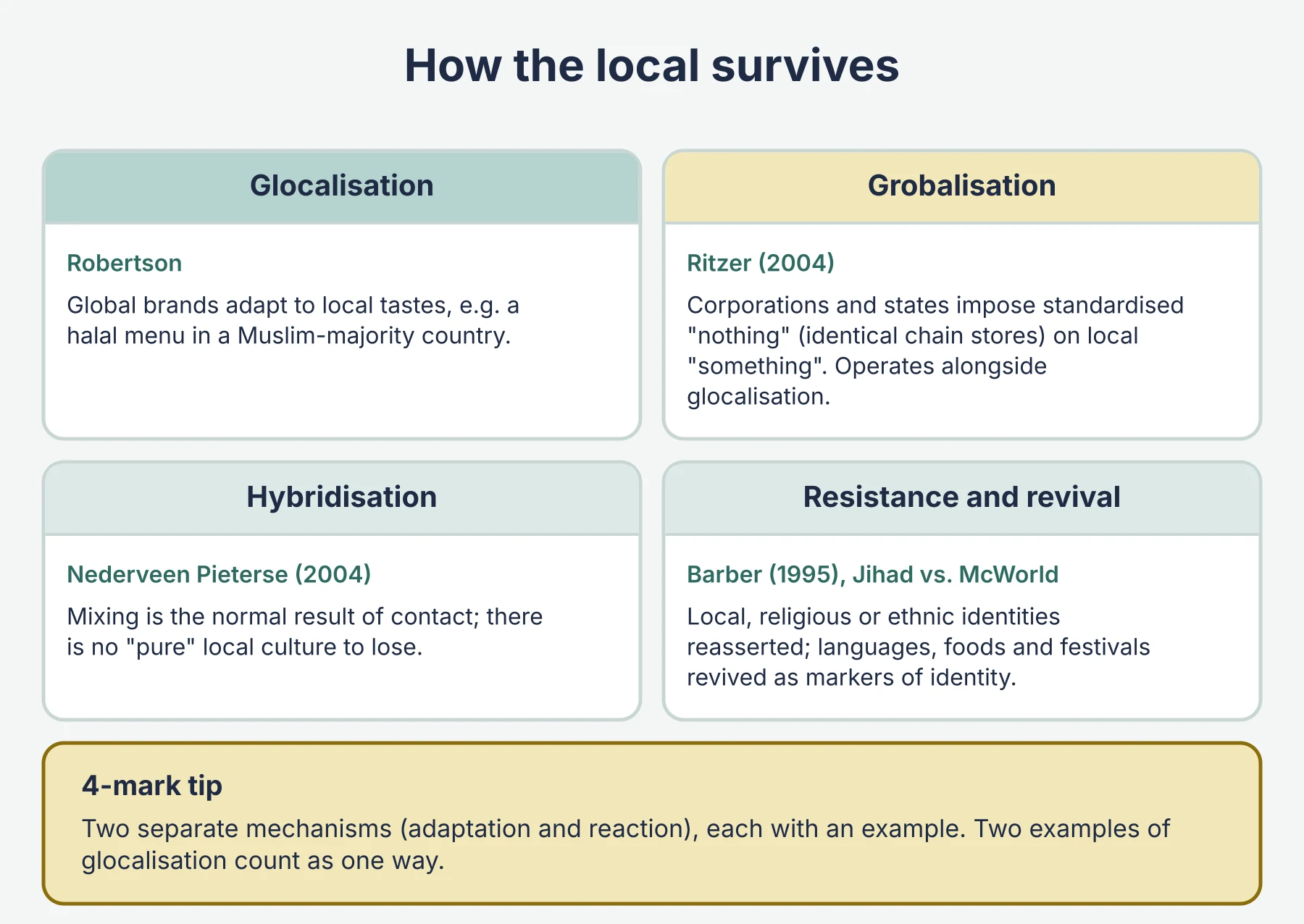
- Grobalisation: George Ritzer (The Globalization of Nothing, 2004) coined this for the drive of corporations and states to impose standardised forms on local areas. He contrasted centrally designed “nothing” (a chain store identical everywhere) with locally rooted “something” (a family restaurant with a local history). Glocalisation and grobalisation operate at the same time.
- Hybridisation: Jan Nederveen Pieterse (Globalization and Culture: Global Mélange, 2004) argued that mixing is the normal result of contact between cultures, so there is no “pure” local culture to lose.
- Resistance and revival: Benjamin Barber (Jihad vs. McWorld, 1995) described a clash between homogenising consumer capitalism and movements that reassert local, religious or ethnic identity. Local languages, foods, crafts and festivals can be revived as markers of identity precisely because global culture is everywhere.
Annotated model answer
Question: Outline two ways in which the local may survive cultural globalisation. [4]
Global brands often adapt to local tastes, for example a fast-food chain offering a halal menu in a Muslim-majority country, so local norms shape the global product (glocalisation) [point and example]. Local identities may also be reasserted as a reaction to global culture, as Barber suggests, for example through the revival of a regional language on local radio and social media [second distinct point, linked to a thinker].
Why it works: two separate mechanisms (adaptation, reaction), each with an example. Two examples of glocalisation would count as one way.
Extract from a 12-mark answer: Evaluate the view that globalisation has gone as far as neo-liberals claim.
Hirst and Thompson argue that trade and investment are concentrated among a few rich regions, so what neo-liberals call a global market is really internationalisation between powerful states [knowledge, sceptical view]. This fits labour more than capital: money crosses borders instantly, but most people in my society need a visa to work abroad [application to own society]. So economic globalisation is advanced for capital and goods but limited for people [analysis by type]. However, transformationalists would add that even states which still control borders now share power with corporations and international bodies, so the sceptics may understate change [evaluation using a third view].
Common mistakes
- Defining globalisation as “countries becoming connected” without saying what flows or what changes.
- Treating the three types as equally advanced; the specification asks about extent, so compare them.
- Using cultural imperialism as fact rather than as one contested view.
- Forgetting that negative globalists and sceptics are different: sceptics doubt how far globalisation has gone, while negative globalists accept it and condemn its effects.
- Discussing “the local” only as a victim; the specification asks how it survives.
Exam technique for the command words
- Identify: name the point, no development needed.
- Outline: give the point with brief development or an example.
- Explain: give the point and its consequence (“so”, “which means”).
- Analyse: break the issue into parts, for example by type of globalisation or by social group.
- Evaluate / Assess / To what extent: weigh views against evidence and reach a supported judgement. Use own-society examples where the question asks for them.
Where next
Globalisation’s actors (states, corporations, agencies, NGOs) are covered in who is involved in globalisation. For cultural globalisation through media, see the People and technology study guide.
Related resources
-
Practice questions
OxfordAQA International A-level Sociology (9690): What is meant by globalisation? – Practice Questions
Original OxfordAQA 9690 practice questions on the meaning, types and extent of globalisation and the global and the local, with mark-scheme answers.
Sociology · OxfordAQA · A Level
Try questions -
Revision notes
OxfordAQA International A-level Sociology (9690): What is meant by globalisation? – Revision Notes
Revision notes for OxfordAQA 9690 section 3.2.1.2: definitions, types and extent of globalisation, the three views, winners and losers, and glocalisation.
Sociology · OxfordAQA · A Level
Revise topic -
Study guides
OxfordAQA International A-level Sociology (9690): Who is involved in globalisation?
Study guide to OxfordAQA 9690 section 3.2.1.3: the roles of states, TNCs, UN and transnational agencies, NGOs, grassroots movements, indigenous peoples and aid.
Sociology · OxfordAQA · A Level
Read guide
Related articles
Get free revision emails (optional)
Occasional emails with practice questions, worked explanations and links to free resources for the qualification and subjects you choose. No spam, and you can unsubscribe from any email. The free tools on this site never need an email.