
Study Guides
OxfordAQA International A-level Sociology (9690): Demographic changes - migration and diasporas
Study guide to OxfordAQA 9690 section 3.2.1.4: explanations of migration, borders and visas, refugees, types of migrant, diasporas and climate-linked migration.
- Subject
- Sociology
- Level
- A LEVEL
- Topic
- Unit 3 – People and Development
- Author
- Marlbridge Academic Team
- Updated
- Reviewed by
- Naqiya Yousaf (what this means)
Aligned to OxfordAQA A Level Sociology (9690), Version 1.1. Official specification .
Syllabus page (what it covers and how it is assessed): OxfordAQA A Level Sociology.
Syllabus points this page covers
9690 (A Level)
- 3.2.1.4 Demographic changes - migration and diasporas
Found an error? Report a correction.
Need help with this topic? Request a free trial class for A Level Sociology (9690).
This guide covers content point 3.2.1.4 Demographic changes - migration and diasporas of the OxfordAQA International A-level Sociology (9690) specification, Version 1.1, assessed in the Unit 3 People and development exam. The specification lists: “How and why people have migrated and still do so: push and pull explanations”; internal and international migration; borders, passports and visas; refugees and forced migration; economic migrants, undocumented workers and digital nomads; the “growth and development of diasporas and transnational networks”; and the “effects on migration of climate change”.
The Unit 3 People and development study guide introduces Lee’s push-pull model, the 1951 Refugee Convention and Cohen’s diaspora types. This page adds the theories that go beyond push and pull, the politics of borders, and the sociology of diaspora identity. Pair it with the migration and diasporas revision notes and the migration and diasporas practice questions.
Explaining migration: beyond push and pull
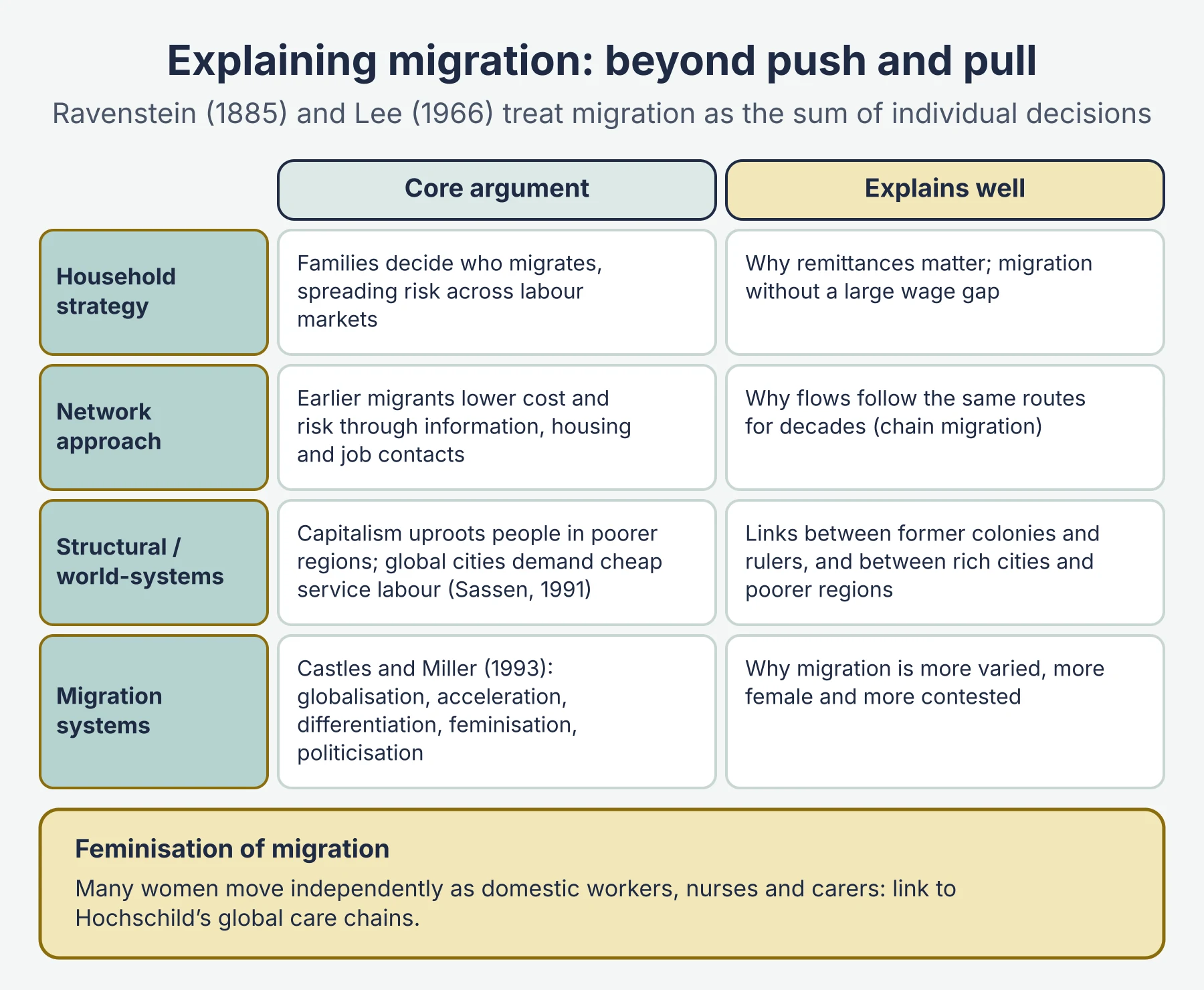
Push-pull thinking goes back to Ernst Ravenstein’s “laws of migration” (1885), based on British census data. He observed, for example, that most migrants travel short distances and that migration often happens in steps, from village to town to city. Lee (1966) added intervening obstacles. Both treat migration as the sum of individual decisions. Sociologists have added four alternatives.
| Approach | Core argument | What it explains well |
|---|---|---|
| Household strategy | Families, not individuals, decide who migrates, spreading risk by placing one member in a different labour market | Why remittances matter and why people migrate even without a large wage gap |
| Network approach | Earlier migrants lower the cost and risk for later ones through information, housing and job contacts | Why flows follow the same routes for decades (chain migration) |
| Structural / world-systems | Capitalist penetration of poorer regions uproots people, while global cities demand cheap service labour (Saskia Sassen, The Global City, 1991) | Why migration links former colonies and their former rulers, and rich cities with poorer regions |
| Migration-systems view | Stephen Castles and Mark Miller (The Age of Migration, first edition 1993) identify trends such as the globalisation, acceleration, differentiation, feminisation and politicisation of migration | Why migration is now more varied, more female and more politically contested |
The feminisation of migration is worth a sentence in most answers: many migrants now move independently as domestic workers, nurses and carers, linking this topic to Hochschild’s global care chains.
Internal and international migration
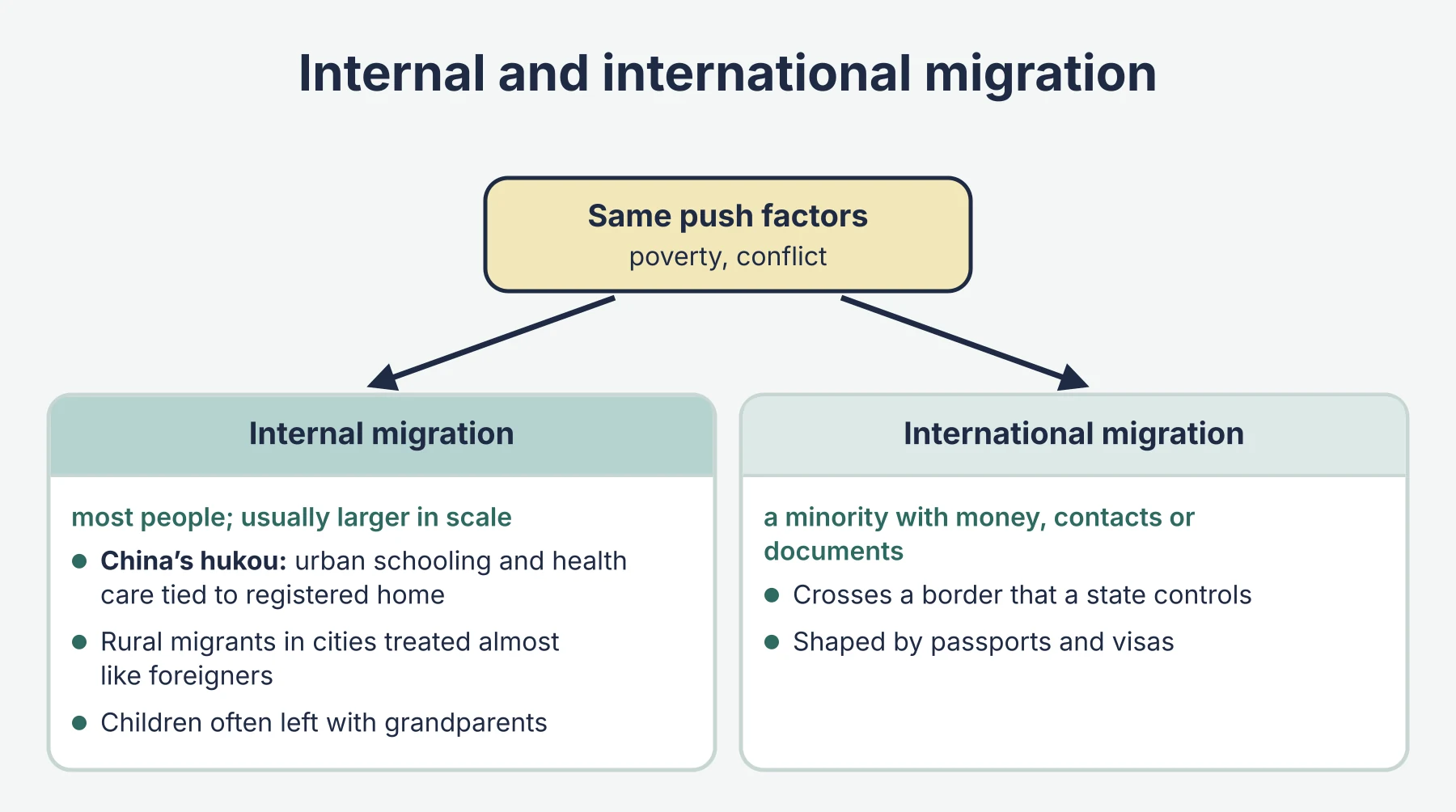
Internal migration is usually larger in scale than international migration. In China, the hukou household registration system ties access to many urban public services, such as schooling and health care, to a person’s registered home. Rural migrants working in cities may therefore be internal migrants who are treated almost like foreigners, and many leave their children with grandparents in villages.
International migration differs because it crosses a border that a state controls. A strong answer notes that the same push factors (poverty, conflict) produce internal moves for most people and international moves for a minority with money, contacts or documents.
Borders, passports and visas
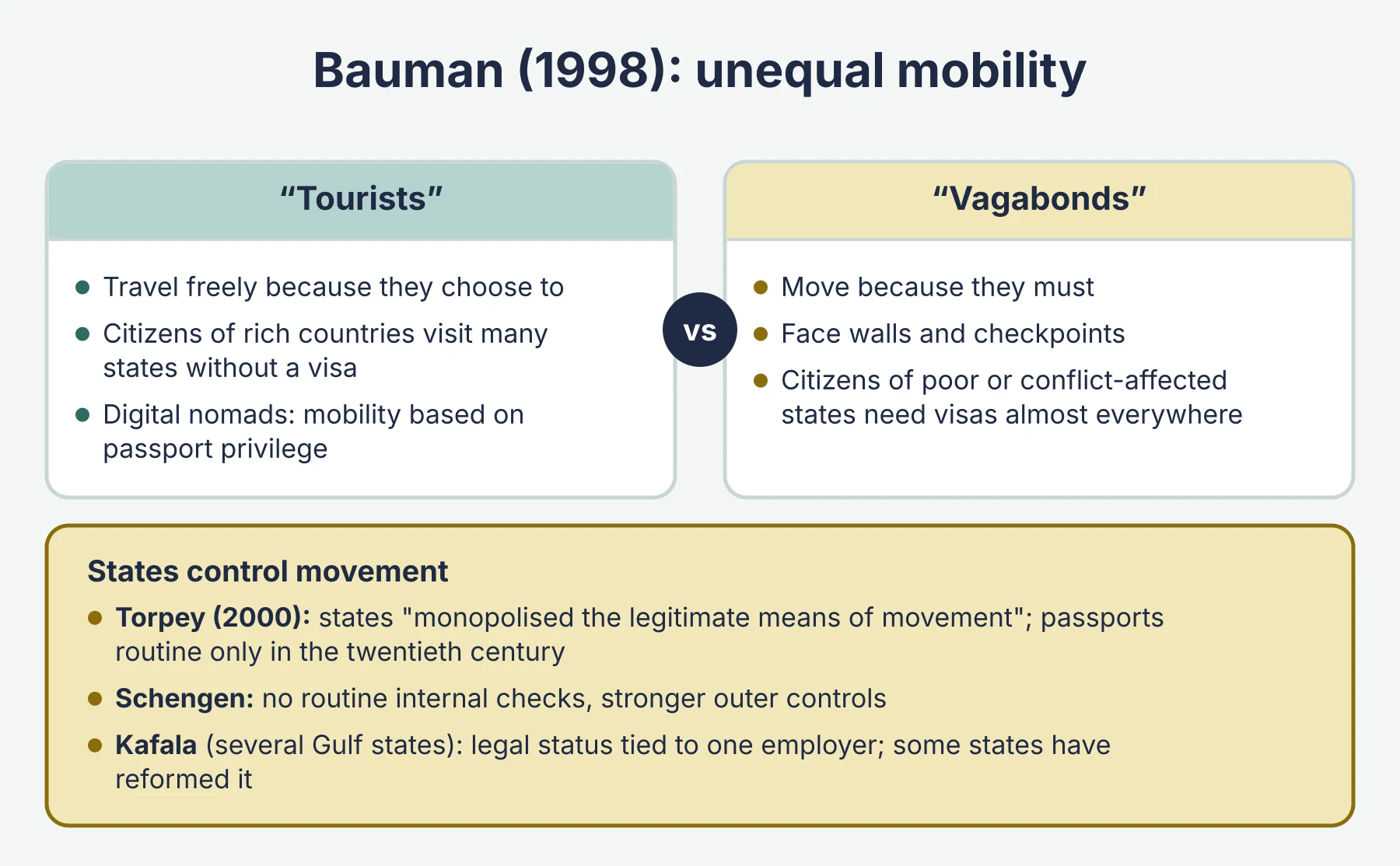
John Torpey (The Invention of the Passport, 2000) argued that modern states have “monopolised the legitimate means of movement”: only states can now authorise who may cross borders. Passports became routine only in the twentieth century.
Mobility is highly unequal. Zygmunt Bauman (Globalization: The Human Consequences, 1998) contrasted “tourists”, who travel freely because they choose to, with “vagabonds”, who move because they must and face walls and checkpoints. A citizen of a rich country can visit many states without a visa; a citizen of a poor or conflict-affected state may need a visa for almost anywhere.
Borders can also open. The Schengen Area in Europe removed routine checks at internal borders between member states, while strengthening controls at its outer edge. In several Gulf states, the kafala sponsorship system has tied a migrant worker’s legal status to a single employer, which critics say leaves workers open to exploitation; some states have reformed it.
Refugees and forced migration
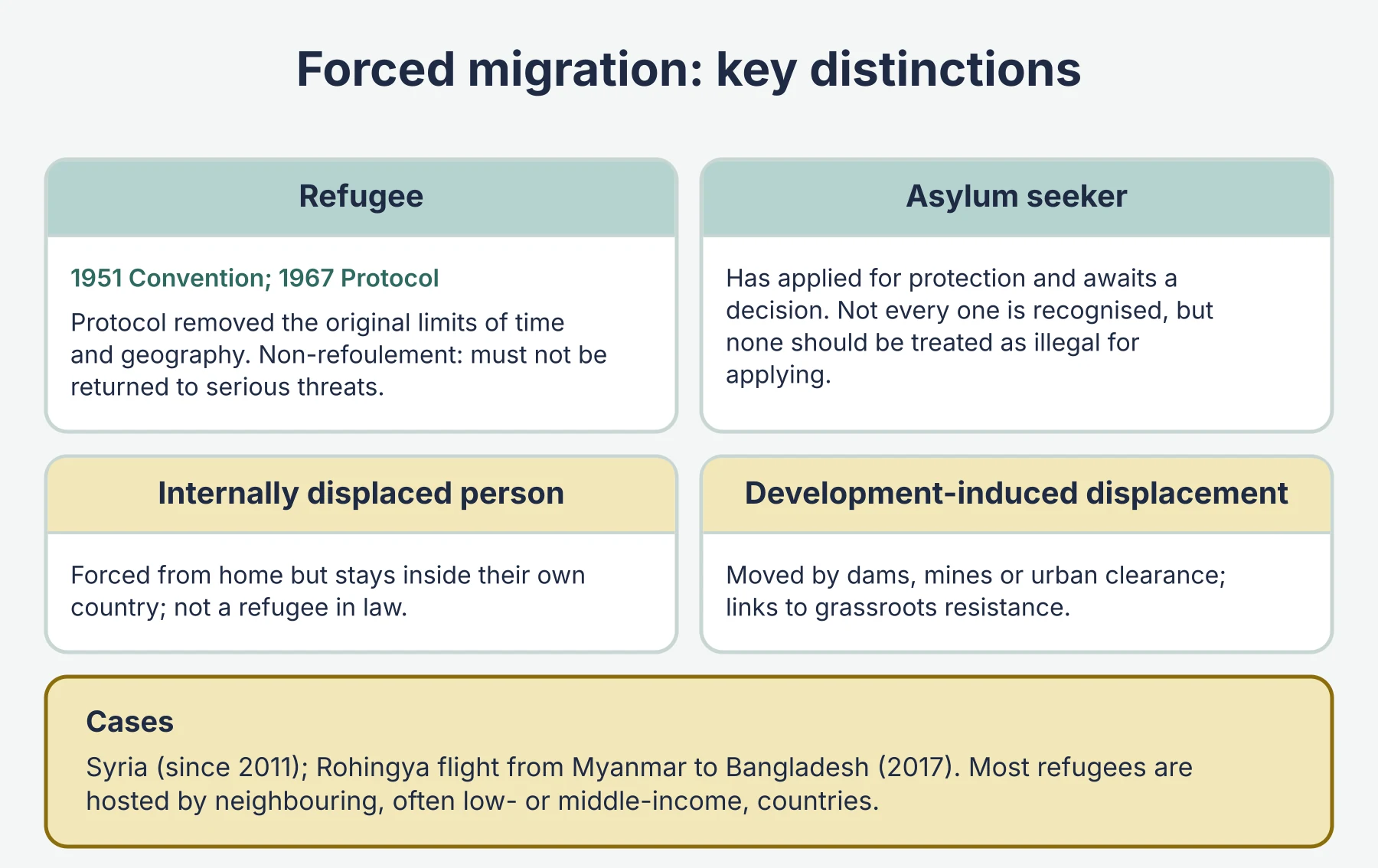
The 1951 Convention defined refugees narrowly, and its 1967 Protocol removed the original limits of time and geography. Key distinctions:
- Asylum seeker: a person who has applied for protection and is waiting for a decision. Not every asylum seeker is recognised as a refugee, but none should be treated as illegal for applying.
- Non-refoulement: the principle that refugees must not be returned to a place where they face serious threats.
- Internally displaced persons: people forced from their homes who stay inside their own country; they are not refugees in law.
- Development-induced displacement: people moved by dams, mines or urban clearance, linking this point to grassroots resistance in 3.2.1.3.
Large forced movements since 2011 include people fleeing the war in Syria and, in 2017, the flight of Rohingya people from Myanmar to Bangladesh. Most refugees are hosted by neighbouring, often low- or middle-income, countries, not by the richest states.
Economic migrants, undocumented workers and digital nomads
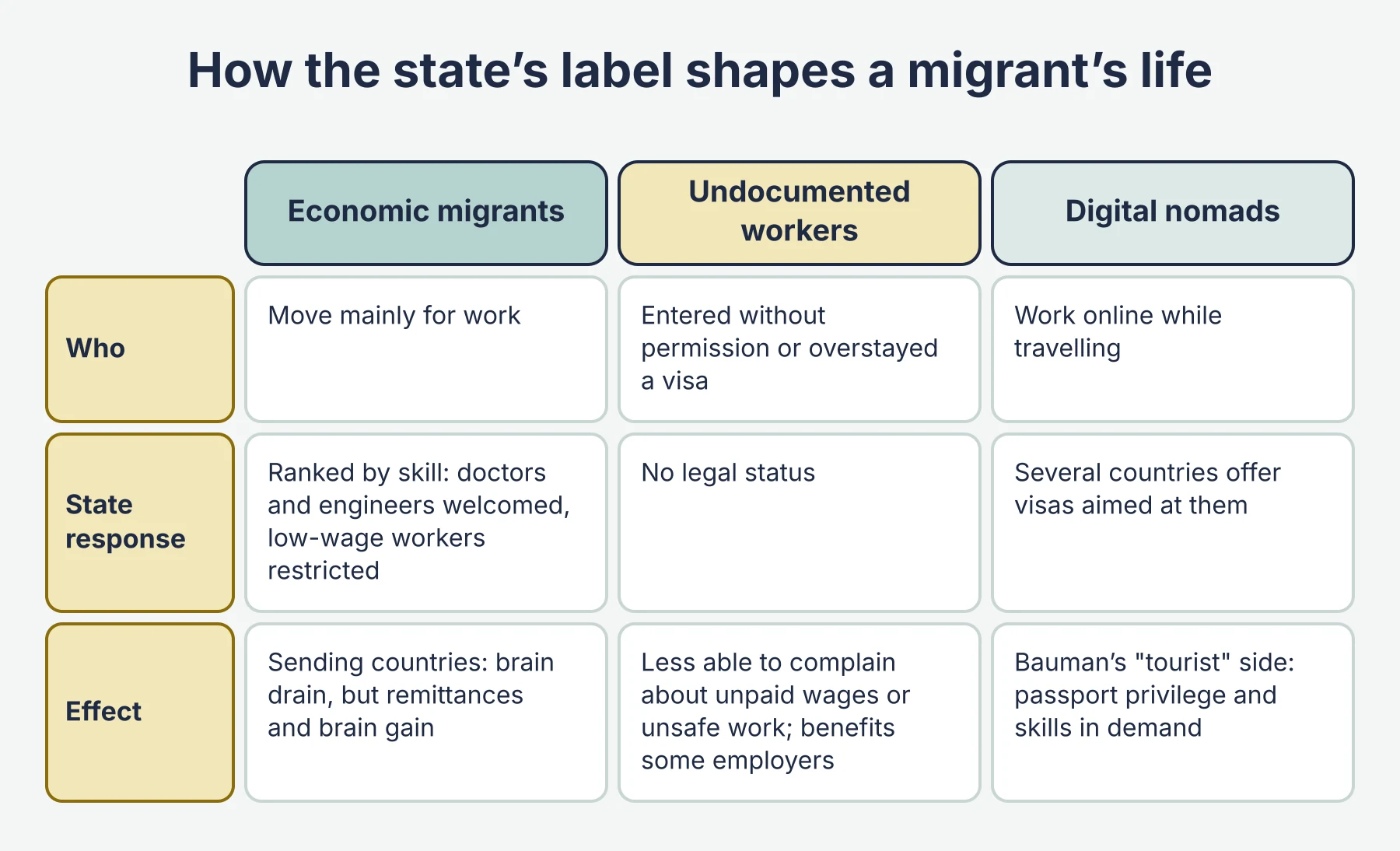
These categories show how the state’s label shapes the migrant’s life.
- Economic migrants move mainly for work; states often rank them by skill, welcoming doctors and engineers while restricting low-wage workers. Sending countries may lose skilled workers (brain drain) but gain remittances and returning skills (brain gain).
- Undocumented workers entered without permission or overstayed a visa. Without legal status, they are less able to complain about unpaid wages or unsafe work, which benefits some employers.
- Digital nomads work online while travelling. Several countries now offer visas aimed at them. They show the “tourist” side of Bauman’s contrast: high mobility based on passport privilege and global demand for their skills.
Diasporas and transnational networks
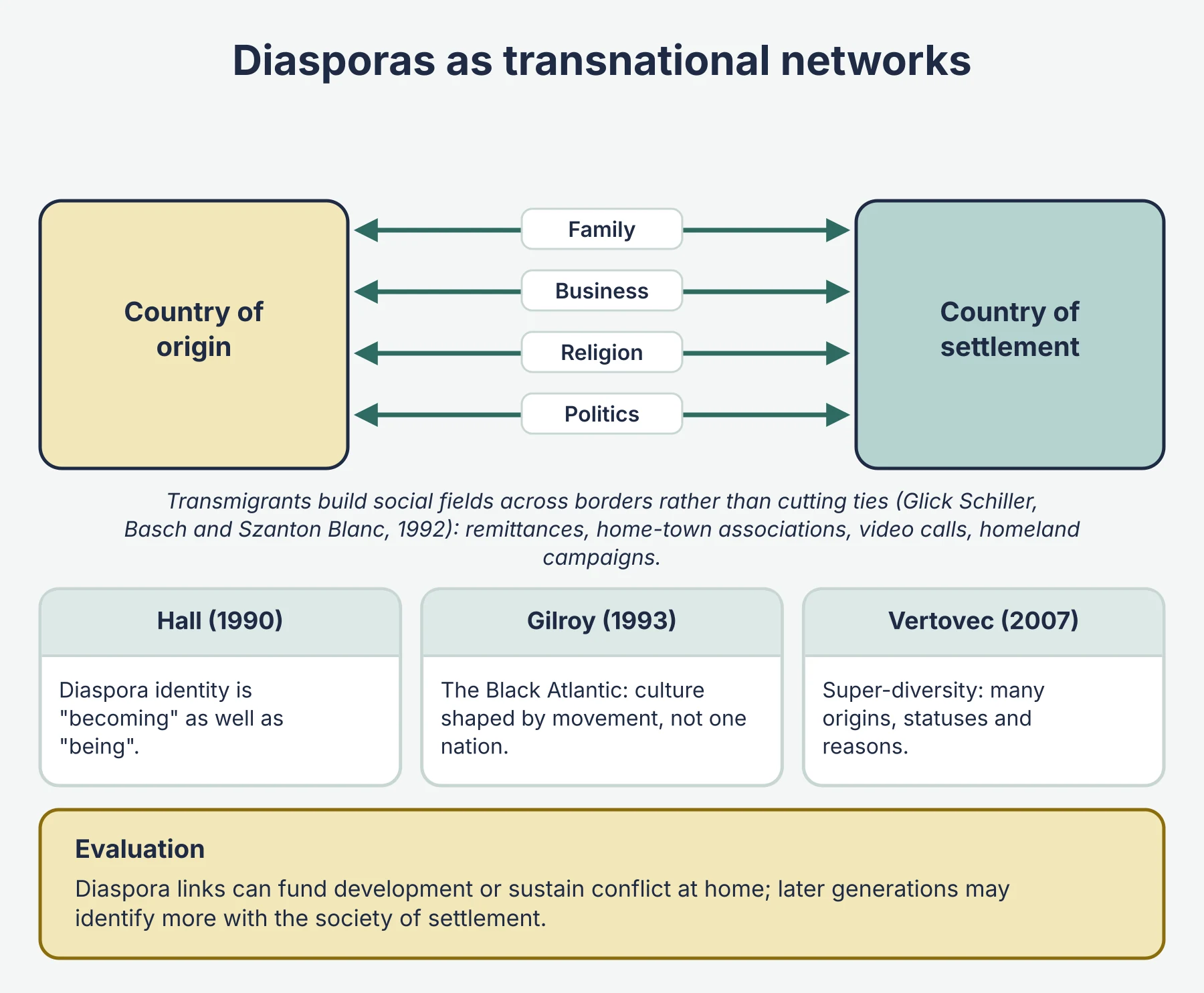
Diaspora identity. Stuart Hall (“Cultural Identity and Diaspora”, 1990) argued that diasporic identity is a matter of “becoming” as well as “being”: it is remade through memory, mixing and new experience rather than fixed by origin. Paul Gilroy (The Black Atlantic, 1993) described a culture shaped by movement across the Atlantic among Africa, the Americas and Europe, not by any one nation.
Transnationalism. Nina Glick Schiller, Linda Basch and Cristina Szanton Blanc (1992) introduced the idea of transmigrants: people who build social fields linking their country of origin and settlement, through family, business, religion and politics, rather than cutting ties. Remittances, home-town associations, video calls and political campaigns in the homeland all sustain these networks.
Super-diversity. Steven Vertovec (2007) used this term for cities where migrants come from many countries, with many legal statuses and different reasons for moving. It warns against treating “migrants” as one group.
Evaluation. Diaspora links can support development through investment and remittances, but they can also sustain conflict at home through funding, and second and third generations may identify far more with the society of settlement than with an ancestral homeland.
Climate change and migration
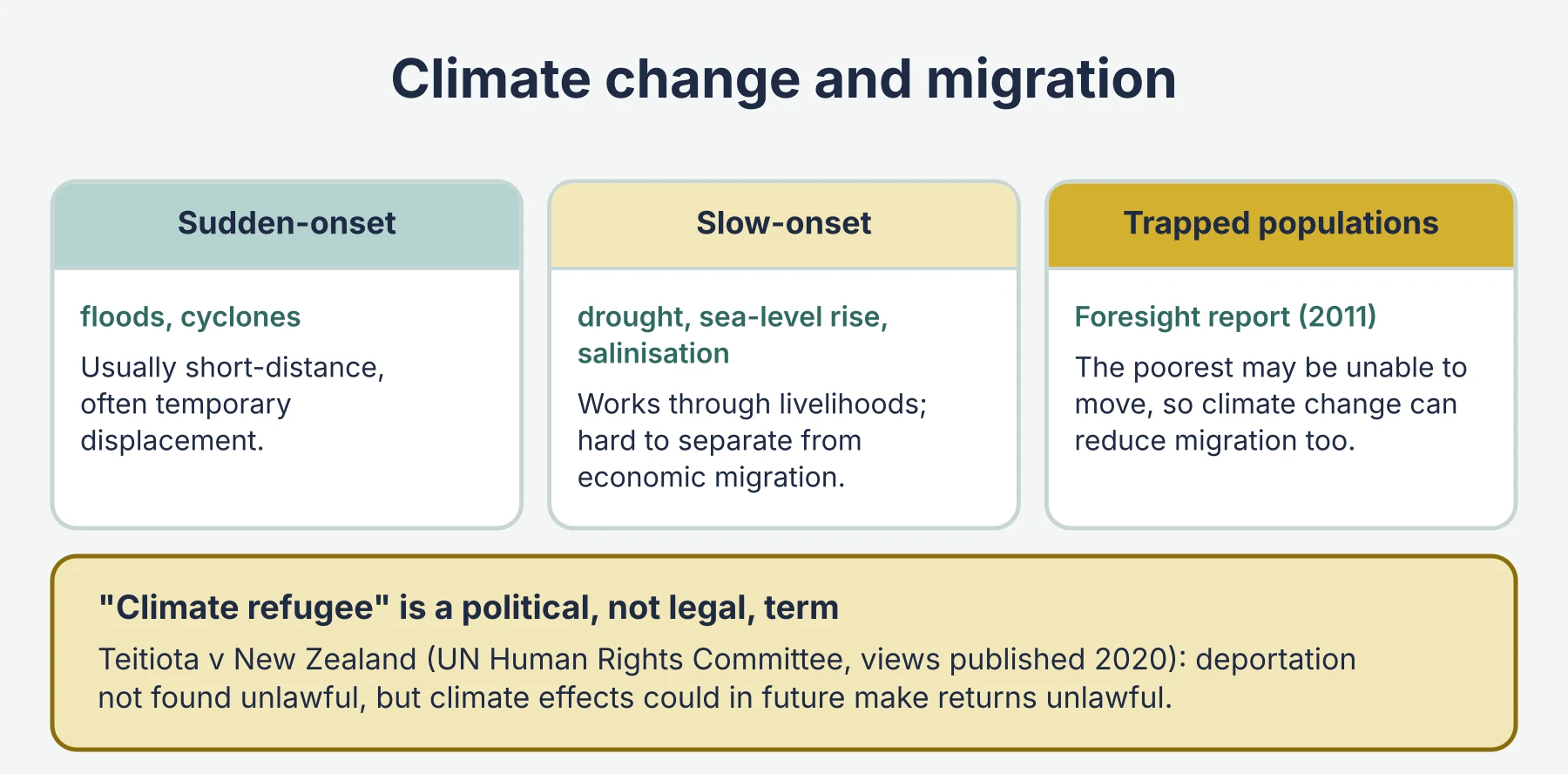
- Sudden-onset events (floods, cyclones) usually cause short-distance, often temporary, displacement.
- Slow-onset change (drought, sea-level rise, salinisation of farmland) works through livelihoods and is hard to separate from economic migration.
- Trapped populations: a UK government Foresight report (2011) on migration and environmental change warned that the poorest may be unable to move at all, so climate change can reduce migration as well as cause it.
- Law: the UN Human Rights Committee, in a case brought by Ioane Teitiota of Kiribati against New Zealand (views published 2020), did not find his deportation unlawful but stated that climate effects could in future make returning people unlawful. “Climate refugee” is therefore a political, not legal, term.
Annotated model answer
Extract from an 8-mark answer: Analyse two reasons why migration flows follow the same routes over time.
Network theory argues that earlier migrants provide information, housing and job contacts, so each move lowers the cost for the next [reason 1, mechanism]. In my society, workers from one district go to the same Gulf city because relatives already work there [application]. Second, structural views note that colonial ties left shared languages and recruitment links, so flows often run between former colonies and former colonial powers [reason 2]. These explanations show that migration is not just individual push-pull calculation, because the same push factors exist in places that send no migrants [analysis and evaluation].
Common mistakes
- Using “illegal migrant” for asylum seekers.
- Treating push-pull as the only explanation.
- Ignoring internal migration, which is larger in scale.
- Writing about diasporas only as nostalgia; the specification stresses growth and development of networks.
- Claiming climate change will cause a set number of migrants; projections vary widely and depend on definitions.
Exam technique
Identify and outline questions often ask you to distinguish types of migrant; give the defining feature of each. Explain questions need a mechanism. In evaluate answers, contrast individual (push-pull) and structural explanations and bring in own-society examples of migration routes, remittances or border rules.
Where next
Migration is tied to obstacles to progress, such as conflict and climate, and to who is involved in globalisation, for UNHCR and states.
Related resources
-
Practice questions
OxfordAQA International A-level Sociology (9690): Demographic changes - migration and diasporas – Practice Questions
Original OxfordAQA 9690 practice questions on migration theories, borders, forced migration, migrant types, diasporas and climate change, with full answers.
Sociology · OxfordAQA · A Level
Try questions -
Revision notes
OxfordAQA International A-level Sociology (9690): Demographic changes - migration and diasporas – Revision Notes
Revision notes for OxfordAQA 9690 section 3.2.1.4: migration theories, borders and visas, refugees and forced migration, migrant types, diasporas and climate.
Sociology · OxfordAQA · A Level
Revise topic -
Study guides
OxfordAQA International A-level Sociology (9690): Obstacles to progress
Guide to OxfordAQA 9690 section 3.2.1.5: modernisation, Marxist and feminist views of obstacles to development, health and education gaps, climate and war.
Sociology · OxfordAQA · A Level
Read guide
Related articles
Get free revision emails (optional)
Occasional emails with practice questions, worked explanations and links to free resources for the qualification and subjects you choose. No spam, and you can unsubscribe from any email. The free tools on this site never need an email.