
Revision Notes
OxfordAQA International A-level Sociology (9690): Demographic changes - migration and diasporas – Revision Notes
Revision notes for OxfordAQA 9690 section 3.2.1.4: migration theories, borders and visas, refugees and forced migration, migrant types, diasporas and climate.
- Subject
- Sociology
- Level
- A LEVEL
- Topic
- Unit 3 – People and Development
- Author
- Marlbridge Academic Team
- Updated
- Reviewed by
- Naqiya Yousaf (what this means)
Aligned to OxfordAQA A Level Sociology (9690), Version 1.1. Official specification .
Syllabus page (what it covers and how it is assessed): OxfordAQA A Level Sociology.
Syllabus points this page covers
9690 (A Level)
- 3.2.1.4 Demographic changes - migration and diasporas
Found an error? Report a correction.
Need help with this topic? Request a free trial class for A Level Sociology (9690).
These notes condense content point 3.2.1.4 Demographic changes - migration and diasporas of OxfordAQA International A-level Sociology (9690), Version 1.1, assessed in the Unit 3 exam. Full explanations are in the migration and diasporas study guide; the unit overview is in the Unit 3 revision notes.
What the specification lists
- How and why people have migrated and still do: push and pull explanations.
- Internal and international migration.
- Borders, passports and visas.
- Refugees; forced migration.
- Economic migrants, undocumented workers, digital nomads.
- Growth and development of diasporas and transnational networks.
- Effects on migration of climate change.
Core recall
Explanations of migration
- Ravenstein (1885): “laws of migration” from British census data; most moves are short; migration often happens in steps.
- Lee (1966): push factors, pull factors, intervening obstacles.
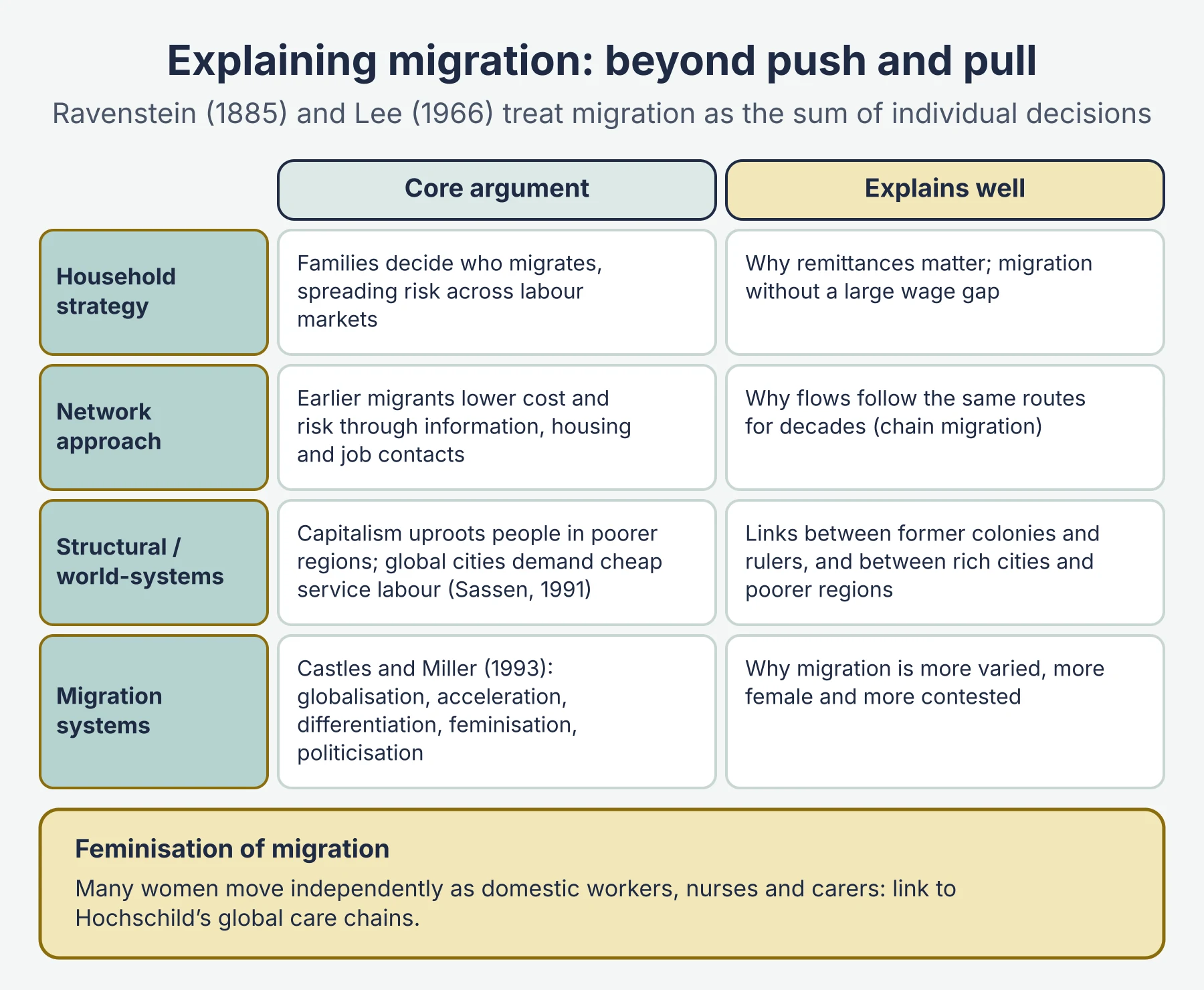
- Household strategy: families place members in different labour markets to spread risk; remittances are the point.
- Network approach: earlier migrants cut costs and risks for later ones, so chain migration follows fixed routes.
- Structural / world-systems: capitalism uproots people in poorer regions; global cities need cheap service labour (Sassen, 1991).
- Castles and Miller (1993): globalisation, acceleration, differentiation, feminisation and politicisation of migration.
Internal and international
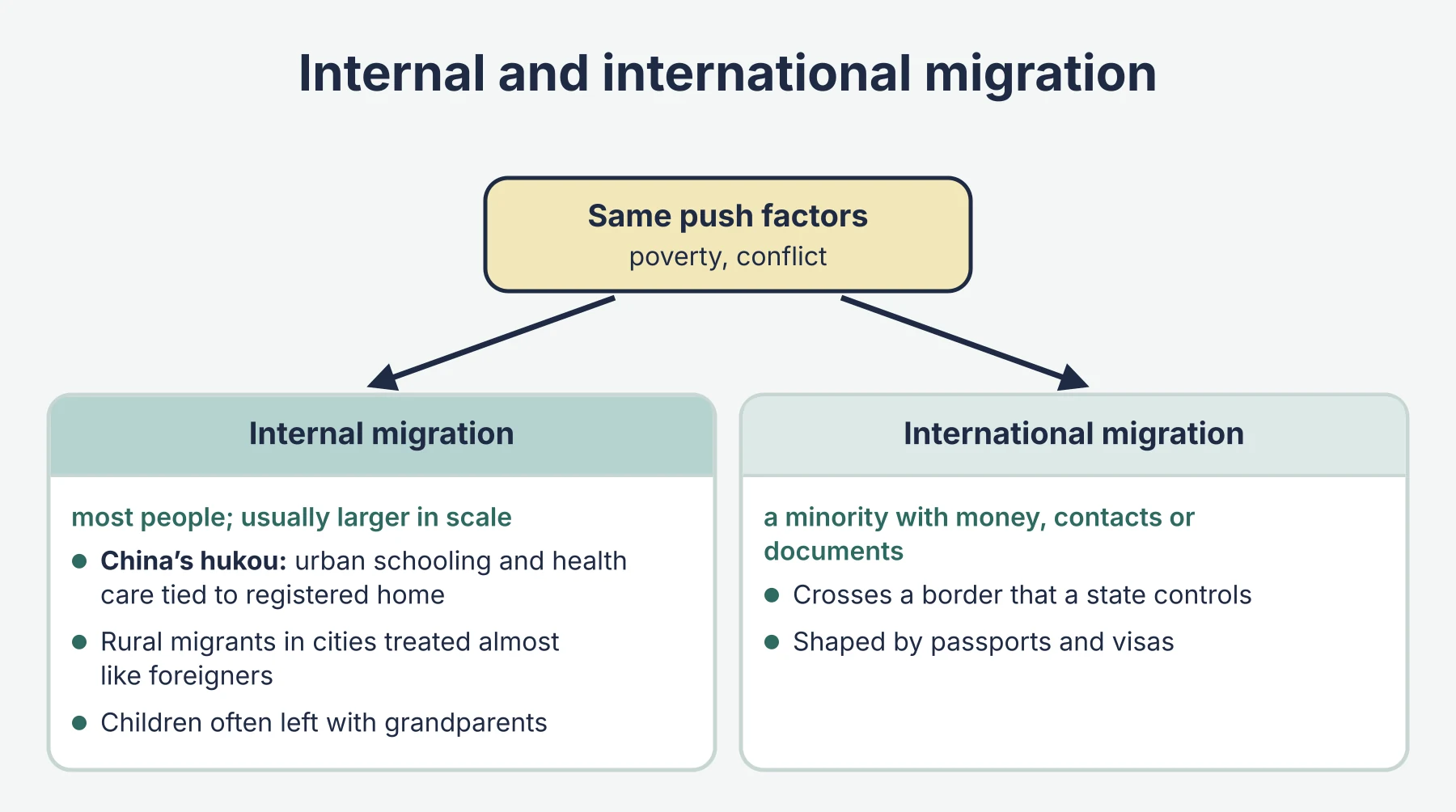
- Internal migration is larger in scale; rural-urban moves drive urbanisation.
- China’s hukou registration ties urban services to registered home, so rural migrants in cities face exclusion; children often stay in villages.
- International moves need money, contacts or documents, so only a minority of those facing push factors make them.
Borders
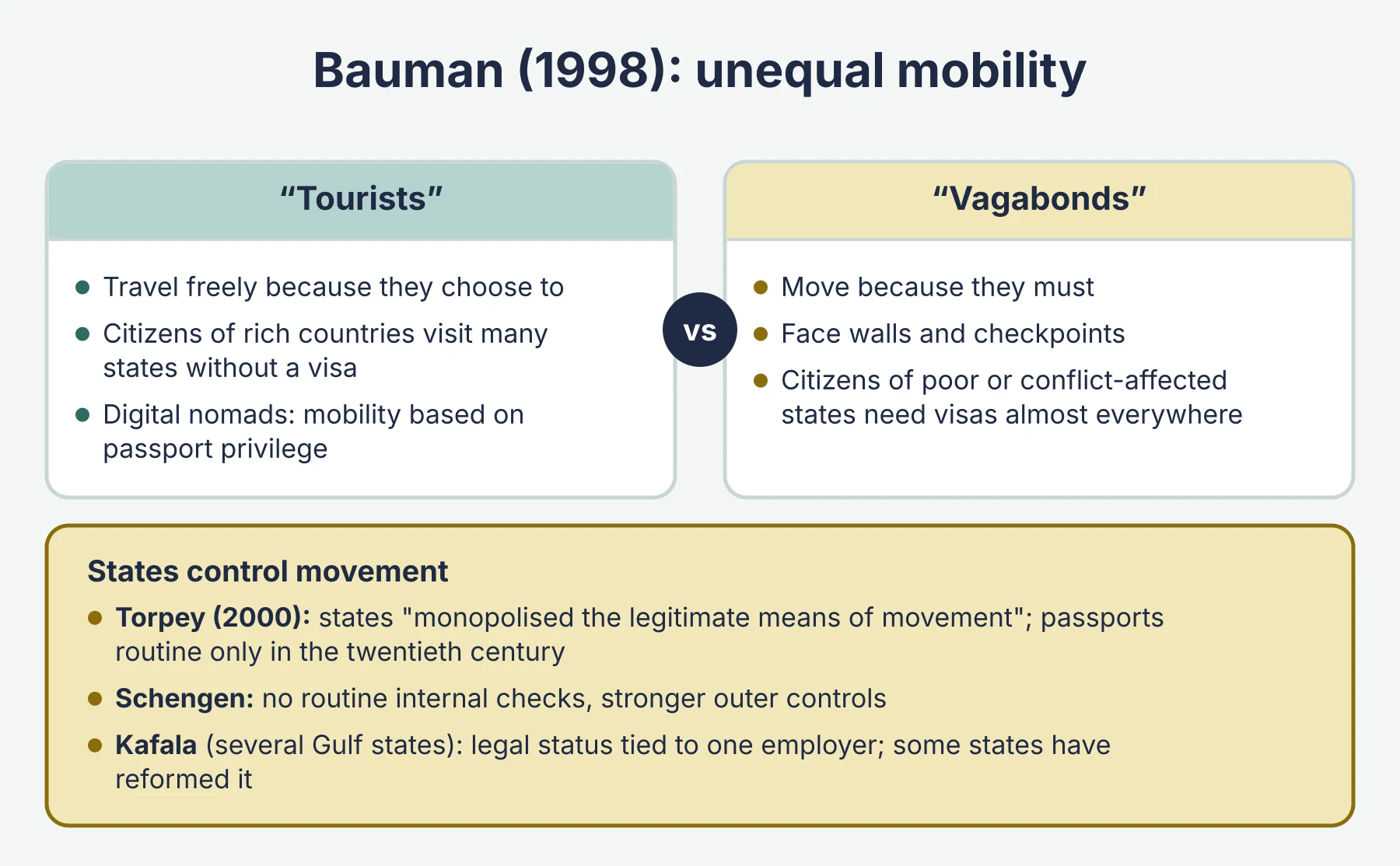
- Torpey (2000): states “monopolised the legitimate means of movement”; routine passports are a twentieth-century development.
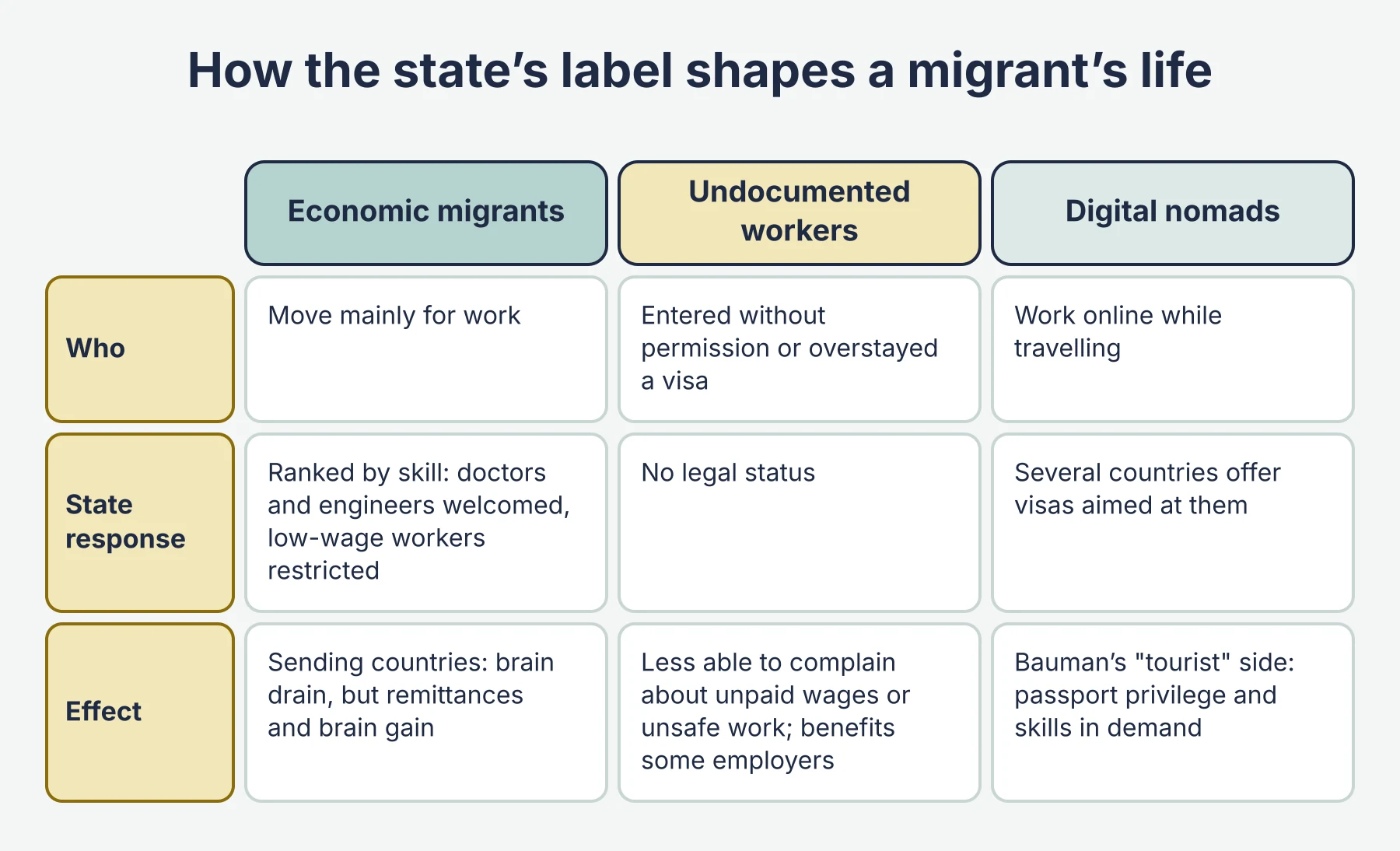
- Bauman (1998): “tourists” move by choice; “vagabonds” move by necessity and meet barriers.
- Schengen: open internal borders, harder outer edge.
- Kafala (some Gulf states): migrant’s legal status tied to one employer; criticised for enabling exploitation; partly reformed.
Forced migration
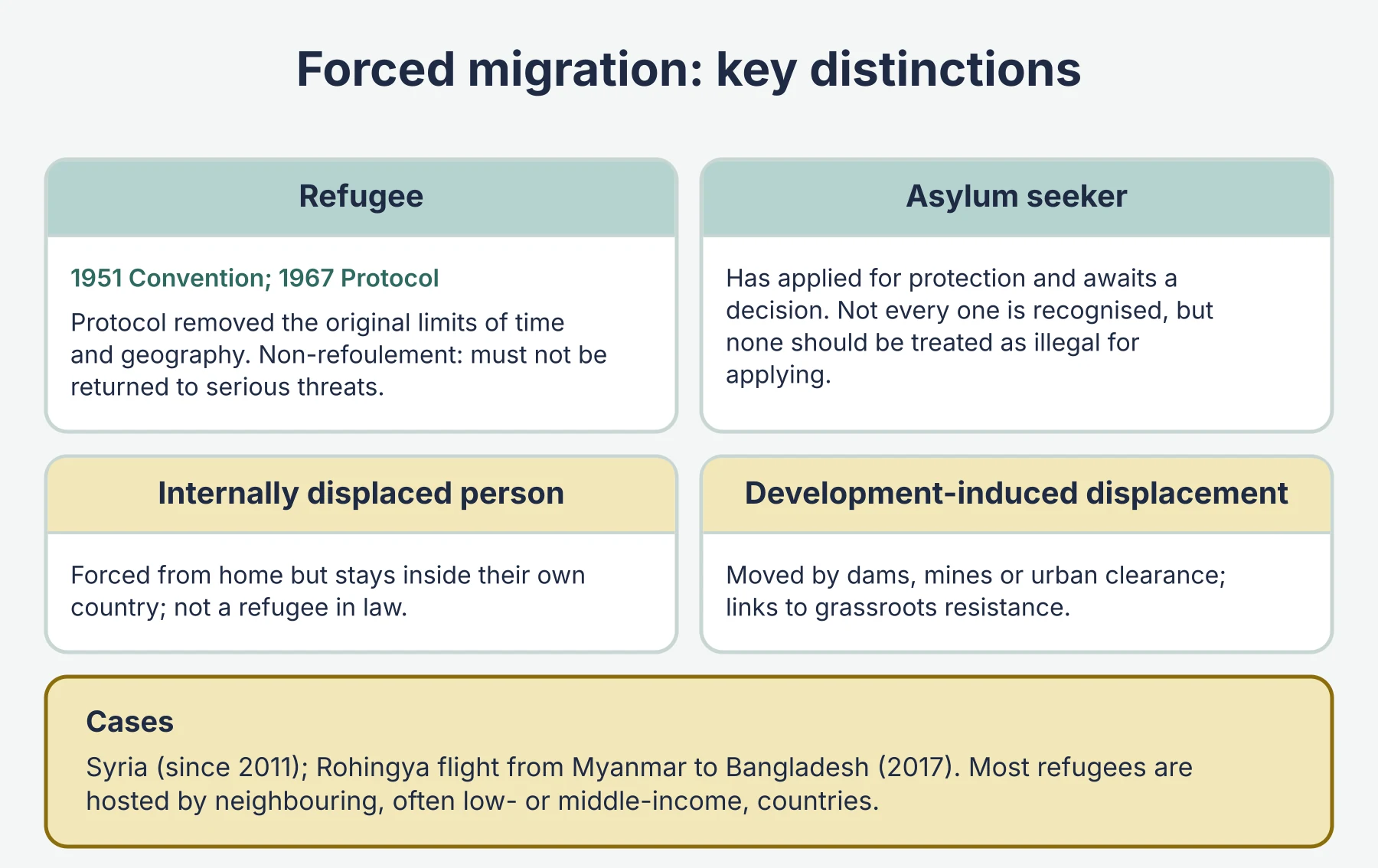
- 1951 Convention narrow definition; 1967 Protocol removed time and geographic limits.
- Non-refoulement: no return to serious threat.
- Asylum seeker: awaiting a decision; applying is not illegal.
- Internally displaced persons: displaced within their own country; not refugees in law.
- Development-induced displacement: dams, mines, urban clearance.
- Most refugees are hosted by neighbouring, often low- or middle-income, states.
Labour migrants
- Economic migrants: ranked by skill by receiving states; brain drain versus brain gain and remittances.
- Undocumented workers: no legal status, so less able to challenge exploitation.
- Digital nomads: remote workers; passport privilege; special visas in several countries.
Diasporas and transnational networks
- Cohen (1997): victim, labour, trade and imperial diasporas.
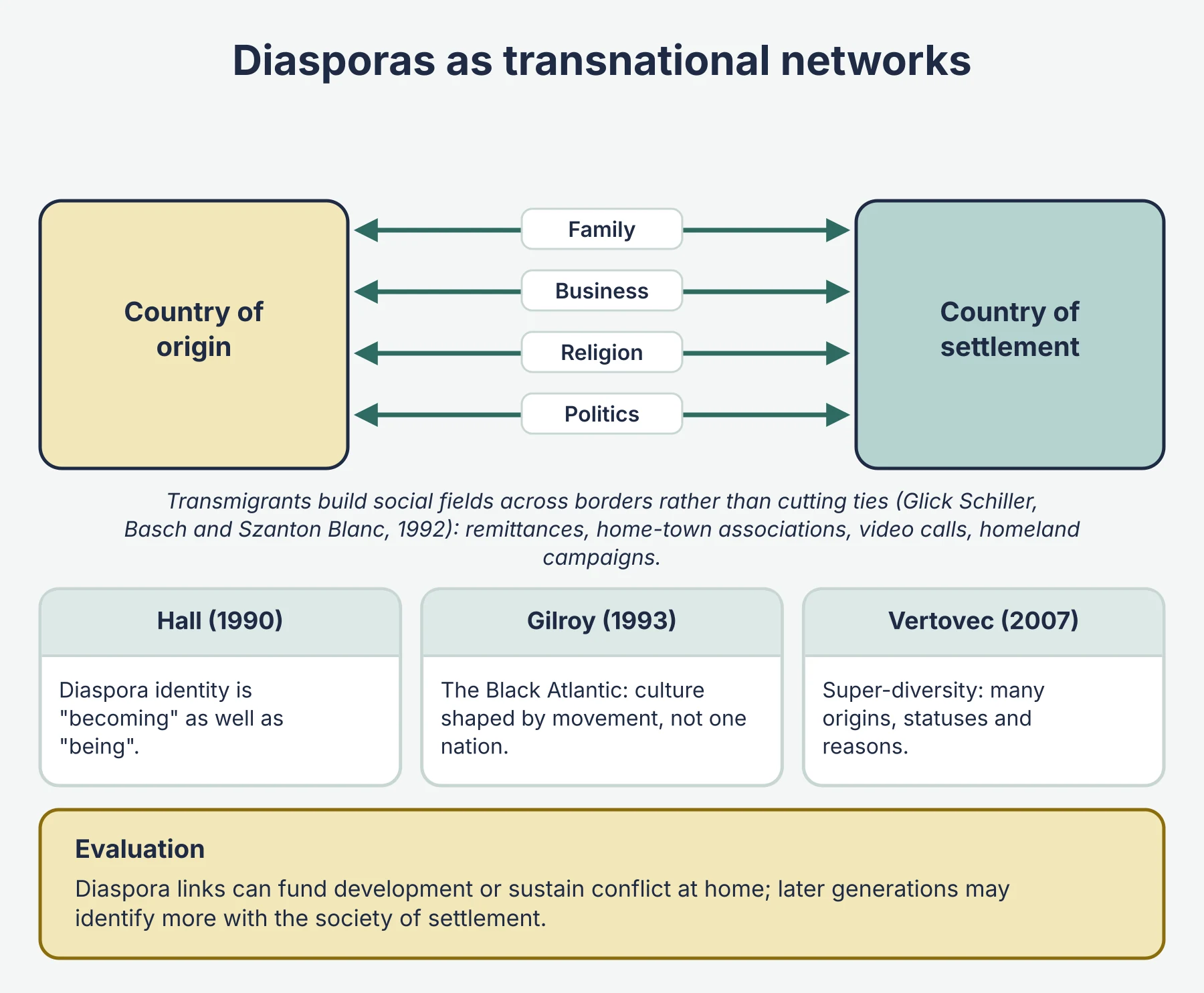
- Hall (1990): diaspora identity is “becoming” as well as “being”.
- Gilroy (1993): The Black Atlantic, culture formed by movement, not one nation.
- Glick Schiller, Basch and Szanton Blanc (1992): transmigrants build social fields across two or more countries.
- Vertovec (2007): super-diversity of origins, statuses and reasons for moving.
- Effects: remittances and investment; can also fund conflict; later generations may identify mainly with the settlement society.
Climate change
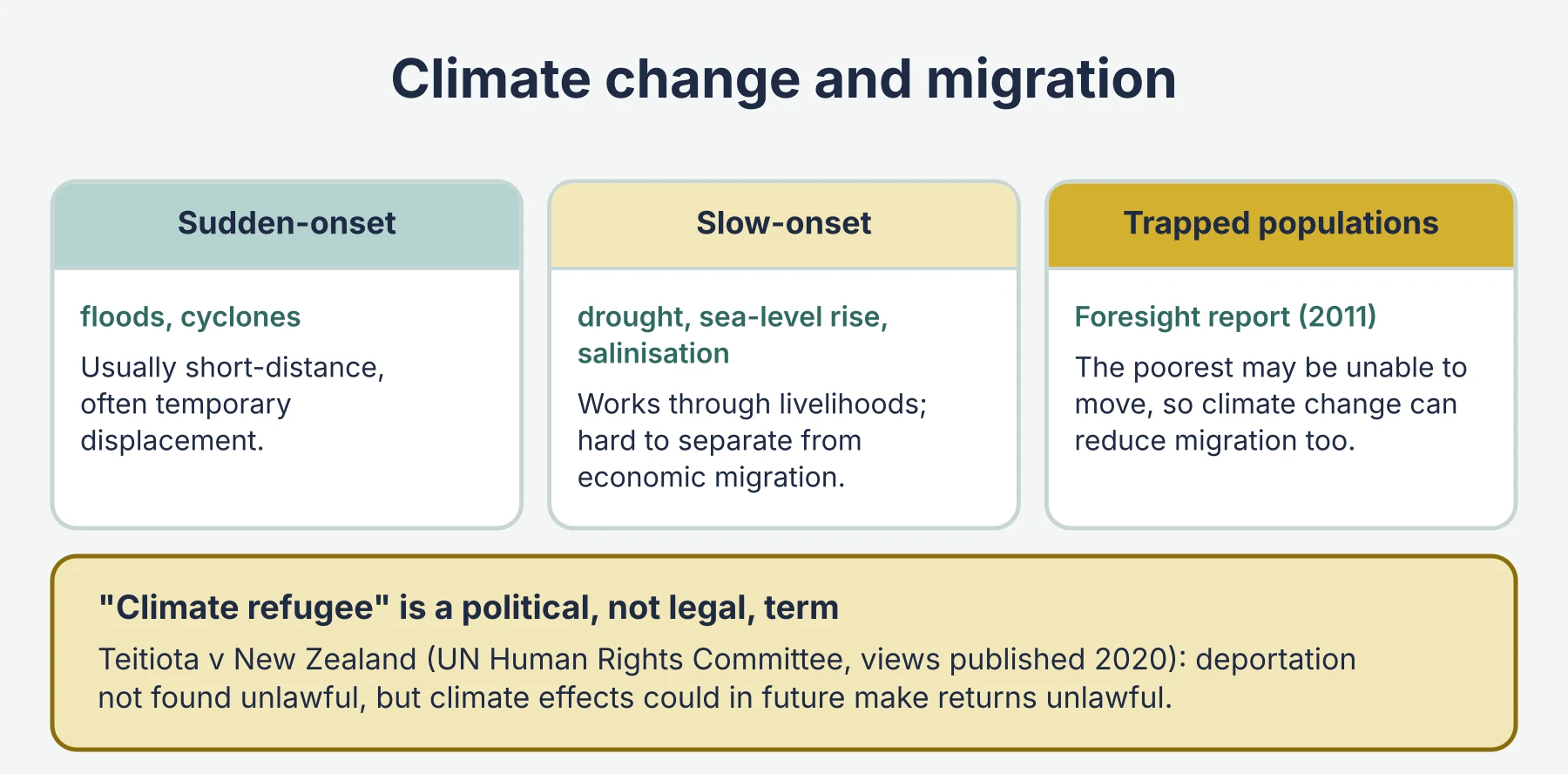
- Sudden-onset (floods, cyclones): mostly short-distance, temporary.
- Slow-onset (drought, sea-level rise, salty soils): works through livelihoods; blurs with economic migration.
- Trapped populations (UK Foresight report, 2011): the poorest may be unable to move.
- Teitiota case (UN Human Rights Committee, views published 2020): deportation from New Zealand to Kiribati not found unlawful, but future climate effects could bar returns. “Climate refugee” is not a legal category.
Key terms
| Term | Definition |
|---|---|
| Internal migration | Movement within a country’s borders |
| International migration | Movement across a national border |
| Chain migration | Migration following earlier migrants through family and community links |
| Remittances | Money sent home by migrants |
| Asylum seeker | Person who has applied for refugee protection and awaits a decision |
| Non-refoulement | Principle that refugees must not be returned to danger |
| Internally displaced person | Person forced from home who stays in their own country |
| Undocumented worker | Person living or working without legal permission |
| Digital nomad | Remote worker who moves between countries |
| Brain drain | Loss of skilled workers from sending countries |
| Diaspora | Population dispersed from a homeland that keeps links with it |
| Transmigrant | Migrant who maintains active social fields in more than one country |
| Feminisation of migration | Rise in women migrating independently, often for care work |
| Trapped population | People too poor or constrained to move away from environmental danger |
Exam traps
- “Illegal” is not the right word for asylum seekers.
- Internally displaced people are not refugees under the 1951 Convention.
- Push-pull ignores structures and networks; always evaluate it with another approach.
- Climate change can reduce mobility (trapped populations), not only increase it.
- “Diaspora” means continuing links with a homeland; a scattered population without links is not described this way.
- Do not invent numbers of future climate migrants.
Self-test
- Give one of Ravenstein’s “laws of migration”.
- How does the household strategy approach differ from Lee’s model?
- What does the network approach explain that push-pull does not?
- Name three trends in migration identified by Castles and Miller.
- What is the hukou system and why does it matter for internal migrants?
- What did Torpey mean by states monopolising “the legitimate means of movement”?
- Explain Bauman’s contrast between tourists and vagabonds.
- What is non-refoulement?
- Why are internally displaced persons not refugees in law?
- What did Hall argue about diasporic identity?
- What is a transmigrant?
- What are trapped populations?
Answers
- Most migrants move short distances, or migration happens in steps.
- It sees the family, not the individual, as deciding, to spread risk and earn remittances.
- Why migration follows the same routes for decades, as earlier migrants help later ones.
- Any three of: globalisation, acceleration, differentiation, feminisation, politicisation.
- China’s household registration system; it links urban services such as schooling and health care to registered home, excluding many rural migrants in cities.
- Only states can now authorise who may cross borders, through passports and visas.
- Tourists move freely by choice; vagabonds move because they must and meet barriers.
- The principle that refugees must not be returned to a place where they face serious threats.
- They have not crossed an international border, which the 1951 definition requires.
- It is a matter of “becoming” as well as “being”, remade through memory and mixing.
- A migrant who maintains family, economic, religious or political ties across two or more countries.
- People too poor or constrained to move away from environmental danger.
Test your application with the migration and diasporas practice questions.
Related resources
-
Study guides
OxfordAQA International A-level Sociology (9690): Obstacles to progress
Guide to OxfordAQA 9690 section 3.2.1.5: modernisation, Marxist and feminist views of obstacles to development, health and education gaps, climate and war.
Sociology · OxfordAQA · A Level
Read guide -
Practice questions
OxfordAQA International A-level Sociology (9690): Obstacles to progress – Practice Questions
Original OxfordAQA 9690 practice questions on modernisation, Marxist and feminist views of obstacles to progress, health, education, climate and conflict.
Sociology · OxfordAQA · A Level
Try questions -
Revision notes
OxfordAQA International A-level Sociology (9690): Obstacles to progress – Revision Notes
Revision notes for OxfordAQA 9690 section 3.2.1.5: modernisation, Marxist and feminist views, health and education gaps, sustainability and conflict.
Sociology · OxfordAQA · A Level
Revise topic
Related articles
Get free revision emails (optional)
Occasional emails with practice questions, worked explanations and links to free resources for the qualification and subjects you choose. No spam, and you can unsubscribe from any email. The free tools on this site never need an email.