
Revision Notes
OxfordAQA International A-level Sociology (9690): Obstacles to progress – Revision Notes
Revision notes for OxfordAQA 9690 section 3.2.1.5: modernisation, Marxist and feminist views, health and education gaps, sustainability and conflict.
- Subject
- Sociology
- Level
- A LEVEL
- Topic
- Unit 3 – People and Development
- Author
- Marlbridge Academic Team
- Updated
- Reviewed by
- Naqiya Yousaf (what this means)
Aligned to OxfordAQA A Level Sociology (9690), Version 1.1. Official specification .
Syllabus page (what it covers and how it is assessed): OxfordAQA A Level Sociology.
Syllabus points this page covers
9690 (A Level)
- 3.2.1.5 Obstacles to progress
Found an error? Report a correction.
Need help with this topic? Request a free trial class for A Level Sociology (9690).
These notes condense content point 3.2.1.5 Obstacles to progress of OxfordAQA International A-level Sociology (9690), Version 1.1, assessed in the Unit 3 exam. For full explanations and a model answer, use the obstacles to progress study guide; for the rest of the unit, the Unit 3 revision notes.
What the specification lists
- Modernisation theory view: persistence of values and practices.
- Marxist views: globalisation and capitalism.
- Feminist views: globalisation and patriarchy.
- Reasons for persistence of inequalities, including in health and education.
- The role of globalisation in the climate crisis and environmental problems; sustainable development.
- Effects of wars and conflicts on development.
Core recall
Defining progress
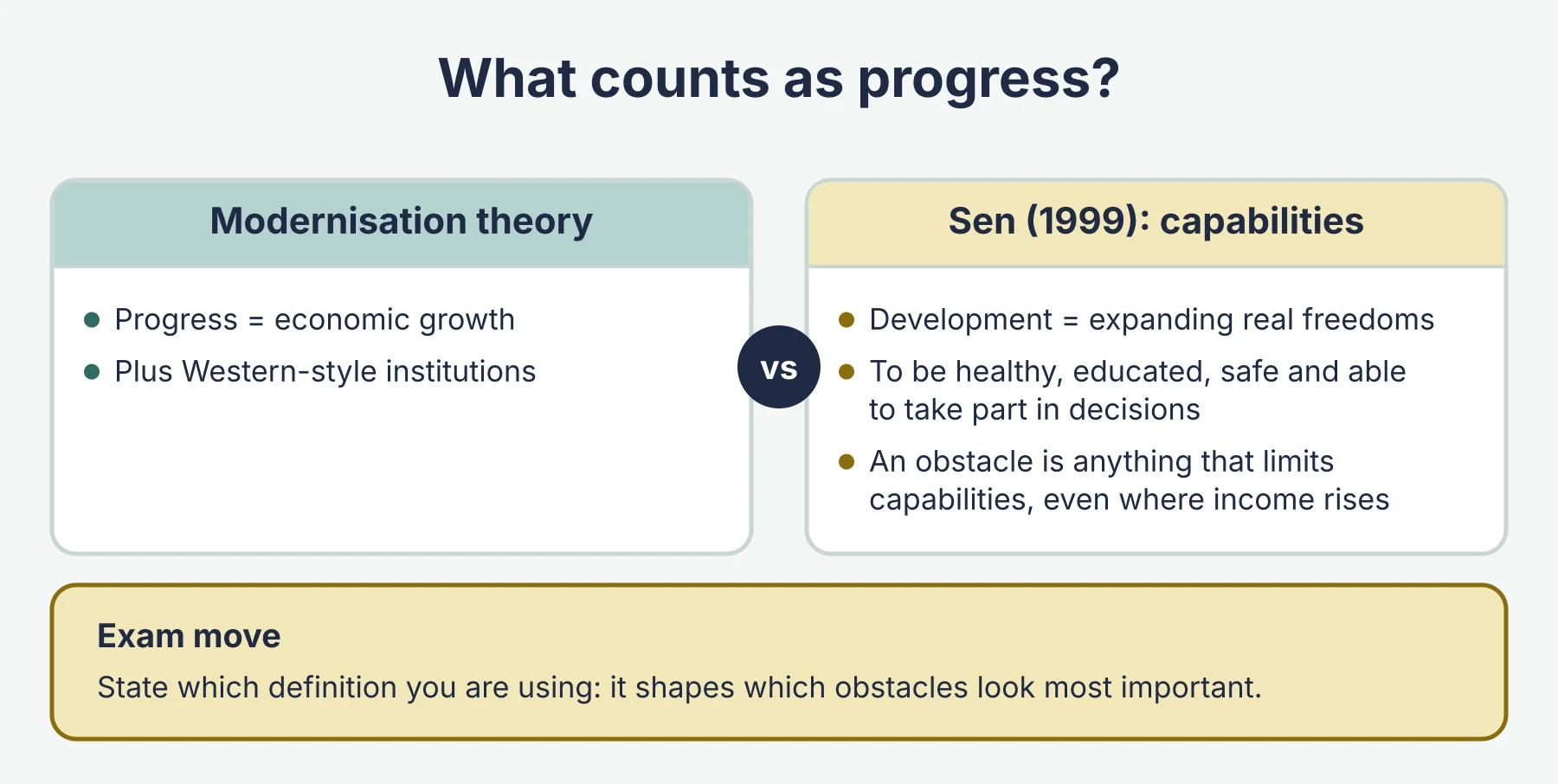
- Modernisation: growth plus Western-style institutions.
- Sen (1999), Development as Freedom: expanding capabilities, the real freedoms to be healthy, educated, safe and involved in decisions.
Modernisation view
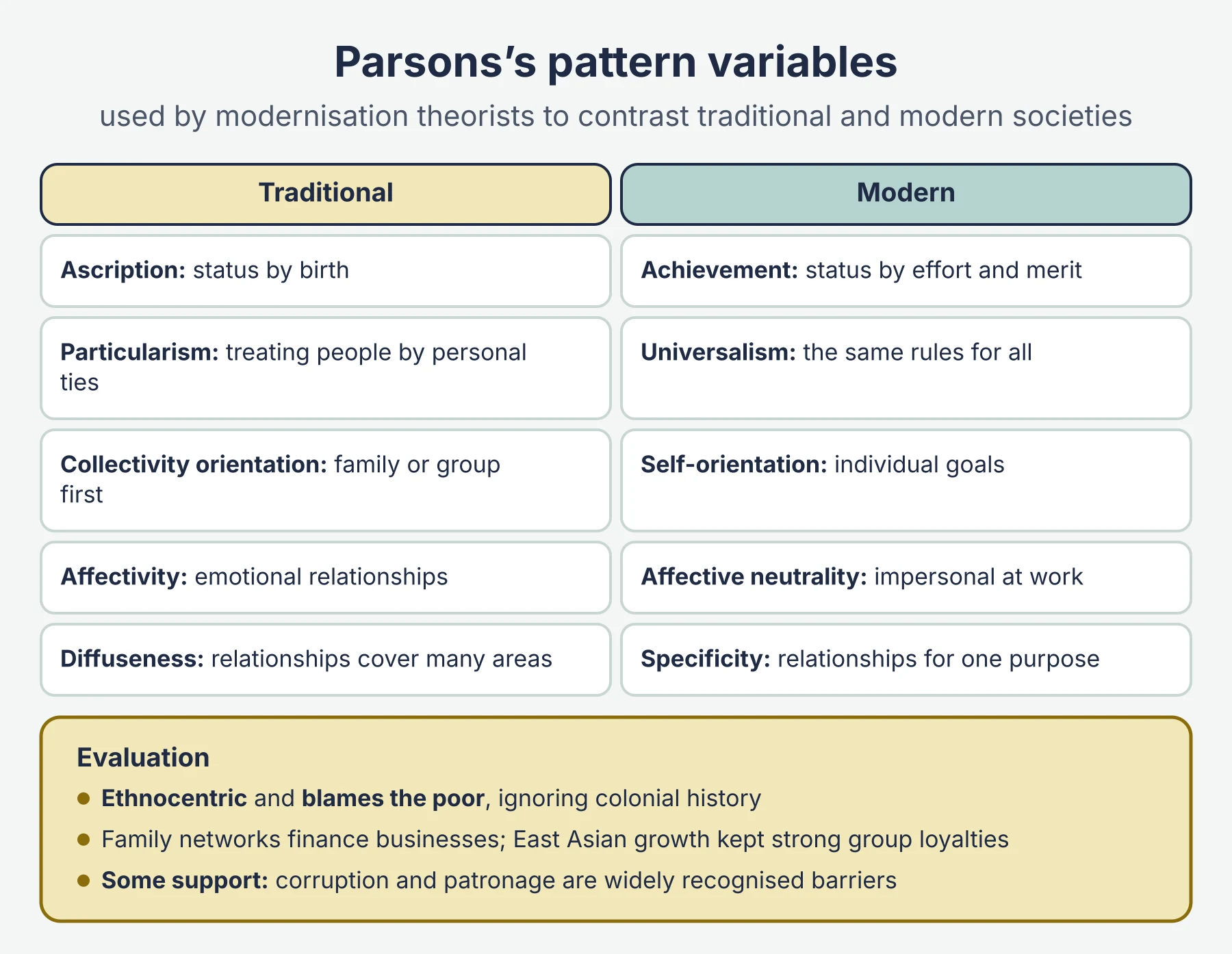
- Parsons’s pattern variables: ascription versus achievement; particularism versus universalism; collectivity versus self-orientation; affectivity versus affective neutrality; diffuseness versus specificity.
- Obstacles: nepotism, status by birth, wide kin obligations that reduce saving.
- Inkeles and Smith (1974): factories and schools create “modern” individuals.
- Against: ethnocentric; blames the poor; ignores colonial history; family networks can fund enterprise; East Asian growth with strong group loyalties.
- For: corruption and patronage are widely recognised barriers.
Marxist views
- Frank (metropolis and satellite); Wallerstein (core, semi-periphery, periphery).
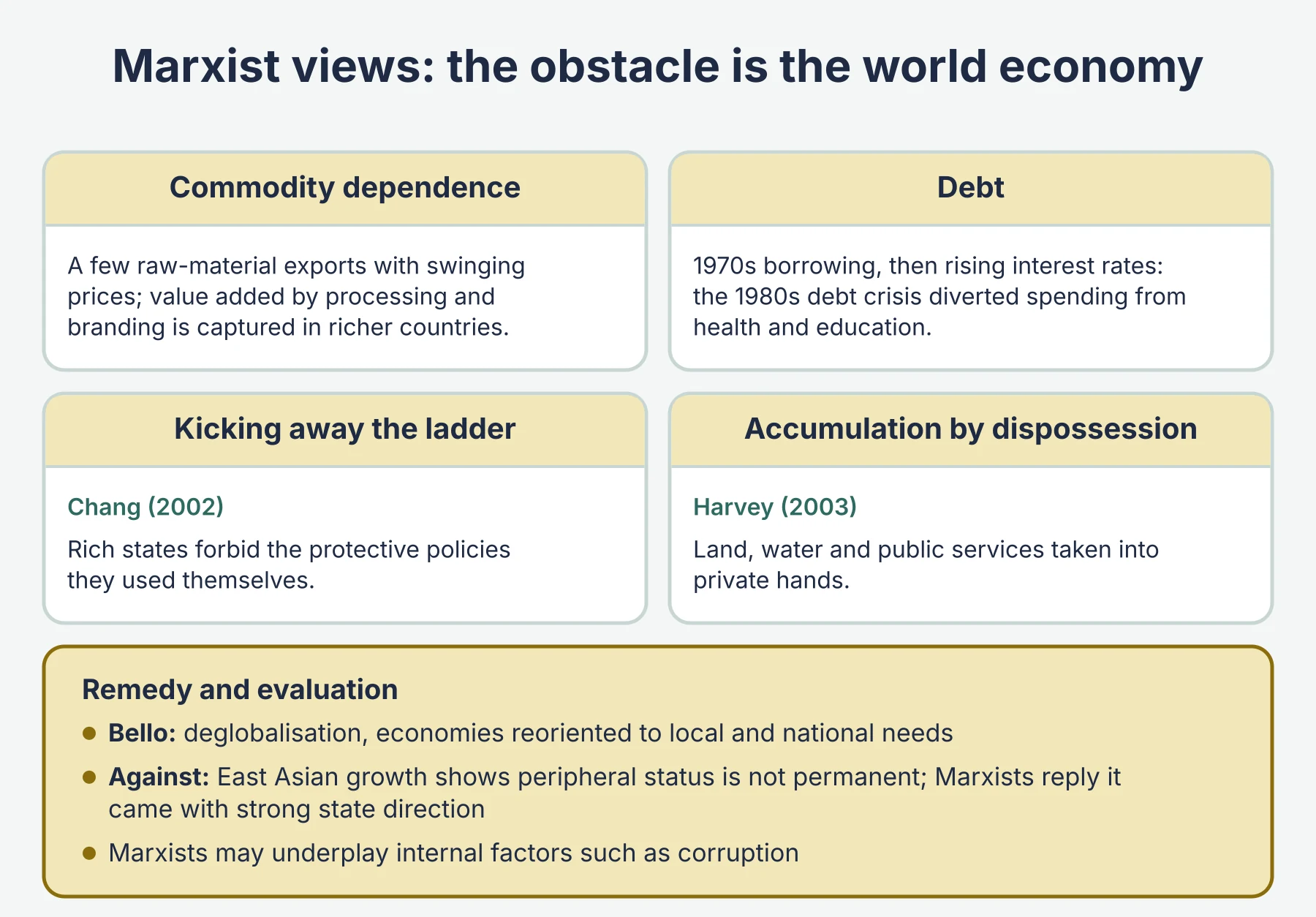
- Commodity dependence: few raw-material exports with volatile prices; value added captured elsewhere.
- Debt crisis of the 1980s: repayments and conditions cut public spending.
- Chang (2002): rich states “kicked away the ladder” of protection.
- Harvey (2003): accumulation by dispossession, privatising land, water and public services.
- Bello: deglobalisation as the remedy.
- Against: East Asian growth; internal factors such as corruption underplayed. Marxist reply: that growth relied on strong state direction.
Feminist views
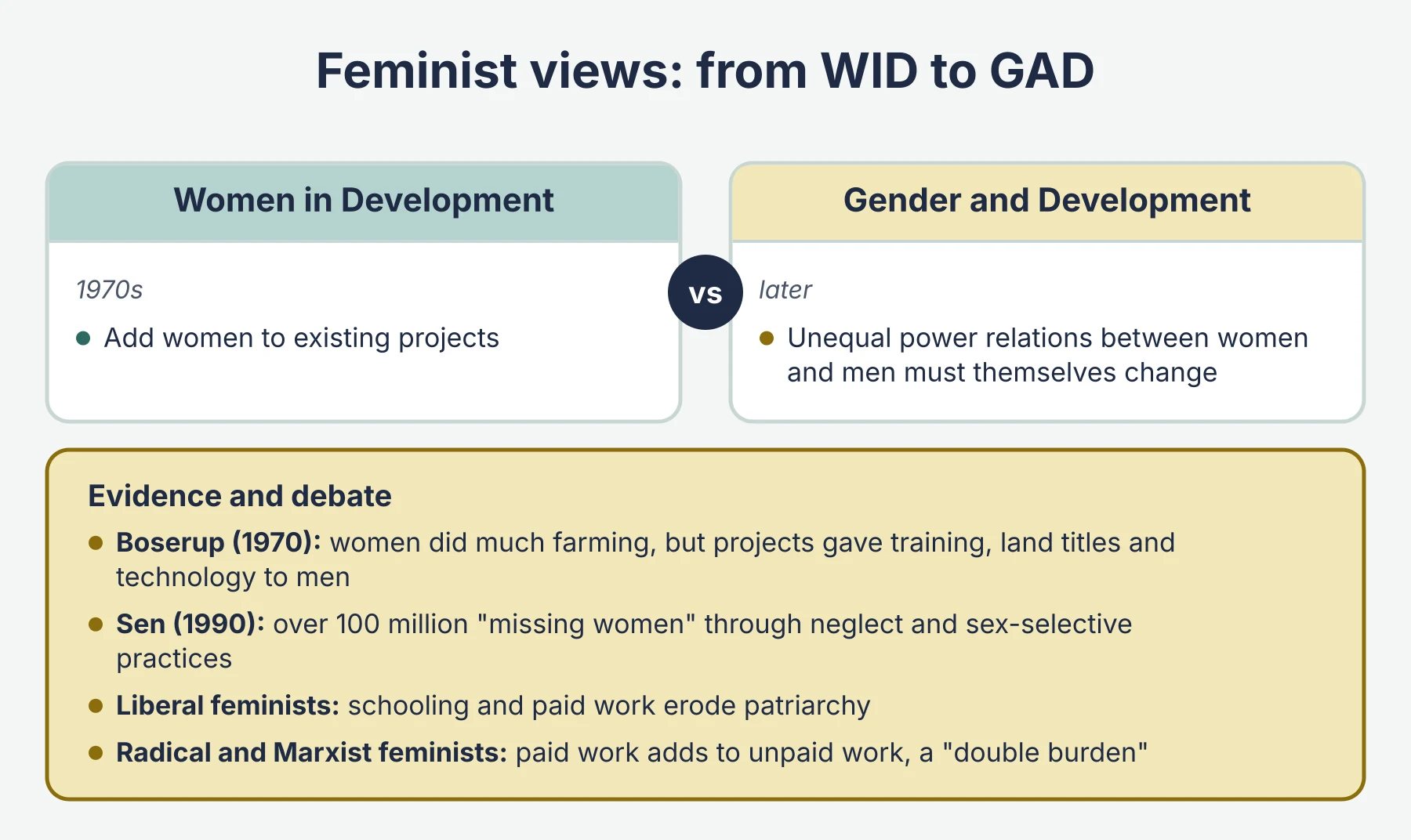
- Boserup (1970): women did much farming, but projects gave land, training and technology to men.
- WID (add women to projects) to GAD (change gender power relations).
- Sen (1990): over 100 million “missing women” from neglect and sex-selective practices.
- Mies, Elson and Pearson, Hochschild: global production and care chains depend on undervalued female labour.
- Liberal feminist counter: rising girls’ enrolment and women’s employment. Reply: the double burden.
Persistence of health and education inequalities
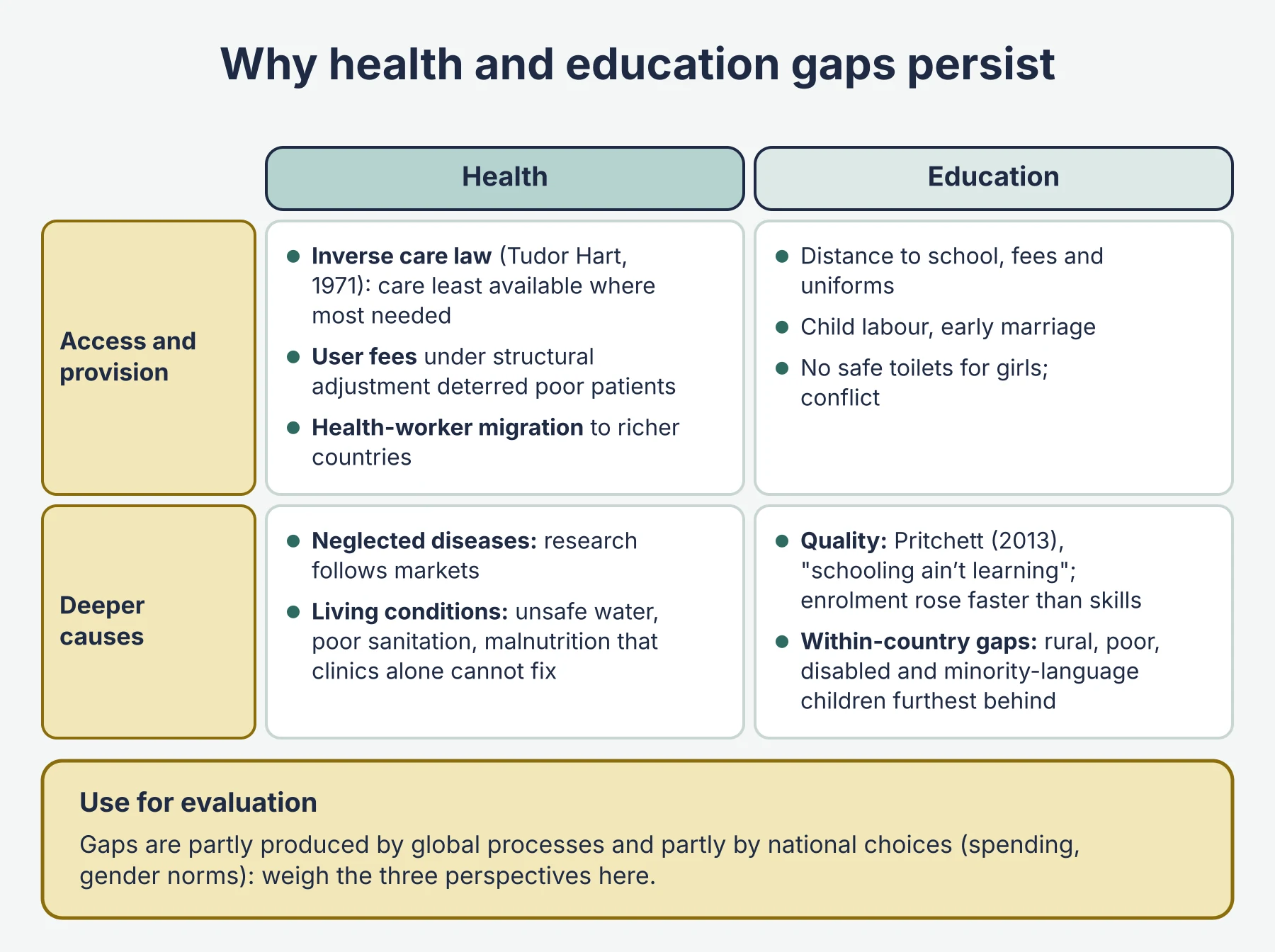
- Health: inverse care law (Tudor Hart, 1971); user fees under structural adjustment; migration of doctors and nurses; research neglect of diseases of the poor; water, sanitation and nutrition.
- Education: distance, fees, child labour, early marriage, lack of safe toilets for girls, conflict.
- Quality: Pritchett (2013), “schooling ain’t learning”: enrolment outpaced learning.
- Gaps within countries: rural, poor, disabled and minority-language children.
Climate and sustainable development
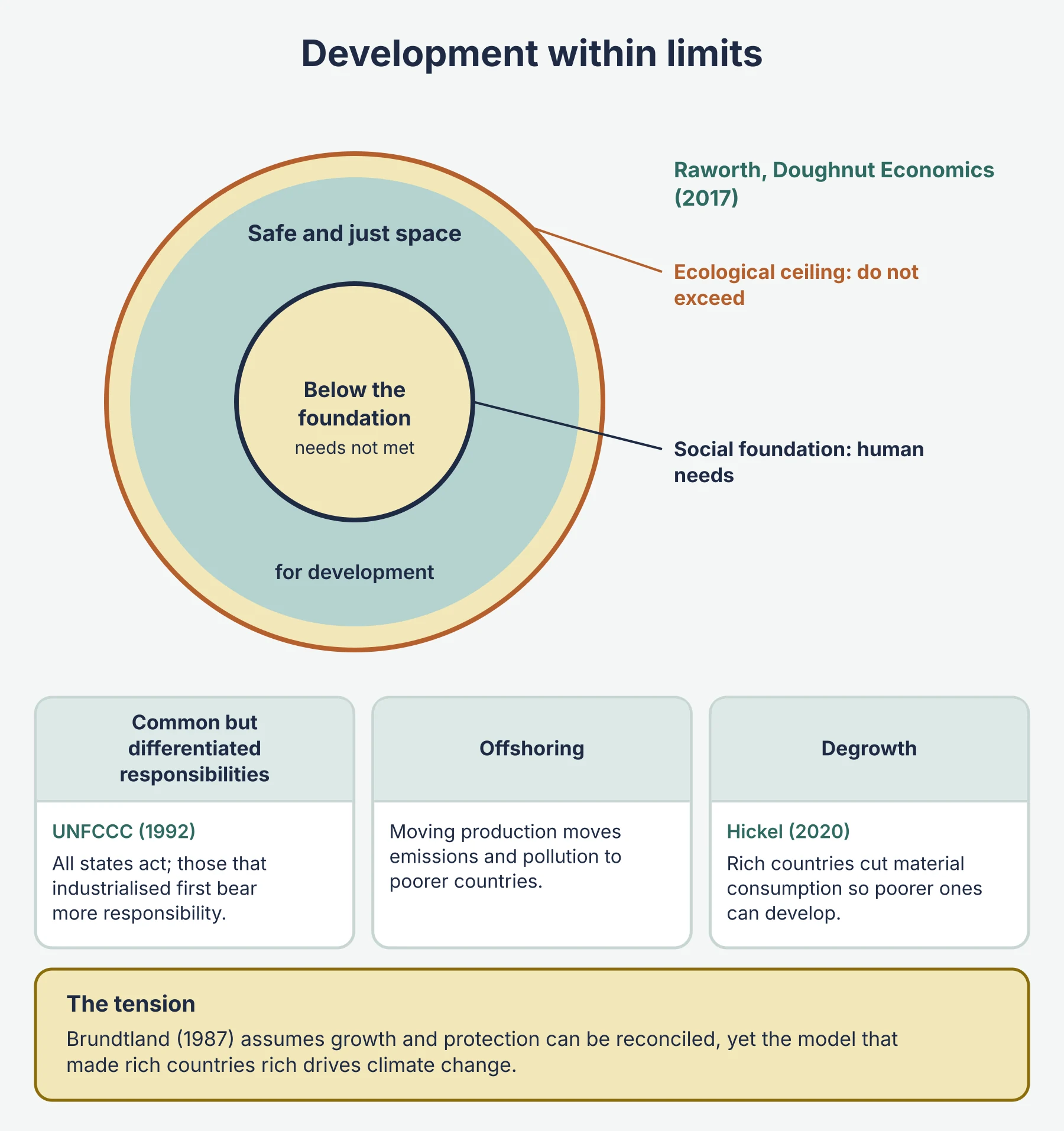
- “Common but differentiated responsibilities” (UN climate convention, 1992).
- Offshoring moves emissions and pollution to poorer producer countries.
- Brundtland (1987): growth and protection reconciled.
- Raworth (2017): doughnut, a social foundation and an ecological ceiling.
- Hickel (2020): degrowth in rich countries.
War and conflict
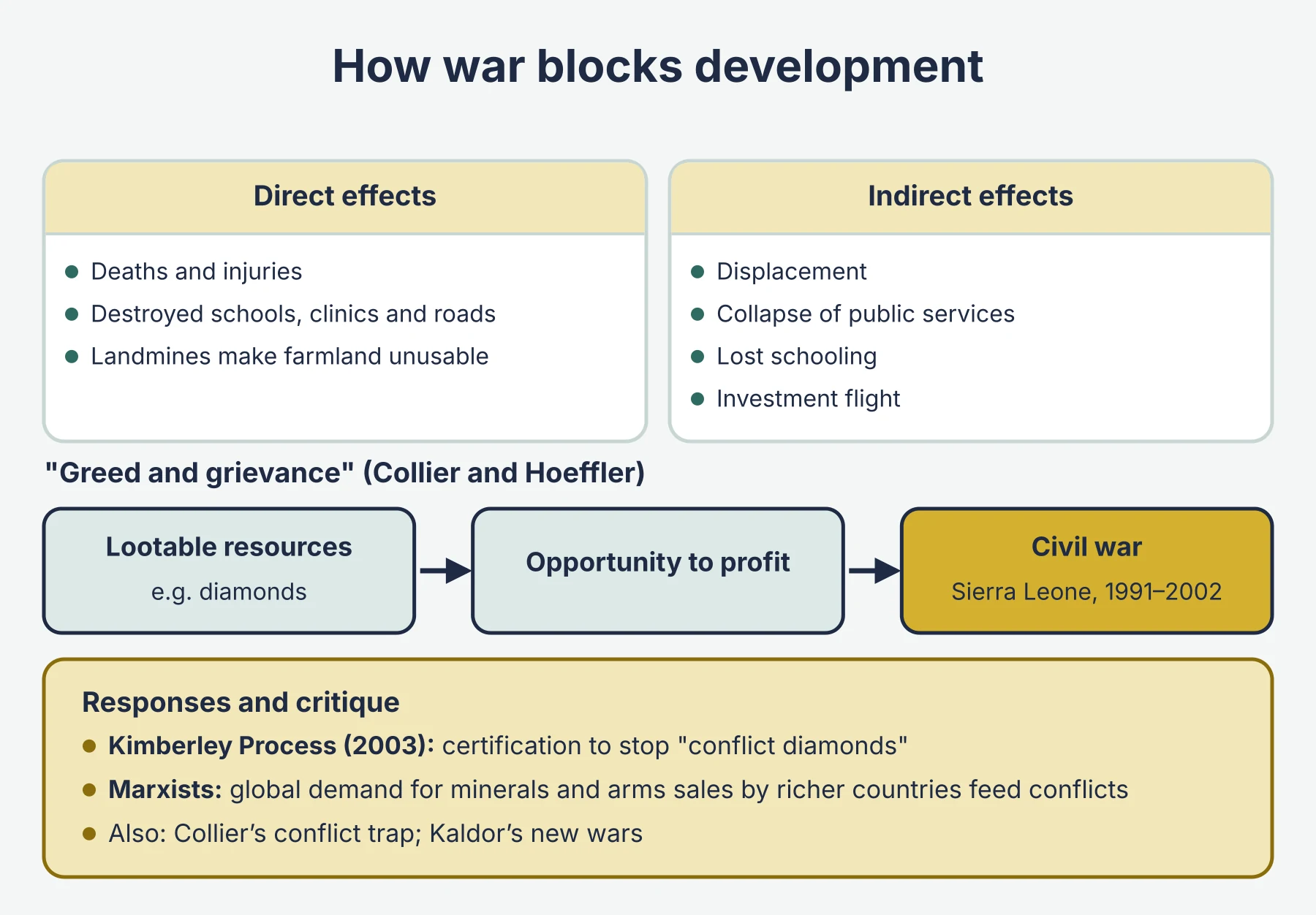
- Direct: deaths, destroyed infrastructure, landmines on farmland.
- Indirect: displacement, collapsed services, lost schooling, investment flight.
- Collier’s conflict trap; Kaldor’s new wars.
- Collier and Hoeffler: “greed and grievance”; lootable resources help explain where wars start.
- Resource curse: Sierra Leone (1991 to 2002); Kimberley Process (2003) against conflict diamonds.
- Marxist addition: global mineral demand and arms sales feed conflict.
Key terms
| Term | Definition |
|---|---|
| Capabilities | Real freedoms people have to live lives they value (Sen) |
| Pattern variables | Parsons’s contrasts between traditional and modern orientations |
| Particularism | Treating people according to personal ties |
| Commodity dependence | Reliance on a few raw-material exports |
| Accumulation by dispossession | Expanding capital by privatising common or public resources (Harvey) |
| Women in Development | 1970s approach adding women to development projects |
| Gender and Development | Approach that seeks to change unequal gender power relations |
| Double burden | Paid work added to unpaid domestic work |
| Inverse care law | Good care is least available where most needed |
| Common but differentiated responsibilities | All states act, but early industrialisers bear more responsibility |
| Degrowth | Planned reduction of material consumption in rich countries |
| Resource curse | Natural wealth linked to conflict, corruption or slow development |
Exam traps
- Compare, do not list. Three perspectives in sequence with no judgement stays in the middle band.
- Define progress. Growth-based and capability-based definitions give different answers.
- Mechanisms, not labels. “Debt is an obstacle” needs the chain: repayments, cuts, fees, falling use of services.
- Do not overstate East Asia. It challenges dependency theory but also challenges pure free-market views, because states directed growth.
- Sustainable development is contested. Contrast Brundtland with degrowth.
- War has long-term effects. Mention services, schooling and investment, not just destruction.
Self-test
- How does Sen define development?
- Give two of Parsons’s pattern variables and the “modern” side of each.
- Give one strength and one criticism of the modernisation view.
- What is commodity dependence and why is it an obstacle?
- What did Harvey mean by accumulation by dispossession?
- What did Boserup show about development projects?
- What is the difference between WID and GAD?
- What is the inverse care law?
- What did Pritchett mean by “schooling ain’t learning”?
- What does “common but differentiated responsibilities” mean?
- How does degrowth differ from Brundtland’s sustainable development?
- Give one example of the resource curse.
Answers
- As expanding people’s capabilities, the real freedoms to live lives they value.
- Any two: ascription to achievement; particularism to universalism; collectivity to self-orientation; affectivity to affective neutrality; diffuseness to specificity.
- Strength: corruption and patronage are recognised barriers. Criticism: ethnocentric or blames the poor while ignoring colonialism.
- Reliance on a few raw-material exports; prices swing sharply and the value from processing is captured in richer countries.
- Capitalism expands by taking land, water or public services into private ownership.
- Women did much of the farming, but projects gave land titles, training and technology mainly to men, lowering women’s status.
- WID added women to existing projects; GAD seeks to change unequal power relations between women and men.
- Good medical care tends to be least available where it is most needed.
- Children may attend school without learning basic skills, so enrolment is not the same as education.
- All states must act on climate change, but those that industrialised first bear more responsibility.
- Brundtland assumes growth and protection can go together; degrowth argues rich countries must reduce consumption.
- Diamonds funding armed groups in Sierra Leone’s civil war (1991 to 2002).
Apply these in the obstacles to progress practice questions.
Related resources
-
Study guides
OxfordAQA International A-Level Sociology (9690): The Great Divergence
Study guide to OxfordAQA 9690 section 3.2.1.1: imperialism, enslavement, Polanyi and Braudel on capitalism, why Europe industrialised, legacies and development.
Sociology · OxfordAQA · A Level
Read guide -
Practice questions
OxfordAQA International A-Level Sociology (9690): The Great Divergence – Practice Questions
Original OxfordAQA 9690 Unit 3 style questions on imperialism, enslavement, Polanyi, why Europe industrialised and legacies of colonialism, with answers.
Sociology · OxfordAQA · A Level
Try questions -
Revision notes
OxfordAQA International A-Level Sociology (9690): The Great Divergence – Revision Notes
Revision notes for OxfordAQA 9690 section 3.2.1.1: imperialism, enslavement, Polanyi, Braudel, Rodney, Frank, Weber, Sachs, legacies and development factors.
Sociology · OxfordAQA · A Level
Revise topic
Related articles
Get free revision emails (optional)
Occasional emails with practice questions, worked explanations and links to free resources for the qualification and subjects you choose. No spam, and you can unsubscribe from any email. The free tools on this site never need an email.