
Study Guides
OxfordAQA International A-level Sociology (9690): Obstacles to progress
Guide to OxfordAQA 9690 section 3.2.1.5: modernisation, Marxist and feminist views of obstacles to development, health and education gaps, climate and war.
- Subject
- Sociology
- Level
- A LEVEL
- Topic
- Unit 3 – People and Development
- Author
- Marlbridge Academic Team
- Updated
- Reviewed by
- Naqiya Yousaf (what this means)
Aligned to OxfordAQA A Level Sociology (9690), Version 1.1. Official specification .
Syllabus page (what it covers and how it is assessed): OxfordAQA A Level Sociology.
Syllabus points this page covers
9690 (A Level)
- 3.2.1.5 Obstacles to progress
Found an error? Report a correction.
Need help with this topic? Request a free trial class for A Level Sociology (9690).
This guide covers content point 3.2.1.5 Obstacles to progress of the OxfordAQA International A-level Sociology (9690) specification, Version 1.1, assessed in the Unit 3 People and development exam. The specification lists: “Modernisation theory view: persistence of values and practices”; “Marxist views: globalisation and capitalism”; “Feminist views: globalisation and patriarchy”; “Reasons for persistence of inequalities, including in health and education”; “The role of globalisation in the climate crisis and environmental problems; sustainable development”; and “Effects of wars and conflicts on development”.
The Unit 3 People and development study guide summarises each perspective with its main names (Frank, Wallerstein, Mies, Hochschild, Collier, Kaldor). This page goes further: the detail of each argument, extra evidence, and how to build a comparative evaluation. Use it with the obstacles to progress revision notes and the obstacles to progress practice questions.
What “progress” means first
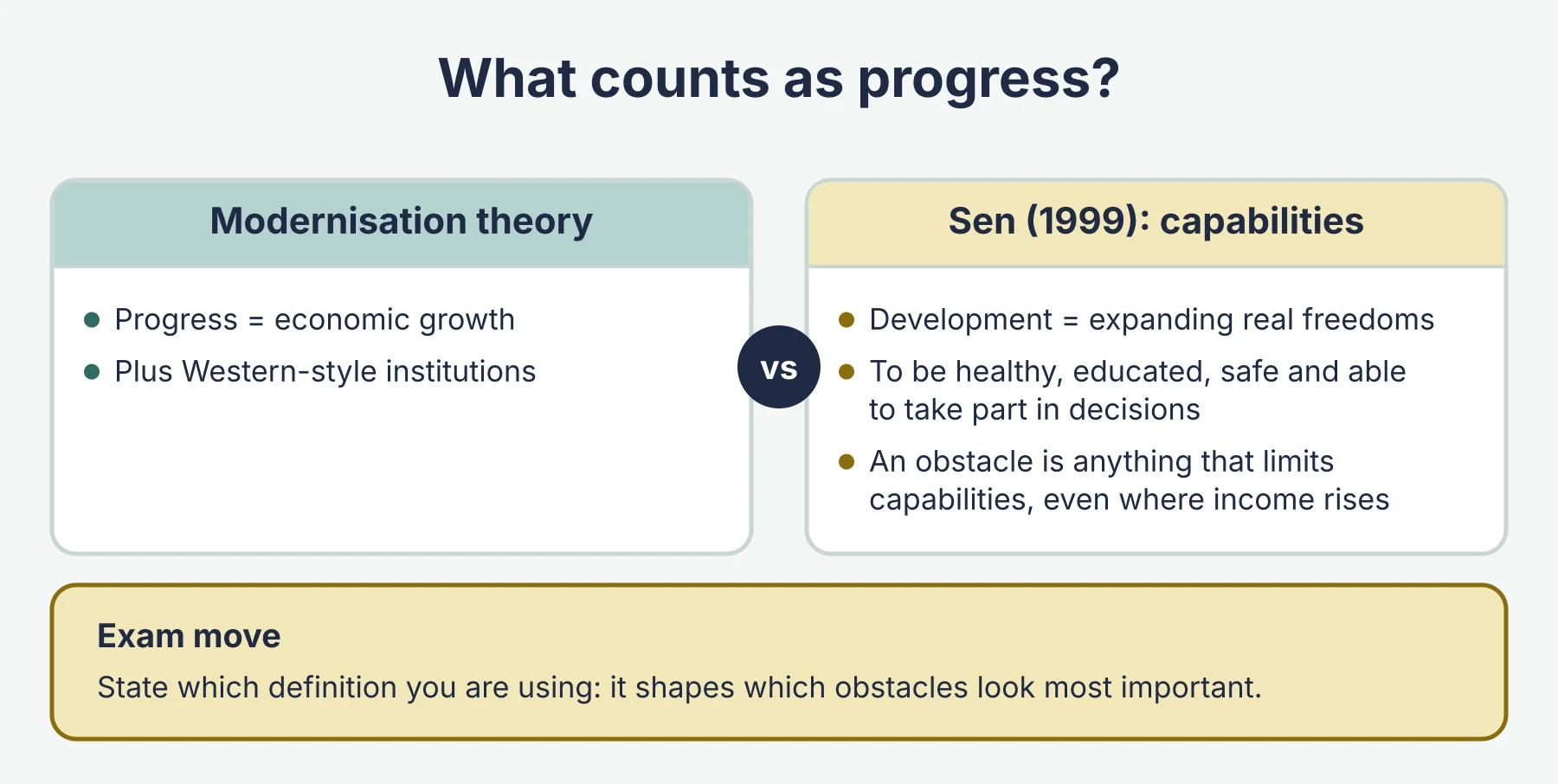
Every answer depends on what counts as progress. Modernisation theory equates it with economic growth and Western-style institutions. Amartya Sen (Development as Freedom, 1999) defined development as expanding people’s real freedoms or capabilities: to be healthy, educated, safe and able to take part in decisions. On Sen’s view, an obstacle is anything that limits capabilities, even in a country whose income is rising. State which definition you are using; it shapes which obstacles look most important.
Modernisation theory: values and practices
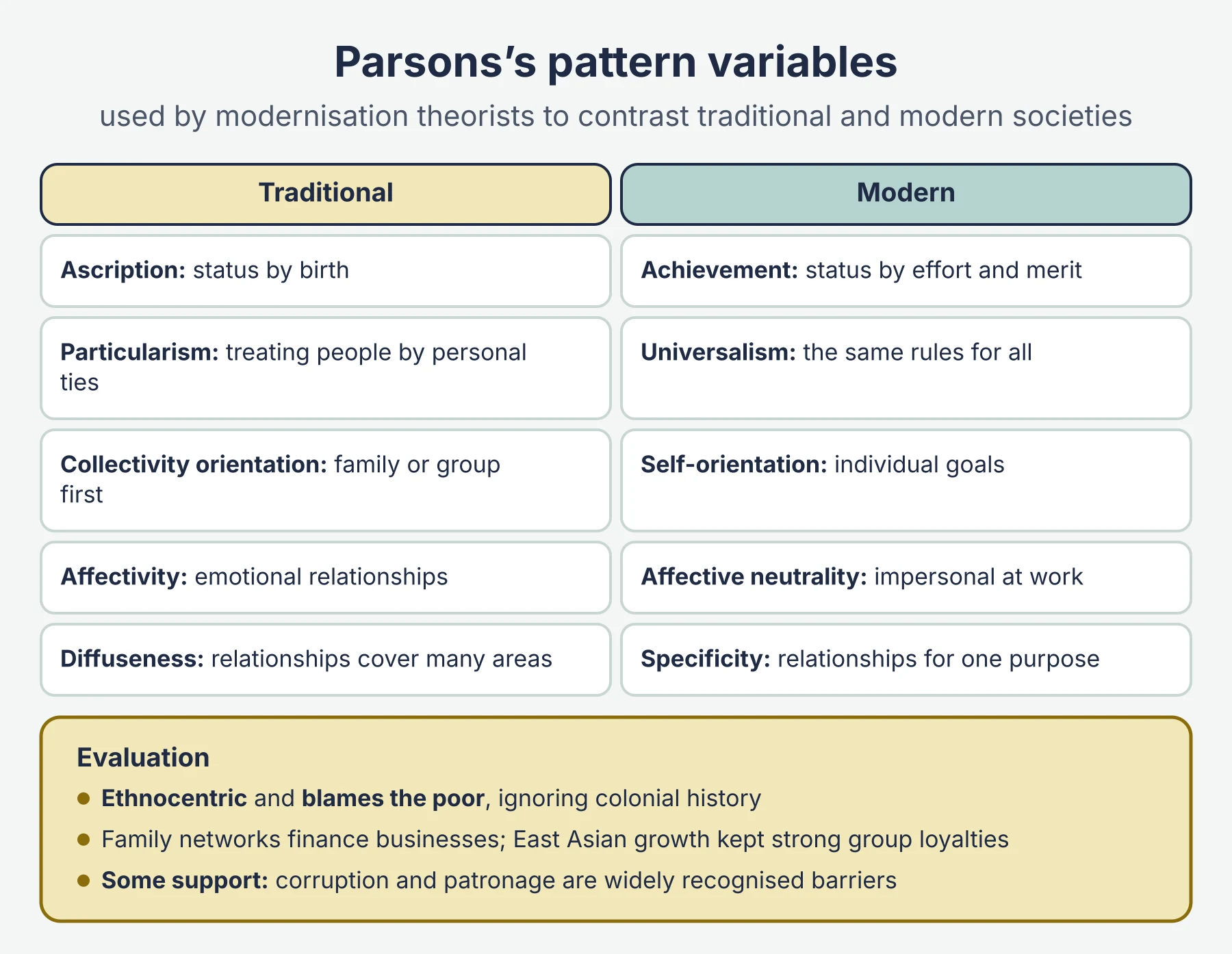
Modernisation theorists drew on Talcott Parsons’s pattern variables, which contrast traditional and modern orientations:
| Traditional | Modern |
|---|---|
| Ascription: status by birth | Achievement: status by effort and merit |
| Particularism: treating people according to personal ties | Universalism: applying the same rules to all |
| Collectivity orientation: duty to family or group first | Self-orientation: individual goals |
| Affectivity: emotional relationships | Affective neutrality: impersonal relationships at work |
| Diffuseness: relationships covering many areas of life | Specificity: relationships limited to one purpose |
Applied to development, obstacles include hiring relatives rather than the best candidate (particularism), status fixed by caste or lineage (ascription), and obligations to share earnings with a wide kin group, which can reduce saving and investment. Alex Inkeles and David Smith (Becoming Modern, 1974) argued that factory work and schooling create “modern” individuals open to new experience and planning.
Evaluation.
- Ethnocentric: it treats Western history as the only route.
- Blames the poor: it locates obstacles inside poorer societies and ignores colonial history and global power.
- Tradition can support growth: family networks have financed many businesses, and East Asian economies combined rapid growth with strong family and group loyalties.
- Some support: corruption and patronage (forms of particularism) are widely recognised as barriers, including by governments of less developed countries themselves.
Marxist views: globalisation and capitalism
Marxists place the obstacle in the structure of the world capitalist economy, not in local culture.
- Dependency and world-systems: Frank’s metropolis and satellite, Wallerstein’s core, semi-periphery and periphery (covered in the Unit 3 overview).
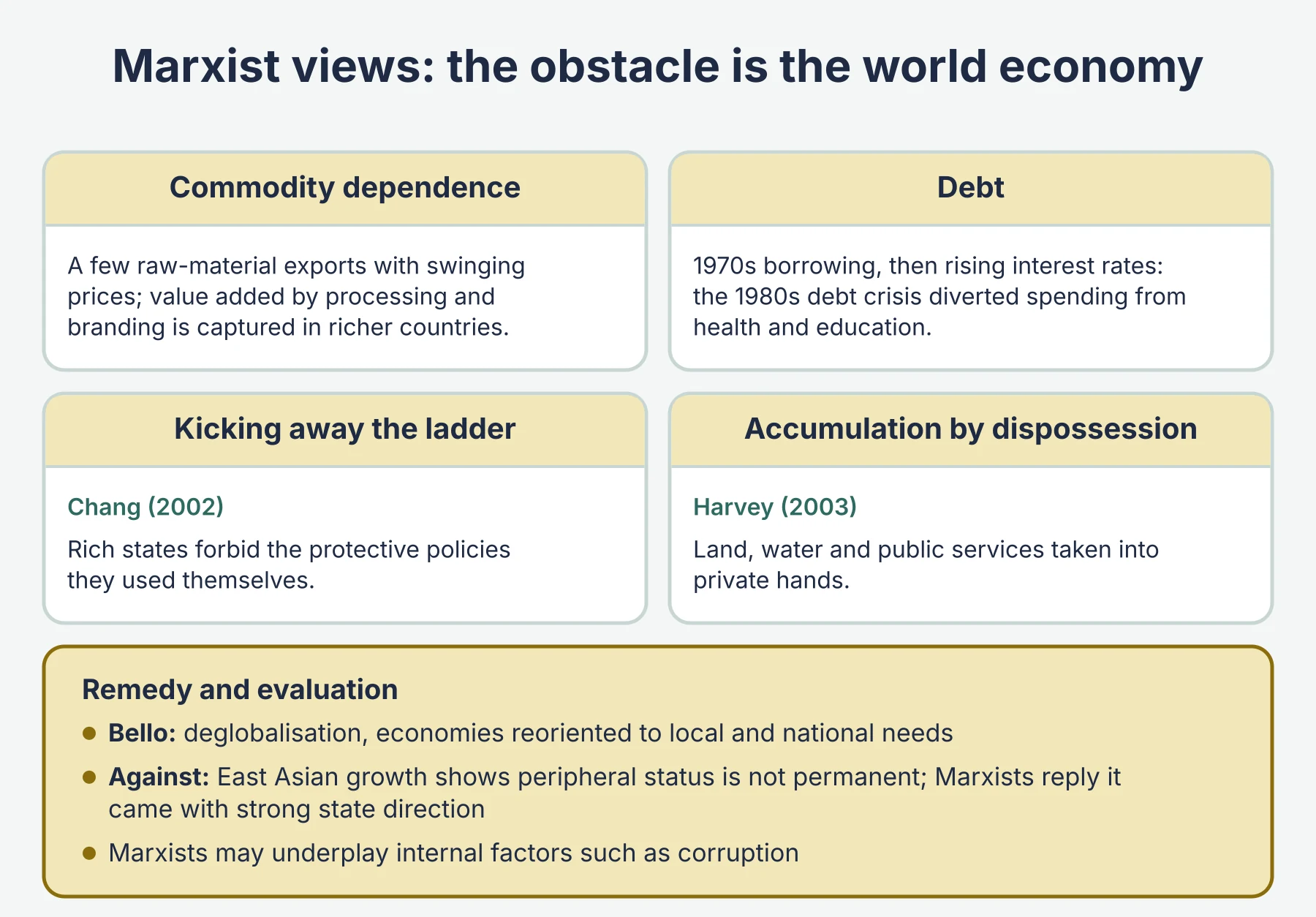
- Commodity dependence and unequal exchange: many poorer economies export a few raw materials whose prices swing sharply, while importing manufactured goods. Value added through processing and branding is captured in richer countries.
- Debt: borrowing in the 1970s followed by rising interest rates led to the debt crisis of the 1980s. Repayments and loan conditions diverted spending from health and education.
- Rules of the game: Chang (Kicking Away the Ladder, 2002) argued that rich states now forbid the protective policies they used themselves.
- Accumulation by dispossession: David Harvey (The New Imperialism, 2003) argued that capitalism expands by taking common or public resources (land, water, public services) into private hands through privatisation and land grabs.
- Bello’s deglobalisation proposes the remedy: economies reoriented to local and national needs.
Evaluation. The growth of China, South Korea and other East Asian economies shows that peripheral status is not permanent; neo-liberals argue those countries succeeded by joining global markets. Marxists reply that they did so with strong state direction, not free markets alone. Critics also say Marxist views underplay internal factors such as corruption, which modernisation theorists stress.
Feminist views: globalisation and patriarchy
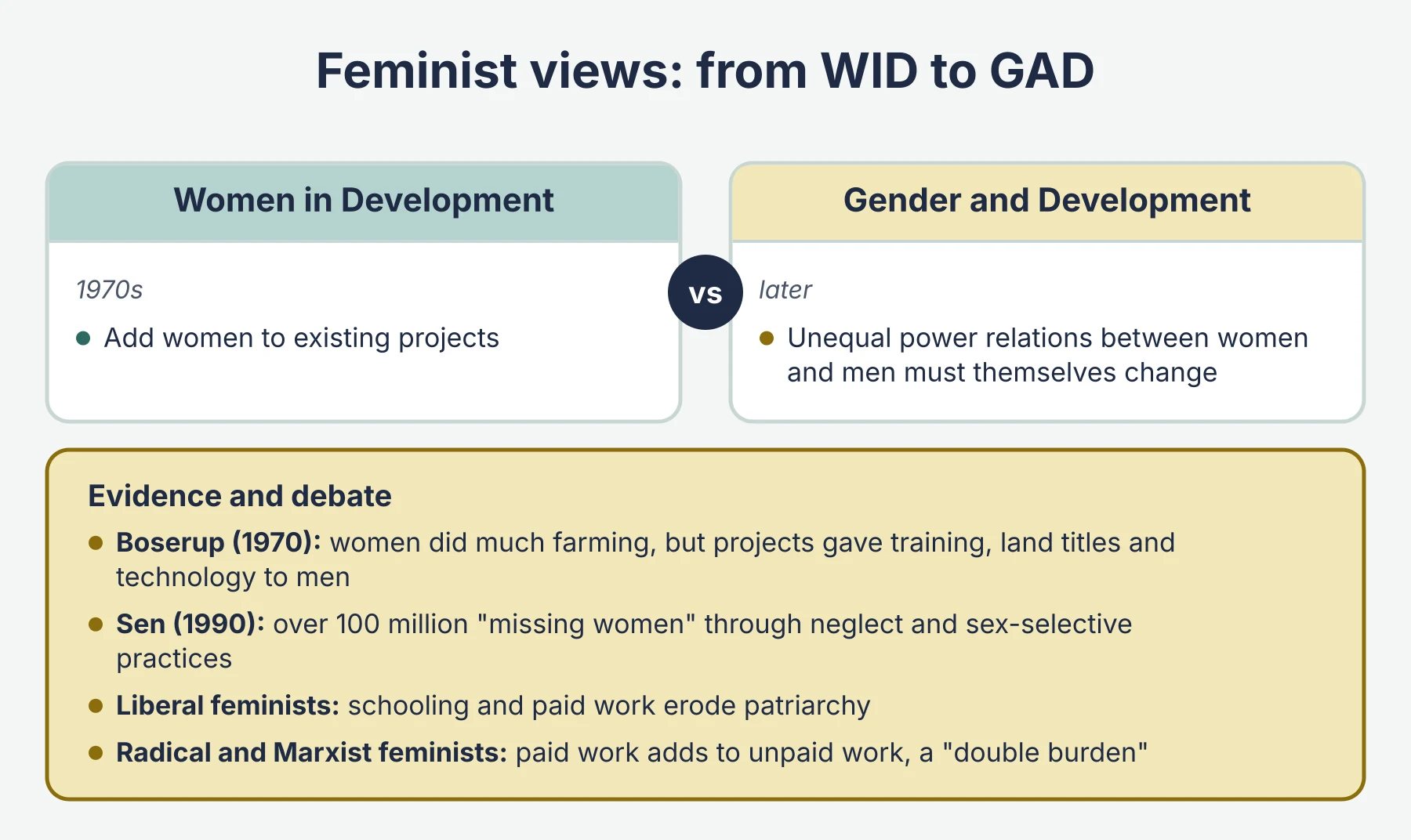
- Ester Boserup (Woman’s Role in Economic Development, 1970) showed that women did much of the farming in many regions, yet development projects gave training, land titles and new technology mainly to men, so modernisation could lower women’s status.
- From WID to GAD: the “Women in Development” approach of the 1970s sought to add women to existing projects. The later “Gender and Development” approach argued that unequal power relations between women and men must themselves change.
- “Missing women”: Sen (1990) argued that over 100 million women were “missing” from the world’s population, because of neglect of girls’ health and nutrition, and sex-selective practices, in parts of Asia and North Africa.
- Globalised labour: Mies, Elson and Pearson, and Hochschild (in the Unit 3 overview) show global production and care chains relying on women’s undervalued work.
Evaluation. Liberal feminists point to large rises in girls’ school enrolment and women’s paid employment as evidence that globalisation can erode patriarchy. Radical and Marxist feminists reply that paid work is often added to unpaid domestic work, producing a “double burden”.
Why inequalities in health and education persist
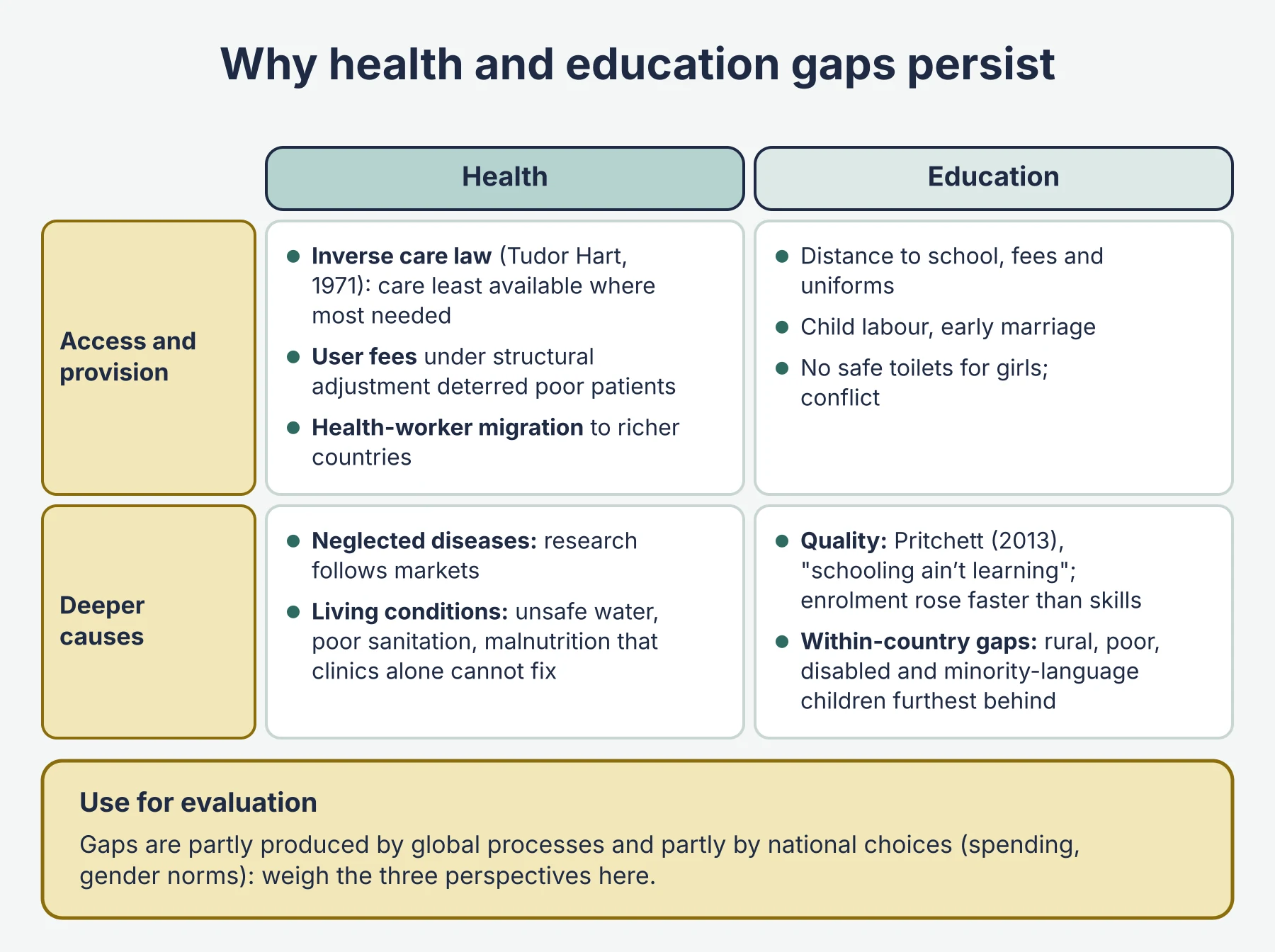
Inequalities persist between and within countries. Useful mechanisms:
- Health
- Inverse care law (Julian Tudor Hart, 1971): good medical care tends to be least available where it is most needed.
- User fees introduced under structural adjustment deterred poor patients.
- Health-worker migration: doctors and nurses trained in poorer countries move to richer ones.
- Neglected diseases: research effort follows markets, so diseases of the poor attract less investment.
- Living conditions: unsafe water, poor sanitation and malnutrition cause illness that clinics alone cannot fix.
- Education
- Access: distance to school, fees and uniforms, child labour, early marriage, lack of safe toilets for girls, and conflict.
- Quality: Lant Pritchett (The Rebirth of Education, 2013) argued that “schooling ain’t learning”: enrolment rose much faster than skills, because many children attend school without learning basic literacy and numeracy.
- Within-country gaps: rural, poor, disabled and minority-language children fall furthest behind.
The point for evaluation is that these gaps are partly produced by global processes (debt, migration, markets) and partly by national choices (spending priorities, gender norms), which is where the three perspectives can be weighed.
Globalisation, the climate crisis and sustainable development
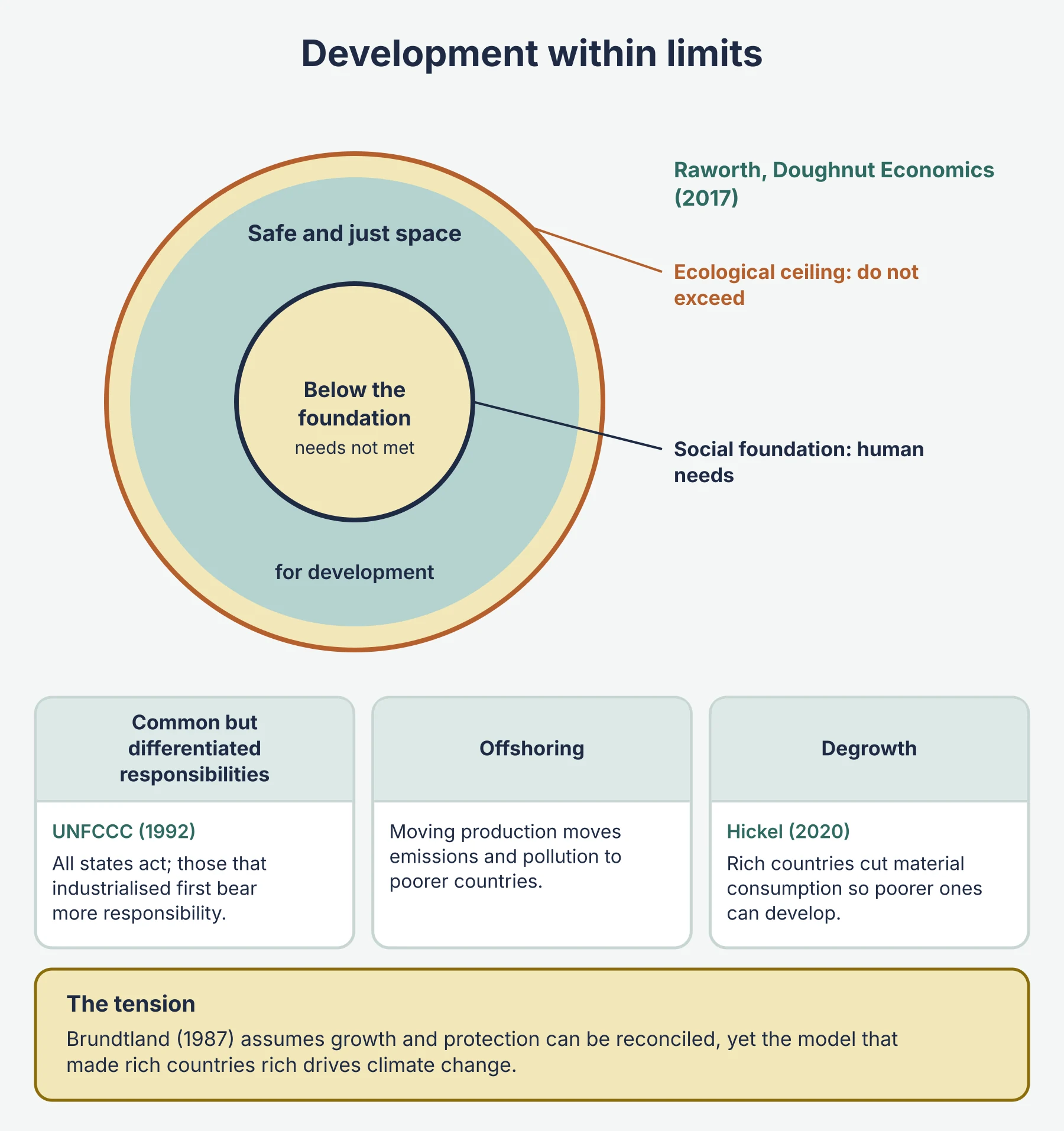
- Responsibility: the UN Framework Convention on Climate Change (1992) adopted the principle of “common but differentiated responsibilities”: all states must act, but those that industrialised first bear more responsibility.
- Offshoring: when production moves to poorer countries, so do its emissions and pollution, even though consumers elsewhere buy the goods.
- Sustainable development (Brundtland, 1987) assumes growth and environmental protection can be reconciled. Kate Raworth (Doughnut Economics, 2017) argued that development must meet a social foundation of human needs without exceeding an ecological ceiling. Degrowth writers such as Jason Hickel (Less Is More, 2020) argue that rich countries must reduce material consumption so that poorer ones can develop.
This tension is an obstacle in itself: the model of progress that made rich countries rich is the model that drives climate change.
Effects of wars and conflicts
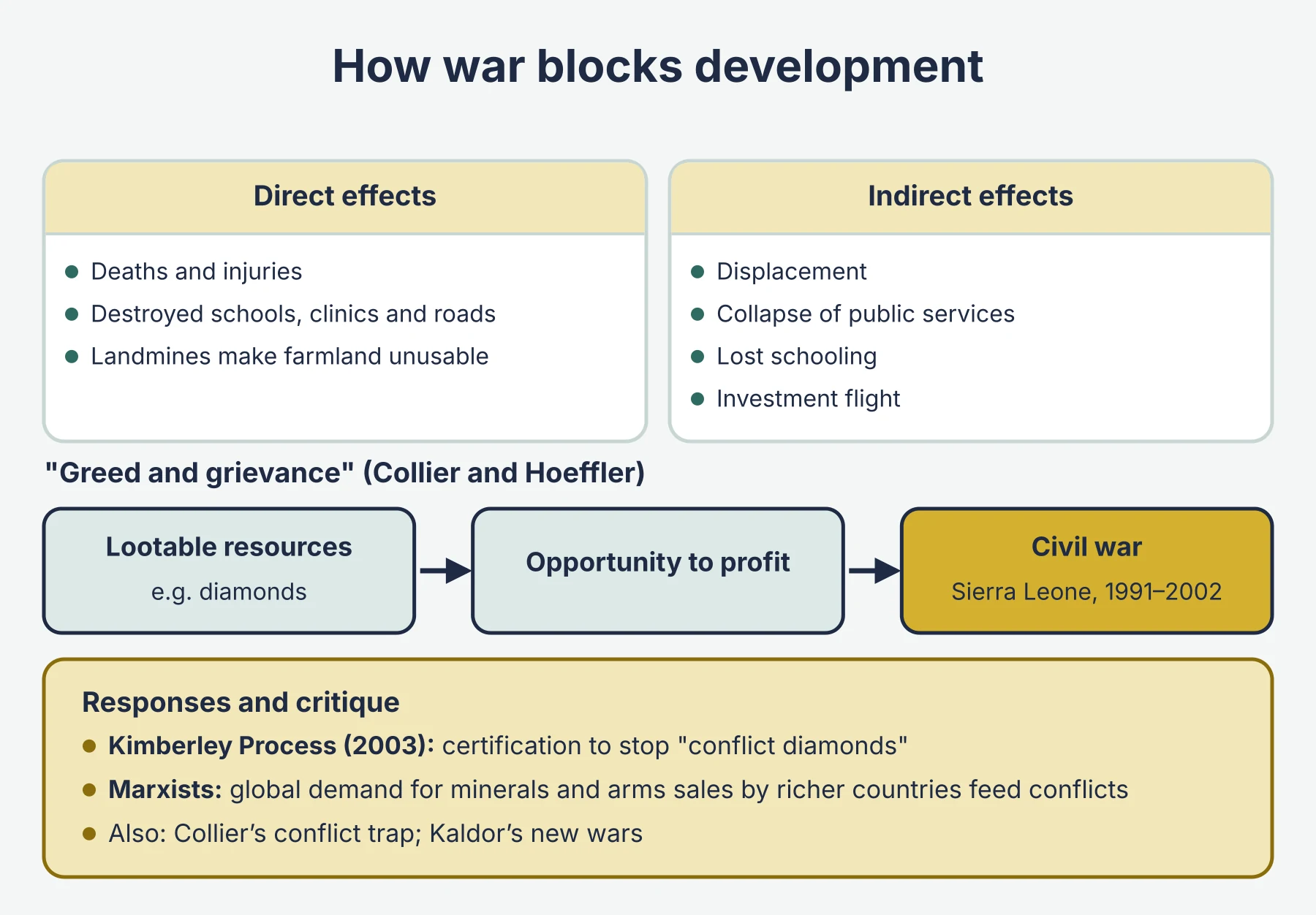
- Direct effects: deaths, injuries, destruction of schools, clinics and roads; landmines that make farmland unusable for years.
- Indirect effects: displacement, collapse of public services, lost schooling, investment flight.
- The conflict trap (Collier) and new wars (Kaldor) are in the overview. Paul Collier and Anke Hoeffler’s work on “greed and grievance” argued that the opportunity to profit, for example from lootable resources, helps explain where civil wars break out.
- Resource curse: diamonds funded armed groups in Sierra Leone’s civil war (1991 to 2002); the Kimberley Process certification scheme (2003) was created to stop “conflict diamonds” entering the market.
Evaluation. Marxists add that global demand for minerals and arms sales by richer countries feed conflicts, so war is not only a local failure.
Annotated model answer
Extract from a 12-mark answer: Evaluate the modernisation view that traditional values are the main obstacle to progress.
Modernisation theorists use Parsons’s pattern variables: where status is ascribed and jobs go to relatives, talent is wasted [knowledge]. In my society, hiring through family connections in some public offices supports this [application]. Yet the same family networks finance many small businesses, so tradition is not simply a barrier [analysis]. Marxists argue that commodity dependence and debt matter more, and Boserup shows that “modern” projects themselves lowered women’s status, so values cannot be the main obstacle [evaluation from two perspectives].
Common mistakes
- Describing three perspectives one after another with no comparison.
- Using “development” without defining it.
- Writing about health and education gaps without a mechanism.
- Treating sustainable development as uncontested; contrast Brundtland with degrowth.
- Discussing war only as destruction, without long-term effects on services and investment.
Exam technique
For outline questions on obstacles, give the obstacle and its effect. For explain, show the chain (debt leads to cuts, cuts lead to user fees, fees reduce clinic use). For evaluate and to what extent, judge one perspective against at least one other and end with a reasoned conclusion, using own-society examples where asked.
Where next
Compare with how globalisation is defined in what is meant by globalisation, and with environmental inequality in the People and the environment study guide.
Related resources
-
Practice questions
OxfordAQA International A-level Sociology (9690): Obstacles to progress – Practice Questions
Original OxfordAQA 9690 practice questions on modernisation, Marxist and feminist views of obstacles to progress, health, education, climate and conflict.
Sociology · OxfordAQA · A Level
Try questions -
Revision notes
OxfordAQA International A-level Sociology (9690): Obstacles to progress – Revision Notes
Revision notes for OxfordAQA 9690 section 3.2.1.5: modernisation, Marxist and feminist views, health and education gaps, sustainability and conflict.
Sociology · OxfordAQA · A Level
Revise topic -
Study guides
OxfordAQA International A-Level Sociology (9690): The Great Divergence
Study guide to OxfordAQA 9690 section 3.2.1.1: imperialism, enslavement, Polanyi and Braudel on capitalism, why Europe industrialised, legacies and development.
Sociology · OxfordAQA · A Level
Read guide
Related articles
Get free revision emails (optional)
Occasional emails with practice questions, worked explanations and links to free resources for the qualification and subjects you choose. No spam, and you can unsubscribe from any email. The free tools on this site never need an email.