
Study Guides
OxfordAQA IGCSE Accounting: Adjustments for other payables, other receivables and income (9215)
Study guide to ledger entries and statement effects for other payables, other receivables, income due and income received in advance, OxfordAQA 9215.
- Subject
- Accounting
- Level
- IGCSE
- Topic
- Development of the accounting model
- Author
- Marlbridge Academic Team
- Updated
- Reviewed by
- Javaid Iqbal Sabri (what this means)
Aligned to OxfordAQA IGCSE Accounting (9215), First teaching 2024, first examined 2026. Official specification .
Syllabus page (what it covers and how it is assessed): OxfordAQA IGCSE Accounting.
Syllabus points this page covers
9215
- Adjustments for payables, receivables and income
Found an error? Report a correction.
Need help with this topic? Request a free trial class for IGCSE Accounting (9215).
This guide is aligned to the OxfordAQA International GCSE Accounting (9215) specification, version 1.2, for exams from May/June 2026. It covers the adjustments listed in section 3.3 for other payables, other receivables, income due and income received in advance, and the instruction to make entries for them in ledger accounts, in income statements and in statements of financial position. Section 3.3 falls within the content assessed by Paper 1 (content 1 to 3) and Paper 2 (content 3 to 5). All amounts on this page are in dollars.
Use it with the revision notes and the practice questions. Related pages are the guides to recording data and verification of records. The course hub is OxfordAQA IGCSE Accounting, the printable checklist tracks your progress, and the free diagnostics show where to start.
What the specification asks for
| Specification wording | What you must be able to do |
|---|---|
| Adjustments: other payables | Record an expense that belongs to this year but has not been paid |
| Adjustments: other receivables | Record an expense paid this year that belongs to the next period |
| Adjustments: income due | Record income earned this year but not yet received |
| Adjustments: income received in advance | Record income received this year that belongs to the next period |
| Entries in ledger accounts | Balance the account, carry down and bring down the balance, transfer the charge |
| Entries in income statements and statements of financial position | Show the adjusted figure in the income statement and the balance in the right section of the statement of financial position |
Section 3.3 names the accruals concept in its list of concepts. Section 3.4 repeats these four items when it describes how concepts affect financial statements. This guide covers only the four items named in your scope; the other adjustments in the section 3.3 list are separate topics.
The idea behind every adjustment
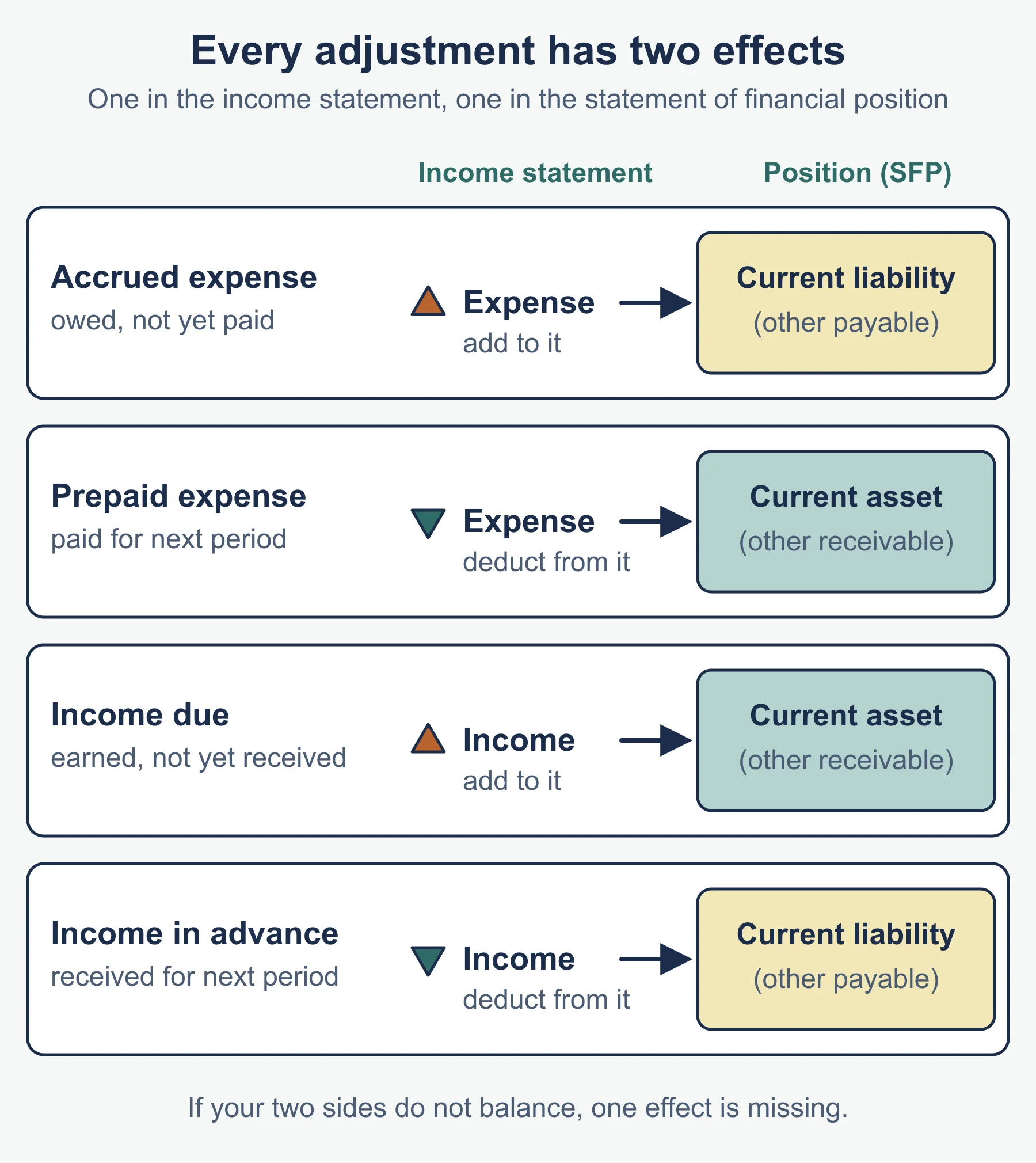
The accruals concept says that income and expenses belong to the period in which they are earned or used, not the period in which cash moves. A bank statement shows when money moved. The income statement must show what the business earned and used up in the year. The adjustments close the gap between the two.
Some books use the older names accrued expenses and prepayments. This guide uses the specification’s wording.
| Adjustment | Is it an asset or a liability? | Effect on this year’s profit | Where it appears in the statement of financial position |
|---|---|---|---|
| Other payables | Liability (the business owes) | Expense goes up, profit goes down | Current liabilities |
| Other receivables | Asset (the business has paid early) | Expense goes down, profit goes up | Current assets |
| Income due | Asset (the business is owed) | Income goes up, profit goes up | Current assets |
| Income received in advance | Liability (the business owes service) | Income goes down, profit goes down | Current liabilities |
Each of these is short term, so each sits in the current section. Other receivables and income due are separate lines because one is an expense paid early and the other is income not yet received.
Other payables
Other payables arise when the business has used something in the year but the invoice or bill has not been paid by the year end.
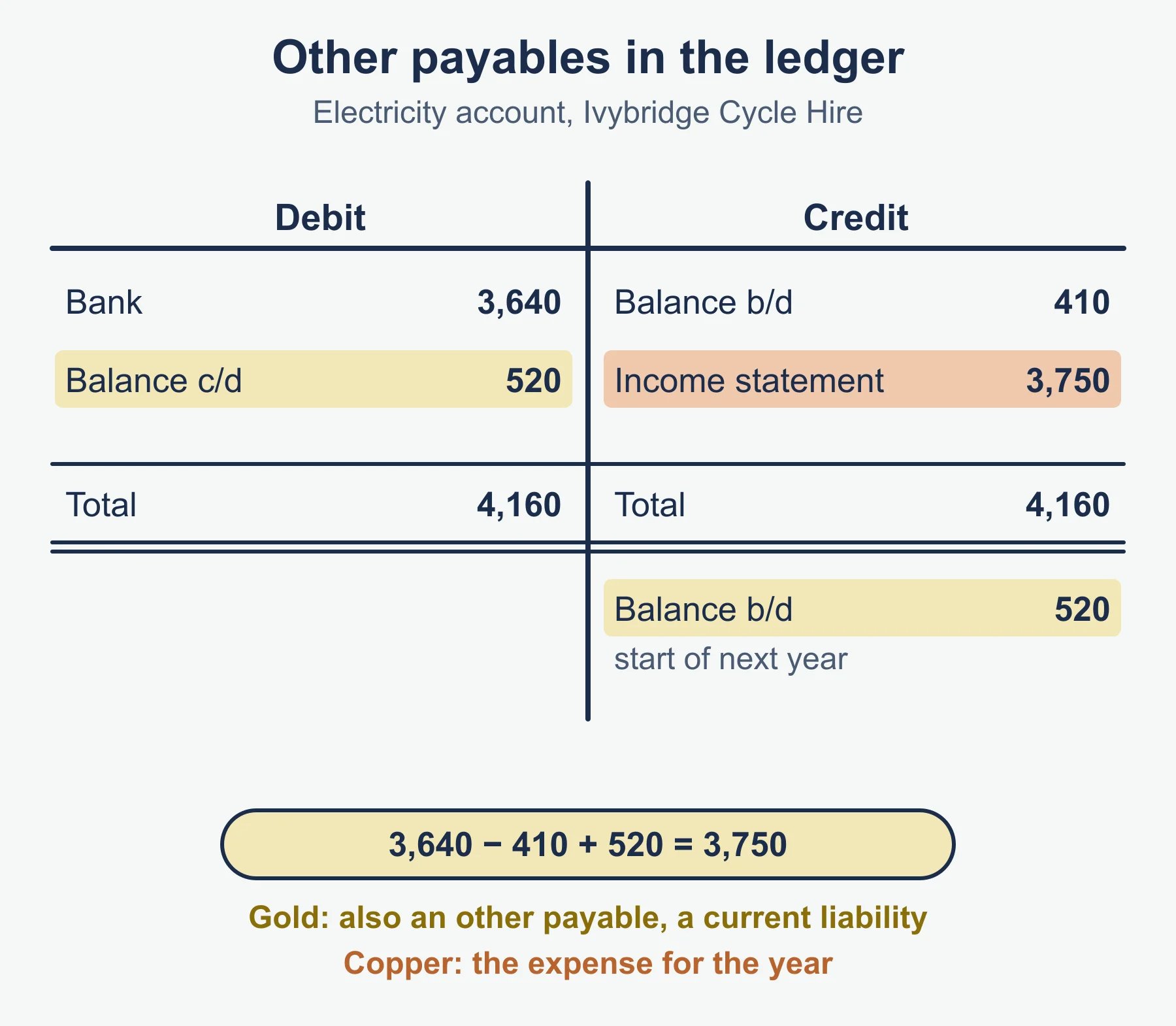
Ivybridge Cycle Hire, a sole trader, has a year end of 31 December 2026. The electricity account shows that 410 was owing on 1 January 2026. During the year the business paid 3,640. A bill for 520 for the last quarter arrived in January 2027 and covers use before the year end.
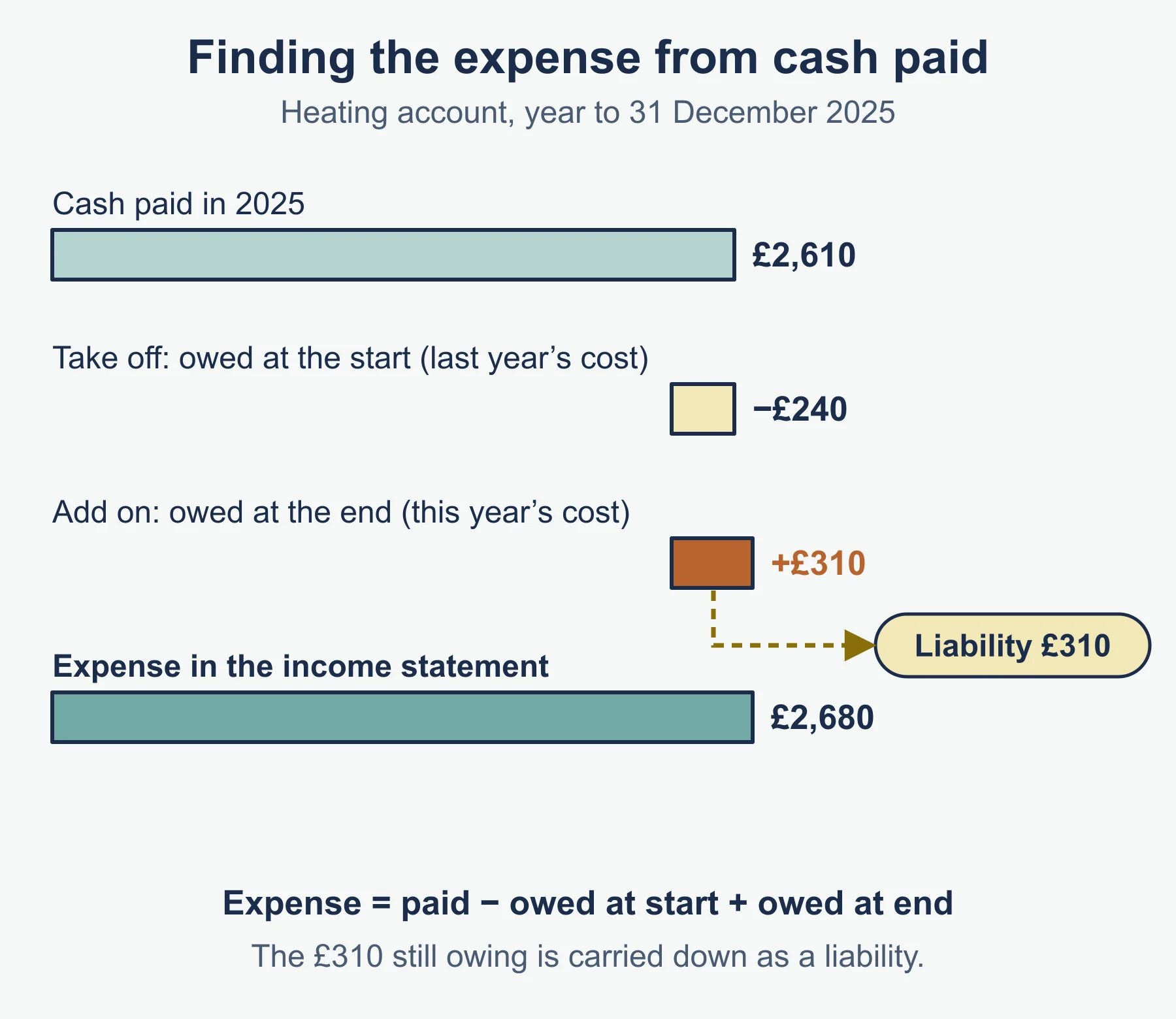
The charge for the year is the cash paid, less the amount owing at the start (which belongs to last year), plus the amount owing at the end: 3,640 - 410 + 520 = 3,750.
| Electricity account | |||
|---|---|---|---|
| Debit | Credit | ||
| Bank | 3,640 | Balance b/d (owing at start) | 410 |
| Balance c/d (owing at end) | 520 | Income statement | 3,750 |
| 4,160 | 4,160 | ||
| Balance b/d (owing at start of 2027) | 520 |
Follow the steps in this order. Enter the payments. Enter the opening balance on the credit side, because the account starts with a credit balance when money is owed. Insert the closing owing figure on the debit side as balance c/d. The balancing figure on the credit side is the transfer to the income statement. Finally bring the balance down on the credit side of the new period. The 520 is also shown as an other payable under current liabilities.
Other receivables
Other receivables arise when the business has paid for something that it will use in a later period.
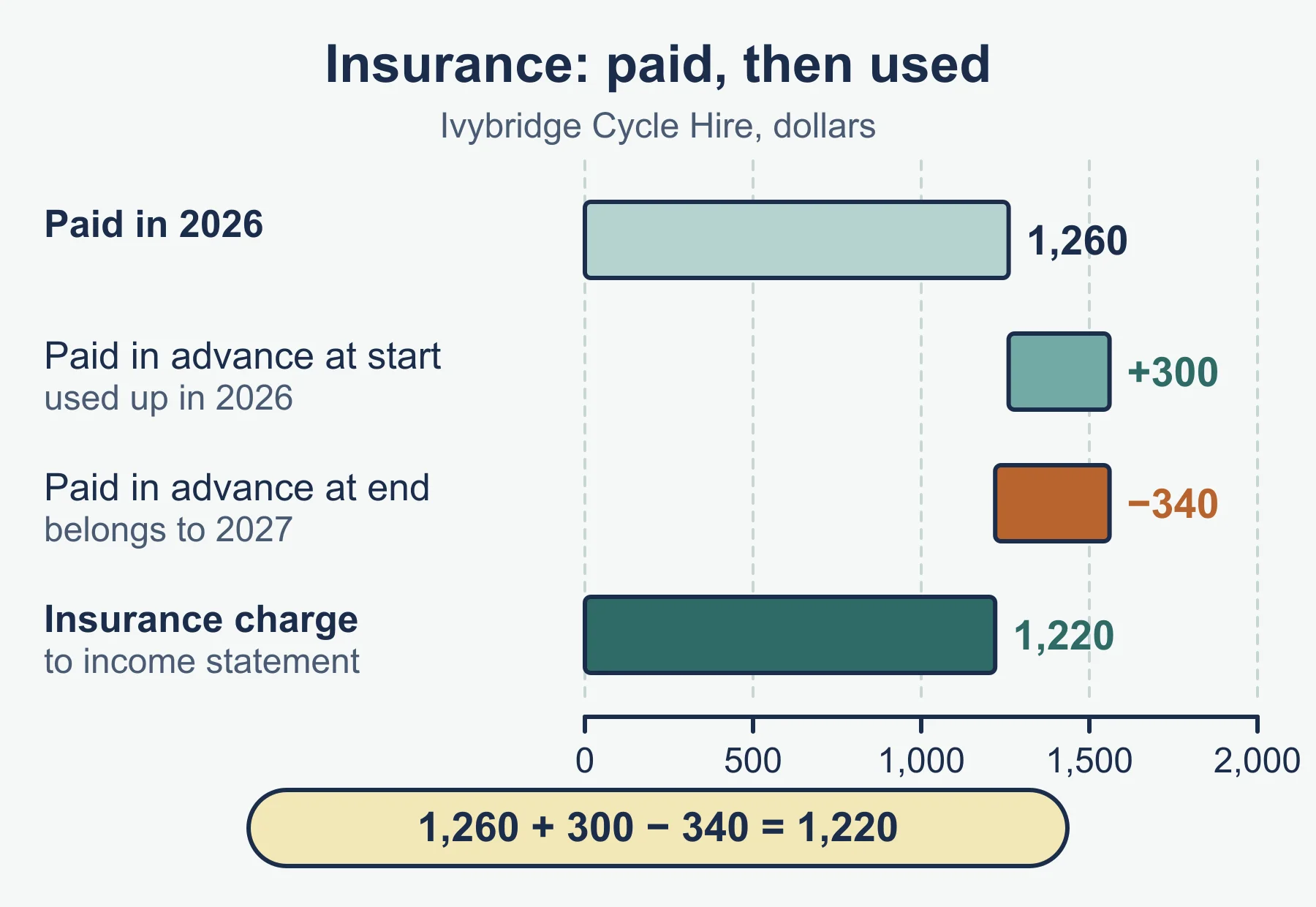
Ivybridge Cycle Hire paid insurance of 1,260 during 2026. On 1 January 2026 there was a prepaid amount of 300 brought forward from 2025. At 31 December 2026, 340 of the amount paid relates to 2027.
Charge for the year: 1,260 + 300 - 340 = 1,220.
| Insurance account | |||
|---|---|---|---|
| Debit | Credit | ||
| Balance b/d (paid in advance at start) | 300 | Income statement | 1,220 |
| Bank | 1,260 | Balance c/d (paid in advance at end) | 340 |
| 1,560 | 1,560 | ||
| Balance b/d (start of 2027) | 340 |
This time the opening balance is on the debit side, because the business has an asset at the start. The closing balance is carried down on the credit side, and the balancing figure on the credit side is the charge to the income statement.
Working out the amount from the dates
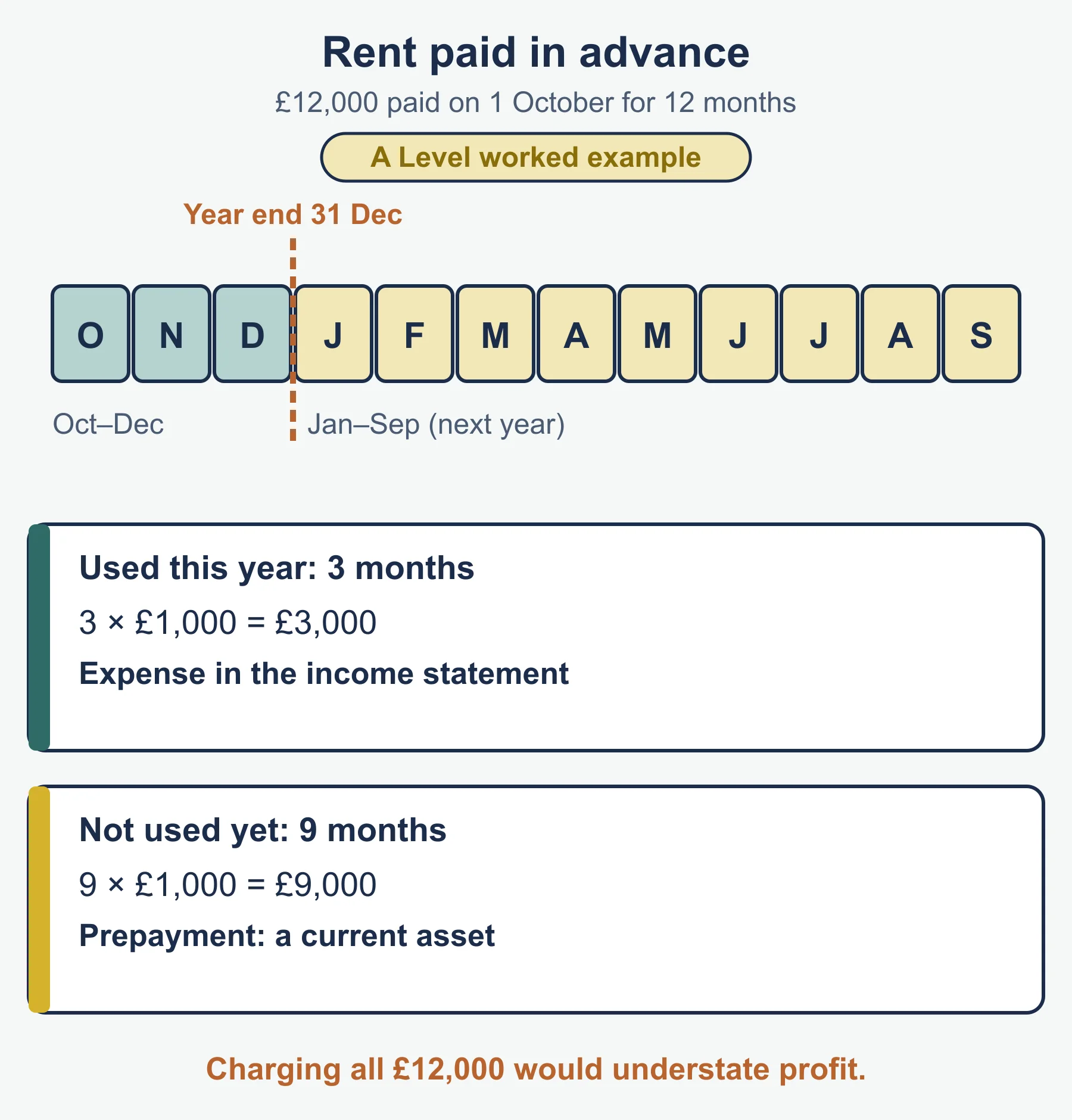
Sometimes you have to work out the prepaid amount yourself. The business pays an annual operating licence of 1,800 on 1 April 2026. The licence covers twelve months and the year end is 31 December 2026.
- Months used in 2026: 9, so the charge is 1,800 x 9/12 = 1,350.
- Months left: 3, so the other receivable is 1,800 x 3/12 = 450.
- Check: 1,350 + 450 = 1,800.
Income due
Income due arises when the business has earned income but has not yet received the cash.
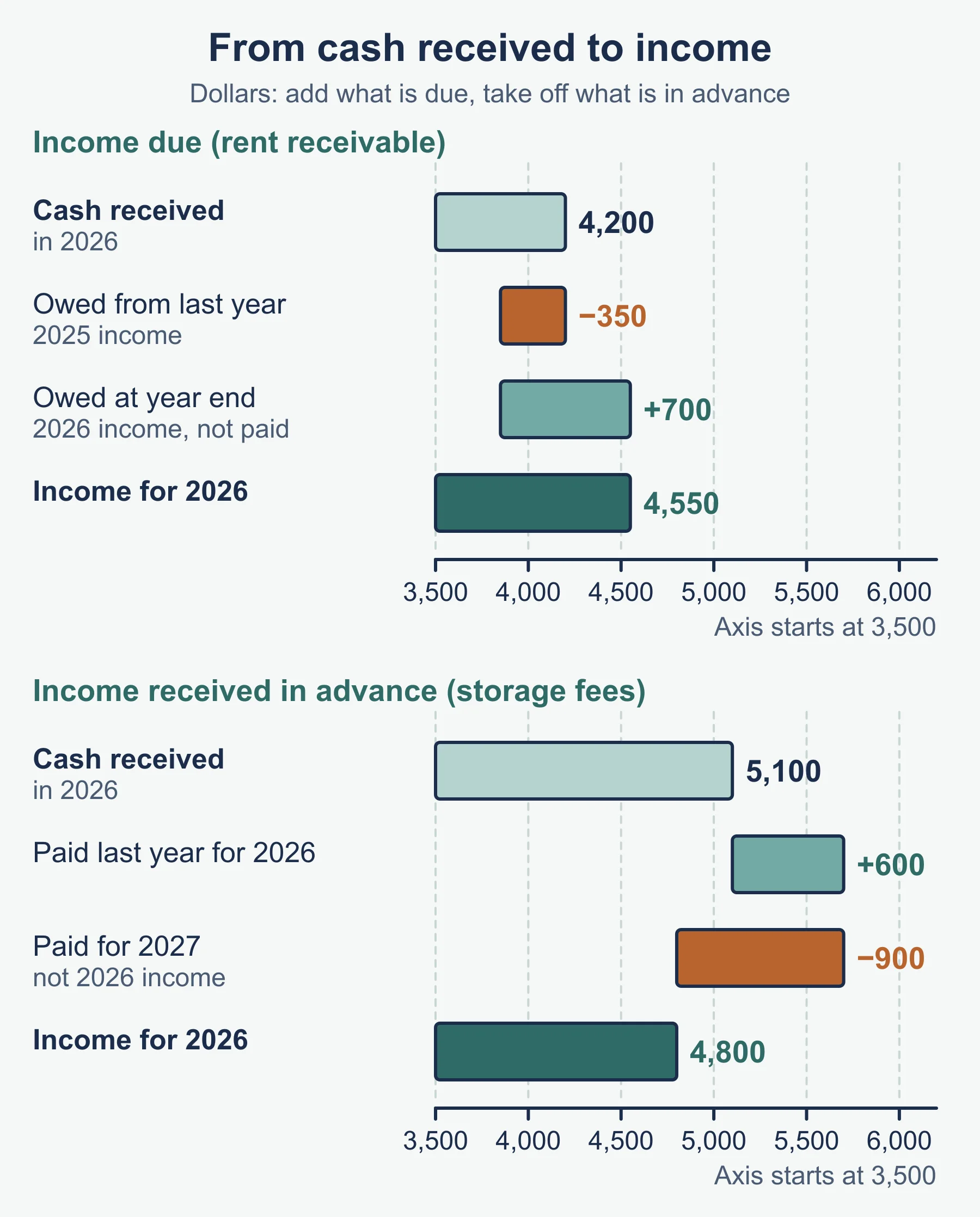
Ivybridge Cycle Hire lets a storage unit to a neighbour. On 1 January 2026 the neighbour owed 350 for rent from 2025. During 2026 the business received 4,200. At 31 December 2026 the neighbour owes 700 for the last months of the year.
Income for the year: 4,200 - 350 + 700 = 4,550.
| Rent receivable account | |||
|---|---|---|---|
| Debit | Credit | ||
| Balance b/d (due at start) | 350 | Bank | 4,200 |
| Income statement | 4,550 | Balance c/d (due at end) | 700 |
| 4,900 | 4,900 | ||
| Balance b/d (start of 2027) | 700 |
The opening 350 is already an asset on the debit side, and its receipt in 2026 belongs to last year. The 700 closing is an asset, so it appears as balance c/d on the credit side and as balance b/d on the debit side. The 4,550 is transferred to the income statement as income.
Income received in advance
Income received in advance arises when cash has arrived for a service the business has not yet provided.
Rowan Bay Kayaks charges for boat storage. At 1 January 2026 it held 600 received in 2025 for storage in 2026. During 2026 it received 5,100. Of that, 900 is for storage from January 2027.
Income for 2026: 5,100 + 600 - 900 = 4,800.
| Storage fees account | |||
|---|---|---|---|
| Debit | Credit | ||
| Income statement | 4,800 | Balance b/d (received in advance at start) | 600 |
| Balance c/d (received in advance at end) | 900 | Bank | 5,100 |
| 5,700 | 5,700 | ||
| Balance b/d (start of 2027) | 900 |
The 900 is a liability because the business owes the customer a service. It appears under current liabilities as income received in advance. It is not income for 2026.
The four ledger patterns side by side
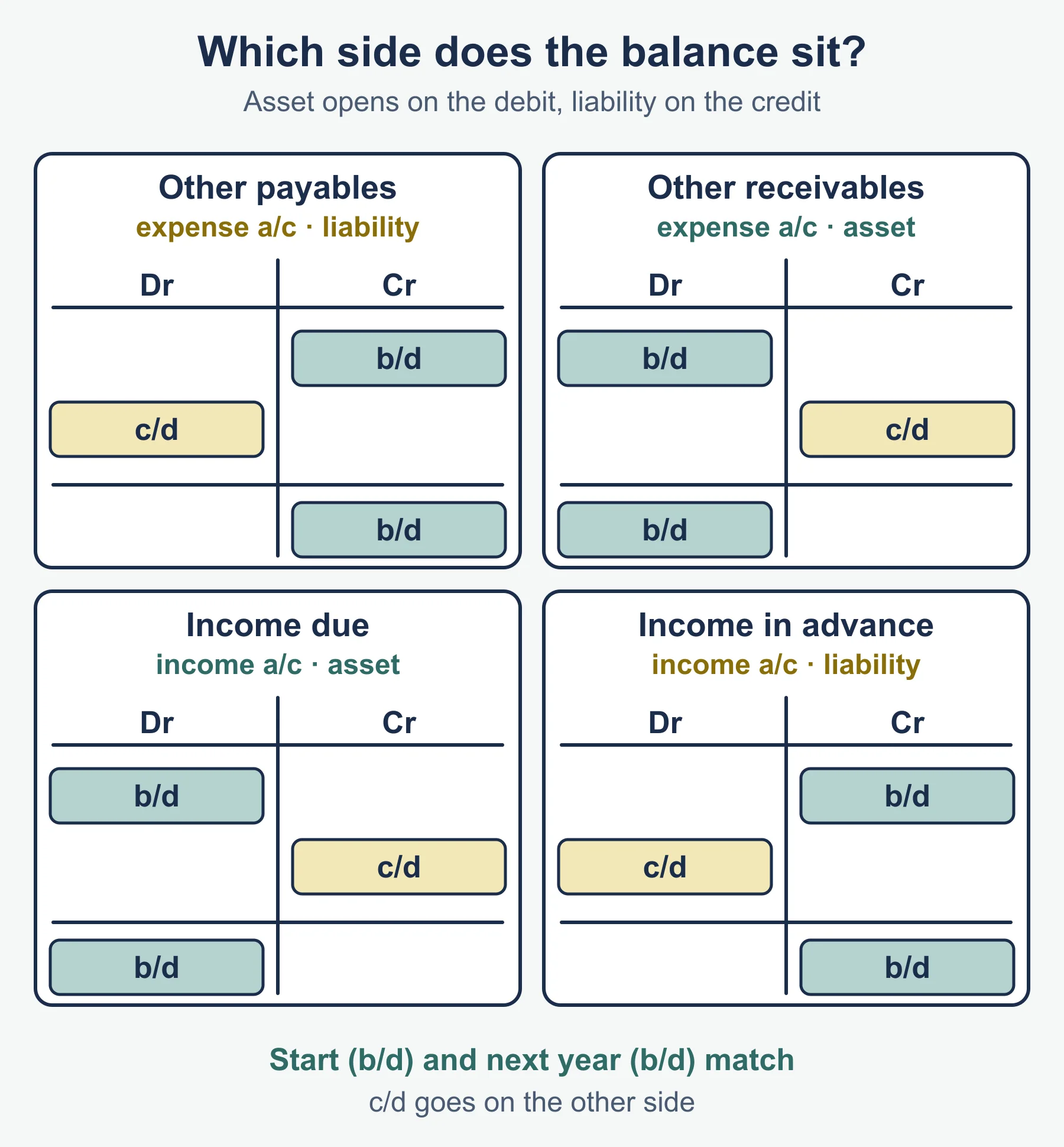
| Adjustment | Opening balance sits on | Closing balance carried down on | Closing balance brought down on |
|---|---|---|---|
| Other payables (expense account) | Credit | Debit | Credit |
| Other receivables (expense account) | Debit | Credit | Debit |
| Income due (income account) | Debit | Credit | Debit |
| Income received in advance (income account) | Credit | Debit | Credit |
Always finish by checking that both sides of the account have the same total.
Effects on the financial statements
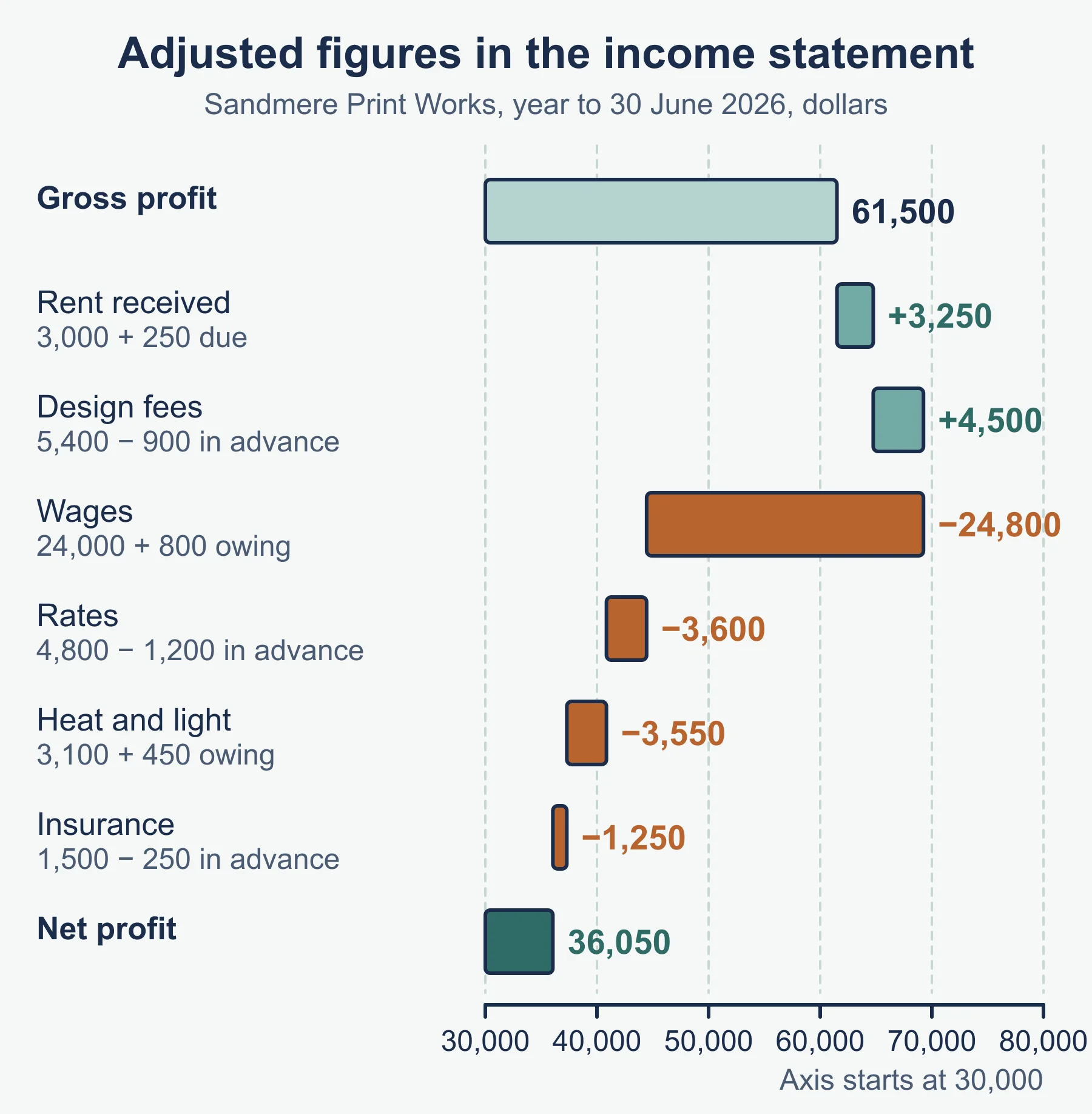
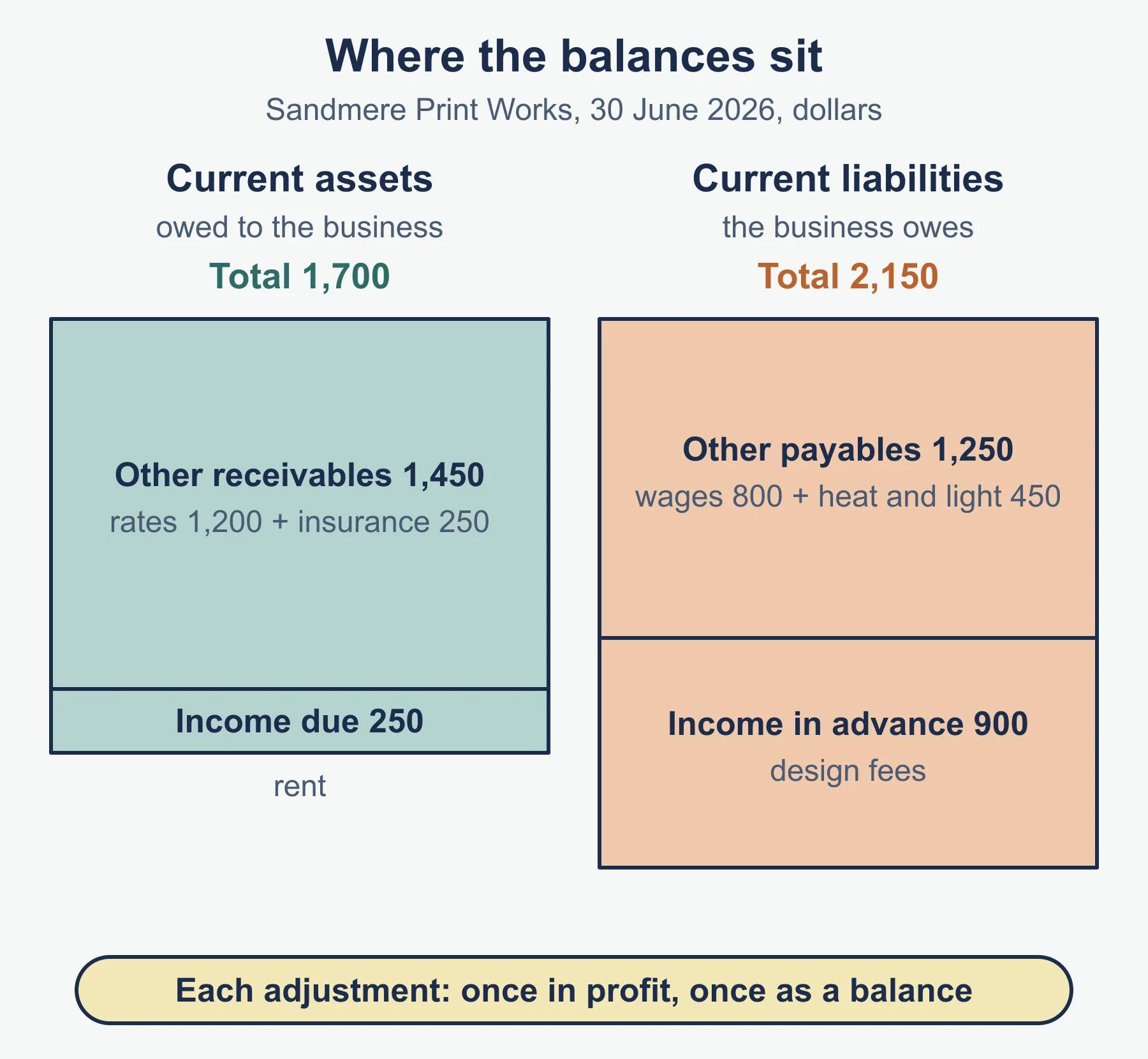
Sandmere Print Works, a sole trader, has a year end of 30 June 2026. The gross profit is 61,500. Ledger work has produced these figures:
| Item | Paid or received | Adjustment | Figure for the year |
|---|---|---|---|
| Wages | 24,000 paid | 800 owing | 24,800 |
| Rates | 4,800 paid | 1,200 paid in advance | 3,600 |
| Heat and light | 3,100 paid | 450 owing | 3,550 |
| Insurance | 1,500 paid | 250 paid in advance | 1,250 |
| Rent received | 3,000 received | 250 due | 3,250 |
| Design fees | 5,400 received | 900 received in advance | 4,500 |
Income statement extract for the year ended 30 June 2026:
| Gross profit | 61,500 |
| Add rent received | 3,250 |
| Add design fees | 4,500 |
| 69,250 | |
| Less wages | 24,800 |
| Less rates | 3,600 |
| Less heat and light | 3,550 |
| Less insurance | 1,250 |
| Total expenses | 33,200 |
| Net profit | 36,050 |
Statement of financial position extract at 30 June 2026:
| Current assets | |
|---|---|
| Other receivables (rates 1,200 and insurance 250) | 1,450 |
| Income due (rent) | 250 |
| Current liabilities | |
| Other payables (wages 800 and heat and light 450) | 1,250 |
| Income received in advance (design fees) | 900 |
Each adjustment appears twice: once in the income statement and once as a balance in the statement of financial position. If you have changed the profit but have no balance to show, or the reverse, something is missing.
Correcting a draft profit
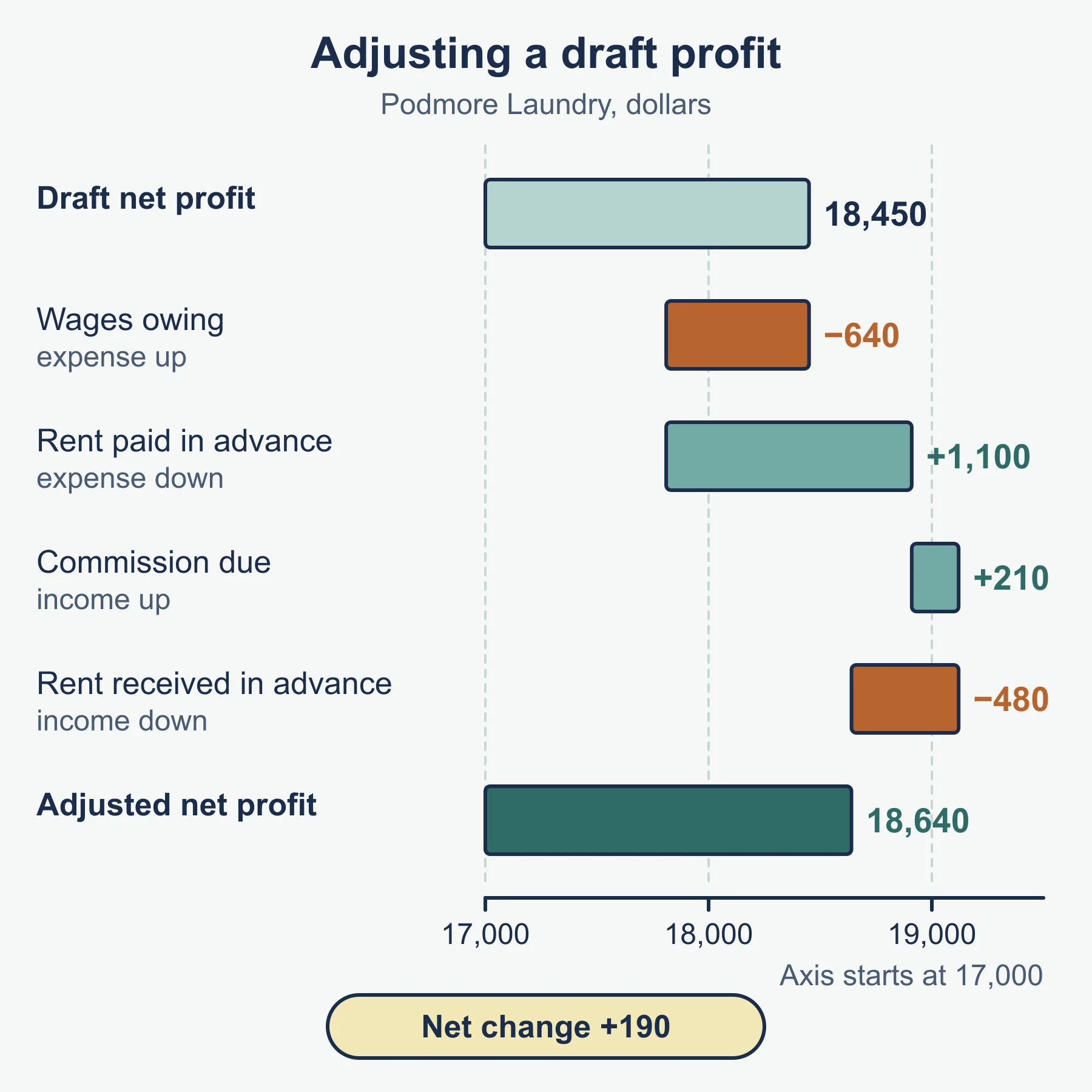
A draft profit is sometimes prepared from cash records before the year-end adjustments. Podmore Laundry is in its first year, so there are no opening balances. The draft net profit is 18,450. The adjustments not yet made are wages owing 640, rent paid in advance 1,100, commission due 210 and rent received in advance 480.
| Adjustment | Effect on profit | Running profit |
|---|---|---|
| Draft profit | 18,450 | |
| Wages owing | - 640 | 17,810 |
| Rent paid in advance | + 1,100 | 18,910 |
| Commission due | + 210 | 19,120 |
| Rent received in advance | - 480 | 18,640 |
Adjusted net profit is 18,640. The net change is +190, from -640 + 1,100 + 210 - 480.
Common errors
- Adding the opening balance to the payments in an expense account with other payables. An opening amount owing is last year’s cost, so it is taken off the cash paid.
- Putting a balance brought down on the wrong side. Check whether the item is an asset (debit) or a liability (credit).
- Treating income received in advance as income for the year. It is a liability until the service is given.
- Listing other payables as non-current liabilities, or other receivables among non-current assets. All four items are short term.
- Applying the fraction to the wrong period. Count the months used in the year, then the months left, and check that they add to the full period.
- Changing the ledger but leaving the statement figure alone, or the other way round.
Next steps
Work through the practice questions and keep the revision notes to hand. The diagnostics are a quick way to check what you still need to revise.
Frequently asked questions
What are other payables? Other payables arise when a business has used something in the year but has not yet paid for it, such as electricity owing at the year end. They are current liabilities.
What are other receivables? Other receivables arise when a business has paid for something it will use in a later period, such as insurance paid in advance. They are current assets.
How do you work out a prepaid amount from dates? Count the months used in the year and the months left. For example, an annual licence of 1,800 with 9 months used in the year gives a charge of 1,350 and an other receivable of 450.
How do you calculate income for the year when some was received in advance? Income = cash received + amount received in advance at the start − amount received in advance at the end. The closing amount is a liability, because the business still owes the customer a service.
How does each adjustment affect the financial statements? Each adjustment appears twice: once in the income statement, at the adjusted expense or income figure, and once as a current asset or current liability in the statement of financial position.
Official syllabus
OxfordAQA International GCSE Accounting (9215) specification, version 1.2, for teaching from September 2024 and exams from May/June 2026, published by OxfordAQA. Subject content section 3.3 (Development of the accounting model), with the related list in section 3.4.
Get free revision emails (optional)
Occasional emails with practice questions, worked explanations and links to free resources for the qualification and subjects you choose. No spam, and you can unsubscribe from any email. The free tools on this site never need an email.
Related resources
-
Practice questions
OxfordAQA IGCSE Accounting: Adjustments for payables, receivables and income (9215) – Practice Questions
Twelve original practice questions with worked answers on other payables, other receivables, income due and income received in advance, OxfordAQA 9215.
Accounting · OxfordAQA · IGCSE
Try questions -
Revision notes
OxfordAQA IGCSE Accounting: Adjustments for payables, receivables and income (9215) – Revision Notes
Condensed revision notes on other payables, other receivables, income due and income received in advance for OxfordAQA International GCSE Accounting.
Accounting · OxfordAQA · IGCSE
Revise topic -
Study guides
OxfordAQA IGCSE Accounting: Capital and revenue items, depreciation and disposal of non-current assets (9215)
Study guide to capital and revenue items, depreciation methods, provisions and disposal accounts for OxfordAQA IGCSE Accounting 9215.
Accounting · OxfordAQA · IGCSE
Read guide
Related articles
-
teaching
A Level tuition in Dubai: Cambridge or Pearson Edexcel International A Level?
Schools in Dubai and Abu Dhabi teach either Cambridge International AS & A Level or Pearson Edexcel International A Level. How the two are structured, why it matters for tuition, and how online classes from Lahore work.
9 October 2026
-
curriculum guides
Choosing subjects at IGCSE and A Level
How subject choices at 14 and 16 affect university options later, and how to keep pathways open without overloading a timetable.
28 July 2026
Studying this with a teacher
Working through Accounting IGCSE?
This page is free and stays free. If you would rather be taught it, Marlbridge runs Accounting classes one-to-one and in small groups of up to 15, online in your own time zone. The first trial class is free. WhatsApp replies within an hour (8am–11pm Pakistan time, every day); email the same day.
OxfordAQA Accounting teachers at Marlbridge

