
Study Guides
OxfordAQA IGCSE Accounting: Capital and revenue items, depreciation and disposal of non-current assets (9215)
Study guide to capital and revenue items, depreciation methods, provisions and disposal accounts for OxfordAQA IGCSE Accounting 9215.
- Subject
- Accounting
- Level
- IGCSE
- Topic
- Development of the accounting model
- Author
- Marlbridge Academic Team
- Updated
- Reviewed by
- Javaid Iqbal Sabri (what this means)
Aligned to OxfordAQA IGCSE Accounting (9215), First teaching 2024, first examined 2026. Official specification .
Syllabus page (what it covers and how it is assessed): OxfordAQA IGCSE Accounting.
Syllabus points this page covers
9215
- Capital and revenue expenditure and income
Found an error? Report a correction.
Need help with this topic? Request a free trial class for IGCSE Accounting (9215).
This guide follows the OxfordAQA International GCSE Accounting (9215) specification, version 1.2, for exams from May/June 2026 onwards. It covers the part of section 3.3 (Development of the accounting model) on capital and revenue expenditure and income, depreciation and the disposal of non-current assets. The qualification is untiered. All amounts in this guide are in dollars. Revision notes are at the revision notes and exam-style questions at the practice set. Course hub: OxfordAQA IGCSE Accounting. Printable list of topics: checklist. To find weak spots first, use the free diagnostics. Double entry basics are in Sources and recording of data.
What the specification asks you to do
| Specification point (section 3.3) | What you must be able to do |
|---|---|
| Capital and revenue expenditure and income | Tell the four apart and say where each is recorded |
| Why non-current assets depreciate | Identify and explain reasons, for example obsolescence and wear and tear |
| Depreciation as a non-cash expense | Treat it as one, and know its effect on the valuation of assets |
| Straight line and reducing balance | Explain and apply both methods |
| Entering depreciation | Post it to the books, including the provision for depreciation |
| Disposal of a non-current asset | Record the sale, using a disposal account |
The specification also lists depreciation charges and disposals among the adjustments recorded in ledger accounts, so these entries appear in the work you do for financial statements.
Capital and revenue: expenditure
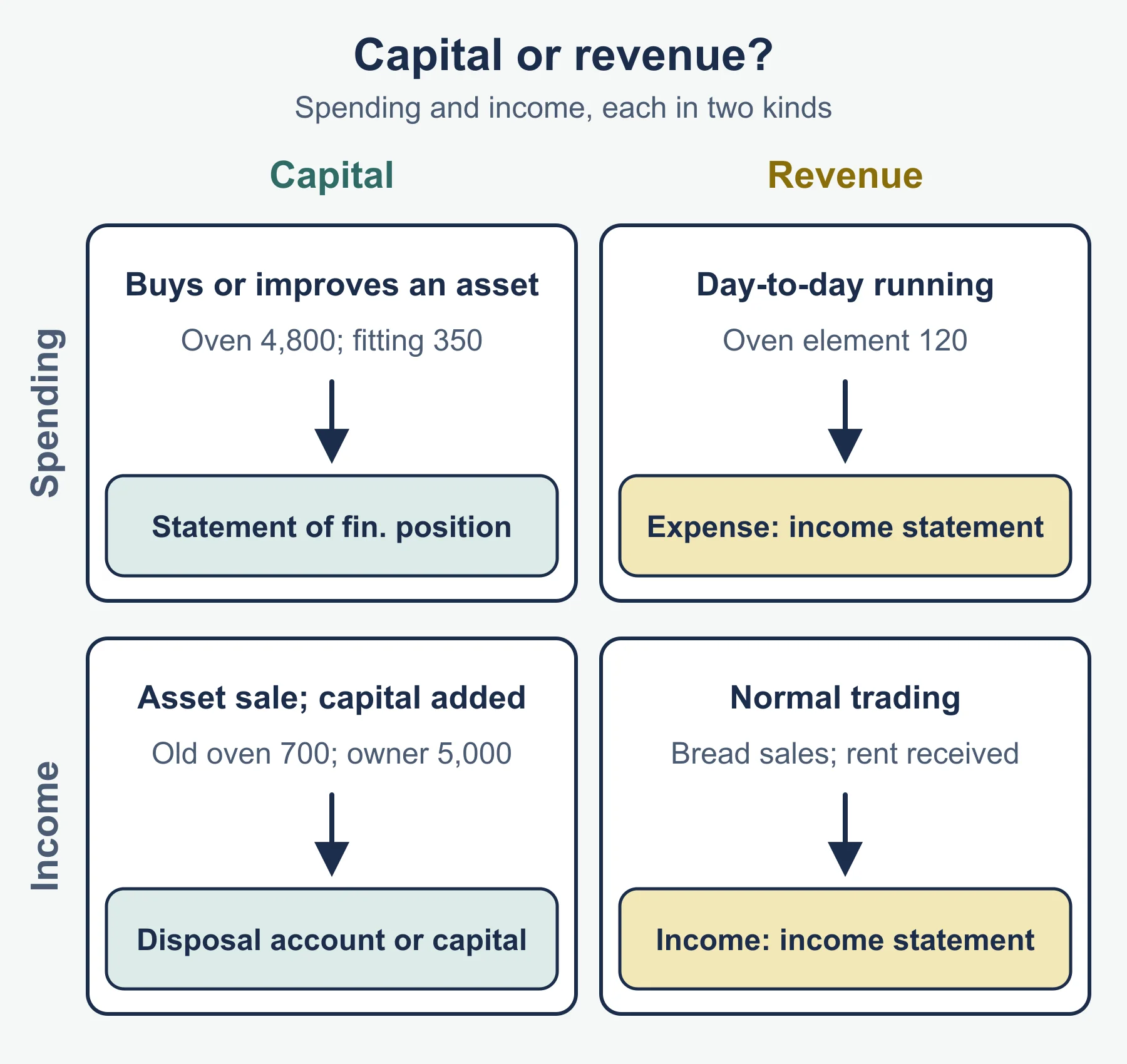
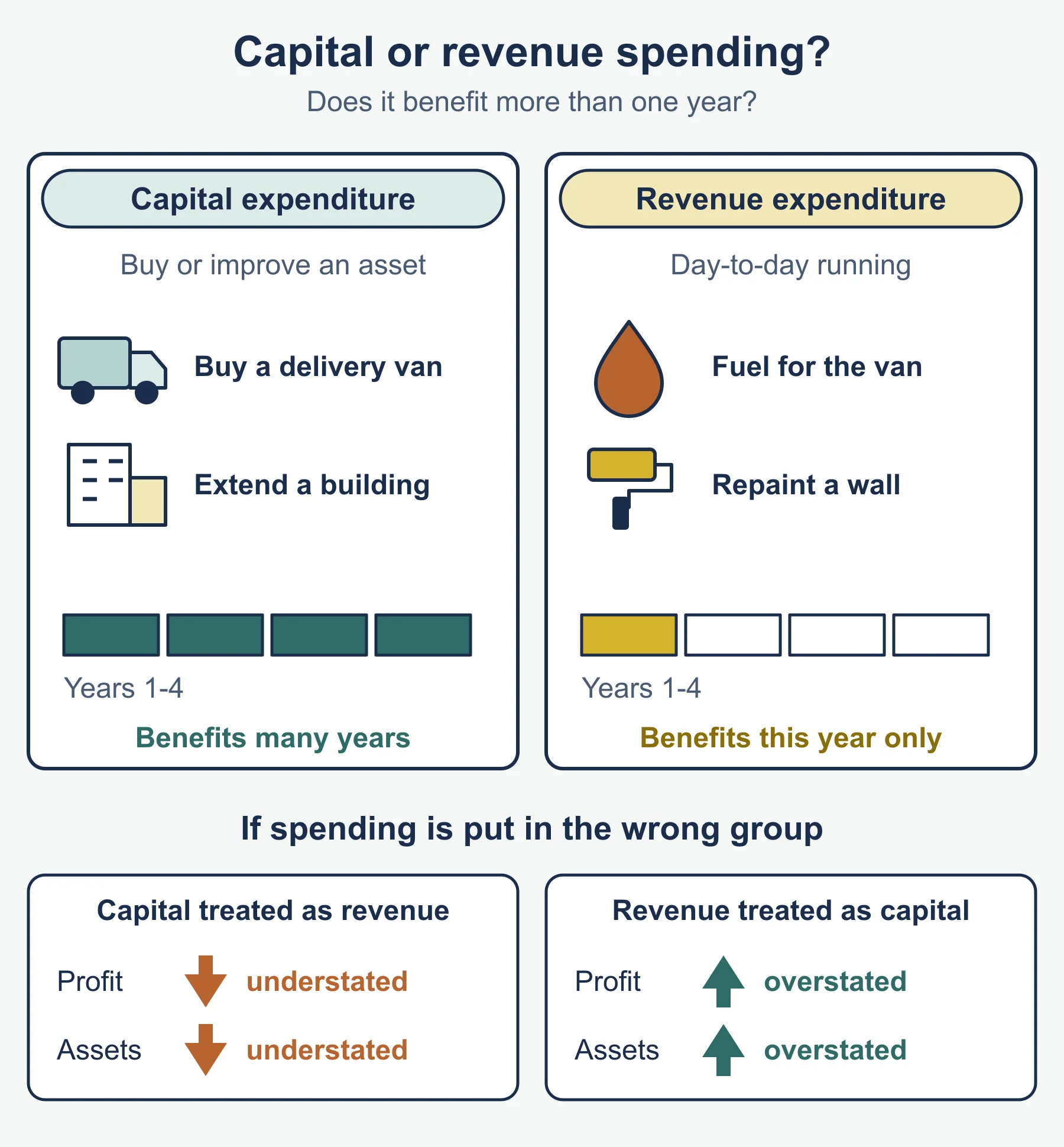
Capital expenditure is spending that buys, improves or brings a non-current asset into use. The benefit lasts for more than one accounting period. It is recorded as an asset and appears in the statement of financial position.
Revenue expenditure is spending on the day-to-day running of the business, or on keeping an asset in its present condition. The benefit is used up in the period. It is an expense in the income statement.
Costs needed to get an asset ready for use count as capital: delivery, installation and legal fees on buying property. Repairs and maintenance count as revenue.
Worked example 1: classifying items
Thorncombe Bakery made these payments in its first year. Classify each one.
| Payment | Amount | Classification | Reason |
|---|---|---|---|
| New industrial oven | 4,800 | Capital expenditure | Lasts many years |
| Delivery and fitting of the oven | 350 | Capital expenditure | Needed to bring it into use |
| Replacing a broken oven element | 120 | Revenue expenditure | Restores, does not improve |
| Routine repainting of the shop | 640 | Revenue expenditure | Maintenance |
| Solicitor’s fee on buying the shop | 900 | Capital expenditure | Cost of acquiring the property |
Capital and revenue: income
Revenue income comes from the normal trading and investing activity of the business: sales, rent received, commission received and similar. It is credited to the income statement.
Capital income is money received that is not from normal trading: proceeds from selling a non-current asset, and extra capital put in by the owner. It does not go to the income statement as sales. Sale proceeds go through the disposal account (explained below). Capital introduced increases the owner’s capital in the statement of financial position.
| Receipt | Classification |
|---|---|
| Sale of bread to customers | Revenue income |
| Rent received for letting the flat above the shop | Revenue income |
| Owner pays 5,000 into the business bank account | Capital income |
| Sale of the old oven for 700 | Capital income |
Why misclassification matters
Treating a capital item as revenue expenditure lowers profit and understates assets. Treating a revenue item as capital raises profit and overstates assets.
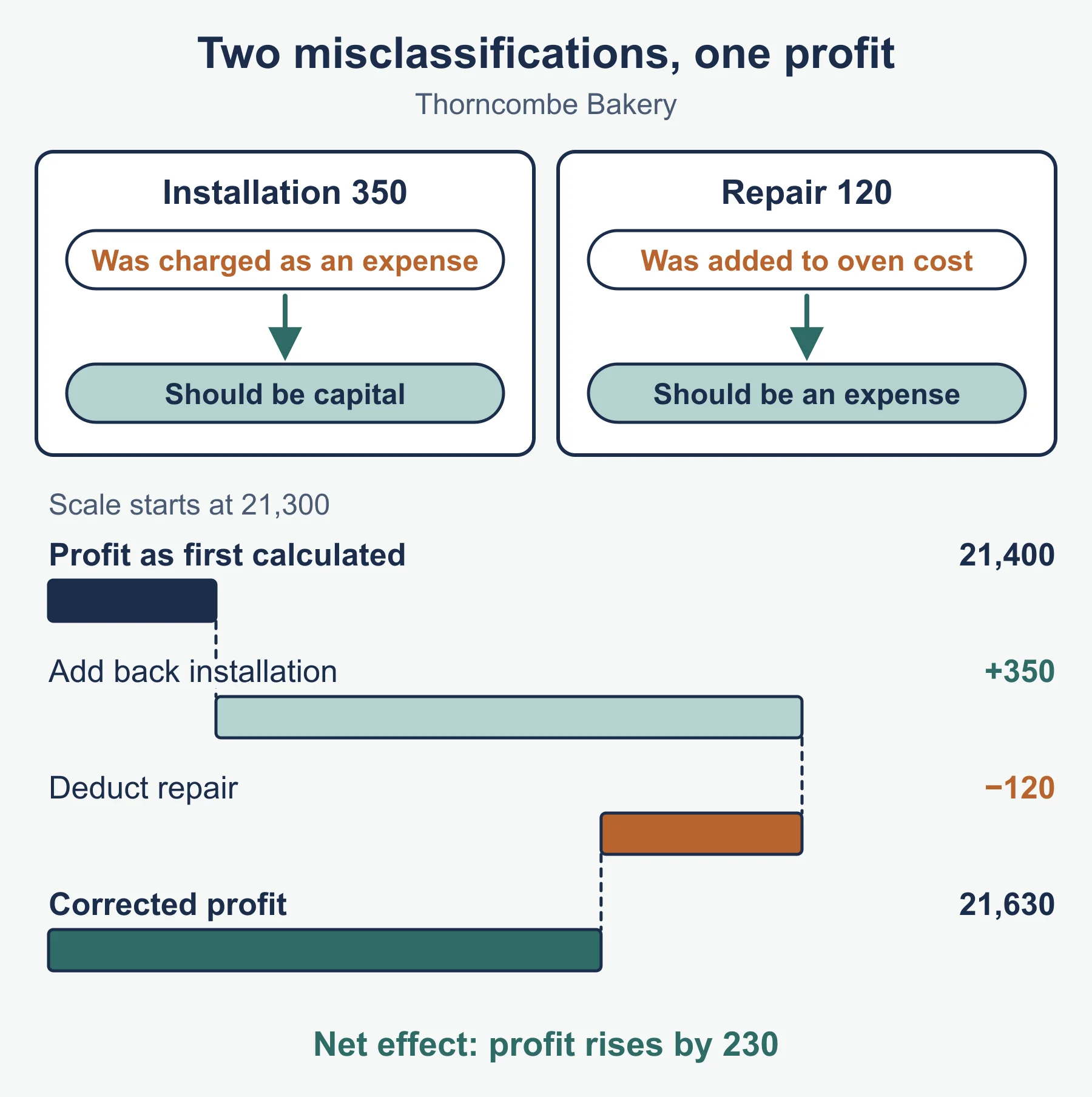
Worked example 2: Thorncombe’s profit was first calculated as 21,400. The 350 installation cost had been charged as an expense, and the 120 repair had been added to the cost of the oven.
| Step | Effect | Profit |
|---|---|---|
| Profit as first calculated | 21,400 | |
| Installation was capital, so remove the expense | add 350 | 21,750 |
| Repair was revenue, so charge it | deduct 120 | 21,630 |
Corrected profit is 21,630. This ignores any depreciation on the extra 350, which would be small by comparison.
Why non-current assets depreciate
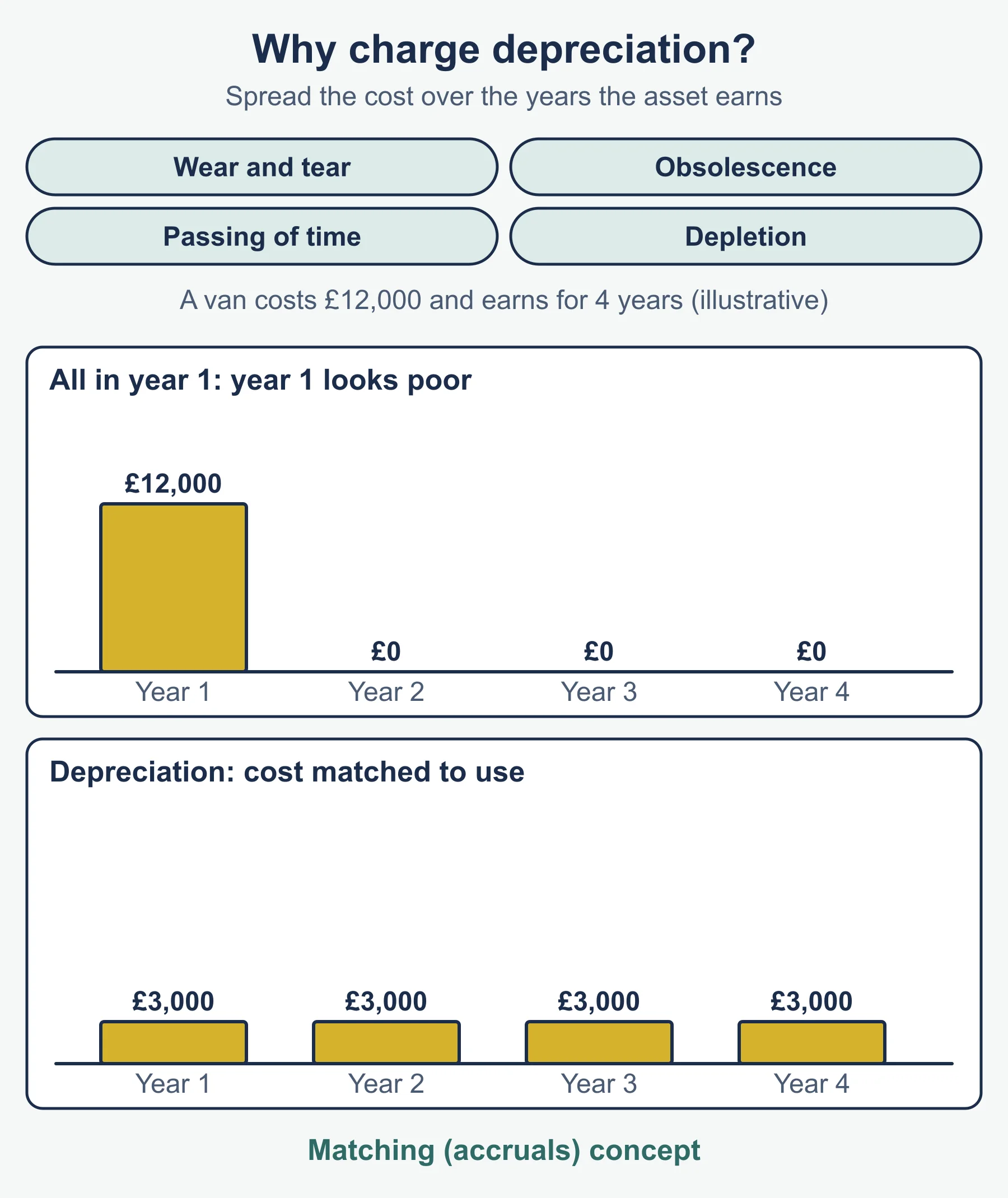
A non-current asset is kept for use over several years, but it does not last for ever. Depreciation spreads the cost over the years in which the asset helps to earn revenue. Reasons for depreciation include:
- wear and tear from use, such as engine mileage or machinery running every day
- obsolescence, where newer technology makes the asset out of date even though it still works
- passage of time, for example a lease that runs out or an asset that deteriorates with age.
Depreciation is not a way of valuing the asset at its market price. It is a method of sharing out cost.
Depreciation is a non-cash expense
The cash leaves the business when the asset is bought. Each year’s depreciation charge moves no cash. It is an expense in the income statement, so it lowers profit, and it reduces the value at which the asset is shown. The bank balance does not change when the charge is posted, and no money is put aside by it.
The value shown for the asset is its cost less the total depreciation so far. This is often called net book value (NBV) or carrying amount. Both names mean the same thing.
Straight line method
The same amount is charged every year.
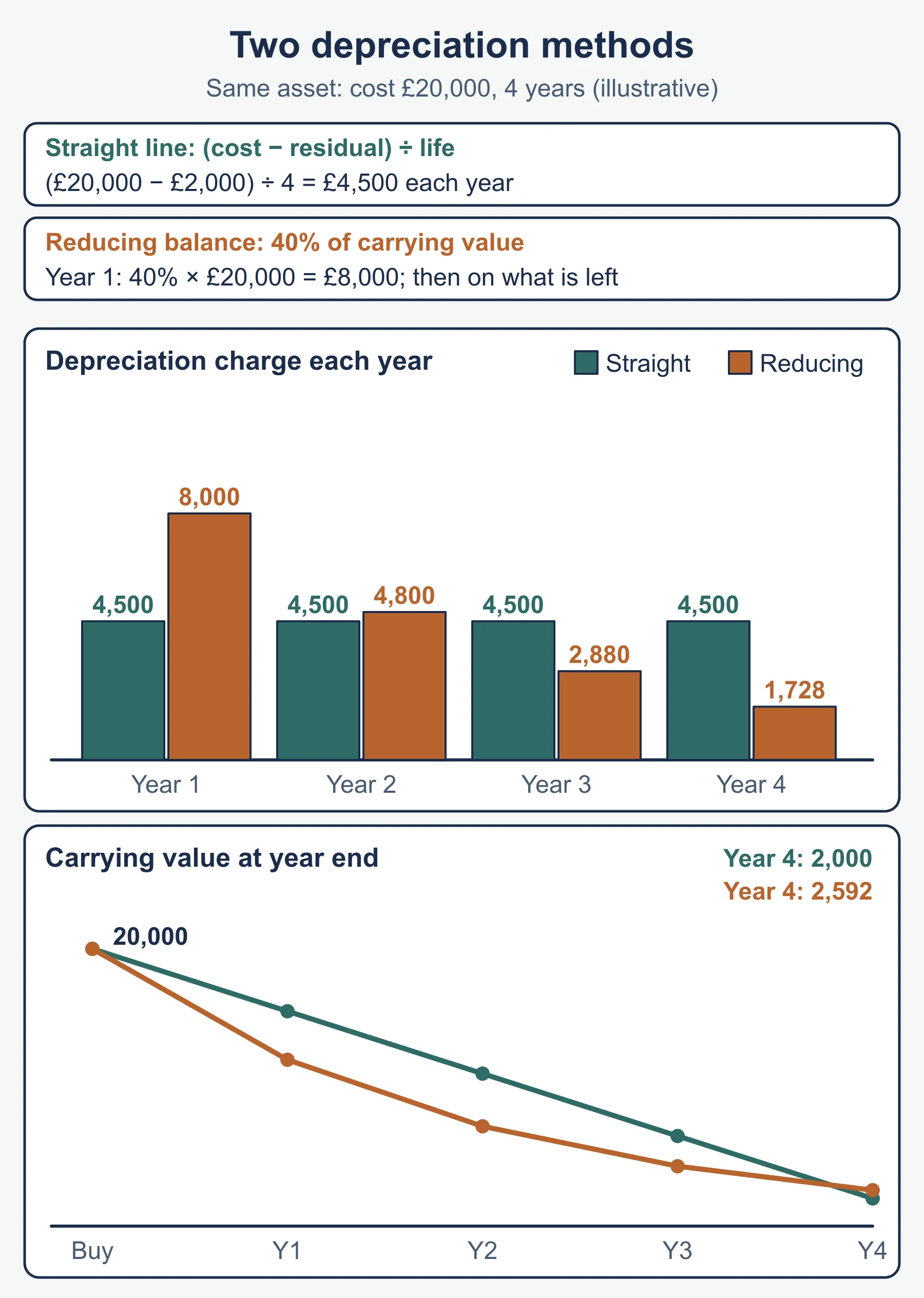
Annual charge = (cost − estimated residual value) ÷ estimated useful life in years.
Residual value is what the business expects to receive when the asset is no longer needed. A rate given as a percentage of cost produces the same result each year.
Reducing balance method
A fixed percentage is applied each year to the NBV at the start of that year. The charge is largest in year 1 and falls each year. It suits assets that lose value fastest when new, such as vehicles. Residual value is not deducted in the calculation: you apply the percentage to the NBV.
Worked example 3: straight line
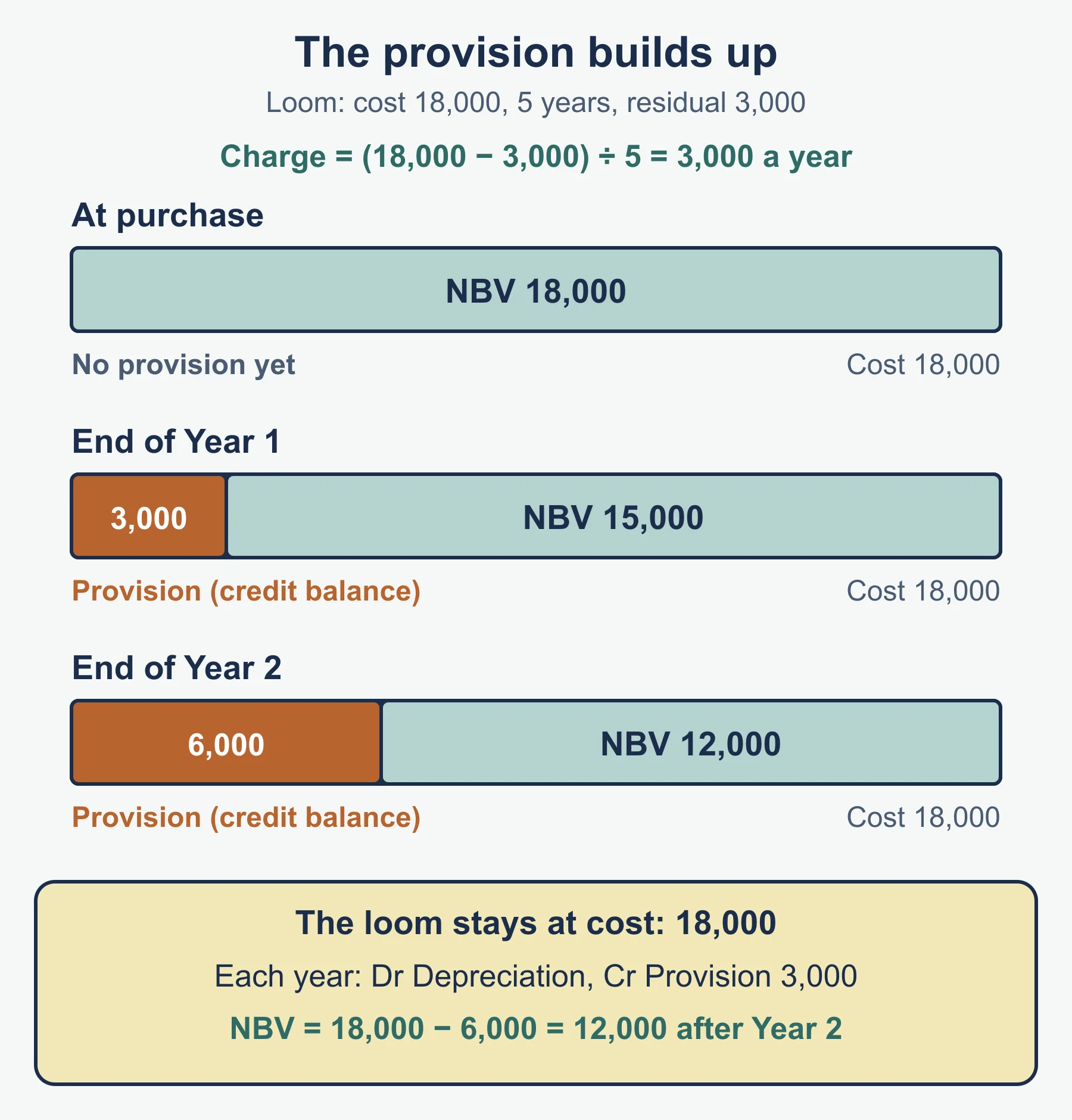
Sellick Textiles buys a loom on 1 January Year 1 for 18,000. It expects the loom to last 5 years and be worth 3,000 at the end.
Annual charge = (18,000 − 3,000) ÷ 5 = 3,000.
| Year | Charge | Provision at year end | NBV |
|---|---|---|---|
| 1 | 3,000 | 3,000 | 15,000 |
| 2 | 3,000 | 6,000 | 12,000 |
Worked example 4: reducing balance
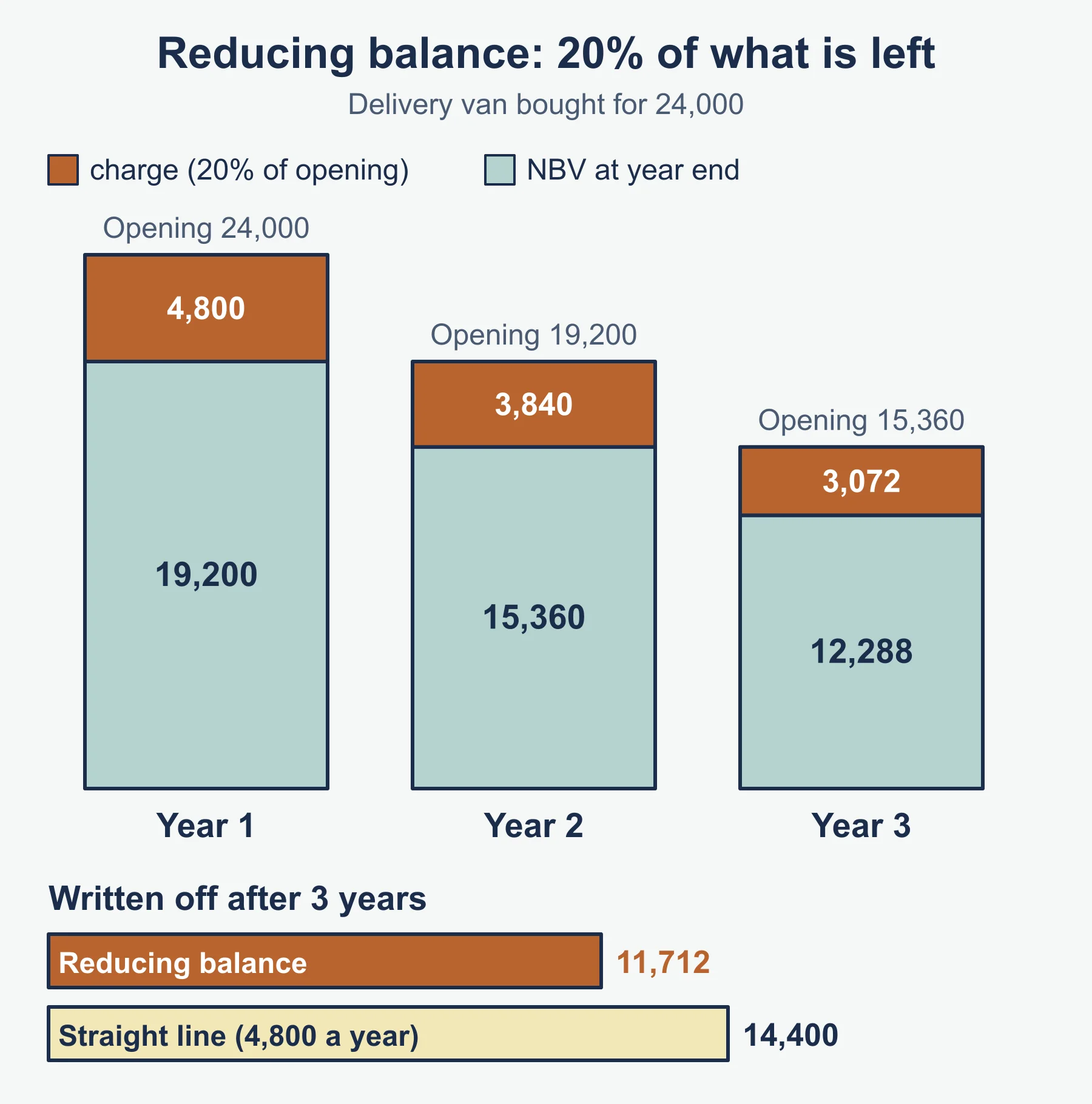
Sellick Textiles also buys a delivery van on 1 January Year 1 for 24,000 and uses 20% reducing balance.
| Year | Opening NBV | Charge (20%) | Provision at year end | Closing NBV |
|---|---|---|---|---|
| 1 | 24,000 | 4,800 | 4,800 | 19,200 |
| 2 | 19,200 | 3,840 | 8,640 | 15,360 |
| 3 | 15,360 | 3,072 | 11,712 | 12,288 |
Compare a straight line charge of 4,800 a year, which would have written off 14,400 over three years (a 5-year life and no residual value). Reducing balance has written off 11,712: the same in Year 1, then less each year.
Both methods should be used consistently from year to year. Switching methods without good reason makes profits harder to compare.
Entering depreciation: the provision for depreciation
Instead of reducing the asset account directly, the asset stays at cost. A separate account, the provision for depreciation, builds up the total depreciation. Each year you:
- Debit the depreciation account and credit the provision for depreciation account with the year’s charge.
- Transfer the depreciation account balance to the income statement (debit income statement, credit depreciation account).
- Carry the provision forward as a credit balance.
The statement of financial position shows cost, less provision for depreciation, giving NBV.
Worked example 5: the loom accounts
Ledger entries for the loom in Example 3. Year 1 and Year 2 both end on 31 December.
Loom (non-current asset) account
| Debit | Credit | ||
|---|---|---|---|
| Year 1 Bank | 18,000 | Year 1 Balance c/d | 18,000 |
| Year 2 Balance b/d | 18,000 |
Provision for depreciation: loom
| Debit | Credit | ||
|---|---|---|---|
| Year 1 Balance c/d | 3,000 | Year 1 Depreciation | 3,000 |
| Year 2 Balance c/d | 6,000 | Year 2 Balance b/d | 3,000 |
| Year 2 Depreciation | 3,000 | ||
| Total | 6,000 | Total | 6,000 |
The Year 2 balance b/d of 6,000 is on the credit side and appears in the next year’s accounts.
Year 2 statement of financial position extract (non-current assets):
| Cost | Provision for depreciation | NBV | |
|---|---|---|---|
| Loom | 18,000 | 6,000 | 12,000 |
The income statement for Year 2 shows depreciation of 3,000 as an expense.
Disposal of non-current assets
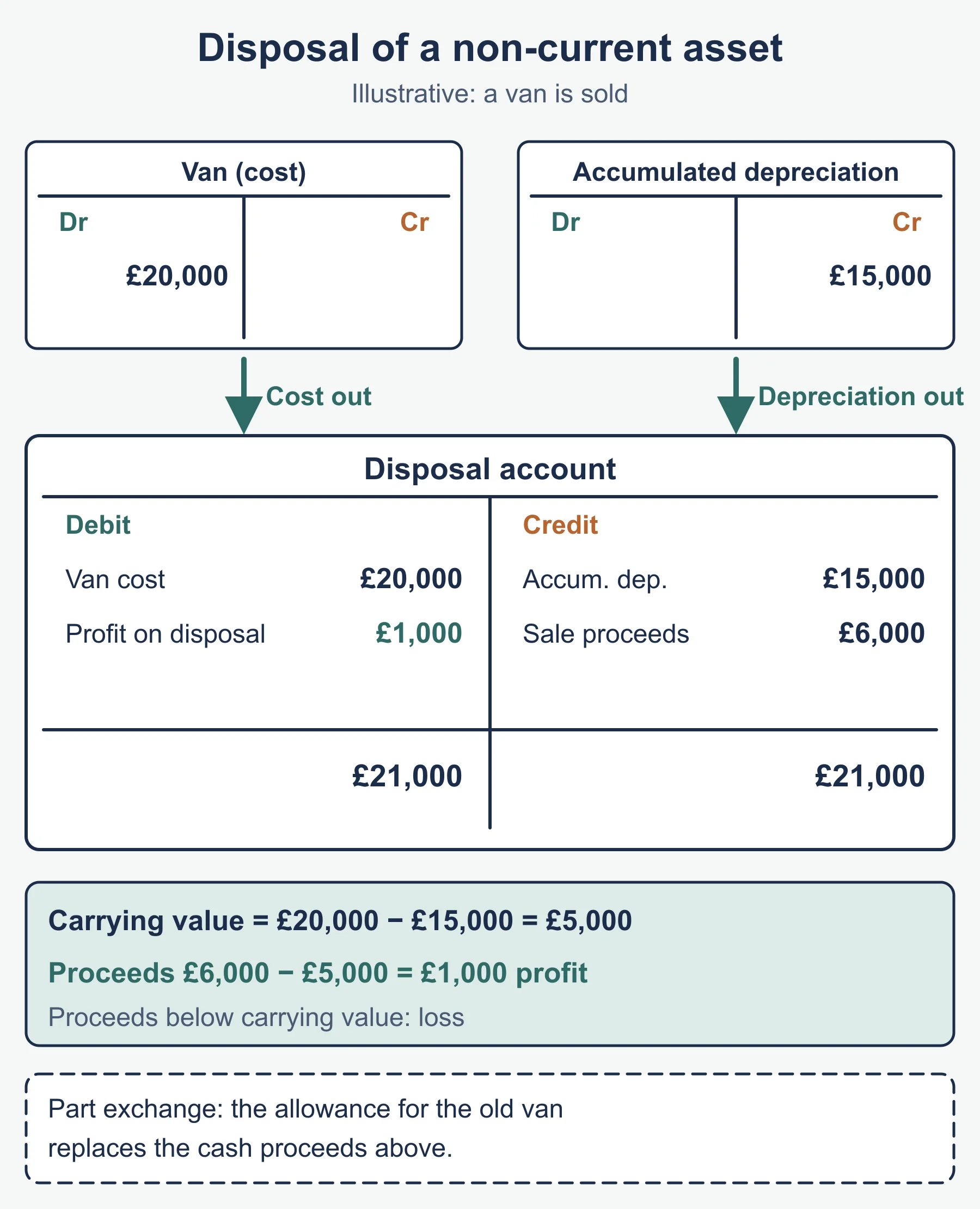
When an asset is sold you must remove its cost and its provision from the books and find the profit or loss on sale. A disposal account does this. Its layout:
- Debit: the asset account (cost of the asset).
- Credit: the provision for depreciation on that asset, and the sale proceeds.
- The balancing figure is the profit or loss on disposal.
If credits are less than the debit, the balancing figure goes on the credit side and is a loss. If credits are more, it goes on the debit side and is a profit. The balance is transferred to the income statement.
Check: profit or loss = sale proceeds − NBV at date of sale.
Worked example 6: a loss
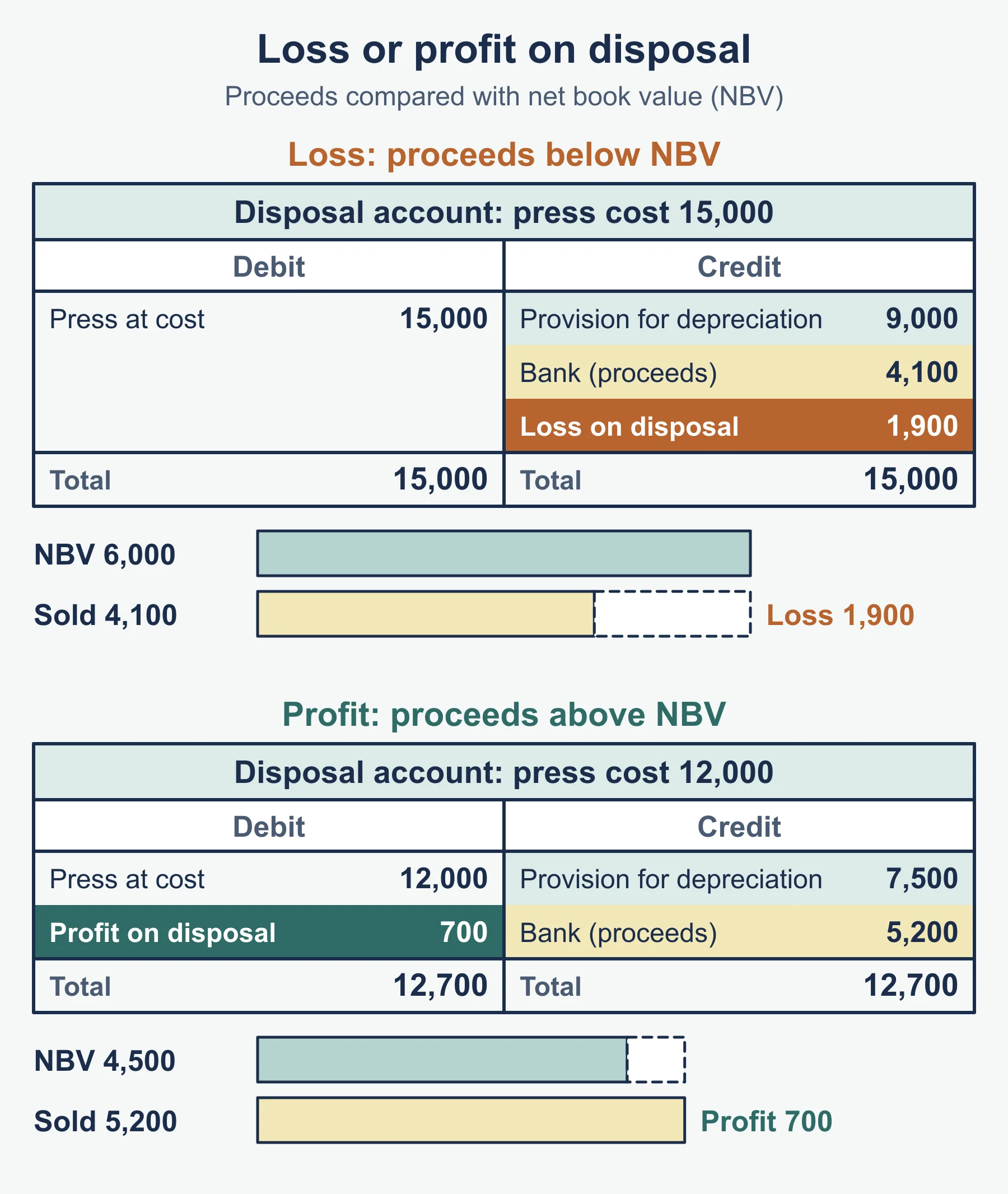
Sellick Textiles sells a press that cost 15,000. Its provision for depreciation is 9,000 and it is sold for 4,100 by bank transfer.
| Debit | Credit | ||
|---|---|---|---|
| Press at cost | 15,000 | Provision for depreciation | 9,000 |
| Bank | 4,100 | ||
| Loss on disposal (income statement) | 1,900 | ||
| Total | 15,000 | Total | 15,000 |
Check: NBV was 6,000 and the press sold for 4,100, so there is a loss of 1,900.
Worked example 7: a profit
A different press cost 12,000, has a provision of 7,500 and sells for 5,200. NBV is 4,500, so there is a profit of 700.
| Debit | Credit | ||
|---|---|---|---|
| Press at cost | 12,000 | Provision for depreciation | 7,500 |
| Profit on disposal (income statement) | 700 | Bank | 5,200 |
| Total | 12,700 | Total | 12,700 |
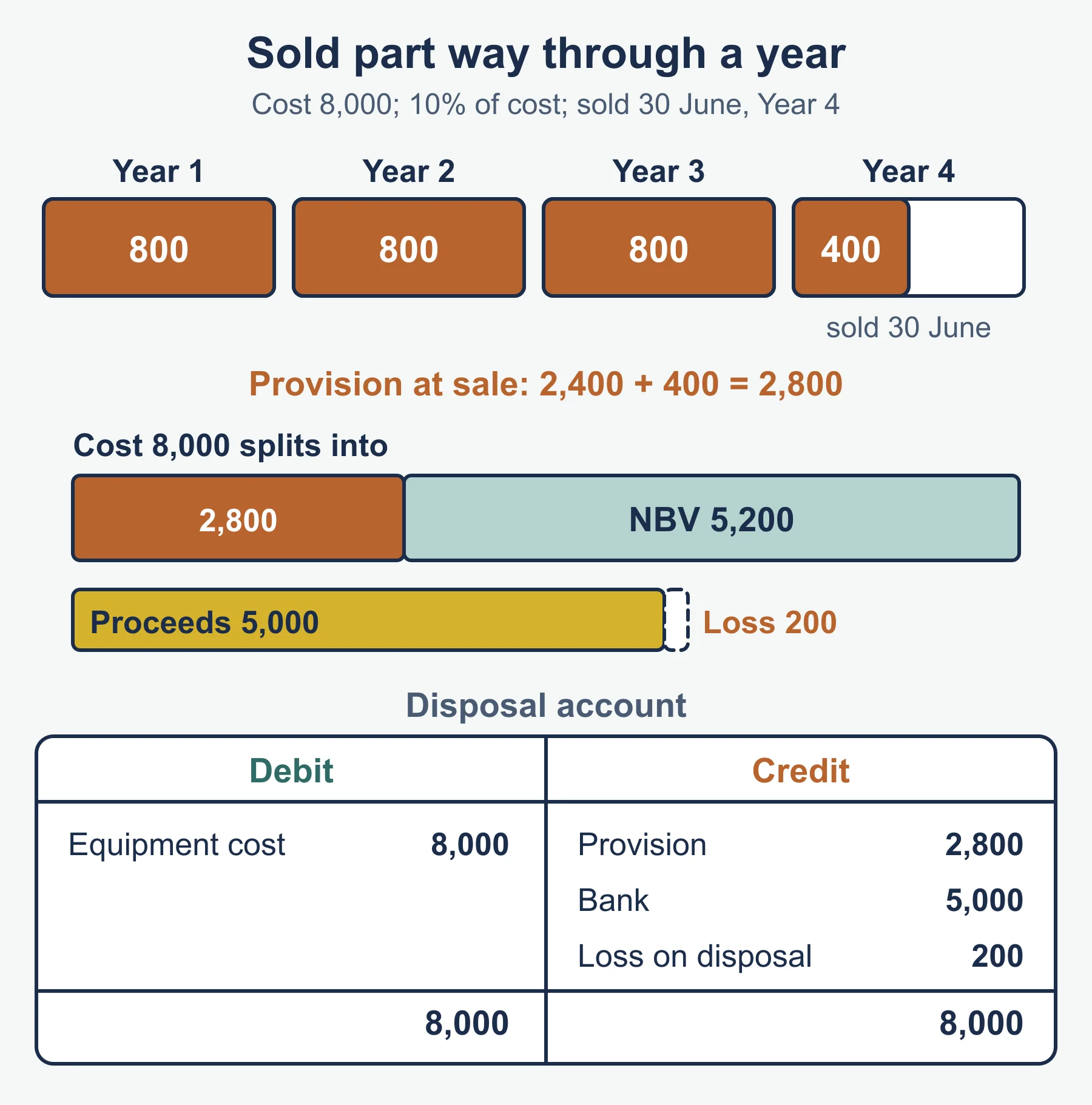
Worked example 8: sale part way through a year
Equipment cost 8,000 on 1 January Year 1 and is depreciated at 10% of cost a year, charged for each month of ownership. It is sold on 30 June Year 4 for 5,000. The question will tell you the policy for the year of purchase and sale.
- Annual charge 800. Provision at 31 December Year 3 = 3 × 800 = 2,400.
- Charge for Year 4 up to the sale = 800 × 6/12 = 400. Provision at sale = 2,800.
- NBV = 8,000 − 2,800 = 5,200.
- Proceeds 5,000, so the loss on disposal is 200.
Post the 400 charge to the provision before you open the disposal account.
Common errors
- Debiting the disposal account with NBV rather than cost.
- Putting the profit or loss on the wrong side.
- Applying the reducing balance percentage to cost every year.
- Forgetting to add the part-year depreciation before a disposal.
- Treating sale proceeds as sales income.
- Showing the asset at cost in the statement of financial position with no provision.
Frequently asked questions
Are delivery and installation costs capital expenditure? Yes. Costs needed to get an asset ready for use, such as delivery, installation and legal fees, count as capital expenditure and are added to the cost of the asset.
What happens to profit if capital expenditure is treated as revenue? Treating a capital item as revenue expenditure lowers profit and understates assets. Treating a revenue item as capital does the opposite.
How is reducing balance depreciation calculated? A fixed percentage is applied each year to the net book value at the start of that year, so the charge is largest in the first year and falls each year after.
How do you find the profit or loss on disposal? Profit or loss = sale proceeds − net book value at the date of sale. In the disposal account, if the credits are less than the debit the balancing figure on the credit side is a loss; if they are more, the balancing figure on the debit side is a profit.
Why is the asset kept at cost with a separate provision for depreciation? The asset account stays at cost and the provision for depreciation account builds up the total depreciation to date. The statement of financial position then shows cost, less the provision, giving net book value.
Official syllabus
OxfordAQA International GCSE Accounting (9215), specification version 1.2, first teaching 2024, first examined 2026, published by OxfordAQA. Section 3.3, Development of the accounting model.
Get free revision emails (optional)
Occasional emails with practice questions, worked explanations and links to free resources for the qualification and subjects you choose. No spam, and you can unsubscribe from any email. The free tools on this site never need an email.
Related resources
-
Practice questions
OxfordAQA IGCSE Accounting: Capital and revenue, depreciation and disposal (9215) – Practice Questions
Original questions with worked answers on capital and revenue items, depreciation and disposals for OxfordAQA IGCSE Accounting 9215.
Accounting · OxfordAQA · IGCSE
Try questions -
Revision notes
OxfordAQA IGCSE Accounting: Capital and revenue, depreciation and disposal (9215) – Revision Notes
Revision notes on capital and revenue items, depreciation methods and the disposal account for OxfordAQA IGCSE Accounting 9215.
Accounting · OxfordAQA · IGCSE
Revise topic -
Study guides
OxfordAQA IGCSE Accounting: General accounting concepts and their use (9215)
Study guide to the ten general accounting concepts in OxfordAQA International GCSE Accounting 9215 and how each shapes records, valuations and statements.
Accounting · OxfordAQA · IGCSE
Read guide
Related articles
-
teaching
A Level tuition in Dubai: Cambridge or Pearson Edexcel International A Level?
Schools in Dubai and Abu Dhabi teach either Cambridge International AS & A Level or Pearson Edexcel International A Level. How the two are structured, why it matters for tuition, and how online classes from Lahore work.
9 October 2026
-
curriculum guides
Choosing subjects at IGCSE and A Level
How subject choices at 14 and 16 affect university options later, and how to keep pathways open without overloading a timetable.
28 July 2026
Studying this with a teacher
Working through Accounting IGCSE?
This page is free and stays free. If you would rather be taught it, Marlbridge runs Accounting classes one-to-one and in small groups of up to 15, online in your own time zone. The first trial class is free. WhatsApp replies within an hour (8am–11pm Pakistan time, every day); email the same day.
OxfordAQA Accounting teachers at Marlbridge

