
Study Guides
OxfordAQA IGCSE Accounting: General accounting concepts and their use (9215)
Study guide to the ten general accounting concepts in OxfordAQA International GCSE Accounting 9215 and how each shapes records, valuations and statements.
- Subject
- Accounting
- Level
- IGCSE
- Topic
- Development of the accounting model
- Author
- Marlbridge Academic Team
- Updated
- Reviewed by
- Javaid Iqbal Sabri (what this means)
Aligned to OxfordAQA IGCSE Accounting (9215), First teaching 2024, first examined 2026. Official specification .
Syllabus page (what it covers and how it is assessed): OxfordAQA IGCSE Accounting.
Syllabus points this page covers
9215
- General accounting concepts and their use
Found an error? Report a correction.
Need help with this topic? Request a free trial class for IGCSE Accounting (9215).
This guide covers the first two rows of section 3.3 (Development of the accounting model) in the OxfordAQA International GCSE Accounting (9215) specification, version 1.2, for exams from May/June 2026 onwards: the ten general accounting concepts used in preparing accounting records, and their use in the situations the specification lists. All amounts on this page are in dollars. Business names and figures are invented.
Use it with the revision notes and the practice questions. The course hub is at OxfordAQA IGCSE Accounting, the printable checklist lists every outcome, and the free diagnostics show which topics to work on first. For how the two papers are organised, see the exam preparation guide.
What the specification asks for
| Specification content | What you need to be able to do | Section of this guide |
|---|---|---|
| General accounting concepts used in the preparation of accounting records | Know and explain each of the ten named concepts, from business entity through to realisation | Ten concepts below |
| Use of concepts: preparation of financial statements | Say which concept explains a treatment in the statements | Situation 1 |
| Use of concepts: asset valuation | Explain why assets are shown at the figures they are | Situation 2 |
| Use of concepts: depreciation of non-current assets | Link depreciation to accruals, consistency and historic cost | Situation 3 |
| Use of concepts: inventories (cost or net realisable value as the basis for valuation) | Value inventory at whichever is lower, cost or net realisable value | Situation 4 |
| Use of concepts: recording the purchase of non-current assets | Decide what is capitalised and what is expensed | Situation 5 |
| Use of concepts: recording transactions in ledger accounts | Apply duality and the other concepts when posting | Situation 6 |
The specification also lists adjustments (for example other payables and receivables, income due or received in advance, doubtful and irrecoverable debts, depreciation, disposals and inventory). They appear here only as illustrations of the concepts.
The ten concepts
Business entity
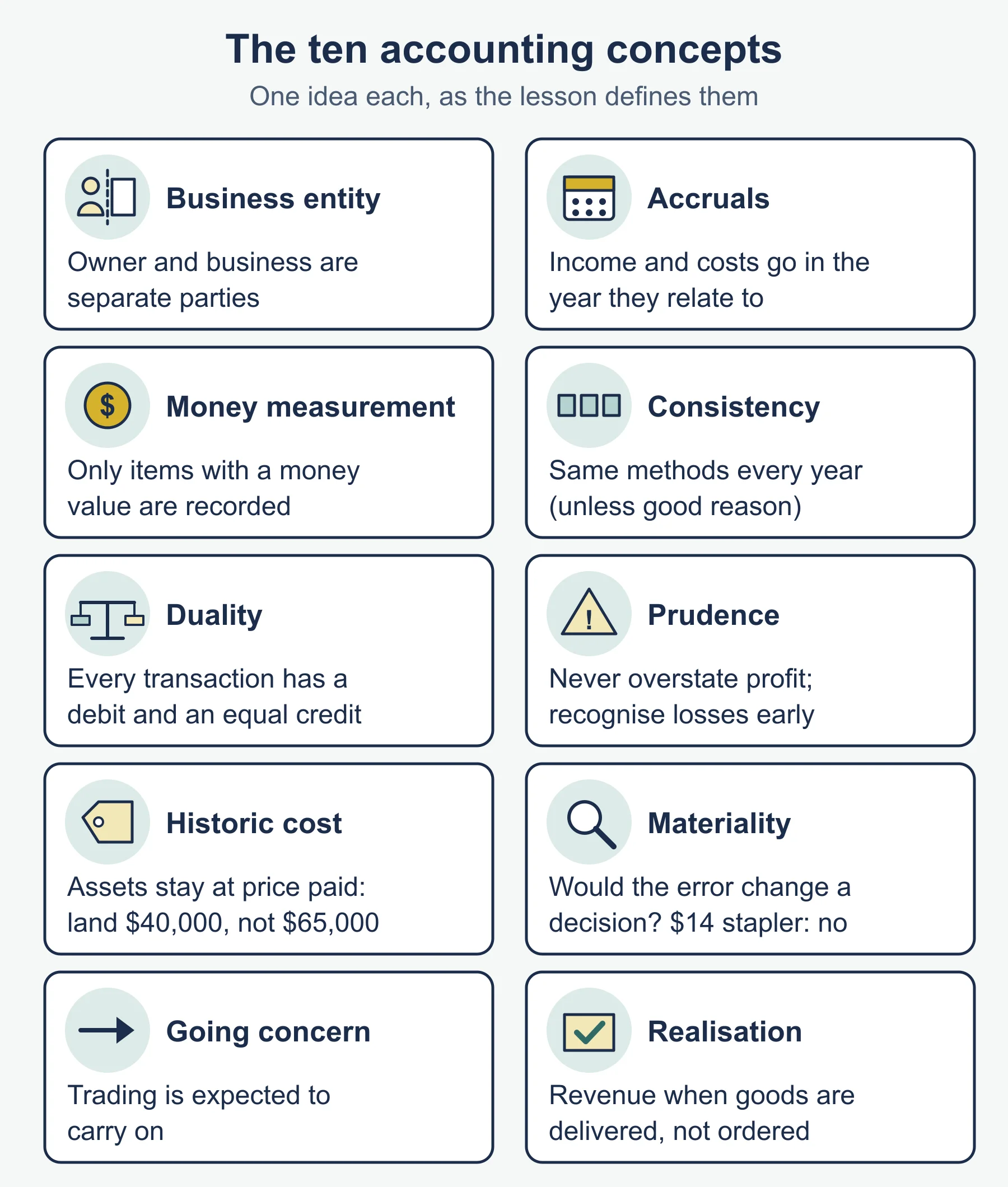
The owner and the business are two different parties for accounting. Only the business’s own dealings belong in its books. If Ms Marnham, who runs Marnham Cycles, pays her family’s grocery bill from the business bank account, that is not a business expense. It is recorded as drawings, which reduce her capital.
Money measurement
Only items that can be measured in money are recorded. A new repair mechanic’s skill, the shop’s good reputation and a dispute with a supplier have no recorded value. A purchase of tyres for 640 is recorded because it has a money amount. The limitation is that the statements leave out things that matter to the business’s value.
Duality
Every transaction has two effects, a debit in one account and an equal credit in another. This is why the trial balance should balance. Buying a till for 450 by bank transfer is recorded as a debit in the equipment account and a credit in the bank account.
Historic cost
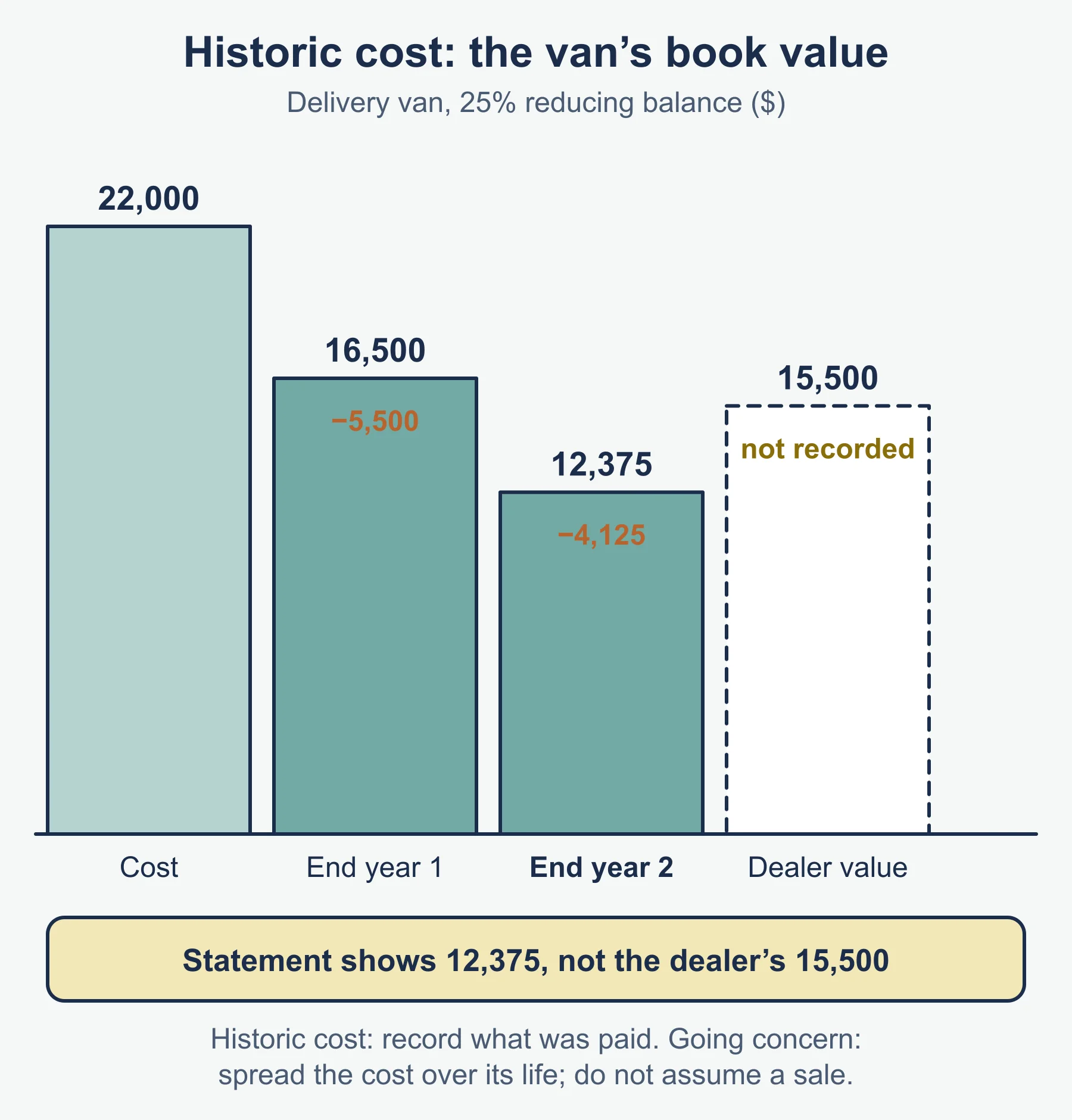
Assets are recorded at the price actually paid when they were bought, not at what they might be worth later. Marnham Cycles buys its workshop land for 40,000. Its value is now estimated at 65,000, but the statement of financial position still shows 40,000. The figure is objective and can be checked against an invoice, but it can become out of date.
Going concern
Unless evidence says otherwise, the accounts are prepared on the footing that trading will carry on into the foreseeable future. This is why assets such as equipment are valued on the basis of being used, and why a prepayment is carried forward as an asset. If a business were about to close, assets would instead be valued at what they would fetch if sold.
Accruals
Each item of revenue and expense belongs to the year it relates to, whenever the cash happens to move. An expense used but unpaid at the year end is an other payable. Paying for something in advance creates an other receivable (a prepayment). The same idea applies to income due and income received in advance.
Consistency
The same methods are used from one period to the next. If a business uses straight line depreciation on vehicles this year, it should not switch to reducing balance next year simply because it gives a more attractive profit. A change is possible, but only for a good reason and with the effect disclosed. Consistency makes year-to-year comparison fair.
Prudence
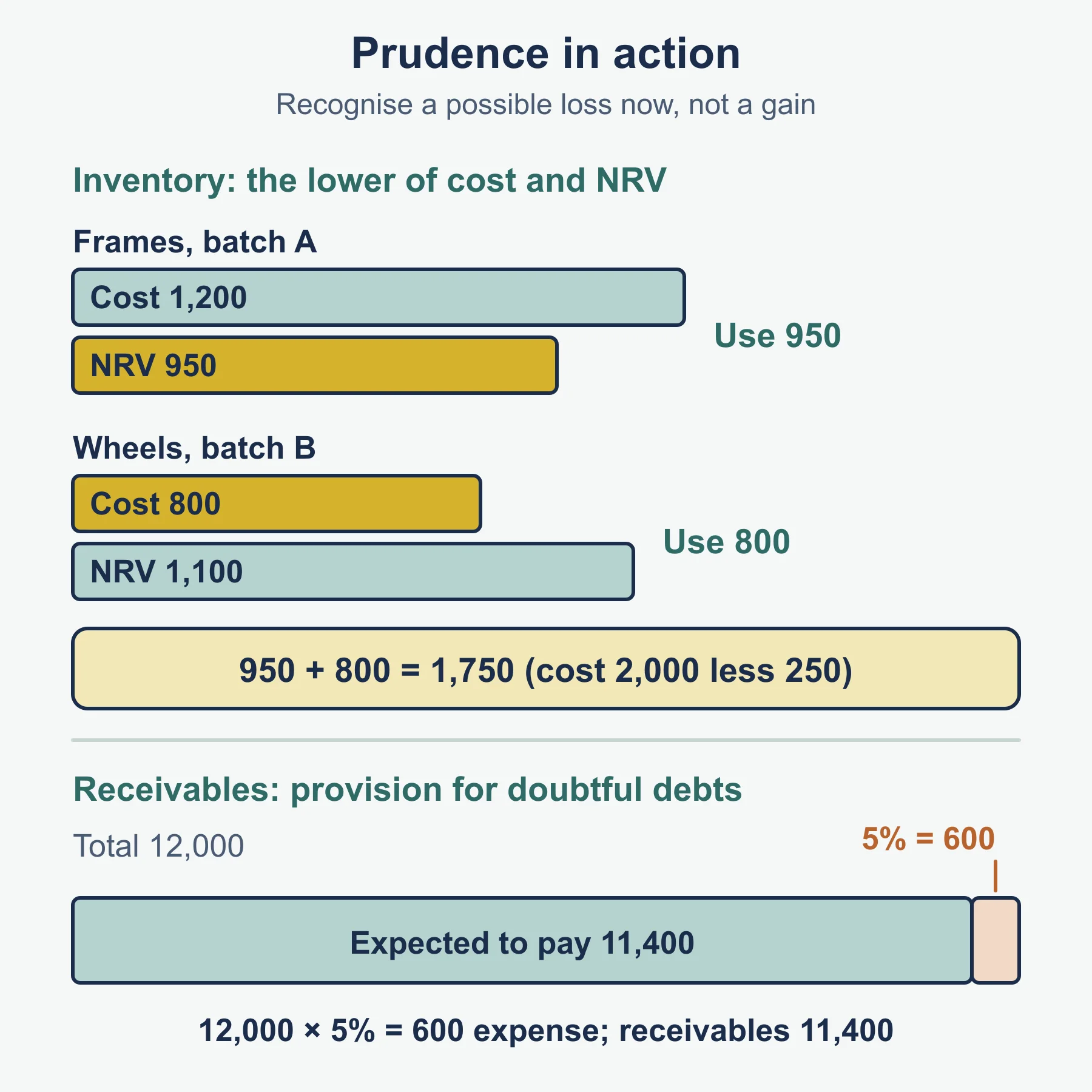
Do not overstate profit or assets and do not understate expenses or liabilities. Recognise losses as soon as they are foreseen, but do not recognise gains until they are realised. Both the provision for doubtful debts and the write-down of inventory below cost come from prudence. Prudence does not allow a business to deliberately understate profit.
Materiality
An item is material when a mistake in it or its omission could alter what a reader of the statements decides. Trivial items are treated in the simplest way. A stapler costing 14 is expensed at once instead of being capitalised and depreciated, because the effect on profit is too small to matter. A larger business will usually treat larger sums as immaterial.
Realisation
Revenue is recognised when the goods are delivered or the service is performed and the customer becomes liable to pay, not when the order is placed and not necessarily when the cash arrives. An order received in December for goods delivered in January is January revenue.
The concepts in use
Situation 1: preparation of financial statements
The statements bring many concepts together. The income statement matches expenses to the year (accruals), uses the same methods each year (consistency), and does not anticipate profit from sales not yet made (realisation). The statement of financial position shows assets at historic cost less depreciation, assumes going concern, and shows only business items (business entity).
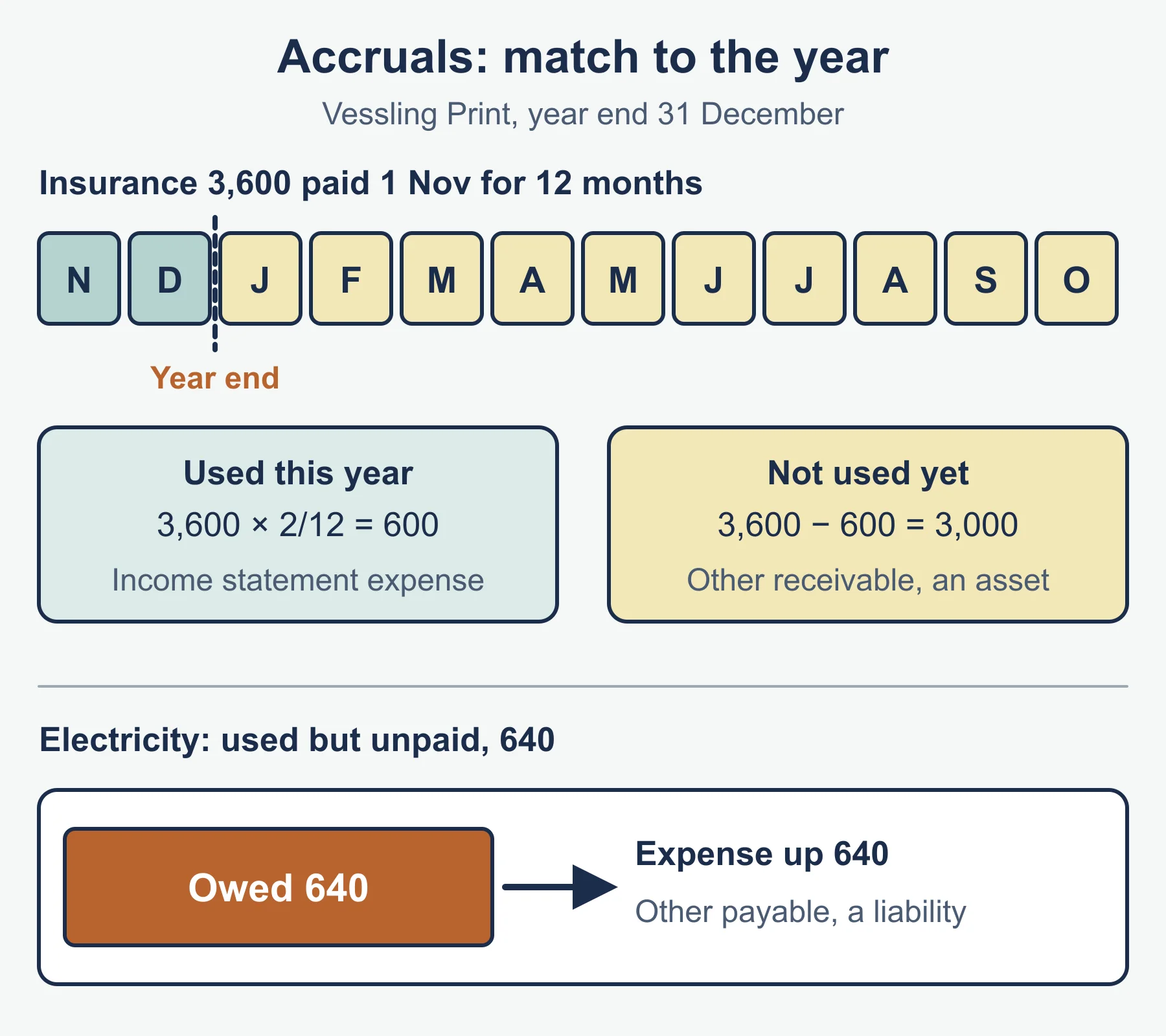
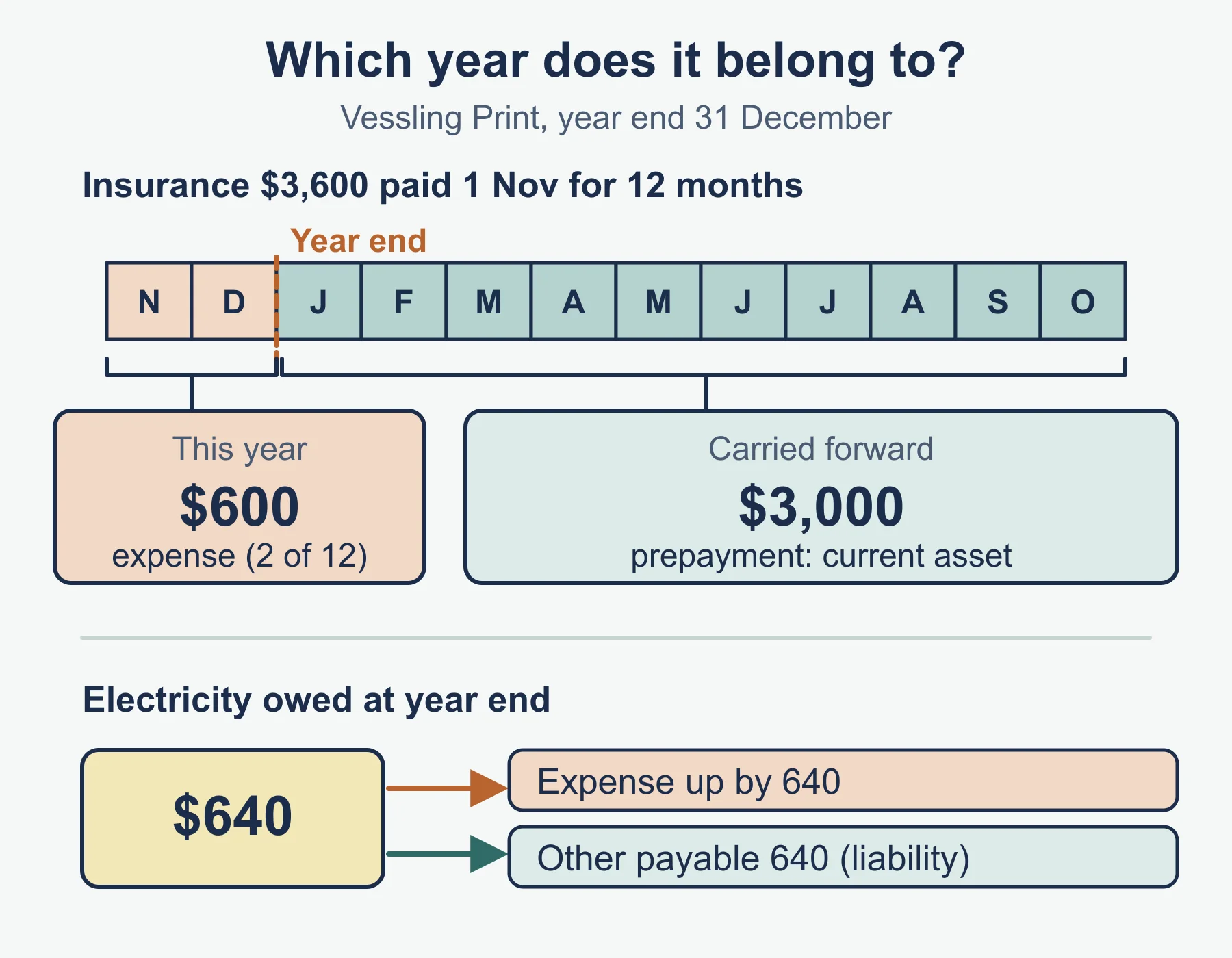
Worked example. Vessling Print’s year ends on 31 December. It paid insurance of 3,600 on 1 November, covering 12 months. The expense belonging to the current year is 3,600 × 2/12 = 600. The remaining 3,000 relates to the next ten months, so it is shown as an other receivable (prepayment) in current assets. At year end the business also owes 640 for electricity. In the income statement the expense is increased by 640, and 640 is shown as an other payable in current liabilities. Accruals explains both; the going concern assumption explains why the prepayment is carried forward as an asset.
Situation 2: asset valuation
Non-current assets appear at historic cost less accumulated depreciation, which is their net book value. Net book value is an accounting figure, not a market value. Receivables are shown after deducting the provision for doubtful debts (prudence). Inventory is shown at the lower of cost and net realisable value. Money measurement limits what can be valued, and historic cost explains why land bought long ago is not revalued.
Situation 3: depreciation of non-current assets
Depreciation spreads the cost of an asset over the years it is used, so each year bears a fair share of the cost (accruals). It is a non-cash expense, so charging it does not take money out of the bank. Assets lose value through wear and tear, obsolescence, the passage of time and use. Historic cost is the starting point for the calculation, and consistency requires the same method year after year.
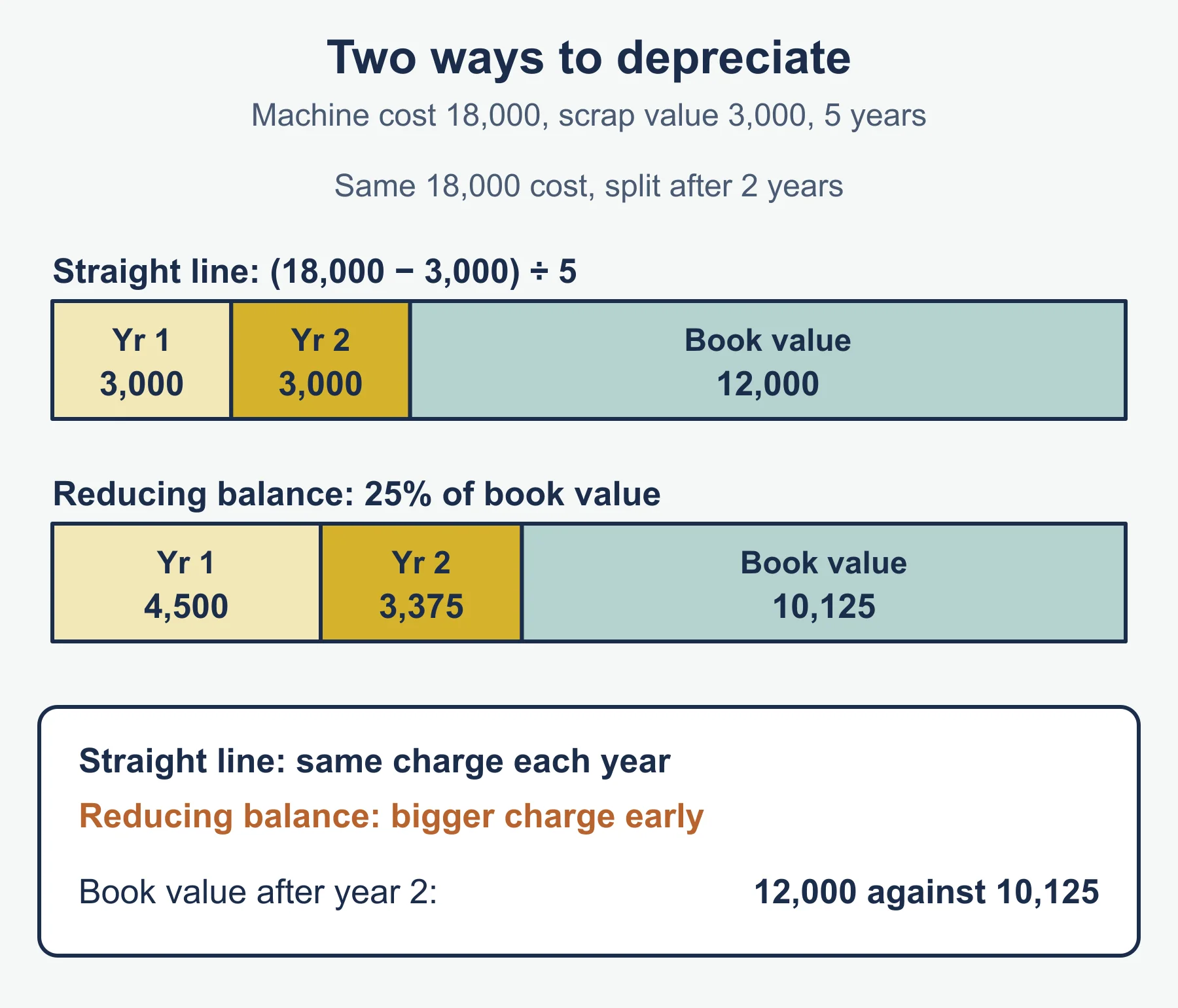
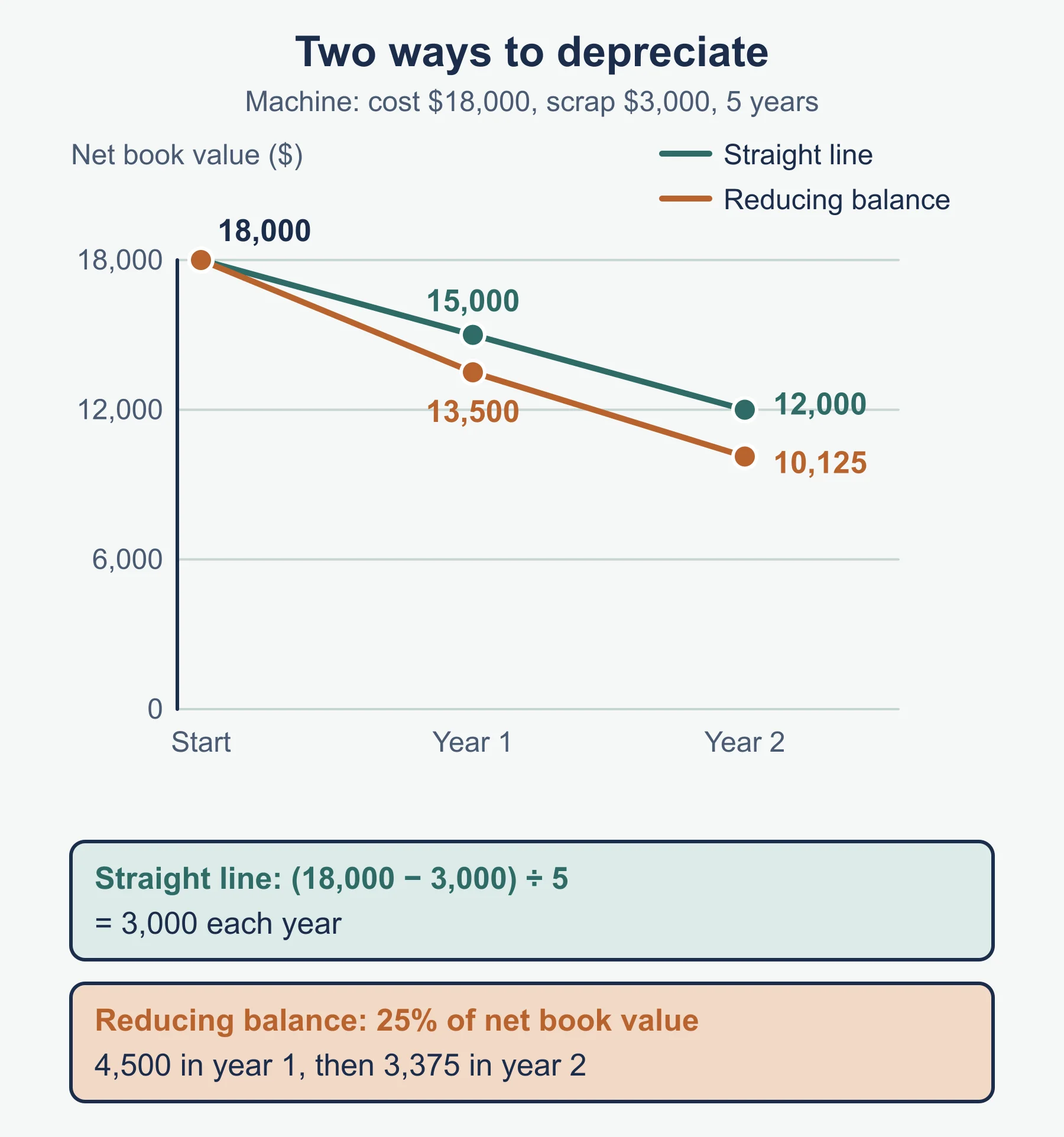
Worked example. Marnham Cycles buys a machine for 18,000 and expects to scrap it after five years for 3,000.
| Method | Calculation | Year 1 | Year 2 | Net book value after year 2 |
|---|---|---|---|---|
| Straight line | (18,000 - 3,000) / 5 | 3,000 | 3,000 | 12,000 |
| Reducing balance 25% | 25% of net book value | 4,500 | 3,375 | 10,125 |
Straight line gives the same charge every year; reducing balance gives a bigger charge early on. Either is acceptable. Applying the chosen one every year is consistency.
Situation 4: inventories at cost or net realisable value
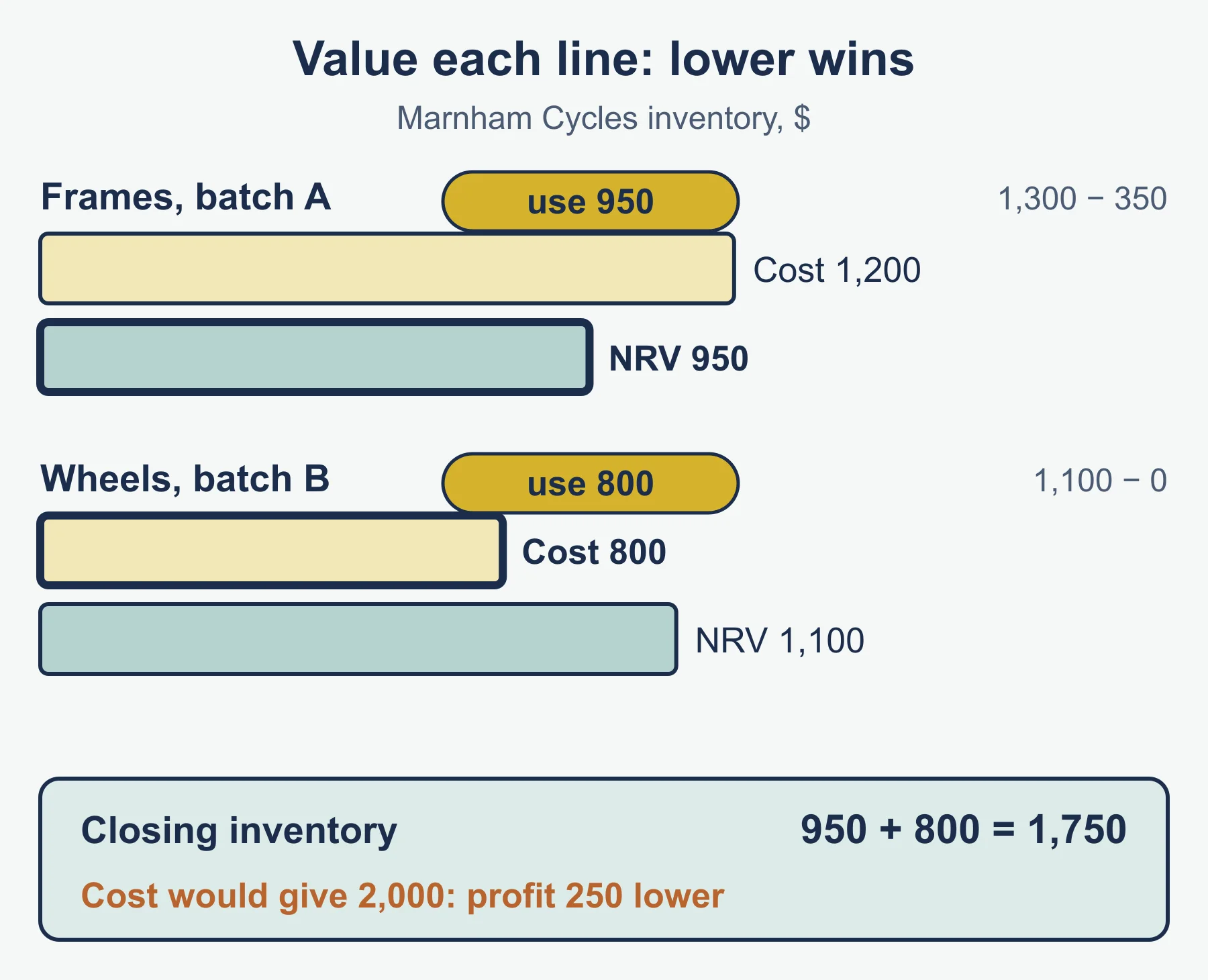
Net realisable value is the expected selling price less any costs needed to make the item saleable and to sell it. Each line of inventory is taken at cost or net realisable value, whichever is lower. This is prudence: a loss is recognised as soon as it is foreseen, but a gain is not.
Worked example. Marnham Cycles has two lines in inventory at the year end.
| Line | Cost | Selling price | Cost to repair | Net realisable value | Value used |
|---|---|---|---|---|---|
| Frames, batch A | 1,200 | 1,300 | 350 | 950 | 950 |
| Wheels, batch B | 800 | 1,100 | nil | 1,100 | 800 |
| Total | 2,000 | 1,750 |
Batch A is written down by 250 and batch B stays at cost. Closing inventory is 1,750, so cost of sales is 250 higher and profit is 250 lower than if cost had been used for both. Do not add the two net realisable values: the rule applies line by line.
Situation 5: recording the purchase of non-current assets
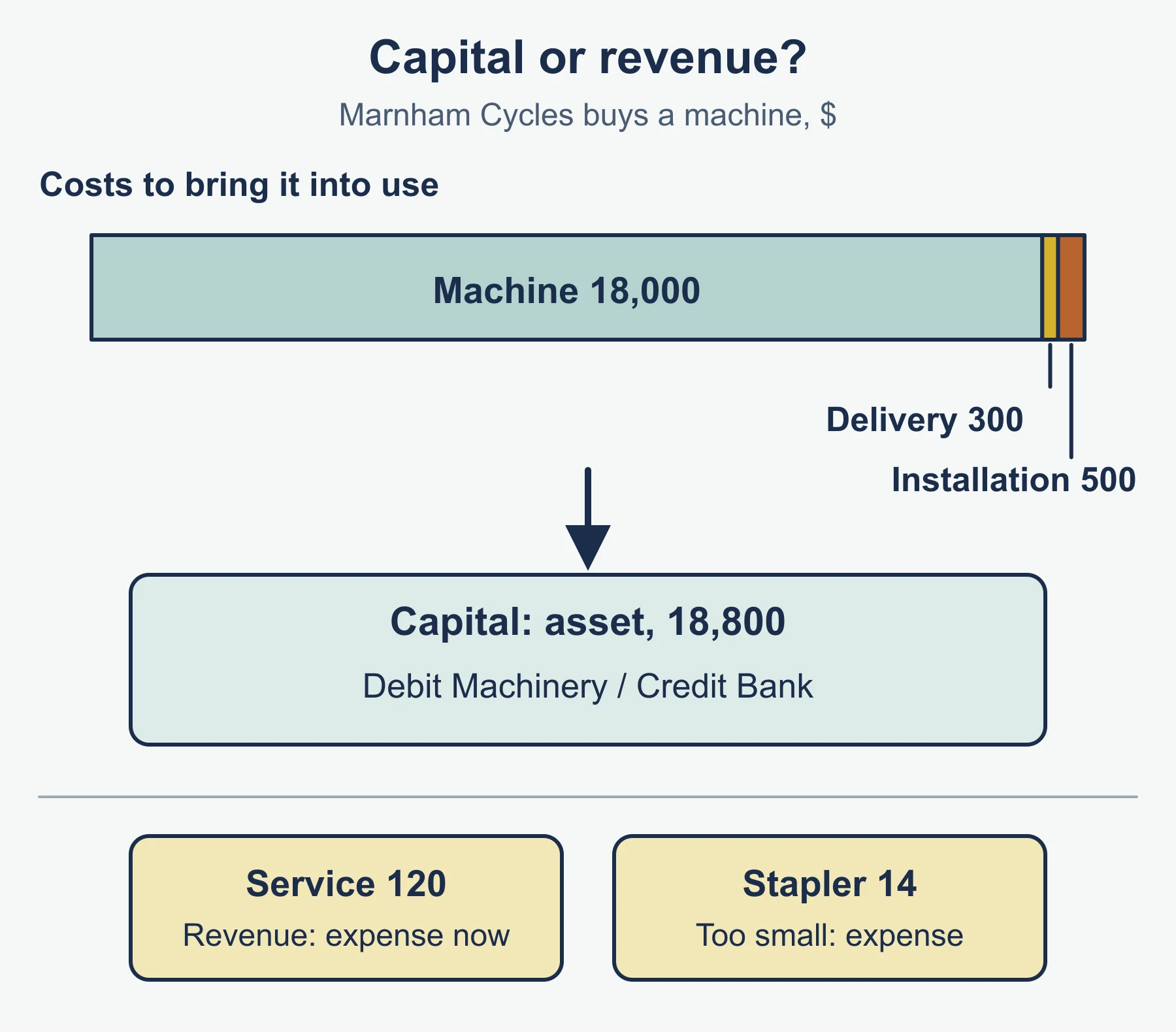
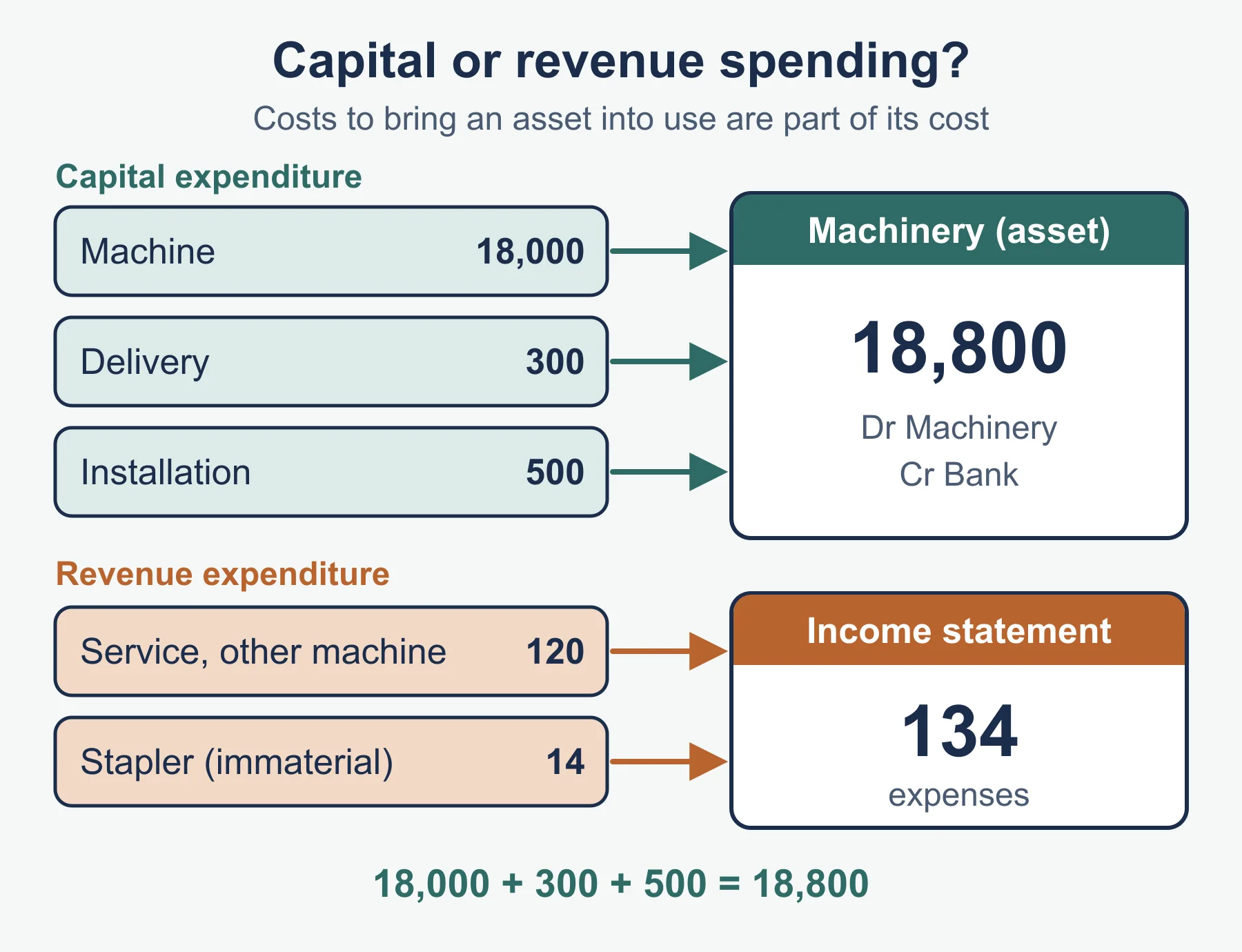
Capital expenditure buys or improves a non-current asset and is recorded in an asset account. Revenue expenditure keeps the business running and goes to the income statement. Under historic cost, all costs needed to bring the asset into use are part of its cost.
Worked example. Marnham Cycles buys a machine for 18,000, pays 300 delivery and 500 installation, and pays 120 to service another machine. The machine’s cost is 18,000 + 300 + 500 = 18,800, and the 120 service is revenue expenditure. The entry is a debit to machinery of 18,800 and a credit to bank of 18,800. A purchase of a stapler for 14 would be expensed because of materiality.
Situation 6: recording transactions in ledger accounts
Duality drives every posting. Business entity decides what is posted, money measurement decides whether it can be posted, and accruals decides which period it belongs to. Closing balances are carried down to become the opening balances of the next period (going concern).
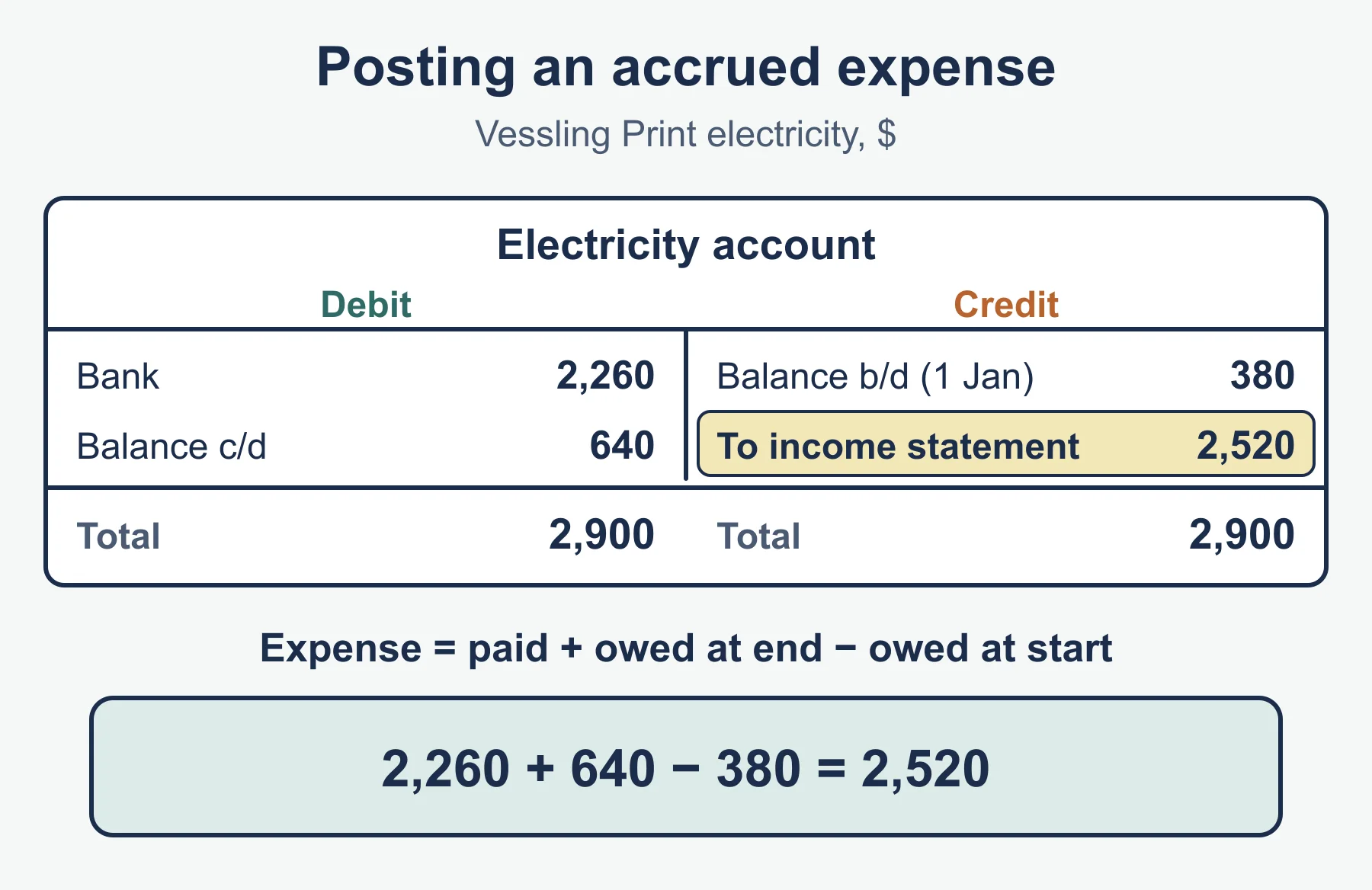
Worked example. Vessling Print’s electricity account for the year. It owed 380 at the start, paid 2,260 during the year and owes 640 at the end.
Posting the account on the usual two-sided layout:
| Debit side | Credit side | ||
|---|---|---|---|
| Bank | 2,260 | Balance b/d (1 Jan) | 380 |
| Balance c/d | 640 | Income statement transfer | 2,520 |
| Total | 2,900 | Total | 2,900 |
The charge of 2,520 is 2,260 + 640 - 380. The other side of each posting is a credit or debit elsewhere, which is duality.
Provision for doubtful debts: prudence in action
If trade receivables are 12,000 and the business estimates that 5% may not pay, the provision is 600. The income statement carries an expense of 600 (or just the increase if a provision already existed) and receivables are shown at 11,400. Prudence recognises the possible loss now, before it is certain.
Common errors
- Writing a definition without applying it. Questions usually describe a situation, so name the concept and link it to the facts.
- Confusing accruals with prudence. Matching an expense to the right year is accruals. Writing down inventory or providing for doubtful debts is prudence.
- Saying historic cost means assets never change in value. The recorded cost stays; depreciation reduces the net book value.
- Valuing inventory in total instead of line by line, which can hide a write-down.
- Treating prudence as permission to understate profit. It requires caution, not bias.
- Calling depreciation a way of saving money for replacement. It is an expense with no cash movement.
Frequently asked questions
What is the business entity concept? The owner and the business are treated as two different parties for accounting, so only the business’s own dealings are recorded. Paying the owner’s private bills from the business is drawings, not an expense.
What does the prudence concept mean? Do not overstate profit or assets and do not understate expenses or liabilities; recognise losses as soon as they are foreseen. Prudence requires caution, not bias, so it is not permission to understate profit.
When is revenue recognised under the realisation concept? Revenue is recognised when the goods are delivered or the service is performed and the customer becomes liable to pay, not when the order is placed and not necessarily when the cash arrives.
What is the difference between accruals and prudence? Matching an expense or income to the right year is accruals. Writing down inventory to net realisable value or providing for doubtful debts is prudence.
What makes an item material? An item is material when a mistake in it, or its omission, could alter what a reader of the statements decides. Trivial items are treated in the simplest way, such as expensing a cheap stapler at once instead of depreciating it.
Official syllabus
Source: OxfordAQA International GCSE Accounting (9215), specification version 1.2, for exams from May/June 2026 onwards, section 3.3 Development of the accounting model (general accounting concepts and their use).
Get free revision emails (optional)
Occasional emails with practice questions, worked explanations and links to free resources for the qualification and subjects you choose. No spam, and you can unsubscribe from any email. The free tools on this site never need an email.
Related resources
-
Practice questions
OxfordAQA IGCSE Accounting: General accounting concepts and their use (9215) – Practice Questions
Eleven original practice questions with worked answers on the general accounting concepts and their use, for OxfordAQA International GCSE Accounting 9215.
Accounting · OxfordAQA · IGCSE
Try questions -
Revision notes
OxfordAQA IGCSE Accounting: General accounting concepts and their use (9215) – Revision Notes
Condensed notes on the ten general accounting concepts in OxfordAQA International GCSE Accounting 9215, with worked reminders and a self-test.
Accounting · OxfordAQA · IGCSE
Revise topic -
Study guides
OxfordAQA IGCSE Accounting: Irrecoverable debts, provisions for doubtful debts and inventory (9215)
Study guide to writing off irrecoverable debts, providing for doubtful debts and valuing inventory at cost or net realisable value, for OxfordAQA 9215.
Accounting · OxfordAQA · IGCSE
Read guide
Related articles
-
teaching
A Level tuition in Dubai: Cambridge or Pearson Edexcel International A Level?
Schools in Dubai and Abu Dhabi teach either Cambridge International AS & A Level or Pearson Edexcel International A Level. How the two are structured, why it matters for tuition, and how online classes from Lahore work.
9 October 2026
-
curriculum guides
Choosing subjects at IGCSE and A Level
How subject choices at 14 and 16 affect university options later, and how to keep pathways open without overloading a timetable.
28 July 2026
Studying this with a teacher
Working through Accounting IGCSE?
This page is free and stays free. If you would rather be taught it, Marlbridge runs Accounting classes one-to-one and in small groups of up to 15, online in your own time zone. The first trial class is free. WhatsApp replies within an hour (8am–11pm Pakistan time, every day); email the same day.
OxfordAQA Accounting teachers at Marlbridge

