
Revision Notes
OxfordAQA IGCSE Accounting: General accounting concepts and their use (9215) – Revision Notes
Condensed notes on the ten general accounting concepts in OxfordAQA International GCSE Accounting 9215, with worked reminders and a self-test.
- Subject
- Accounting
- Level
- IGCSE
- Topic
- Development of the accounting model
- Author
- Marlbridge Academic Team
- Updated
- Reviewed by
- Javaid Iqbal Sabri (what this means)
Aligned to OxfordAQA IGCSE Accounting (9215), First teaching 2024, first examined 2026. Official specification .
Syllabus page (what it covers and how it is assessed): OxfordAQA IGCSE Accounting.
Syllabus points this page covers
9215
- General accounting concepts and their use
Found an error? Report a correction.
Need help with this topic? Request a free trial class for IGCSE Accounting (9215).
These notes condense section 3.3 of the OxfordAQA International GCSE Accounting (9215) specification, version 1.2 (exams from May/June 2026 onwards): the ten general accounting concepts and their use in the listed situations. For full explanations read the study guide, then test yourself with the practice questions. Also see the course hub, the printable checklist and the free diagnostics. Amounts are in dollars; all businesses and figures are invented.
The ten concepts at a glance
| Concept | One-line meaning | Quick test | Example of use |
|---|---|---|---|
| Business entity | Business and owner are separate | Is it the business’s own transaction? | Owner’s personal bill is drawings |
| Money measurement | Record only what has a money value | Can I put a dollar figure on it? | Staff morale is not recorded |
| Duality | Each transaction has two equal effects | What is the debit and what is the credit? | Equipment bought by cheque: debit equipment, credit bank |
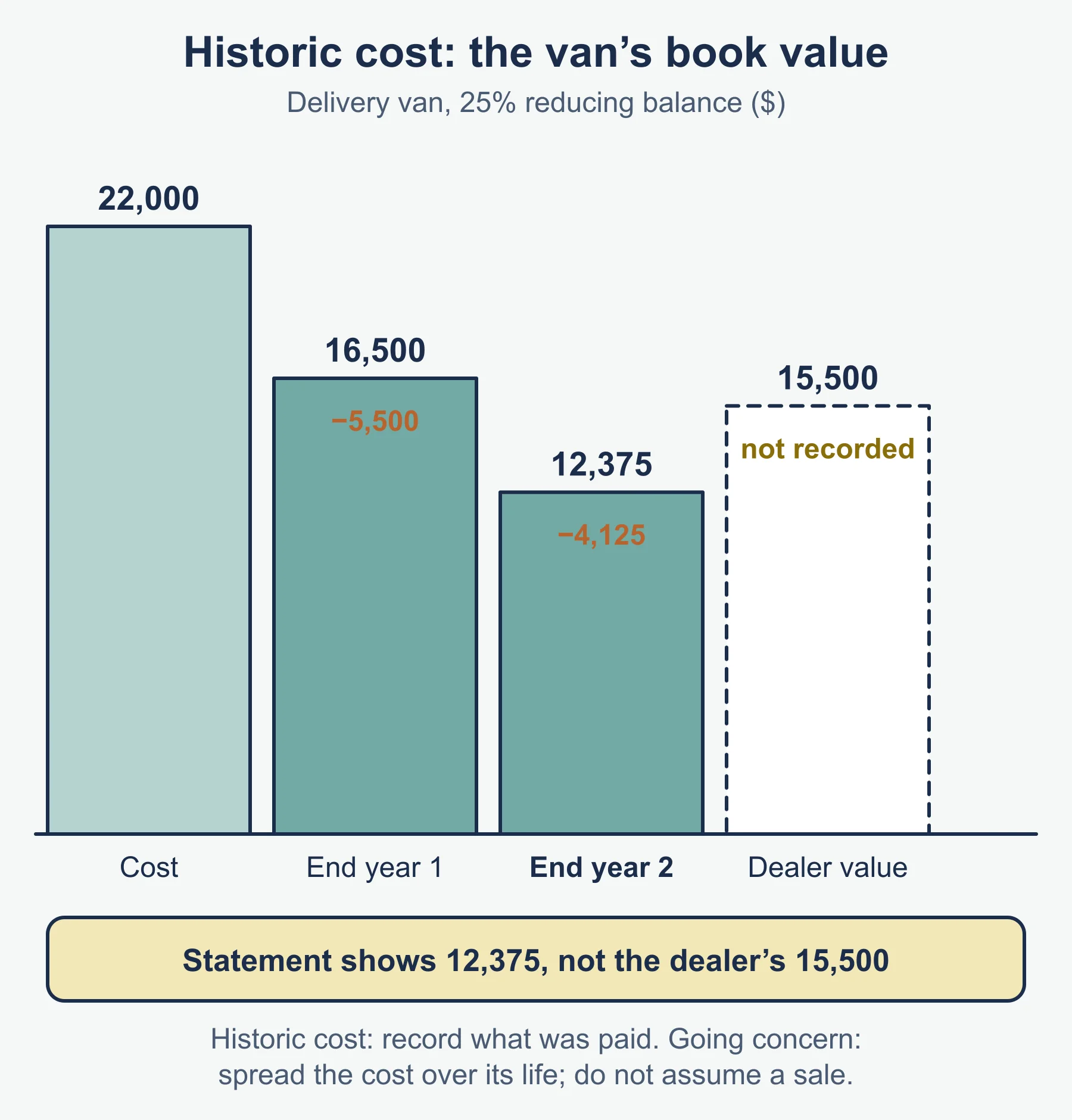
| Historic cost | Record at the price paid | What did it cost when bought? | Land bought for 30,000 stays at 30,000 |
| Going concern | Business will carry on trading | Is closure expected? | Prepayments carried forward |
| Accruals | Match income and expenses to the period | When was it earned or used? | Unpaid wages are an other payable |
| Consistency | Same methods each period | Did the method change? | Same depreciation method each year |
| Prudence | Do not overstate profit or assets | Is there a foreseeable loss? | Provision for doubtful debts |
| Materiality | Only significant items need full treatment | Would it change a decision? | A 9 stapler is expensed |
| Realisation | Revenue earned on delivery or service | Has the customer become liable to pay? | Order in March, delivery in April: April revenue |
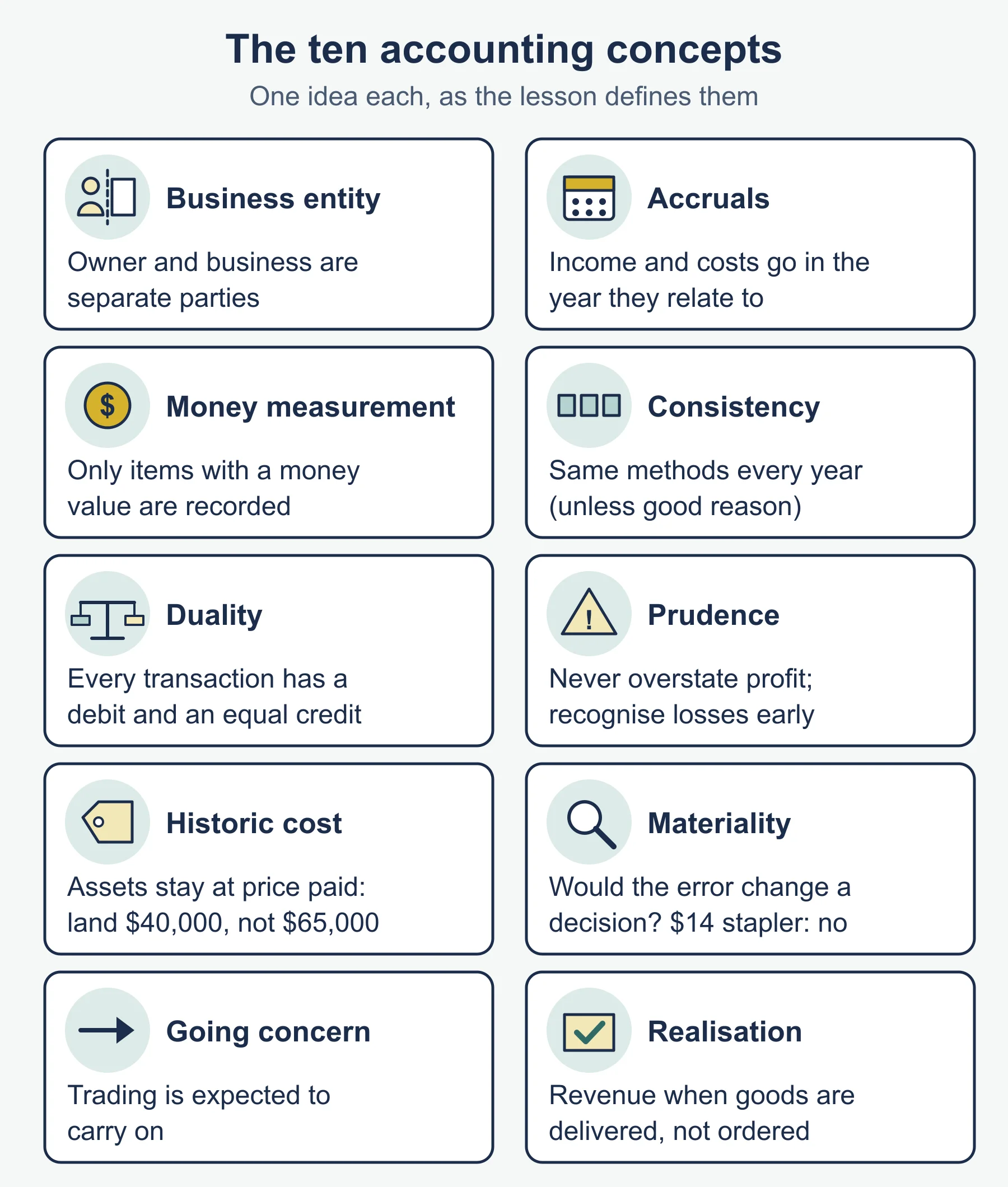
Must-know distinctions
- Accruals versus prudence: accruals puts the item in the right year; prudence chooses the cautious figure when the amount is uncertain.
- Business entity versus money measurement: the first decides whose transaction it is, the second decides whether it has a money value.
- Historic cost versus net realisable value: assets generally stay at cost, but inventory is written down to net realisable value when that is lower.
- Consistency versus prudence: consistency means keeping a method; it does not mean never correcting a method that is wrong.
- Realisation versus cash received: a credit sale is revenue on delivery, even though no cash has arrived.
- Going concern versus break-up: if closure is expected, assets would be valued at what they would sell for.
The six situations in the specification
| Situation | Concepts that drive it | The rule to remember |
|---|---|---|
| Preparation of financial statements | Accruals, consistency, realisation, business entity | Match to the year, same methods, only real sales, only business items |
| Asset valuation | Historic cost, prudence, going concern | Cost less depreciation; receivables less provision; inventory at lower figure |
| Depreciation of non-current assets | Accruals, consistency, historic cost | Spread cost over use; same method each year; non-cash expense |
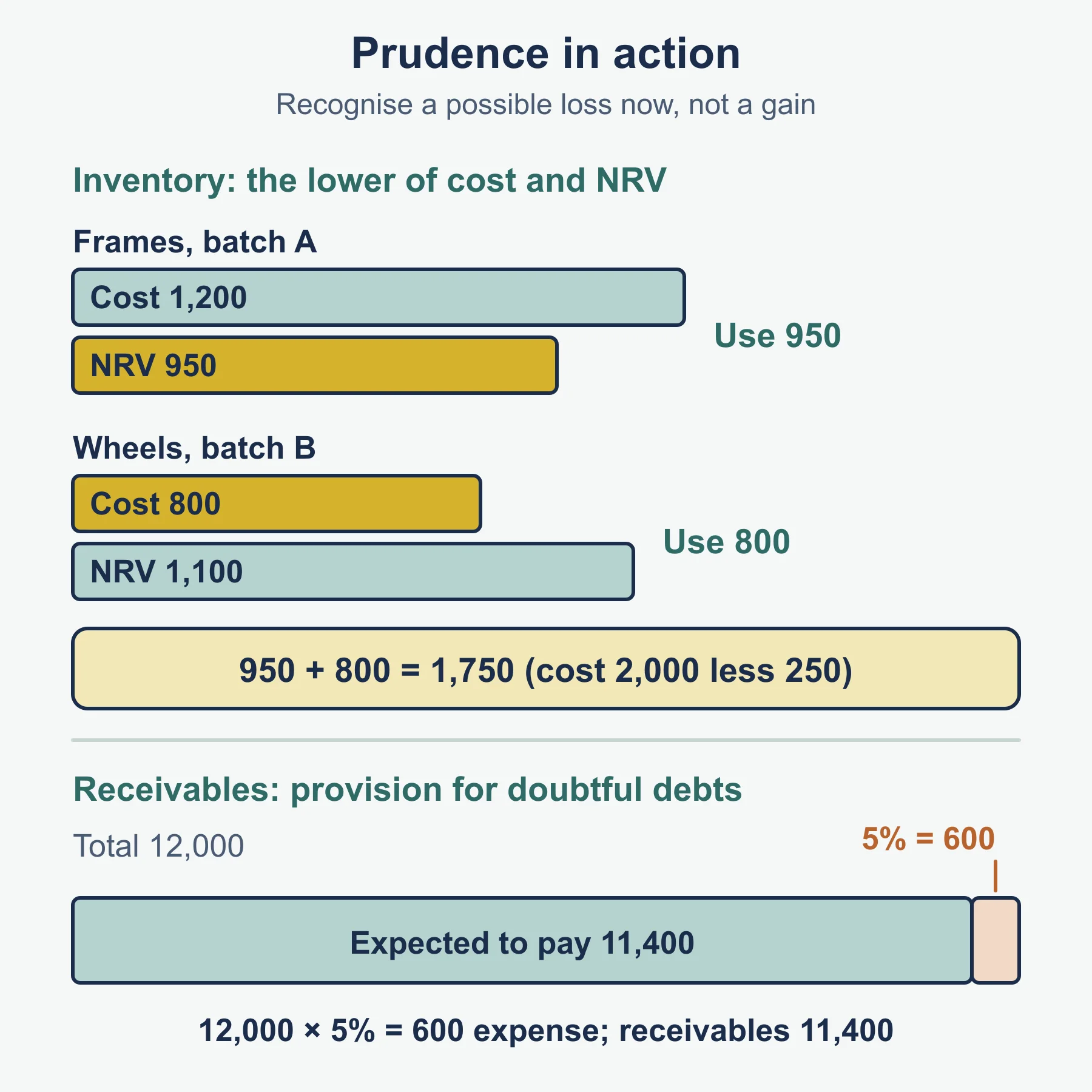
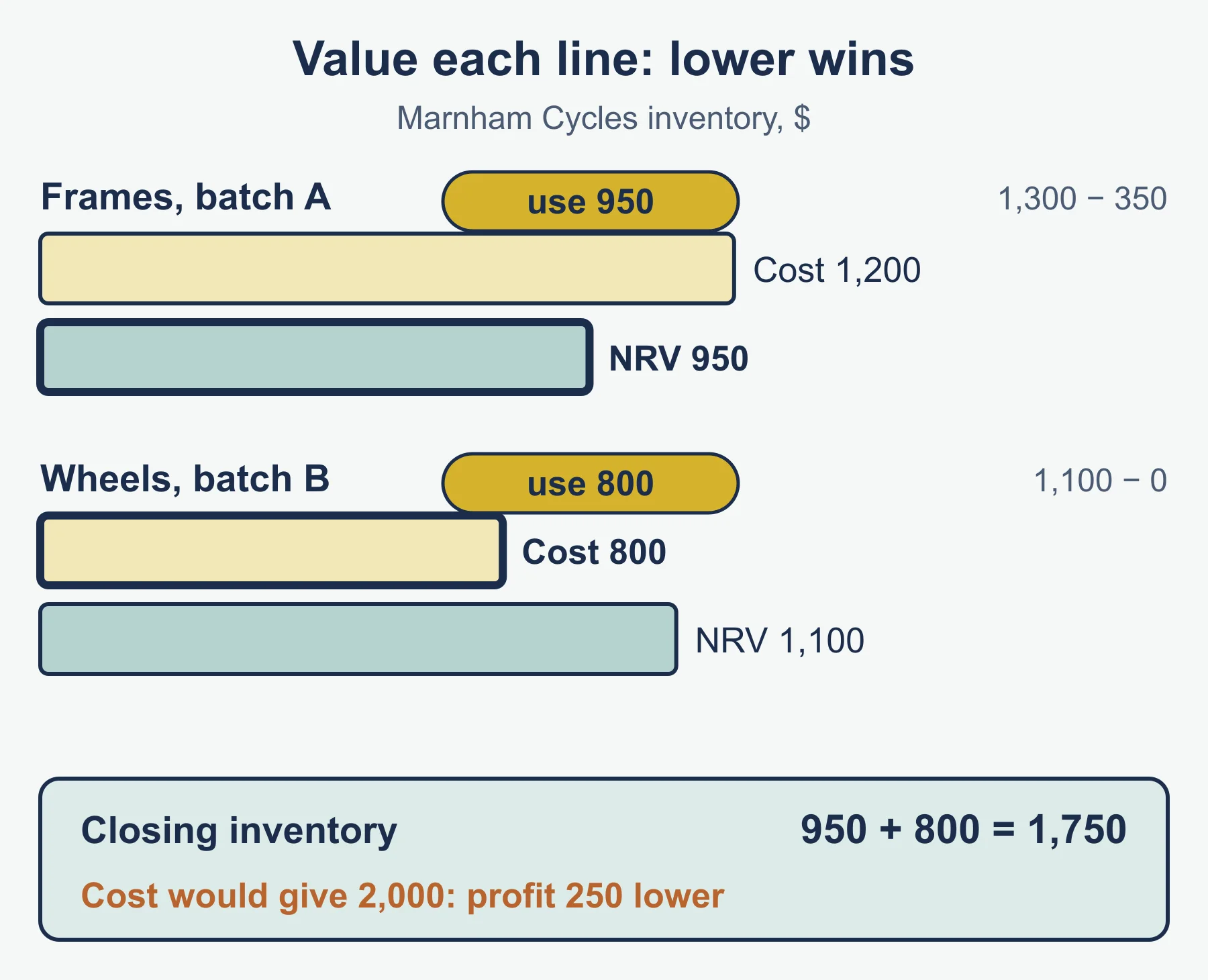
| Inventories | Prudence | Cost or net realisable value, whichever is lower, for each line |
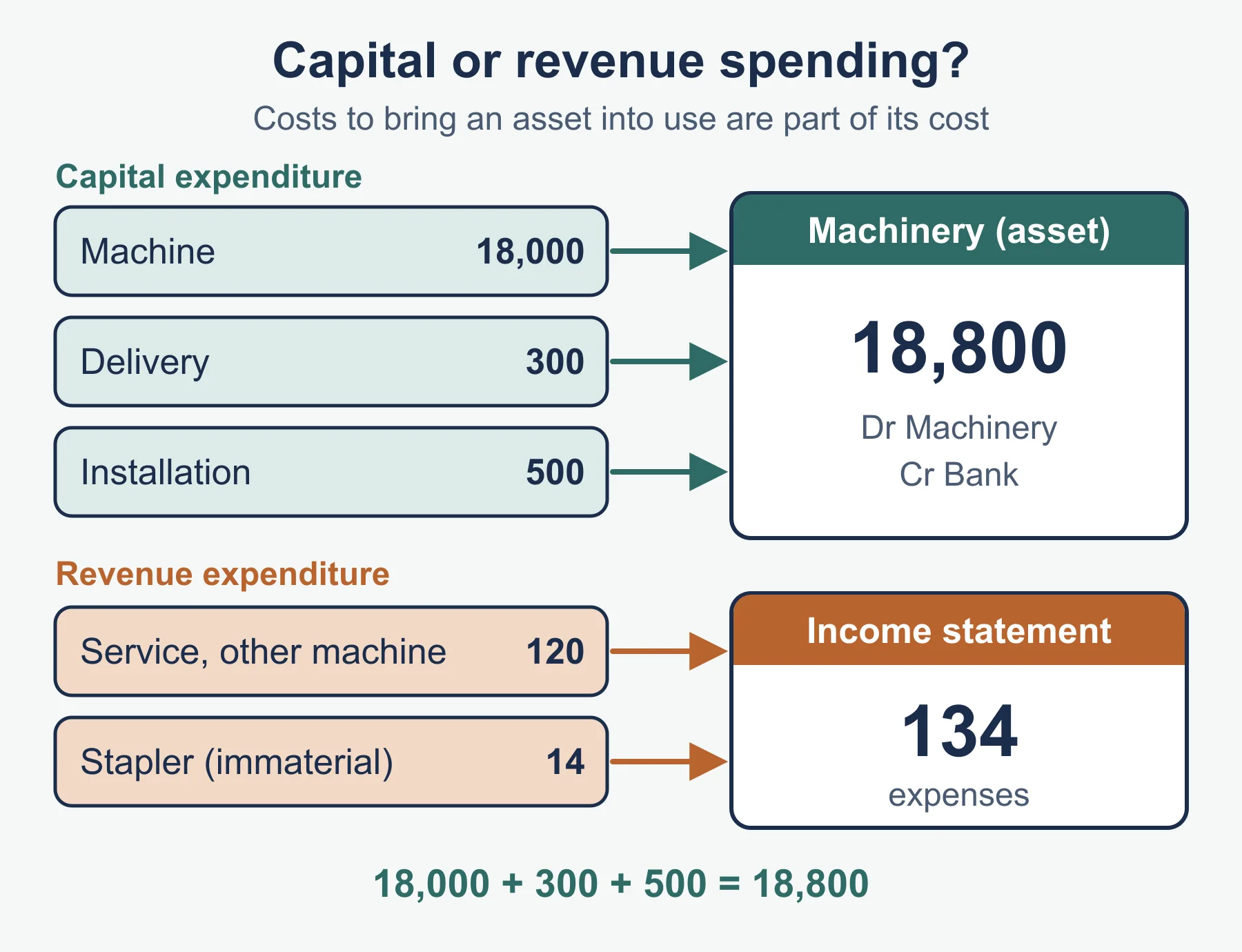
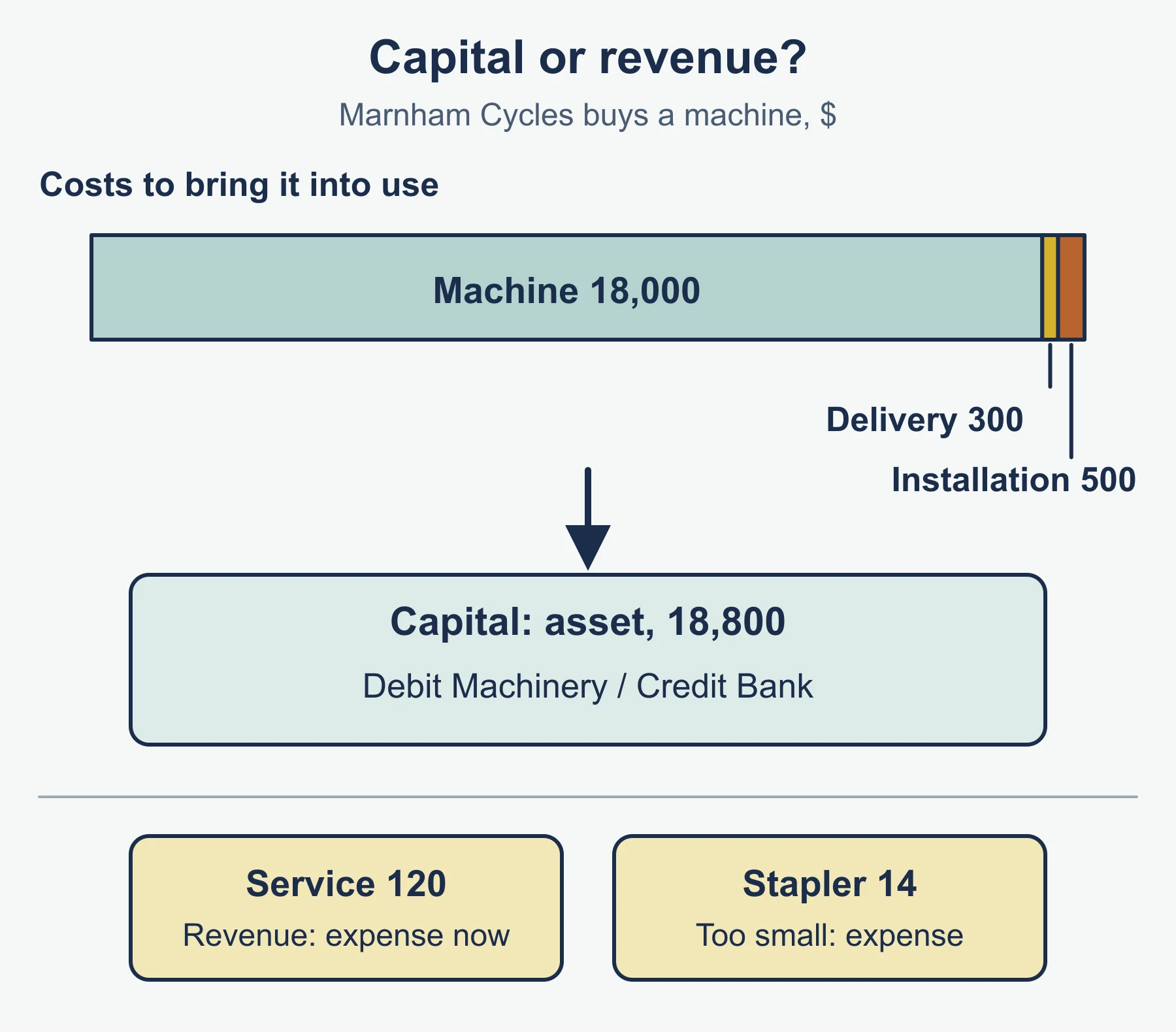
| Purchase of non-current assets | Historic cost, materiality | Capitalise all costs of bringing it into use; expense trivial items |
| Transactions in ledger accounts | Duality, accruals, business entity | Two equal entries; right period; business items only |
Formulas and methods
Net realisable value = expected selling price - costs to make saleable - selling costs.
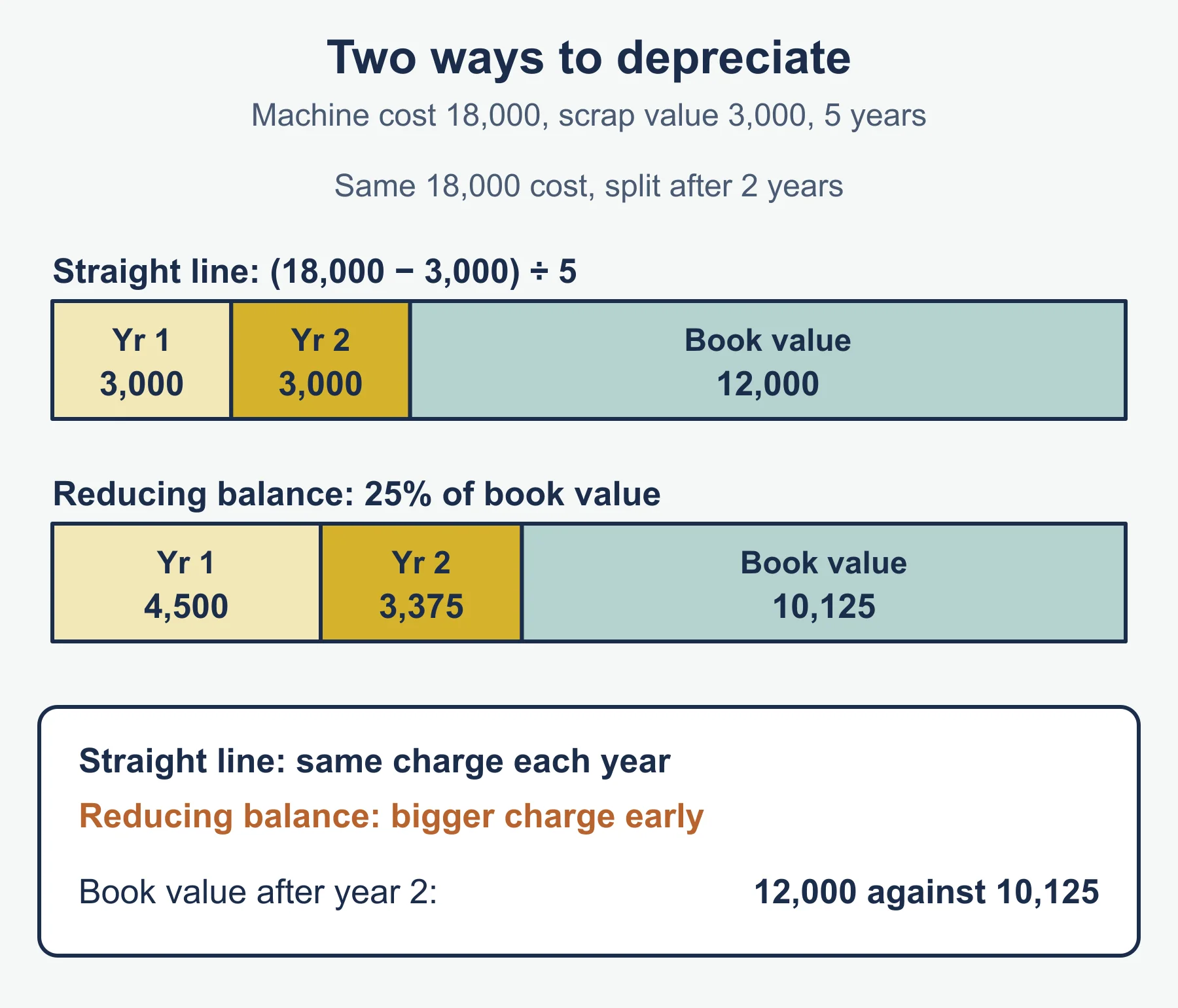
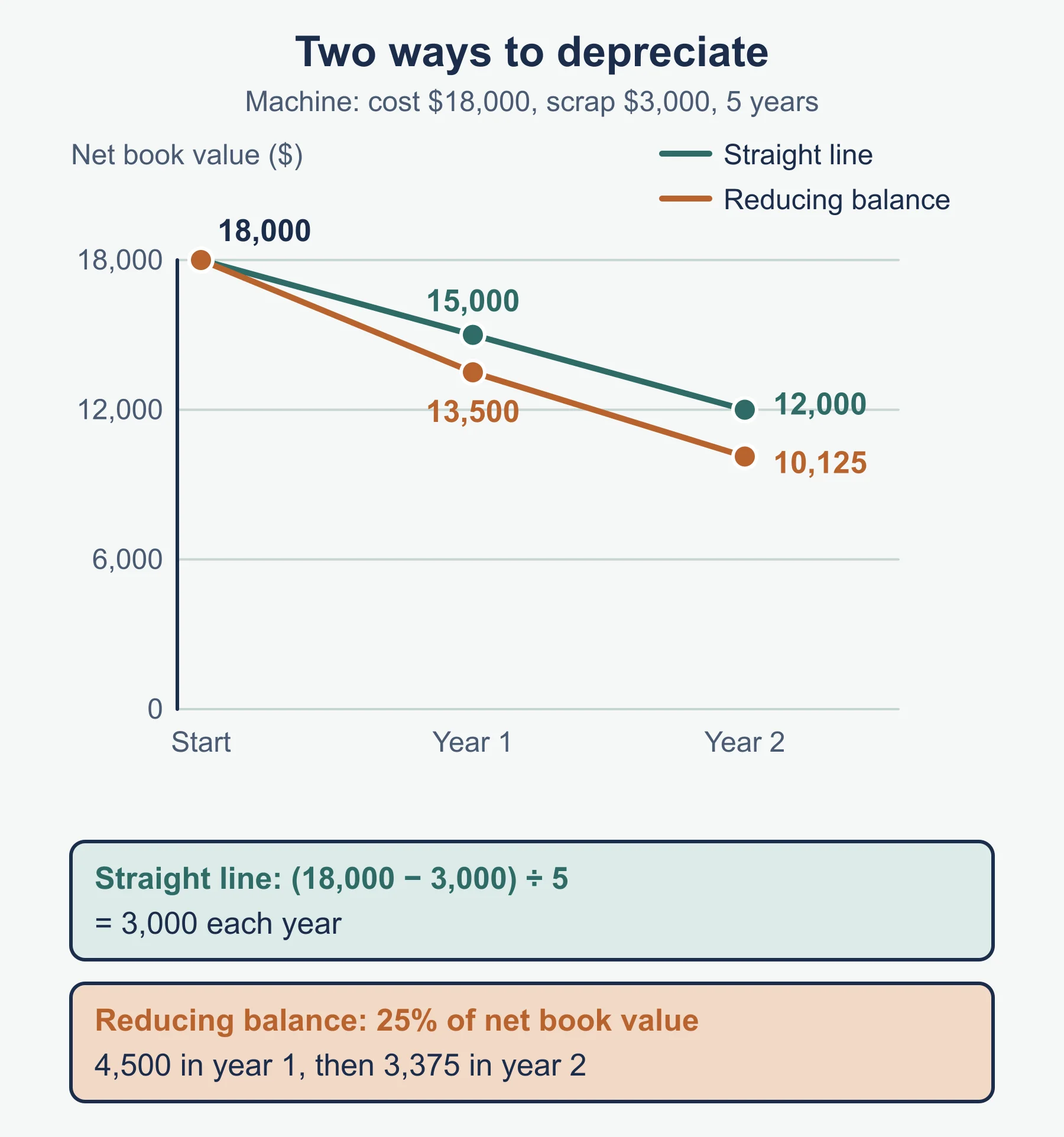
Straight line depreciation per year = (cost - residual value) / number of years.
Reducing balance depreciation per year = rate × net book value at the start of the year.
Net book value = cost - accumulated depreciation.
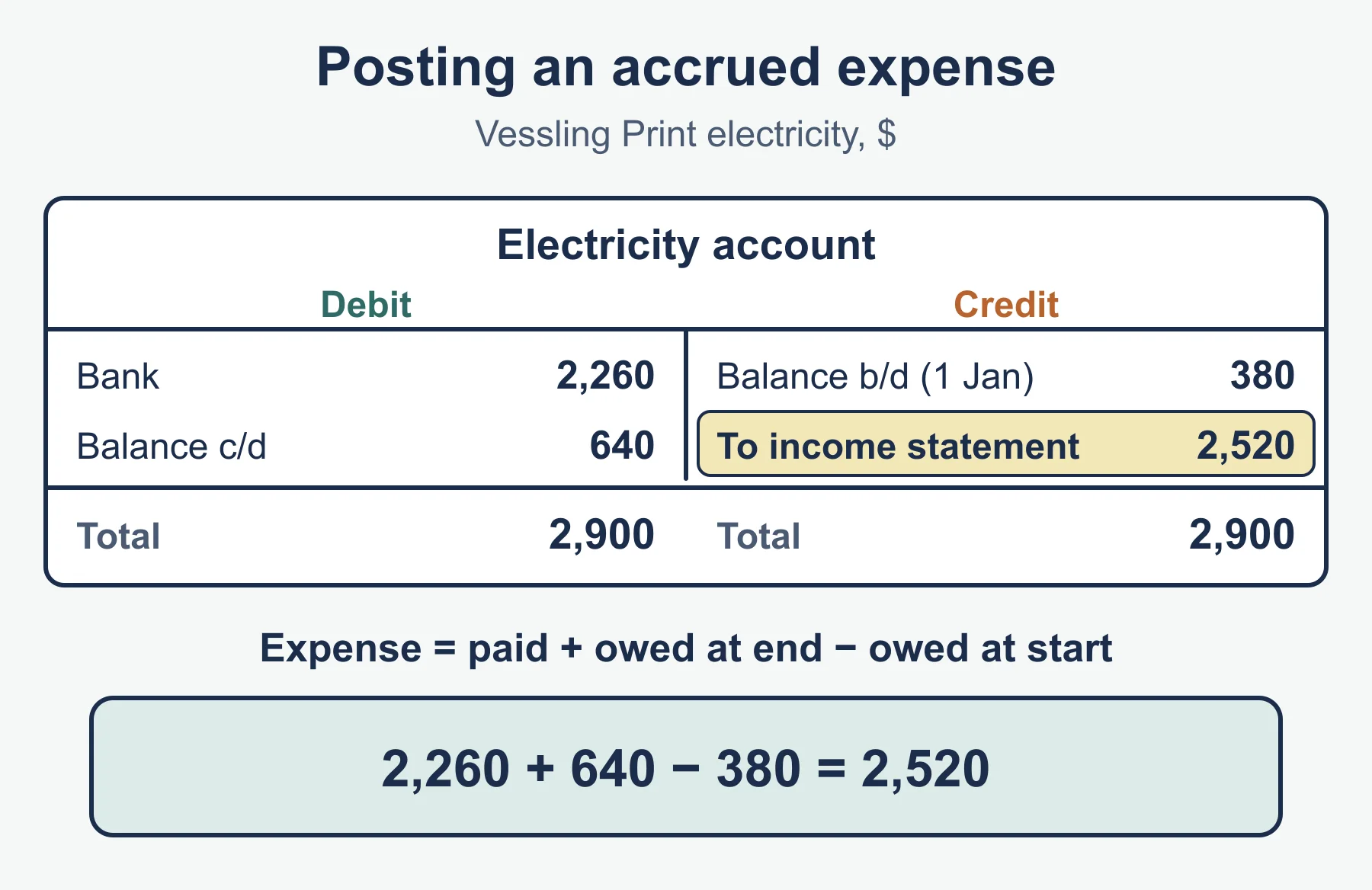
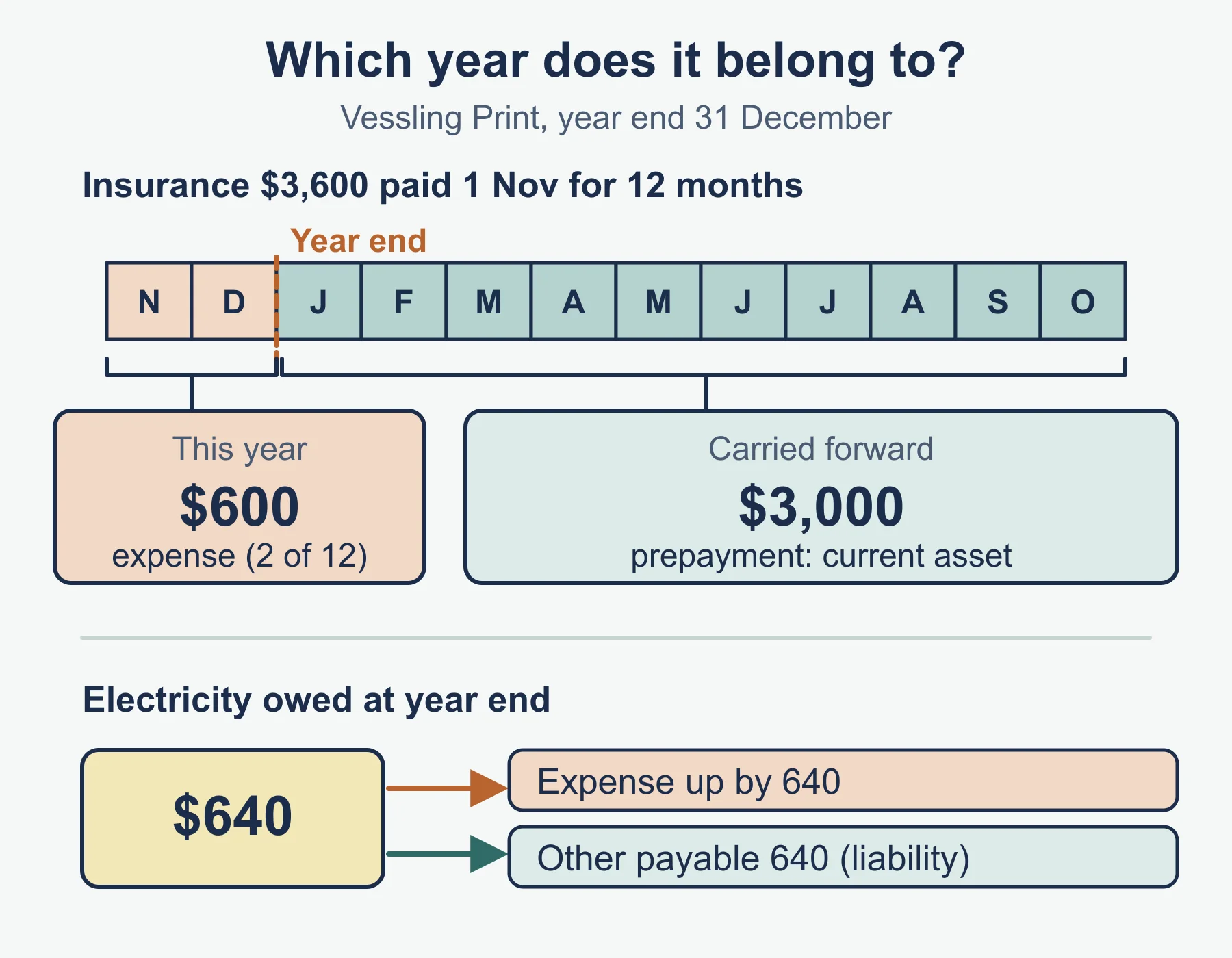
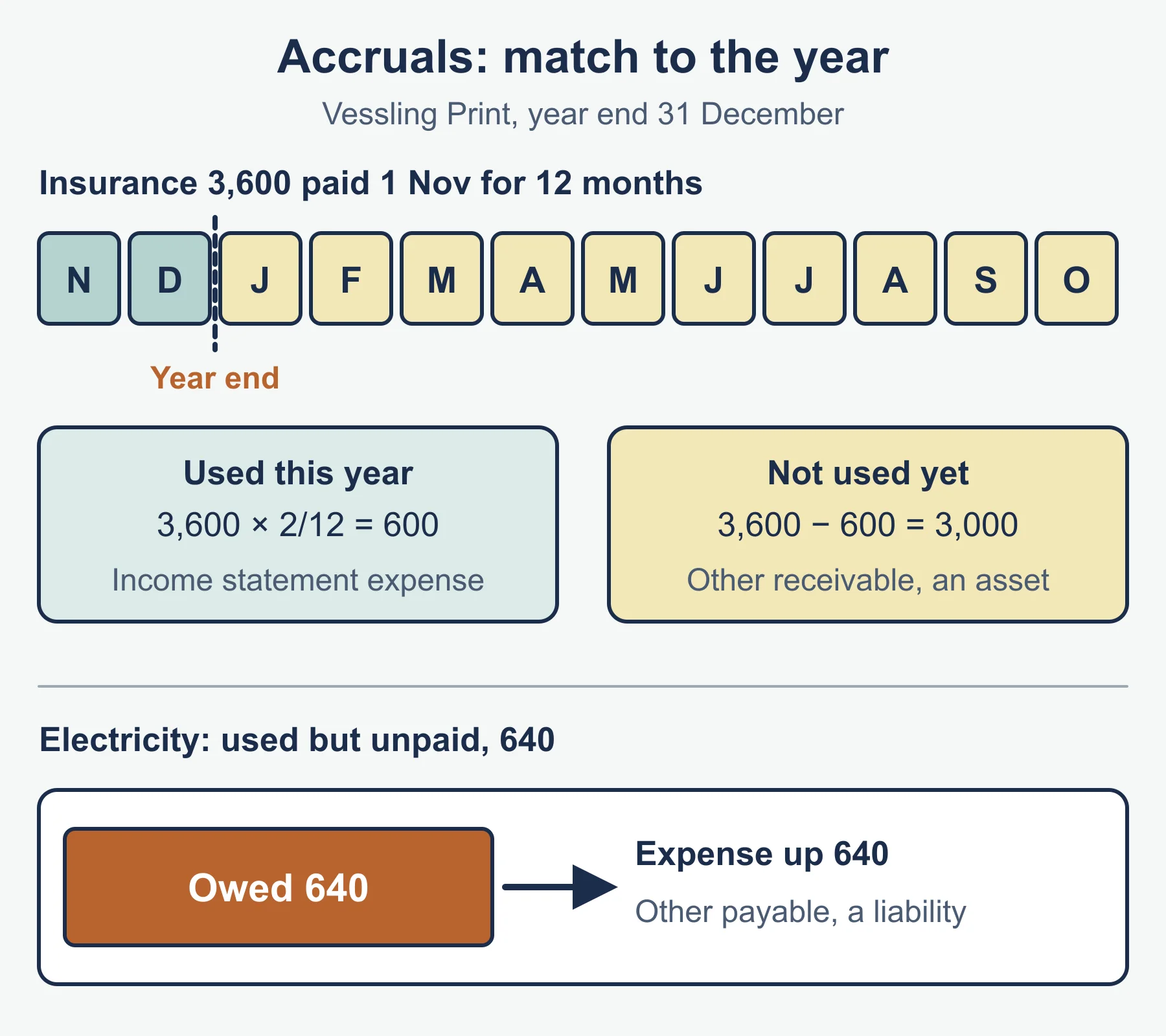
Expense for the year = cash paid + closing amount owed - opening amount owed (for an accrued expense). For a prepaid expense: cash paid + opening prepayment - closing prepayment.
Method: valuing inventory
- List each line separately.
- Work out net realisable value for each line.
- For each line, take cost or net realisable value, whichever is lower.
- Add the chosen figures. The total is closing inventory.
- Write down only by the amount the lower figure falls below cost.
Method: choosing the concept in an explain question
- Identify what is being recorded or valued.
- Match it to a concept from the ten.
- State what the concept requires.
- Apply it to the figures in the question.
- State the effect on profit or on the asset’s value.
Worked reminders
Reminder 1: prepayment and accrual. Orrelby Hardware pays rent of 7,200 on 1 October for 12 months, and its year ends 31 December. Three months are used: 7,200 × 3/12 = 1,800 is the expense, and 5,400 is carried forward as a prepayment. This is accruals, with going concern supporting the carry forward.
Reminder 2: two depreciation methods. Orrelby Hardware buys a delivery van for 9,600 with a residual value of 1,200 and a life of six years. Straight line: (9,600 - 1,200) / 6 = 1,400 each year. Reducing balance at 20%: year 1 is 20% of 9,600 = 1,920, year 2 is 20% of (9,600 - 1,920) = 1,536. Consistency means using the same method each year.
Reminder 3: net realisable value. A line of paint is bought for 70 per unit but is damaged. It can be sold for 70 after spending 12 per unit on repair. Net realisable value is 70 - 12 = 58 per unit, which is below cost, so each unit is valued at 58.
Reminder 4: capital or revenue. Zandry Foods pays 2,500 for a freezer and 150 to have it delivered, and also pays 90 for repairs to an old freezer. The new freezer is capital expenditure at 2,650 (debit freezers, credit bank). The repair is revenue expenditure, so it goes to the income statement.
Reminder 5: duality. Zandry Foods takes goods costing 200 for the owner’s own use. By business entity this is not a business expense. Debit drawings 200, credit purchases 200 (or inventory, depending on the method). Both effects are equal, which is duality.
Effect on profit of common treatments
| Treatment | Concept | Effect on profit for the year |
|---|---|---|
| Inventory written down to net realisable value | Prudence | Lower, because cost of sales rises |
| Expense accrued at the year end | Accruals | Lower, because the expense rises |
| Expense prepaid at the year end | Accruals | Higher than if the whole payment were charged |
| Provision for doubtful debts increased | Prudence | Lower, by the increase only |
| Repair wrongly treated as capital expenditure | Breaks the capital and revenue rule | Overstated in the year |
| Depreciation charged | Accruals | Lower, with no cash movement |
Memory aid: accruals asks “which period?”, prudence asks “what is the cautious figure?”, and consistency asks “did I use the same method as last year?”.
Quick self-test
- Which concept is breached if an owner’s holiday is paid from the business bank account and charged as an expense?
- Name the concept that explains why a lorry bought two years ago for 30,000 is not shown at its current market price.
- Which concept requires revenue to be recorded when goods are delivered?
- A business has valued inventory at selling price. Which concept does this go against, and in which direction does it distort profit?
- Cost 450, selling price 520, selling costs 90. What value is used for inventory?
- Calculate straight line depreciation for an asset costing 12,500, residual value 2,500, life five years.
- Calculate the year 2 reducing balance charge at 40% on an asset costing 5,000.
- Insurance of 2,400 for 12 months was paid on 1 July. What is the prepayment at 31 December?
- Which concept allows a business to expense a pack of printer paper rather than record it as inventory?
- Why is a provision for doubtful debts an example of prudence?
- State two reasons why non-current assets depreciate.
- Which concept supports the preparation of statements on the basis that the business will continue?
Answers
- Business entity.
- Historic cost.
- Realisation.
- Prudence, because selling price includes profit not yet realised; profit is overstated.
- Net realisable value is 520 - 90 = 430, which is below cost, so 430.
- (12,500 - 2,500) / 5 = 2,000 per year.
- Year 1: 40% of 5,000 = 2,000. Year 2: 40% of 3,000 = 1,200.
- Six months remain: 2,400 × 6/12 = 1,200.
- Materiality.
- It recognises a probable loss on receivables before the debt is actually written off.
- Two from wear and tear, obsolescence, the passage of time, and use.
- Going concern.
Where marks are usually lost
- Writing out the definition but not linking it to the facts in the question.
- Choosing accruals when the answer is prudence (or the reverse).
- Valuing inventory as one total instead of line by line.
- Forgetting selling costs when finding net realisable value.
- Writing “depreciation is a cash cost” or “depreciation puts money aside”.
- Treating all costs of an asset purchase as revenue expenditure; delivery and installation of a new asset are part of its cost.
- Using the original cost as the base for reducing balance every year.
- Showing the prepayment as an expense, or the accrual as an asset.
- Saying the business “owns” the owner’s personal assets, which ignores business entity.
Frequently asked questions
How many general accounting concepts are in OxfordAQA International GCSE Accounting 9215? Ten. The specification also names six situations in which they are applied: preparation of financial statements, asset valuation, depreciation of non-current assets, inventories, purchase of non-current assets and transactions in ledger accounts.
What is the difference between the accruals and prudence concepts? Accruals puts each item in the right year. Prudence chooses the cautious figure when an amount is uncertain.
What is the difference between business entity and money measurement? Business entity decides whose transaction it is, separating the business from its owner. Money measurement decides whether an item can be recorded, because it must have a money value.
How is net realisable value calculated? Net realisable value = expected selling price − costs to make the goods saleable − selling costs. Inventory is valued line by line at the lower of cost and net realisable value.
Is depreciation a cash cost? No. Writing that depreciation is a cash cost, or that it puts money aside, is a common mistake; it spreads the cost of an asset over its useful life without moving any cash.
Official syllabus
Source: OxfordAQA International GCSE Accounting (9215), specification version 1.2, for exams from May/June 2026 onwards, section 3.3 Development of the accounting model (general accounting concepts and their use).
Get free revision emails (optional)
Occasional emails with practice questions, worked explanations and links to free resources for the qualification and subjects you choose. No spam, and you can unsubscribe from any email. The free tools on this site never need an email.
Related resources
-
Study guides
OxfordAQA IGCSE Accounting: Irrecoverable debts, provisions for doubtful debts and inventory (9215)
Study guide to writing off irrecoverable debts, providing for doubtful debts and valuing inventory at cost or net realisable value, for OxfordAQA 9215.
Accounting · OxfordAQA · IGCSE
Read guide -
Practice questions
OxfordAQA IGCSE Accounting: Irrecoverable debts, provisions and inventory (9215) – Practice Questions
Original questions with worked answers on irrecoverable debts, provisions for doubtful debts and inventory, for OxfordAQA IGCSE Accounting 9215.
Accounting · OxfordAQA · IGCSE
Try questions -
Revision notes
OxfordAQA IGCSE Accounting: Irrecoverable debts, provisions and inventory (9215) – Revision Notes
Condensed notes on irrecoverable debts, provisions for doubtful debts and opening and closing inventory for OxfordAQA International GCSE Accounting 9215.
Accounting · OxfordAQA · IGCSE
Revise topic
Related articles
-
teaching
A Level tuition in Dubai: Cambridge or Pearson Edexcel International A Level?
Schools in Dubai and Abu Dhabi teach either Cambridge International AS & A Level or Pearson Edexcel International A Level. How the two are structured, why it matters for tuition, and how online classes from Lahore work.
9 October 2026
-
curriculum guides
Choosing subjects at IGCSE and A Level
How subject choices at 14 and 16 affect university options later, and how to keep pathways open without overloading a timetable.
28 July 2026
Studying this with a teacher
Working through Accounting IGCSE?
This page is free and stays free. If you would rather be taught it, Marlbridge runs Accounting classes one-to-one and in small groups of up to 15, online in your own time zone. The first trial class is free. WhatsApp replies within an hour (8am–11pm Pakistan time, every day); email the same day.
OxfordAQA Accounting teachers at Marlbridge

