
Revision Notes
OxfordAQA IGCSE Accounting: Irrecoverable debts, provisions and inventory (9215) – Revision Notes
Condensed notes on irrecoverable debts, provisions for doubtful debts and opening and closing inventory for OxfordAQA International GCSE Accounting 9215.
- Subject
- Accounting
- Level
- IGCSE
- Topic
- Development of the accounting model
- Author
- Marlbridge Academic Team
- Updated
- Reviewed by
- Javaid Iqbal Sabri (what this means)
Aligned to OxfordAQA IGCSE Accounting (9215), First teaching 2024, first examined 2026. Official specification .
Syllabus page (what it covers and how it is assessed): OxfordAQA IGCSE Accounting.
Syllabus points this page covers
9215
- Irrecoverable debts, provisions for doubtful debts and inventory
Found an error? Report a correction.
Need help with this topic? Request a free trial class for IGCSE Accounting (9215).
These notes condense part of section 3.3 of the OxfordAQA International GCSE Accounting (9215) specification, version 1.2, for exams from May/June 2026 onwards: irrecoverable debts, provisions for doubtful debts, and opening and closing inventory at cost or net realisable value. For full explanations and worked ledgers, read the study guide. Test yourself with the practice questions, check progress with the free diagnostics, and tick off topics on the printable checklist. The course hub lists the rest of the course. Amounts are in dollars.
Key terms
| Term | Meaning |
|---|---|
| Trade receivable | A customer who owes the business for goods bought on credit |
| Irrecoverable debt | A trade receivable’s balance the business does not expect to collect, so it is written off |
| Provision for doubtful debts | An estimate of the loss on the receivables that remain, held as a credit balance |
| Inventory | Goods held for resale |
| Net realisable value | Expected selling price less costs of repair or completion and selling costs |
| Cost of sales | Opening inventory + purchases - closing inventory |
Not examined
- The recovery of irrecoverable debts (the specification says so).
- FIFO, AVCO and LIFO inventory valuation (stated in section 3.4).
Entries at a glance
| Event | Debit | Credit | Statement effect |
|---|---|---|---|
| Debt written off | Irrecoverable debts | Customer’s account (trade receivables ledger) | Expense in income statement; receivables fall |
| Year end: clear irrecoverable debts | Income statement | Irrecoverable debts | Closes the account |
| Provision created or increased | Income statement | Provision for doubtful debts | Expense; provision deducted from receivables |
| Provision decreased | Provision for doubtful debts | Income statement | Profit rises (reduction in expenses or other income) |
| Opening inventory | Income statement | Inventory | Added to purchases in cost of sales |
| Closing inventory | Inventory | Income statement | Deducted in cost of sales; asset in the statement of financial position |
Method: irrecoverable debts
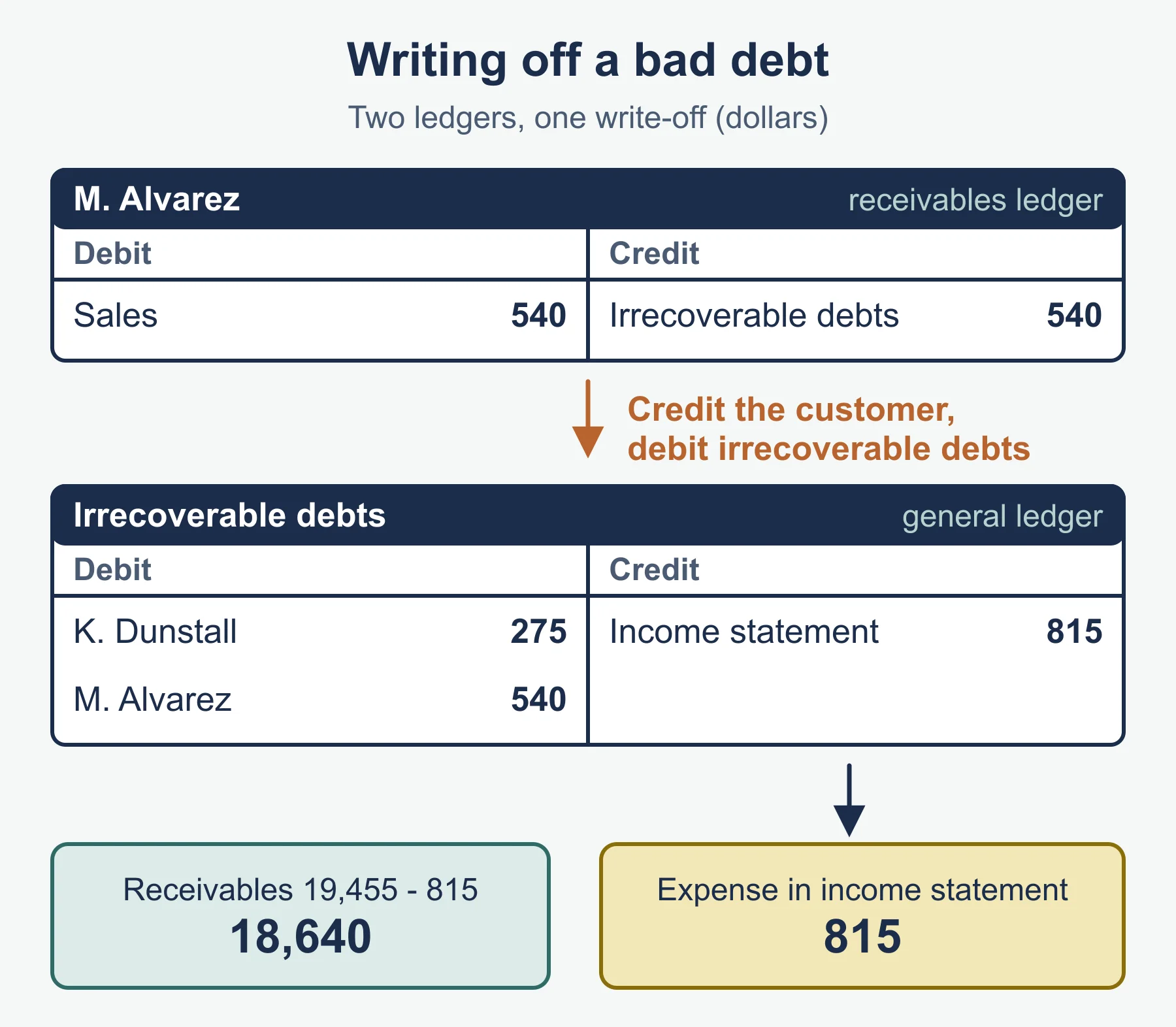
- Credit the customer’s account with the balance written off.
- Debit the irrecoverable debts account.
- At the year end, transfer the total to the income statement.
- Show only the remaining trade receivables in the statement of financial position.
Reminder: a hire club owes 330 and is declared insolvent. Debit irrecoverable debts 330, credit the club’s account 330. Trade receivables fall by 330 and profit falls by 330.
Method: provision for doubtful debts
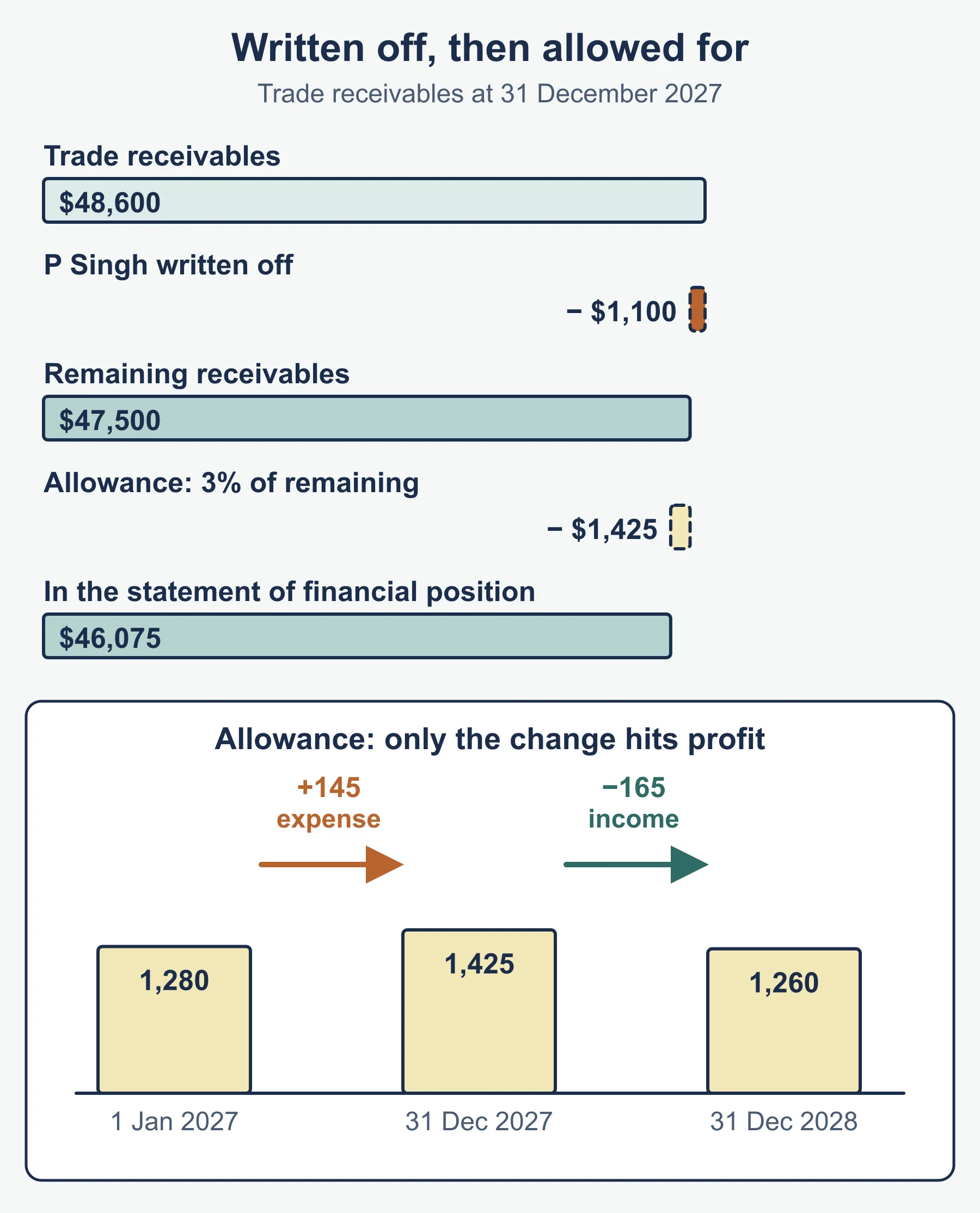
- Write off any irrecoverable debts first.
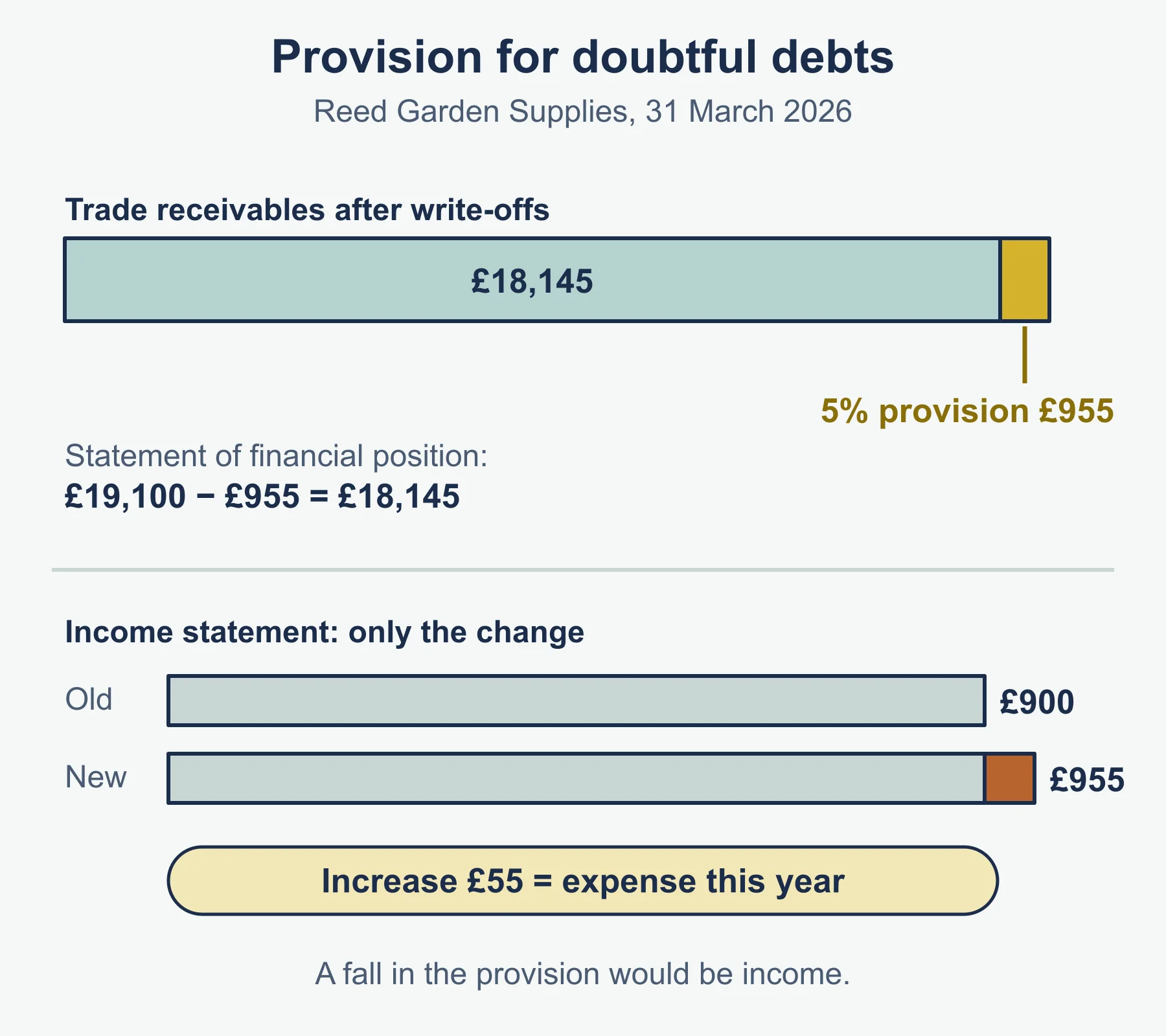
- Take the percentage of the remaining trade receivables. This is the new provision.
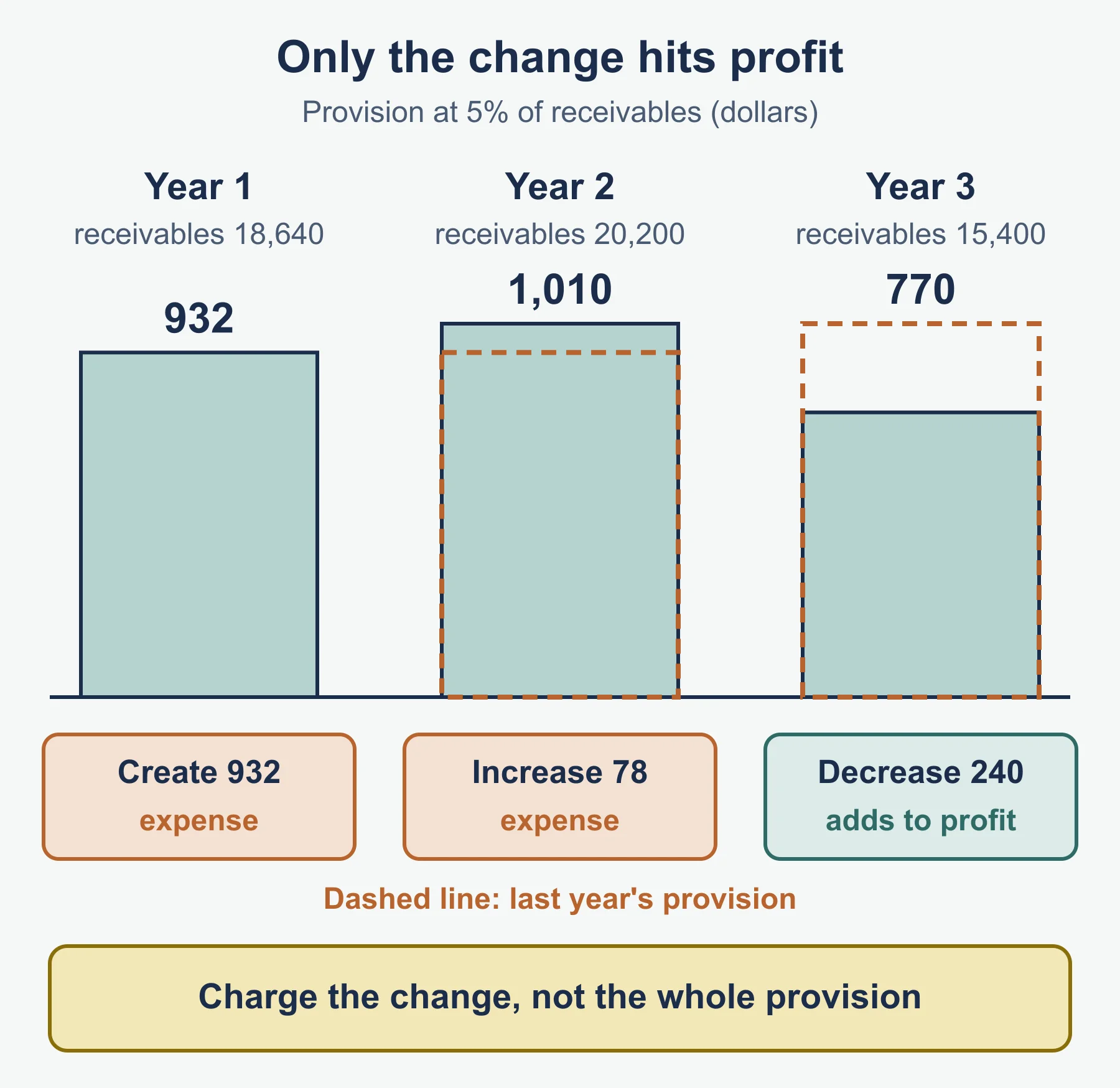
- Compare with the existing provision. Only the difference goes to the income statement.
- Deduct the new provision from trade receivables in the statement of financial position.
| Case | Receivables | Rate | New provision | Old provision | Action |
|---|---|---|---|---|---|
| Increase | 12,500 | 4% | 500 | 380 | Charge 120 as an expense |
| Decrease | 13,000 | 3% | 390 | 520 | Credit 130 to income statement; profit rises |
Presentation in the statement of financial position: trade receivables 12,500, less provision (500), giving 12,000.
Method: inventory
- Find opening inventory (last year’s closing figure).
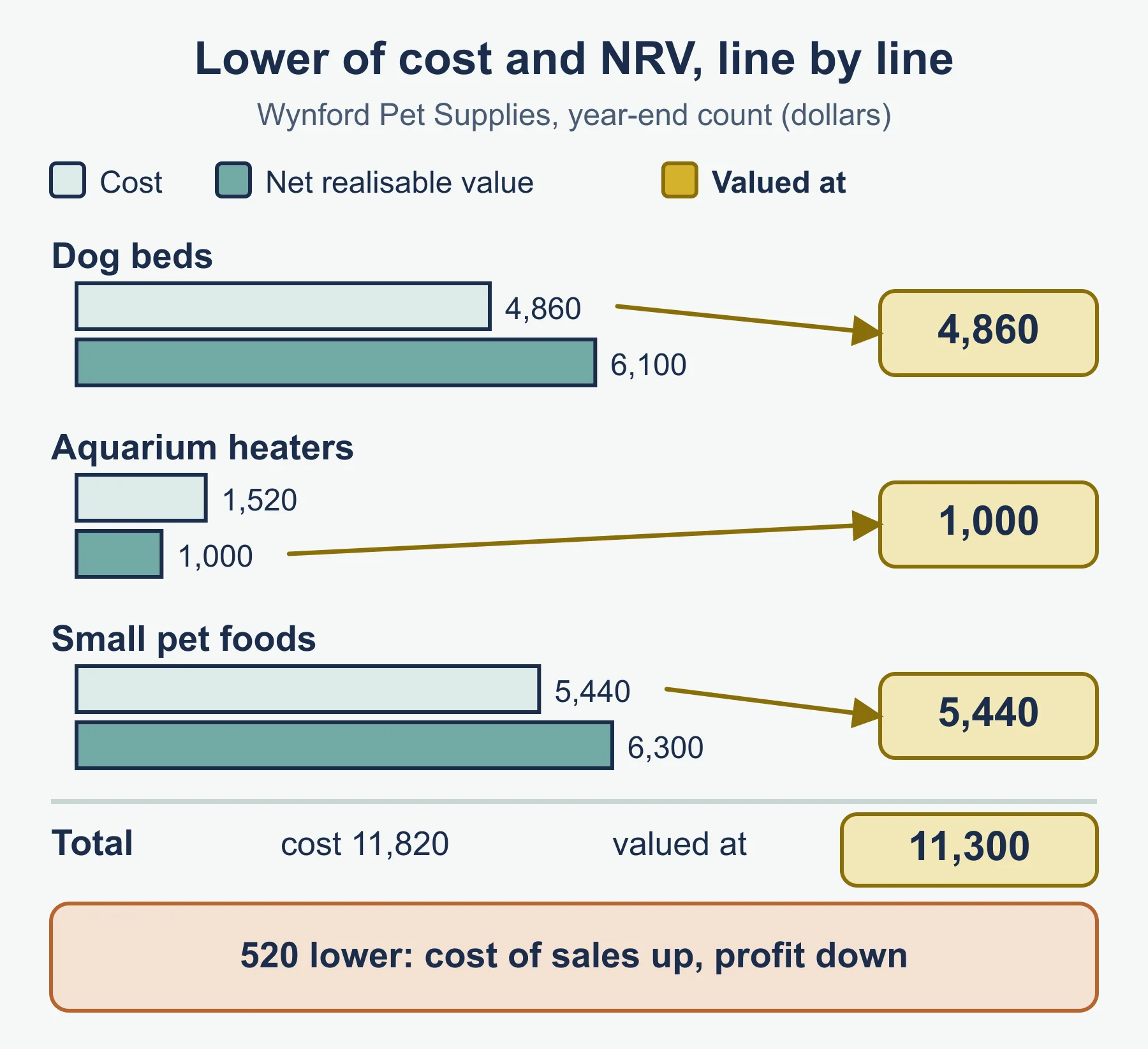
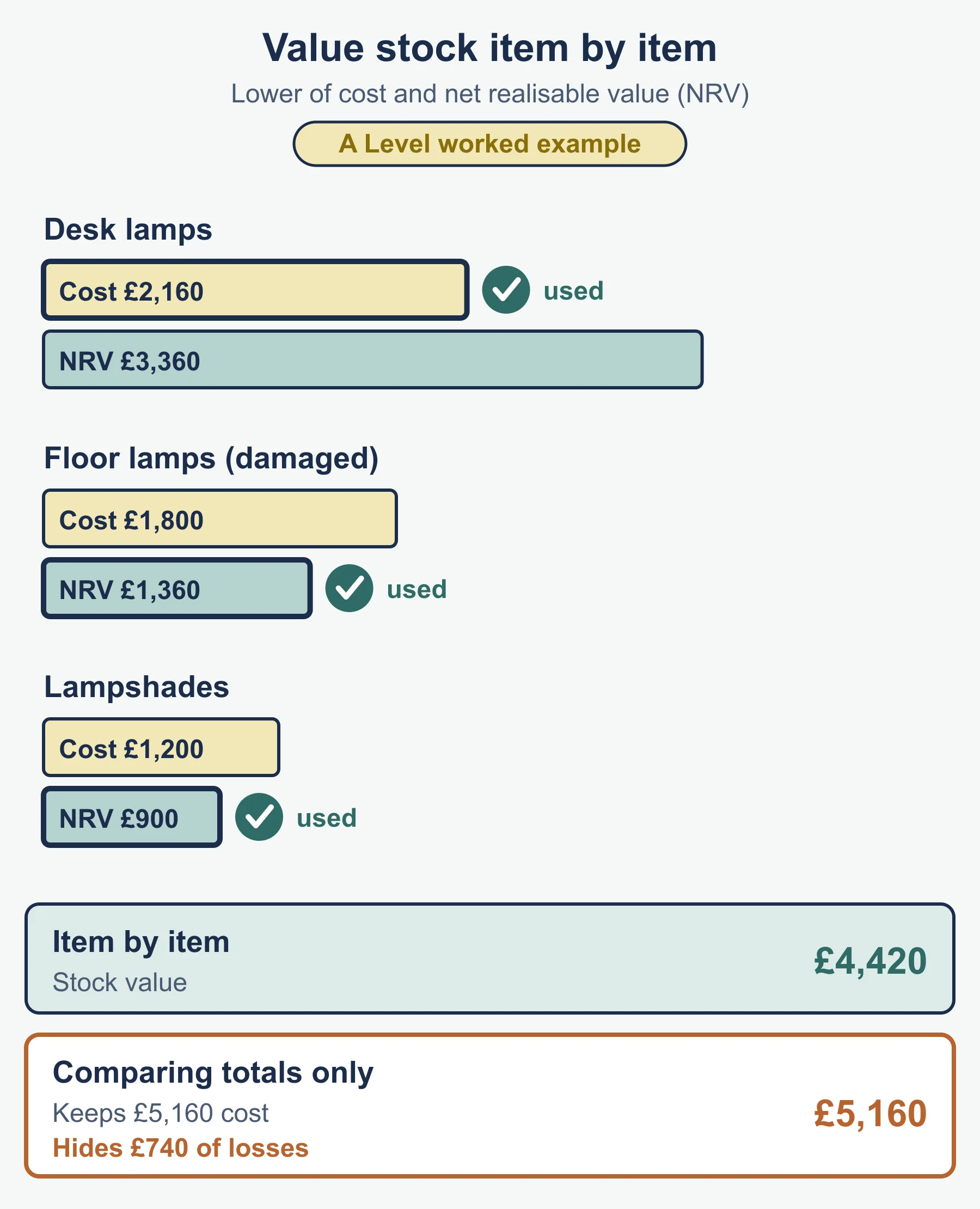
- Value closing inventory line by line at the lower of cost and net realisable value.
- Calculate cost of sales: opening inventory + purchases - closing inventory.
- Show closing inventory as a current asset.
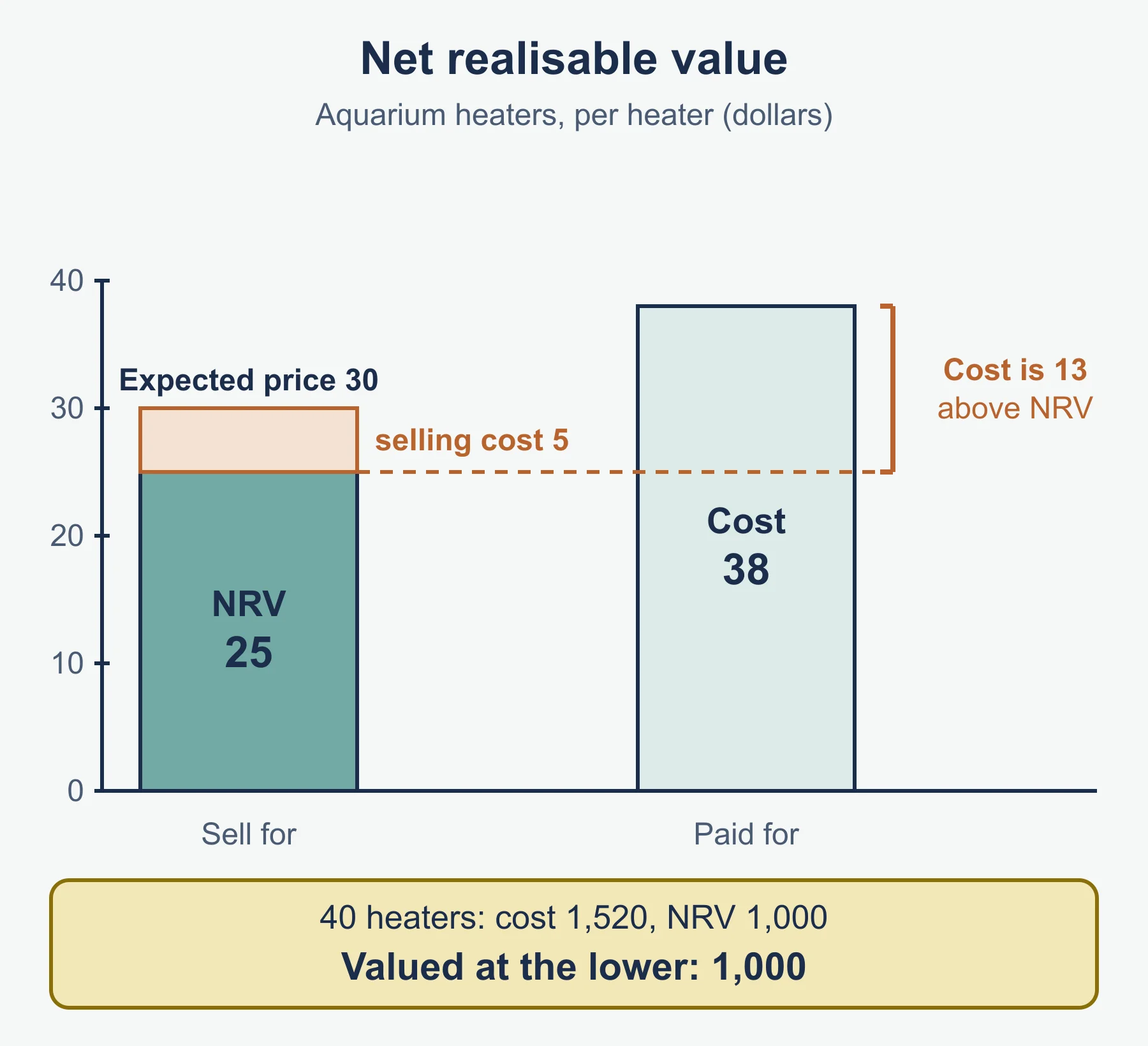
Net realisable value reminder: a line of 28 units cost 40 each. Each can be sold for 36, but 6 of selling costs falls on each. Net realisable value is 30 each, or 840 for the line, against cost of 1,120. Value the line at 840. The 280 difference is a reduction in profit this year.
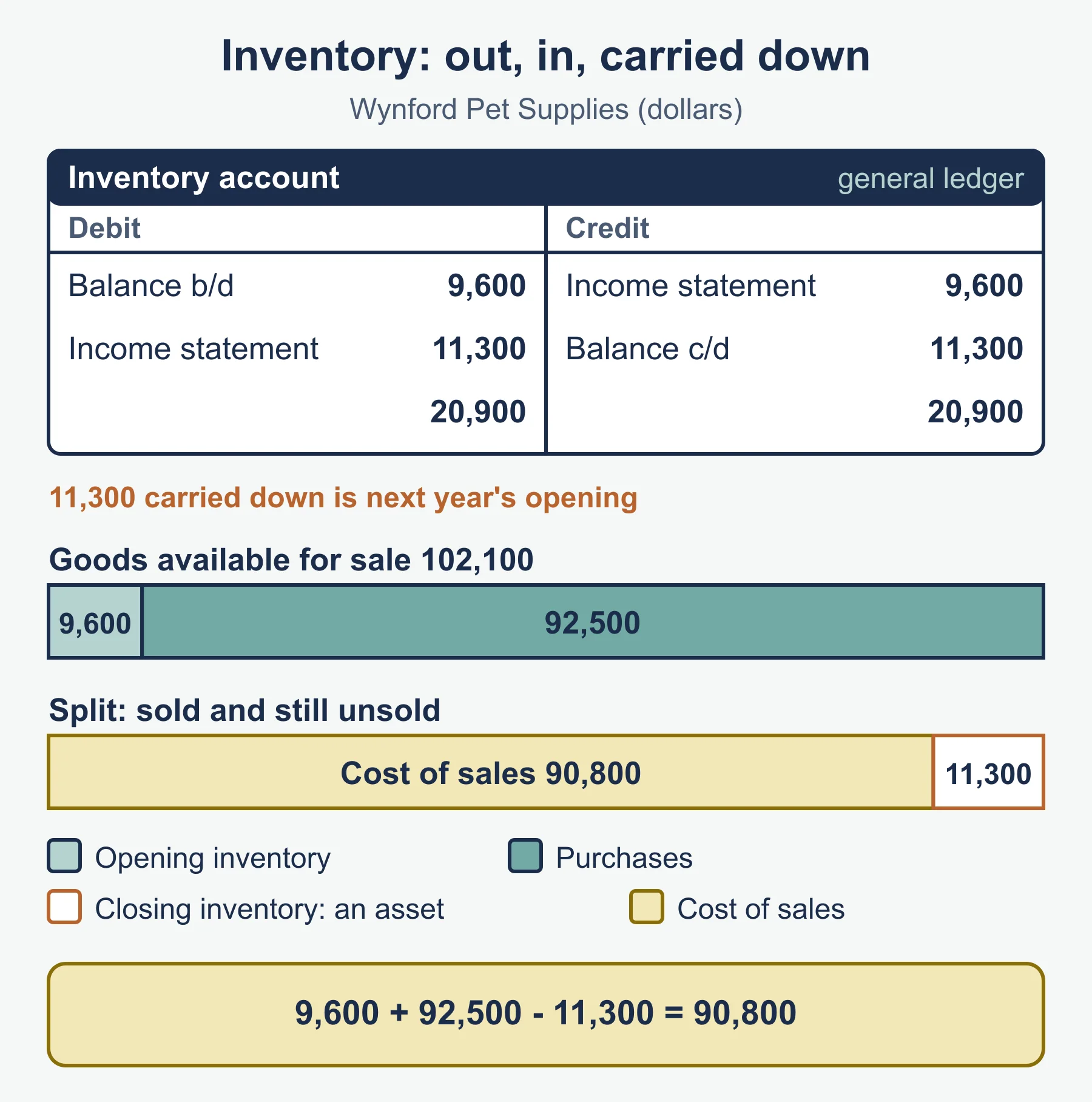
Ledger shape of the inventory account:
| Debit | Credit |
|---|---|
| Balance b/d (opening) | Income statement (opening moved out) |
| Income statement (closing moved in) | Balance c/d (closing) |
Must-know distinctions
| Compare | Point |
|---|---|
| Irrecoverable debt vs provision | The debt is certain and tied to a named customer; the provision is an estimate on the remaining receivables |
| Write-off vs provision in the ledger | A write-off credits a customer; a provision credits the provision account |
| Increase vs decrease in provision | Increase is an expense; decrease raises profit |
| Cost vs net realisable value | Use whichever is lower for each line |
| Opening vs closing inventory | Opening is added to purchases; closing is deducted |
| Inventory error: this year vs next | The same error changes profit in opposite directions in consecutive years |
Concepts in these adjustments
- Prudence: do not overstate assets or profit. Supports the provision and lower-of-cost-and-net-realisable-value.
- Accruals: match losses to the period of the sales.
- Historic cost: start from what the goods cost.
- Consistency: apply the same percentage and valuation basis each year.
- Going concern: assume the business keeps trading when valuing inventory.
Worked reminder: all three adjustments together
Revenue 52,000; opening inventory 3,100; purchases 30,400; closing inventory 3,600; running expenses 9,800; irrecoverable debts 260 already written off; trade receivables 6,000; existing provision 220; new provision 5%.
| Step | Working | Result |
|---|---|---|
| Cost of sales | 3,100 + 30,400 - 3,600 | 29,900 |
| Gross profit | 52,000 - 29,900 | 22,100 |
| New provision | 6,000 x 5% | 300 |
| Increase in provision | 300 - 220 | 80 |
| Total expenses | 9,800 + 260 + 80 | 10,140 |
| Net profit | 22,100 - 10,140 | 11,960 |
In the statement of financial position, current assets show inventory 3,600 and trade receivables 6,000 less provision (300), giving 5,700.
What an inventory error does
| Error | Cost of sales | Gross and net profit | Following year |
|---|---|---|---|
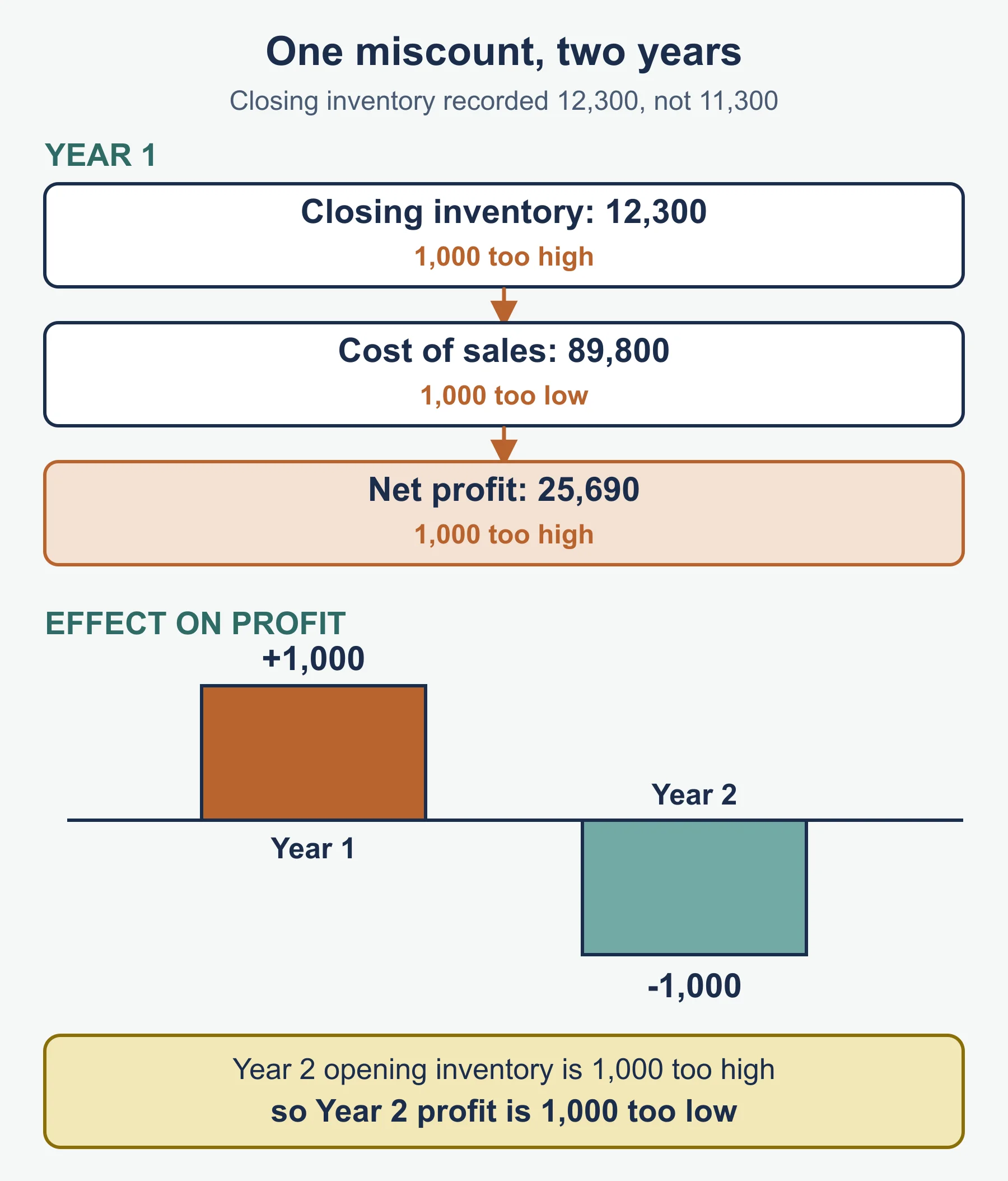
| Closing inventory too high | Too low | Too high | Opening inventory too high, so profit too low |
| Closing inventory too low | Too high | Too low | Opening inventory too low, so profit too high |
The statement of financial position is also wrong at the year end by the same amount, because inventory is a current asset.
Command words
- State or name: give the point without development.
- Calculate: show the working, because the method can earn credit even if the answer is wrong.
- Prepare or complete: lay out the account or statement with headings, dates and totals.
- Explain: give a reason and link it to the business in the question. For a concept, name it and apply it.
A routine for adjustment questions
- Read the whole question and list each adjustment before you calculate anything.
- Deal with irrecoverable debts first, because they change the trade receivables total used for the provision.
- Work out the provision and its increase or decrease.
- Value closing inventory line by line, then calculate cost of sales.
- Place each figure in the income statement and the statement of financial position, and say where it goes in both.
- Check that gross profit, total expenses and net profit add up before you move on.
Quick self-test
- State what is meant by an irrecoverable debt.
- Which account is credited when a customer’s debt is written off?
- Where does the balance on the irrecoverable debts account go at the year end?
- Trade receivables are 8,400 after write-offs. The provision is 5% and the existing provision is 300. What is charged to the income statement?
- The provision falls from 560 to 480. What is the effect on net profit?
- In the statement of financial position, from which item is the provision deducted?
- An item cost 47. It will sell for 52 with selling costs of 9. At what value should it be included in inventory?
- Opening inventory is 5,000, purchases 31,000 and closing inventory 6,200. Calculate cost of sales.
- Closing inventory is overstated by 400. What is the effect on net profit for the year?
- Name the concept that explains why inventory is not carried above net realisable value.
Answers
- A balance owed by a trade receivable that the business does not expect to collect, so it is written off as an expense.
- The customer’s account in the trade receivables ledger, with irrecoverable debts debited.
- It is transferred to the income statement as an expense.
- New provision 420 (8,400 x 5%), less 300 existing: an expense of 120.
- Net profit rises by 80.
- Trade receivables.
- 43 (52 - 9), because it is lower than the cost of 47.
- 29,800 (36,000 - 6,200).
- Net profit is overstated by 400.
- Prudence.
Where marks are usually lost
- Debiting the customer when writing off a debt instead of crediting.
- Applying the percentage before removing the irrecoverable debts.
- Charging the full provision instead of the increase or decrease.
- Describing a decrease in the provision as a cost.
- Valuing inventory at net realisable value when it is higher than cost.
- Putting closing inventory in the expenses instead of deducting it in cost of sales.
- Leaving the provision out of the statement of financial position, or deducting it from the wrong item.
- Giving an explanation without naming the concept or linking it to the situation in the question.
- Omitting headings, dates or totals on ledger accounts.
Frequently asked questions
What is an irrecoverable debt? A balance owed by a trade receivable that the business does not expect to collect, so it is written off: credit the customer’s account and debit the irrecoverable debts account.
What is the difference between an irrecoverable debt and a provision for doubtful debts? An irrecoverable debt is certain and tied to a named customer. A provision is an estimate on the remaining trade receivables, credited to the provision account rather than to a customer.
Is the recovery of irrecoverable debts examined in OxfordAQA International GCSE Accounting 9215? No. The specification says the recovery of irrecoverable debts is not examined, and FIFO, AVCO and LIFO inventory valuation methods are not examined either.
How is the provision for doubtful debts shown in the statement of financial position? The full provision is deducted from trade receivables, for example trade receivables 12,500 less provision 500. Only the increase or decrease goes to the income statement.
What does an inventory error do to profit? The same error changes profit in opposite directions in consecutive years, because this year’s closing inventory becomes next year’s opening inventory.
Official syllabus
OxfordAQA International GCSE Accounting (9215), specification version 1.2, for exams from May/June 2026 onwards, published by OxfordAQA. These notes cover part of section 3.3.
Get free revision emails (optional)
Occasional emails with practice questions, worked explanations and links to free resources for the qualification and subjects you choose. No spam, and you can unsubscribe from any email. The free tools on this site never need an email.
Related resources
-
Study guides
OxfordAQA IGCSE Accounting: Adjustments for other payables, other receivables and income (9215)
Study guide to ledger entries and statement effects for other payables, other receivables, income due and income received in advance, OxfordAQA 9215.
Accounting · OxfordAQA · IGCSE
Read guide -
Practice questions
OxfordAQA IGCSE Accounting: Adjustments for payables, receivables and income (9215) – Practice Questions
Twelve original practice questions with worked answers on other payables, other receivables, income due and income received in advance, OxfordAQA 9215.
Accounting · OxfordAQA · IGCSE
Try questions -
Revision notes
OxfordAQA IGCSE Accounting: Adjustments for payables, receivables and income (9215) – Revision Notes
Condensed revision notes on other payables, other receivables, income due and income received in advance for OxfordAQA International GCSE Accounting.
Accounting · OxfordAQA · IGCSE
Revise topic
Related articles
-
teaching
A Level tuition in Dubai: Cambridge or Pearson Edexcel International A Level?
Schools in Dubai and Abu Dhabi teach either Cambridge International AS & A Level or Pearson Edexcel International A Level. How the two are structured, why it matters for tuition, and how online classes from Lahore work.
9 October 2026
-
curriculum guides
Choosing subjects at IGCSE and A Level
How subject choices at 14 and 16 affect university options later, and how to keep pathways open without overloading a timetable.
28 July 2026
Studying this with a teacher
Working through Accounting IGCSE?
This page is free and stays free. If you would rather be taught it, Marlbridge runs Accounting classes one-to-one and in small groups of up to 15, online in your own time zone. The first trial class is free. WhatsApp replies within an hour (8am–11pm Pakistan time, every day); email the same day.
OxfordAQA Accounting teachers at Marlbridge

