
Study Guides
OxfordAQA IGCSE Accounting: Irrecoverable debts, provisions for doubtful debts and inventory (9215)
Study guide to writing off irrecoverable debts, providing for doubtful debts and valuing inventory at cost or net realisable value, for OxfordAQA 9215.
- Subject
- Accounting
- Level
- IGCSE
- Topic
- Development of the accounting model
- Author
- Marlbridge Academic Team
- Updated
- Reviewed by
- Javaid Iqbal Sabri (what this means)
Aligned to OxfordAQA IGCSE Accounting (9215), First teaching 2024, first examined 2026. Official specification .
Syllabus page (what it covers and how it is assessed): OxfordAQA IGCSE Accounting.
Syllabus points this page covers
9215
- Irrecoverable debts, provisions for doubtful debts and inventory
Found an error? Report a correction.
Need help with this topic? Request a free trial class for IGCSE Accounting (9215).
This guide follows the OxfordAQA International GCSE Accounting (9215) specification, version 1.2, for exams from May/June 2026 onwards. It covers part of section 3.3, Development of the accounting model: irrecoverable debts, provisions for doubtful debts, and opening and closing inventory, using cost or net realisable value, in ledger accounts and financial statements. All amounts are in dollars. The qualification is assessed by written papers only, and content 3 is listed under both Paper 1 and Paper 2, so you can meet this material in either.
Related pages: revision notes, practice questions, the course hub, the printable checklist and the free diagnostics.
What the specification asks for
| Specification point (section 3.3) | What you must be able to do |
|---|---|
| Adjustments: irrecoverable debts | Write off a debt in the ledger, and show the expense in the income statement |
| Make entries for irrecoverable debts in the trade receivables ledger and financial statements | Credit the customer’s account, debit irrecoverable debts, and show trade receivables correctly in the statement of financial position |
| Adjustments: provisions for doubtful debts | Create, increase and decrease a provision, in the ledger and in both statements |
| Adjustments: opening and closing inventory | Transfer both to the income statement, and carry closing inventory forward as an asset |
| Inventories valued using cost or net realisable value | Value each line at the lower of the two and explain why |
| Use of concepts in situations | Link prudence, accruals, historic cost and consistency to these adjustments |
The specification states that the recovery of irrecoverable debts will not be examined, so this guide does not cover it. Section 3.4 also excludes inventory valuation by FIFO, AVCO or LIFO from the examination. Inventory here is valued on cost or net realisable value only.
Irrecoverable debts
A credit sale creates a trade receivable: the customer owes the business money. If the business decides it will never be paid, for example because the customer has closed down, the debt is irrecoverable. The asset has gone, so the business must remove it and recognise the loss as an expense.
Two sets of books are involved. The customer’s personal account sits in the trade receivables ledger. The irrecoverable debts account sits in the general ledger.
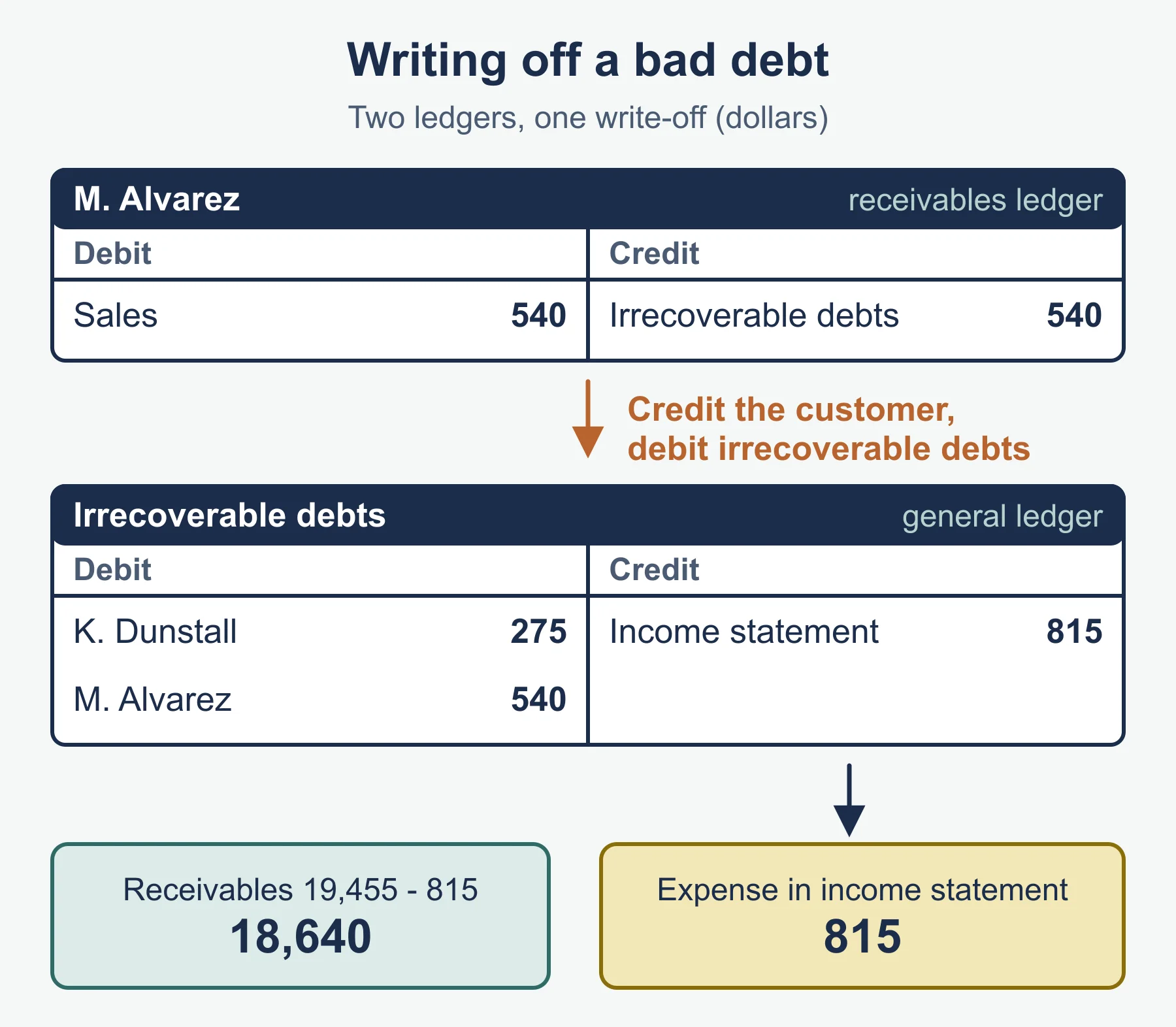
Wynmoor Cycle Works sells bicycles on credit to clubs and schools. In June it decides that K. Dunstall’s balance of 275 cannot be collected. In September it decides the same about M. Alvarez, who owes 540.
| Entry | Debit | Credit |
|---|---|---|
| June write-off | Irrecoverable debts 275 | K. Dunstall account 275 |
| September write-off | Irrecoverable debts 540 | M. Alvarez account 540 |
M. Alvarez account (trade receivables ledger)
| Date | Details | Debit | Date | Details | Credit |
|---|---|---|---|---|---|
| 1 Mar | Sales | 540 | 12 Sep | Irrecoverable debts | 540 |
Irrecoverable debts account (general ledger)
| Date | Details | Debit | Date | Details | Credit |
|---|---|---|---|---|---|
| 30 Jun | K. Dunstall | 275 | 31 Dec | Income statement | 815 |
| 12 Sep | M. Alvarez | 540 | |||
| 815 | 815 |
At the year end the account is cleared into the income statement, where 815 is listed with the expenses. Before the two write-offs the trade receivables total was 19,455. Afterwards it is 18,640, which is the figure that goes into the statement of financial position, or the trial balance, before any provision is deducted.
Provisions for doubtful debts
An irrecoverable debt is certain. A provision for doubtful debts deals with something less certain: among the receivables still on the books, some may not pay, but you cannot yet say which. The business estimates the likely loss, often as a percentage of trade receivables, and sets it aside.
The provision is not a customer’s balance and is not written off against any named account. It is a separate credit balance in the general ledger. In the statement of financial position it is deducted from trade receivables. Because only the change in the provision affects profit, you work with the difference each year.
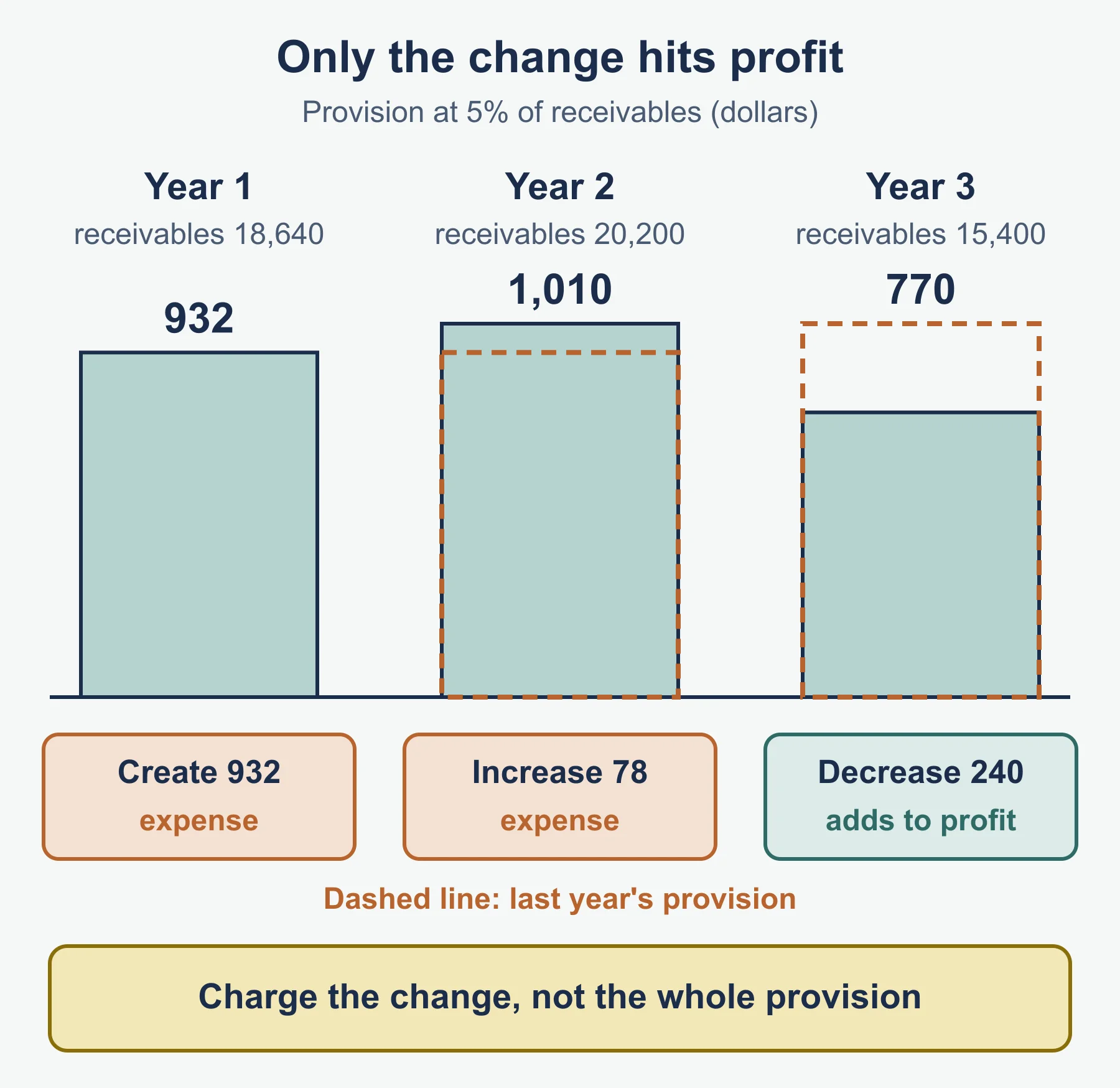
Wynmoor Cycle Works provides 5% of trade receivables, calculated after irrecoverable debts have been written off.
| Year end | Trade receivables | Provision needed at 5% | Existing provision | Change |
|---|---|---|---|---|
| Year 1 | 18,640 | 932 | nil | Create 932 |
| Year 2 | 20,200 | 1,010 | 932 | Increase 78 |
| Year 3 | 15,400 | 770 | 1,010 | Decrease 240 |
Provision for doubtful debts account, year 2
| Date | Details | Debit | Date | Details | Credit |
|---|---|---|---|---|---|
| 31 Dec | Balance c/d | 1,010 | 1 Jan | Balance b/d | 932 |
| 31 Dec | Income statement | 78 | |||
| 1,010 | 1,010 |
Provision for doubtful debts account, year 3
| Date | Details | Debit | Date | Details | Credit |
|---|---|---|---|---|---|
| 31 Dec | Income statement | 240 | 1 Jan | Balance b/d | 1,010 |
| 31 Dec | Balance c/d | 770 | |||
| 1,010 | 1,010 |
In year 2 the increase of 78 is an expense in the income statement, listed with the other expenses. In year 3 the decrease of 240 is a gain that raises profit, shown as a reduction in expenses or as other income. In the year 2 statement of financial position:
| Current assets | |
|---|---|
| Trade receivables | 20,200 |
| Less provision for doubtful debts | (1,010) |
| 19,190 |
Opening and closing inventory
Inventory is the goods the business holds for resale. The income statement needs the cost of the goods actually sold, so it adjusts purchases for the change in inventory:
Cost of sales = opening inventory + purchases - closing inventory
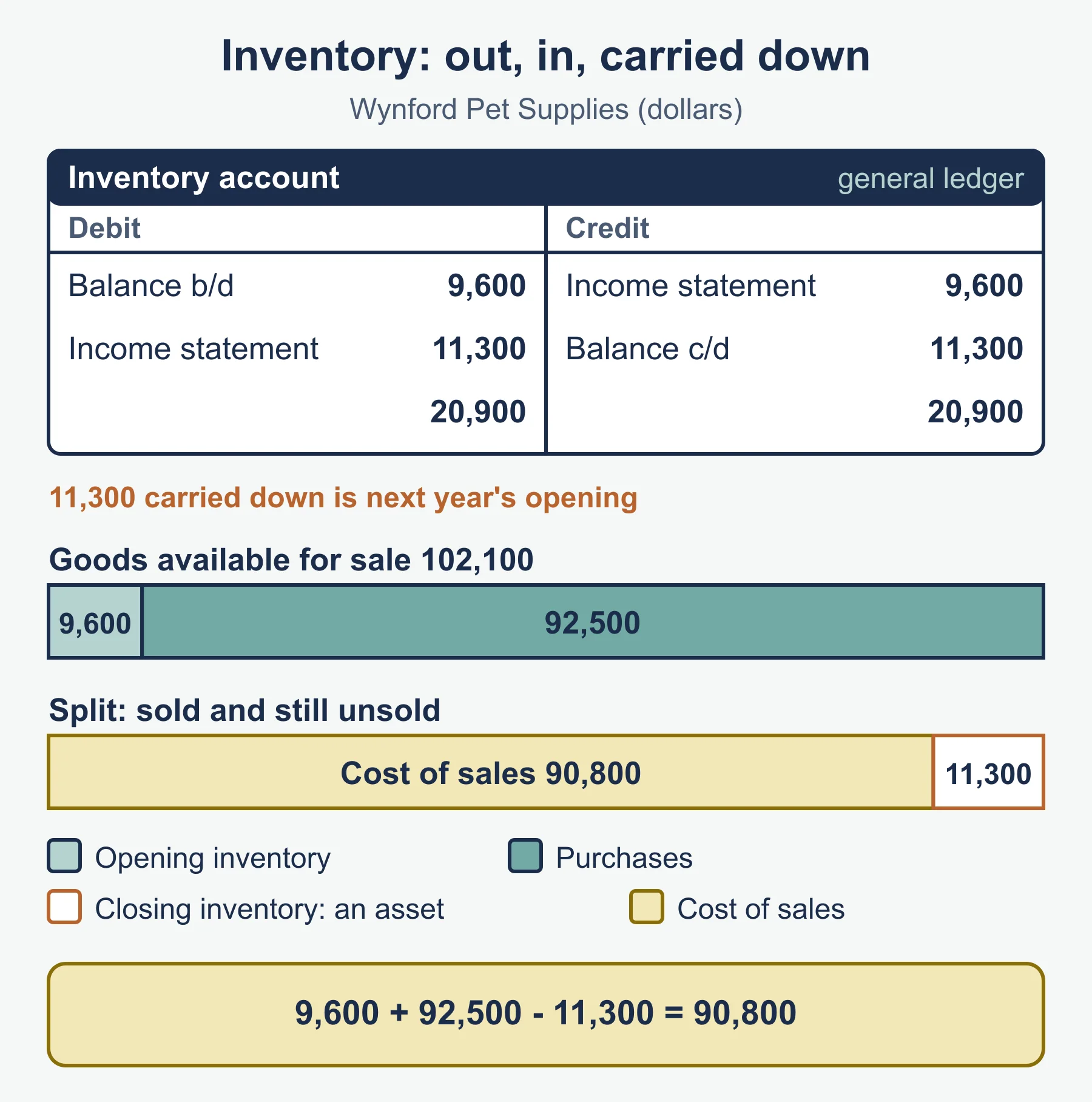
The ledger handles this in two steps. Opening inventory is moved out of the inventory account to the income statement. Closing inventory is moved in from the income statement, and the account’s balance carried down becomes the asset in the statement of financial position. Wynford Pet Supplies has opening inventory of 9,600 and closing inventory of 11,300.
Inventory account
| Date | Details | Debit | Date | Details | Credit |
|---|---|---|---|---|---|
| 1 Jan | Balance b/d | 9,600 | 31 Dec | Income statement | 9,600 |
| 31 Dec | Income statement | 11,300 | 31 Dec | Balance c/d | 11,300 |
| 20,900 | 20,900 |
On 1 January the next year, 11,300 is brought down as the new opening inventory.
Valuing inventory: cost or net realisable value
The starting point is cost, which links to the historic cost concept. If goods will sell for less than they cost, prudence says you must not carry them at more than you can recover. So each line is valued at the lower of cost and net realisable value:
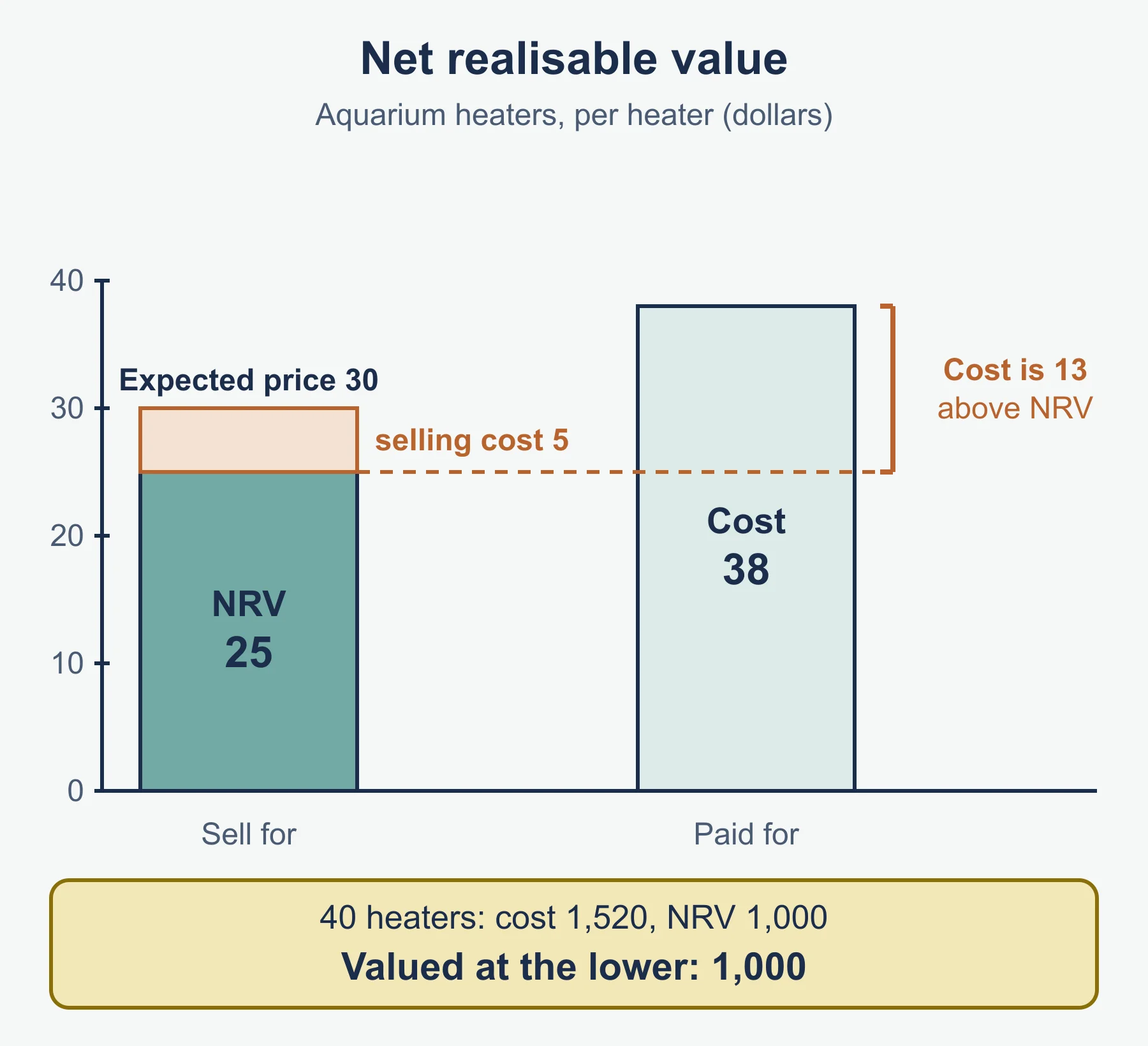
Net realisable value = expected selling price - any costs of repair or completion - selling costs
At the year end Wynford counts three lines. The heaters were stored in damaged boxes: 40 heaters cost 38 each, will probably sell at 30 each, and each needs 5 of selling costs, so net realisable value is 25 each, or 1,000 for the line.
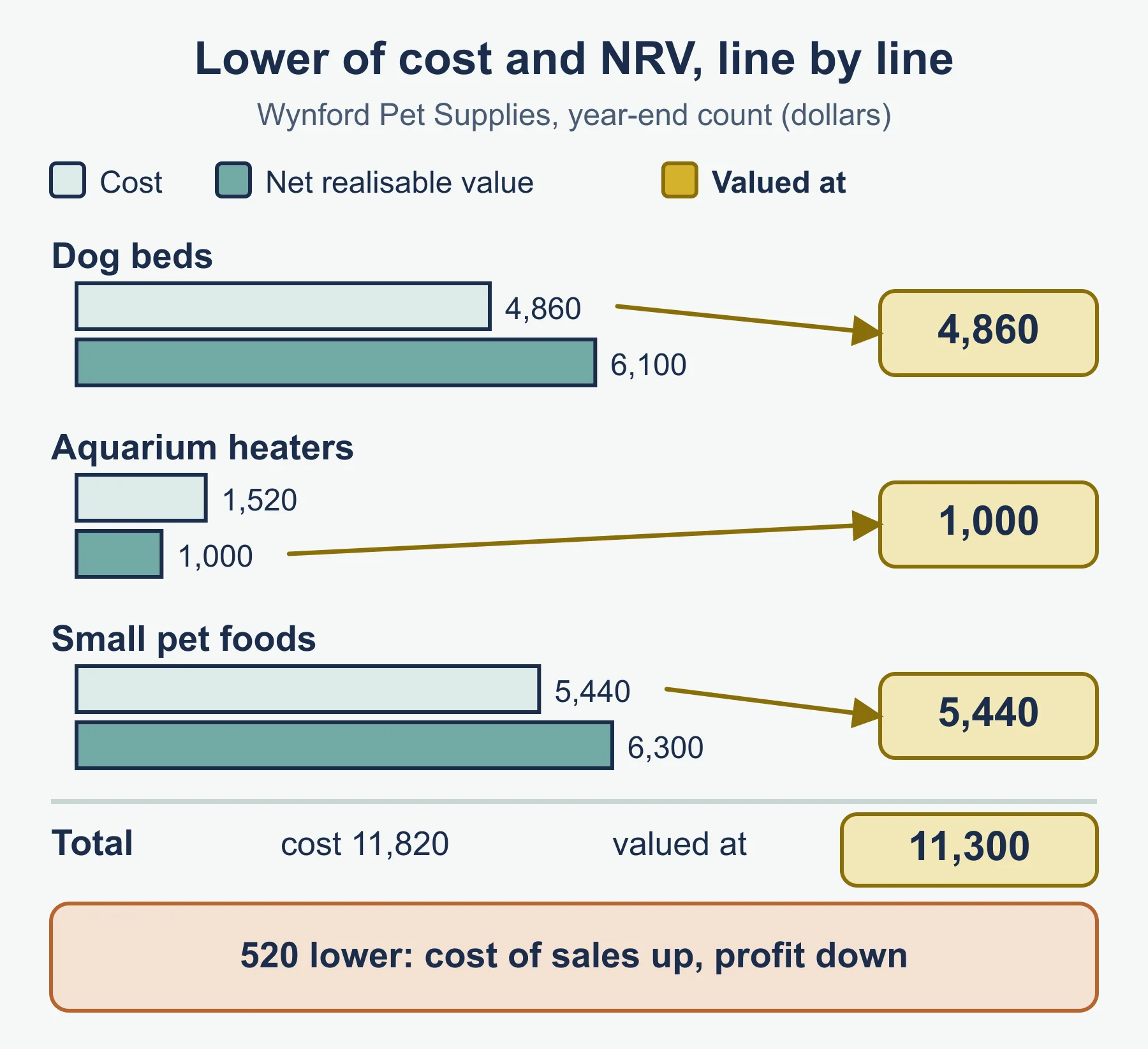
| Line | Cost | Net realisable value | Valued at |
|---|---|---|---|
| Dog beds | 4,860 | 6,100 | 4,860 |
| Aquarium heaters | 1,520 | 1,000 | 1,000 |
| Small pet foods | 5,440 | 6,300 | 5,440 |
| Total | 11,820 | 13,400 | 11,300 |
The value used is 11,300. The 520 difference from cost lowers closing inventory, raises cost of sales and so lowers profit now. A gain is never anticipated: a line worth more than cost stays at cost until it is sold.
Closing inventory is counted line by line each year using the same basis. That is the consistency concept: changing the basis from year to year would make profits impossible to compare.
Putting it together: Wynford Pet Supplies
The trial balance at 31 December shows revenue 148,200, purchases 92,500, opening inventory 9,600, wages 21,400, rent 6,000, general expenses 4,300, irrecoverable debts 780 (already written off), trade receivables 14,600 and a provision for doubtful debts of 500. Closing inventory is 11,300, from the table above. The provision is to be 5% of trade receivables: 730, an increase of 230.
Income statement for the year ended 31 December
| Revenue | 148,200 | |
| Opening inventory | 9,600 | |
| Purchases | 92,500 | |
| 102,100 | ||
| Less closing inventory | (11,300) | |
| Cost of sales | (90,800) | |
| Gross profit | 57,400 | |
| Wages | 21,400 | |
| Rent | 6,000 | |
| General expenses | 4,300 | |
| Irrecoverable debts | 780 | |
| Increase in provision for doubtful debts | 230 | |
| Total expenses | (32,710) | |
| Net profit | 24,690 |
Statement of financial position (extract)
| Current assets | ||
|---|---|---|
| Inventory | 11,300 | |
| Trade receivables | 14,600 | |
| Less provision for doubtful debts | (730) | 13,870 |
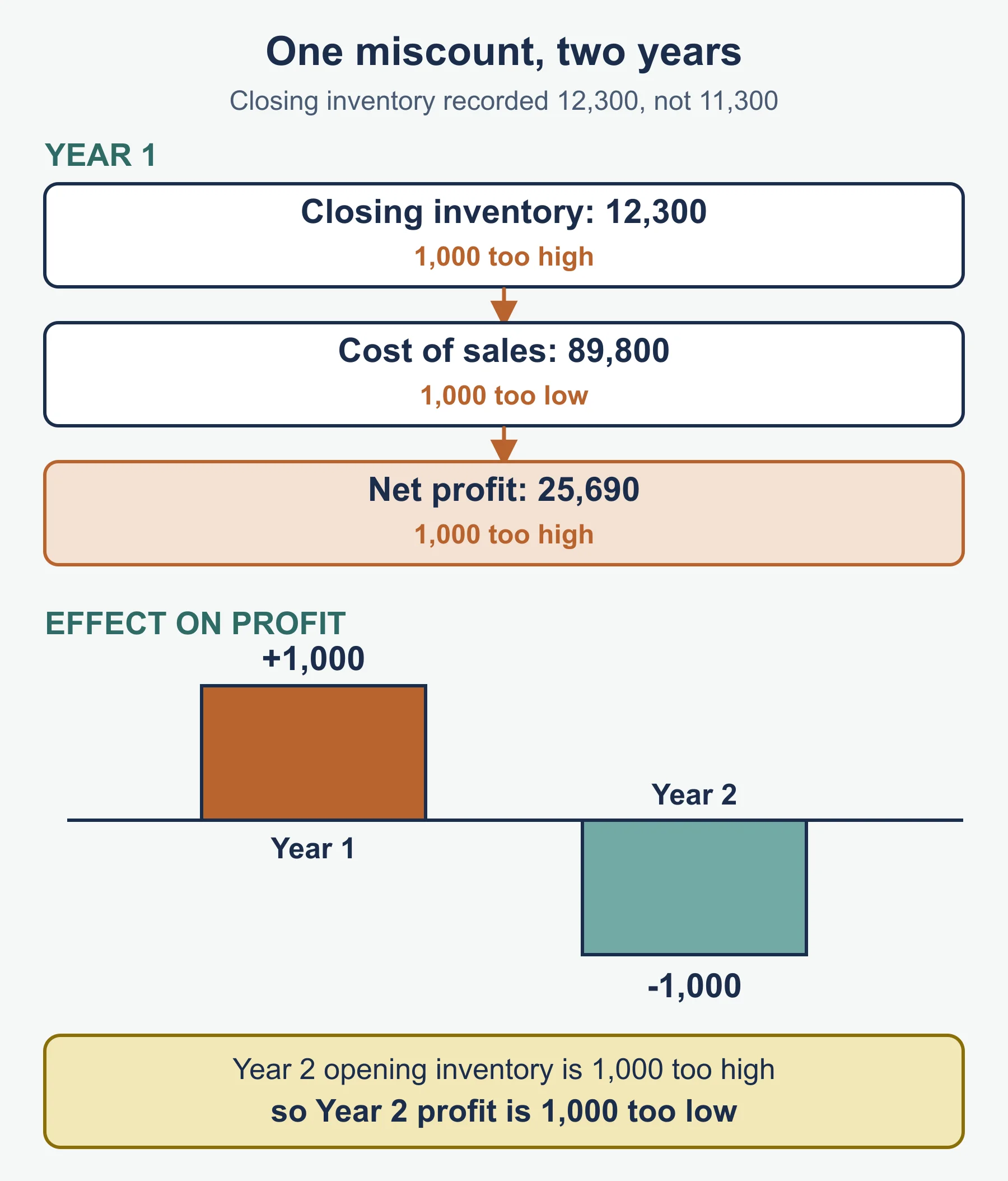
Suppose closing inventory had been wrongly recorded as 12,300. Cost of sales would fall to 89,800, and net profit would rise to 25,690, an overstatement of 1,000. The next year’s opening inventory would then be 1,000 too high, which understates that year’s profit by the same amount.
The concepts behind the adjustments
- Prudence: do not overstate assets or profit. It supports the provision and the lower-of-cost-and-net-realisable-value rule.
- Accruals: the loss on sales belongs to the period of the sales, which is why a provision is made each year end rather than waiting for debts to go bad.
- Historic cost: inventory starts at what it cost, not what you hope to sell it for.
- Consistency: use the same method of calculating the provision and valuing inventory from year to year.
- Going concern: you value goods on the basis that the business will keep trading and selling them in the normal way.
Common errors
- Debiting the customer’s account when writing off a debt. The customer is credited.
- Calculating the provision on trade receivables before irrecoverable debts are removed.
- Charging the whole provision to the income statement each year instead of only the change.
- Treating a decrease in the provision as an expense.
- Deducting the provision from inventory rather than trade receivables.
- Valuing a line above cost because its net realisable value is higher.
- Adding closing inventory in the expenses instead of deducting it in the calculation of cost of sales.
Next, try the practice questions, then use the revision notes to consolidate.
Frequently asked questions
How is an irrecoverable debt written off? Credit the customer’s account in the trade receivables ledger and debit the irrecoverable debts account in the general ledger. At the year end the irrecoverable debts account is cleared into the income statement as an expense.
Why does a business keep a provision for doubtful debts? Among the receivables still on the books, some may not pay, but the business cannot yet say which. It estimates the likely loss, often as a percentage of trade receivables, and sets it aside, which applies the prudence concept.
How is cost of sales calculated? Cost of sales = opening inventory + purchases − closing inventory. In the ledger, opening inventory is moved to the income statement and closing inventory is brought in from it.
Is the recovery of irrecoverable debts examined in OxfordAQA 9215? No. The specification states that the recovery of irrecoverable debts will not be examined.
How is net realisable value calculated for inventory? Net realisable value = expected selling price − any costs of repair or completion − selling costs. Each line is valued at the lower of cost and net realisable value.
Official syllabus
OxfordAQA International GCSE Accounting (9215), specification version 1.2, for exams from May/June 2026 onwards, published by OxfordAQA. This guide covers part of section 3.3.
Get free revision emails (optional)
Occasional emails with practice questions, worked explanations and links to free resources for the qualification and subjects you choose. No spam, and you can unsubscribe from any email. The free tools on this site never need an email.
Related resources
-
Practice questions
OxfordAQA IGCSE Accounting: Irrecoverable debts, provisions and inventory (9215) – Practice Questions
Original questions with worked answers on irrecoverable debts, provisions for doubtful debts and inventory, for OxfordAQA IGCSE Accounting 9215.
Accounting · OxfordAQA · IGCSE
Try questions -
Revision notes
OxfordAQA IGCSE Accounting: Irrecoverable debts, provisions and inventory (9215) – Revision Notes
Condensed notes on irrecoverable debts, provisions for doubtful debts and opening and closing inventory for OxfordAQA International GCSE Accounting 9215.
Accounting · OxfordAQA · IGCSE
Revise topic -
Study guides
OxfordAQA IGCSE Accounting: Adjustments for other payables, other receivables and income (9215)
Study guide to ledger entries and statement effects for other payables, other receivables, income due and income received in advance, OxfordAQA 9215.
Accounting · OxfordAQA · IGCSE
Read guide
Related articles
-
teaching
A Level tuition in Dubai: Cambridge or Pearson Edexcel International A Level?
Schools in Dubai and Abu Dhabi teach either Cambridge International AS & A Level or Pearson Edexcel International A Level. How the two are structured, why it matters for tuition, and how online classes from Lahore work.
9 October 2026
-
curriculum guides
Choosing subjects at IGCSE and A Level
How subject choices at 14 and 16 affect university options later, and how to keep pathways open without overloading a timetable.
28 July 2026
Studying this with a teacher
Working through Accounting IGCSE?
This page is free and stays free. If you would rather be taught it, Marlbridge runs Accounting classes one-to-one and in small groups of up to 15, online in your own time zone. The first trial class is free. WhatsApp replies within an hour (8am–11pm Pakistan time, every day); email the same day.
OxfordAQA Accounting teachers at Marlbridge

