
Revision Notes
OxfordAQA IGCSE Accounting: Capital and revenue, depreciation and disposal (9215) – Revision Notes
Revision notes on capital and revenue items, depreciation methods and the disposal account for OxfordAQA IGCSE Accounting 9215.
- Subject
- Accounting
- Level
- IGCSE
- Topic
- Development of the accounting model
- Author
- Marlbridge Academic Team
- Updated
- Reviewed by
- Javaid Iqbal Sabri (what this means)
Aligned to OxfordAQA IGCSE Accounting (9215), First teaching 2024, first examined 2026. Official specification .
Syllabus page (what it covers and how it is assessed): OxfordAQA IGCSE Accounting.
Syllabus points this page covers
9215
- Capital and revenue expenditure and income
Found an error? Report a correction.
Need help with this topic? Request a free trial class for IGCSE Accounting (9215).
These notes condense the part of section 3.3 of the OxfordAQA International GCSE Accounting (9215) specification, version 1.2 (exams from May/June 2026), that deals with capital and revenue items, depreciation and disposals. Full explanations and worked examples are in the study guide. Test yourself with the practice set. Other links: course hub, checklist and free diagnostics. Amounts are in dollars. For double entry practice, see the recording notes.
Capital and revenue at a glance
| Capital | Revenue | |
|---|---|---|
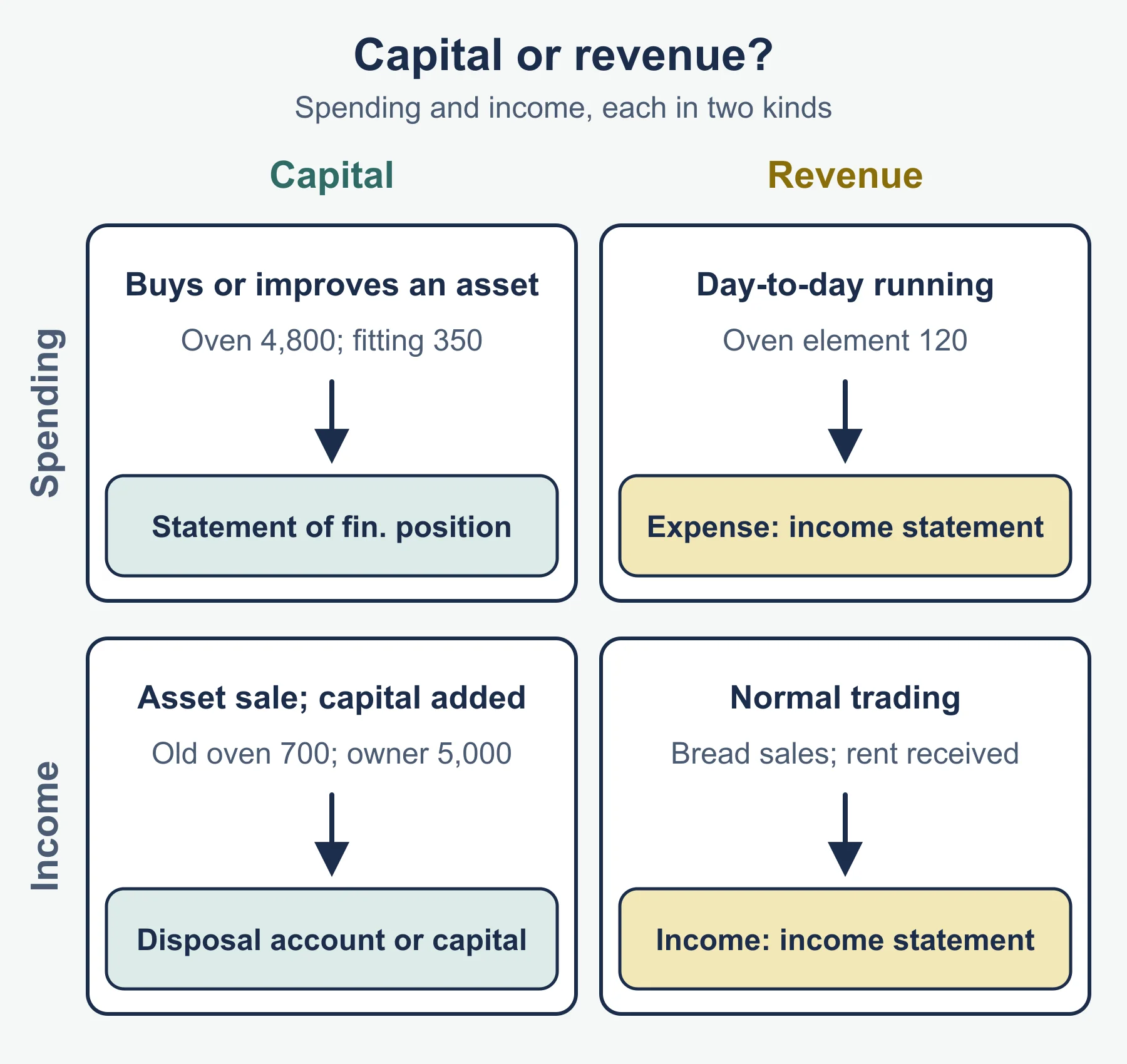
| Expenditure | Buys or improves a non-current asset, or gets it ready for use | Running costs and keeping assets in working order |
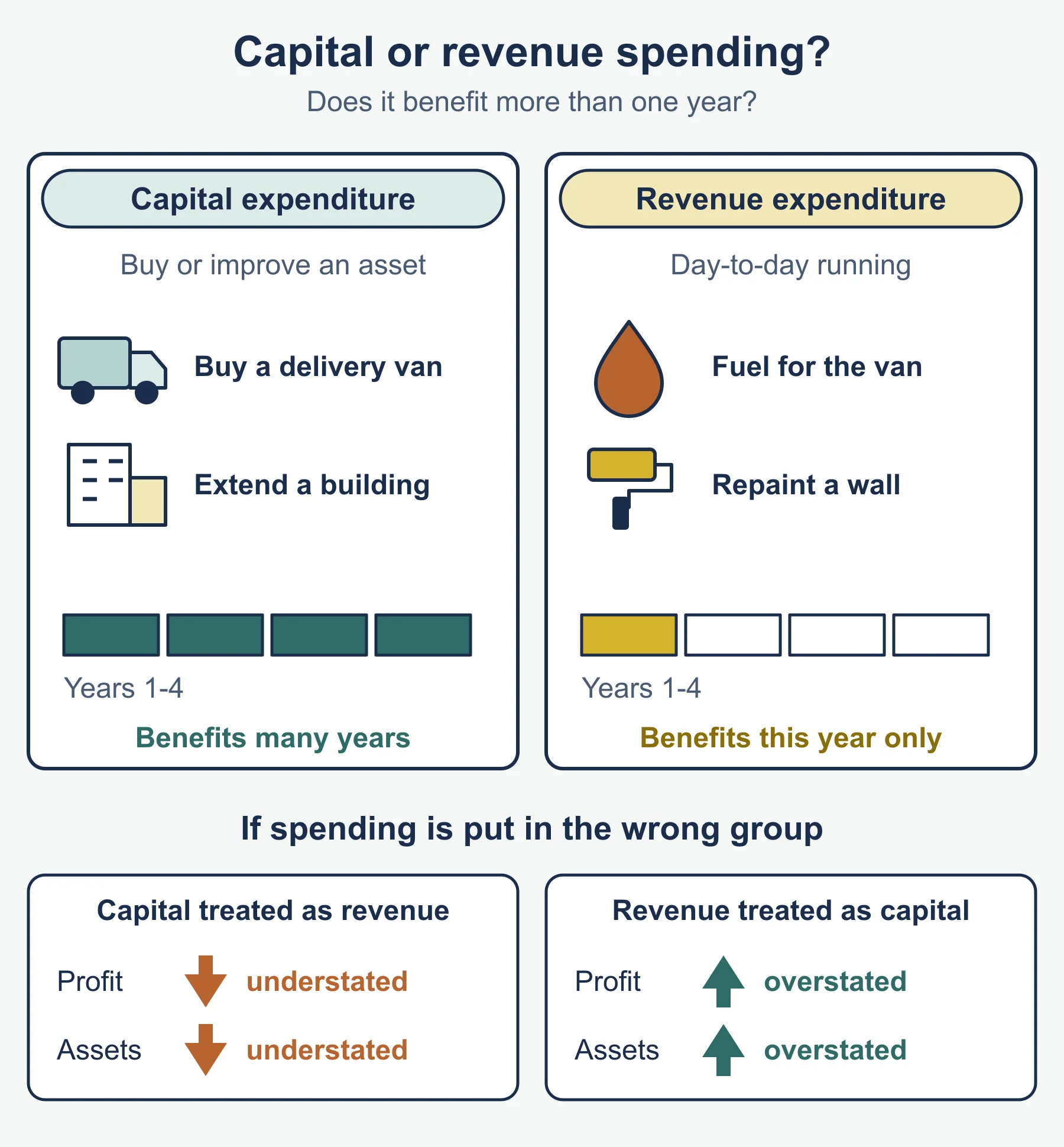
| Benefit lasts | More than one period | The current period |
| Shown in | Statement of financial position | Income statement |
| Income | Sale proceeds of a non-current asset; capital introduced by the owner | Sales, rent received, commission received |
Test question: does this spending add to what the business owns for the long term, or does it keep things running? Delivery, installation and legal costs of acquiring an asset are capital. Repairs and servicing are revenue.
Typical capital expenditure: buying a vehicle, fitting out new premises, paying carriage on a machine bought, legal fees on buying a building. Typical revenue expenditure: wages, fuel, insurance, servicing a vehicle, replacing a small part. Typical capital income: money from selling an old van, extra capital paid in by the owner. Typical revenue income: sales, fees earned, interest received, rent received.
If an item is put in the wrong place
| Error | Profit | Assets |
|---|---|---|
| Capital item charged as an expense | Understated | Understated |
| Revenue item added to an asset | Overstated | Overstated |
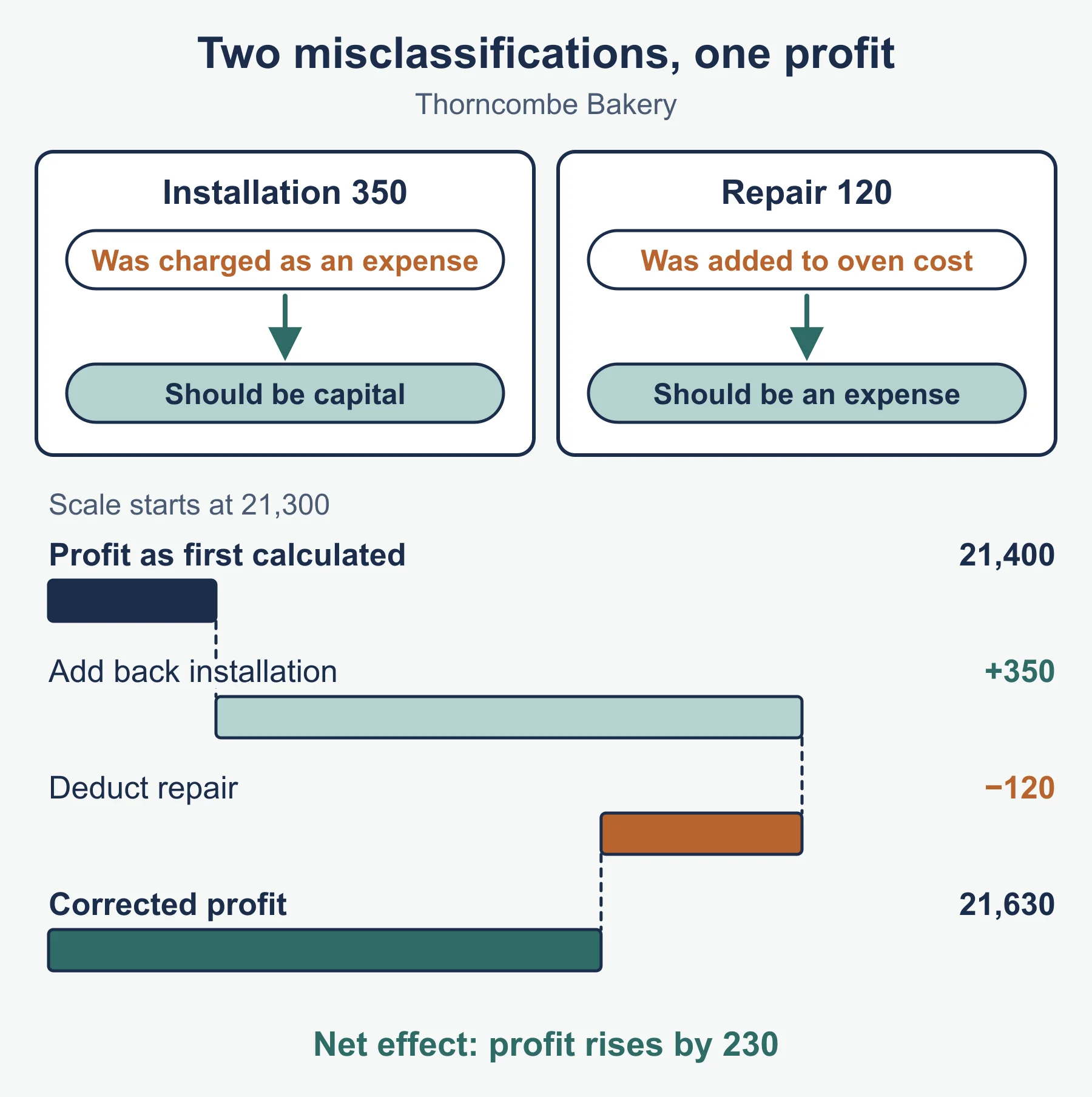
Correct profit by adding back the capital item wrongly expensed, or deducting the revenue item wrongly capitalised. Ignore the small depreciation effect unless asked.
Why assets depreciate
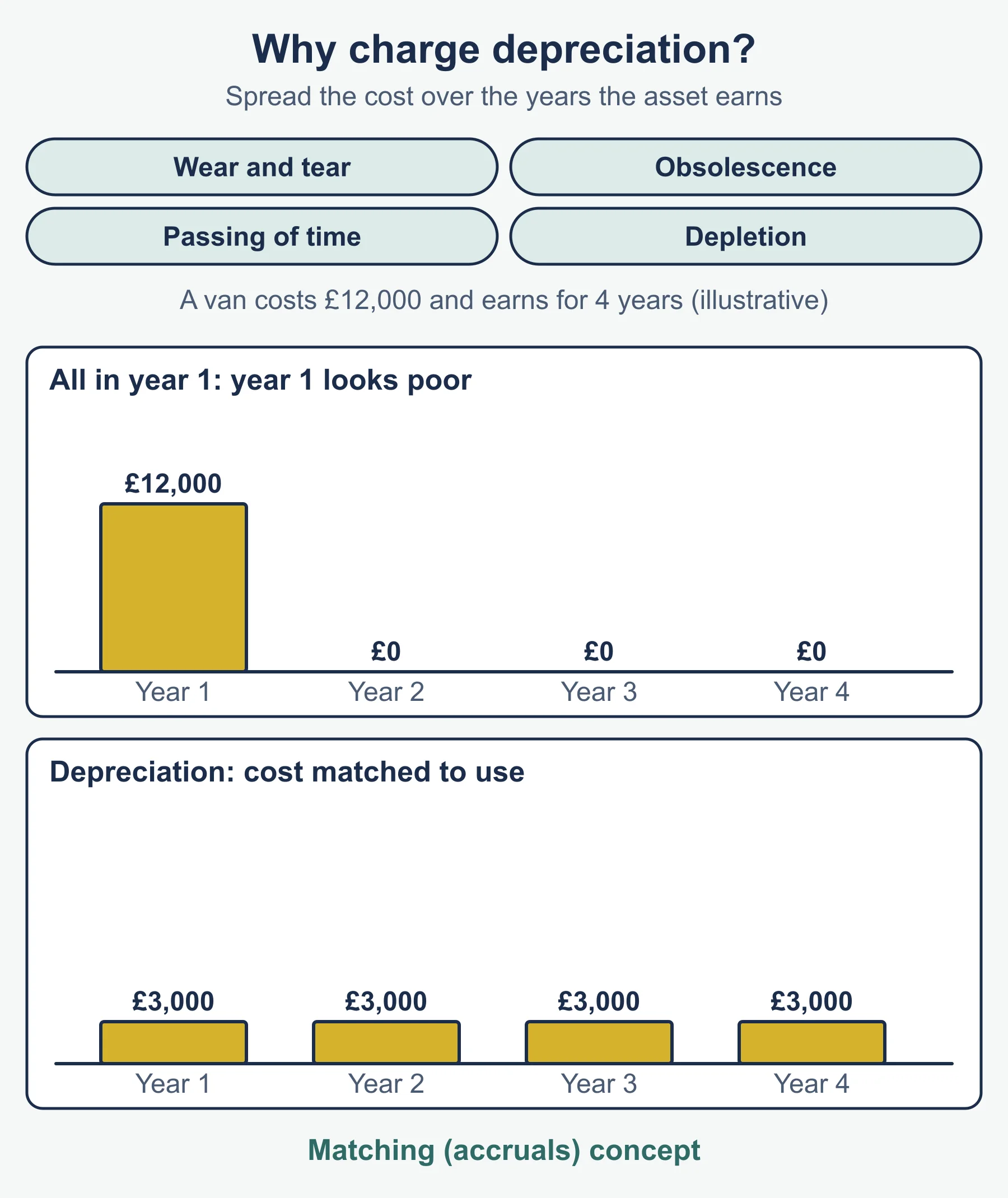
- Wear and tear from use.
- Obsolescence: replaced by newer, better equipment.
- Passage of time and age.
Depreciation spreads cost over the useful life. It is not a market valuation.
Depreciation is a non-cash expense
- Cash leaves when the asset is bought, not when depreciation is charged.
- The charge reduces profit.
- The charge reduces the value of the asset in the statement of financial position.
- Net book value (NBV) = cost − provision for depreciation.
The two methods
| Straight line | Reducing balance | |
|---|---|---|
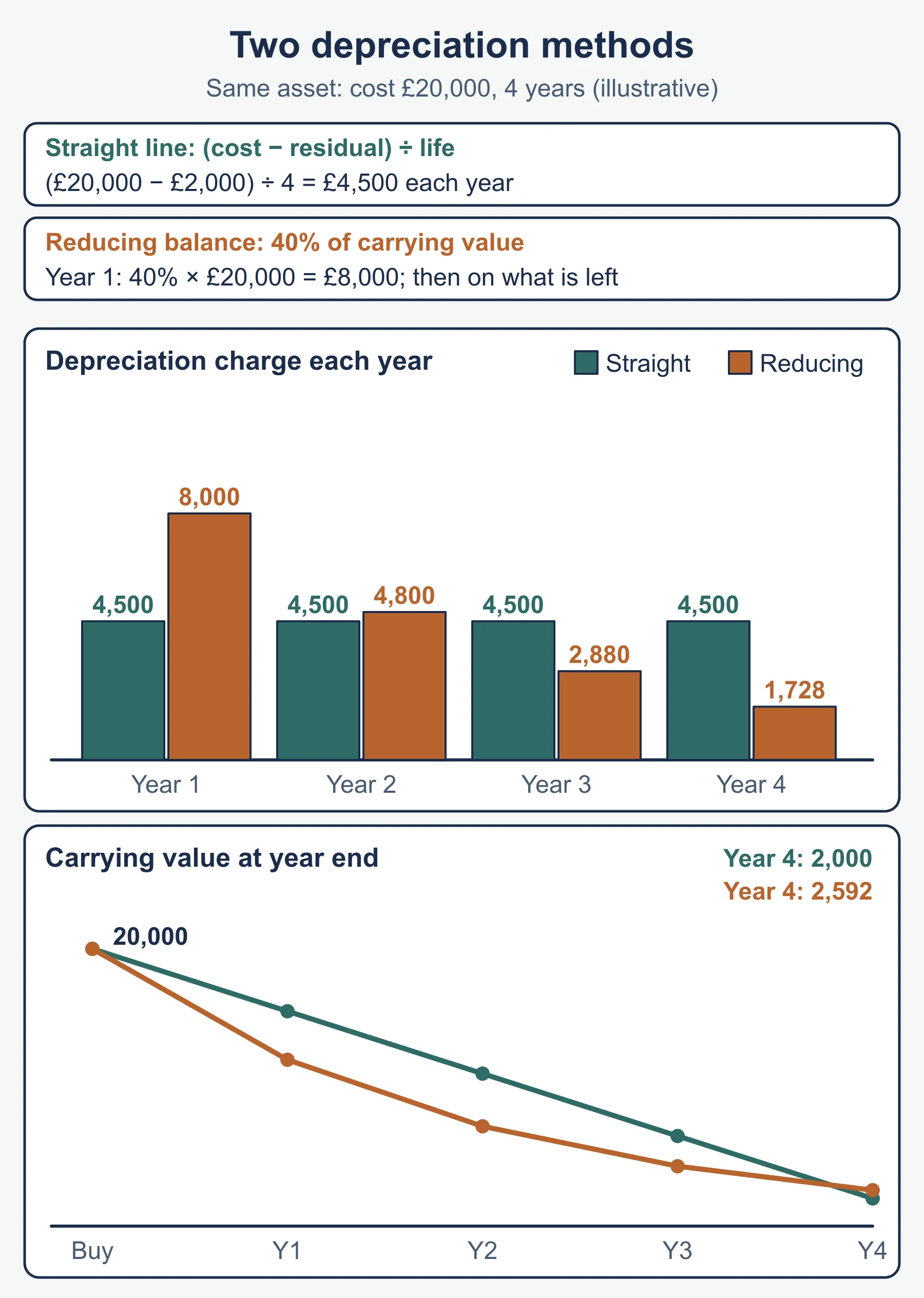
| Charge | (Cost − residual value) ÷ life | Fixed % of NBV at start of year |
| Pattern | Same every year | Falls each year |
| Residual value | Deducted before dividing | Not deducted in the calculation |
| Suits | Assets used evenly | Assets that lose value fastest early on |
Use one method consistently.
Worked reminder: both methods
Machine cost 36,000.
- Straight line, residual 4,000, life 8 years: (36,000 − 4,000) ÷ 8 = 4,000 each year.
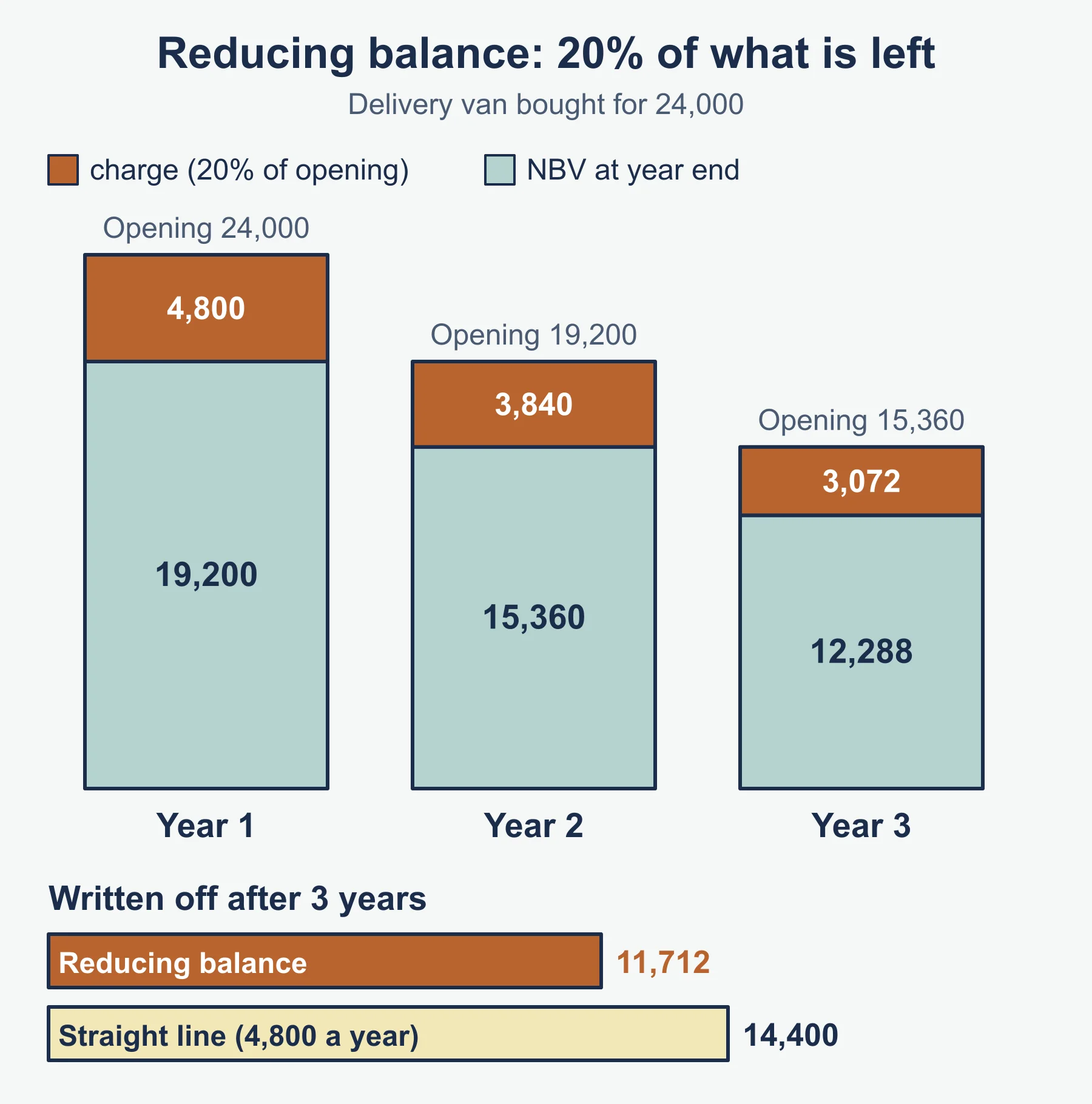
- 20% reducing balance: Year 1 is 7,200 (NBV 28,800); Year 2 is 5,760 (NBV 23,040); Year 3 is 4,608 (NBV 18,432).
Method in steps: recording depreciation
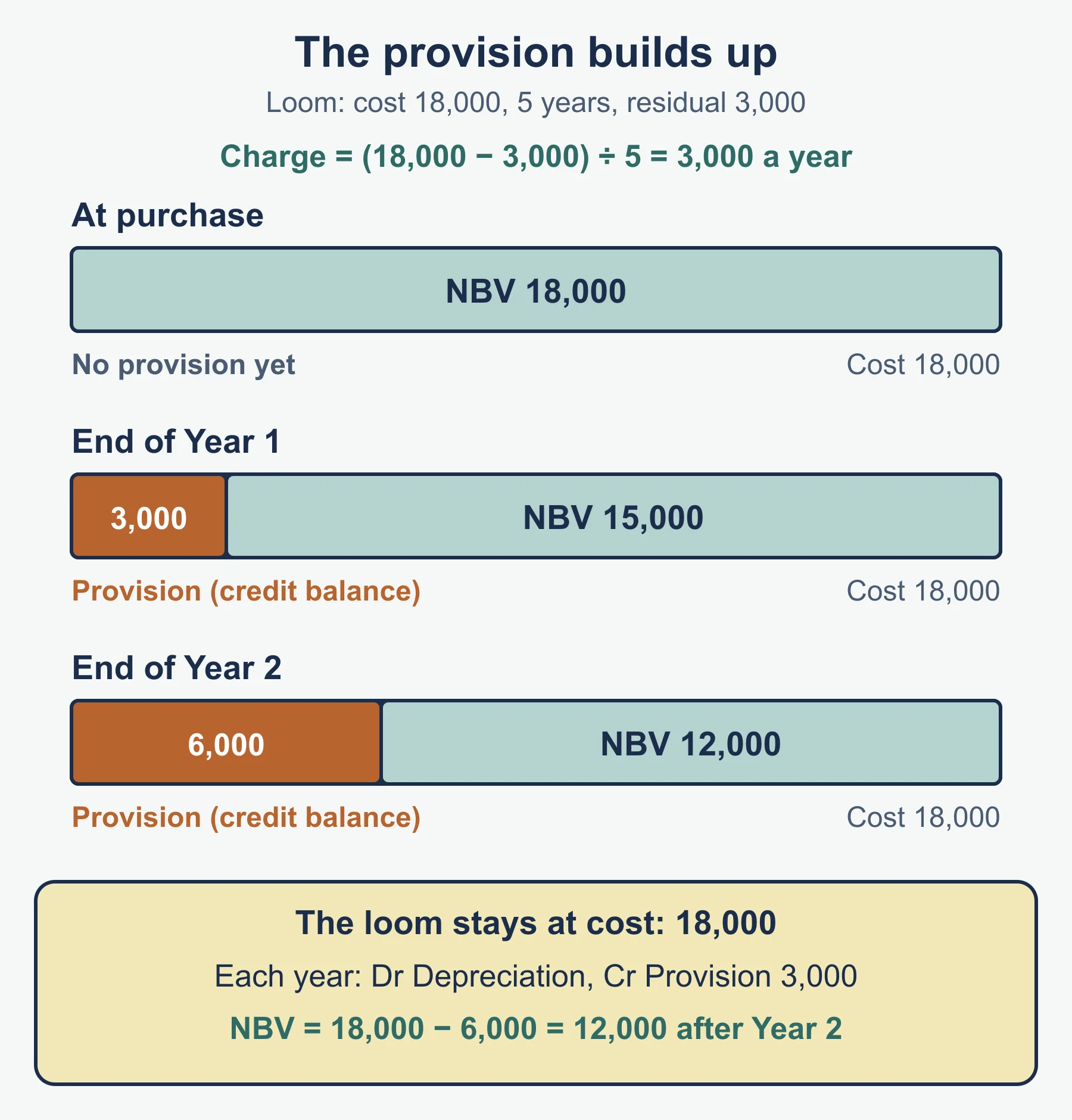
- Debit depreciation account, credit provision for depreciation account.
- Transfer the depreciation account to the income statement.
- Carry the provision forward as a credit balance (it grows each year).
- Asset account stays at cost.
- In the statement of financial position, show cost, less provision, equals NBV.
| Account | Side | Amount |
|---|---|---|
| Depreciation | Debit | Year’s charge |
| Provision for depreciation | Credit | Year’s charge |
| Income statement | Debit | Year’s charge |
Worked reminder: the second year of a reducing balance asset
Equipment cost 16,000 and is depreciated at 25% reducing balance. Year 1 charge is 4,000 and the NBV is 12,000. Year 2 charge is 25% × 12,000 = 3,000.
| Provision for depreciation | Debit | Credit |
|---|---|---|
| Year 2 balance c/d | 7,000 | |
| Year 2 balance b/d | 4,000 | |
| Year 2 depreciation | 3,000 | |
| Totals | 7,000 | 7,000 |
Statement of financial position extract: equipment 16,000, less provision 7,000, NBV 9,000.
Method in steps: disposal account
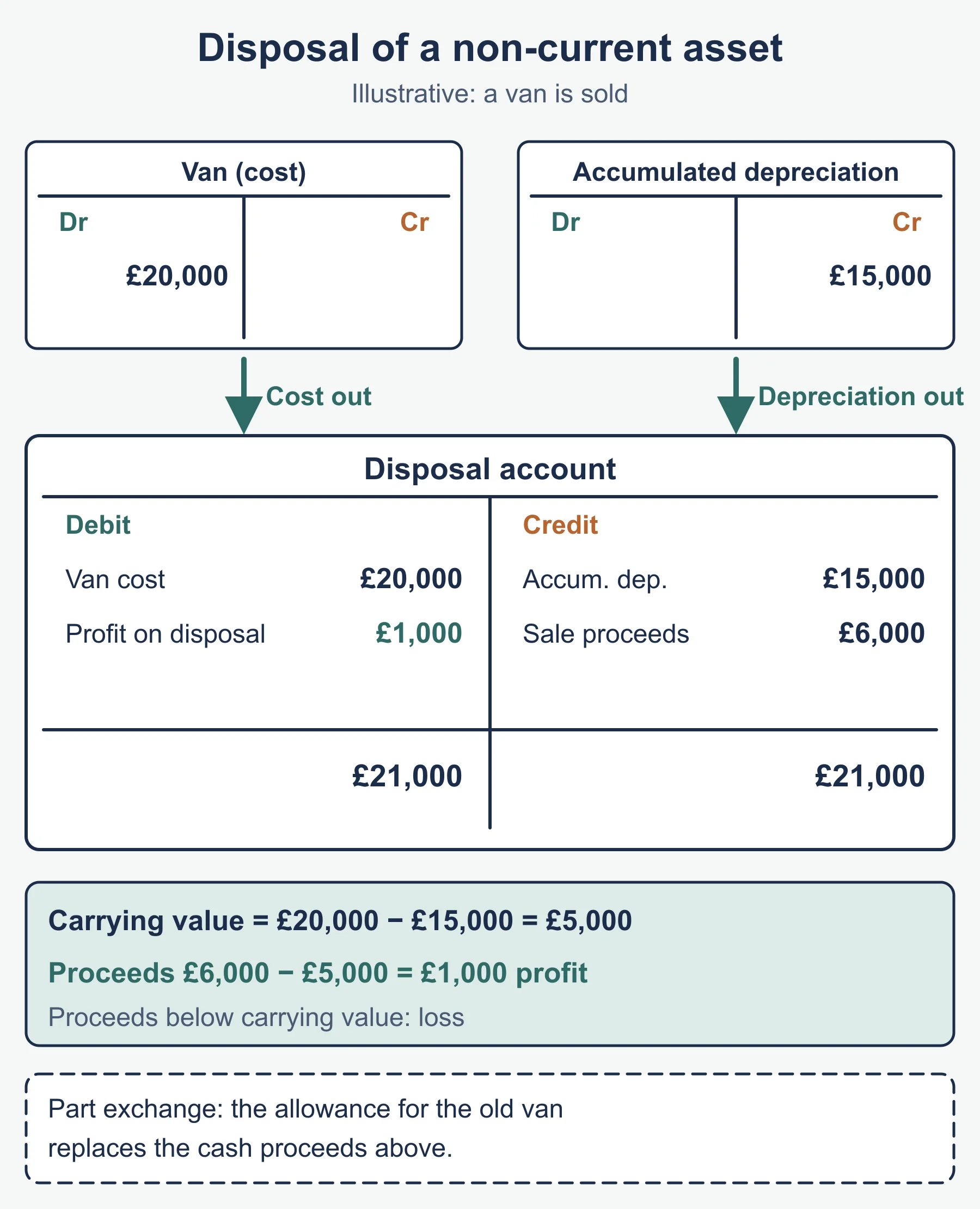
- Debit: the asset account at cost.
- Credit: the provision for depreciation on that asset.
- Credit: the sale proceeds (debit bank, or the account of the buyer if on credit).
- Balance the account. The difference is the profit or loss.
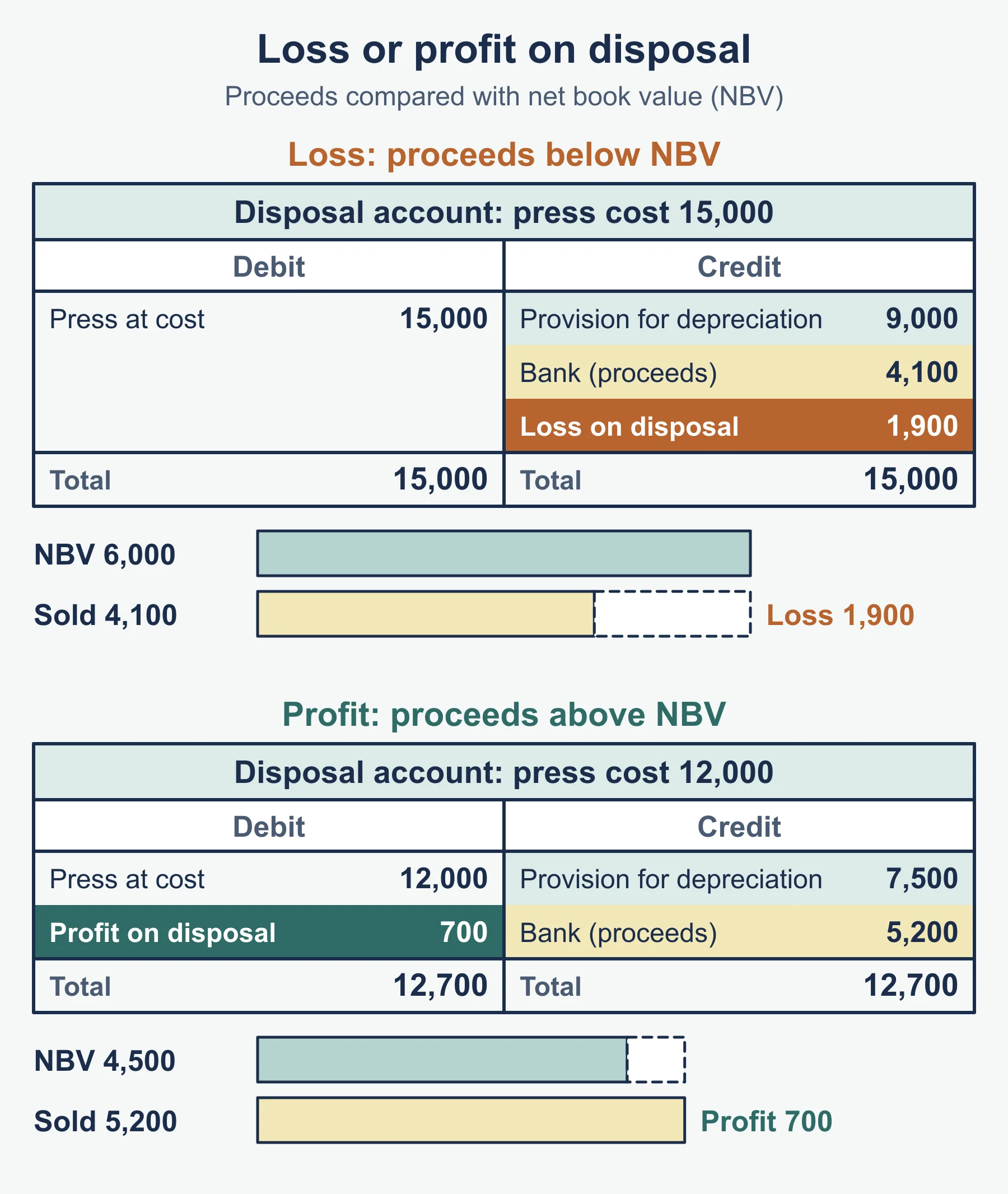
- Credits fall short of the debit: loss, entered on the credit side.
- Credits exceed the debit: profit, entered on the debit side.
- Transfer the profit or loss to the income statement.
Quick check: profit or loss = proceeds − NBV.
Worked reminder: a loss
Cost 30,000; provision 21,000; sold for 7,000.
| Debit | Credit | ||
|---|---|---|---|
| Asset at cost | 30,000 | Provision for depreciation | 21,000 |
| Bank | 7,000 | ||
| Loss on disposal | 2,000 | ||
| Total | 30,000 | Total | 30,000 |
NBV is 9,000, proceeds are 7,000, so the loss is 2,000.
Worked reminder: a profit
Cost 20,000; provision 12,000; sold for 9,500. NBV is 8,000, so there is a profit of 1,500. The debit side holds the asset at cost (20,000) and the profit (1,500), a total of 21,500. The credit side holds the provision (12,000) and the bank receipt (9,500), also 21,500.
Part-year depreciation before sale
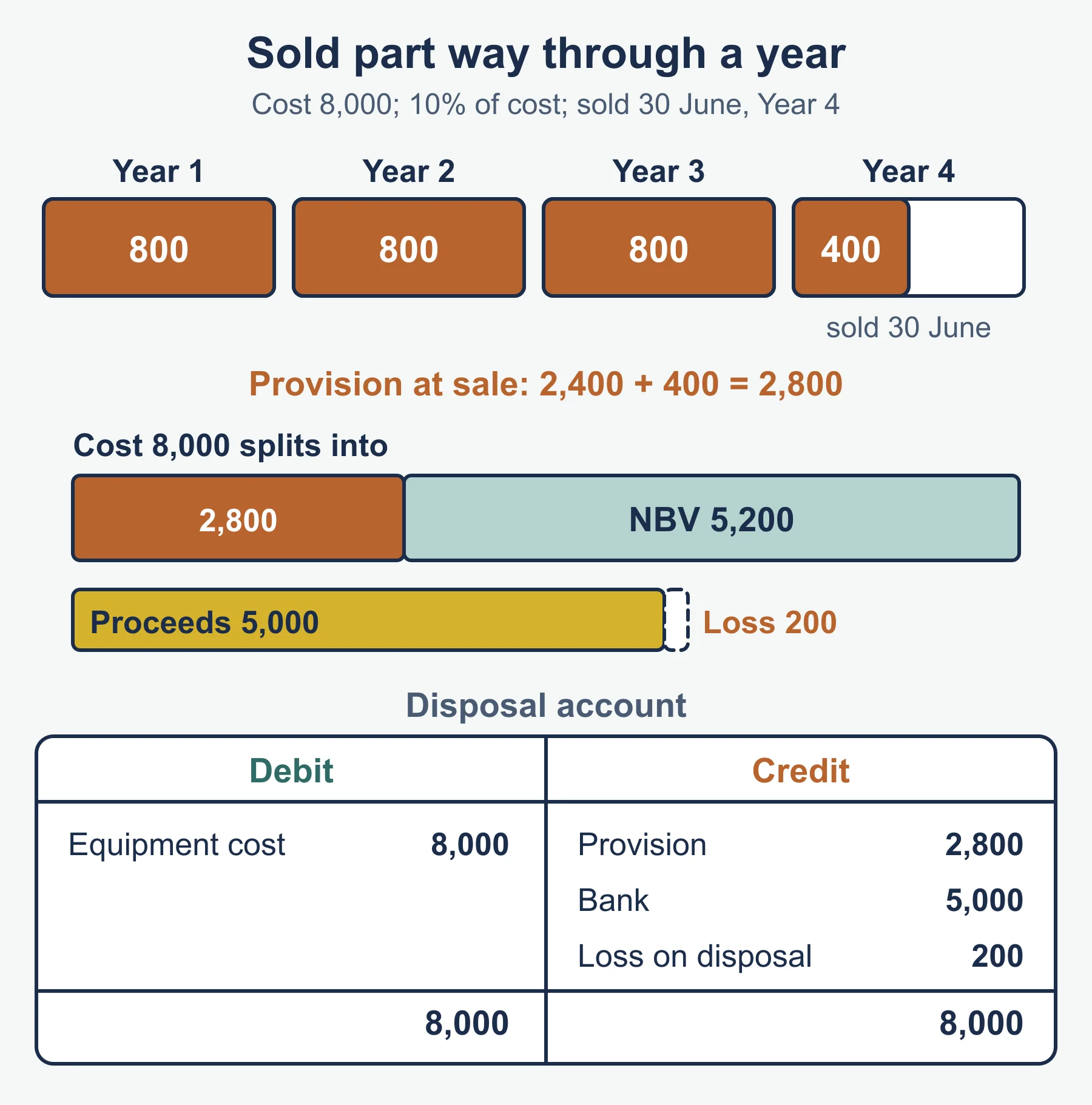
If the asset is sold part way through the year and the question says to charge depreciation for the months owned, charge it first, add it to the provision, then open the disposal account. Read the question for the policy used.
Wording to use in written answers
- Say “capital expenditure” or “revenue expenditure”, then give the reason in one clause: “it brings the asset into use” or “it keeps the asset in working order”.
- For a reason why an asset depreciates, name the cause and link it to the asset: “newer machines make this one obsolete, so it earns less”.
- For non-cash, say what does not happen: no money leaves the bank when the charge is posted.
- For a disposal, label the entry as profit or loss on disposal and say it goes to the income statement.
Must-know distinctions
- Cost versus NBV: the asset account holds cost; NBV is cost less provision.
- Depreciation expense versus provision: the expense is the year’s charge in the income statement; the provision is the total to date in the statement of financial position.
- Loss on disposal versus a fall in value: the loss is measured against NBV, not against cost.
- Capital income versus revenue income: sale proceeds of a non-current asset are not sales.
- Straight line versus reducing balance: only straight line subtracts a residual value in the formula.
Quick self-test
- Is buying a photocopier for the office capital or revenue expenditure?
- Is replacing a broken window pane capital or revenue expenditure?
- Give two reasons why a non-current asset depreciates.
- Straight line: cost 45,000, residual value 5,000, life 10 years. Annual charge?
- 30% reducing balance on cost 50,000. What is the charge in Year 2?
- Cost 50,000, provision 38,000, sold for 9,500. State the profit or loss.
- On which side of the disposal account does the provision for depreciation appear?
- Is depreciation a cash flow? Explain briefly.
- Repairs of 2,000 are wrongly added to the cost of an asset. What is the effect on profit?
- 20% reducing balance on 36,000. What is the provision after three years?
- Are the proceeds of selling old equipment capital or revenue income?
- Cost 18,000, provision 7,500. What is the NBV?
Answers
- Capital expenditure.
- Revenue expenditure.
- Any two from: wear and tear, obsolescence, passage of time.
- (45,000 − 5,000) ÷ 10 = 4,000.
- Year 1 charge 15,000, NBV 35,000, so Year 2 is 30% × 35,000 = 10,500.
- NBV 12,000, proceeds 9,500, so a loss of 2,500.
- The credit side.
- No. The cash went out when the asset was bought; the charge only reduces profit and the asset value.
- Profit is overstated by 2,000 (before any depreciation effect).
- NBV after three years is 18,432, so the provision is 36,000 − 18,432 = 17,568.
- Capital income.
- 18,000 − 7,500 = 10,500.
Where marks are usually lost
- Describing a repair as capital because it is expensive, when its purpose is upkeep.
- Writing a reason for depreciation as “the asset gets old” with no link to wear, obsolescence or time.
- Using the straight line formula without deducting the residual value.
- Applying the reducing balance percentage to the original cost each year.
- Putting the profit on the credit side of the disposal account, or the loss on the debit side.
- Entering NBV in the disposal account instead of cost and provision separately.
- Leaving out the provision for depreciation in the statement of financial position extract.
- Treating the depreciation charge as a payment that reduces the bank balance.
- Missing the months of depreciation owed in the year of sale when the question asks for them.
Frequently asked questions
How do you tell capital expenditure from revenue expenditure? Ask whether the spending adds to what the business owns for the long term, or keeps the business running day to day. Buying a vehicle or paying carriage on a machine bought is capital expenditure; wages, fuel, insurance and servicing a vehicle are revenue expenditure.
Why do non-current assets depreciate? Through wear and tear from use, obsolescence when newer, better equipment replaces them, and the passage of time. Depreciation spreads the cost over the useful life; it is not a market valuation.
Is depreciation a cash expense? No. Cash leaves when the asset is bought, not when depreciation is charged. The charge reduces profit and the net book value of the asset, but not the bank balance.
How is depreciation recorded in OxfordAQA International GCSE Accounting 9215? Debit the depreciation account and credit the provision for depreciation account with the year’s charge, then transfer the depreciation to the income statement. The statement of financial position shows cost less the provision, giving net book value.
Are proceeds from selling a non-current asset sales income? No. Sale proceeds of a non-current asset are capital income, recorded in the disposal account, not sales.
Official syllabus
OxfordAQA International GCSE Accounting (9215), specification version 1.2, first teaching 2024, first examined 2026, published by OxfordAQA. Section 3.3, Development of the accounting model.
Get free revision emails (optional)
Occasional emails with practice questions, worked explanations and links to free resources for the qualification and subjects you choose. No spam, and you can unsubscribe from any email. The free tools on this site never need an email.
Related resources
-
Study guides
OxfordAQA IGCSE Accounting: General accounting concepts and their use (9215)
Study guide to the ten general accounting concepts in OxfordAQA International GCSE Accounting 9215 and how each shapes records, valuations and statements.
Accounting · OxfordAQA · IGCSE
Read guide -
Practice questions
OxfordAQA IGCSE Accounting: General accounting concepts and their use (9215) – Practice Questions
Eleven original practice questions with worked answers on the general accounting concepts and their use, for OxfordAQA International GCSE Accounting 9215.
Accounting · OxfordAQA · IGCSE
Try questions -
Revision notes
OxfordAQA IGCSE Accounting: General accounting concepts and their use (9215) – Revision Notes
Condensed notes on the ten general accounting concepts in OxfordAQA International GCSE Accounting 9215, with worked reminders and a self-test.
Accounting · OxfordAQA · IGCSE
Revise topic
Related articles
-
teaching
A Level tuition in Dubai: Cambridge or Pearson Edexcel International A Level?
Schools in Dubai and Abu Dhabi teach either Cambridge International AS & A Level or Pearson Edexcel International A Level. How the two are structured, why it matters for tuition, and how online classes from Lahore work.
9 October 2026
-
curriculum guides
Choosing subjects at IGCSE and A Level
How subject choices at 14 and 16 affect university options later, and how to keep pathways open without overloading a timetable.
28 July 2026
Studying this with a teacher
Working through Accounting IGCSE?
This page is free and stays free. If you would rather be taught it, Marlbridge runs Accounting classes one-to-one and in small groups of up to 15, online in your own time zone. The first trial class is free. WhatsApp replies within an hour (8am–11pm Pakistan time, every day); email the same day.
OxfordAQA Accounting teachers at Marlbridge

