
Study Guides
OxfordAQA IGCSE Accounting: Internal and external stakeholders (9215)
Study guide to internal and external stakeholders in OxfordAQA International GCSE Accounting 9215, with each group's interests and a worked example.
- Subject
- Accounting
- Level
- IGCSE
- Topic
- Interpretation, analysis and communication of financial information
- Author
- Marlbridge Academic Team
- Updated
- Reviewed by
- Javaid Iqbal Sabri (what this means)
Aligned to OxfordAQA IGCSE Accounting (9215), First teaching 2024, first examined 2026. Official specification .
Syllabus page (what it covers and how it is assessed): OxfordAQA IGCSE Accounting.
Syllabus points this page covers
9215
- Stakeholders in a business
Found an error? Report a correction.
Need help with this topic? Request a free trial class for IGCSE Accounting (9215).
This guide follows the OxfordAQA International GCSE Accounting (9215) specification, version 1.2, for exams from May/June 2026. It covers the first content point of specification section 3.5, “Interpretation, analysis and communication of financial information”: identifying the internal and external stakeholders who have an interest in a business organisation. Section 3.5 sits in the content that the specification assigns to Paper 2, Financial Statements (content 3 to 5). The same guide is condensed in the revision notes, and you can test yourself with the practice questions. Course pages are on the OxfordAQA IGCSE Accounting hub and the printable checklist. If you want to find your weak topics first, try the free diagnostics.
All amounts in this guide are in dollars. The business names and figures are invented.
What you must be able to do
| Specification wording | What it means for you |
|---|---|
| Identify internal and external stakeholders who have an interest in a business organisation | Name the groups and say what each wants to know about the business |
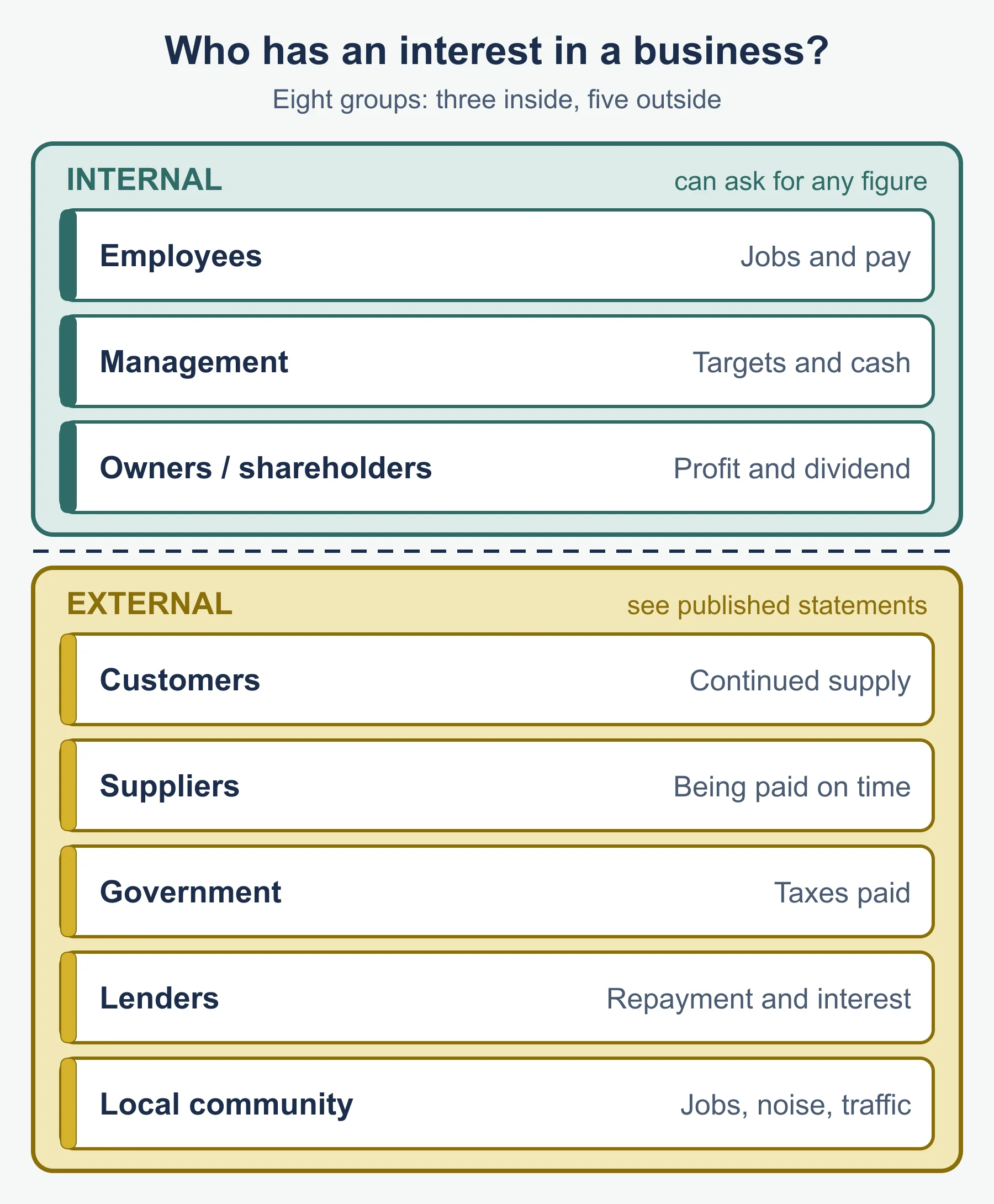
| Internal stakeholders | Employees, management, owners/shareholders |
| External stakeholders | Customers, suppliers, government, lenders, local community |
The specification lists exactly eight groups. Learn them as two lists, three internal and five external, and learn one clear interest for each. A stakeholder is any person or group with an interest in how a business performs, because its decisions or results affect them. Some stakeholders also make decisions that affect the business, but the test is the interest, not the power.
Internal and external: the dividing line
Internal stakeholders work in, manage or own the business. They can see the books and ask for any figure. External stakeholders sit outside it. They usually see only what the business chooses or is required to publish, such as published financial statements, and they judge the business from that.
Keep this distinction in mind, because it explains why the groups want different information. An owner can ask for a management report next week. A lender deciding whether to extend a loan relies on the statements it is given.
The three internal stakeholders
Employees
Employees depend on the business for their income. Their main interests are:
- job security, which depends on whether the business is profitable and likely to continue
- pay rises, bonuses and pension contributions, which the business can only afford if it earns enough
- working conditions and training, which cost money
An employee therefore reads profit and cash availability as signs of whether wages will be paid on time and whether jobs are safe. A business reporting falling profit may mean redundancies or frozen pay.
Management
Managers run the business day to day, often for owners who are not involved in operations. In a small business the manager and the owner may be the same person, but in a company they are usually different people. Their interests are:
- how well the business is performing against its targets, so that they can make decisions
- their own job security, and any bonus linked to profit or revenue
- having enough cash to pay bills as they fall due
Managers need detailed and frequent information, such as which product earns the most profit. That is why they are described as internal users who can ask for more than anyone else.
Owners and shareholders
The specification groups these together. A sole trader or partner owns the business directly. In a company, the owners are the shareholders, who hold shares. Their interests are:
- profit, because it belongs to them after all costs and interest are paid
- the return they receive, which in a company is paid as a dividend (a share of profit paid out to shareholders)
- the value of their investment, which rises if the business grows
- the risk that they lose the capital they put in
Owners compare profit with the capital they have invested, and they decide whether to take profit out or leave it in to grow the business. Profit left in the business is retained profit.
The five external stakeholders
Customers
Customers want to buy goods or services reliably, at a fair price and with good quality and after-sales service. A customer who has paid in advance, or who depends on one supplier for a part, wants to know the business will still be trading in a year. Their interest is mainly continuity of supply and value for money.
Suppliers
Suppliers sell goods or services to the business, often on credit. Their interest is whether the business will pay what it owes, on time, and whether it will keep placing orders. They look at how much the business owes in total and whether it has the cash to settle. A supplier who doubts the business may refuse credit or ask for cash on delivery.
Government
The government, through its tax authorities and other bodies, is interested in the taxes the business pays and in whether it follows the law. Examples are tax on profits, tax collected on sales, and tax on employees’ wages that the business collects. Governments also care about the jobs the business provides and about compliance with employment, safety and reporting rules. You do not need names of specific tax regimes: write “taxes” and link them to profit, sales and wages.
Lenders
Lenders, such as banks, provide loans. Their interests are:
- being repaid the loan on the agreed dates
- receiving interest on time
- the business having enough profit and cash to pay both, and assets that could be sold if it fails
A lender wants stability. Unlike an owner, a lender does not gain extra if the business becomes very profitable, so its focus is safety, not growth.
Local community
The local community is the people living and working near the business. Their interests are:
- jobs and local spending
- environmental effects such as noise, traffic and waste
- whether the business supports local activities or will close and leave empty premises
The community has no financial claim on the business, but it is still a stakeholder because it is affected by what the business does.
Worked example
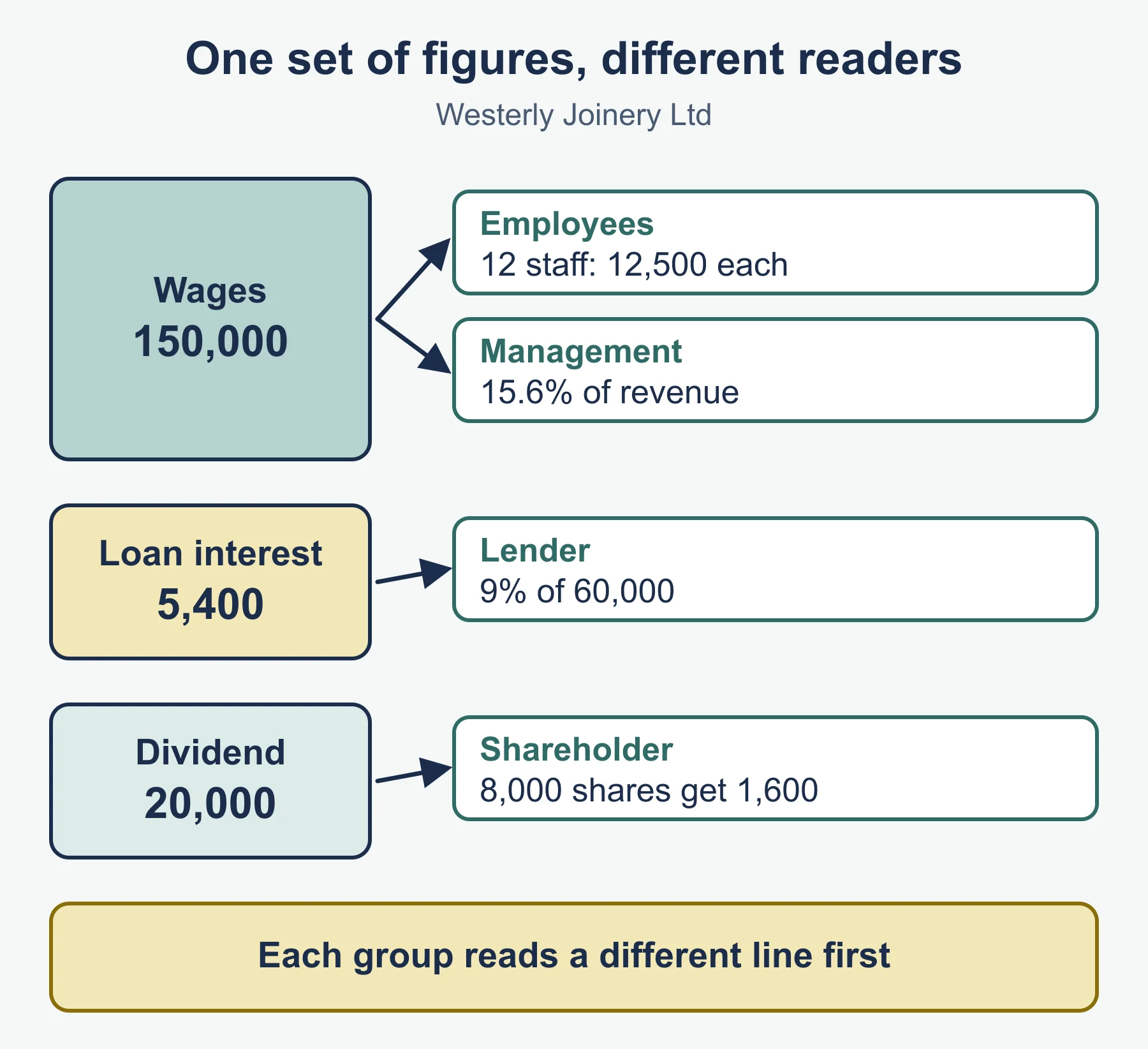
Westerly Joinery Ltd makes kitchen fittings. It has 12 employees and 100,000 shares in issue, and it has a bank loan of 60,000 at 9% a year. A summary of its year:
| Item | Amount |
|---|---|
| Revenue | 960,000 |
| Cost of sales | 576,000 |
| Gross profit | 384,000 |
| Wages | 150,000 |
| Other expenses | 164,000 |
| Operating profit | 70,000 |
| Loan interest | 5,400 |
| Profit for the year before tax | 64,600 |
| Dividend proposed | 20,000 |
| Profit retained | 44,600 |
Question: Identify which stakeholders would be most interested in the wage figure, the loan interest and the dividend, and explain why.
Answer:
- The wage figure of 150,000 is paid to 12 employees, an average of 12,500 each. Employees care because the business must stay profitable enough to keep paying it. Management cares because wages are a large cost to control. Wages are 15.6% of revenue, so a rise would reduce profit noticeably.
- The loan interest of 5,400 is 9% of 60,000. The lender cares because this is its return. Profit before interest was 70,000, so the business earns far more than the interest it must pay. That tells the lender the interest looks safe.
- The dividend of 20,000 is paid to shareholders. A holder of 8,000 of the 100,000 shares would receive 1,600, because the dividend is 0.20 per share. Shareholders care because it is their return. It is 31.0% of profit, so most profit, 44,600, stays in the business to fund growth.
Notice that the same set of figures serves all three groups. What differs is which line each reads first.
Where interests collide
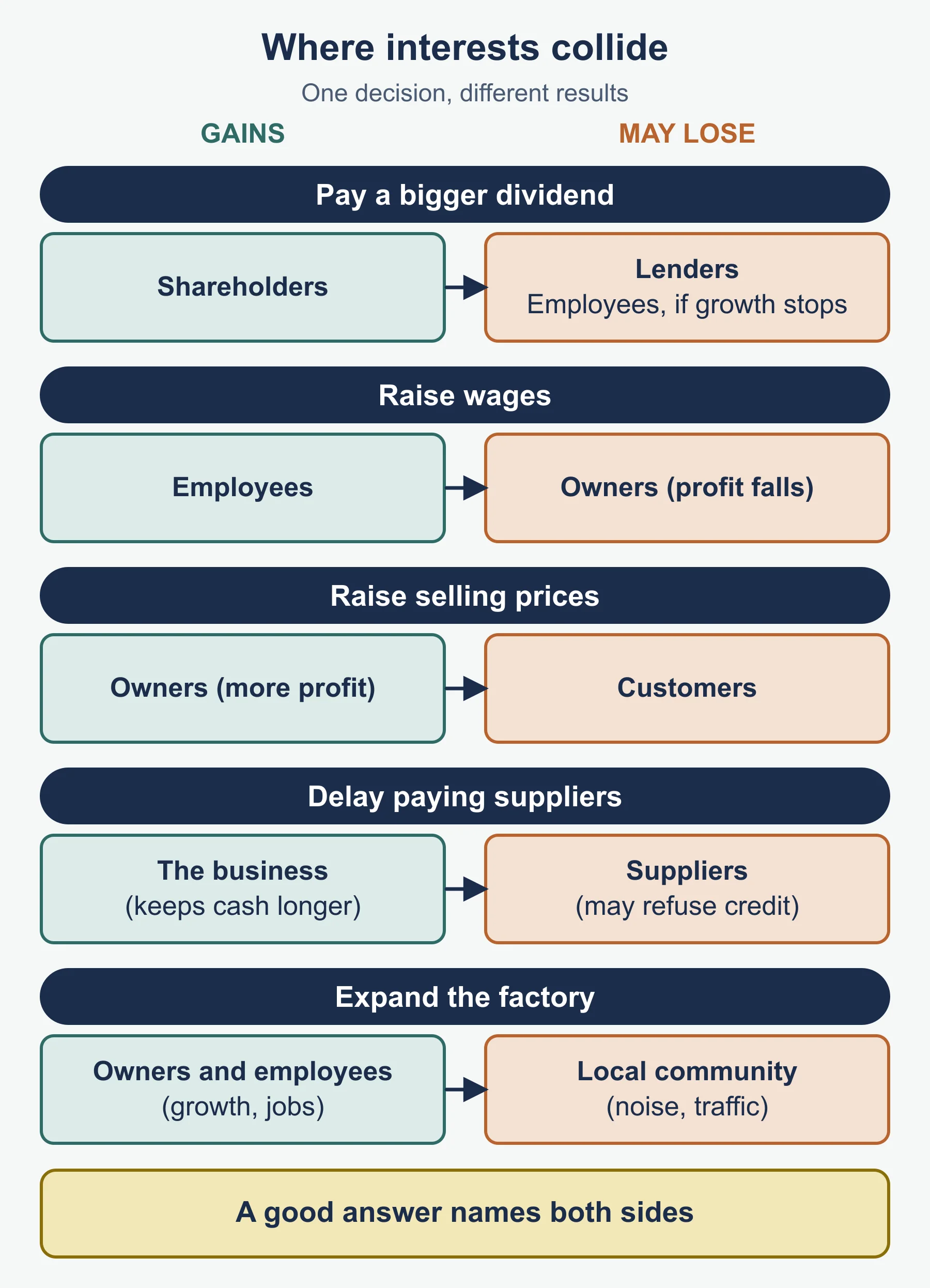
Stakeholders do not always want the same outcome, and a good answer says so.
| Decision | Who gains | Who may lose |
|---|---|---|
| Pay a bigger dividend | Shareholders | Lenders, who want cash kept for repayments; employees if growth stops |
| Raise wages | Employees | Owners, because profit falls |
| Raise selling prices | Owners, through higher profit | Customers |
| Delay paying suppliers | The business, which keeps cash for longer | Suppliers, who may refuse further credit |
| Expand the factory | Owners and employees, through growth and jobs | Local community, through noise and traffic |
Linking stakeholders to financial statements
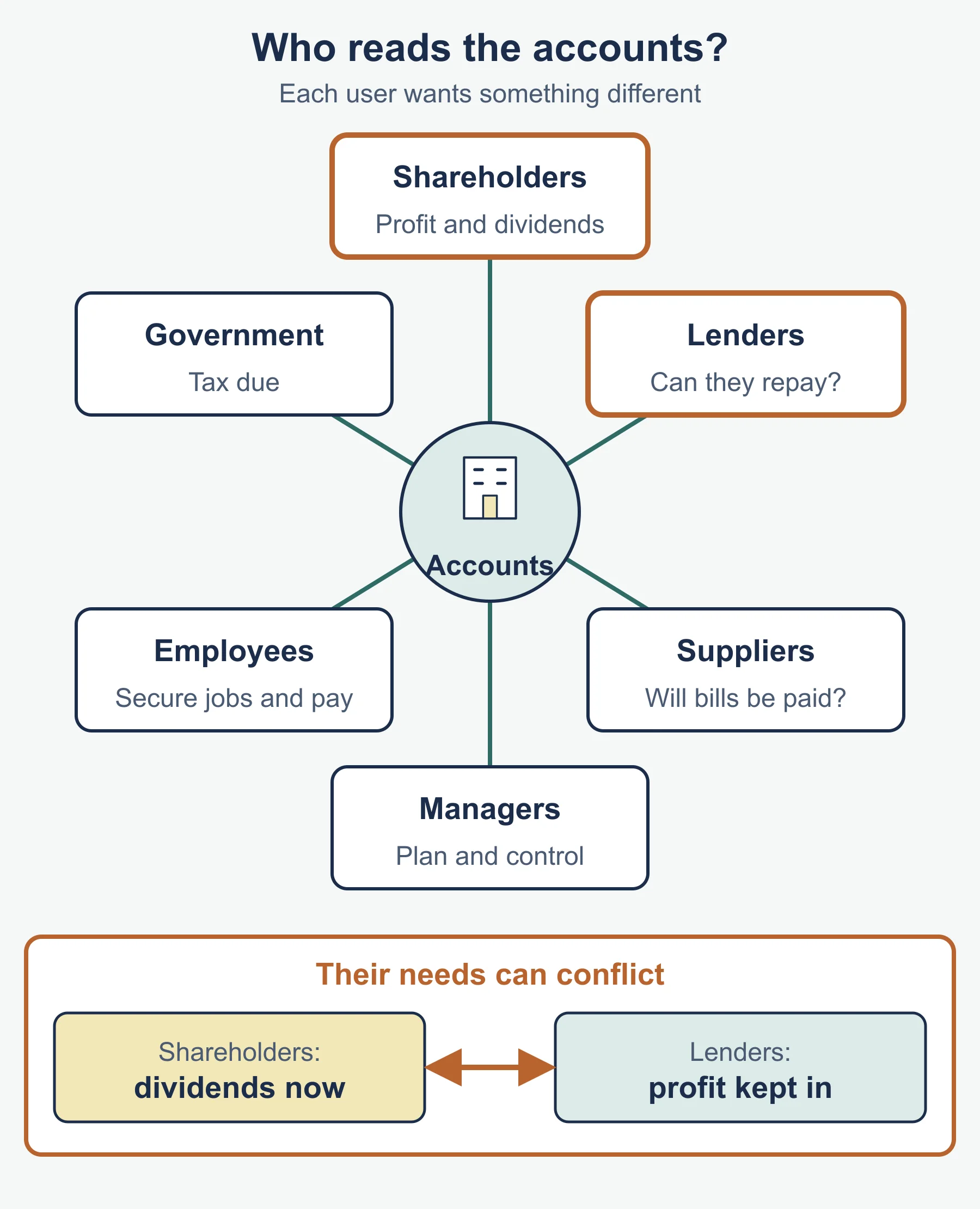
Each group looks at different parts of the same statements. Owners and managers focus on the statement of profit or loss, because it shows profit. Lenders and suppliers look at the statement of financial position, because it shows what the business owns and owes. Employees and the community are often most concerned with whether the business is stable enough to keep operating.
You are not asked here to calculate ratios. Later parts of section 3.5 deal with those, and they build on this list because a ratio is chosen to answer a particular stakeholder’s question.
Answering questions on stakeholders
- If asked to identify, name the group precisely, using the specification’s wording.
- If asked for an interest, link it to the business: say what they want and why the financial information matters to them.
- Give a different interest for each group. Do not write “profit” for every answer.
- Use the context. If the scenario says the business has a large overdraft, the lender’s and suppliers’ interests become more urgent.
- When asked about internal or external, check which side the group is on. Lenders and customers are external even though they deal with the business constantly.
Common errors
- Placing lenders or suppliers in the internal list because they have a close relationship with the business
- Writing only “they want to know about the business”, which gains nothing
- Saying employees care about profit for its own sake, instead of about jobs and pay
- Treating shareholders and lenders as having identical interests
- Forgetting the local community, which is the stakeholder most often missed
- Confusing dividend, which goes to shareholders, with interest, which goes to lenders
Frequently asked questions
What do employees want to know about a business? Employees depend on the business for their income, so they are interested in job security, pay rises and working conditions. They read profit and cash availability as signs of whether wages will be paid and jobs will continue.
Why are lenders interested in a business’s accounts? Lenders want to be repaid on the agreed dates and to receive interest on time, so they look for stability and enough cash. Unlike an owner, a lender does not gain extra if the business becomes very profitable.
Is the local community a stakeholder if it has no financial claim on the business? Yes. The local community has no financial claim, but it is affected by the business through jobs, local spending and environmental effects such as noise, traffic and waste.
Which stakeholder is most often missed in exam answers? The local community is the stakeholder most often missed. Other common errors are placing lenders or suppliers in the internal list and confusing dividends, which go to shareholders, with interest, which goes to lenders.
How should I answer an identify question on stakeholders in OxfordAQA 9215? Name the group precisely, using the specification’s wording, such as owners/shareholders or local community. Longer explain answers should say what the group wants and why.
Official syllabus
OxfordAQA International GCSE Accounting (9215), specification version 1.2, section 3.5, published by OxfordAQA, for exams from May/June 2026.
Get free revision emails (optional)
Occasional emails with practice questions, worked explanations and links to free resources for the qualification and subjects you choose. No spam, and you can unsubscribe from any email. The free tools on this site never need an email.
Related resources
-
Practice questions
OxfordAQA IGCSE Accounting: Internal and external stakeholders (9215) – Practice Questions
Eleven original practice questions with worked answers on internal and external stakeholders for OxfordAQA International GCSE Accounting 9215.
Accounting · OxfordAQA · IGCSE
Try questions -
Revision notes
OxfordAQA IGCSE Accounting: Internal and external stakeholders (9215) – Revision Notes
Condensed revision notes on the eight internal and external stakeholders in OxfordAQA International GCSE Accounting 9215, with a self-test.
Accounting · OxfordAQA · IGCSE
Revise topic -
Study guides
OxfordAQA IGCSE Accounting: Limitations of financial statements and the use of computers in accounting (9215)
Study guide to the limits of financial statements and ratio analysis, and to computerised versus manual accounting, for OxfordAQA IGCSE Accounting 9215.
Accounting · OxfordAQA · IGCSE
Read guide
Related articles
-
teaching
A Level tuition in Dubai: Cambridge or Pearson Edexcel International A Level?
Schools in Dubai and Abu Dhabi teach either Cambridge International AS & A Level or Pearson Edexcel International A Level. How the two are structured, why it matters for tuition, and how online classes from Lahore work.
9 October 2026
-
curriculum guides
Choosing subjects at IGCSE and A Level
How subject choices at 14 and 16 affect university options later, and how to keep pathways open without overloading a timetable.
28 July 2026
Studying this with a teacher
Working through Accounting IGCSE?
This page is free and stays free. If you would rather be taught it, Marlbridge runs Accounting classes one-to-one and in small groups of up to 15, online in your own time zone. The first trial class is free. WhatsApp replies within an hour (8am–11pm Pakistan time, every day); email the same day.
OxfordAQA Accounting teachers at Marlbridge

