
Revision Notes
OxfordAQA IGCSE Accounting: Internal and external stakeholders (9215) – Revision Notes
Condensed revision notes on the eight internal and external stakeholders in OxfordAQA International GCSE Accounting 9215, with a self-test.
- Subject
- Accounting
- Level
- IGCSE
- Topic
- Interpretation, analysis and communication of financial information
- Author
- Marlbridge Academic Team
- Updated
- Reviewed by
- Javaid Iqbal Sabri (what this means)
Aligned to OxfordAQA IGCSE Accounting (9215), First teaching 2024, first examined 2026. Official specification .
Syllabus page (what it covers and how it is assessed): OxfordAQA IGCSE Accounting.
Syllabus points this page covers
9215
- Stakeholders in a business
Found an error? Report a correction.
Need help with this topic? Request a free trial class for IGCSE Accounting (9215).
These notes condense the first content point of section 3.5 of the OxfordAQA International GCSE Accounting (9215) specification, version 1.2, for exams from May/June 2026: identifying internal and external stakeholders and their interests. For full explanations and a worked example, read the study guide. When you are ready to test yourself, use the practice questions. Course pages: the OxfordAQA IGCSE Accounting hub, the checklist and the free diagnostics.
All amounts are in dollars and all business names are invented.
The list to learn
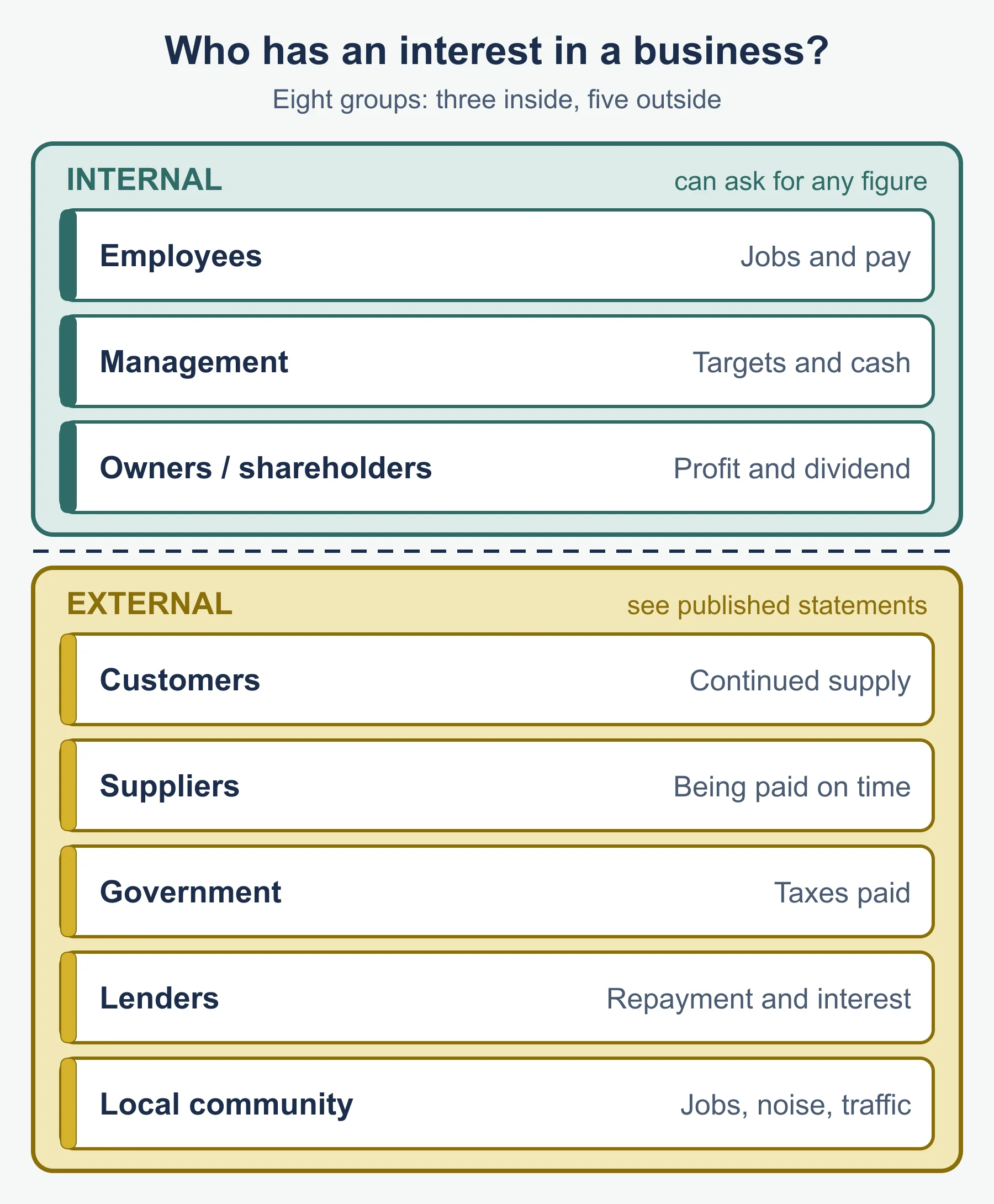
A stakeholder is a person or group with an interest in a business because its results or decisions affect them.
| Type | Group | One-line interest |
|---|---|---|
| Internal | Employees | Job security, pay, conditions |
| Internal | Management | Performance against targets, decisions, own job or bonus |
| Internal | Owners/shareholders | Profit, dividends, value of their investment |
| External | Customers | Reliable supply, fair price, quality, service |
| External | Suppliers | Prompt payment, continued orders |
| External | Government | Taxes, law and regulation, jobs |
| External | Lenders | Repayment and interest, security |
| External | Local community | Jobs, environment, local spending |
The specification gives exactly these eight groups, three internal and five external.
Method in steps
- Read the question: is it asking you to identify, state an interest, or explain why a group wants information?
- Name the group using the specification’s wording.
- State what that group wants.
- Tie it to a figure or fact in the scenario, such as profit, a loan or the number of staff.
- If the question asks for a decision, say who gains and who loses.
Internal stakeholders in brief
- Employees: they rely on the business for income. Falling profit may mean no pay rise or fewer jobs. They are not usually interested in profit for its own sake.
- Management: they run the business and can ask for any report. They need figures to control costs and plan. A bonus may depend on profit.
- Owners/shareholders: they are paid last, after costs and interest. Profit belongs to them. A dividend is the part paid out as cash. Retained profit is the part kept in the business.
External stakeholders in brief
- Customers: they want the business to keep trading, especially if they rely on it for a product, a warranty or a deposit already paid.
- Suppliers: they sell on credit, so they are exposed to the risk of not being paid. They look at how much the business owes and whether it has cash.
- Government: it collects taxes linked to profit, sales and wages, and it expects the business to follow the law.
- Lenders: they are repaid a fixed amount plus interest. They do not share extra profit, so they care about safety and spare cash.
- Local community: it has no financial claim but is affected by jobs, noise, traffic and waste.
Must-know distinctions
| Compare | Key difference |
|---|---|
| Internal and external | Internal groups work in, run or own the business and can ask for any figure. External groups rely on what is published or given to them |
| Dividend and interest | Dividend goes to shareholders and depends on profit. Interest goes to lenders and is owed whatever the profit |
| Owners and lenders | Owners want growth in profit. Lenders want safe repayment |
| Management and owners | In a company they are often different people. In a small business they may be the same person |
| Retained profit and dividend | Retained profit stays in the business. A dividend leaves it |
Small worked reminder
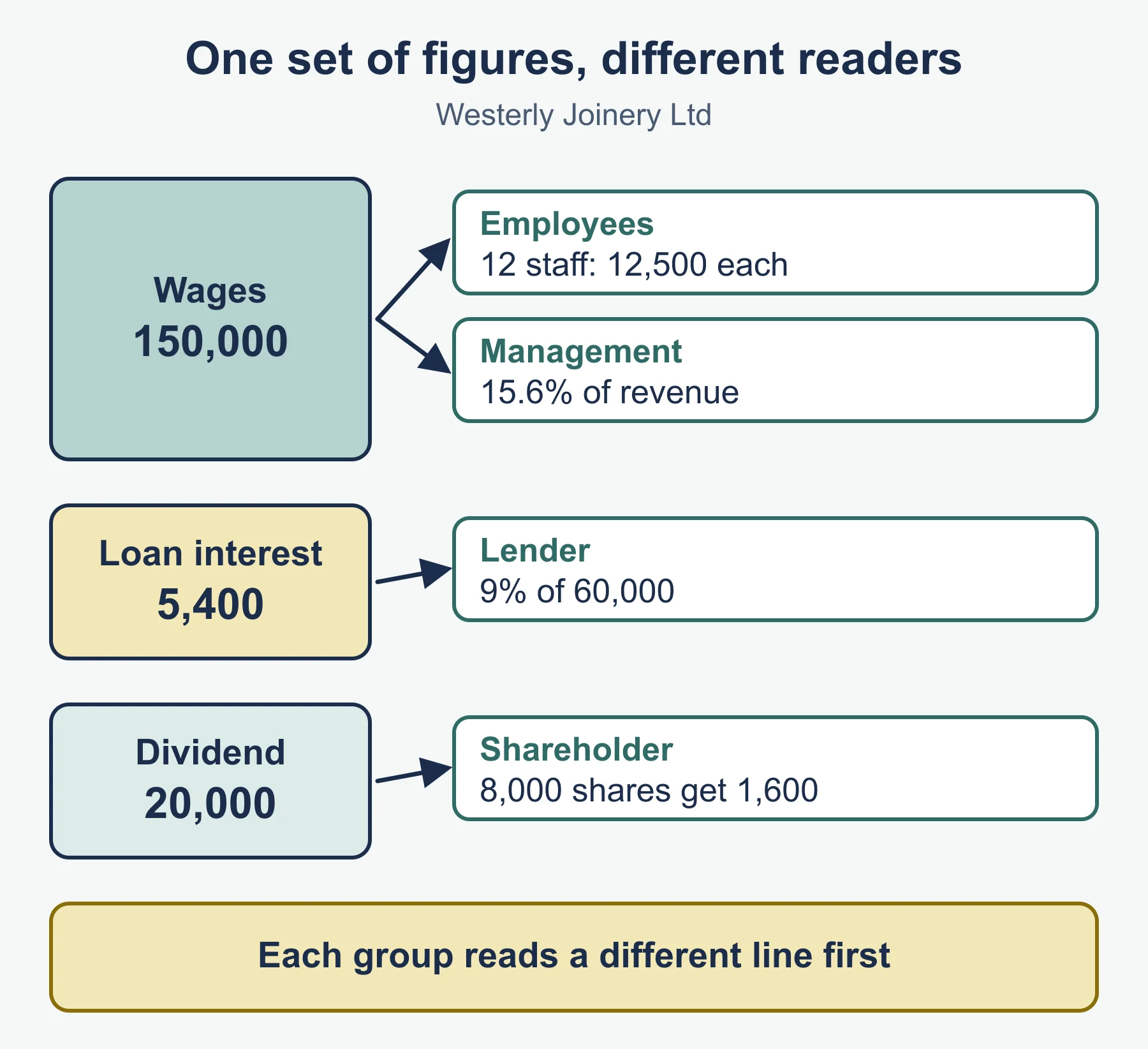
Pennine Bakes Ltd has revenue of 360,000 and profit for the year of 27,000.
- Profit is 7.5% of revenue (27,000 / 360,000 x 100).
- It owes its flour supplier 44,000 against annual purchases of 264,000. That is about 60.8 days of purchases (44,000 / 264,000 x 365), which a supplier would notice when deciding how long to allow for payment.
- A bank loan of 40,000 at 8% costs 3,200 in interest each year. Treat 27,000 as the profit before that interest, so the bank sees a comfortable margin to pay it.
The same business, three readers: the owner sees the profit, the supplier sees the debt owed, the lender sees whether interest can be paid.
Where interests collide
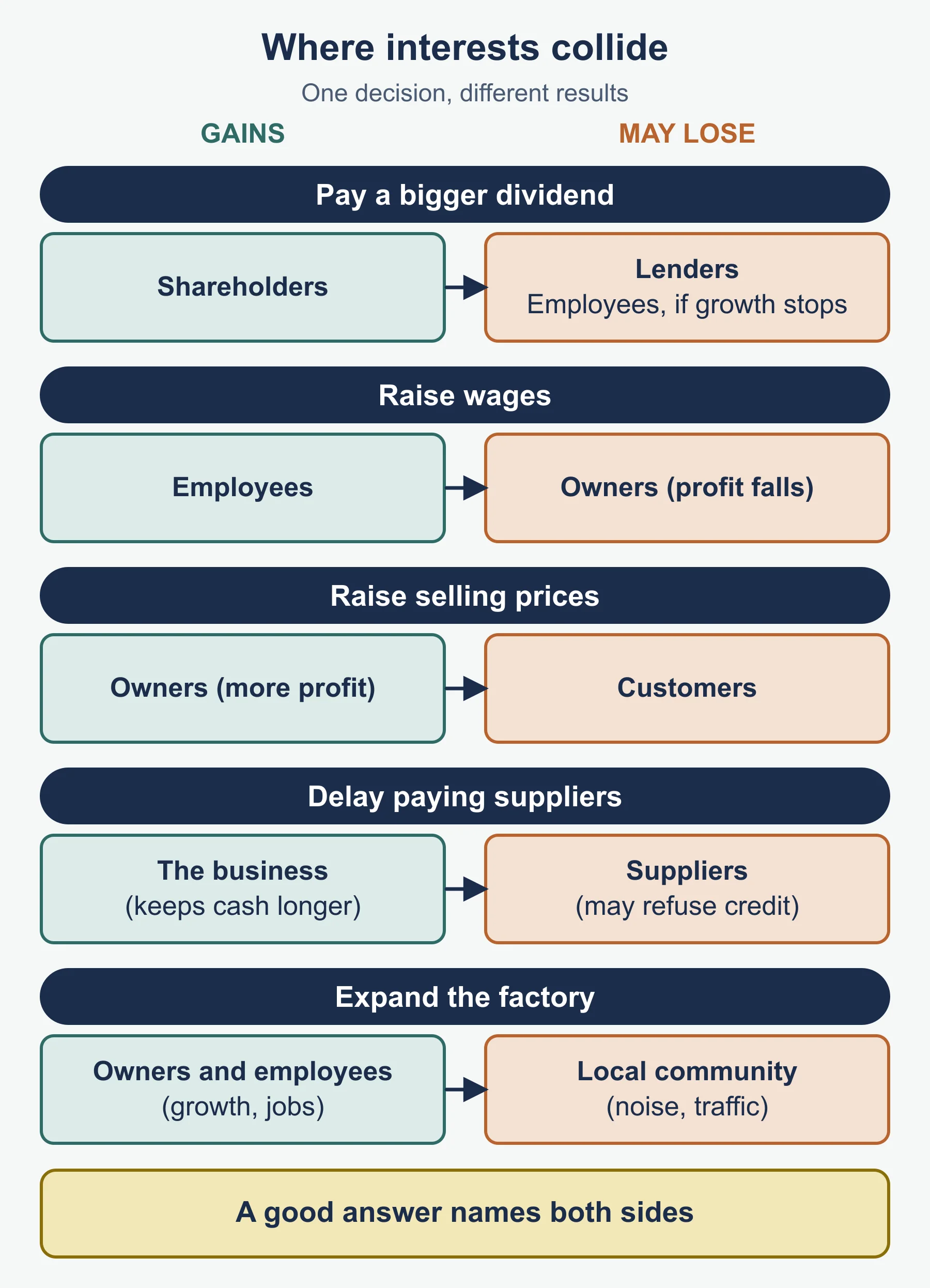
| If the business does this | A group that benefits | A group that may object |
|---|---|---|
| Pays out most of its profit as dividend | Shareholders | Lenders and employees, who want it to stay stable |
| Cuts staff to save cost | Owners | Employees, local community |
| Stretches payment to suppliers | The business | Suppliers |
| Cuts prices to win sales | Customers | Owners, if profit falls |
| Builds a larger site | Employees, owners | Local community |
Which information each group reads first
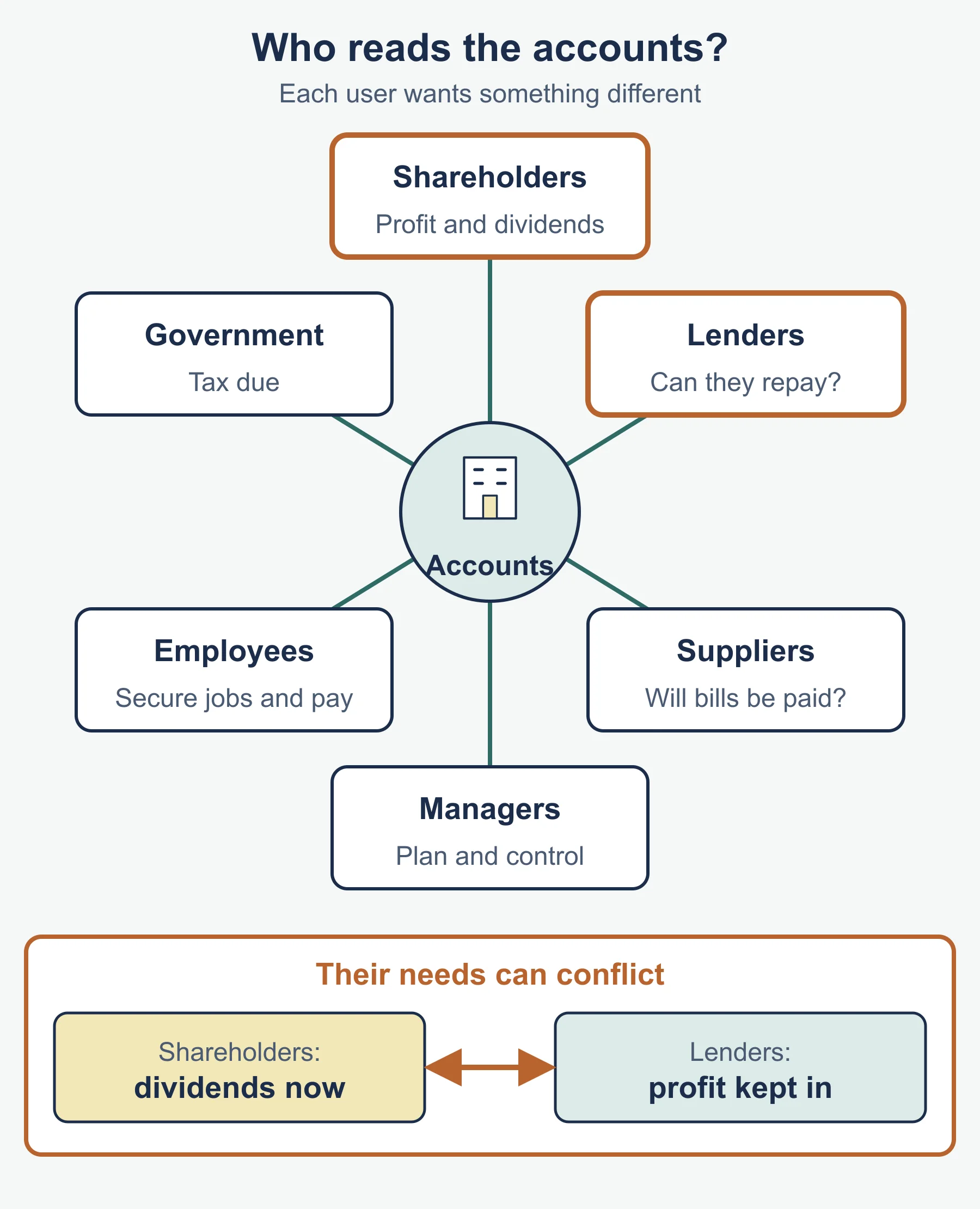
| Group | What they look for | Why |
|---|---|---|
| Employees | Profit trend and any news of cost cutting | Shows whether jobs and pay are safe |
| Management | Detailed internal reports | Needed to control costs and meet targets |
| Owners/shareholders | Profit for the year, dividend, retained profit | Their return and the growth of their investment |
| Customers | Signs the business is stable | They need goods, repairs or refunds in future |
| Suppliers | Amounts owed and cash available | Decides whether to keep selling on credit |
| Government | Profit, sales and wages | Basis for the taxes due |
| Lenders | Profit before interest, loans already owed, assets | Decides whether repayment is safe |
| Local community | Local news on jobs, expansion or closure | Affects their everyday lives |
Profit appears in several rows, but for different reasons. A good answer always says why.
Two model answers
Question: State two interests of lenders in a business. [2]
Model answer: lenders want to be repaid the amount borrowed on the agreed dates, and they want interest paid on time. Each point is a separate interest, so write them as two separate statements.
Question: Explain why shareholders and lenders might disagree about a large dividend. [3]
Model answer: shareholders receive the dividend, so a large one increases their return. Lenders are owed fixed repayments, so they prefer that cash is kept in the business to meet them. A large dividend therefore benefits shareholders but may reduce the cash available to repay lenders.
Notice the pattern: say what group one gains, say what group two risks, then link them with “therefore”. This three-step shape works for most conflict questions.
Command words you may meet with this topic
- Identify or state: a short answer is enough, such as naming a group or giving one interest.
- Explain: give the interest and the reason, using a linking word such as because or so.
- Suggest: apply the idea to the scenario given, even if the answer is not in your notes.
- Evaluate or justify: weigh up more than one group and reach a conclusion.
Memory aids
- Internal: “EMO” for employees, management, owners.
- External: “CSGLL” for customers, suppliers, government, lenders, local community. Say it aloud a few times, or make up your own sentence from those letters.
- Money flows: wages go to employees, dividends to shareholders, interest to lenders, payments for goods to suppliers, taxes to the government.
- Ask of every stakeholder: what do they give to the business, and what do they get back? The answer is usually their interest.
Quick self-test
Try each question without looking back. Answers follow.
- How many internal stakeholders does the specification list, and what are they?
- How many external stakeholders does it list, and what are they?
- Why is a lender an external stakeholder even though it deals with the business regularly?
- State one interest of employees that is not “profit”.
- Which stakeholder receives a dividend?
- Which stakeholder receives interest on a loan?
- Why might a supplier refuse to give credit to a business?
- Name one tax-related interest of the government.
- State one way the local community can be affected by a business.
- Pennine Bakes pays a dividend of 9,000 out of profit of 27,000. How much profit is retained and what percentage of profit is paid out?
Answers
- Three: employees, management, owners/shareholders.
- Five: customers, suppliers, government, lenders, local community.
- It does not work in, run or own the business. It relies on information that the business supplies.
- Job security, pay rises, pension contributions, working conditions or training (any one).
- Owners/shareholders.
- Lenders.
- It doubts that the business will pay what it owes on time.
- Taxes on profit, tax collected on sales, or tax on employees’ wages (any one).
- Jobs, local spending, noise, traffic, waste or the effect of closure (any one).
- Retained profit is 27,000 - 9,000 = 18,000. The dividend is 9,000 / 27,000 = 33.3% of profit.
Where marks are usually lost
- Writing “profit” as the interest of every stakeholder
- Placing lenders, suppliers or customers in the internal list
- Giving a general statement that is not linked to the scenario
- Confusing dividend and interest
- Leaving out the local community or the government
- Naming a group but not saying what it wants
- Describing a conflict without saying who gains and who loses
- Adding tax rules from one country when “taxes” is enough
Frequently asked questions
Who are the internal and external stakeholders in OxfordAQA International GCSE Accounting 9215? The specification lists eight groups. The three internal stakeholders are employees, management and owners or shareholders; the five external stakeholders are customers, suppliers, government, lenders and the local community.
What is the difference between a dividend and loan interest? A dividend goes to shareholders and depends on profit. Loan interest goes to lenders and is owed whatever the profit.
What is a stakeholder? A stakeholder is a person or group with an interest in a business because its results or decisions affect them.
Why might shareholders and lenders disagree about a large dividend? Shareholders receive the dividend, so a large one increases their return. Lenders are owed fixed repayments and prefer cash to be kept in the business to meet them, so a large dividend may reduce the cash available to repay them.
What is the difference between internal and external stakeholders? Internal groups work in, run or own the business and can ask for any figure. External groups rely on what is published or given to them.
Official syllabus
OxfordAQA International GCSE Accounting (9215), specification version 1.2, section 3.5, published by OxfordAQA, for exams from May/June 2026.
Get free revision emails (optional)
Occasional emails with practice questions, worked explanations and links to free resources for the qualification and subjects you choose. No spam, and you can unsubscribe from any email. The free tools on this site never need an email.
Related resources
-
Study guides
OxfordAQA IGCSE Accounting: Limitations of financial statements and the use of computers in accounting (9215)
Study guide to the limits of financial statements and ratio analysis, and to computerised versus manual accounting, for OxfordAQA IGCSE Accounting 9215.
Accounting · OxfordAQA · IGCSE
Read guide -
Practice questions
OxfordAQA IGCSE Accounting: Limitations of financial statements and the use of computers in accounting (9215) – Practice Questions
Eleven original questions with worked answers on limits of financial statements, ratios and computers in accounting for OxfordAQA IGCSE Accounting 9215.
Accounting · OxfordAQA · IGCSE
Try questions -
Revision notes
OxfordAQA IGCSE Accounting: Limitations of financial statements and the use of computers in accounting (9215) – Revision Notes
Revision notes on limits of financial statements and ratio analysis, and computerised versus manual accounting, for OxfordAQA IGCSE Accounting 9215.
Accounting · OxfordAQA · IGCSE
Revise topic
Related articles
-
teaching
A Level tuition in Dubai: Cambridge or Pearson Edexcel International A Level?
Schools in Dubai and Abu Dhabi teach either Cambridge International AS & A Level or Pearson Edexcel International A Level. How the two are structured, why it matters for tuition, and how online classes from Lahore work.
9 October 2026
-
curriculum guides
Choosing subjects at IGCSE and A Level
How subject choices at 14 and 16 affect university options later, and how to keep pathways open without overloading a timetable.
28 July 2026
Studying this with a teacher
Working through Accounting IGCSE?
This page is free and stays free. If you would rather be taught it, Marlbridge runs Accounting classes one-to-one and in small groups of up to 15, online in your own time zone. The first trial class is free. WhatsApp replies within an hour (8am–11pm Pakistan time, every day); email the same day.
OxfordAQA Accounting teachers at Marlbridge

