
Revision Notes
OxfordAQA IGCSE Accounting: Limitations of financial statements and the use of computers in accounting (9215) – Revision Notes
Revision notes on limits of financial statements and ratio analysis, and computerised versus manual accounting, for OxfordAQA IGCSE Accounting 9215.
- Subject
- Accounting
- Level
- IGCSE
- Topic
- Interpretation, analysis and communication of financial information
- Author
- Marlbridge Academic Team
- Updated
- Reviewed by
- Javaid Iqbal Sabri (what this means)
Aligned to OxfordAQA IGCSE Accounting (9215), First teaching 2024, first examined 2026. Official specification .
Syllabus page (what it covers and how it is assessed): OxfordAQA IGCSE Accounting.
Syllabus points this page covers
9215
- Limitations of financial statements and ratio analysis
Found an error? Report a correction.
Need help with this topic? Request a free trial class for IGCSE Accounting (9215).
These notes condense the full study guide for the OxfordAQA International GCSE Accounting (9215) specification, version 1.2, for exams from May/June 2026 onwards. They cover two content points in section 3.5: the limitations of financial statements and ratio analysis, with both financial and non-financial factors, and the advantages and disadvantages of computerised software compared with manual methods. Section 3.5 falls in Paper 2 (content 3 to 5). Amounts are in dollars and all businesses are invented.
Use the OxfordAQA IGCSE Accounting hub and the printable checklist to track progress, the free diagnostics to find gaps, and the practice questions to test yourself. For who reads the statements, see the stakeholders guide.
The big idea
A statement or ratio is a summary of the past, in money, at a date or over a period. It says what happened. It does not say why, what comes next, or what the numbers leave out.
Key terms
| Term | Meaning |
|---|---|
| Limitation | A reason a statement or ratio cannot give a full or reliable picture of performance |
| Financial factor | A limit that comes from how the figures are produced or used |
| Non-financial factor | A real influence on the business that does not appear in the statements |
| Historical cost | Assets recorded at what was paid, not at today’s value |
| Snapshot | The statement of financial position shows one date only |
| Computerised software | Programs that record transactions, post to ledgers and produce reports |
| Manual methods | Handwritten books and ledgers |
Financial limitations at a glance
| Limitation | One-line explanation | Quick example |
|---|---|---|
| Past, not future | Statements record what already happened | A strong year before the main customer leaves |
| Snapshot | One date may be unrepresentative | Inventory low at a quiet season end |
| Historical cost | Assets understated after price rises | A building bought long ago shows a low figure |
| Estimates and policies | Depreciation and inventory choices change profit | Two shops, same trade, different profit |
| Needs comparison | A ratio alone means little | A current ratio of 1.8 with no benchmark |
| Different definitions | Other businesses may calculate differently | Different year ends or different margins in the trade |
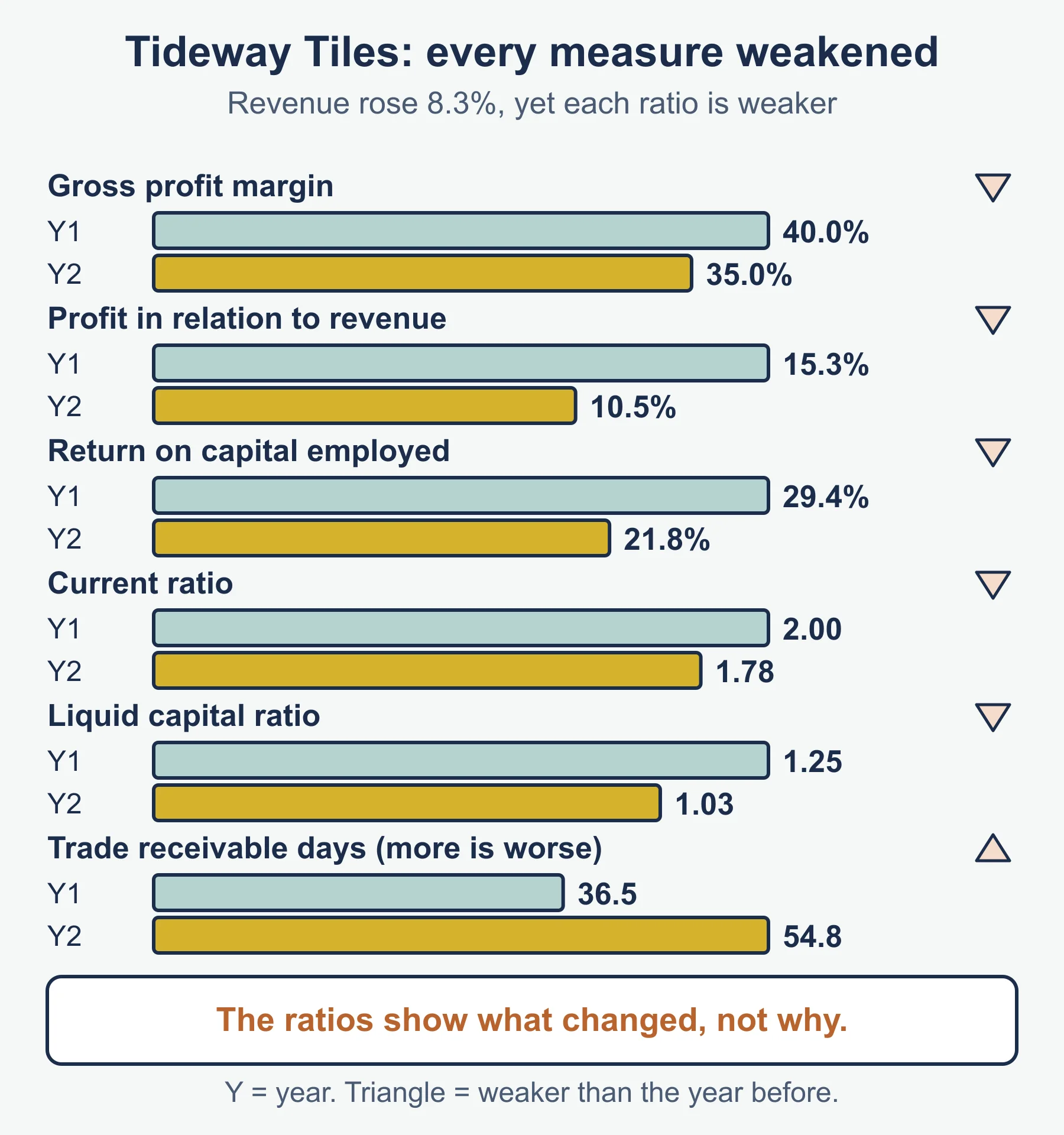
| No reasons | A ratio shows change, not cause | Margin falls: price cuts or dearer purchases? |
| Averages hide detail | One figure covers many items | One slow customer inside receivable days |
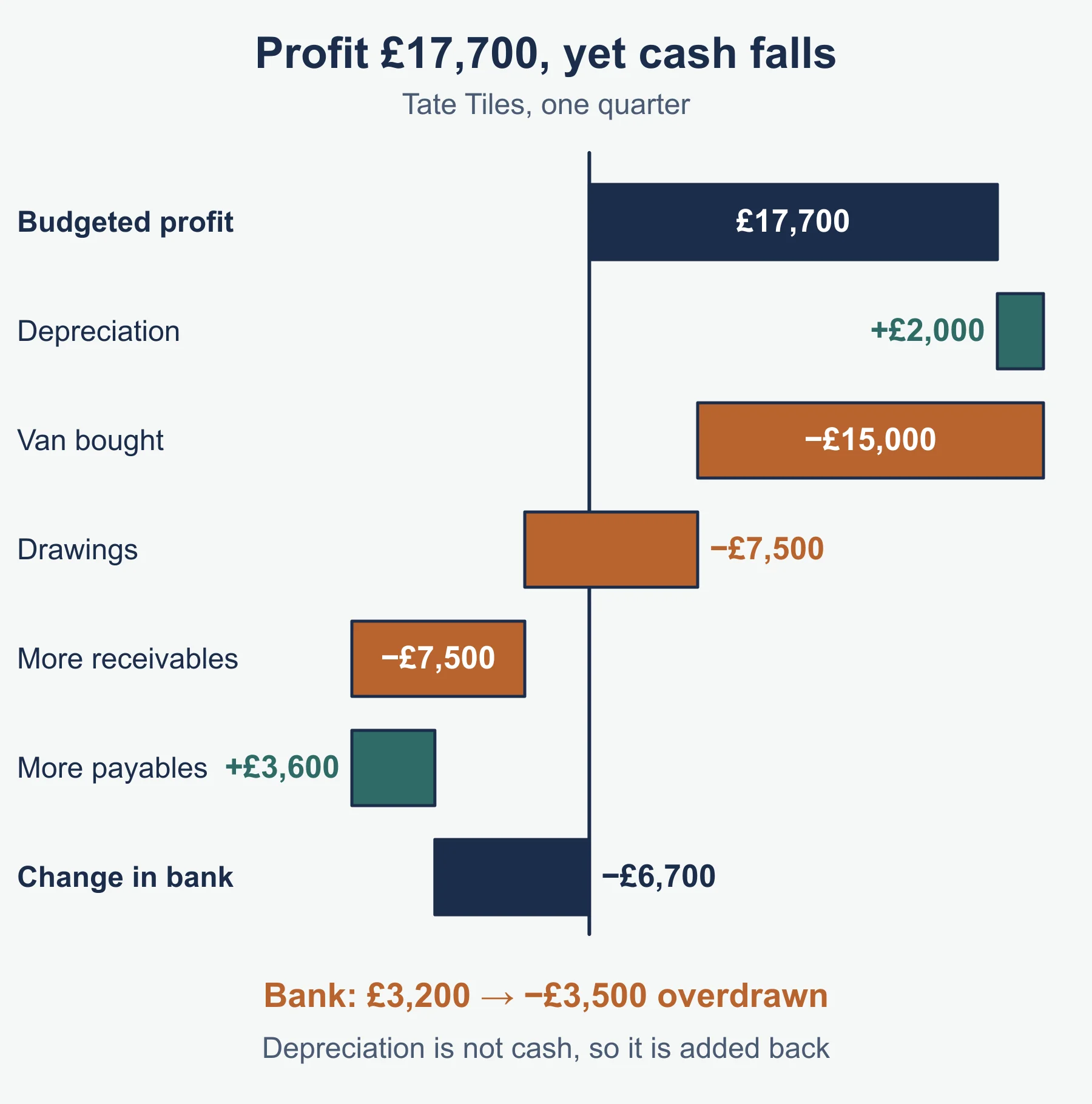
| Profit is not cash | Profit can exist without cash | Profit made, but customers pay late |
Non-financial factors at a glance
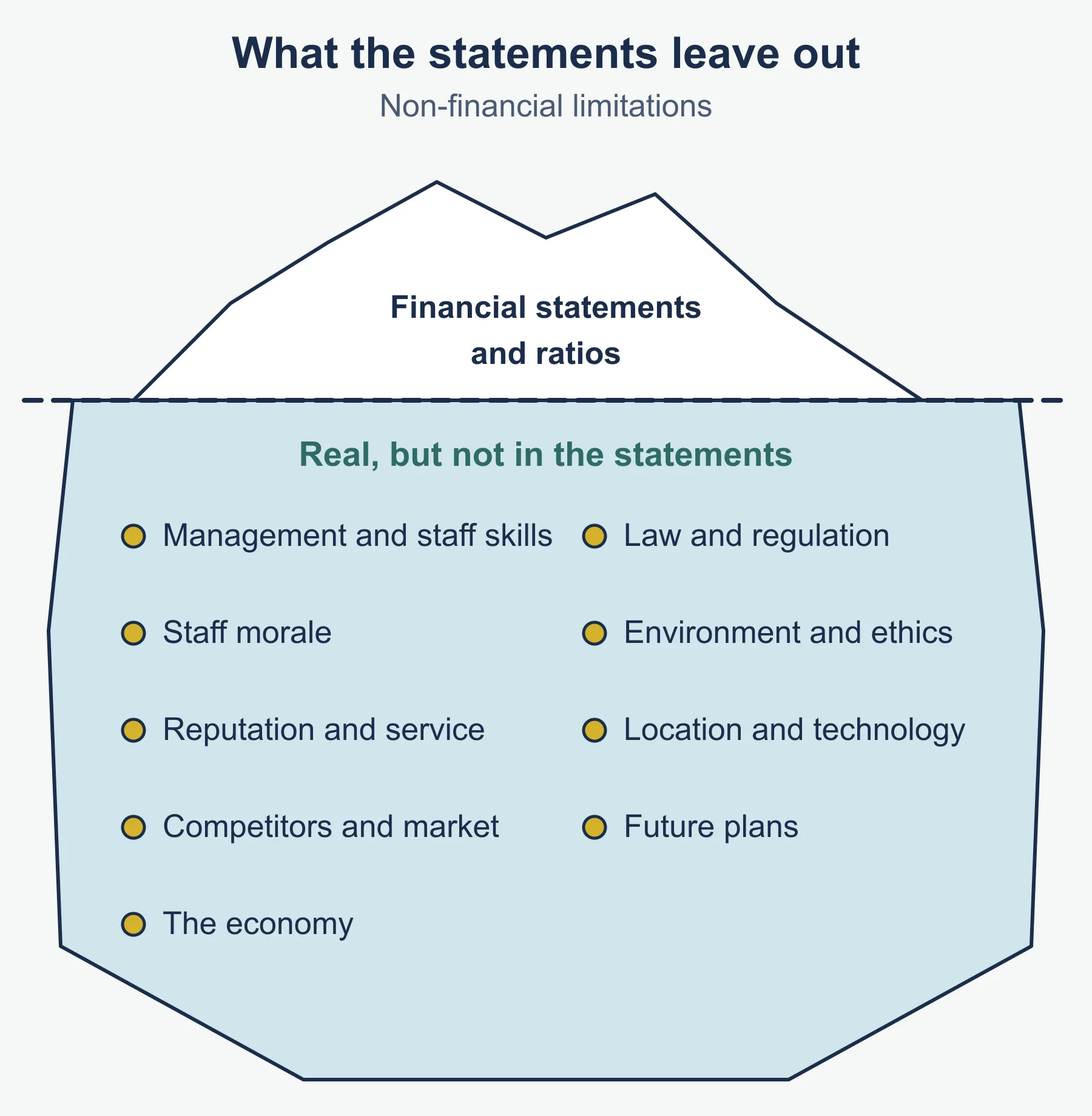
- Management quality and staff skills
- Staff morale and industrial relations
- Reputation and customer service
- Competitors and market conditions
- The wider economy (interest rates, spending, exchange rates)
- Changes in law
- Environmental and ethical conduct
- Location and technology
- Future plans such as a new product or closure
Memory aid: people, market, law, planet, plans.
Method in steps: appraise with limits
- Calculate the ratios asked for, using the OxfordAQA formulas.
- Compare with a previous year, a budget or a similar business.
- Say what the ratios suggest about profitability or liquidity.
- State one or two limitations that apply to this case.
- Name what extra information you would want.
- Give a conclusion in one sentence.
Worked reminders
Snapshot effect
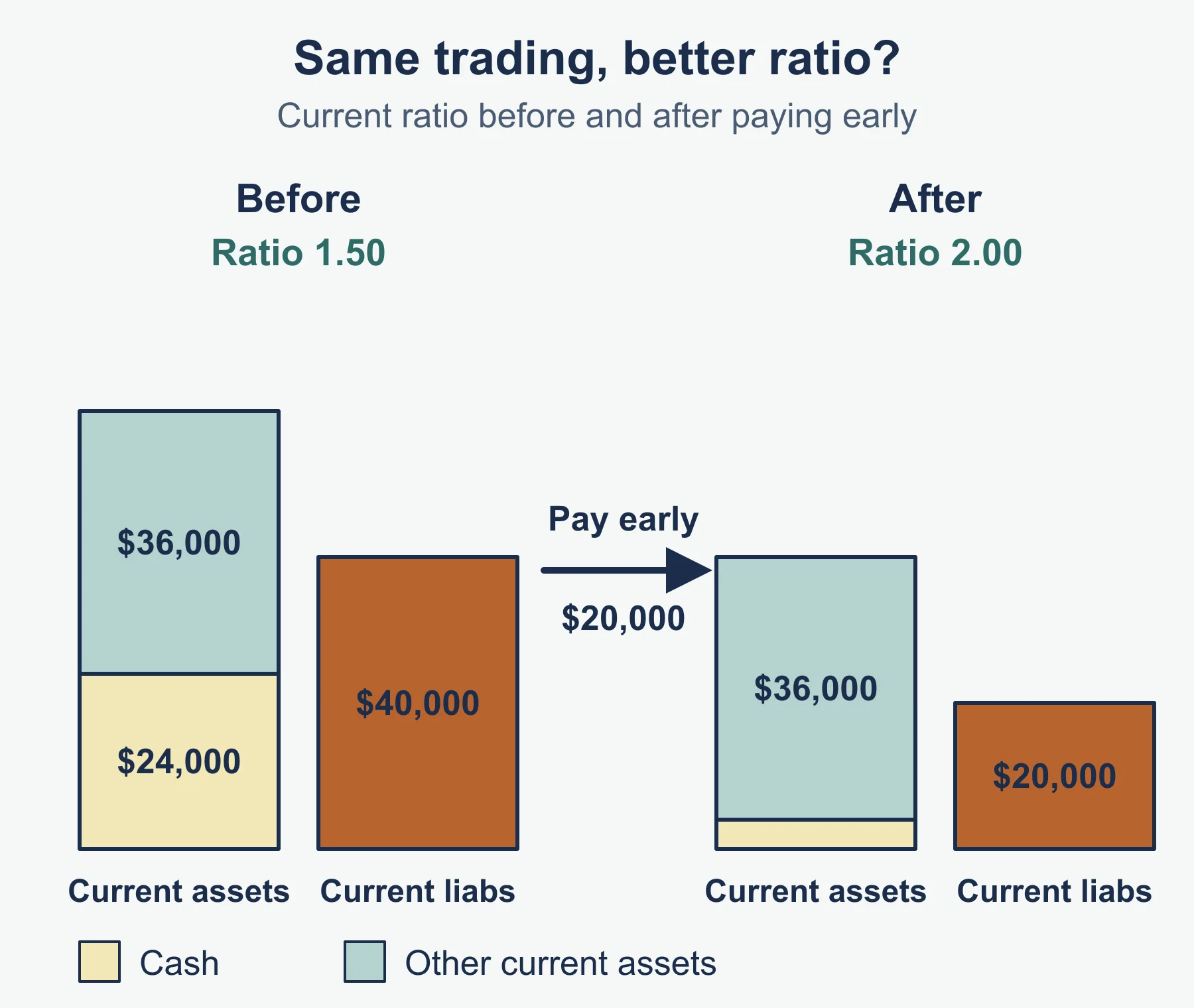
Current assets 60,000 (cash 24,000), current liabilities 40,000, so current ratio 1.50. Paying 20,000 of payables from cash gives 40,000 / 20,000 = 2.00. Trading is unchanged, but the ratio looks better.
Policy effect
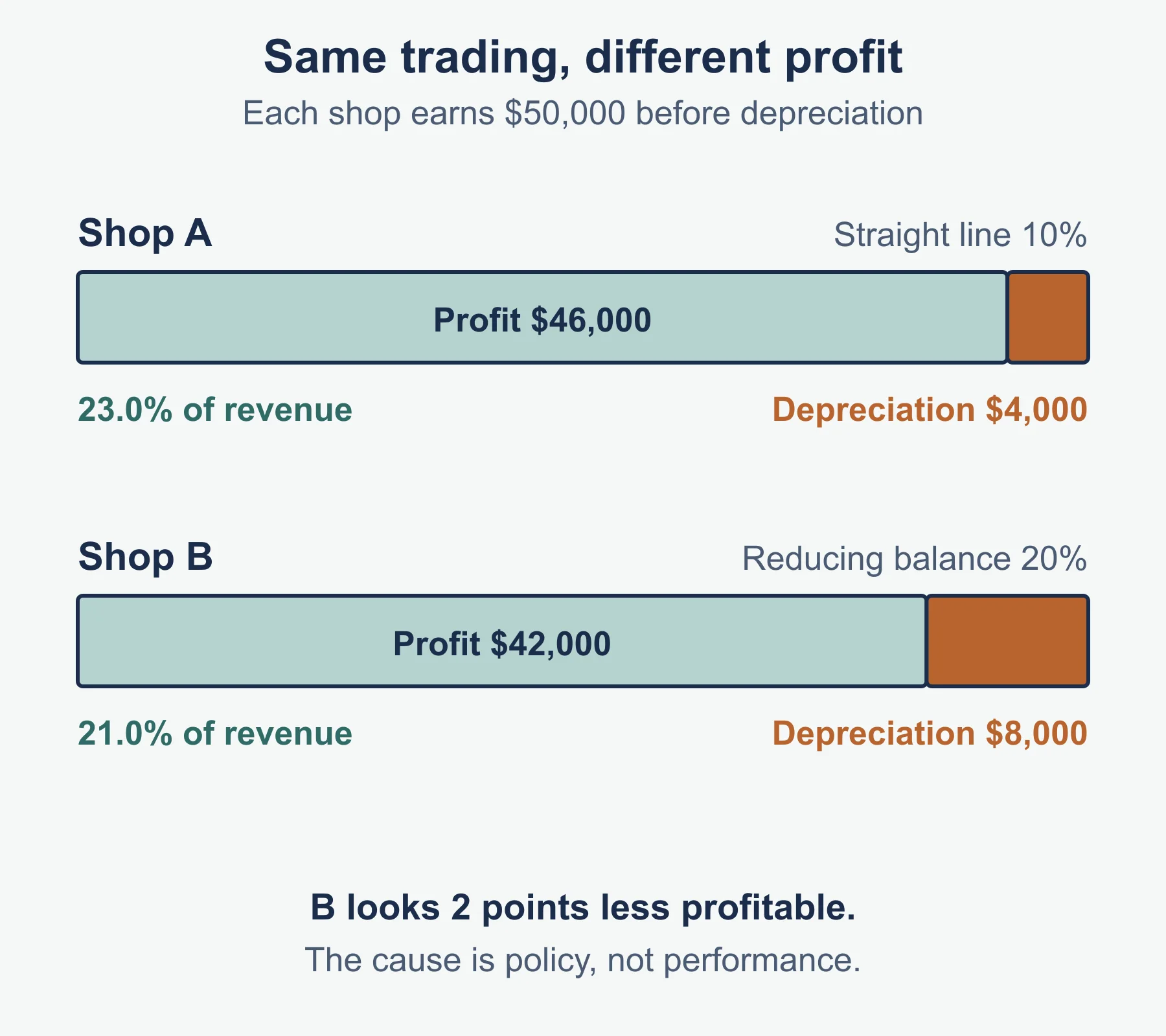
Machine cost 40,000, 50,000 profit before depreciation, revenue 200,000. Straight line at 10% charges 4,000, giving profit 46,000 and a margin of 23.0%. Reducing balance at 20% charges 8,000 in year 1, giving 42,000 and 21.0%.
Seasonal inventory
Cost of sales 360,000. Closing inventory 30,000 gives 12 times. Opening 90,000 with closing 30,000 averages 60,000, which gives 6 times. The year-end figure alone flatters the business.
Historical cost effect
Profit is 30,000. Capital employed on historical cost is 150,000, so the return is 20.0%. If the same assets were restated to today’s values, capital employed would be 240,000 and the return 12.5%. The business has not changed, only the basis of the figures.
Sentence frames for written answers
Use these to turn a fact into a point that earns credit.
- Limitation: “[Factor] limits the usefulness of the ratio because it means the figure may not show [what the user wants to know].”
- Link to the case: “In this business, the year-end inventory is high, so the rate of inventory turnover may not be typical of the whole year.”
- Extra information: “I would also want to know the previous year’s figures and the reason for the change.”
- Computers, advantage: “Entering a sale once updates the ledger accounts automatically, which saves time and avoids copying errors.”
- Computers, disadvantage: “Hardware and training are costs, which a small business with few transactions may not recover.”
- Conclusion: “The ratios suggest profitability has fallen, but because they do not explain why, the owner should investigate before acting.”
Command words
| Command word | What to do here |
|---|---|
| State | Give the point briefly, with no explanation |
| Explain | Give the point and the reason it matters |
| Calculate | Show the formula or working and the answer with units or percentage sign |
| Suggest | Give a sensible reason that fits the case |
| Evaluate or assess | Give points for and against, then a judgement |
Computers: advantages and disadvantages
| Advantages | Disadvantages |
|---|---|
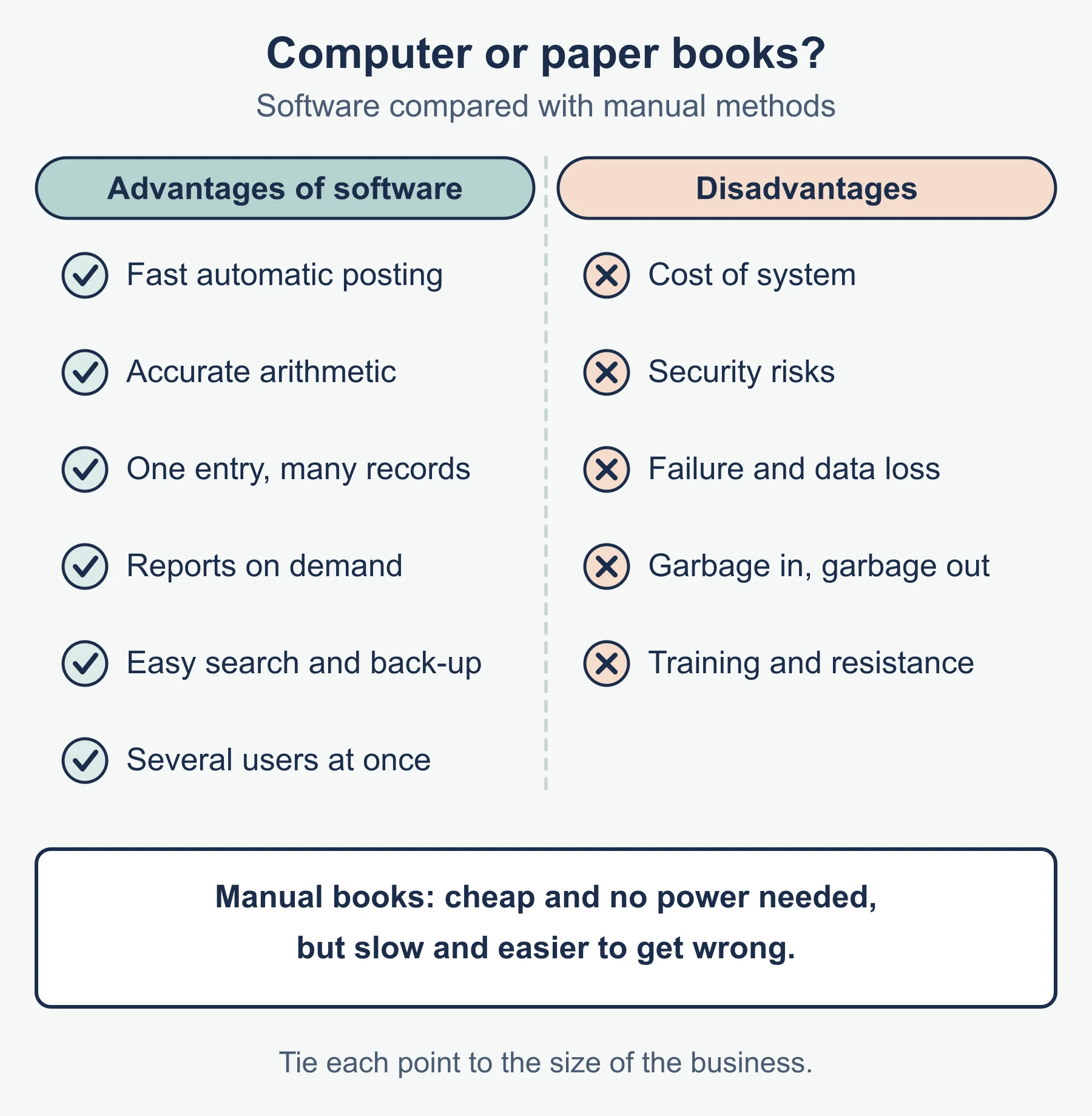
| Fast posting and totals | Cost of hardware, software, updates, training |
| Arithmetic is automatic | Hacking, viruses and fraud risk |
| One entry updates many records | Power failure or system crash |
| Trial balance and statements on demand | Wrong data still posted wrongly |
| Easy storage, search and back-up | Staff need training and may resist |
| Several users, controlled by passwords | Back-ups must be made and kept |
Manual methods: low cost, no power needed, suit few transactions. Slow, error-prone, hard to search.
Must-know distinctions
- Limitation of a statement (historical cost, snapshot) versus limitation of a ratio (needs comparison, no reasons). Many points apply to both.
- Financial factor versus non-financial factor. Staff morale is non-financial.
- Profit versus cash. A profitable business can have no cash.
- Software removes arithmetic slips. It does not remove input errors or errors of principle.
- A limit is not a reason to ignore the figures. Say what they suggest first.
Quick self-test
- State two non-financial factors that an income statement does not show.
- Why does historical cost limit a return on capital employed comparison?
- A business has current assets of 90,000 and current liabilities of 60,000. Calculate the current ratio.
- It uses 30,000 of its cash to pay trade payables. Calculate the new current ratio.
- Give two reasons why comparing your ratios with a rival’s might mislead.
- Cost of sales is 270,000, opening inventory 45,000 and closing inventory 15,000. Calculate the rate of inventory turnover on average inventory.
- Give one financial reason and one non-financial reason a business could report profit and still be in difficulty.
- State two advantages of computerised software over manual methods.
- State two disadvantages of computerised software.
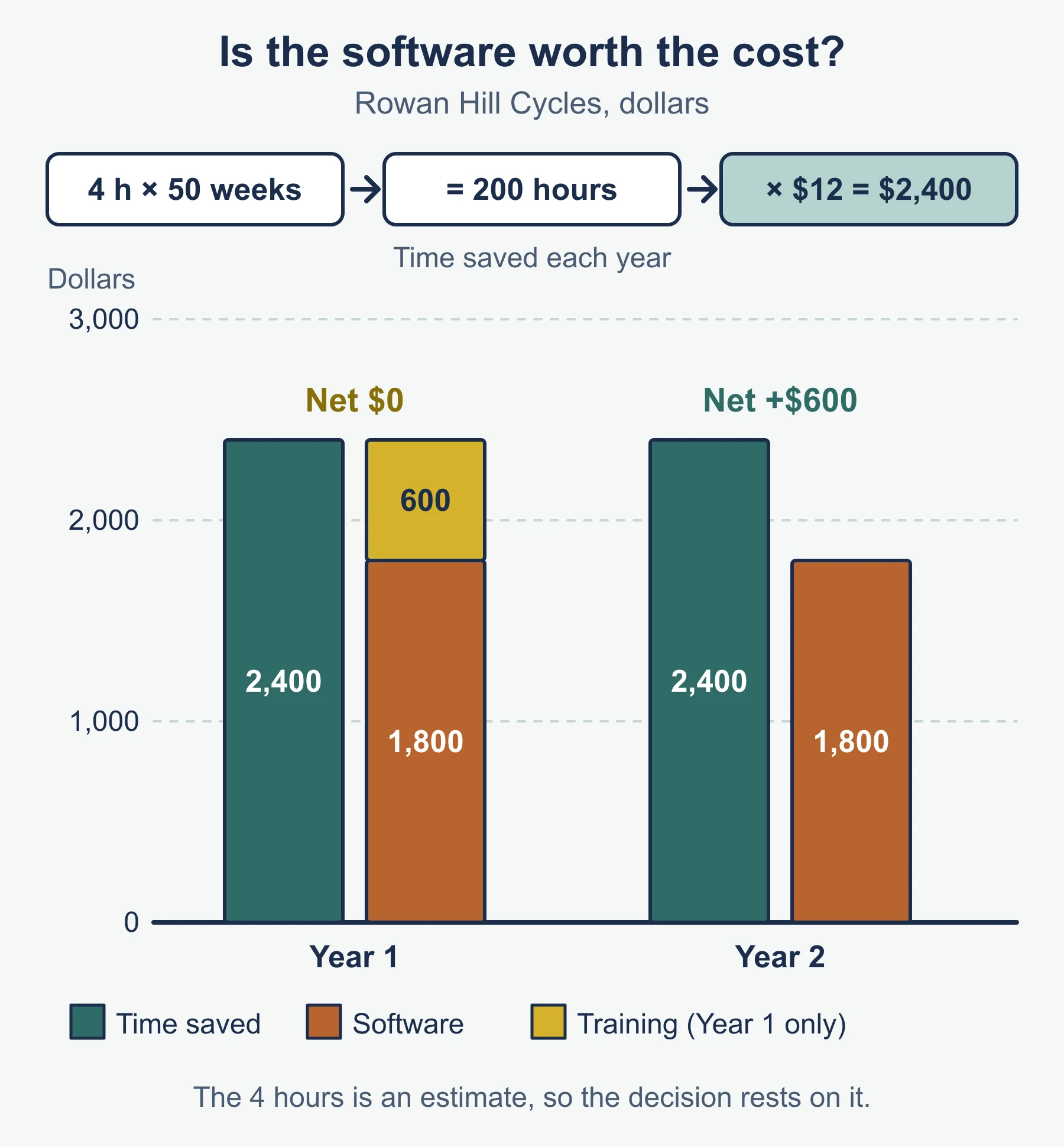
- A shop pays 1,500 a year for software that saves 200 hours at 11 an hour. What is the yearly net saving?
- True or false: a computerised system cannot post a wrong amount.
Answers
- Any two from staff morale, reputation, competitors, market conditions, law, management quality.
- Assets are shown at cost less depreciation, so capital employed is below current value and two businesses that bought at different times look different.
- 90,000 / 60,000 = 1.50.
- Current assets 60,000 and current liabilities 30,000, so 2.00.
- Different accounting policies or definitions; different size, products or year end.
- Average inventory = (45,000 + 15,000) / 2 = 30,000. 270,000 / 30,000 = 9 times.
- Financial: customers pay late so cash is short. Non-financial: a key customer leaving or a new competitor.
- Any two from speed, automatic arithmetic, one entry updating several records, quick reports, easy storage.
- Any two from cost, security risk, system failure, staff training, wrong data still posted.
- 200 x 11 = 2,200, less 1,500 = 700.
- False. It posts whatever is entered, so wrong amounts are posted wrongly.
Where marks are usually lost
- Writing “ratios are inaccurate” instead of saying what they leave out.
- Giving a limitation with no link to the business in the question.
- Calling a non-financial factor, such as reputation, a financial one.
- Quoting a ratio and concluding nothing from it.
- Giving only advantages of computers, or only disadvantages.
- Saying software stops all errors or that manual methods are always cheaper.
- Comparing ratios across businesses without saying the definitions and sizes may differ.
- Using year-end figures without noting that they may be unrepresentative.
Frequently asked questions
What non-financial factors do financial statements not show? Management quality and staff skills, staff morale and industrial relations, reputation and customer loyalty, market and competitor conditions, changes in law and environmental conduct.
Does accounting software remove all errors? No. Software removes arithmetic slips, but it does not remove input errors or errors of principle, because wrong data is still posted wrongly.
What is the difference between a limitation of a statement and a limitation of a ratio? A limitation of a statement comes from how the figures are produced, such as historical cost or a year-end snapshot. A limitation of a ratio is that it needs a comparison and does not give reasons. Many points apply to both.
Should I ignore ratios because they have limitations? No. A limit is not a reason to ignore the figures: say what the ratios suggest first, then explain what limits their usefulness.
What are the advantages and disadvantages of manual accounting? Manual methods cost little, need no power and suit a business with few transactions. They are slow, error-prone and hard to search.
Official syllabus
OxfordAQA International GCSE Accounting (9215), specification version 1.2, section 3.5, published by OxfordAQA, for exams from May/June 2026 onwards.
Get free revision emails (optional)
Occasional emails with practice questions, worked explanations and links to free resources for the qualification and subjects you choose. No spam, and you can unsubscribe from any email. The free tools on this site never need an email.
Related resources
-
Study guides
OxfordAQA IGCSE Accounting: Accounting ratios and financial measures (9215)
Study guide to the nine financial ratios and measures in OxfordAQA International GCSE Accounting 9215: standard forms, worked examples and interpretation.
Accounting · OxfordAQA · IGCSE
Read guide -
Practice questions
OxfordAQA IGCSE Accounting: Accounting ratios and financial measures (9215) – Practice Questions
Eleven original practice questions with worked answers on the nine ratios and financial measures in OxfordAQA International GCSE Accounting 9215.
Accounting · OxfordAQA · IGCSE
Try questions -
Revision notes
OxfordAQA IGCSE Accounting: Accounting ratios and financial measures (9215) – Revision Notes
Condensed formulae, method steps, interpretation cues and a ten-question self-test on the nine ratios in OxfordAQA International GCSE Accounting 9215.
Accounting · OxfordAQA · IGCSE
Revise topic
Related articles
-
teaching
A Level tuition in Dubai: Cambridge or Pearson Edexcel International A Level?
Schools in Dubai and Abu Dhabi teach either Cambridge International AS & A Level or Pearson Edexcel International A Level. How the two are structured, why it matters for tuition, and how online classes from Lahore work.
9 October 2026
-
curriculum guides
Choosing subjects at IGCSE and A Level
How subject choices at 14 and 16 affect university options later, and how to keep pathways open without overloading a timetable.
28 July 2026
Studying this with a teacher
Working through Accounting IGCSE?
This page is free and stays free. If you would rather be taught it, Marlbridge runs Accounting classes one-to-one and in small groups of up to 15, online in your own time zone. The first trial class is free. WhatsApp replies within an hour (8am–11pm Pakistan time, every day); email the same day.
OxfordAQA Accounting teachers at Marlbridge

