
Study Guides
OxfordAQA IGCSE Accounting: Limitations of financial statements and the use of computers in accounting (9215)
Study guide to the limits of financial statements and ratio analysis, and to computerised versus manual accounting, for OxfordAQA IGCSE Accounting 9215.
- Subject
- Accounting
- Level
- IGCSE
- Topic
- Interpretation, analysis and communication of financial information
- Author
- Marlbridge Academic Team
- Updated
- Reviewed by
- Javaid Iqbal Sabri (what this means)
Aligned to OxfordAQA IGCSE Accounting (9215), First teaching 2024, first examined 2026. Official specification .
Syllabus page (what it covers and how it is assessed): OxfordAQA IGCSE Accounting.
Syllabus points this page covers
9215
- Limitations of financial statements and ratio analysis
Found an error? Report a correction.
Need help with this topic? Request a free trial class for IGCSE Accounting (9215).
This guide follows the OxfordAQA International GCSE Accounting (9215) specification, version 1.2, for exams from May/June 2026 onwards. It covers the last two content points of section 3.5, “Interpretation, analysis and communication of financial information”: the limitations of financial statements and ratio analysis when assessing business performance, and the use of computers in accounting. The specification says section 3.5 is assessed in Paper 2, Financial Statements (content 3 to 5). All amounts are in dollars. Every business and figure is invented.
Start from the OxfordAQA IGCSE Accounting hub and tick progress off on the printable checklist. The free diagnostics show where you are weakest. The groups who read financial statements are in the stakeholders guide, and the exam preparation page covers technique. This topic also has revision notes and practice questions.
What the specification asks you to do
| Specification wording | What it means for you | Where |
|---|---|---|
| The limitations of financial statements and ratio analysis when assessing business performance | Explain why statements and ratios cannot give a complete picture | Sections 1 to 3 |
| Limitations will include those relating to both financial and non-financial factors | Give limits that come from the numbers and limits that come from things the numbers leave out | Sections 2 and 3 |
| Use of computers in accounting | Weigh computerised software against manual methods | Section 5 |
| Advantages and disadvantages of using computerised software for recording accounting data compared to manual methods | Give both sides, tied to the business in the question | Section 5 |
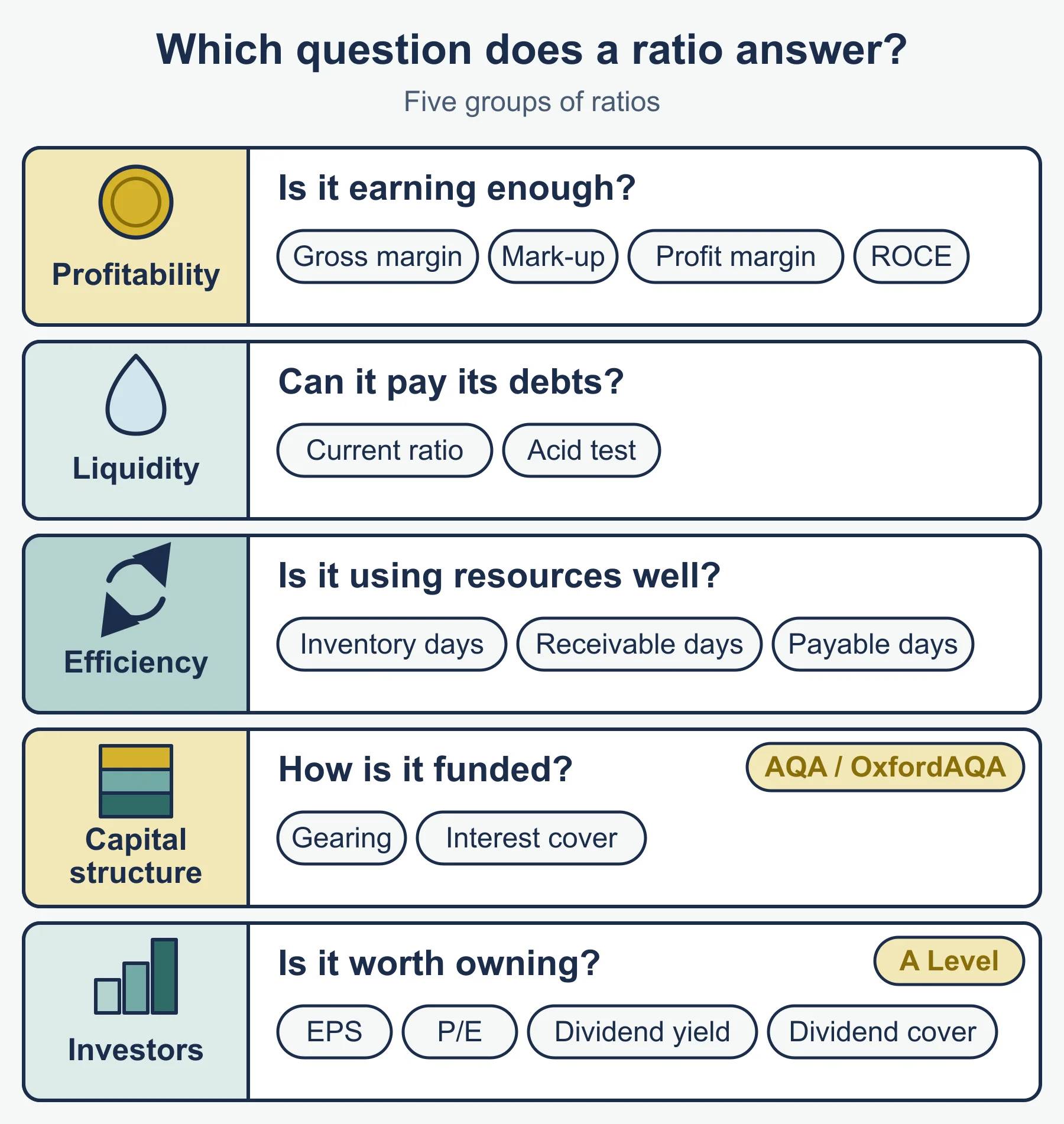
The specification names the ratios you calculate elsewhere in section 3.5 (gross profit margin, markup, rate of inventory turnover, profit in relation to revenue, return on capital employed, current ratio, liquid capital ratio, trade receivable days and trade payable days). It also points to the OxfordAQA guide “Formulae for accounting ratios”. Use that guide for the exact formulas. This page uses the ratios only to show what they can and cannot tell you.
1. Why limits matter
Financial statements report what has already happened, in money. A ratio turns two of those figures into one number that is easy to compare. Both are useful, and both leave things out. An appraisal that quotes a ratio and stops there earns little. A good appraisal also says what else you would need to know before trusting the ratio.
- Financial limitations come from how the figures are produced and used: the date, the policies, the estimates, the lack of comparison.
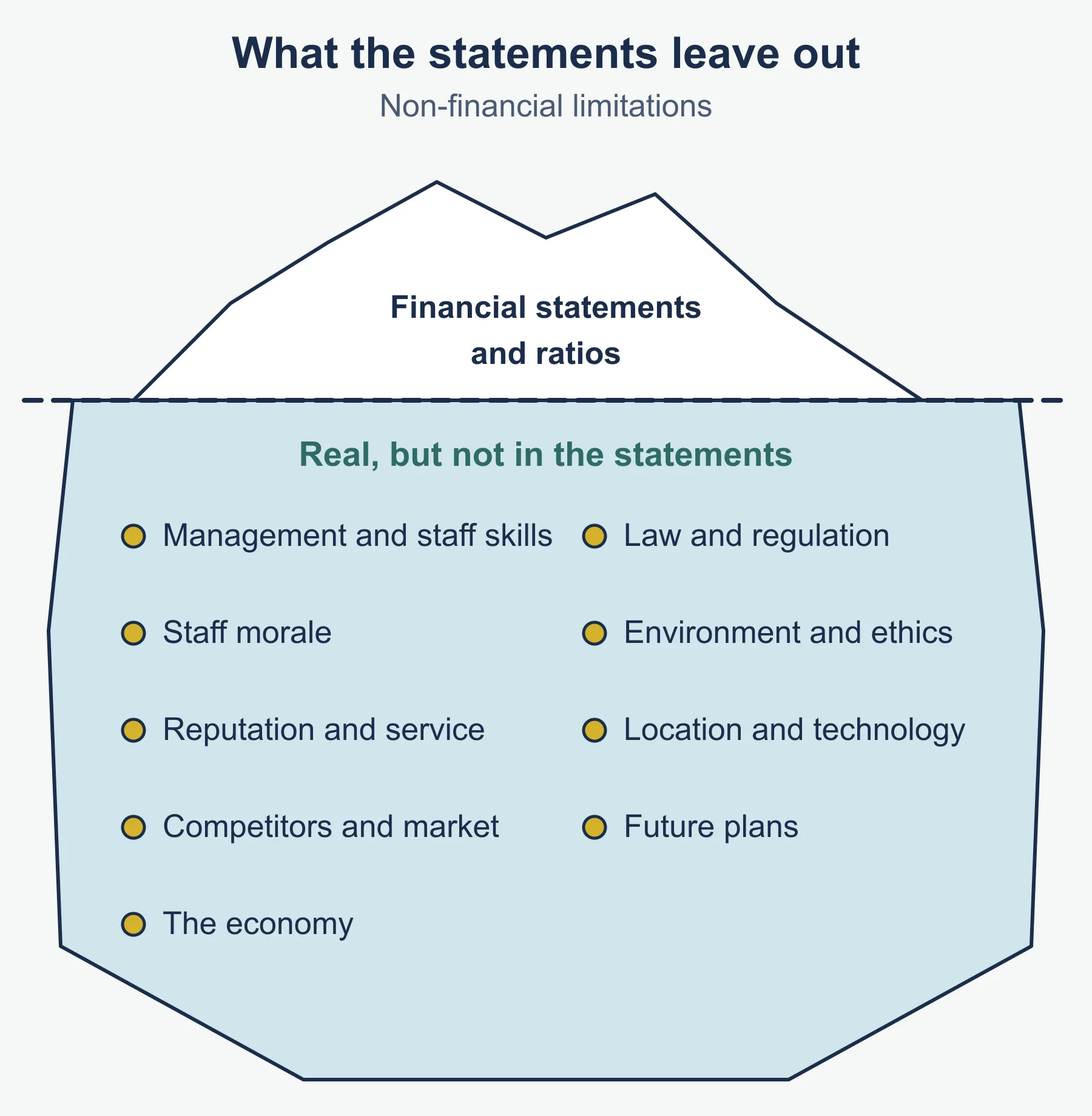
- Non-financial limitations come from facts that are real but do not appear in the statements at all: people, reputation, markets and plans.
2. Financial limitations of statements and ratios
The statements record the past
The income statement covers a period that has ended. The statement of financial position shows one date. Neither tells you what will happen next. A business with a strong year may have just lost its biggest customer.
The statement of financial position is a snapshot
Figures on that single date may be unrepresentative. Seasonal trade is the clearest case. A business can also arrange its affairs just before the year end so that a ratio looks better. This is sometimes called window dressing. The term is not in the specification, but the idea is a direct example of the snapshot limit.
Historical cost and inflation
Non-current assets are usually recorded at cost less depreciation. After years of rising prices, the figures understate what the assets are worth now. That distorts any ratio using capital employed, and it makes two businesses that bought similar assets in different years look different when they are not.
Estimates and accounting policies
Depreciation, allowances for irrecoverable debts and the valuation of inventory all involve judgement. Two businesses with identical trading can report different profit because they chose different methods. Ratios based on profit then differ for reasons that have nothing to do with performance.
Ratios need something to compare with
A figure of 1.8 for the current ratio means little on its own. You need a previous year, a budget, or a similar business. Comparison itself has limits:
- the other business may define its figures differently
- it may sell different goods, so normal margins differ
- it may be much larger or smaller
- its year end may fall at a different time
Ratios do not explain themselves
A ratio shows that something changed. It never says why. A fall in gross profit margin could come from cheaper selling prices, dearer purchases, theft of inventory or an error in counting. You have to look at the underlying figures and ask the managers.
Averages and totals hide detail
One trade receivable days figure can hide a single customer who owes a very large sum. A whole-business profit margin can hide a loss-making product line.
Profit and cash differ
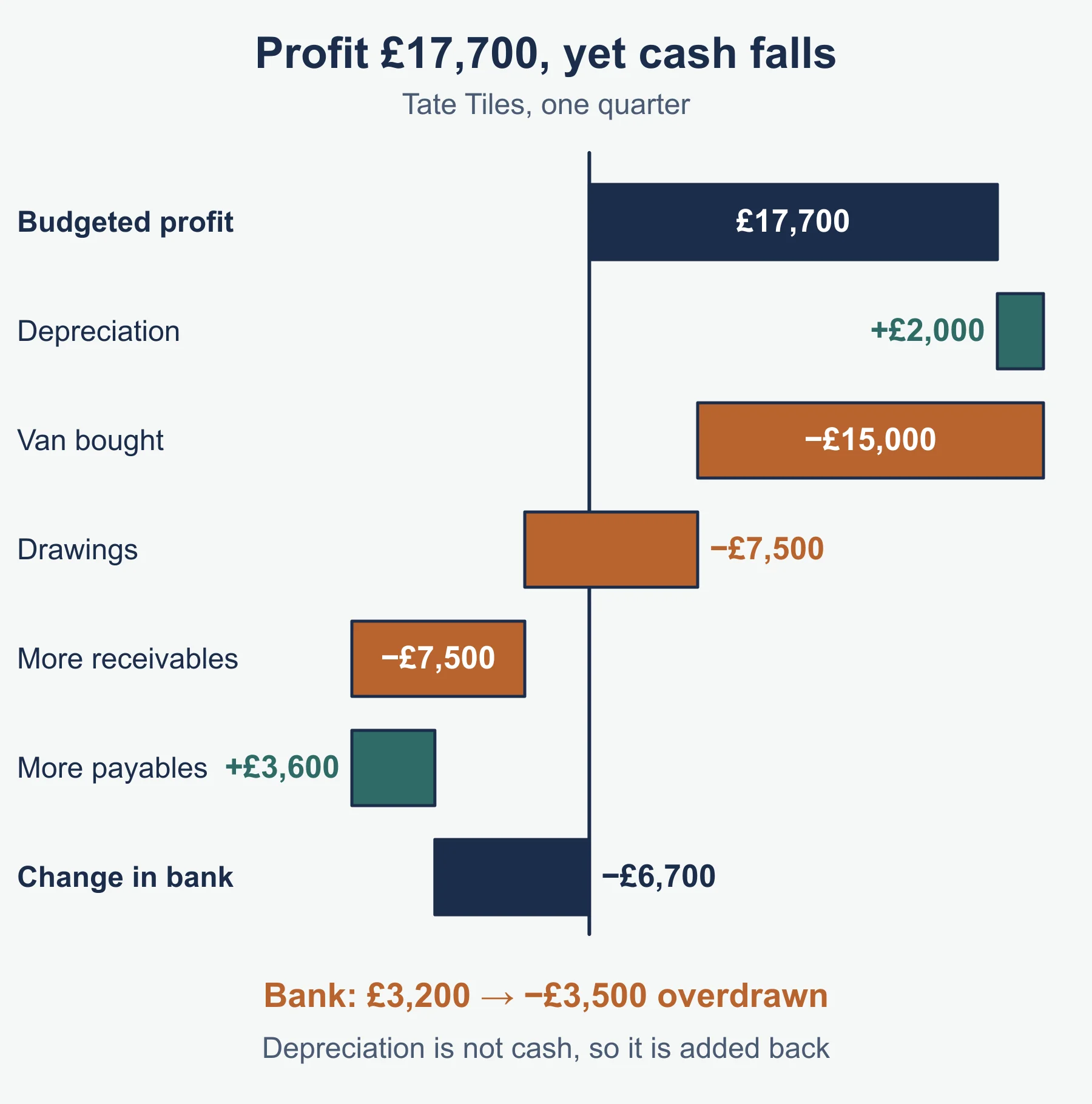
A business can report a profit and still run out of cash, for example when customers pay late or when cash is tied up in inventory. Profit measures performance over a period. It is not a bank balance.
3. Non-financial limitations
These are facts that decide success but are not in the statements.
| Factor | Why it limits what the statements tell you |
|---|---|
| Quality of management and staff skills | A skilled team may improve results next year, a departing key employee may harm them. Neither appears in the figures. |
| Staff morale and labour relations | Poor morale can cause absence and lost output before profit falls. |
| Reputation and customer service | Loyal customers support future revenue, complaints warn of loss. |
| Competitors and market conditions | A new rival or a falling market changes the outlook. |
| The economy | Interest rates, consumer spending and exchange rates affect all businesses. |
| Changes in law or regulation | New rules can raise costs or close a market. |
| Environmental and ethical conduct | Pollution or poor treatment of suppliers can lead to fines or lost customers. |
| Location and technology | A good site or modern equipment is a strength the figures only show indirectly. |
| Future plans | A planned new product or closure is not in last year’s statements. |
In a scenario question, pick the factors that fit it rather than listing all of them.
4. Worked examples
Example 1: a ratio comparison and its limits
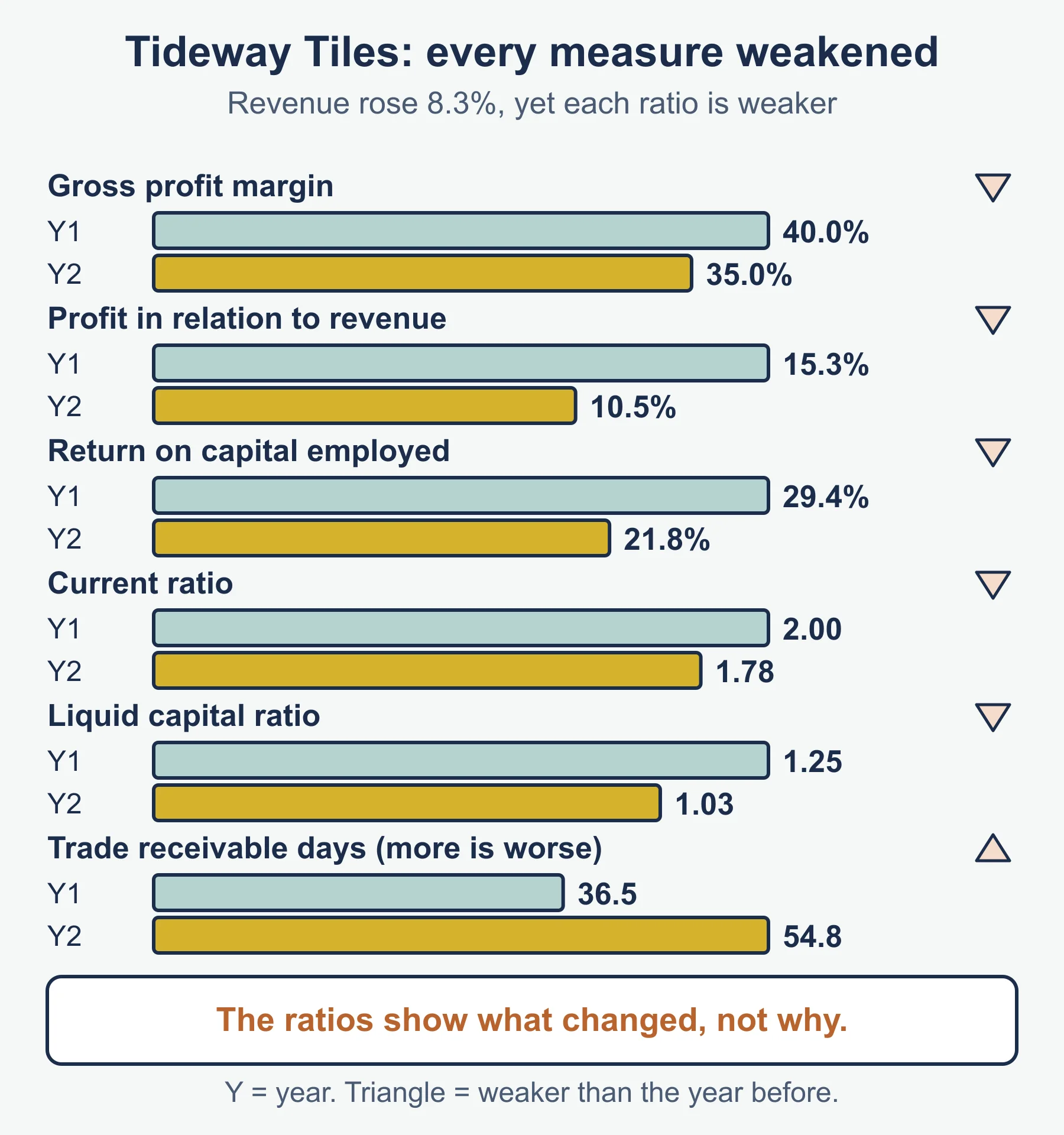
Tideway Tiles sells floor tiles. Capital employed was 250,000 in both years. Figures in dollars:
| Item | Year 1 | Year 2 |
|---|---|---|
| Revenue | 480,000 | 520,000 |
| Cost of sales | 288,000 | 338,000 |
| Gross profit | 192,000 | 182,000 |
| Other expenses | 118,400 | 127,400 |
| Profit for the year | 73,600 | 54,600 |
| Inventory | 36,000 | 60,000 |
| Trade receivables | 48,000 | 78,000 |
| Cash | 12,000 | 4,000 |
| Current liabilities | 48,000 | 80,000 |
| Ratio | Year 1 | Year 2 |
|---|---|---|
| Gross profit margin | 40.0% | 35.0% |
| Profit in relation to revenue | 15.3% | 10.5% |
| Return on capital employed | 29.4% | 21.8% |
| Current ratio | 2.00 | 1.78 |
| Liquid capital ratio | 1.25 | 1.03 |
| Trade receivable days | 36.5 | 54.8 |
Revenue rose by 8.3% but every measure weakened. The statements point to a fall in profitability and tighter liquidity.
The limits are what stop you stopping there. The ratios do not say why the margin fell. It could be discounting to win sales or a dearer supplier. The year 2 inventory and receivables are year-end figures, so they may reflect a big delivery or a big sale in the last week. Two years is a short trend. A comparison with another tile seller would need the same policies. Non-financial factors to find out: did a competitor open nearby, has a major customer been slow because of its own difficulties, and is the owner planning a price rise?
Example 2: a snapshot that can be changed
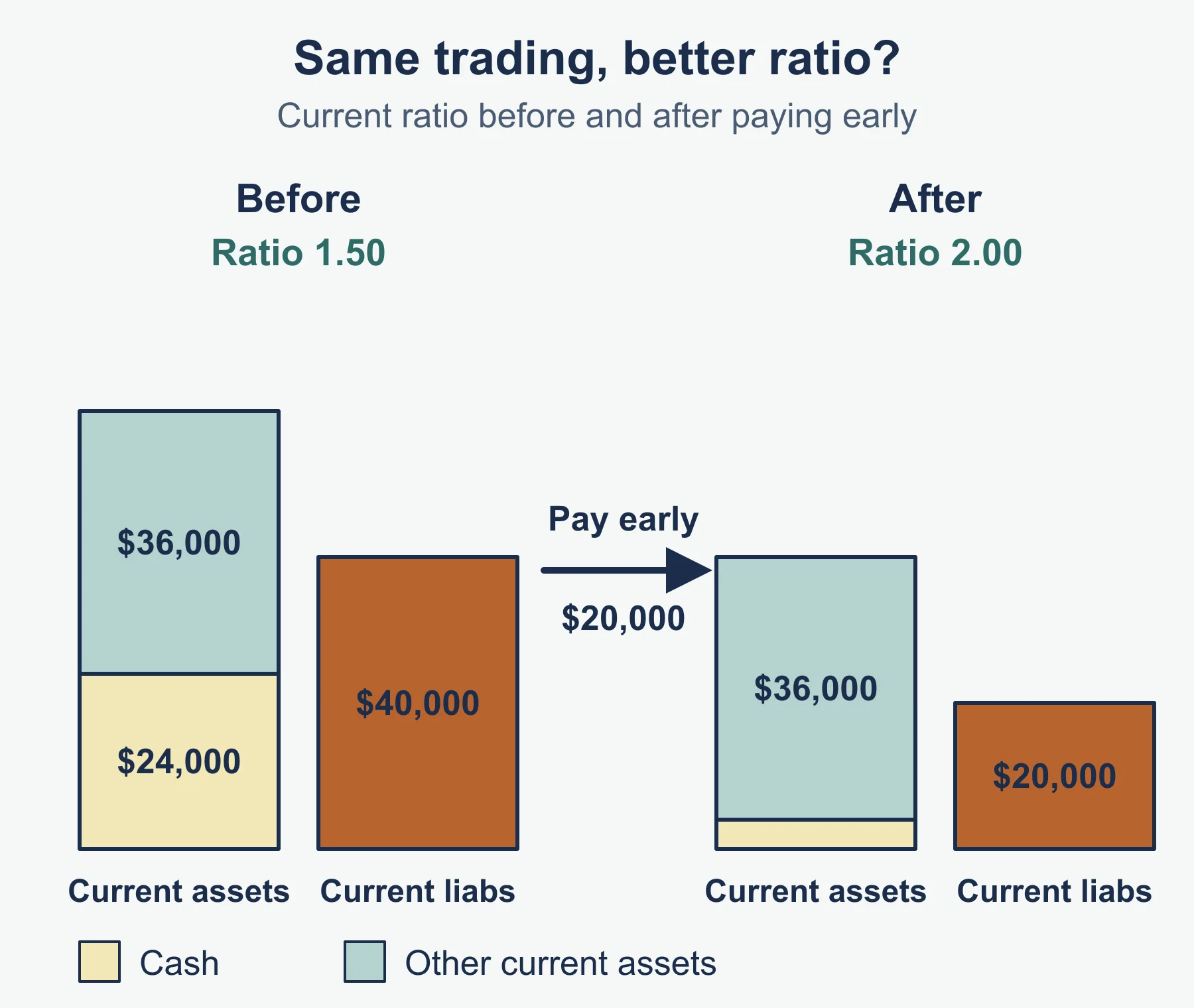
Hartmoor Supplies has current assets of 60,000, of which cash is 24,000, and current liabilities of 40,000. The current ratio is 60,000 / 40,000 = 1.50. Two days before the year end it uses 20,000 of cash to pay trade payables early. Current assets become 40,000 and current liabilities 20,000, so the ratio becomes 2.00.
Nothing about trading has changed, yet the ratio looks stronger because of timing. A lender looking only at this date would be misled.
Example 3: policy differences
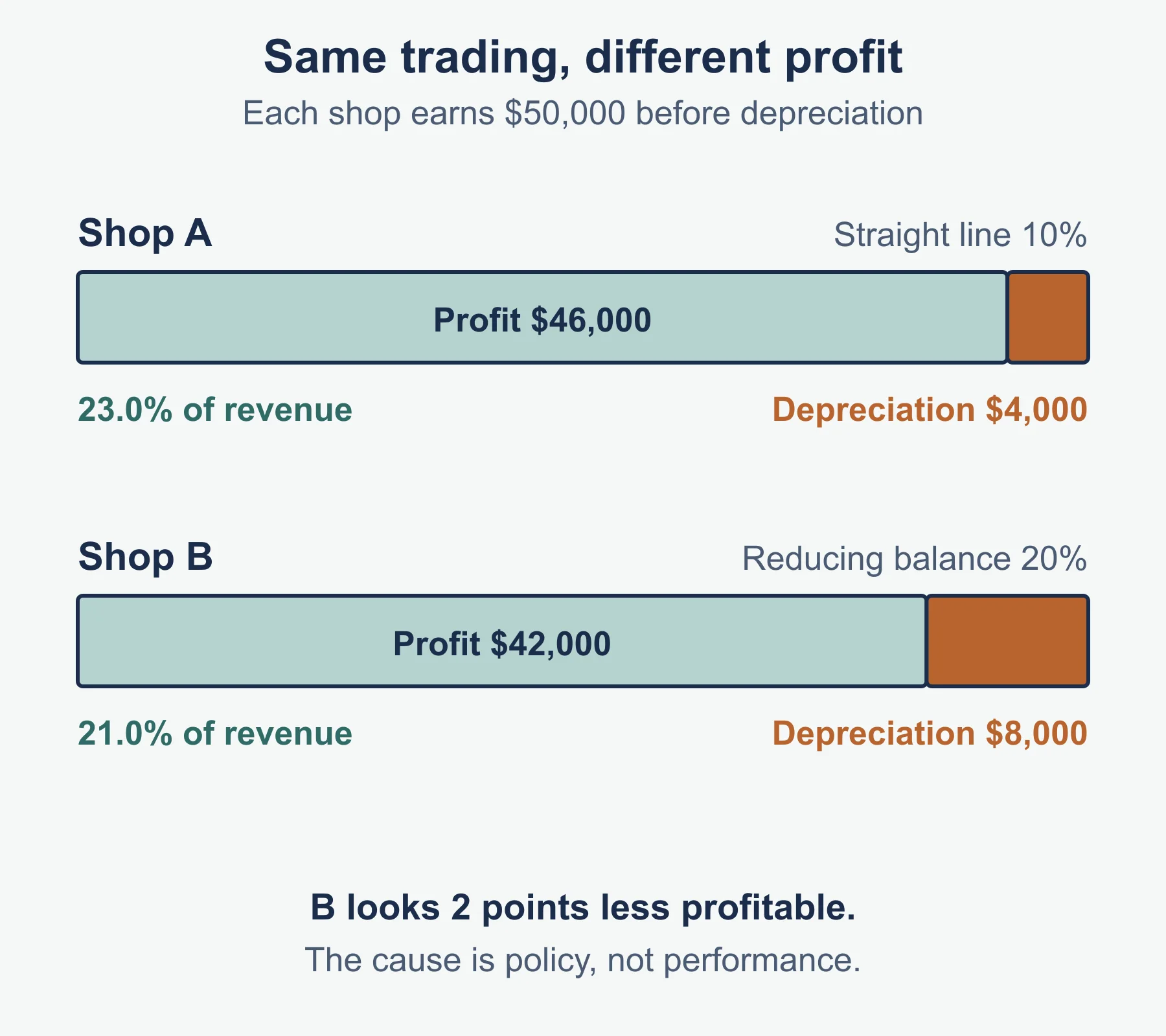
Two shops each buy a machine for 40,000. Shop A uses straight line depreciation at 10% a year, charging 4,000. Shop B uses reducing balance at 20%, charging 8,000 in the first year. Each earns 50,000 before depreciation on revenue of 200,000.
| Shop A | Shop B | |
|---|---|---|
| Profit after depreciation | 46,000 | 42,000 |
| Profit in relation to revenue | 23.0% | 21.0% |
The shops trade identically, yet B looks 2 percentage points less profitable.
5. Computers in accounting
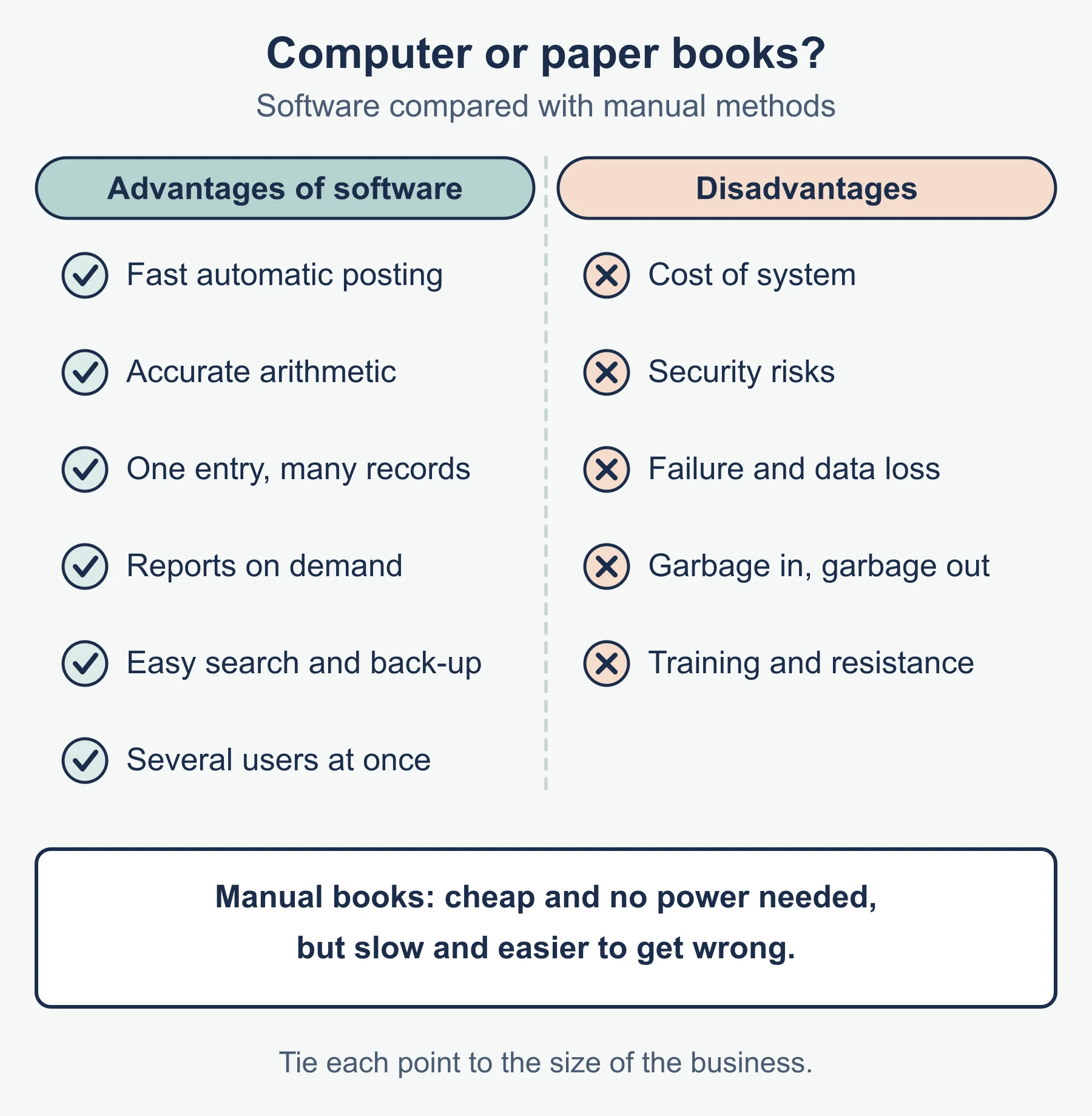
The specification asks for advantages and disadvantages of computerised software for recording accounting data, compared with manual methods. Manual methods mean paper books and ledgers written by hand, possibly with a calculator.
Advantages of computerised software
- Speed. Entries post to the ledger accounts automatically and totals update at once. A manual system needs each entry copied.
- Accuracy of arithmetic. The software adds, balances and carries forward without slips. A trial balance can be produced in seconds.
- One entry, many records. A sale entered once updates the sales, receivables and inventory records, which reduces copying errors.
- Reports on demand. Statements and ratios can be produced at any date, and a manager can see who owes money today.
- Storage and retrieval. Records are easy to search, and back-ups protect against loss.
- Several users. Different staff can work on the records at once, with passwords controlling access.
Disadvantages of computerised software
- Cost. Hardware, licences, updates and staff training are expenses. A very small business may not recover them.
- Security. Data can be hacked, corrupted by a virus or stolen. Staff with access could commit fraud.
- Failure. A power cut, fault or crash can stop work, and data is lost if back-ups are not made.
- Garbage in, garbage out. The software only posts what it is given. Wrong amounts, wrong accounts and errors of principle still occur.
- Training and resistance. Staff must learn the system, and some resist change.
Manual methods in brief
Manual methods cost little, need no power and suit a business with few transactions, but they are slow and easier to get wrong.
Worked example 4: is software worth the cost?
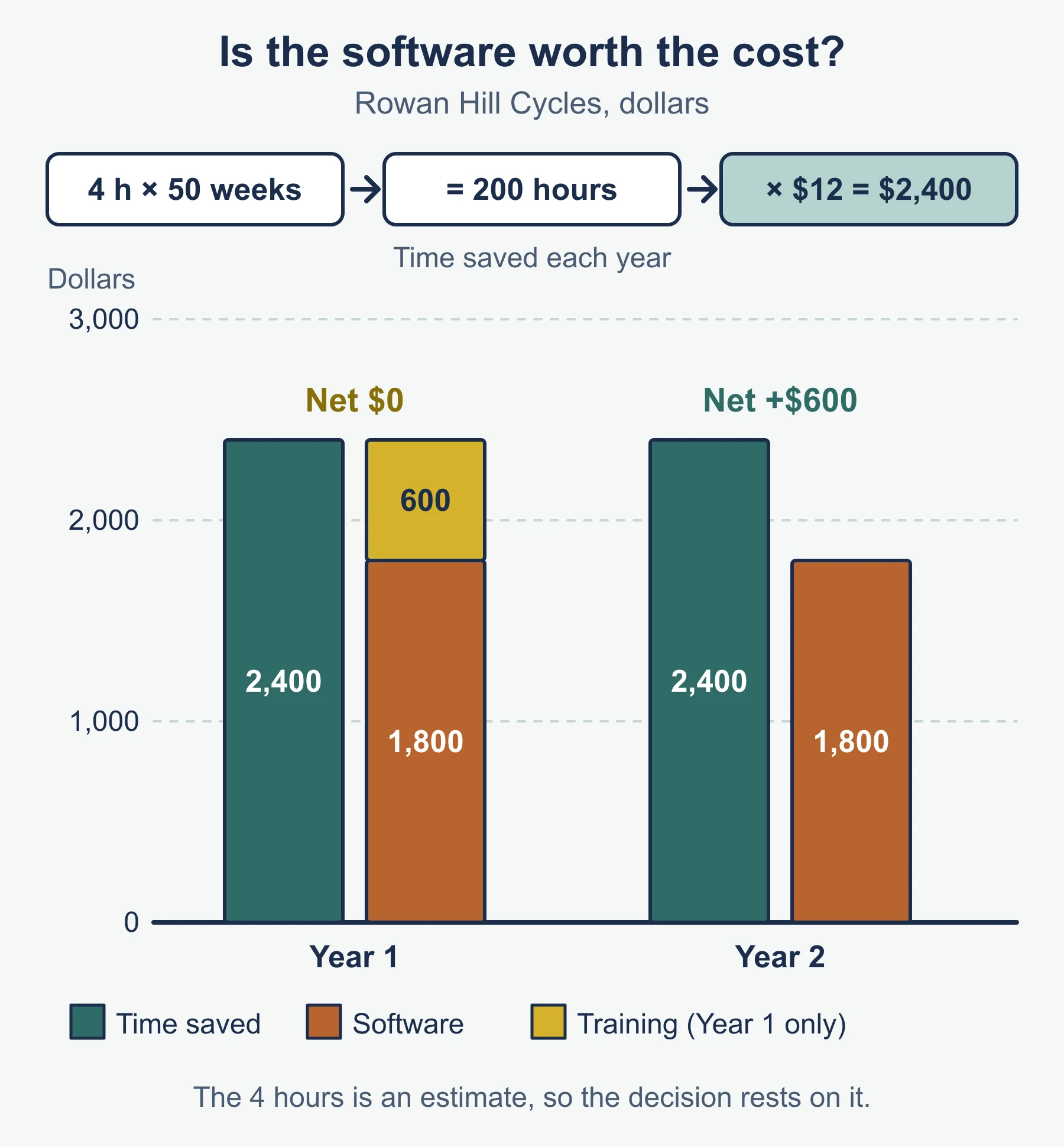
Rowan Hill Cycles processes about 40 ledger entries a day by hand. It is offered software costing 1,800 a year plus 600 for training in the first year only. The owner estimates the software would save 4 hours of bookkeeping a week. Bookkeeper time costs 12 an hour and the shop works 50 weeks a year.
- Time saved: 4 x 50 = 200 hours a year, worth 200 x 12 = 2,400.
- Year 1 cost: 1,800 + 600 = 2,400, so the saving just covers the cost.
- Year 2 onwards cost 1,800, leaving a net saving of 600 a year.
On these figures the software pays for itself in the first year. A fair answer also notes the non-money points: fewer arithmetic errors, but a new risk from data loss. The 4 hours is an estimate, so the decision rests on it.
6. Writing a good answer
- Say whether each point is a limitation of the statements or of the ratio.
- Link the point to the business in the question, using its figures where you can.
- For “advantages and disadvantages”, give at least one of each and tie them to the size of the business.
- If asked to appraise performance, conclude. Say what the figures suggest and what you would still want to know.
Common errors
- Writing “ratios are not accurate” when the sums are fine and the gap is what they leave out.
- Listing limitations with no link to the scenario.
- Saying a computer removes all errors, when wrong data is still posted wrongly.
- Giving only advantages of software, or only disadvantages.
- Calling a non-financial factor, such as staff morale, a financial one.
Frequently asked questions
Why is the statement of financial position called a snapshot? It shows the figures on a single date, which may be unrepresentative. Seasonal trade is the clearest case, and a business can also arrange its affairs just before the year end so that a ratio looks better.
How does historical cost limit financial statements? Non-current assets are usually recorded at cost less depreciation. After years of rising prices the figures understate what the assets are worth now, which distorts any ratio using capital employed.
Why can two identical businesses report different profits? Depreciation, allowances for irrecoverable debts and inventory valuation all involve judgement, so different accounting policies give different figures even when the businesses trade identically.
Do ratios explain why performance changed? No. A ratio shows that something changed but never says why. A fall in gross profit margin could come from several causes, so the reason has to be found from other information.
What are the advantages of computerised accounting software? Entries post to the ledger accounts automatically and totals update at once, which saves time and removes arithmetic slips. Disadvantages include the cost of hardware, licences, updates and staff training.
Official syllabus
OxfordAQA International GCSE Accounting (9215), specification version 1.2, section 3.5, published by OxfordAQA, for exams from May/June 2026 onwards.
Get free revision emails (optional)
Occasional emails with practice questions, worked explanations and links to free resources for the qualification and subjects you choose. No spam, and you can unsubscribe from any email. The free tools on this site never need an email.
Related resources
-
Practice questions
OxfordAQA IGCSE Accounting: Limitations of financial statements and the use of computers in accounting (9215) – Practice Questions
Eleven original questions with worked answers on limits of financial statements, ratios and computers in accounting for OxfordAQA IGCSE Accounting 9215.
Accounting · OxfordAQA · IGCSE
Try questions -
Revision notes
OxfordAQA IGCSE Accounting: Limitations of financial statements and the use of computers in accounting (9215) – Revision Notes
Revision notes on limits of financial statements and ratio analysis, and computerised versus manual accounting, for OxfordAQA IGCSE Accounting 9215.
Accounting · OxfordAQA · IGCSE
Revise topic -
Study guides
OxfordAQA IGCSE Accounting: Accounting ratios and financial measures (9215)
Study guide to the nine financial ratios and measures in OxfordAQA International GCSE Accounting 9215: standard forms, worked examples and interpretation.
Accounting · OxfordAQA · IGCSE
Read guide
Related articles
-
teaching
A Level tuition in Dubai: Cambridge or Pearson Edexcel International A Level?
Schools in Dubai and Abu Dhabi teach either Cambridge International AS & A Level or Pearson Edexcel International A Level. How the two are structured, why it matters for tuition, and how online classes from Lahore work.
9 October 2026
-
curriculum guides
Choosing subjects at IGCSE and A Level
How subject choices at 14 and 16 affect university options later, and how to keep pathways open without overloading a timetable.
28 July 2026
Studying this with a teacher
Working through Accounting IGCSE?
This page is free and stays free. If you would rather be taught it, Marlbridge runs Accounting classes one-to-one and in small groups of up to 15, online in your own time zone. The first trial class is free. WhatsApp replies within an hour (8am–11pm Pakistan time, every day); email the same day.
OxfordAQA Accounting teachers at Marlbridge

