
Revision Notes
OxfordAQA IGCSE Accounting: Appraising business performance, cash and profit (9215) – Revision Notes
Condensed formulas, interpretation phrases, cash versus profit grids and a self-test on ratios and appraisal for OxfordAQA IGCSE Accounting 9215.
- Subject
- Accounting
- Level
- IGCSE
- Topic
- Interpretation, analysis and communication of financial information
- Author
- Marlbridge Academic Team
- Updated
- Reviewed by
- Javaid Iqbal Sabri (what this means)
Aligned to OxfordAQA IGCSE Accounting (9215), First teaching 2024, first examined 2026. Official specification .
Syllabus page (what it covers and how it is assessed): OxfordAQA IGCSE Accounting.
Syllabus points this page covers
9215
- Appraising performance, cash and profit
Found an error? Report a correction.
Need help with this topic? Request a free trial class for IGCSE Accounting (9215).
These notes are aligned to the OxfordAQA International GCSE Accounting (9215) specification, version 1.2, for exams from May/June 2026 onwards. They condense the part of specification section 3.5 on appraising business performance with financial statements and ratios, and on cash versus profit. The full explanations and worked examples are in the study guide. When you are ready, try the practice questions, the course hub, the checklist and the free diagnostics. Amounts are in dollars.
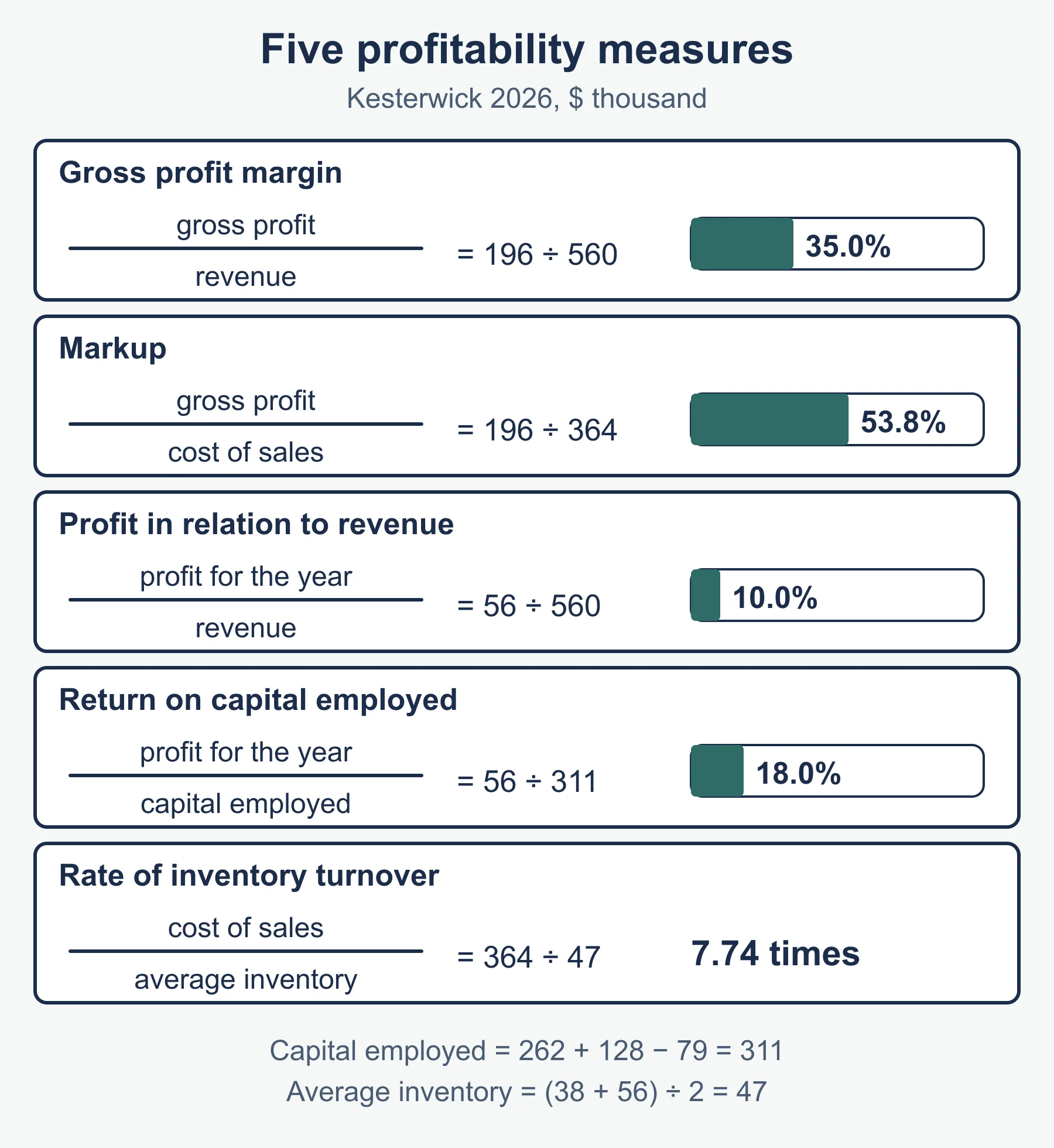
The nine measures in one table
The specification says the formulae are in OxfordAQA’s guide “Formulae for accounting ratios”. These are the standard forms. Confirm them against that guide.
| Measure | Formula | Answer as |
|---|---|---|
| Gross profit margin | gross profit / revenue x 100 | % |
| Markup | gross profit / cost of sales x 100 | % |
| Profit in relation to revenue | profit from operations / revenue x 100 | % |
| Return on capital employed | profit from operations / capital employed x 100 | % |
| Rate of inventory turnover | cost of sales / average inventory | times |
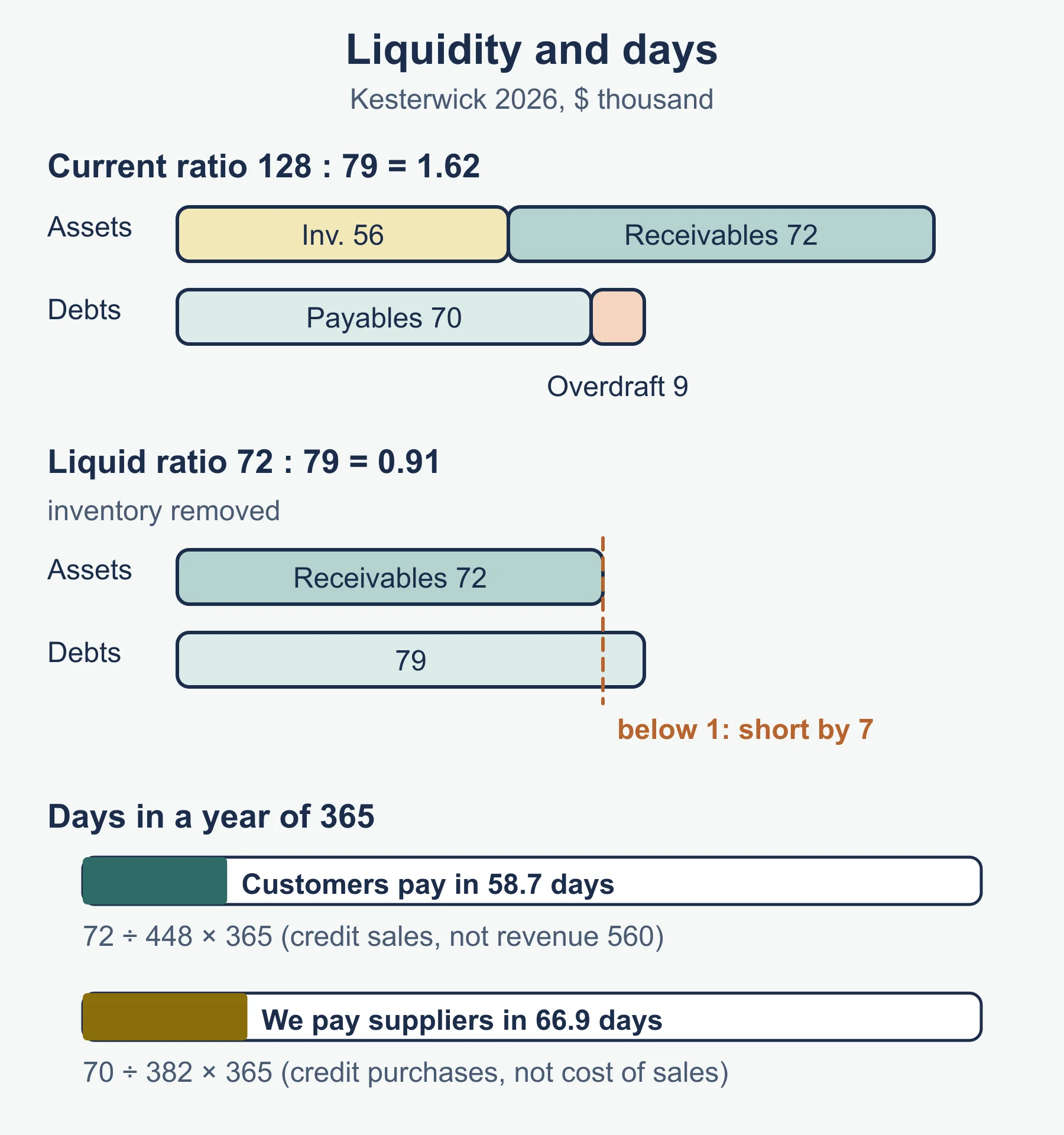
| Current ratio | current assets : current liabilities | x : 1 |
| Liquid capital ratio | (current assets - inventory) : current liabilities | x : 1 |
| Trade receivable days | trade receivables / credit sales x 365 | days |
| Trade payable days | trade payables / credit purchases x 365 | days |
Supporting definitions
- Profit from operations = gross profit - expenses, before loan interest. With no loan interest it equals profit for the year. Profit in relation to revenue and ROCE both use it, as OxfordAQA’s own 9215 mark scheme (Paper 2, May/June 2026) does.
- Capital employed = non-current assets + current assets - current liabilities = capital + non-current liabilities.
- Average inventory = (opening + closing) / 2.
- Working capital = current assets - current liabilities.
- Gross profit = revenue - cost of sales.
- Profit for the year = gross profit - expenses.
Method in steps
- Write the formula.
- Substitute the figures from the income statement or statement of financial position.
- Calculate and give the unit.
- Compare with another year or business.
- Explain the reason and give a judgement.
Worked reminder: Aldmoor Fabrics
Revenue 200,000, cost of sales 130,000, expenses 46,000, capital employed 160,000. Opening inventory 14,000, closing 16,000. Credit sales 146,000, trade receivables 18,000, credit purchases 73,000, trade payables 9,000. Current assets 52,000 (including inventory 16,000), current liabilities 26,000.
| Measure | Working | Result |
|---|---|---|
| Gross profit margin | 70,000 / 200,000 x 100 | 35.0% |
| Markup | 70,000 / 130,000 x 100 | 53.8% |
| Profit in relation to revenue | 24,000 / 200,000 x 100 | 12.0% |
| ROCE | 24,000 / 160,000 x 100 | 15.0% |
| Inventory turnover | 130,000 / 15,000 | 8.67 times |
| Current ratio | 52,000 : 26,000 | 2.00 : 1 |
| Liquid capital ratio | 36,000 : 26,000 | 1.38 : 1 |
| Receivable days | 18,000 / 146,000 x 365 | 45.0 days |
| Payable days | 9,000 / 73,000 x 365 | 45.0 days |
What a change usually means
Use these as starting points, then tie them to the facts in the question.
| Ratio moves | Possible meaning | Possible causes |
|---|---|---|
| Gross profit margin down | Lower profit on each sale | Price cuts, discounts, dearer supplies, wastage |
| Markup down | Smaller addition on cost | Same causes as margin |
| Profit in relation to revenue down | Expenses growing faster than revenue | Wages, rent, advertising, interest |
| ROCE down | Weaker return on investment | Lower profit, or more capital added without extra profit |
| Inventory turnover down | Inventory selling more slowly | Over-buying, weak demand, obsolete lines |
| Inventory turnover up | Faster sales, less cash tied up | Better buying, strong demand (but risk of running out) |
| Current ratio down | Less cover for short-term debts | More payables or overdraft, less cash |
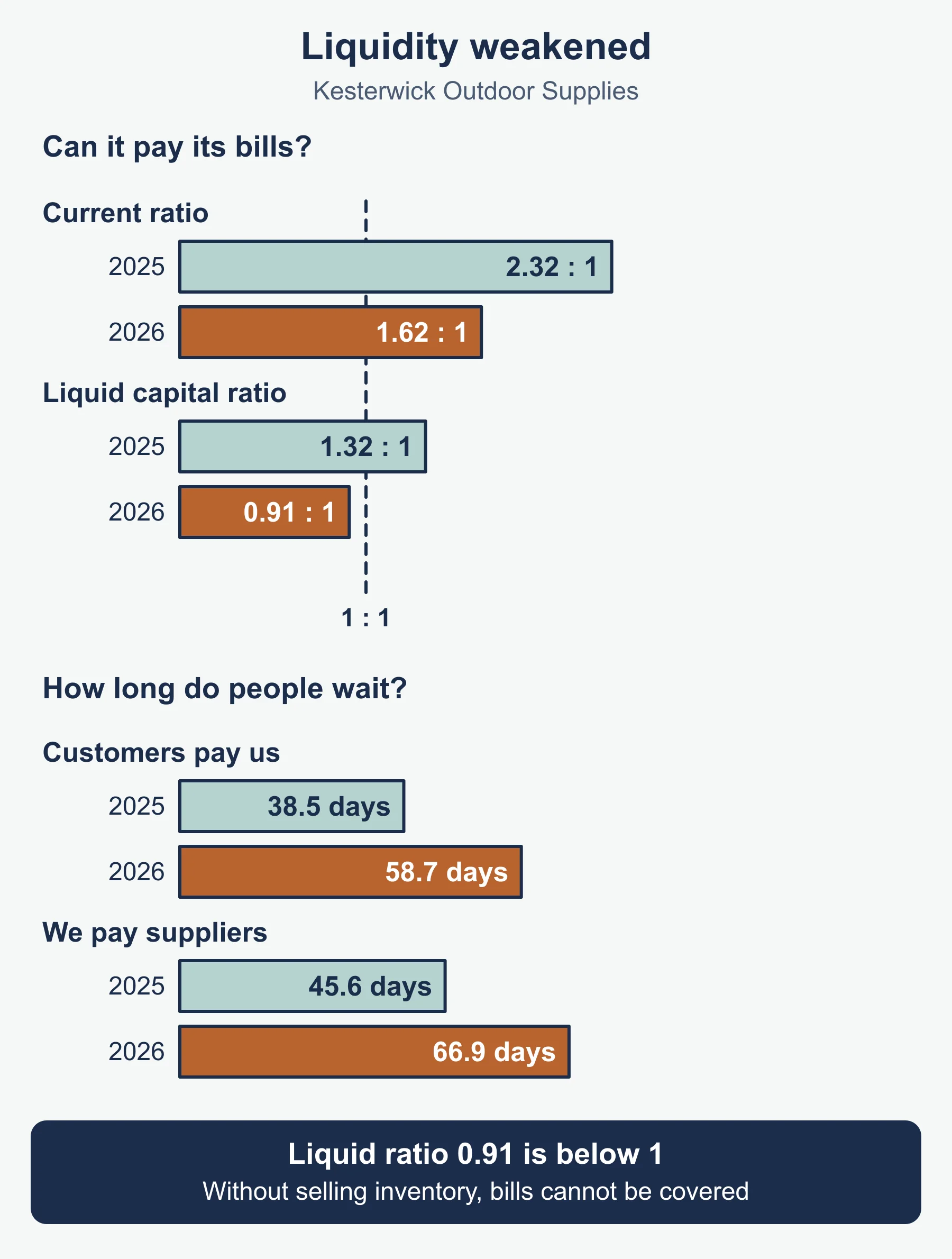
| Liquid capital ratio below 1 | Relying on selling inventory to pay debts | Cash used up, inventory built up |
| Receivable days up | Customers paying slower | Weak credit control, longer terms |
| Payable days up | Taking longer to pay suppliers | Cash shortage, or a negotiated deal; risks goodwill |
A higher ratio is not always better. A very high current ratio can mean idle cash or too much inventory. Very few receivable days might mean credit terms are so tight that sales are lost.
Margin versus markup
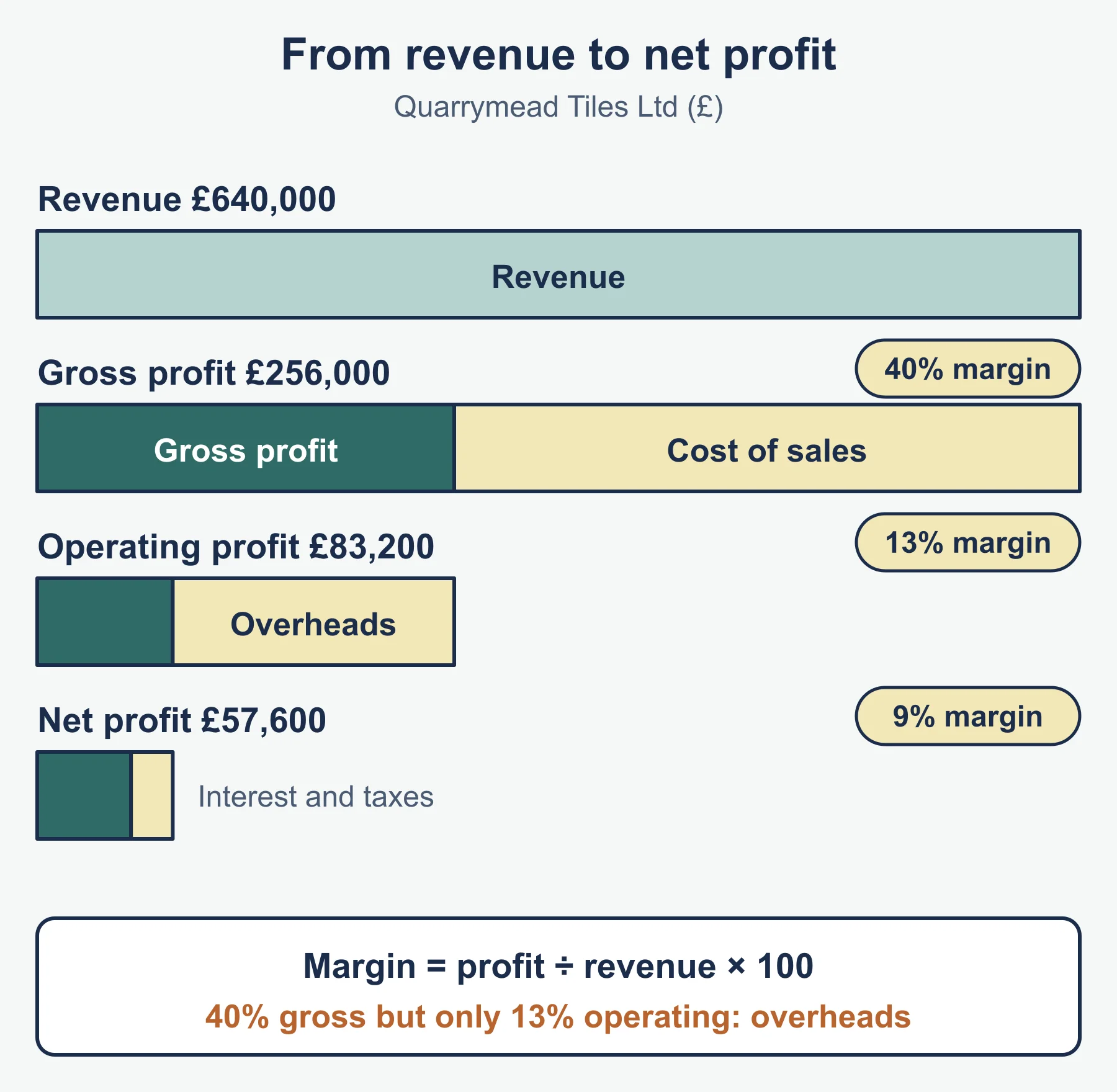
Same gross profit, different base. If gross profit is 70,000 on revenue of 200,000 and cost of sales of 130,000, the margin is 35.0% and the markup is 53.8%. Markup is always larger than margin when the margin is below 100%. Do not mix them up.
Cash versus profit
| Term | Meaning |
|---|---|
| Profit | Revenue less expenses, with sales and costs recorded when they arise |
| Cash | Money actually received and paid, held in the bank or as cash |
| Liquidity | Ability to pay debts as they fall due; depends on cash and quickly convertible assets |
Why they differ
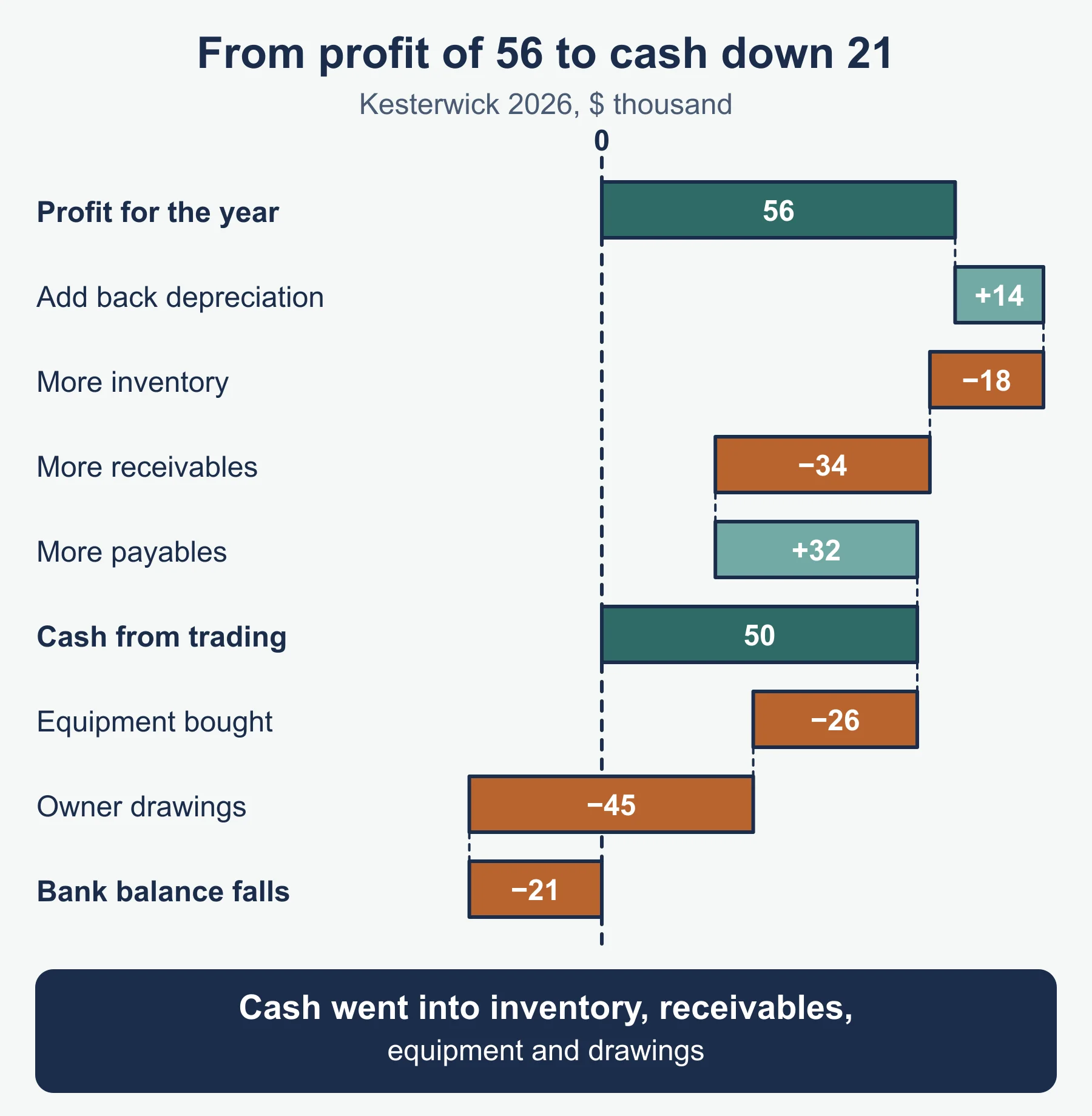
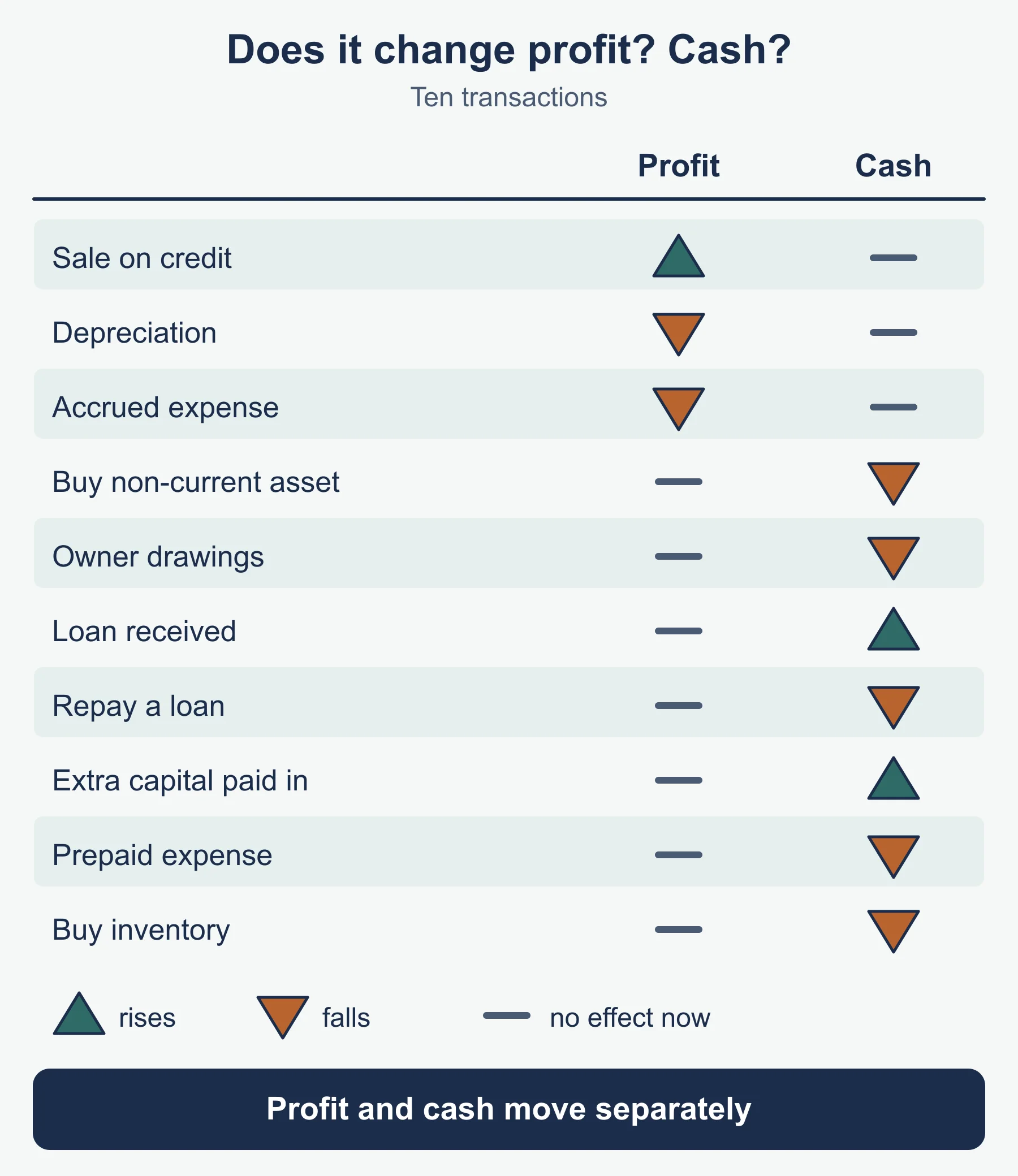
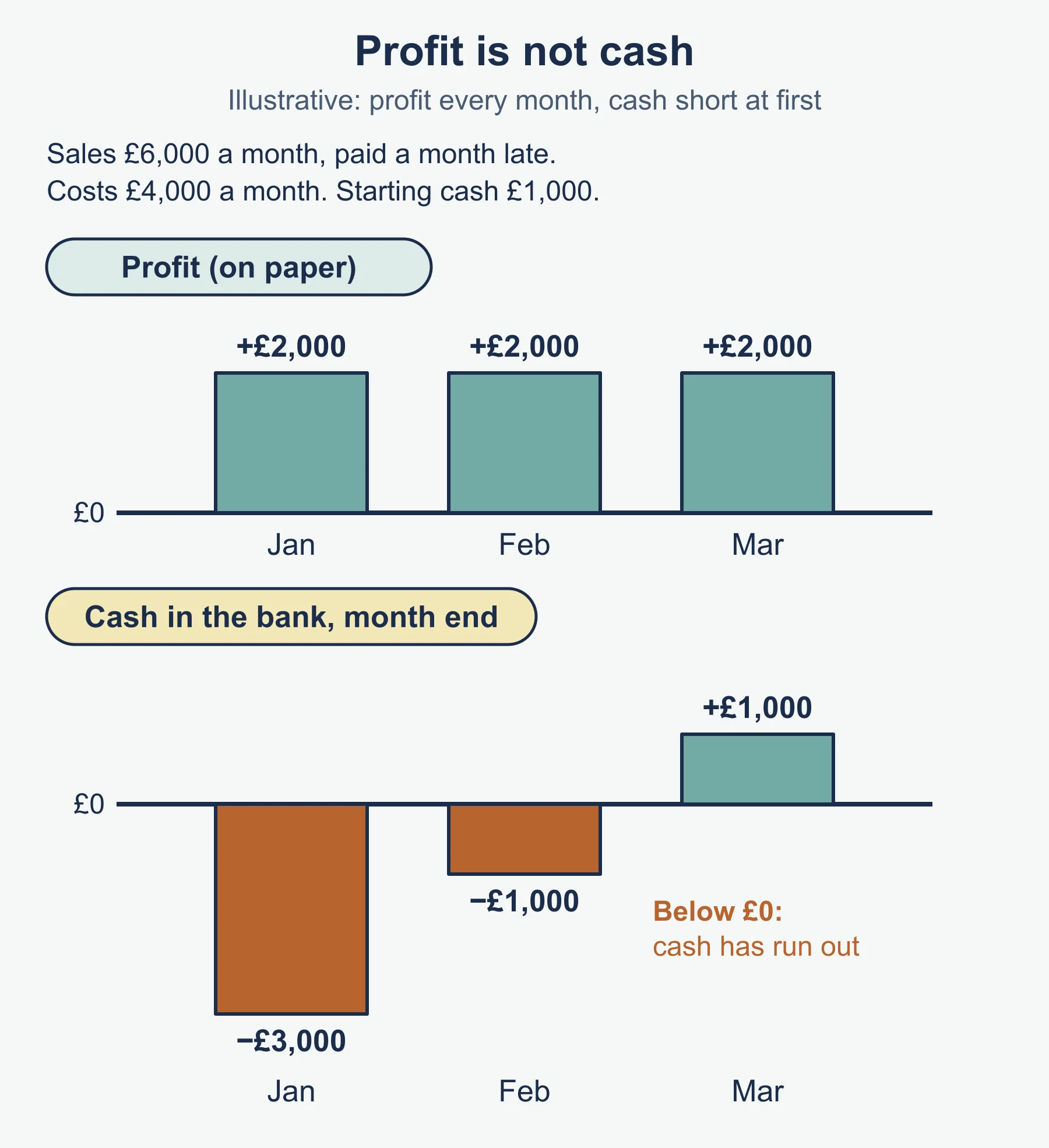
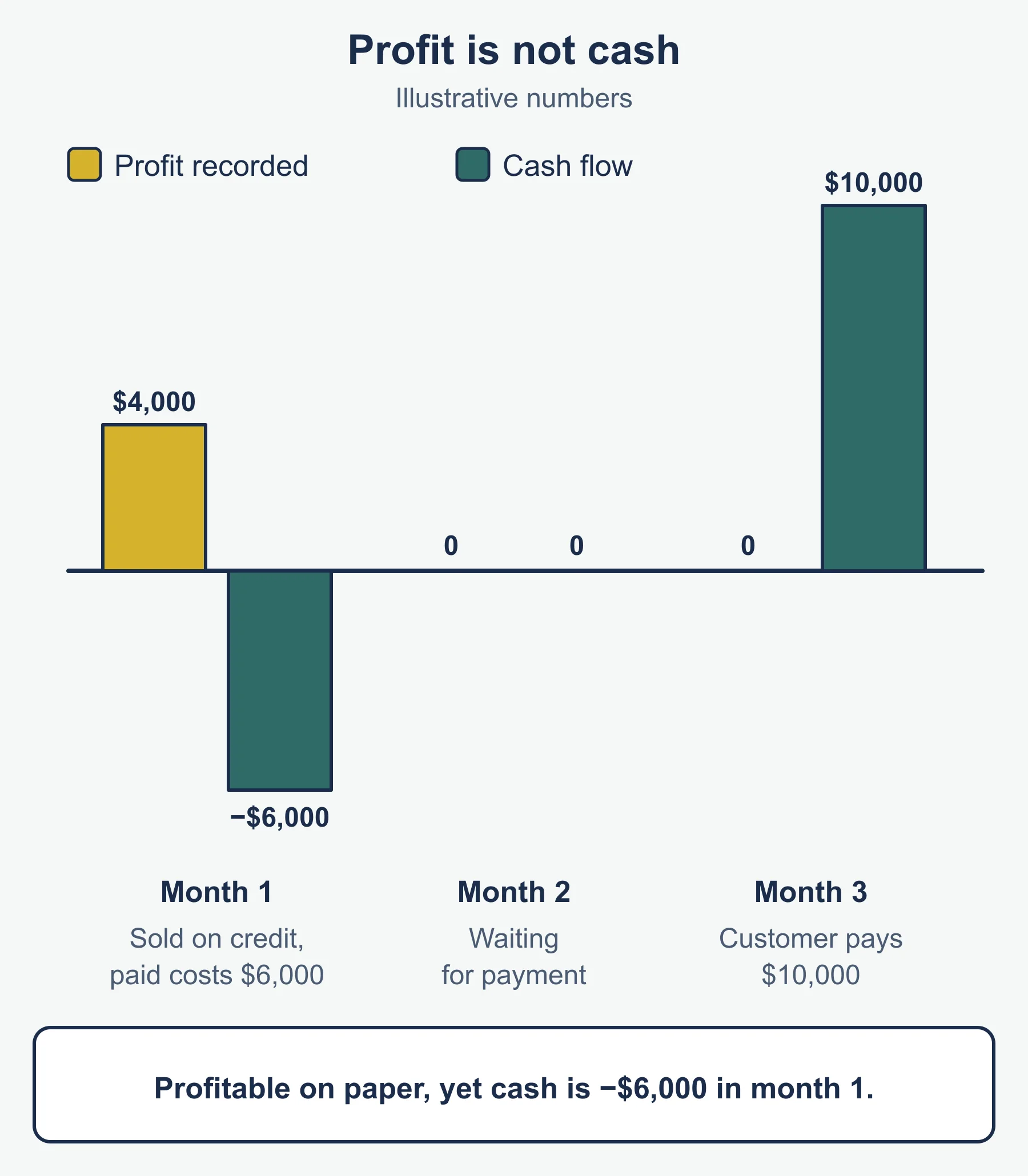
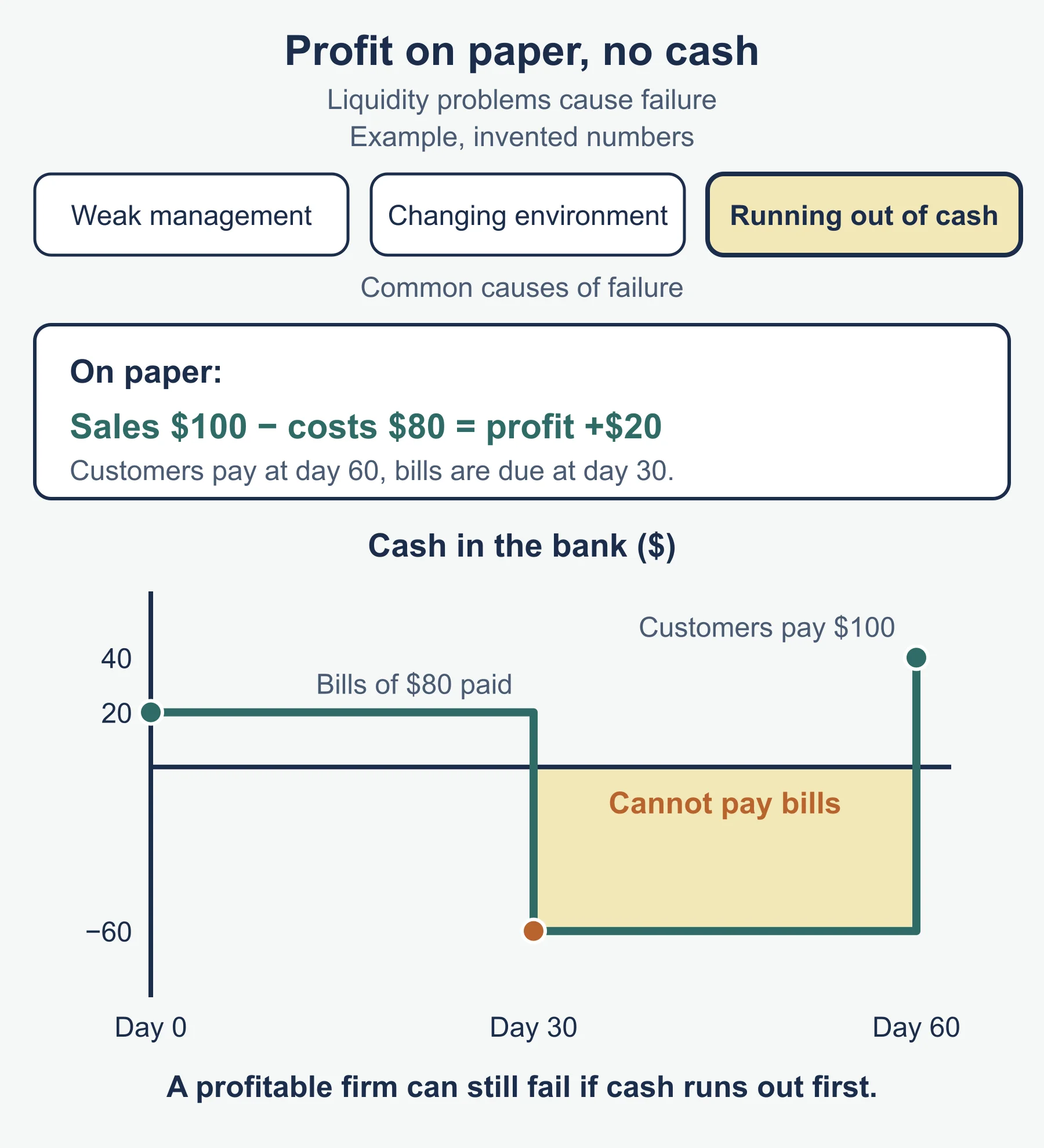
- Credit sales: profit rises now, cash arrives later.
- Credit purchases and accruals: costs are recorded now, cash leaves later.
- Depreciation: reduces profit, no cash leaves.
- Buying non-current assets: cash leaves, profit is not reduced by the whole cost.
- Drawings: reduce cash and capital, not profit.
- Loans and extra capital: raise cash, not profit.
- Inventory build-up: uses cash, no effect on profit until the goods are sold.
Transaction grid
| Transaction | Profit | Cash | Current ratio (if above 1) |
|---|---|---|---|
| Cash sale at a profit | Up | Up | Up |
| Credit sale at a profit | Up | No change | Up |
| Customer pays what they owe | No change | Up | No change |
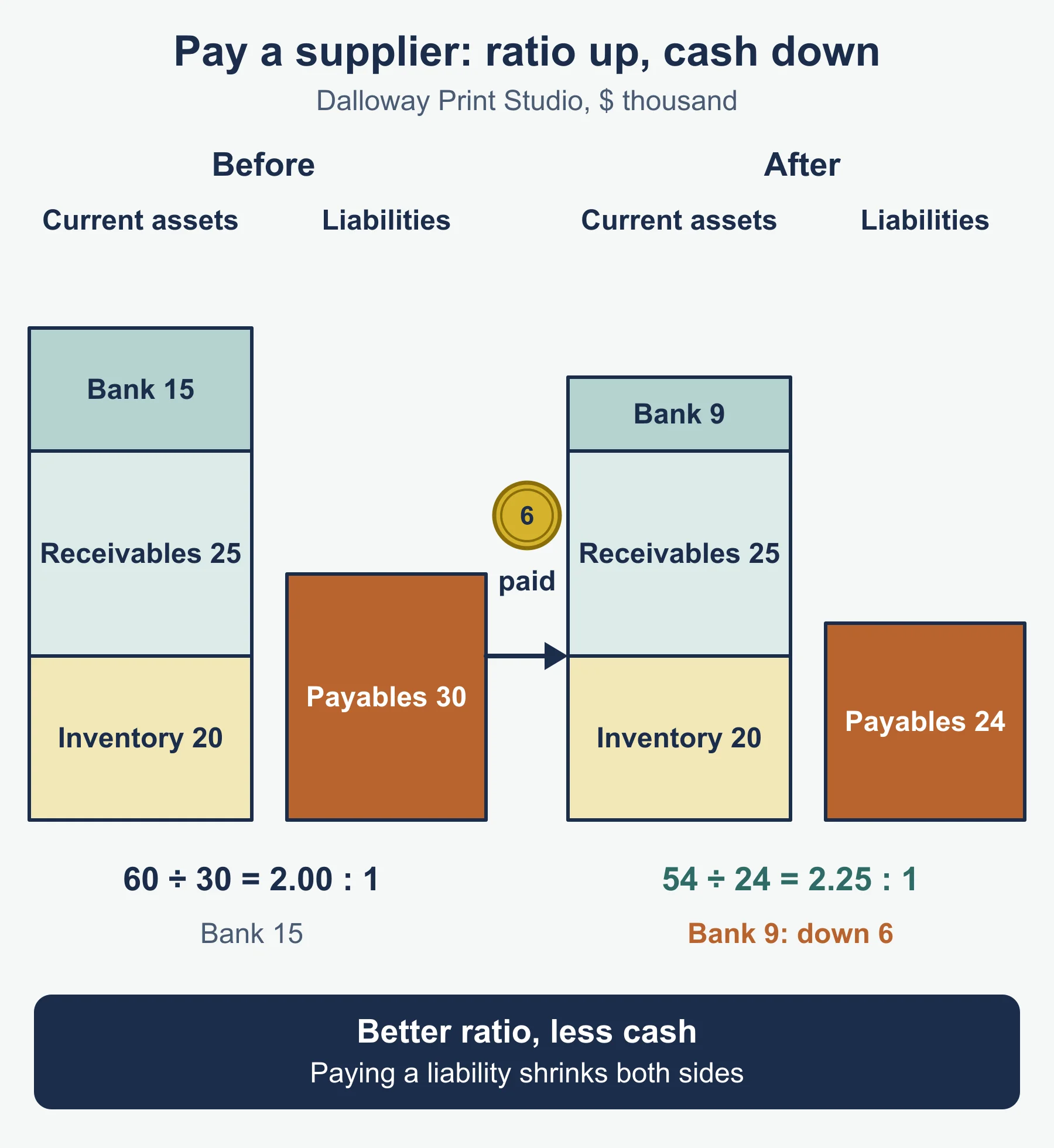
| Pay a supplier from the bank | No change | Down | Up |
| Buy inventory on credit | No change | No change | Down |
| Buy non-current asset for cash | No change | Down | Down |
| Depreciation charge | Down | No change | No change |
| Drawings in cash | No change | Down | Down |
| Take out a long-term loan | No change | Up | Up |
| Pay an expense in cash | Down | Down | Down |
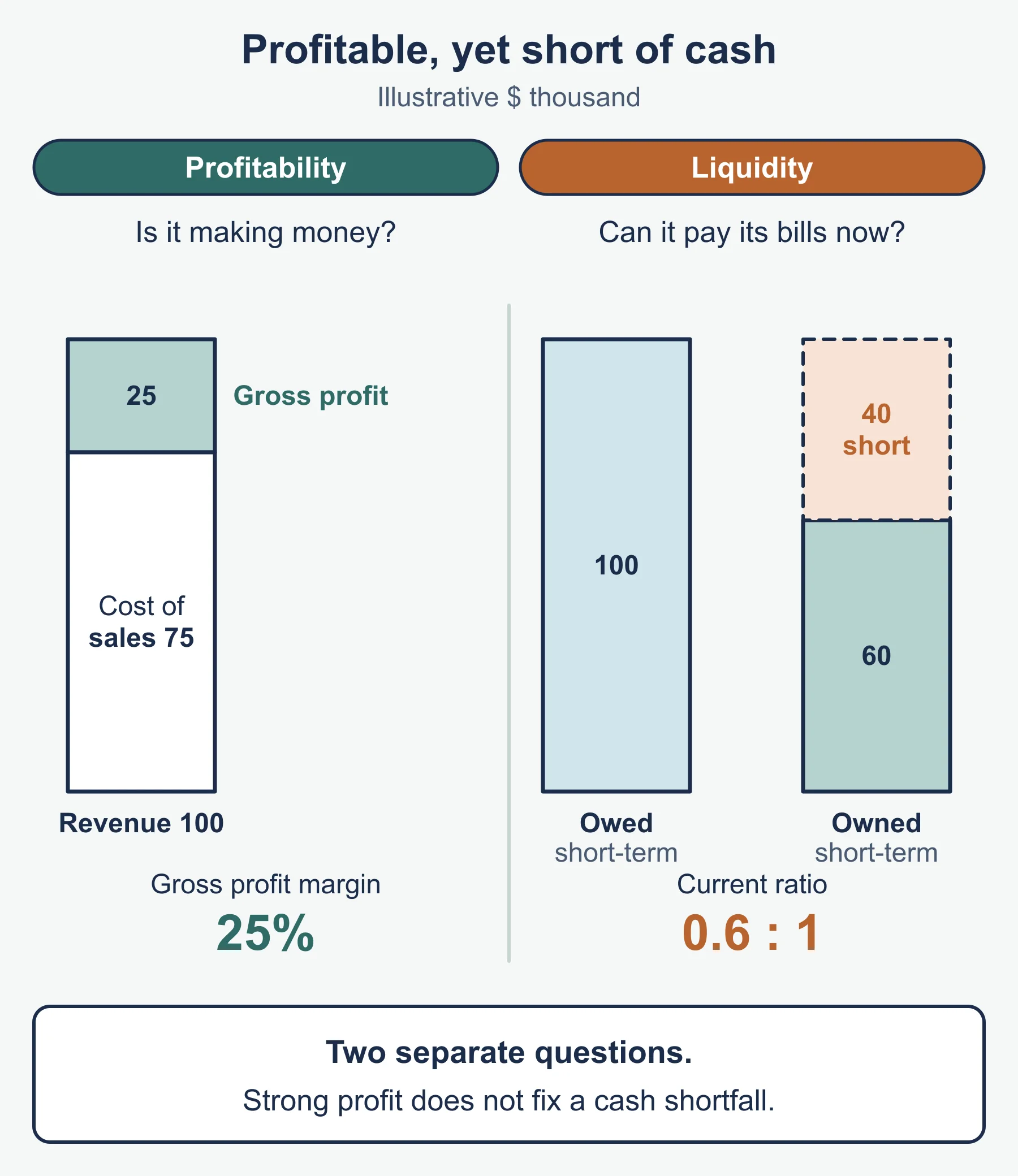
A transaction affects profitability if it changes revenue or expenses. It affects liquidity if it changes current assets or current liabilities.
Quick self-test
- Revenue is 300,000 and gross profit is 90,000. Find the gross profit margin.
- Gross profit is 90,000 and cost of sales is 210,000. Find the markup.
- Cost of sales is 96,000 with opening inventory 10,000 and closing inventory 14,000. Find the rate of inventory turnover.
- Current assets are 45,000 and current liabilities are 30,000. Find the current ratio.
- Inventory in question 4 is 15,000. Find the liquid capital ratio.
- Trade receivables are 24,000 and credit sales 240,000. Find the receivable days to one decimal place.
- Trade payables are 15,000 and credit purchases 120,000. Find the payable days to one decimal place.
- Profit from operations is 18,000 and capital employed 120,000. Find ROCE.
- A business buys inventory on credit. State the effect on profit and on the current ratio, assuming the ratio started above 1.
- A business charges depreciation. State the effect on profit and on cash.
- Name two reasons a profitable business may have a bank overdraft.
Answers
- 90,000 / 300,000 x 100 = 30.0%.
- 90,000 / 210,000 x 100 = 42.9%.
- Average inventory (10,000 + 14,000) / 2 = 12,000. 96,000 / 12,000 = 8 times.
- 45,000 : 30,000 = 1.5 : 1.
- (45,000 - 15,000) : 30,000 = 1.0 : 1.
- 24,000 / 240,000 x 365 = 36.5 days.
- 15,000 / 120,000 x 365 = 45.6 days.
- 18,000 / 120,000 x 100 = 15.0%.
- No effect on profit. The current ratio falls, because current assets and current liabilities rise by the same amount.
- Profit falls. Cash does not change.
- Any two: growth in receivables, growth in inventory, buying non-current assets, large drawings, loan repayments.
Where marks are usually lost
- Giving a number with no formula, so the method cannot be seen.
- Leaving out units: %, times, days or x : 1.
- Using total sales instead of credit sales for receivable days, or the wrong purchases figure for payable days.
- Putting markup over revenue, or margin over cost of sales.
- Describing a change (“it went up”) without a reason, a comparison or a judgement.
- Saying a higher current ratio is always better, or that more profit means more cash.
- Forgetting that drawings and loan repayments change cash but not profit.
- Counting an overdraft as a current asset instead of a current liability when finding capital employed or the current ratio.
- Mixing average inventory and closing inventory between years without saying so.
Model appraisal sentences
Use the pattern: result, comparison, reason, judgement.
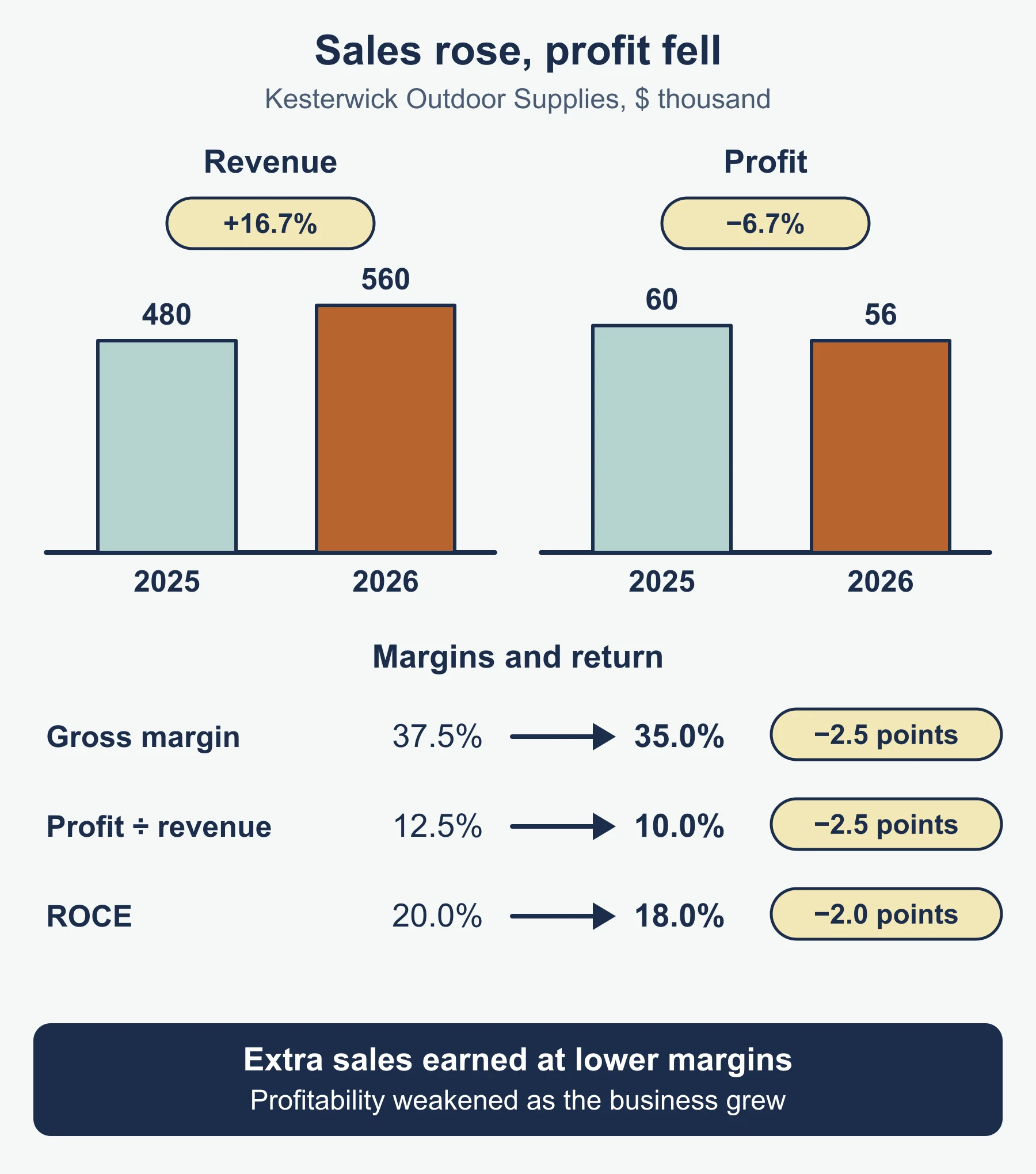
- “Gross profit margin fell from 35.0% to 32.0%, so each sale earned less. Cost of sales rose faster than revenue, which suggests dearer supplies or discounting. This weakens profitability.”
- “The liquid capital ratio is 0.8 : 1, below 1. Without selling inventory the business could not meet all its current liabilities, so the owner should collect receivables sooner.”
- “Profit rose by 10% but the bank balance fell. Much of the profit is tied up in higher receivables and inventory, so profit and cash have moved apart.”
Name the stakeholder where the question does. A lender looks first at liquidity and ROCE. An owner looks at profit in relation to revenue and ROCE. A supplier looks at payable days and the current ratio.
Frequently asked questions
How should I write an appraisal sentence? Use the pattern result, comparison, reason, judgement: state the figure and its direction, compare it with another year, give a likely reason and say what it means for the business.
Is a higher current ratio always better? No. A very high current ratio can mean idle cash or too much inventory, so a higher ratio is not always better for the business.
Which ratios does a lender look at first? A lender looks first at liquidity and ROCE. Name the stakeholder where the question does, and pick the ratios that matter most to that reader.
Do drawings and loan repayments affect profit? No. Drawings and loan repayments reduce cash but do not change profit, which is one reason a profitable business can have a falling bank balance.
What is profit from operations? Profit from operations is gross profit minus expenses, before loan interest. If there is no loan interest, it equals profit for the year.
Official syllabus
Source: OxfordAQA International GCSE Accounting (9215) specification, version 1.2, for exams from May/June 2026 onwards, published by OxfordAQA, section 3.5.
Get free revision emails (optional)
Occasional emails with practice questions, worked explanations and links to free resources for the qualification and subjects you choose. No spam, and you can unsubscribe from any email. The free tools on this site never need an email.
Related resources
-
Study guides
OxfordAQA IGCSE Accounting: Internal and external stakeholders (9215)
Study guide to internal and external stakeholders in OxfordAQA International GCSE Accounting 9215, with each group's interests and a worked example.
Accounting · OxfordAQA · IGCSE
Read guide -
Practice questions
OxfordAQA IGCSE Accounting: Internal and external stakeholders (9215) – Practice Questions
Eleven original practice questions with worked answers on internal and external stakeholders for OxfordAQA International GCSE Accounting 9215.
Accounting · OxfordAQA · IGCSE
Try questions -
Revision notes
OxfordAQA IGCSE Accounting: Internal and external stakeholders (9215) – Revision Notes
Condensed revision notes on the eight internal and external stakeholders in OxfordAQA International GCSE Accounting 9215, with a self-test.
Accounting · OxfordAQA · IGCSE
Revise topic
Related articles
-
teaching
A Level tuition in Dubai: Cambridge or Pearson Edexcel International A Level?
Schools in Dubai and Abu Dhabi teach either Cambridge International AS & A Level or Pearson Edexcel International A Level. How the two are structured, why it matters for tuition, and how online classes from Lahore work.
9 October 2026
-
curriculum guides
Choosing subjects at IGCSE and A Level
How subject choices at 14 and 16 affect university options later, and how to keep pathways open without overloading a timetable.
28 July 2026
Studying this with a teacher
Working through Accounting IGCSE?
This page is free and stays free. If you would rather be taught it, Marlbridge runs Accounting classes one-to-one and in small groups of up to 15, online in your own time zone. The first trial class is free. WhatsApp replies within an hour (8am–11pm Pakistan time, every day); email the same day.
OxfordAQA Accounting teachers at Marlbridge

