
Study Guides
OxfordAQA IGCSE Business: Marketing (9225)
A full study guide to section 3.5 Marketing for OxfordAQA International GCSE Business: customers, segmentation, market research and the 4Ps.
- Subject
- Business
- Level
- IGCSE
- Topic
- Marketing
- Author
- Marlbridge Academic Team
- Updated
- Reviewed by
- Salman Ahmad (what this means)
Aligned to OxfordAQA IGCSE Business (9225), First teaching September 2020, first examined May/June 2022. Official specification .
Syllabus page (what it covers and how it is assessed): OxfordAQA IGCSE Business.
Syllabus points this page covers
9225
- 5 Marketing (whole topic)
Found an error? Report a correction.
Need help with this topic? Request a free trial class for IGCSE Business (9225).
This guide covers section 3.5 Marketing of the OxfordAQA International GCSE Business (9225) specification, version 3.1, for exams from May/June 2022 onwards. The specification lists Marketing as the content assessed in Paper 2, alongside Finance. It has four parts: identifying customers, segmentation, market research and the marketing mix (the 4Ps). Every business, person and figure below is invented. When you are ready, use the revision notes, the practice questions, the course hub, the printable checklist and the free diagnostics.
Map of section 3.5
The sections are 3.5.1 customers, 3.5.2 segmentation, 3.5.3 market research, and 3.5.4 the 4Ps (price, product, promotion, place, including e-commerce and the integrated mix).
3.5.1 Identifying and understanding customers
A business survives only if customers buy. It must find out who its customers are and what they need, then supply a product or service they will pay for. A business that guesses wrong ends up with unsold stock and wasted money.
Customers differ by market:
- Local market: customers near the business, such as a village bakery.
- National market: customers across one country, with regional differences in tastes and incomes.
- International market: customers abroad, where language, culture and income differ, so the product or message may need adapting.
Example: Loomcraft Rugs sells hand-woven rugs. Local customers want durable, low-cost mats. Customers in a distant country want expensive designs with a story about the weavers. Satisfying both needs means two different offers.
3.5.2 Market segmentation
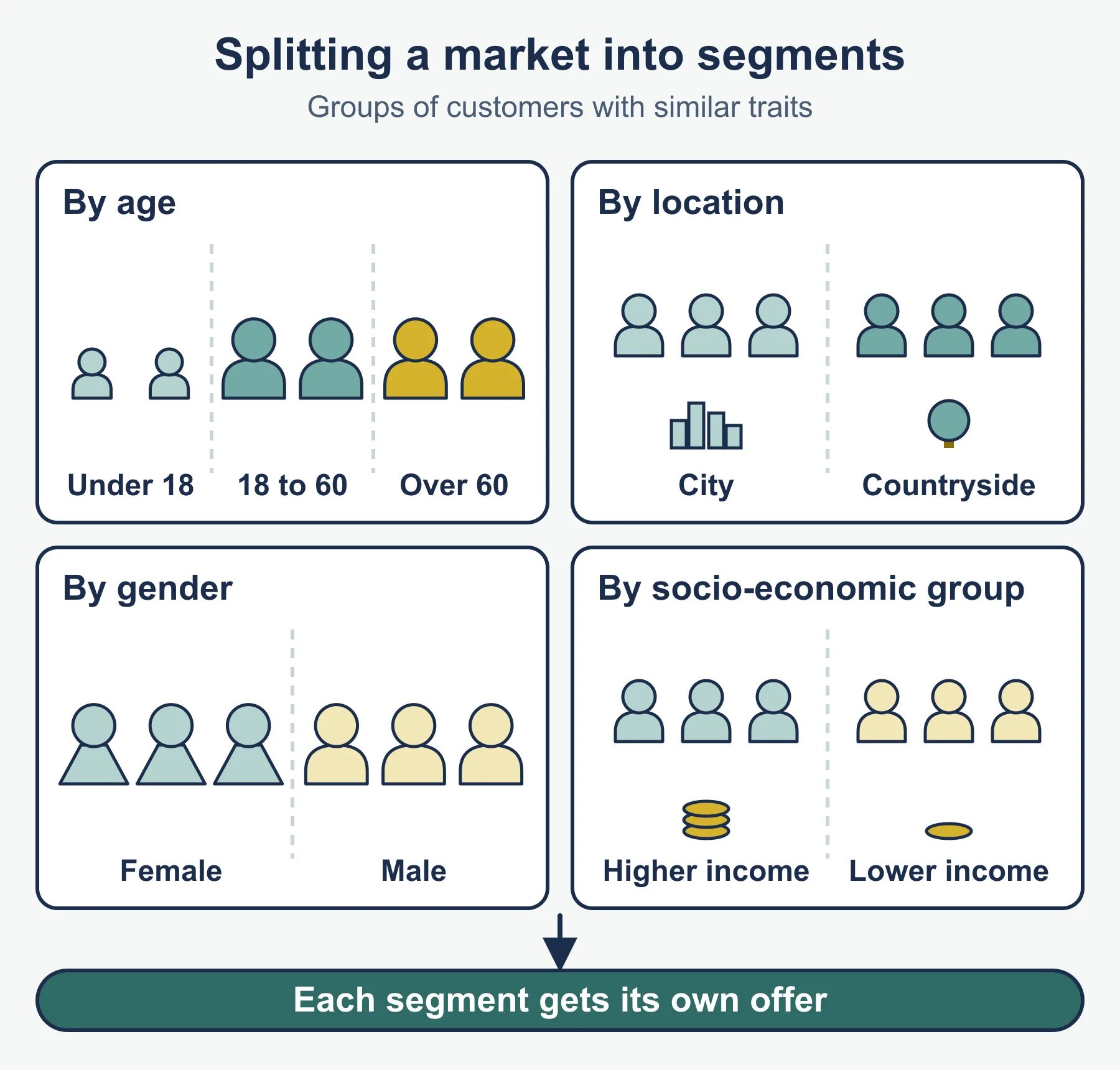
A market segment is a group of customers who share characteristics and so want similar things. Segmentation splits a market into such groups so that a business can target each one. The specification names four types:
| Type | Example of use |
|---|---|
| Gender | A razor brand makes separate ranges and adverts for men and women |
| Age | A phone maker offers a simple handset with large buttons for older users and a high-specification model for teenagers |
| Location | A food company sells mild flavours in one region and spicy ones in another |
| Income | A car maker sells a basic model to low earners and a luxury version to high earners |
Why segment? The business can fit product and message to one group and spend its budget where buyers are. The drawback is cost: several products and campaigns cost more than one.
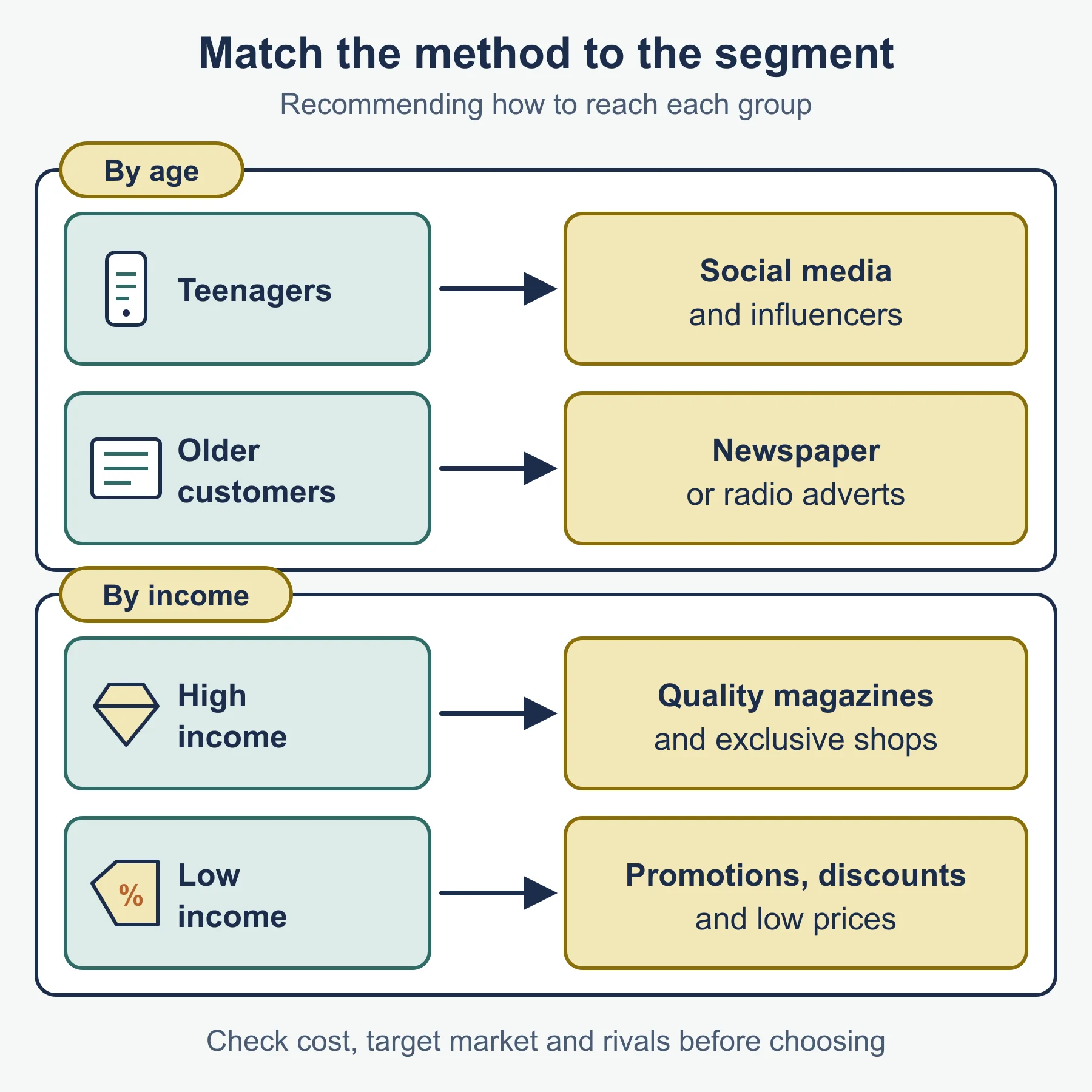
Recommending methods. Match the method to the segment. Teenagers are reached through social media and influencers. Older customers may respond to newspaper or radio advertising. A high-income segment suits quality magazines and exclusive retail. A low-income segment suits promotions, discounts and low prices.
3.5.3 The purpose and methods of market research
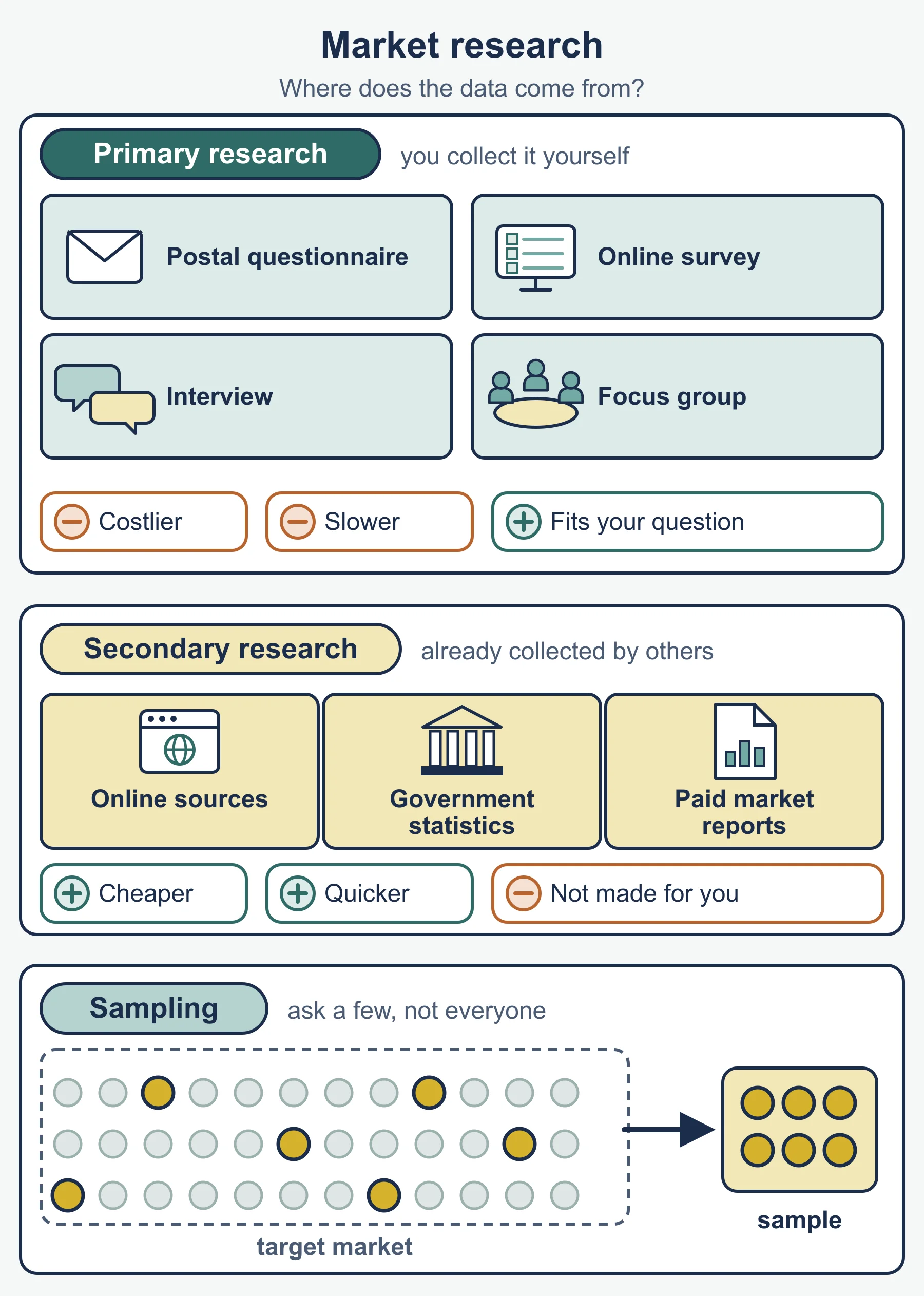
Market research is the collection and analysis of information about a market. Businesses do it to identify market opportunities (gaps, growing demand) and to gain better insight into their customers and competitors. Good research reduces the risk of launching the wrong product.
Types of research
- Primary research is new information collected first-hand for a specific purpose, for example a survey, interview or focus group. It is specific and up to date but costs more time and money.
- Secondary research uses information that already exists, such as government statistics, trade reports or competitors’ websites. It is cheaper and quicker, but it may be dated or may not suit the exact question asked.
- Quantitative research produces numbers that can be counted and charted, such as 62% prefer option A.
- Qualitative research produces opinions, reasons and feelings, such as why customers dislike the packaging.
Techniques, with benefits and drawbacks
| Technique | Benefit | Drawback |
|---|---|---|
| Questionnaire or survey | Many responses; easy to analyse | Low return rates; people may not answer honestly |
| Interview | Detailed answers; questions can be explained | Slow, costly, small sample |
| Focus group | Reveals attitudes and why people think as they do | Group members may influence one another; small sample |
| Online survey (e-commerce) | Cheap, fast and reaches distant customers | Only reaches people online; self-selected respondents |
| Website and sales data | Shows real behaviour, such as pages viewed and items bought | Shows what happened, not why |
Selecting a method. A small business with a tiny budget and nearby customers might use a short face-to-face survey. A firm launching abroad might begin with secondary research, then run online surveys.
Using the findings
You should be able to read tables and charts and use them to decide.
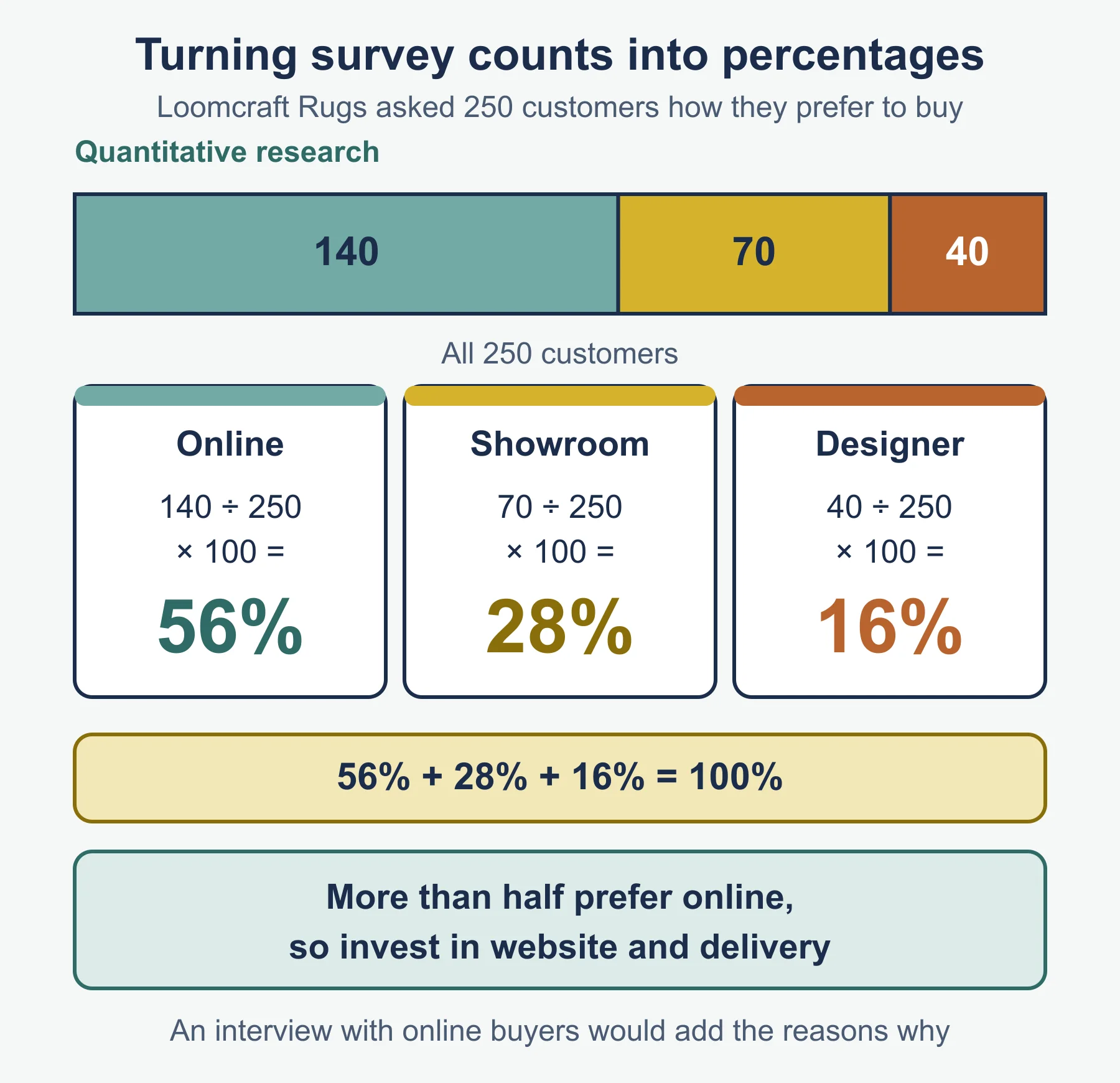
Worked example. Loomcraft Rugs asks 250 customers how they prefer to buy. 140 say online, 70 say in a showroom and 40 say through an interior designer.
- Online: 140 ÷ 250 × 100 = 56%.
- Showroom: 70 ÷ 250 × 100 = 28%.
- Designer: 40 ÷ 250 × 100 = 16%. The three add to 100%.
More than half prefer online, so the business could invest in its website and delivery. The survey is quantitative. A follow-up interview with some online buyers would add qualitative reasons.
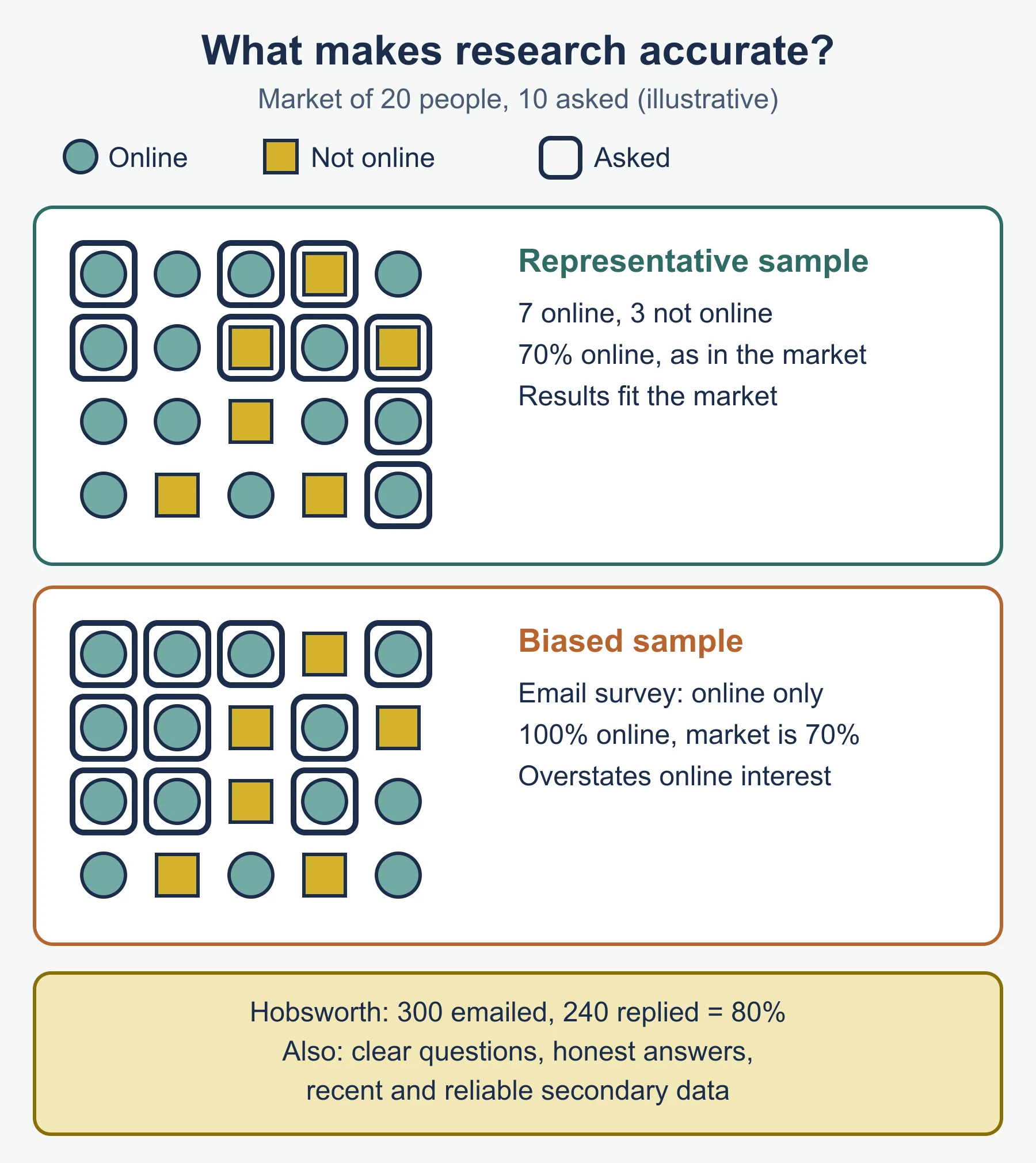
Why results can be inaccurate
- The sample is too small or not representative, for example only existing customers are asked.
- Questions are leading or confusing.
- Respondents say what they think the researcher wants.
- Secondary data is out of date, or the market changes after the research.
Inaccurate results misinform the business, which may launch a product nobody wants.
3.5.4 The marketing mix: price, product, promotion and place
Price
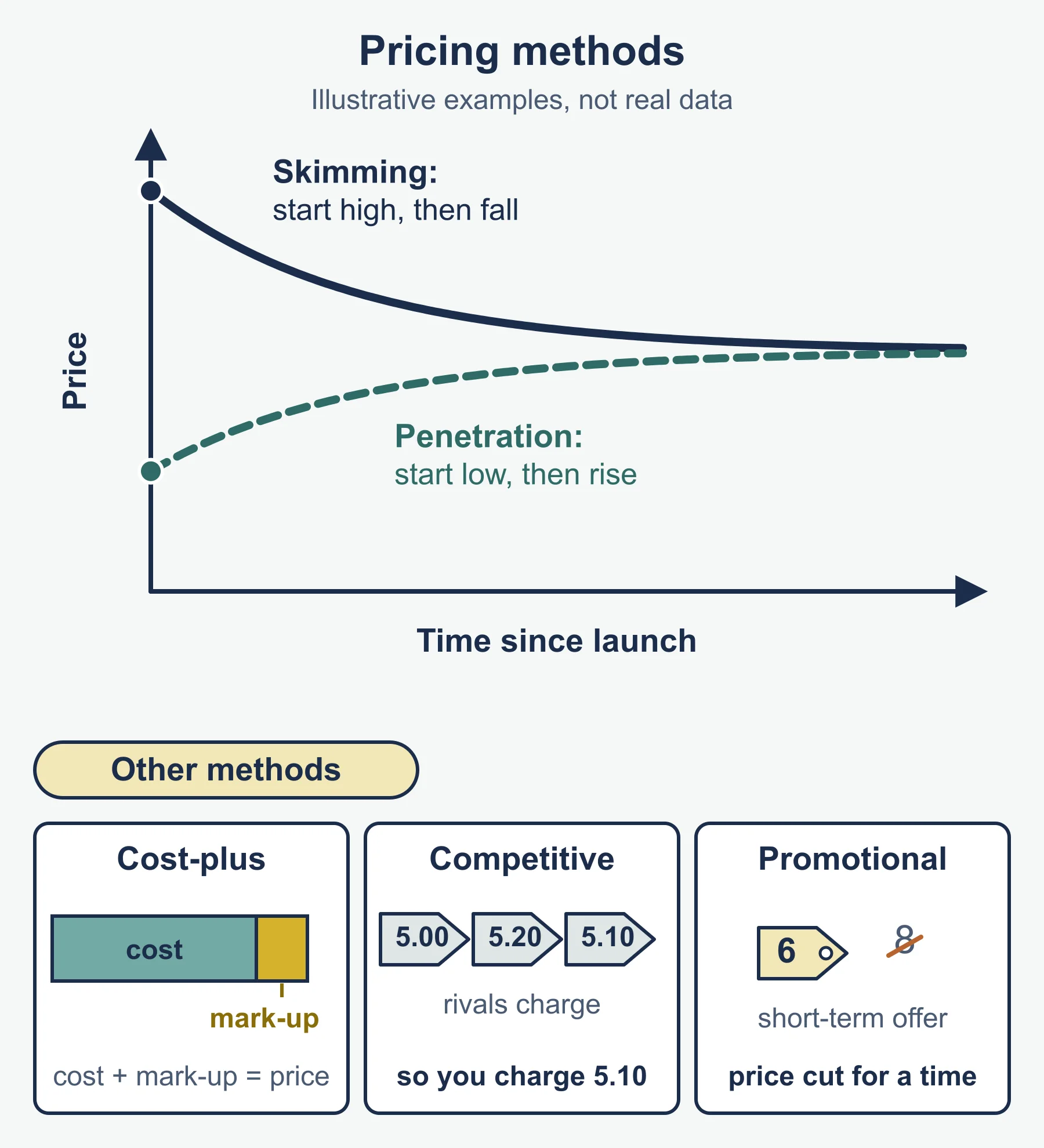
Pricing methods and strategies. Know what each is, when it suits and its impact.
| Method | Meaning | Suits | Impact |
|---|---|---|---|
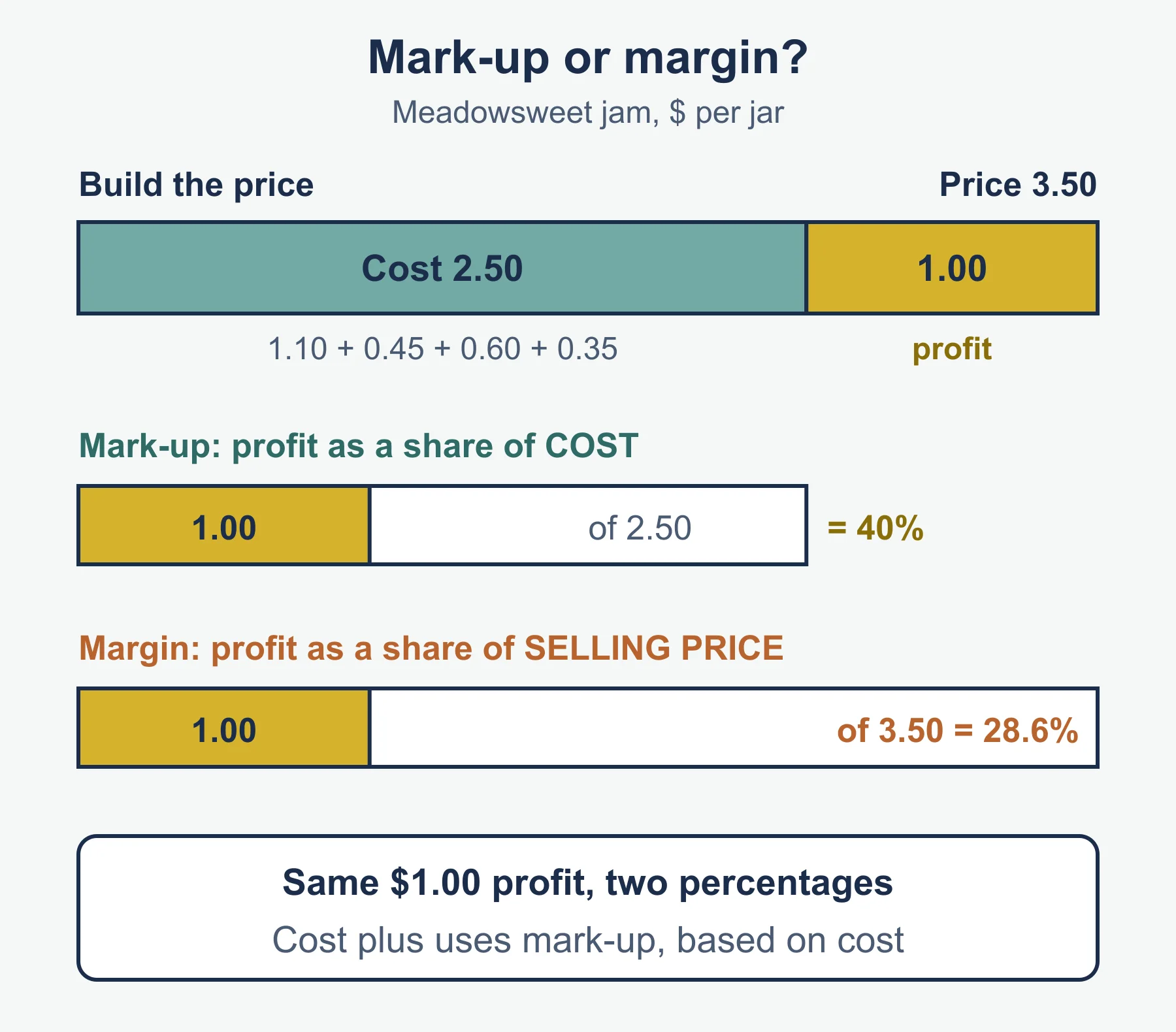
| Cost-plus | Unit cost plus a percentage mark-up | Businesses that must cover costs and want a guaranteed margin | Simple and safe; ignores what customers will pay and competitors’ prices |
| Skimming | High price at launch, lowered later | New, innovative products with few rivals | High early profit per unit; may attract rivals and fewer buyers |
| Penetration | Low price at launch to win market share | Markets with many rivals or price-sensitive buyers | Quick sales and share; low early profit and a hard price rise later |
| Competitive | Price set near rivals’ prices | Markets with similar products | Avoids price wars; limits freedom |
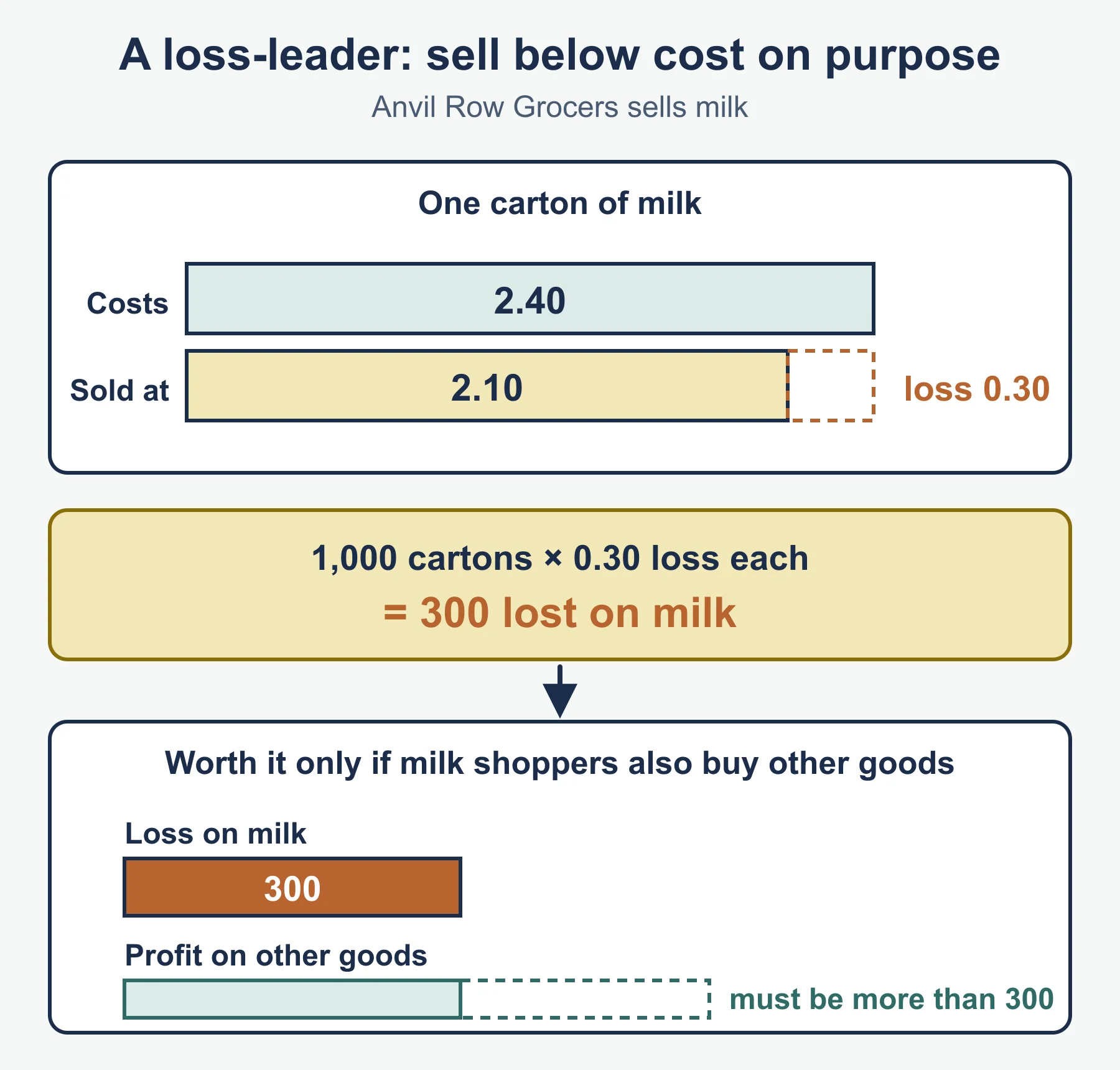
| Loss-leader | A product sold below cost to draw customers who buy other items | Retailers selling many products | Builds footfall; the loss must be recovered on other sales |
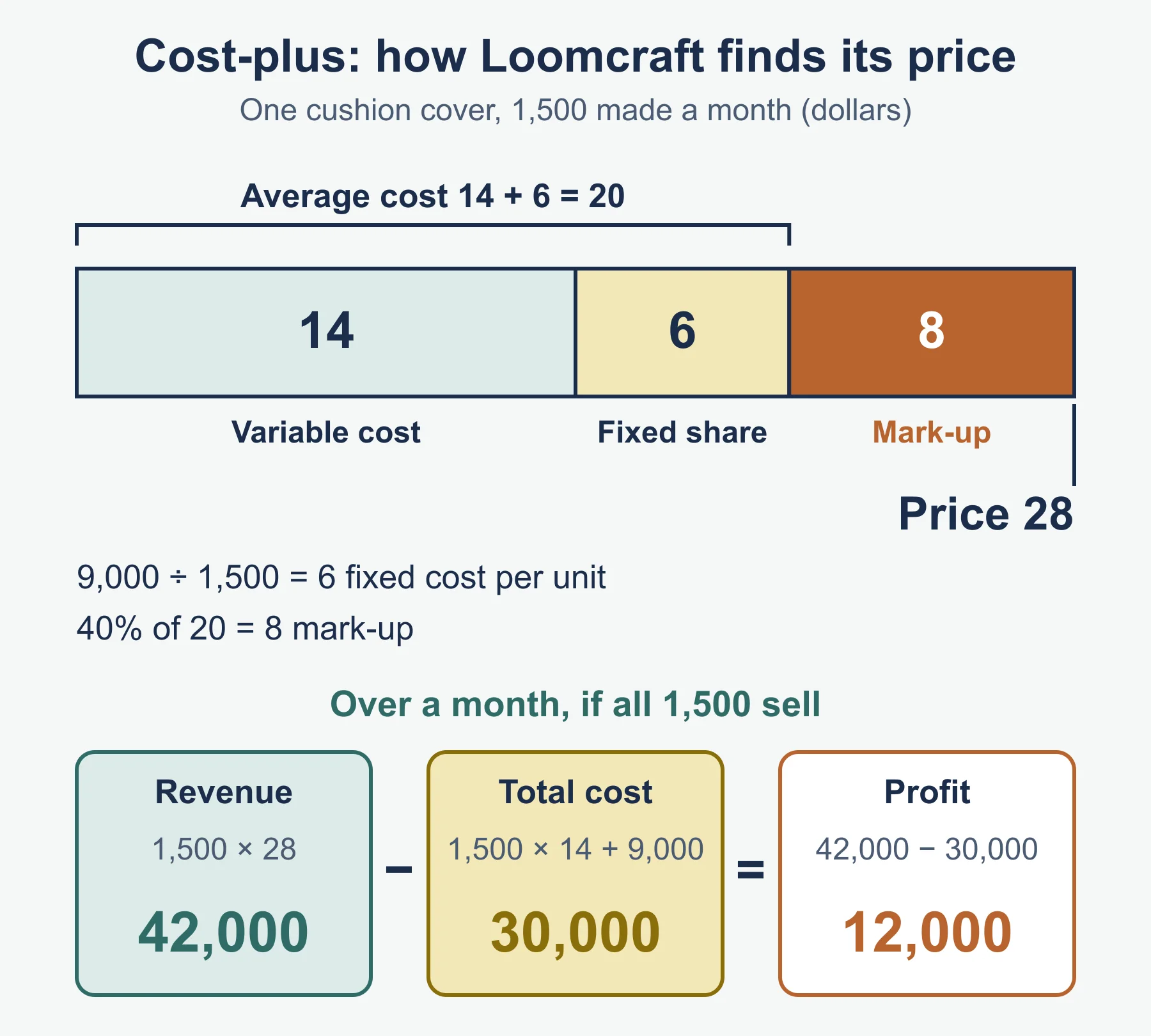
Worked example (cost-plus). Loomcraft makes 1,500 cushion covers a month. Variable cost is 14 dollars each and fixed costs are 9,000 dollars a month.
- Fixed cost per unit = 9,000 ÷ 1,500 = 6.
- Average cost = 14 + 6 = 20.
- A 40% mark-up adds 20 × 0.40 = 8, so the price is 28.
- Revenue 1,500 × 28 = 42,000. Total cost = 1,500 × 14 + 9,000 = 30,000. Profit = 12,000, provided all 1,500 sell.
Loss-leader example. Anvil Row Grocers buys milk at 2.40 and sells it at 2.10, losing 0.30 a carton. On 1,000 cartons the loss is 300. It is worthwhile only if shoppers who come for milk spend more than 300 in profit on other goods.
Factors influencing price. Production costs set the floor, because a price below cost makes a loss. The degree of competition limits how far price can rise. The stage in the product life cycle matters too: a new product may be priced high (skimming) or low (penetration), while a declining one may be discounted. As a business expands, lower unit costs may allow lower prices, but new rivals or markets may force different pricing. To assess suitability, weigh each factor for the business in the case: a firm in a crowded market with thin margins is poorly suited to skimming.
Product
Developing new products. Benefits: new sales, a spread of risk and a stronger image. Risks: development cost and the chance of failure. Adapting an existing product, for example a new flavour, is usually cheaper and less risky than inventing one. Product design, brand image and the target market’s needs must fit: a student laptop needs to be light, durable and affordable.
Product differentiation. A unique selling point (USP) is something that makes a product different from rivals, such as a patented feature or exceptional service. In a competitive market it gives buyers a reason to choose you and may allow a higher price. A good brand image builds recognition and loyalty. A damaged image loses sales.
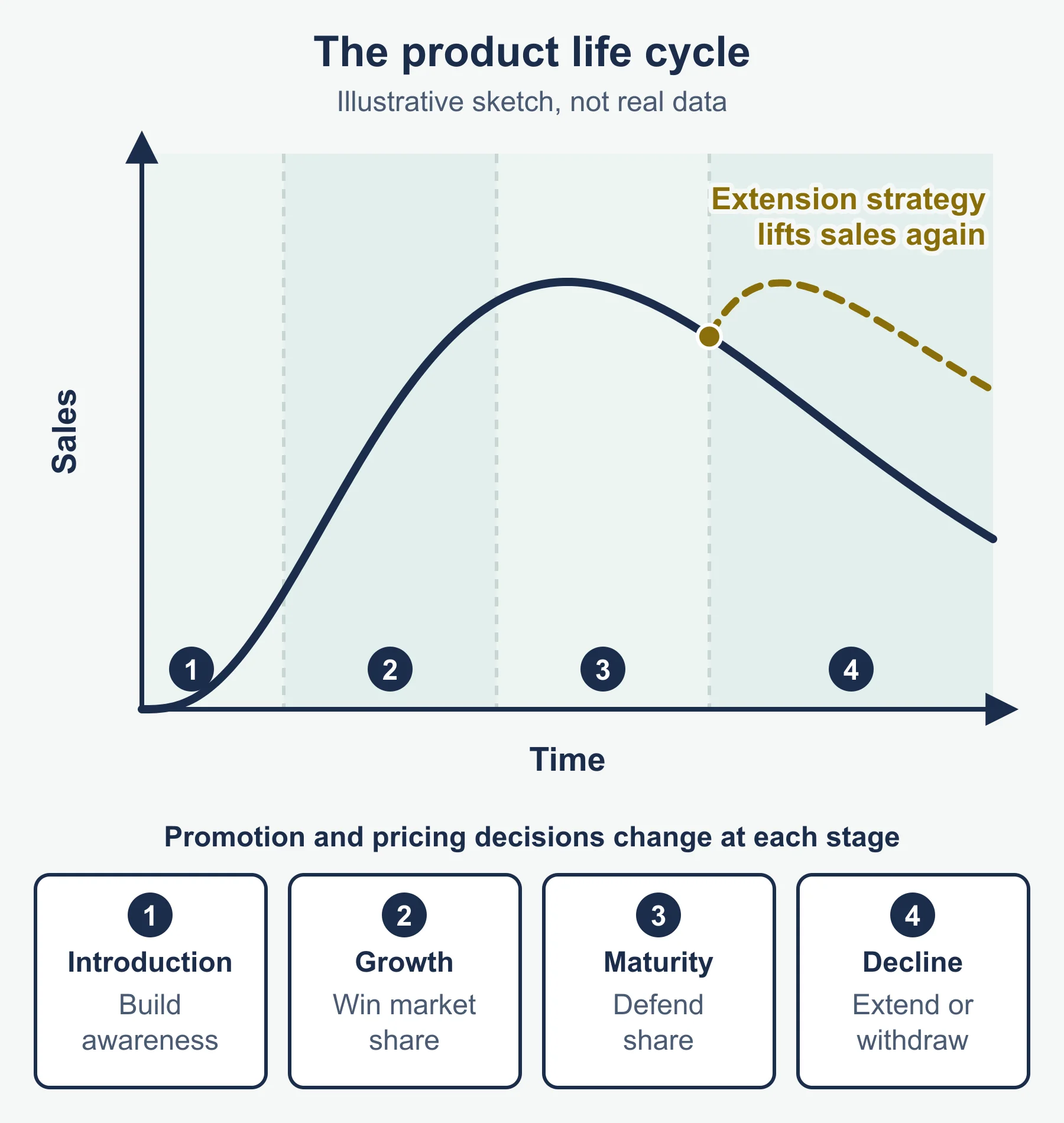
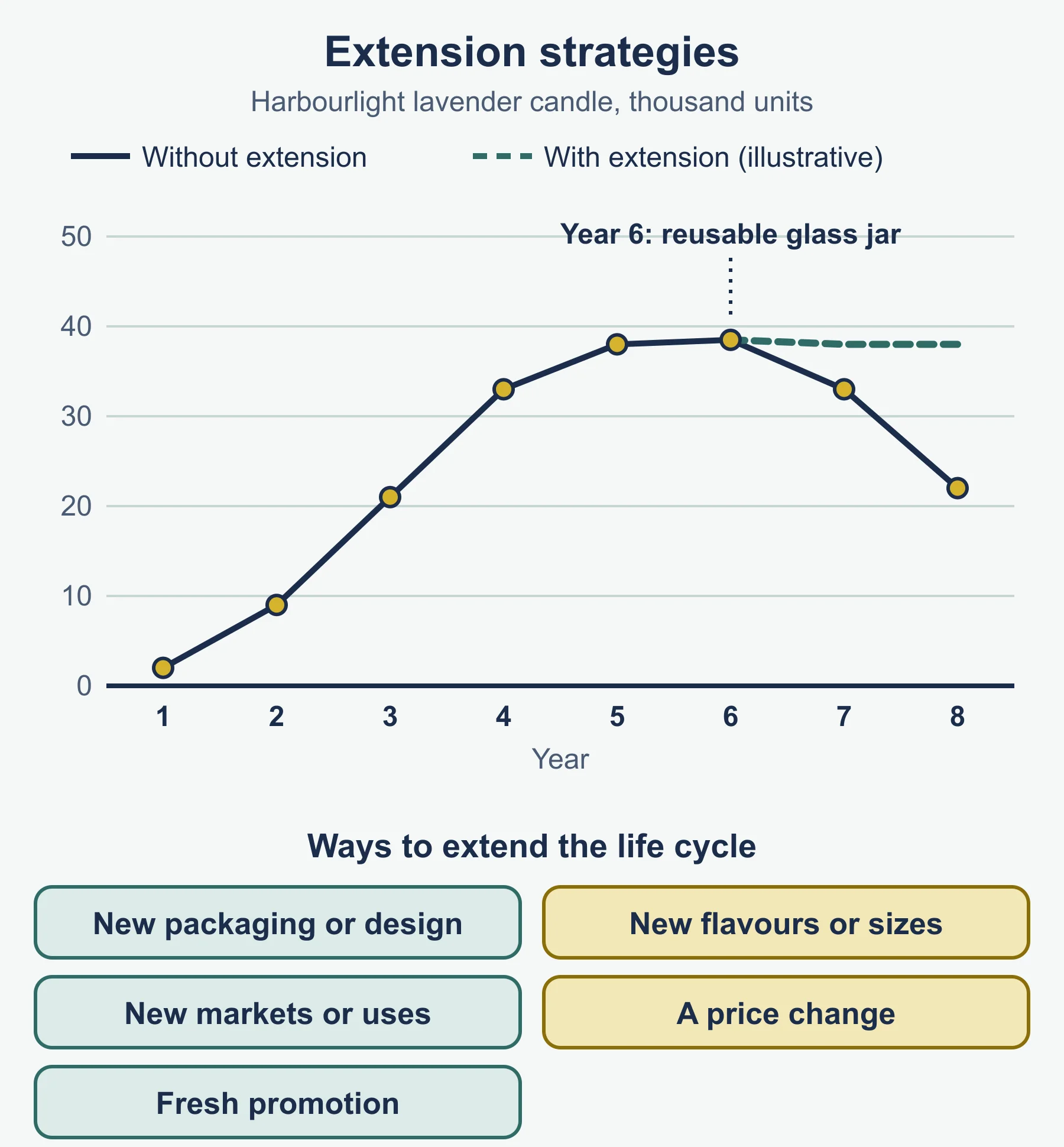
The product life cycle. Stages: introduction, growth, maturity, decline. Demand changes over time.
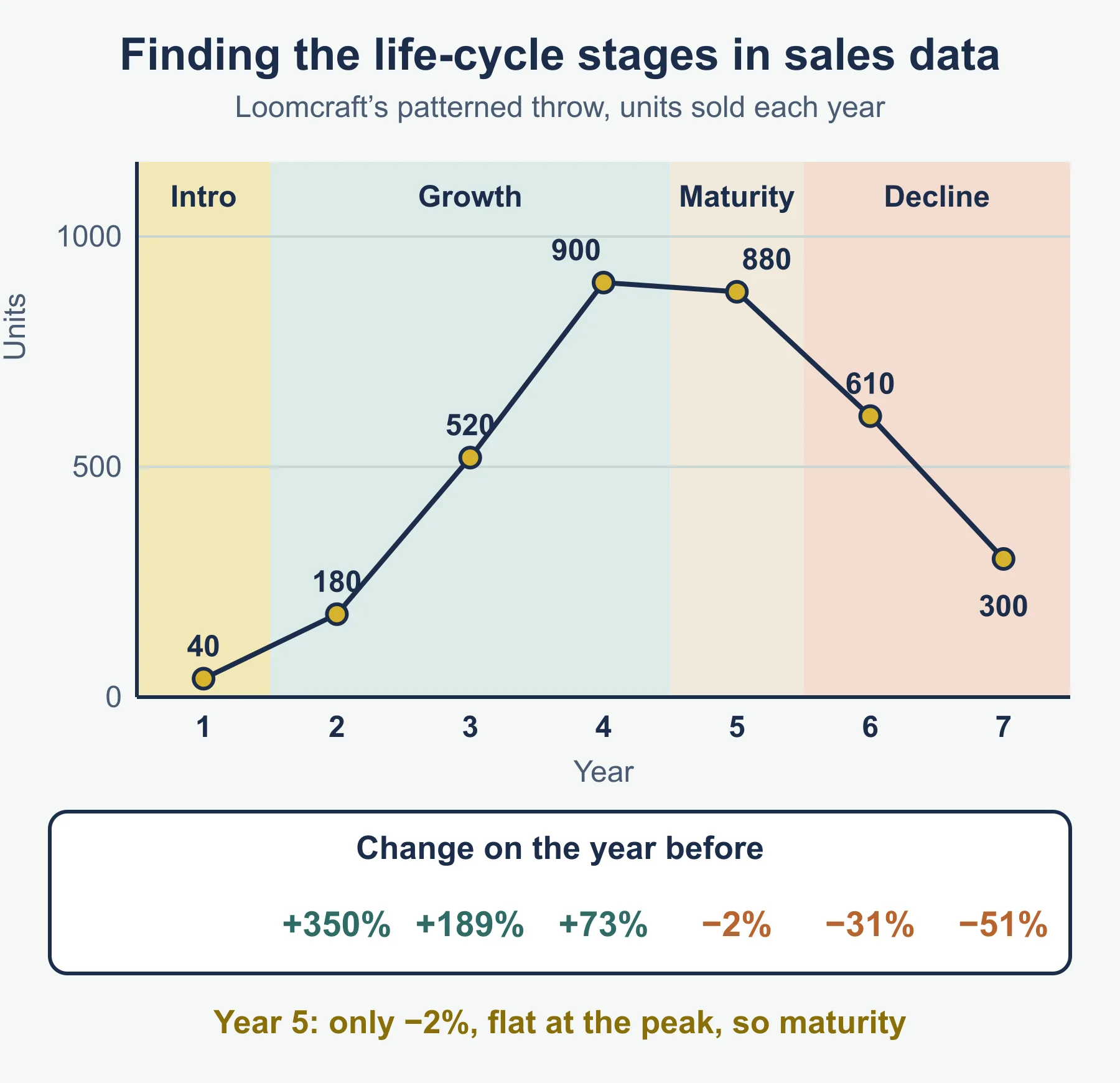
Worked example. Annual sales of Loomcraft’s patterned throw, in units: 40, 180, 520, 900, 880, 610, 300.
- Year 1: 40, introduction (low sales).
- Years 2 to 4: 180, 520, 900, growth (increases of 350%, 189% and 73%).
- Year 5: 880, maturity (sales flat, close to the year 4 peak of 900).
- Years 6 to 7: 610, 300, decline (falls of 31% and 51%).
Extension strategies delay decline: new packaging, new uses, new markets, a price cut, a modified design or heavier promotion. Judge them by cost against likely extra sales. They suit a product still earning at maturity or early decline. If demand has fallen because tastes changed permanently, an extension strategy may only waste money.
Product portfolio. A business’s range of products. It broadens the range to spread risk and reach more segments, and balances it so that mature products fund new ones and not everything declines together.
Promotion
Promotion informs, persuades and reminds. Methods include advertising (TV, radio, print, online, social media), sales promotions (discounts, buy one get one free, free samples), public relations, sponsorship and personal selling. Each has benefits and drawbacks: TV reaches many but is costly; social media is cheap and targeted but can be ignored; discounts lift sales quickly but cut profit.
The promotional mix is the combination used. Choose it using:
- The target market: where it reads, watches and browses.
- The budget: a small budget rules out TV.
- Competitors’ activities: match or differentiate.
- The product: complex goods may need personal selling.
Place
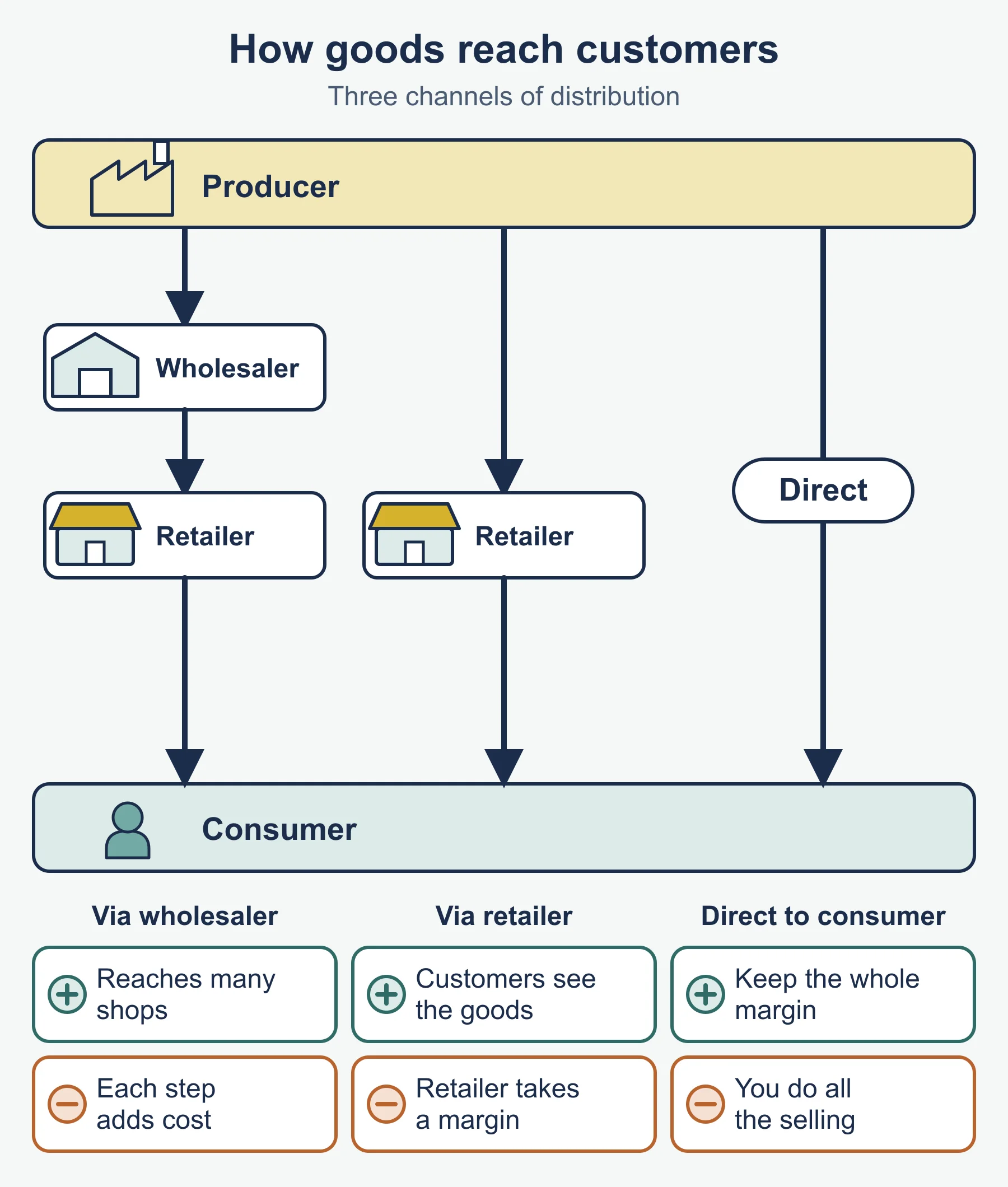
Place is how products reach customers. A channel of distribution is the route from producer to consumer.
- Direct (producer to consumer): own shop, telesales, direct selling, own website.
- Via a retailer (producer, retailer, consumer).
- Via a wholesaler and retailer (producer, wholesaler, retailer, consumer).
Intermediaries: retailers sell to the public and give convenience and display; wholesalers buy in bulk, store and break bulk for retailers; vending machines sell without staff at busy spots; telesales sell by phone; direct selling takes the product to the customer’s home or workplace; e-commerce sells online.
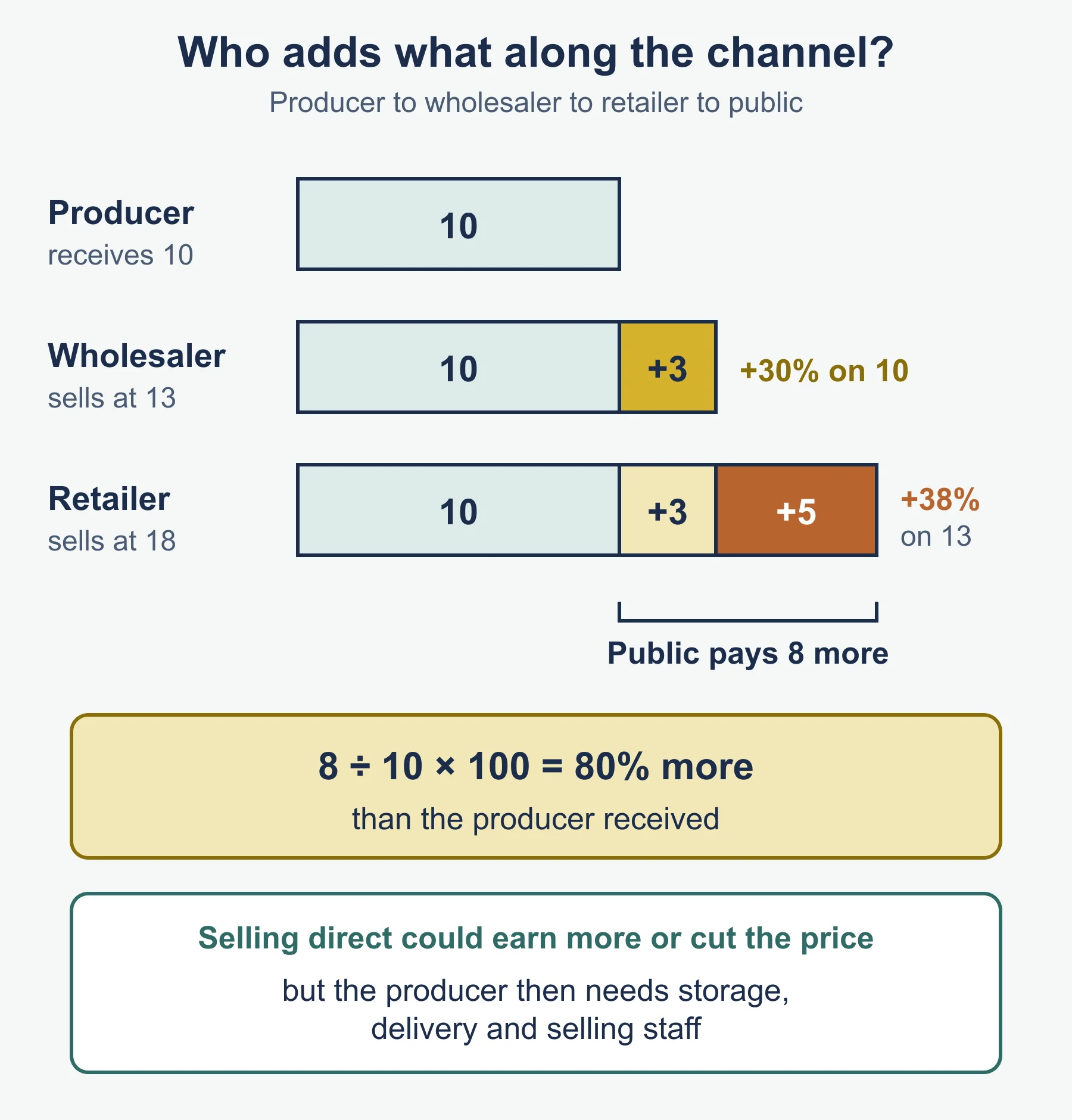
Worked example. A producer sells to a wholesaler at 10, who sells to a retailer at 13, who sells to the public at 18. The wholesaler adds 30% (3 on 10); the retailer adds 38% (5 on 13). The public pays 80% more than the producer received. Going direct could earn a higher price or lower the retail price, but the producer then needs storage, delivery and selling staff.
Analyse the channel against the scenario: product type (perishable, bulky, high value), customer location, cost and control.
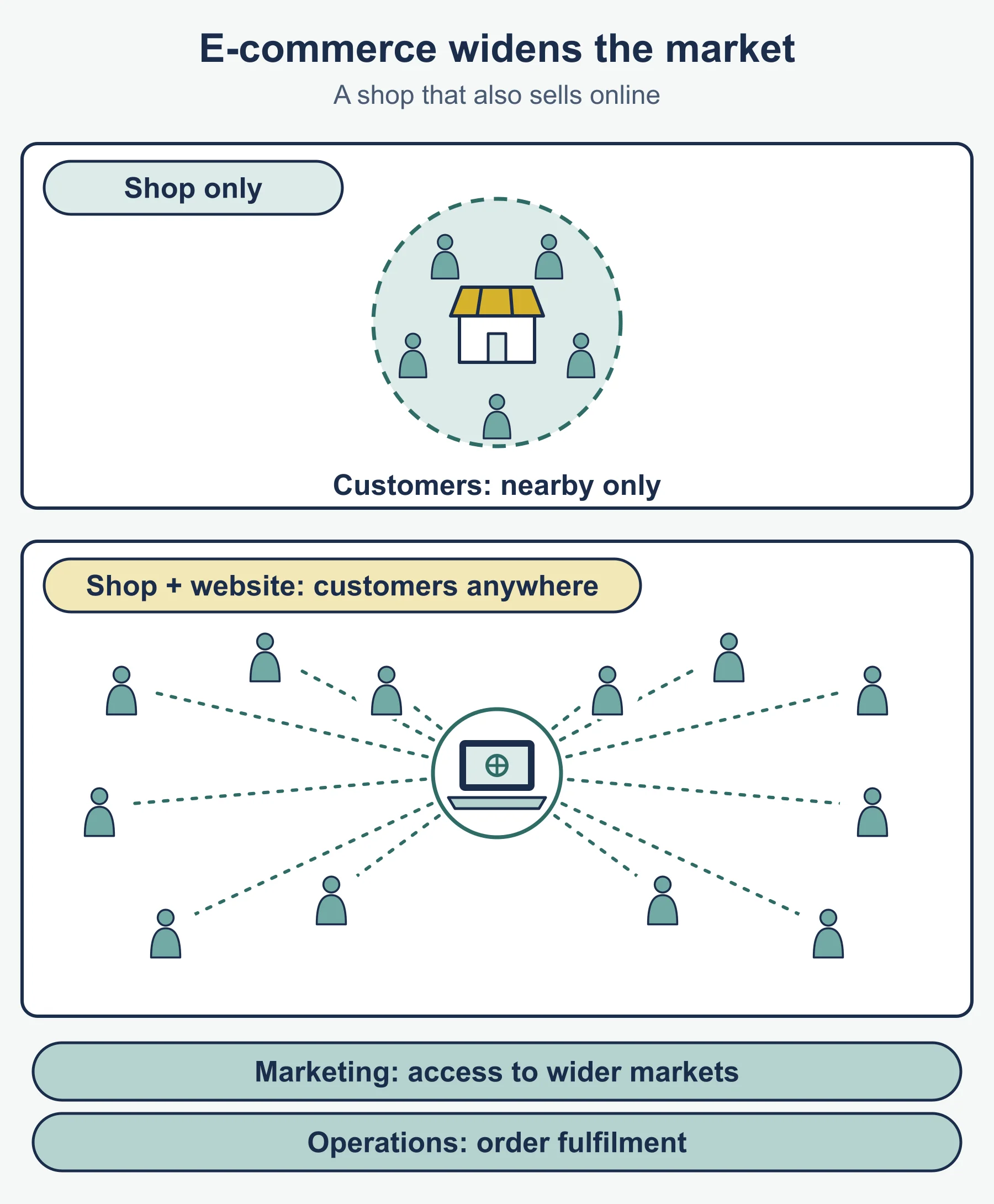
e-Commerce. Online trading is growing in importance because customers can buy at any hour, and a business can reach international markets without opening shops. Benefits: wider reach, lower premises costs, easy data collection. Drawbacks: delivery costs and delays, security and trust worries, strong competition, no chance to touch the product, and the need for good IT. Computer sales suit detailed browsing. Mobile (cell-phone) commerce reaches customers anywhere, but screens are small and weak connections can lose sales.
Integrating the mix
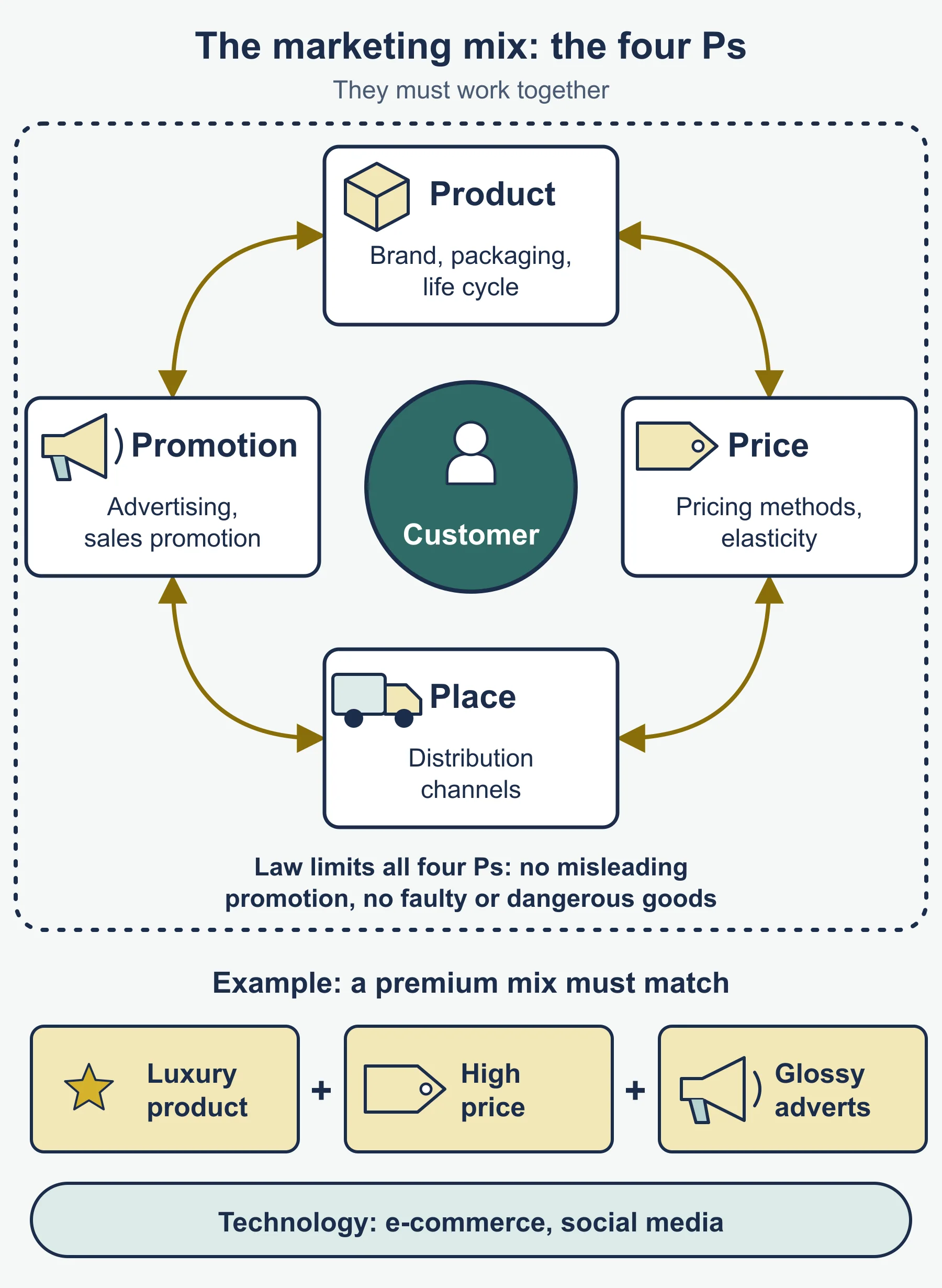
The four elements must fit. A luxury perfume needs a high price, elegant packaging, glossy-magazine advertising and exclusive shops. A budget price with a luxury image confuses buyers. Use the mix to make decisions, for example by recommending the activities that suit a given business and its target market.
The mix changes over time. As a product ages, a business may cut price, change channels (adding online sales), alter promotion from awareness to reminders, or revise the product. Evaluate how a business reacts: does the reaction match the stage, rivals and customer change?
Common errors
- Describing a pricing method without saying when it suits the business.
- Confusing primary and secondary research, or qualitative and quantitative.
- Listing promotion methods without tying them to budget, target market or rivals.
- Treating a mark-up as a profit margin on selling price.
Frequently asked questions
What is a loss leader? A loss leader is a product sold below cost to attract shoppers, in the hope that they buy other goods too. It is worthwhile only if the extra profit on those other goods is greater than the loss on the loss leader.
How should a business choose its promotional mix? Consider the target market and where it reads, watches and browses, the budget available, competitors’ activities and the type of product. A small budget rules out TV, while complex goods may need personal selling.
What is a channel of distribution? A channel of distribution is the route a product takes from producer to consumer. It can be direct, such as the producer’s own shop or website, or go through intermediaries such as retailers and wholesalers.
What is a unique selling point? A unique selling point (USP) is something that makes a product different from rivals’ products and gives customers a reason to choose it, sometimes allowing a higher price.
Why must the marketing mix be integrated? The four elements must fit together and send one message. A luxury perfume, for example, needs a high price, elegant packaging, glossy-magazine advertising and exclusive shops, while a budget price with a luxury image confuses buyers.
Official syllabus
OxfordAQA International GCSE Business (9225) specification, version 3.1, OxfordAQA, for International GCSE exams May/June 2022 onwards. Section 3.5 Marketing (3.5.1 to 3.5.4).
Get free revision emails (optional)
Occasional emails with practice questions, worked explanations and links to free resources for the qualification and subjects you choose. No spam, and you can unsubscribe from any email. The free tools on this site never need an email.
Related resources
-
Practice questions
OxfordAQA IGCSE Business: Marketing (9225) – Practice Questions
Twelve original questions with worked answers on segmentation, market research and the 4Ps for OxfordAQA International GCSE Business section 3.5.
Business · OxfordAQA · IGCSE
Try questions -
Revision notes
OxfordAQA IGCSE Business: Marketing (9225) – Revision Notes
Condensed revision notes for section 3.5 Marketing in OxfordAQA International GCSE Business: segmentation, market research and the 4Ps.
Business · OxfordAQA · IGCSE
Revise topic -
Study guides
OxfordAQA IGCSE Business: Technology and Ethical and environmental considerations (9225)
A full teaching guide to e-commerce, digital communication, ethics, the environment and sustainability for OxfordAQA International GCSE Business.
Business · OxfordAQA · IGCSE
Read guide
Related articles
-
teaching
A Level tuition in Dubai: Cambridge or Pearson Edexcel International A Level?
Schools in Dubai and Abu Dhabi teach either Cambridge International AS & A Level or Pearson Edexcel International A Level. How the two are structured, why it matters for tuition, and how online classes from Lahore work.
9 October 2026
-
curriculum guides
Choosing subjects at IGCSE and A Level
How subject choices at 14 and 16 affect university options later, and how to keep pathways open without overloading a timetable.
28 July 2026
Studying this with a teacher
Working through Business IGCSE?
This page is free and stays free. If you would rather be taught it, Marlbridge runs Business classes one-to-one and in small groups of up to 15, online in your own time zone. The first trial class is free. WhatsApp replies within an hour (8am–11pm Pakistan time, every day); email the same day.
OxfordAQA Business teachers at Marlbridge
