
Revision Notes
OxfordAQA International GCSE Islamiat (9237): The Battles of Badr, Uhud, Trench, Khaibar and Hunayn – Revision Notes
Recall notes on the causes, events and lessons of Badr, Uhud, the Trench, Khaibar and Hunayn, and Aam ul Wufood, for 9237 topic 3.2.1.9, with a self-test.
- Subject
- Islamiyat
- Level
- IGCSE
- Topic
- Paper 2 – The Life of Hazrat Muhammad (pbuh) and Sources of Authority in Islam
- Author
- Marlbridge Academic Team
- Updated
- Reviewed by
- Azam Siddique (what this means)
Aligned to OxfordAQA IGCSE Islamiyat (9237), Version 1.1. Official specification .
Syllabus page (what it covers and how it is assessed): OxfordAQA IGCSE Islamiyat.
Syllabus points this page covers
9237
- 3.2.1 Life and teachings of Hazrat Muhammad (pbuh)
Found an error? Report a correction.
Need help with this topic? Request a free trial class for IGCSE Islamiyat (9237).
These notes condense two statements in 9237 content area 3.2.1.9: “The events and importance of the Battles of Badr, Uhud, Trench, Khaibar, and Hunayn” and “The significance of Aam ul wafood.” The full account is in the battles study guide; the timeline for the whole life is in the Life and Teachings of Hazrat Muhammad (pbuh) revision notes.
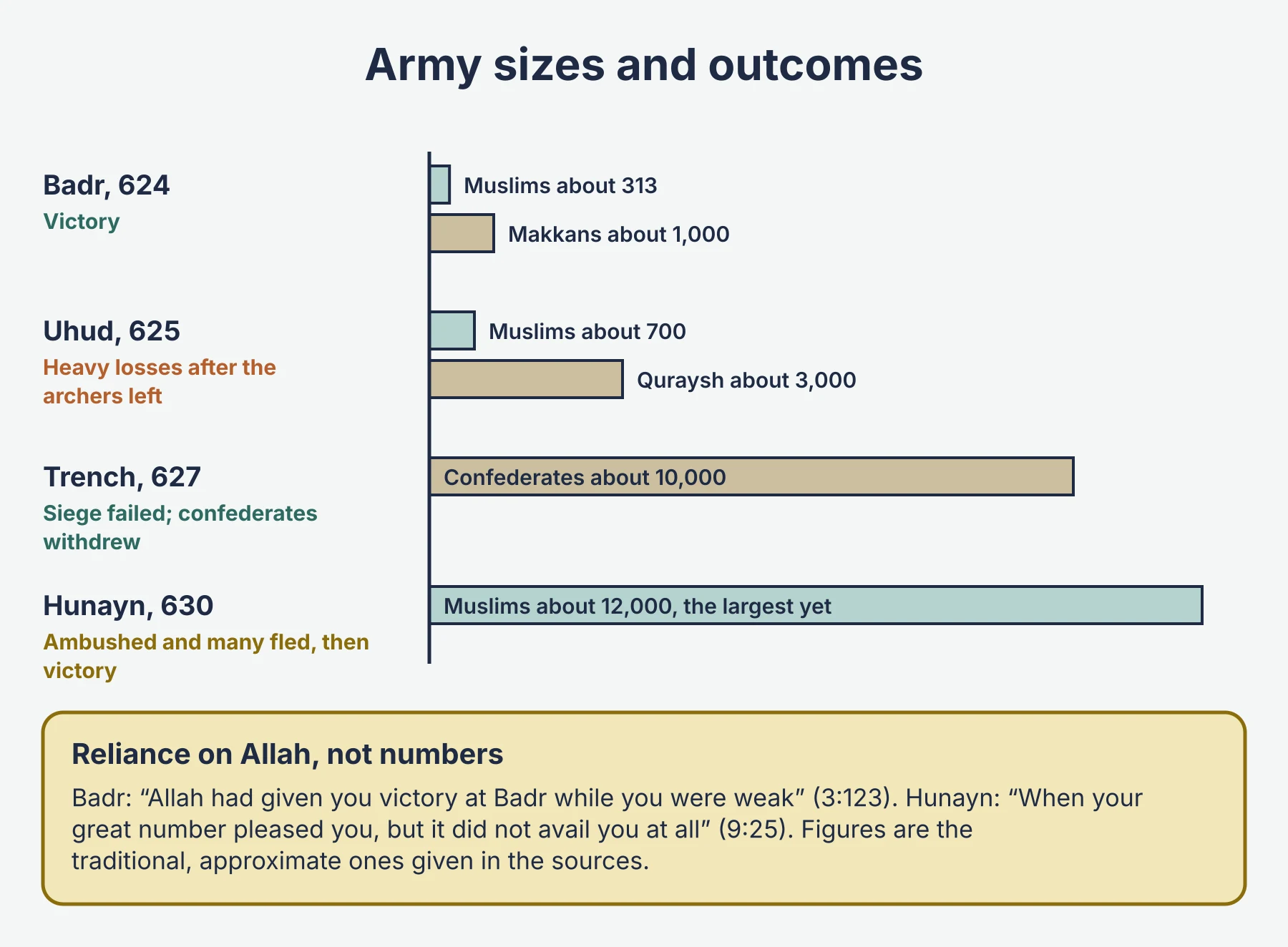
The five battles at a glance
| Battle | Year (CE) | Opponents | Muslims (traditional) | Result | One-word lesson |
|---|---|---|---|---|---|
| Badr | 624 | Quraysh, about 1,000 under Abu Jahl | About 313 | Victory | Faith |
| Uhud | 625 | Quraysh, about 3,000 under Abu Sufyan | About 700 | Heavy losses | Obedience |
| Trench | 627 | Confederates, about 10,000 | Defended Madinah | Siege failed | Unity |
| Khaibar | 628 | Fortified oasis north of Madinah | Besieged the forts | Victory | Security |
| Hunayn | 630 | Hawazin and Thaqif | About 12,000 | Near-rout, then victory | Reliance |
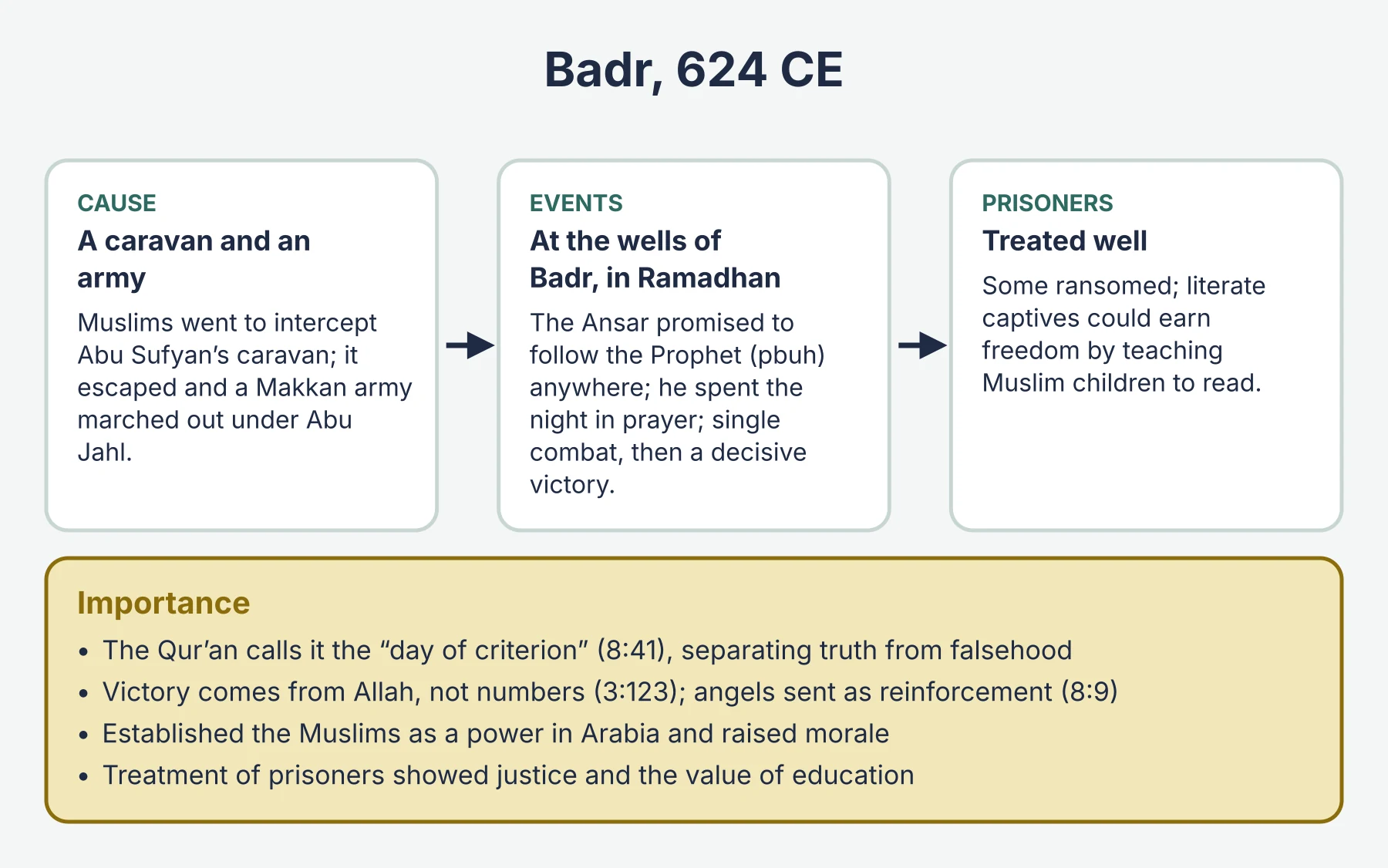
Badr: five facts
- Cause: interception of Abu Sufyan’s caravan; a Makkan army marched out.
- Ramadhan; wells of Badr; the Prophet (pbuh) prayed through the night.
- Single combat: Hamza (RA), Ali (RA), Ubaydah (RA).
- Abu Jahl killed; about fourteen Muslims martyred.
- Prisoners: ransom, or teach Muslim children to read.
Evidence: “day of criterion” (8:41); “Allah had given you victory at Badr while you were weak” (3:123); angels (8:9).
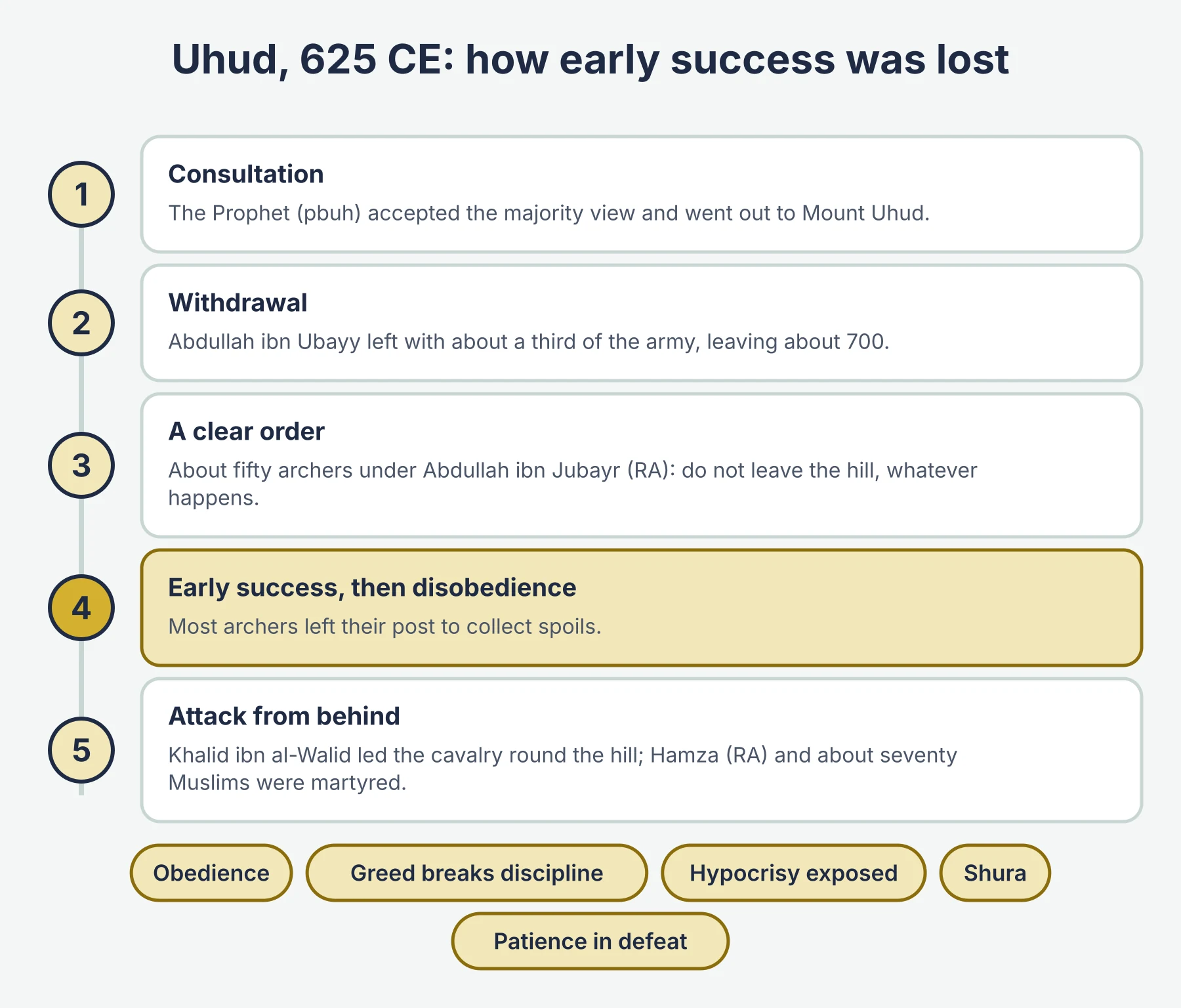
Uhud: five facts
- Revenge for Badr.
- The Prophet (pbuh) consulted and accepted the majority view to go out.
- Abdullah ibn Ubayy withdrew with about a third of the army.
- About fifty archers under Abdullah ibn Jubayr (RA) left their post; Khalid ibn al-Walid attacked from behind.
- Hamza (RA) martyred; the Prophet (pbuh) wounded; Talha (RA) shielded him; about seventy martyred.
Evidence: the prescribed passage 3:121-127 describes Uhud and calls for patience and taqwa (3:125).
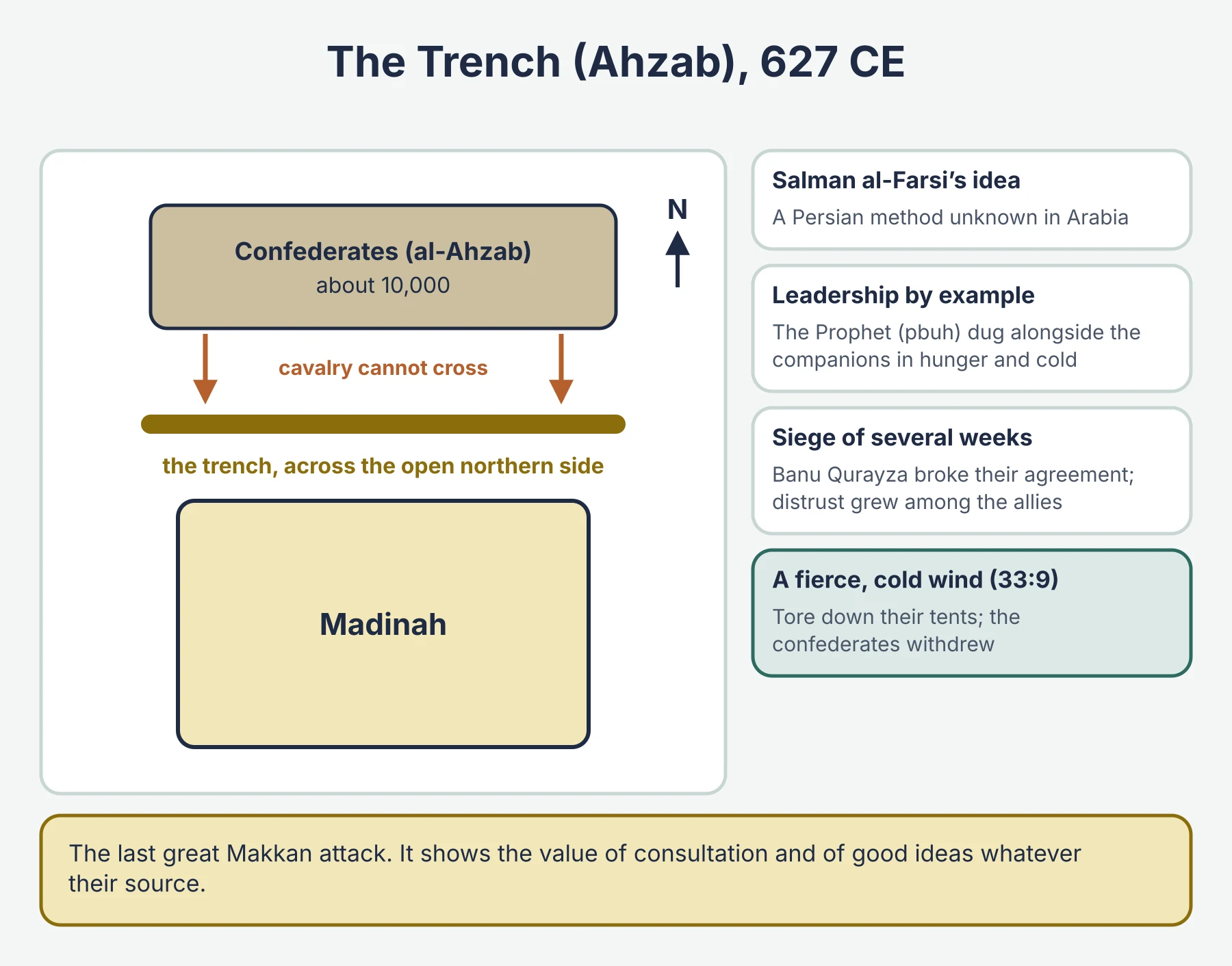
Trench: five facts
- Banu Nadir leaders built an alliance (al-Ahzab) of about 10,000.
- Salman al-Farsi (RA) suggested the trench.
- The Prophet (pbuh) dug alongside the companions.
- Banu Qurayza broke their agreement; siege of several weeks.
- Distrust among the allies and a cold wind (33:9) made them withdraw.
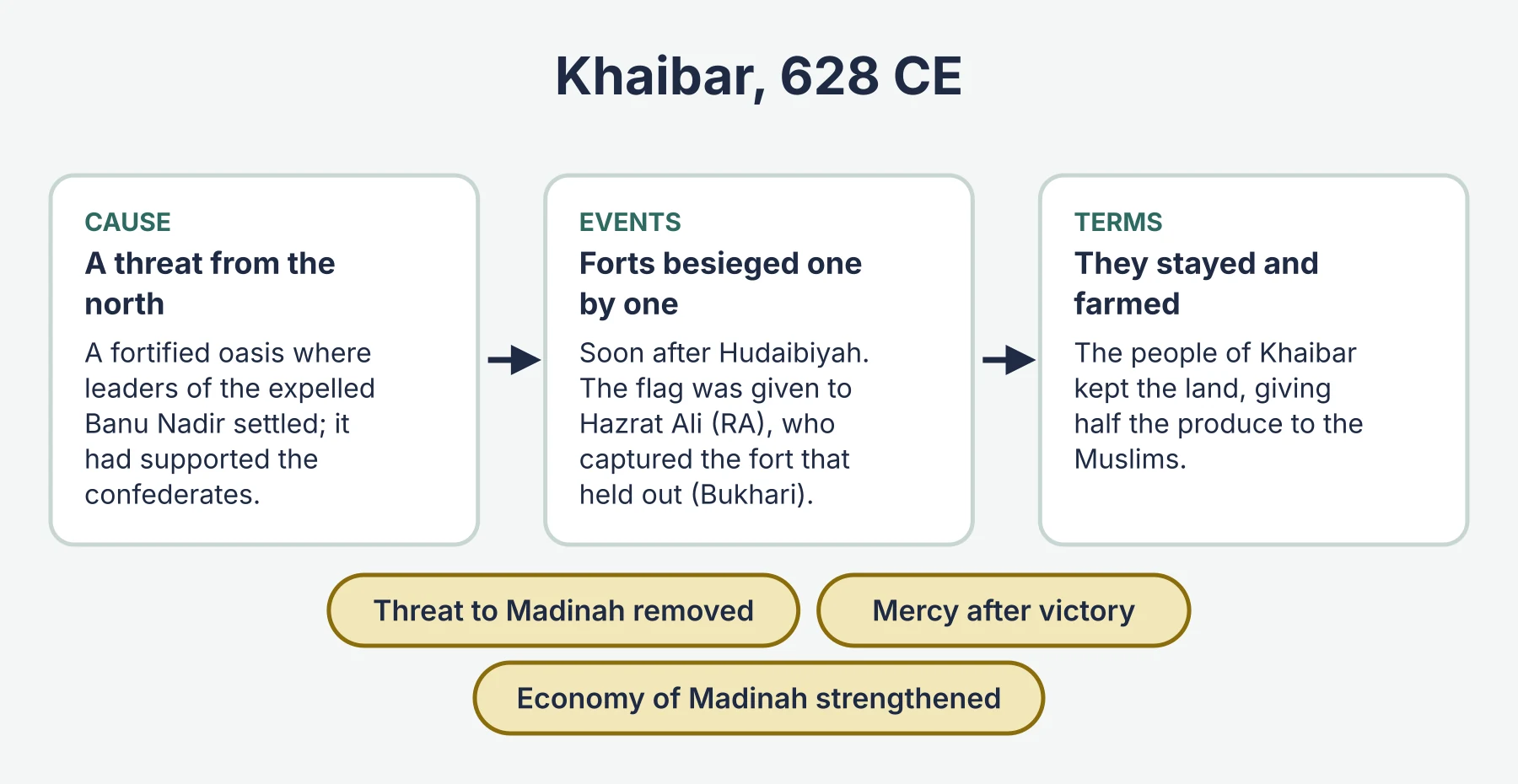
Khaibar: four facts
- Oasis with forts north of Madinah, home of exiled Banu Nadir leaders.
- After the Treaty of Hudaibiyah.
- The flag given to Ali (RA), who took the fort (Bukhari).
- People stayed to farm the land for half of the produce.
Hunayn: five facts
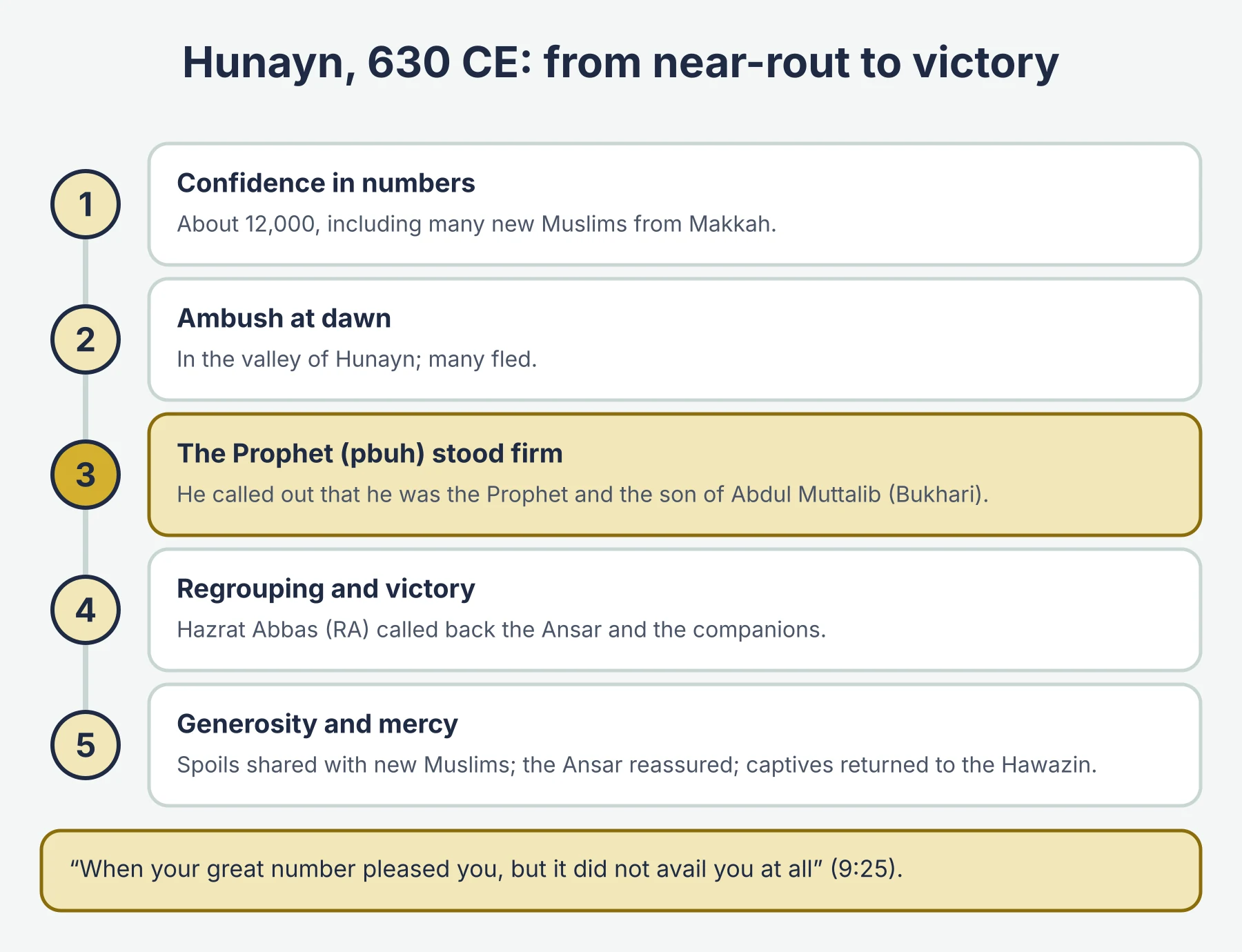
- After the conquest of Makkah; Hawazin and Thaqif.
- The largest Muslim army so far; some proud of its size.
- Ambush at dawn; many fled; the Prophet (pbuh) stood firm.
- Abbas (RA) called the companions back; victory.
- Spoils shared with new Muslims; the Ansar reassured; captives returned to the Hawazin.
Evidence: “when your great number pleased you, but it did not avail you at all” (9:25).
Aam ul Wufood
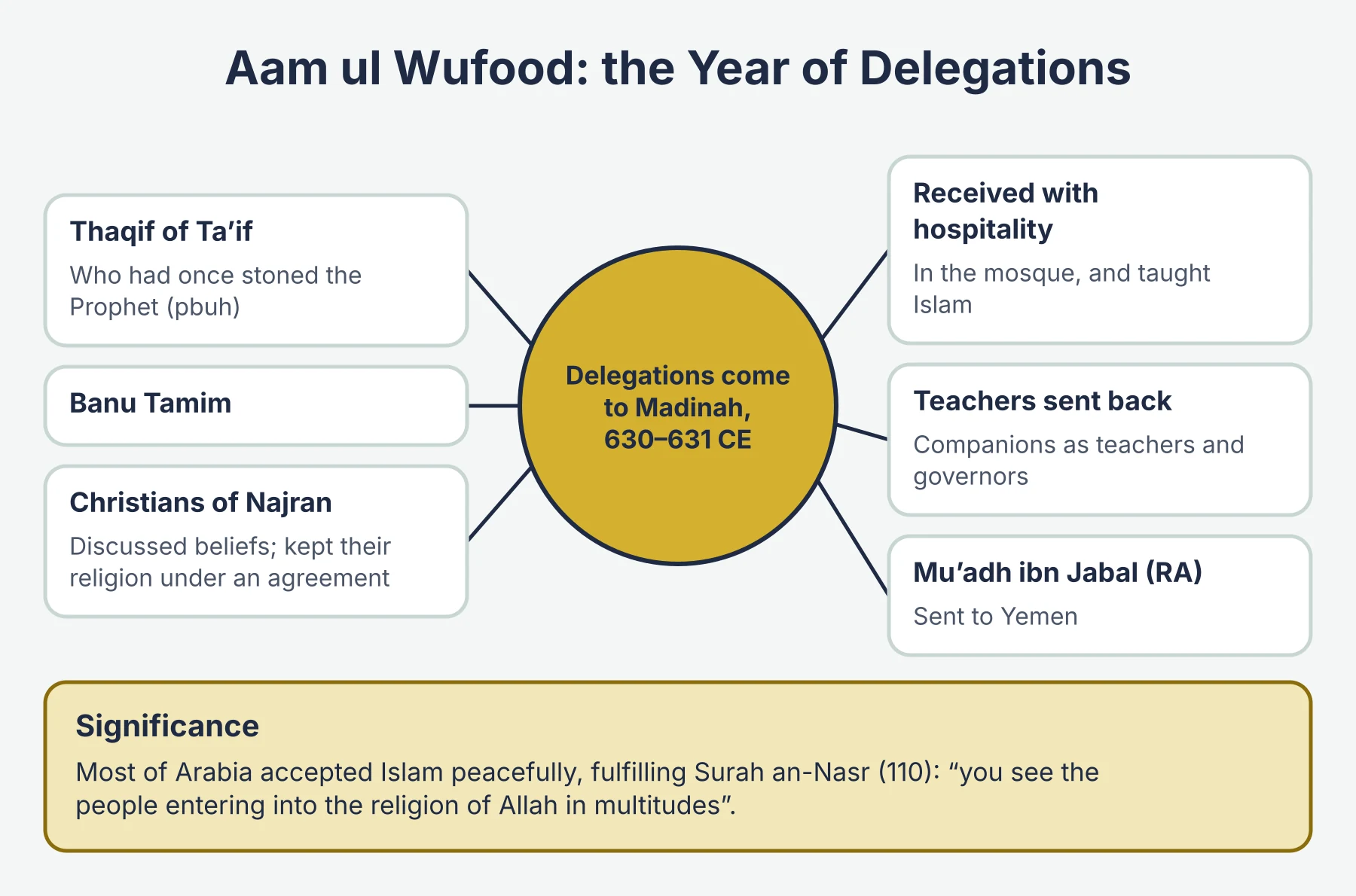
- The Year of Delegations, 630–631 CE.
- Tribes across Arabia sent delegations to Madinah, including Thaqif of Ta’if, Banu Tamim, and Christians of Najran.
- The Prophet (pbuh) hosted them, taught them and sent teachers, such as Mu’adh ibn Jabal (RA) to Yemen.
- Significance: peaceful spread of Islam; unity of Arabia; fulfilment of Surah an-Nasr (110).
The prescribed passage: Qur’an 3:121-127
| Phrase | What it shows |
|---|---|
| “to post the believers at their stations for the battle” | The Prophet’s (pbuh) planning, including the archers |
| “two parties among you were about to lose courage, but Allah was their ally” | Weakness can be overcome by trust in Allah |
| “Allah had given you victory at Badr while you were weak” | Victory comes from Allah, not numbers |
| “if you remain patient and conscious of Allah” | The conditions for Allah’s help |
| “victory is not except from Allah” | The core lesson of all the battles |
Key terms
| Term | Meaning |
|---|---|
| Ghazwah | A campaign in which the Prophet (pbuh) took part |
| Shaheed | A martyr |
| Ansar | The Muslims of Madinah who helped the migrants |
| Muhajirun | The Muslims who migrated from Makkah |
| Munafiqun | Hypocrites, such as Abdullah ibn Ubayy’s followers |
| Al-Ahzab | The confederates at the Trench |
| Shura | Consultation |
| Wufood | Delegations |
| Ghanimah | Spoils of war |
Exam traps
- Uhud was not lost because of numbers; it was lost through disobedience.
- Do not put Khaibar before the Trench or Hudaibiyah.
- Hunayn is the battle where great numbers nearly led to defeat; Badr is the one where small numbers won.
- Aam ul Wufood is a year of peaceful delegations, not a battle.
- Every “importance” answer needs a lesson, not just an event.
Self-test
- Who led the Makkan army at Badr?
- How were literate prisoners of Badr allowed to win their freedom?
- Who commanded the archers at Uhud?
- Who led the Makkan cavalry attack from behind at Uhud?
- Whose idea was the trench?
- What does al-Ahzab mean?
- To whom did the Prophet (pbuh) give the flag at Khaibar?
- What were the terms for the people of Khaibar?
- Which two tribes fought the Muslims at Hunayn?
- Which verse warns about relying on great numbers at Hunayn?
- What is Aam ul Wufood?
- Name one delegation that came to Madinah in that year.
Answers: 1. Abu Jahl. 2. By teaching Muslim children to read. 3. Abdullah ibn Jubayr (RA). 4. Khalid ibn al-Walid. 5. Salman al-Farsi (RA). 6. The confederates or allied tribes. 7. Hazrat Ali (RA). 8. They could stay and farm the land, giving half of the produce to the Muslims. 9. Hawazin and Thaqif. 10. Qur’an 9:25. 11. The Year of Delegations, when tribes from across Arabia came to Madinah to accept Islam or make agreements. 12. Any one: Thaqif of Ta’if; Banu Tamim; the Christians of Najran.
Practise with the battles practice questions.
Source: OxfordAQA, International GCSE Islamiat (9237) specification, Version 1.1, content area 3.2.1.9.
Related resources
-
Study guides
OxfordAQA International GCSE Islamiat (9237): The Battles Fought by Hazrat Muhammad (pbuh)
From Badr to the Farewell Pilgrimage: the battles, the Treaty of Hudaibiyah, the conquest of Makkah and the purification of the Kaaba, for 9237 topic 3.2.1.9.
Islamiyat · OxfordAQA · IGCSE
Read guide -
Practice questions
OxfordAQA International GCSE Islamiat (9237): The Battles Fought by Hazrat Muhammad (pbuh) – Practice Questions
Original questions with mark guidance on the battles, the Treaty of Hudaibiyah, Fath-e-Makkah and the Farewell Pilgrimage, for 9237 topic 3.2.1.9.
Islamiyat · OxfordAQA · IGCSE
Try questions -
Revision notes
OxfordAQA International GCSE Islamiat (9237): The Battles Fought by Hazrat Muhammad (pbuh) – Revision Notes
Recall notes on Badr, Uhud, the Trench, Hudaibiyah, Khaibar, Makkah, Hunayn, Aam ul wafood and the Farewell Pilgrimage, for 9237 topic 3.2.1.9.
Islamiyat · OxfordAQA · IGCSE
Revise topic
Get free revision emails (optional)
Occasional emails with practice questions, worked explanations and links to free resources for the qualification and subjects you choose. No spam, and you can unsubscribe from any email. The free tools on this site never need an email.