
Study Guides
OxfordAQA International GCSE Islamiat (9237): The Battles of Badr, Uhud, Trench, Khaibar and Hunayn
The causes, events and importance of the Battles of Badr, Uhud, the Trench, Khaibar and Hunayn, and the significance of Aam ul Wufood, for 9237 topic 3.2.1.9.
- Subject
- Islamiyat
- Level
- IGCSE
- Topic
- Paper 2 – The Life of Hazrat Muhammad (pbuh) and Sources of Authority in Islam
- Author
- Marlbridge Academic Team
- Updated
- Reviewed by
- Azam Siddique (what this means)
Aligned to OxfordAQA IGCSE Islamiyat (9237), Version 1.1. Official specification .
Syllabus page (what it covers and how it is assessed): OxfordAQA IGCSE Islamiyat.
Syllabus points this page covers
9237
- 3.2.1 Life and teachings of Hazrat Muhammad (pbuh)
Found an error? Report a correction.
Need help with this topic? Request a free trial class for IGCSE Islamiyat (9237).
This guide covers the first two statements in content area 3.2.1.9 of OxfordAQA International GCSE Islamiat (9237): “The events and importance of the Battles of Badr, Uhud, Trench, Khaibar, and Hunayn” and “The significance of Aam ul wafood.” The Life and Teachings of Hazrat Muhammad (pbuh) study guide gives each battle one line in a timeline table. This page explains for each one why it was fought, what happened and what Muslims learn from it, because Paper 2 Section A asks for both events and importance. The Treaty of Hudaibiyah and the conquest of Makkah, also in 3.2.1.9, are covered on the existing page.
Why the Muslims fought
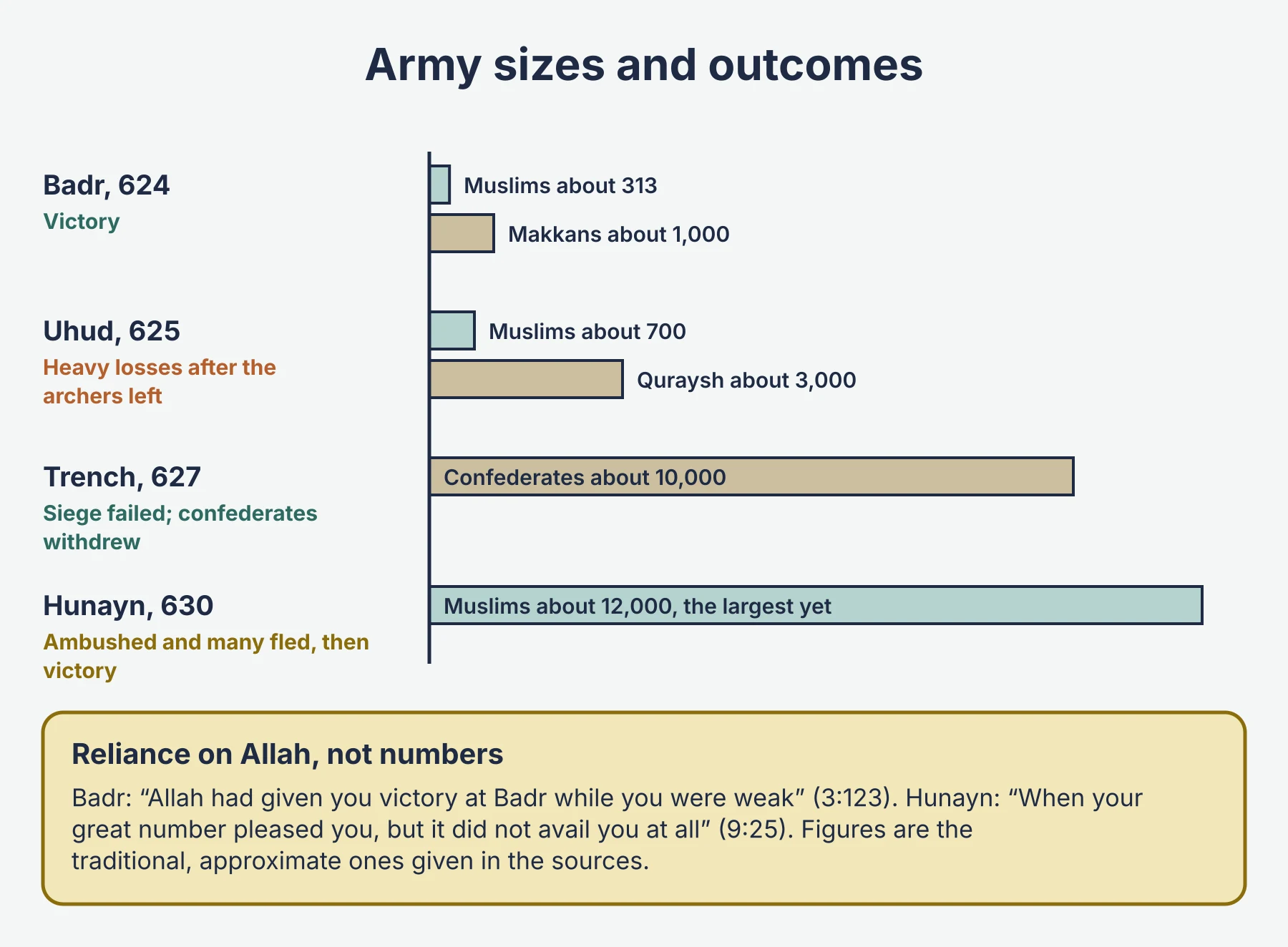
After the Hijrah, the Quraysh had seized the property of the Muslims who left Makkah and remained determined to destroy the new community in Madinah. Permission to fight in self-defence was given in Madinah, and the rule was set: “Fight in the way of Allah those who fight against you but do not transgress” (2:190). Keep this in view: the specification treats the battles as part of the Prophet’s (pbuh) life and teaching, so answers should show the moral lessons, not only military events. Army sizes below are the traditional figures given in the sources and are approximate.
Badr (624 CE)
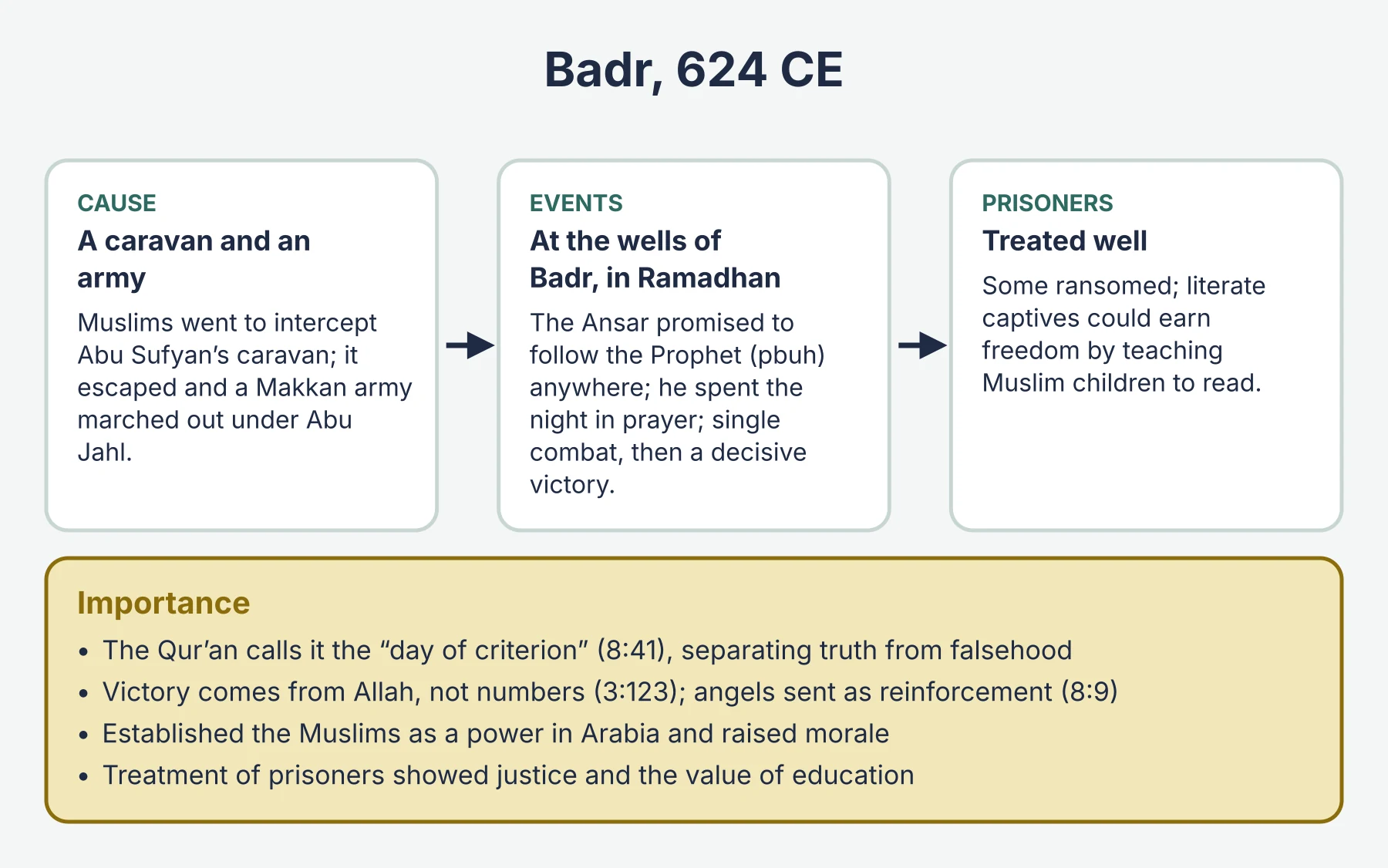
Cause. The Muslims went out to intercept a rich Makkan caravan returning from Syria under Abu Sufyan. The caravan escaped by another route, but a Makkan army of about 1,000, led by Abu Jahl, marched out to fight.
Events. About 313 Muslims, with very few horses, met them at the wells of Badr in Ramadhan. The Prophet (pbuh) consulted his companions; the Ansar, who had pledged only to defend him in Madinah, promised to follow him anywhere. He spent the night in prayer. The battle began with single combat, in which Hazrat Hamza (RA), Hazrat Ali (RA) and Ubaydah ibn al-Harith (RA) faced three Makkan champions. The Muslims won decisively; Abu Jahl was among the Makkans killed, and about fourteen Muslims were martyred.
Prisoners. Captives were treated well. Some were released for ransom, and literate prisoners could earn their freedom by teaching Muslim children to read.
Importance.
- The Qur’an calls it the “day of criterion” (8:41), the day that separated truth from falsehood.
- It showed that victory comes from Allah, not numbers: “Allah had given you victory at Badr while you were weak” (3:123, in the prescribed passage), and angels were sent as reinforcement (8:9).
- It established the Muslims as a power in Arabia and raised the morale of the community.
- The treatment of prisoners showed justice and the value of education.
Uhud (625 CE)
Cause. The Quraysh wanted revenge for Badr. About 3,000 men marched on Madinah under Abu Sufyan.
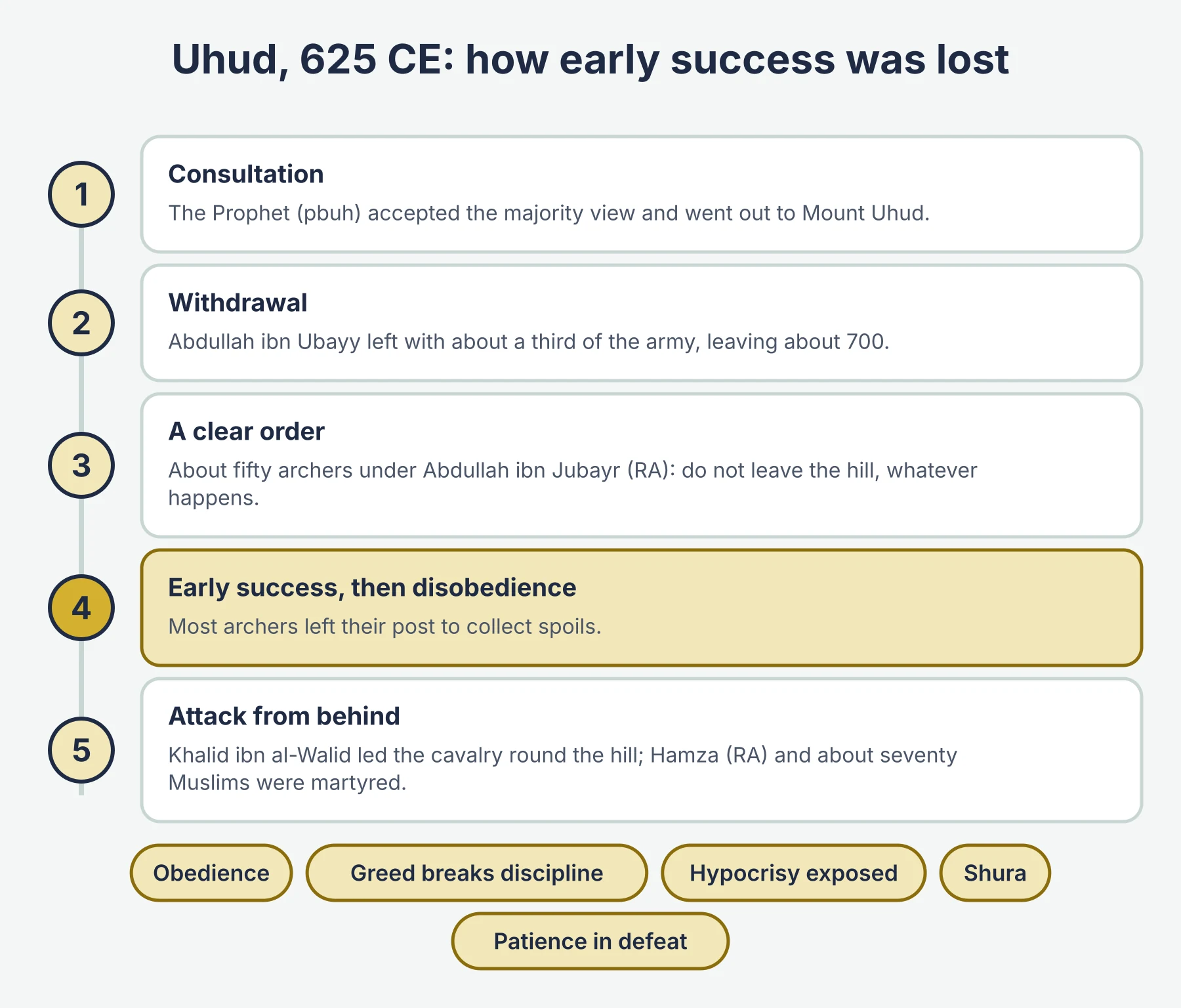
Events. The Prophet (pbuh) would have preferred to defend the city, but he accepted the majority view of his companions and went out to meet the enemy at Mount Uhud. On the way, Abdullah ibn Ubayy, leader of the hypocrites, withdrew with about a third of the army, leaving about 700. The Prophet (pbuh) placed about fifty archers on a hill under Abdullah ibn Jubayr (RA) and ordered them not to leave their position whatever happened. The Muslims gained early success; most of the archers then left their post to collect spoils. Khalid ibn al-Walid, then fighting for Makkah, led the cavalry round the hill and attacked from behind. Hazrat Hamza (RA) was killed; the Prophet (pbuh) was wounded and a rumour spread that he had died; Hazrat Talha (RA) shielded him. About seventy Muslims were martyred.
Importance.
- Obedience: the disaster came from disobeying a clear command, a lesson the prescribed passage connects to patience and taqwa (3:125).
- Greed: desire for spoils broke discipline.
- Hypocrisy exposed: the withdrawal showed who was committed.
- Leadership: the Prophet’s (pbuh) consultation (shura), even when he disagreed, is a model for Muslim decision-making.
- Patience in defeat: the community recovered and continued.
The Trench, or Ahzab (627 CE)
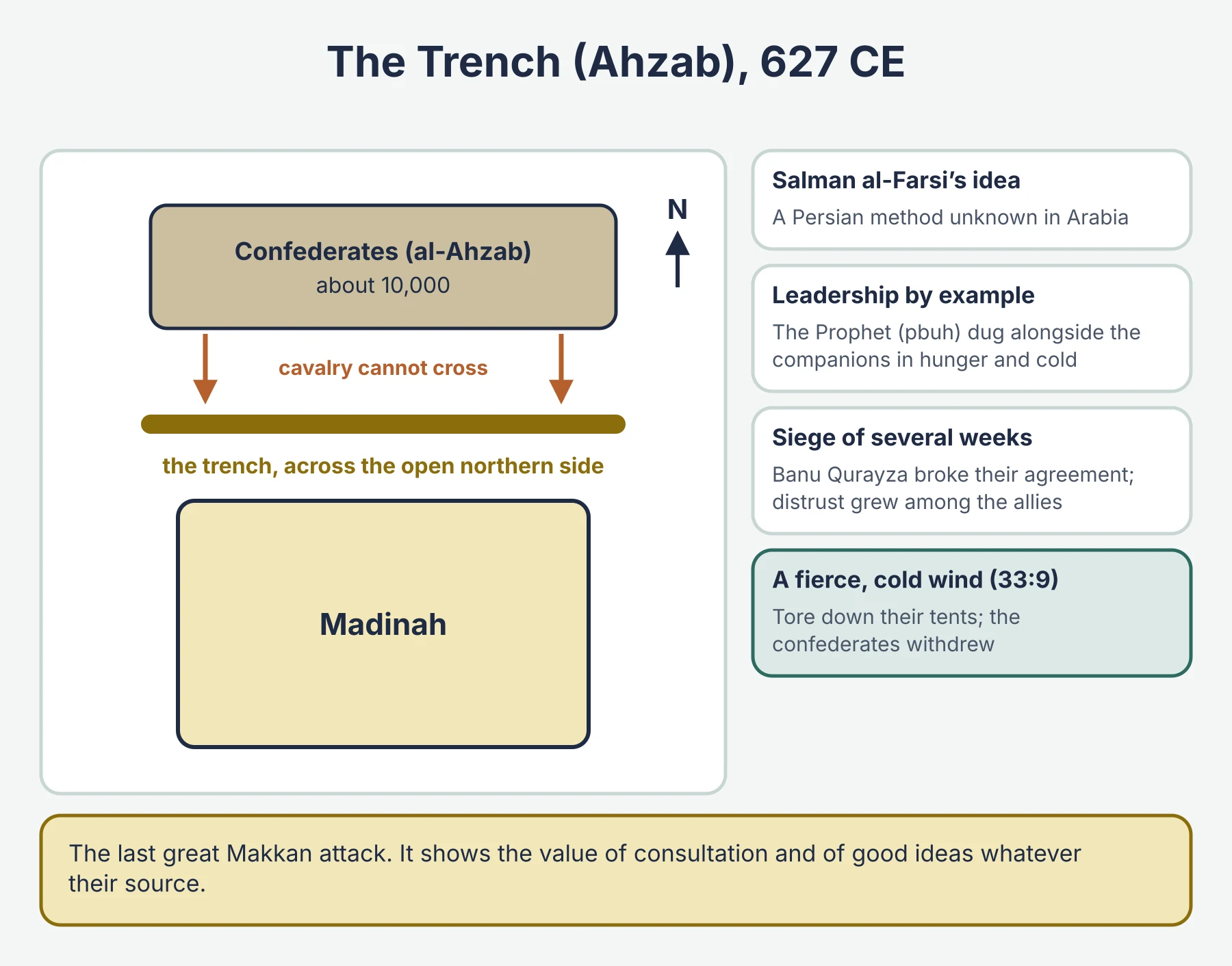
Cause. Leaders of the Banu Nadir, expelled from Madinah, encouraged the Quraysh and other tribes to form an alliance (al-Ahzab, “the confederates”) of about 10,000 to destroy Madinah.
Events. Hazrat Salman al-Farsi (RA) suggested digging a trench across the open northern side of the city, a Persian method unknown in Arabia. The Prophet (pbuh) dug alongside the companions, sharing their hunger and cold. The confederate cavalry could not cross, and a siege lasting several weeks followed. The Banu Qurayza, a Jewish tribe inside Madinah, broke their agreement with the Muslims, which left the city in great danger. Distrust grew between the allies, and a fierce, cold wind tore down their tents (33:9). The confederates withdrew.
Importance.
- It was the last great Makkan attack; afterwards the Prophet (pbuh) said that the Muslims would now go to them, not they to the Muslims.
- It shows the value of consultation and of good ideas whatever their source: a Persian convert’s plan saved the city.
- It shows leadership by example: the Prophet (pbuh) worked with his own hands.
- Surah al-Ahzab describes the fear and the faith of the believers in this siege.
Khaibar (628 CE)
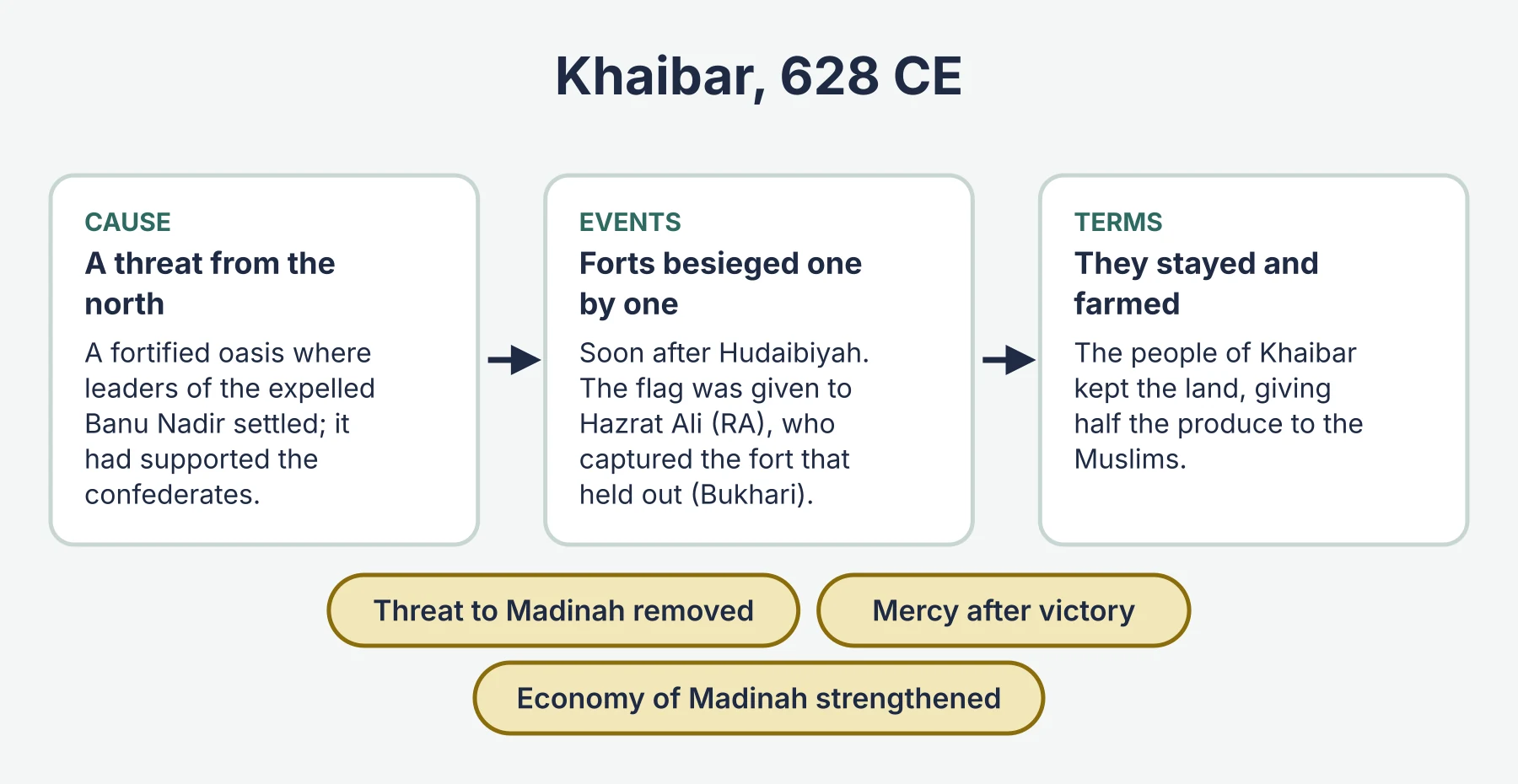
Cause. Khaibar was a fortified oasis north of Madinah where leaders of the expelled Banu Nadir had settled; it had supported the confederates and remained a threat.
Events. Soon after the Treaty of Hudaibiyah, the Muslims besieged the forts one by one. When one fort held out, the Prophet (pbuh) said he would give the flag to a man who loved Allah and His Messenger and whom Allah and His Messenger loved, and gave it to Hazrat Ali (RA), who captured it (Sahih al-Bukhari). The people of Khaibar surrendered. They were allowed to stay and farm the land, giving half the produce to the Muslims.
Importance.
- It removed the threat to Madinah from the north, so the community could live securely under the truce with Makkah.
- The terms allowed the defeated people to keep their homes and religion, showing mercy after victory.
- It strengthened the economy of Madinah.
Hunayn (630 CE)
Cause. After the conquest of Makkah, the Hawazin and Thaqif tribes gathered a large army to fight the Muslims.
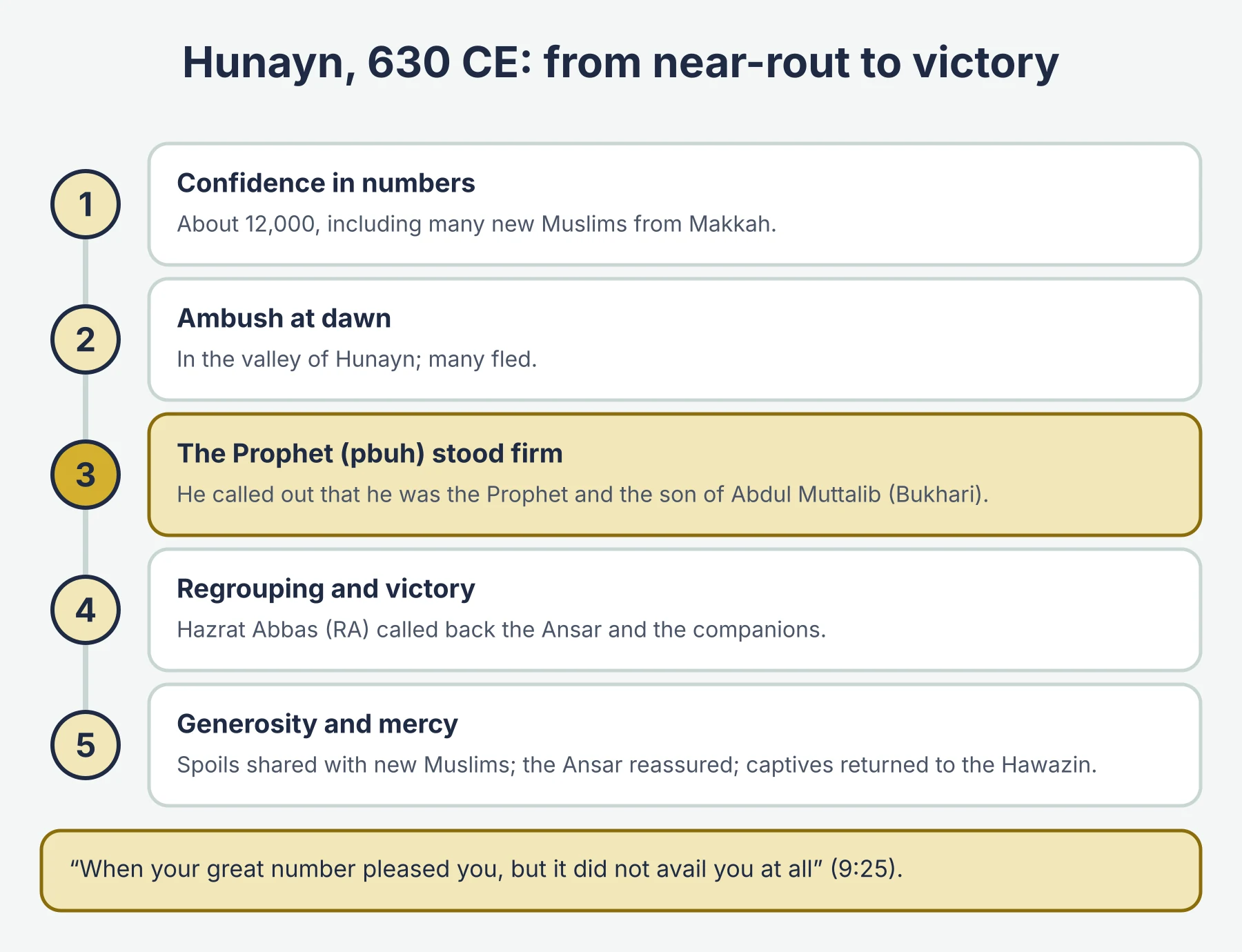
Events. The Muslim army of about 12,000, including many new Muslims from Makkah, was the largest it had been, and some felt confident because of its size. At dawn in the valley of Hunayn it was ambushed and many fled. The Prophet (pbuh) stood firm, calling out that he was the Prophet (pbuh) and the son of Abdul Muttalib (Sahih al-Bukhari). His uncle Hazrat Abbas (RA) called back the Ansar and the companions, who regrouped, and the Muslims won. The large spoils were later shared generously with the new Muslims of Makkah. When some of the Ansar felt overlooked, the Prophet (pbuh) asked whether they were not content that others went home with sheep and camels while they went home with the Messenger of Allah, and they wept with joy. Later, captives were returned to the Hawazin when their delegation came as Muslims.
Importance.
- “When your great number pleased you, but it did not avail you at all” (9:25): reliance must be on Allah, not numbers.
- The Prophet’s (pbuh) courage when others fled is a model of steadfastness.
- His treatment of the Ansar and the Hawazin shows wisdom and mercy in victory.
Aam ul Wufood: the Year of Delegations (630–631 CE)
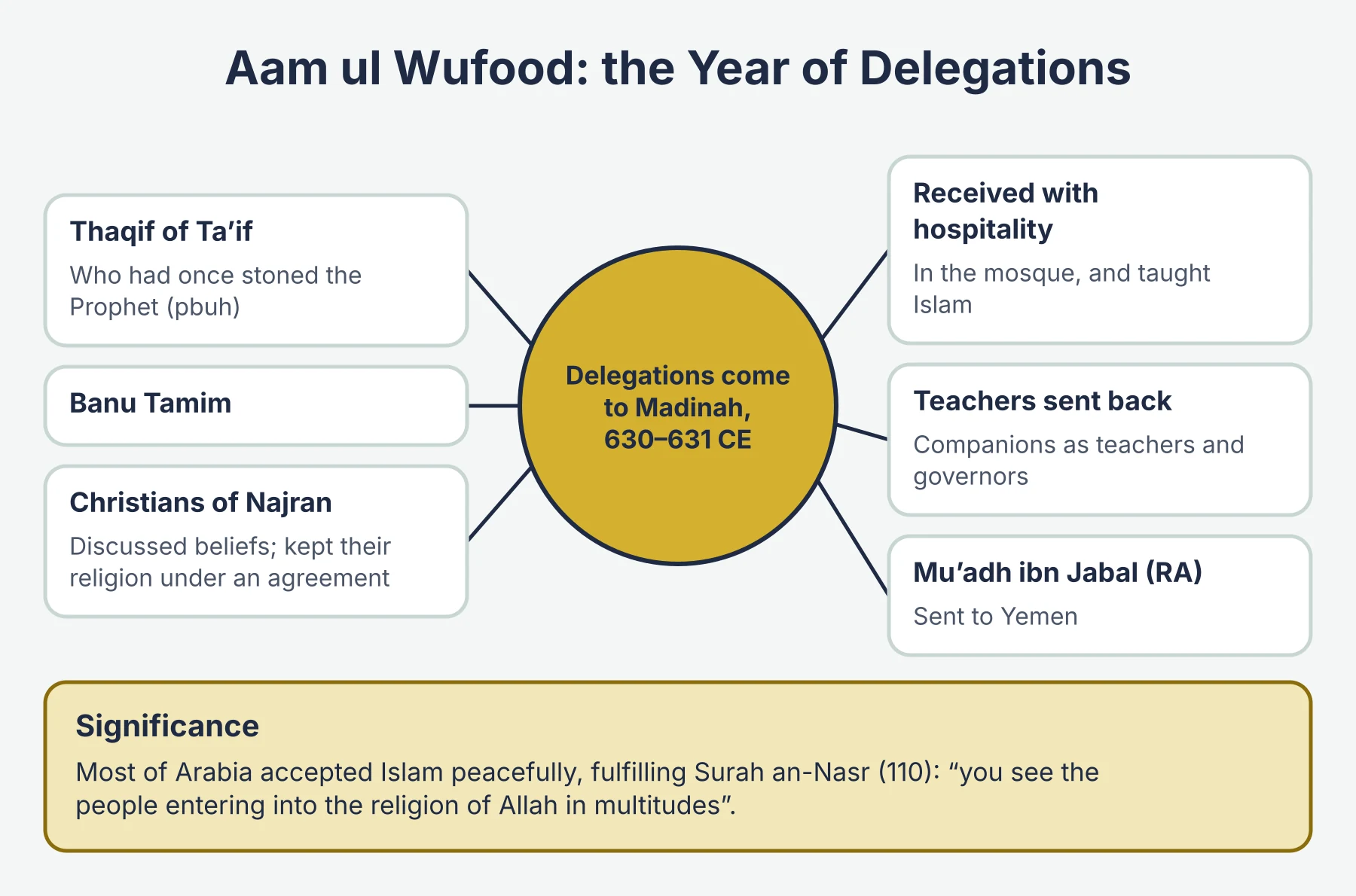
After the conquest of Makkah and the victory at Hunayn, tribes from all over Arabia sent delegations (wufood) to Madinah. They included the Thaqif of Ta’if, who had stoned the Prophet (pbuh) years before; the Banu Tamim; and Christians from Najran, who discussed their beliefs with the Prophet (pbuh) and kept their religion under an agreement with the Muslims. The Prophet (pbuh) received the delegations with hospitality in the mosque, taught them Islam and sent companions back with them as teachers and governors, such as Hazrat Mu’adh ibn Jabal (RA) to Yemen.
Significance. Most of Arabia accepted Islam peacefully, fulfilling Surah an-Nasr (110): “you see the people entering into the religion of Allah in multitudes”. It showed the Prophet (pbuh) as a statesman uniting the tribes, and it showed that the battles had defended a community whose message then spread by persuasion.
Worked example: a 6-mark answer
Question: Explain two lessons Muslims learn from the Battle of Uhud. Apply one teaching from a source of authority in your answer. [6]
One lesson is the importance of obeying the Prophet (pbuh) [1]. The archers were told never to leave the hill, but most left to collect spoils, and Khalid ibn al-Walid attacked from behind, turning victory into heavy losses [1]. A second lesson is that defeat is a test that requires patience [1]. Although Hamza (RA) and about seventy companions were martyred, the community did not give up and recovered within a short time [1]. The prescribed passage says, “if you remain patient and conscious of Allah … your Lord will reinforce you” (3:125), which shows that help from Allah depends on patience and obedience, exactly what the archers forgot [2].
Common mistakes
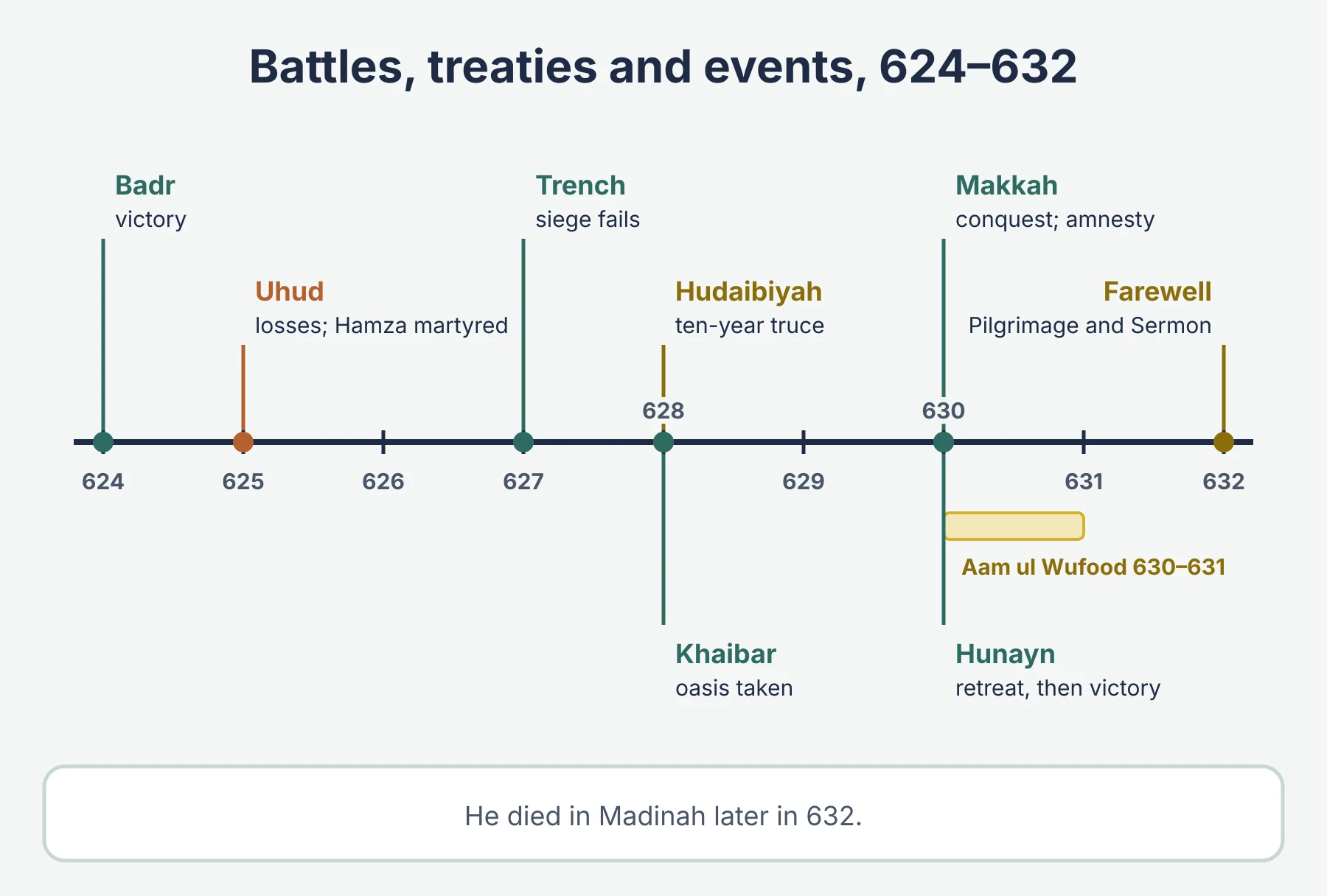
- Confusing the order. Badr, Uhud, Trench, Hudaibiyah, Khaibar, conquest of Makkah, Hunayn, Aam ul Wufood.
- Saying Uhud was lost because the Muslims were outnumbered. They had been winning; the cause was disobedience.
- Writing military detail with no importance. Each 4-mark “explain” needs a lesson for Muslims.
- Treating Hunayn as easy. It began with a near-rout; that is its lesson.
- Forgetting Aam ul Wufood is about peaceful acceptance of Islam, not a battle.
Related pages
- Battles of Badr, Uhud, Trench, Khaibar and Hunayn revision notes
- Battles of Badr, Uhud, Trench, Khaibar and Hunayn practice questions
- Life and Teachings of Hazrat Muhammad (pbuh) revision notes
Source: OxfordAQA, International GCSE Islamiat (9237) specification, Version 1.1, content area 3.2.1.9 and Passage 25.
Related resources
-
Practice questions
OxfordAQA International GCSE Islamiat (9237): The Battles of Badr, Uhud, Trench, Khaibar and Hunayn – Practice Questions
Twelve original questions with mark guidance on the Battles of Badr, Uhud, the Trench, Khaibar and Hunayn, and on Aam ul Wufood, for 9237 topic 3.2.1.9.
Islamiyat · OxfordAQA · IGCSE
Try questions -
Revision notes
OxfordAQA International GCSE Islamiat (9237): The Battles of Badr, Uhud, Trench, Khaibar and Hunayn – Revision Notes
Recall notes on the causes, events and lessons of Badr, Uhud, the Trench, Khaibar and Hunayn, and Aam ul Wufood, for 9237 topic 3.2.1.9, with a self-test.
Islamiyat · OxfordAQA · IGCSE
Revise topic -
Study guides
OxfordAQA International GCSE Islamiat (9237): The Battles Fought by Hazrat Muhammad (pbuh)
From Badr to the Farewell Pilgrimage: the battles, the Treaty of Hudaibiyah, the conquest of Makkah and the purification of the Kaaba, for 9237 topic 3.2.1.9.
Islamiyat · OxfordAQA · IGCSE
Read guide
Get free revision emails (optional)
Occasional emails with practice questions, worked explanations and links to free resources for the qualification and subjects you choose. No spam, and you can unsubscribe from any email. The free tools on this site never need an email.