
Revision Notes
OxfordAQA International GCSE Islamiat (9237): The Hijrah and the Madni Period – Revision Notes
Recall notes on the pledges of Aqaba, the Hijrah journey, the roles of Abu Bakr and Ali (RA), Quba, the Prophet's Mosque and the Charter of Madinah (9237).
- Subject
- Islamiyat
- Level
- IGCSE
- Topic
- Paper 2 – The Life of Hazrat Muhammad (pbuh) and Sources of Authority in Islam
- Author
- Marlbridge Academic Team
- Updated
- Reviewed by
- Azam Siddique (what this means)
Aligned to OxfordAQA IGCSE Islamiyat (9237), Version 1.1. Official specification .
Syllabus page (what it covers and how it is assessed): OxfordAQA IGCSE Islamiyat.
Syllabus points this page covers
9237
- 3.2.1 Life and teachings of Hazrat Muhammad (pbuh)
Found an error? Report a correction.
Need help with this topic? Request a free trial class for IGCSE Islamiyat (9237).
These notes condense content area 3.2.1.7 of 9237: “The events leading up to the Hijrah including the pledges of Aqaba”, the journey “including the roles of Hazrat Abu Bakr (RA) and Hazrat Ali (RA)”, “Early life in Madinah, including Hazrat Muhammad’s (pbuh) role as a statesman and the establishment of the Charter of Madinah” and “The establishment of the first mosque in Madinah.” The full account is in the Hijrah and the Madni period study guide.
Sequence
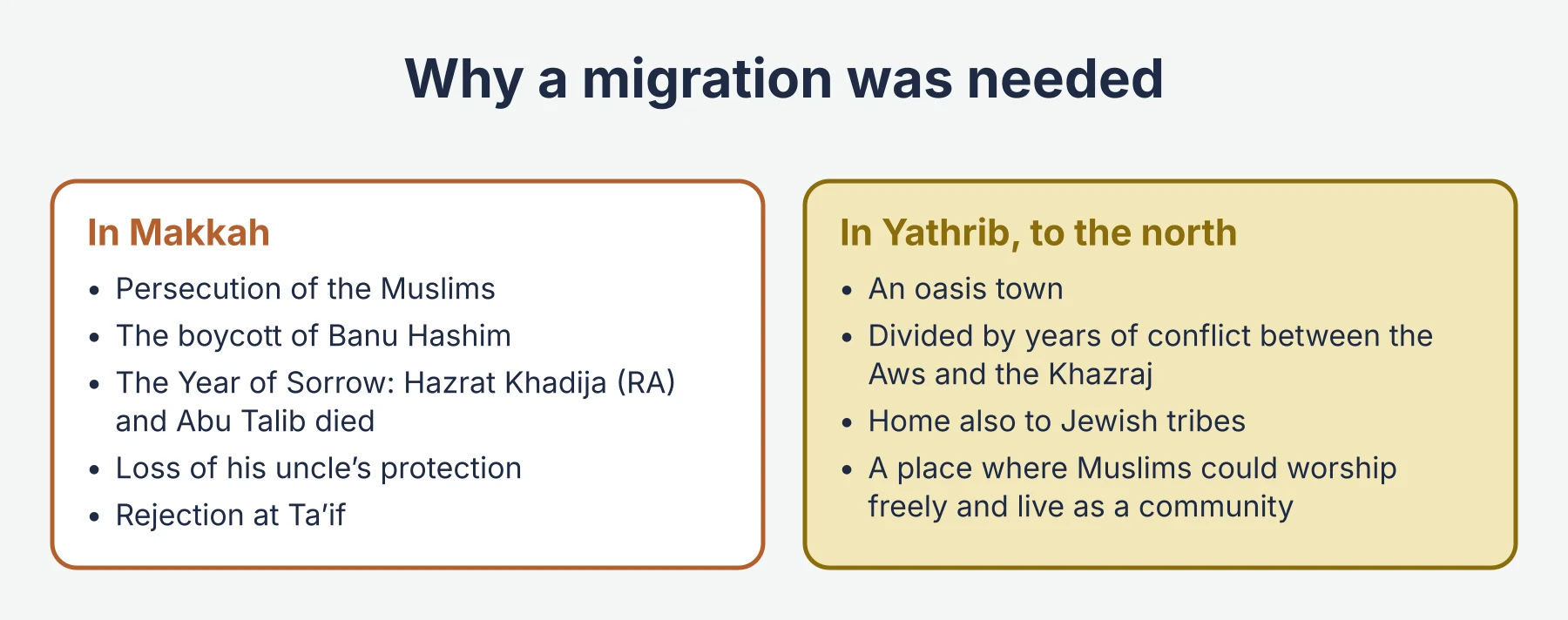
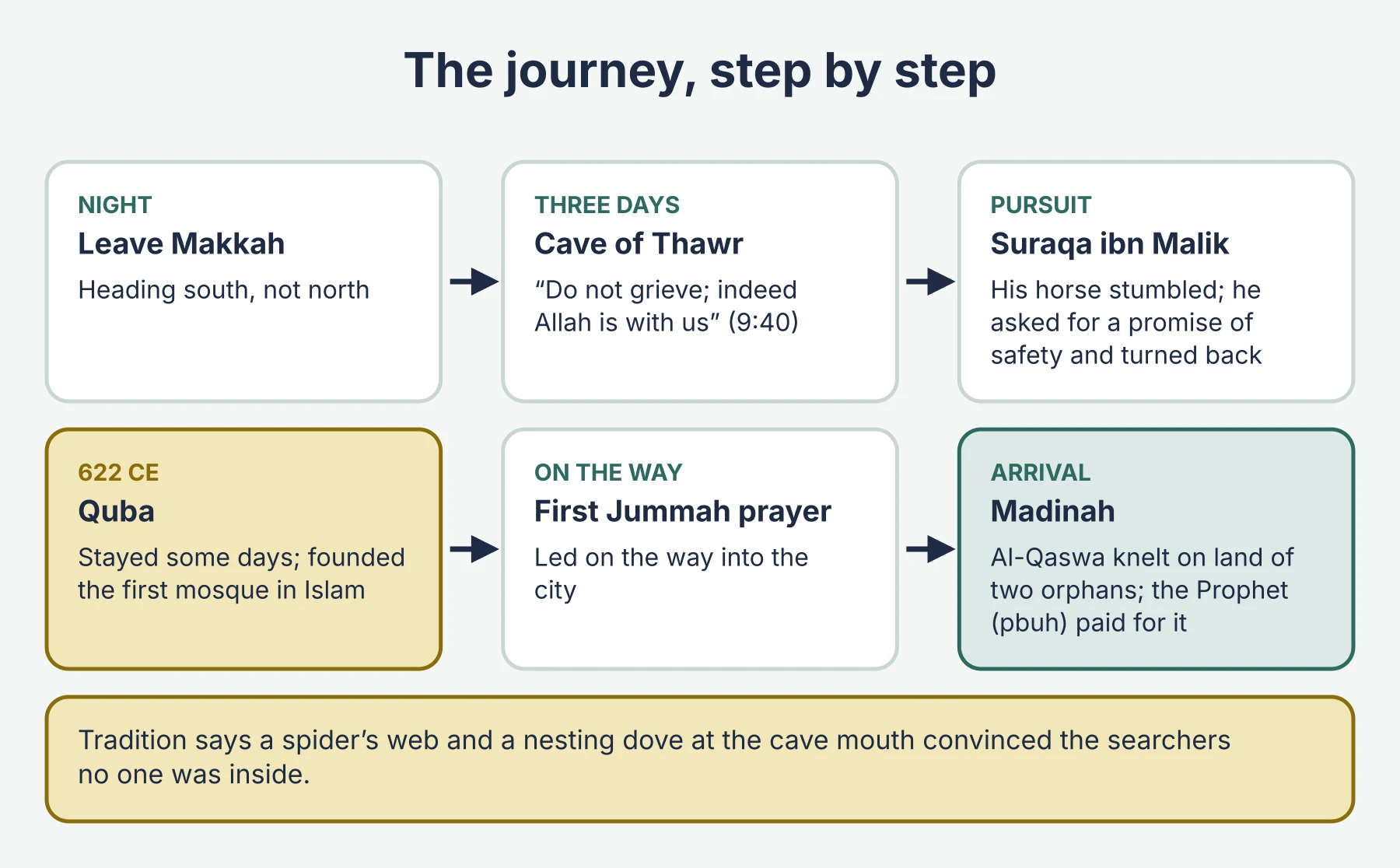
Year of Sorrow and rejection at Ta’if → first converts from Yathrib at the pilgrimage → first pledge of Aqaba (twelve men) → Mus’ab ibn Umair (RA) teaches in Yathrib → second pledge of Aqaba (more than seventy men, two women) → Muslims migrate in small groups → Quraysh plot → Ali (RA) in the bed → Cave of Thawr with Abu Bakr (RA) → pursuit by Suraqa → Quba: first mosque (622 CE) → first Jummah on the way into Madinah → camel kneels; land bought from two orphans → Prophet’s Mosque → brotherhood → Charter of Madinah.
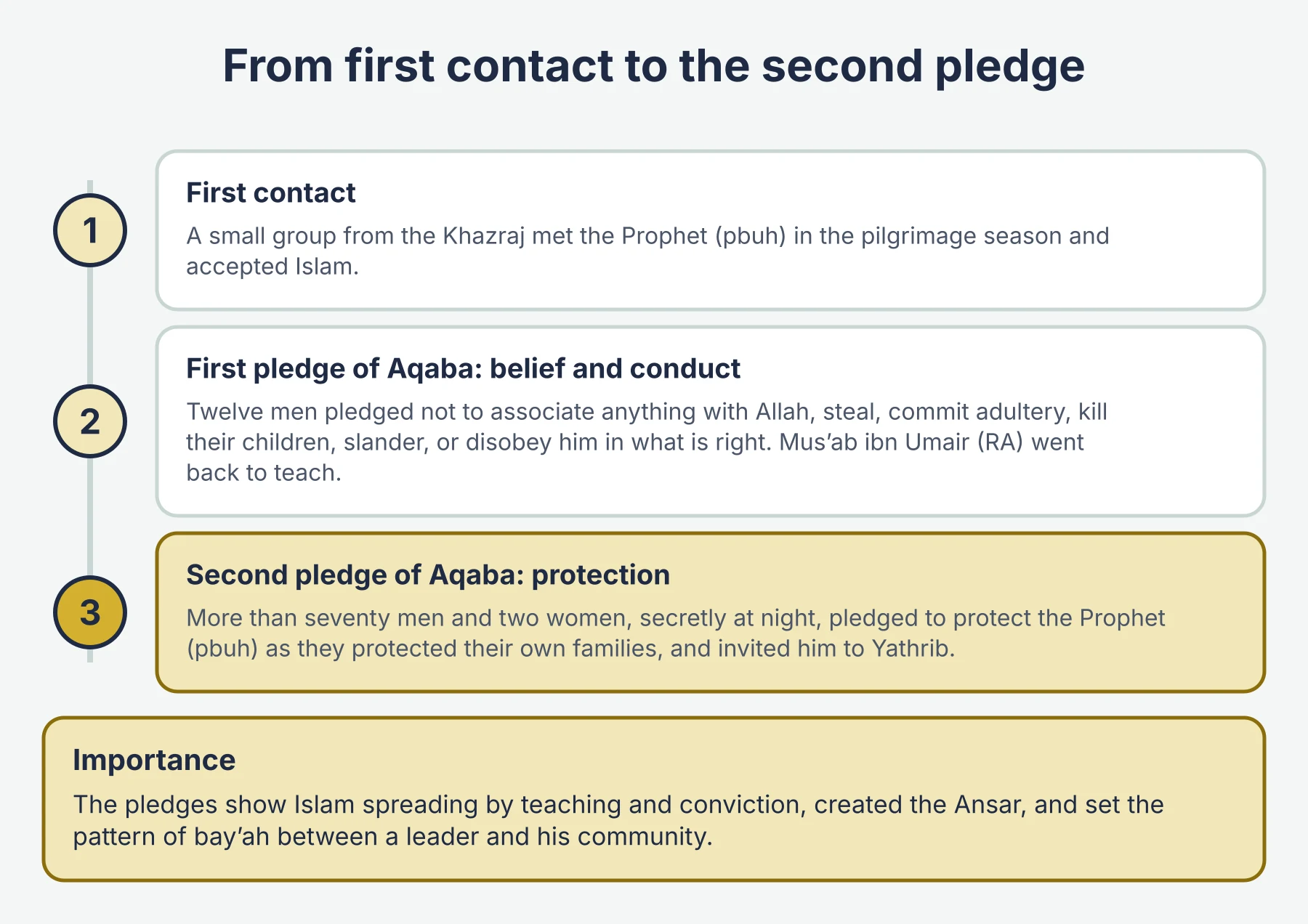
The two pledges compared
| First pledge of Aqaba | Second pledge of Aqaba | |
|---|---|---|
| Who | Twelve men from Yathrib | More than seventy men and two women |
| Promises | No shirk, theft, adultery, killing children, slander; obey in what is right | All of that plus protect the Prophet (pbuh) as their own families |
| Result | Mus’ab ibn Umair (RA) sent as teacher | Invitation to Yathrib; Hijrah becomes possible |
| Nature | Religious and moral | Religious, political and military |
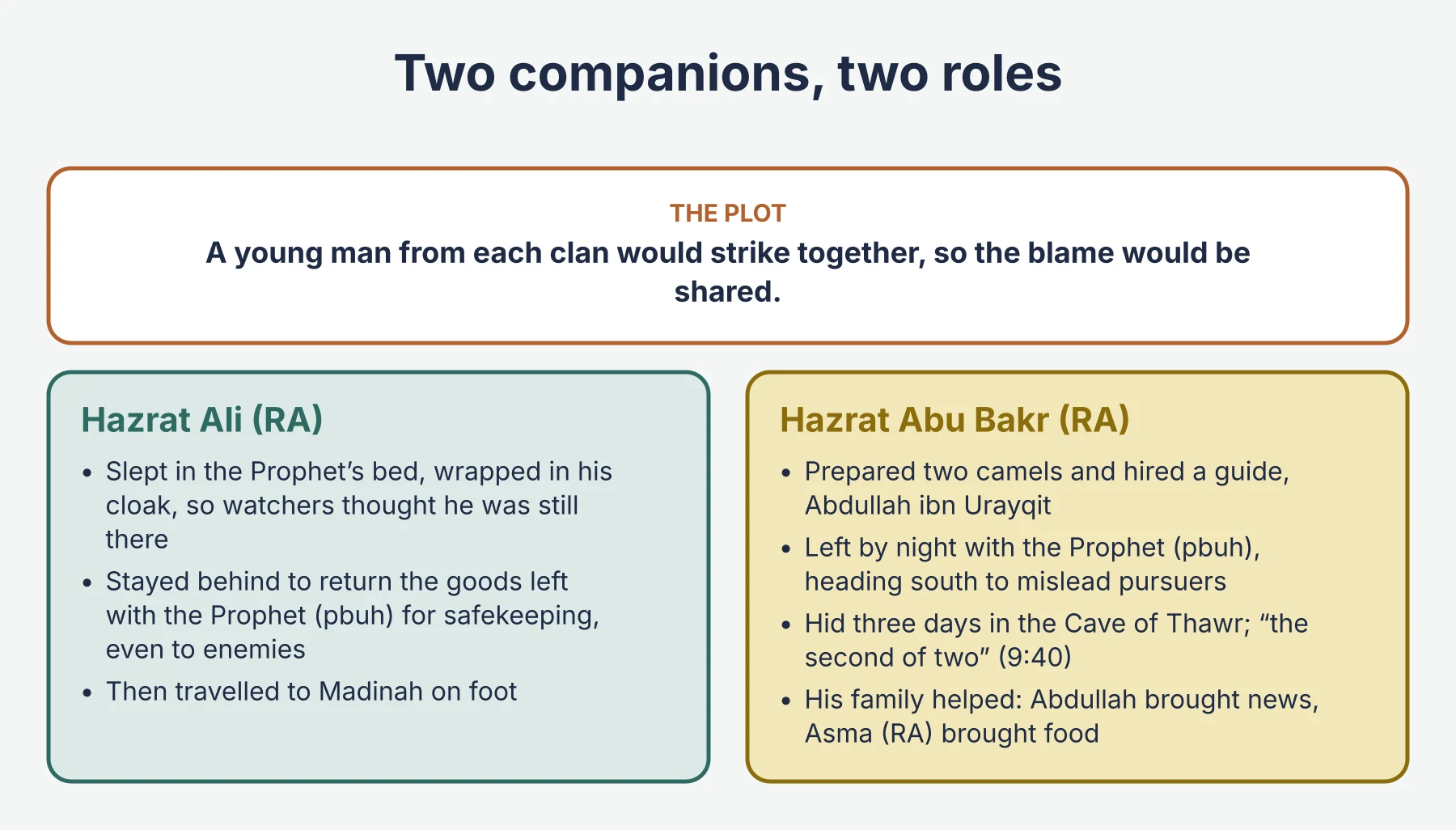
Roles in the journey
| Person | Role |
|---|---|
| Hazrat Ali (RA) | Slept in the Prophet’s (pbuh) bed to deceive the assassins; returned the trusts left with the Prophet (pbuh); then walked to Madinah |
| Hazrat Abu Bakr (RA) | Companion on the journey; prepared camels and a guide; hid with the Prophet (pbuh) in Thawr; “the second of two” (9:40) |
| Asma bint Abu Bakr (RA) | Brought food to the cave |
| Abdullah ibn Abu Bakr (RA) | Brought news from Makkah |
| Abdullah ibn Urayqit | Paid guide |
| Suraqa ibn Malik | Pursuer whose horse stumbled; turned back with a promise of safety |
| Abu Ayyub Ansari (RA) | Hosted the Prophet (pbuh) in Madinah |
The mosques
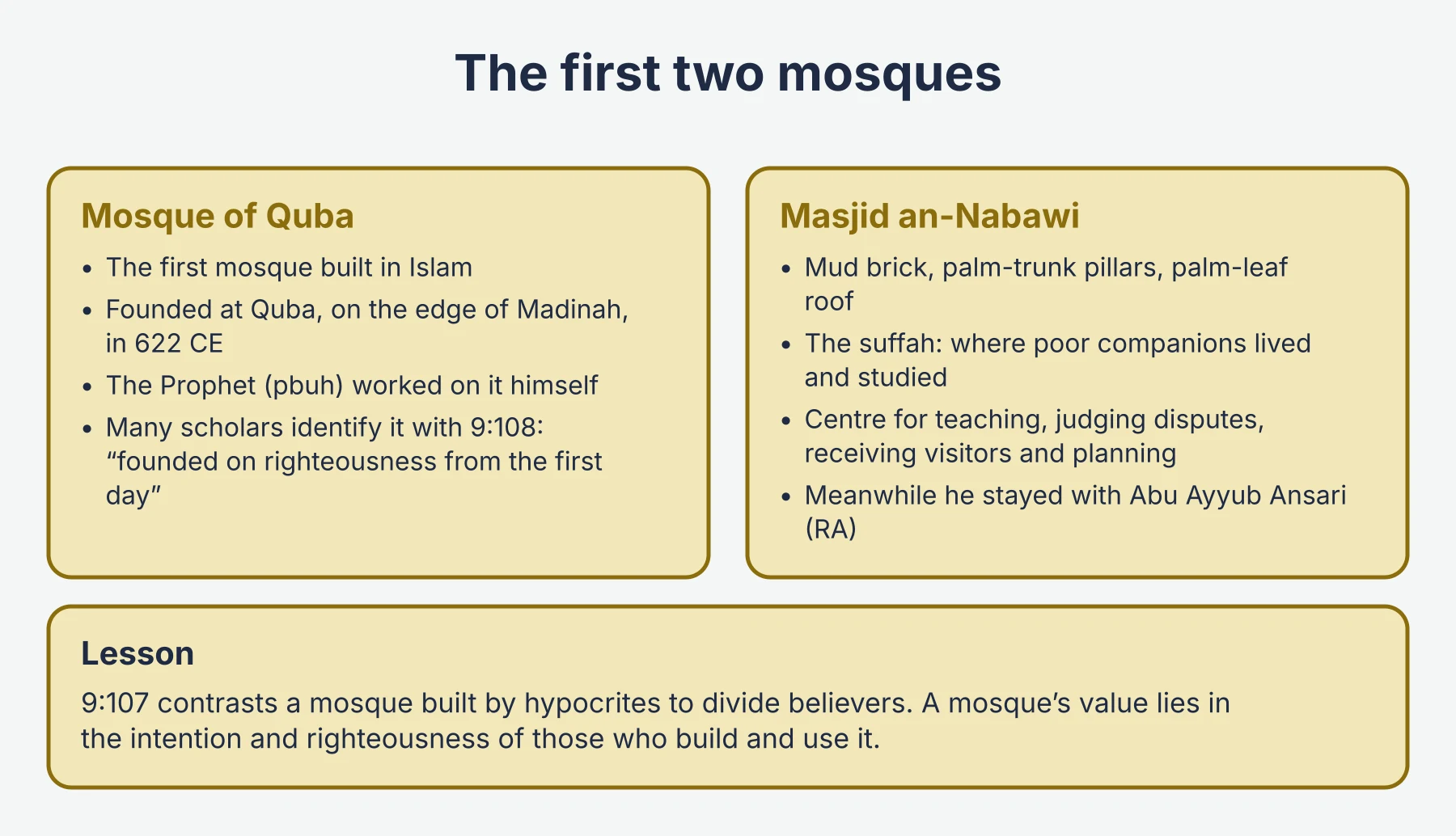
- Quba: the first mosque in Islam, built on arrival at the edge of Madinah.
- Masjid an-Nabawi: built on land bought from two orphans; mud brick, palm trunks and palm leaves; the Prophet (pbuh) worked on it himself.
- Functions: prayer, teaching, judging disputes, receiving delegations, shelter for the poor in the suffah.
- Qur’an 9:108: “a mosque founded on righteousness from the first day”; many scholars say Quba, some the Prophet (pbuh)’s Mosque; contrasted with the hypocrites’ mosque (9:107).
Charter of Madinah: seven terms
- Muslims of Quraysh and Yathrib are one community.
- Jewish tribes who join are part of it and keep their religion.
- Joint defence of Madinah.
- No separate alliance with Quraysh.
- Each group pays its own blood money and ransoms.
- The oppressed must be helped.
- Disputes go to Allah and Muhammad (pbuh); Madinah is a sacred area.
Effects: peace between Aws and Khazraj; security; religious freedom; rule of law over tribal loyalty; the Prophet (pbuh) as head of state.
Statesman: four actions
- Built the mosque as the centre of community and government.
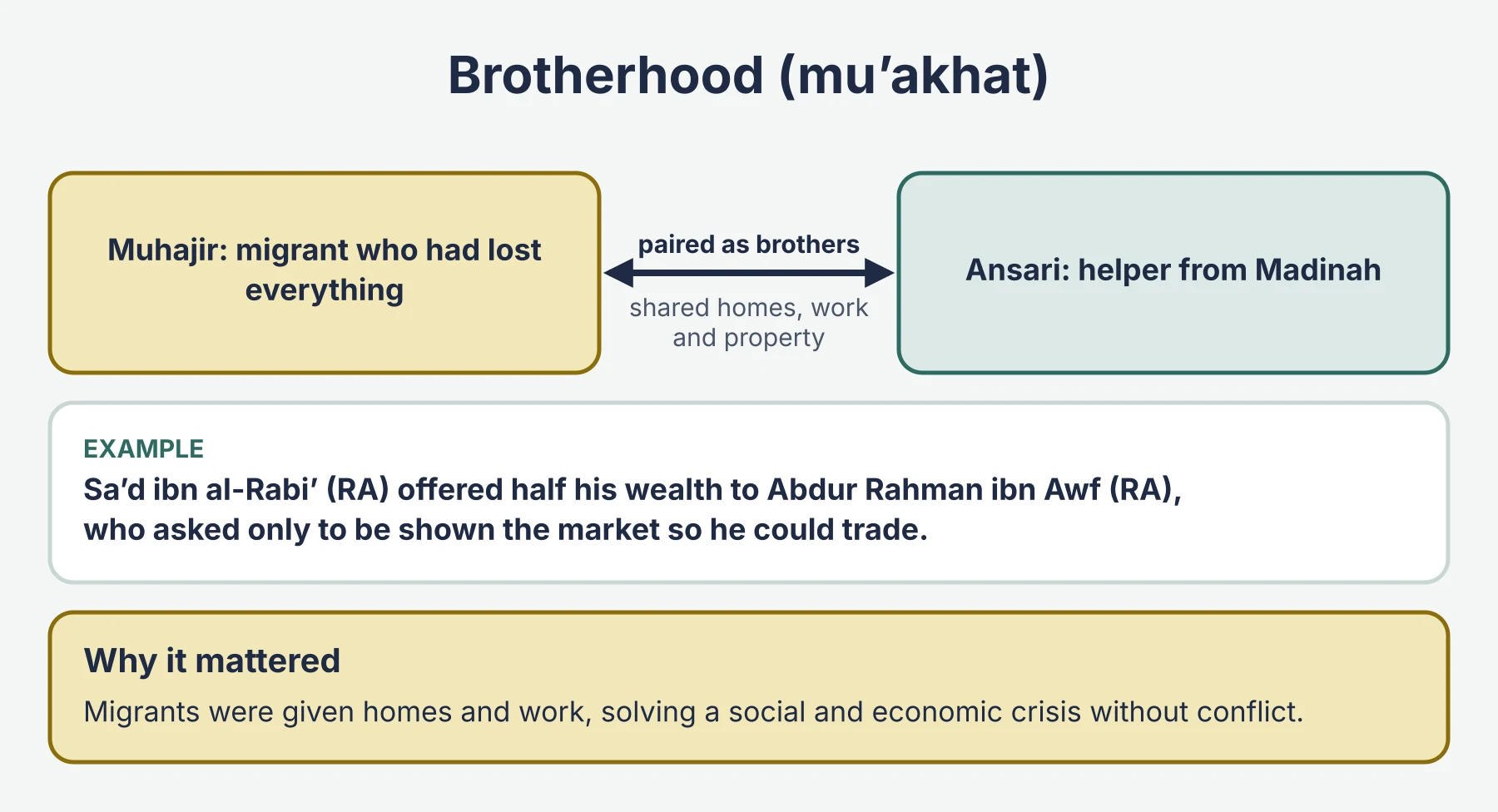
- Created brotherhood (mu’akhat) between Muhajirun and Ansar.
- Wrote the Charter of Madinah.
- Made agreements with neighbouring tribes and organised defence.
Key terms
| Term | Meaning |
|---|---|
| Hijrah | The migration from Makkah to Madinah, 622 CE, start of the Islamic calendar |
| Bay’ah | A pledge of loyalty |
| Aqaba | Valley near Mina where the pledges were made |
| Ansar | “Helpers”: the Muslims of Madinah |
| Muhajirun | “Migrants”: the Muslims from Makkah |
| Mu’akhat | The brotherhood between Muhajirun and Ansar |
| Thawr | The cave where the Prophet (pbuh) and Abu Bakr (RA) hid |
| Quba | Village where the first mosque was built |
| Madinat an-Nabi | “City of the Prophet (pbuh)”, the new name of Yathrib |
| Suffah | Shaded area of the mosque where poor companions lived |
Importance: points for “explain”
- Survival of Islam: escape from the plot and freedom to worship.
- Community: the first Muslim society, with its own mosque, law and leader.
- Calendar: the Hijrah marks year one, showing it was a turning point.
- Character: Ali’s (RA) honesty in returning trusts to enemies; Abu Bakr’s (RA) loyalty; the Ansar’s generosity.
- Coexistence: the Charter protected other religions within one state.
Exam traps
- First pledge ≠ second pledge: only the second promised protection.
- Quba was the first mosque; the Prophet (pbuh)’s Mosque came after.
- The cave on the journey is Thawr, not Hira.
- Ali (RA) did not travel with the Prophet (pbuh); Abu Bakr (RA) did.
- The Charter included non-Muslims; do not describe it as a Muslims-only agreement.
Self-test
- How many people took the first pledge of Aqaba?
- What did the second pledge add to the first?
- Who was sent to teach Islam in Yathrib?
- What two things did Ali (RA) do in Makkah on the night of the Hijrah and after?
- Name the cave where the Prophet (pbuh) and Abu Bakr (RA) hid.
- Which verse records “Do not grieve; indeed Allah is with us”?
- Who brought food to the cave?
- Where was the first mosque in Islam built?
- From whom was the land for the Prophet (pbuh)’s Mosque bought?
- With whom did the Prophet (pbuh) stay while his mosque was built?
- Give two terms of the Charter of Madinah.
- What was mu’akhat?
Answers: 1. Twelve men. 2. A promise to protect the Prophet (pbuh) as they protected their own families. 3. Mus’ab ibn Umair (RA). 4. He slept in the Prophet’s (pbuh) bed and then returned the goods left with the Prophet (pbuh) for safekeeping. 5. Thawr. 6. Qur’an 9:40. 7. Asma bint Abu Bakr (RA). 8. Quba. 9. Two orphans. 10. Abu Ayyub Ansari (RA). 11. Any two: one community; Jewish tribes keep their religion; joint defence; no alliance with Quraysh; disputes referred to Allah and the Prophet (pbuh); help for the oppressed; Madinah a sacred area. 12. The brotherhood that paired each Muhajir with an Ansari to share homes and property.
Practise with the Hijrah and the Madni period practice questions.
Source: OxfordAQA, International GCSE Islamiat (9237) specification, Version 1.1, content area 3.2.1.7.
Related resources
-
Study guides
OxfordAQA International GCSE Islamiat (9237): Ijma and Qiyas as a Source of Shariah
The meaning, role and importance of Ijma (consensus) and Qiyas (analogy) in forming religious rulings, with worked examples, for 9237 topic 3.2.2.6.
Islamiyat · OxfordAQA · IGCSE
Read guide -
Practice questions
OxfordAQA International GCSE Islamiat (9237): Ijma and Qiyas as a Source of Shariah – Practice Questions
Original questions with mark guidance on the meaning, role and importance of Ijma and Qiyas in forming religious rulings, for 9237 topic 3.2.2.6.
Islamiyat · OxfordAQA · IGCSE
Try questions -
Revision notes
OxfordAQA International GCSE Islamiat (9237): Ijma and Qiyas as a Source of Shariah – Revision Notes
Recall notes on the meaning, role and importance of Ijma and Qiyas in forming religious rulings, with Qur'an 4:115, for 9237 topic 3.2.2.6.
Islamiyat · OxfordAQA · IGCSE
Revise topic
Get free revision emails (optional)
Occasional emails with practice questions, worked explanations and links to free resources for the qualification and subjects you choose. No spam, and you can unsubscribe from any email. The free tools on this site never need an email.