
Study Guides
OxfordAQA International GCSE Islamiat (9237): The Hijrah and the Madni Period
The pledges of Aqaba, the journey to Madinah with the roles of Abu Bakr and Ali (RA), the Charter of Madinah and the first mosque, for 9237 topic 3.2.1.7.
- Subject
- Islamiyat
- Level
- IGCSE
- Topic
- Paper 2 – The Life of Hazrat Muhammad (pbuh) and Sources of Authority in Islam
- Author
- Marlbridge Academic Team
- Updated
- Reviewed by
- Azam Siddique (what this means)
Aligned to OxfordAQA IGCSE Islamiyat (9237), Version 1.1. Official specification .
Syllabus page (what it covers and how it is assessed): OxfordAQA IGCSE Islamiyat.
Syllabus points this page covers
9237
- 3.2.1 Life and teachings of Hazrat Muhammad (pbuh)
Found an error? Report a correction.
Need help with this topic? Request a free trial class for IGCSE Islamiyat (9237).
This guide covers content area 3.2.1.7 of OxfordAQA International GCSE Islamiat (9237), The Hijrah and the Madni Period: “The events leading up to the Hijrah including the pledges of Aqaba”, “Hazrat Muhammad’s (pbuh) journey from Makkah to Madinah, including the roles of Hazrat Abu Bakr (RA) and Hazrat Ali (RA)”, “Early life in Madinah, including Hazrat Muhammad’s (pbuh) role as a statesman and the establishment of the Charter of Madinah” and “The establishment of the first mosque in Madinah.” The Life and Teachings of Hazrat Muhammad (pbuh) study guide tells the story in one paragraph. This page breaks it into the four parts the specification names, with the detail needed for 4- and 6-mark answers.
Why a migration was needed
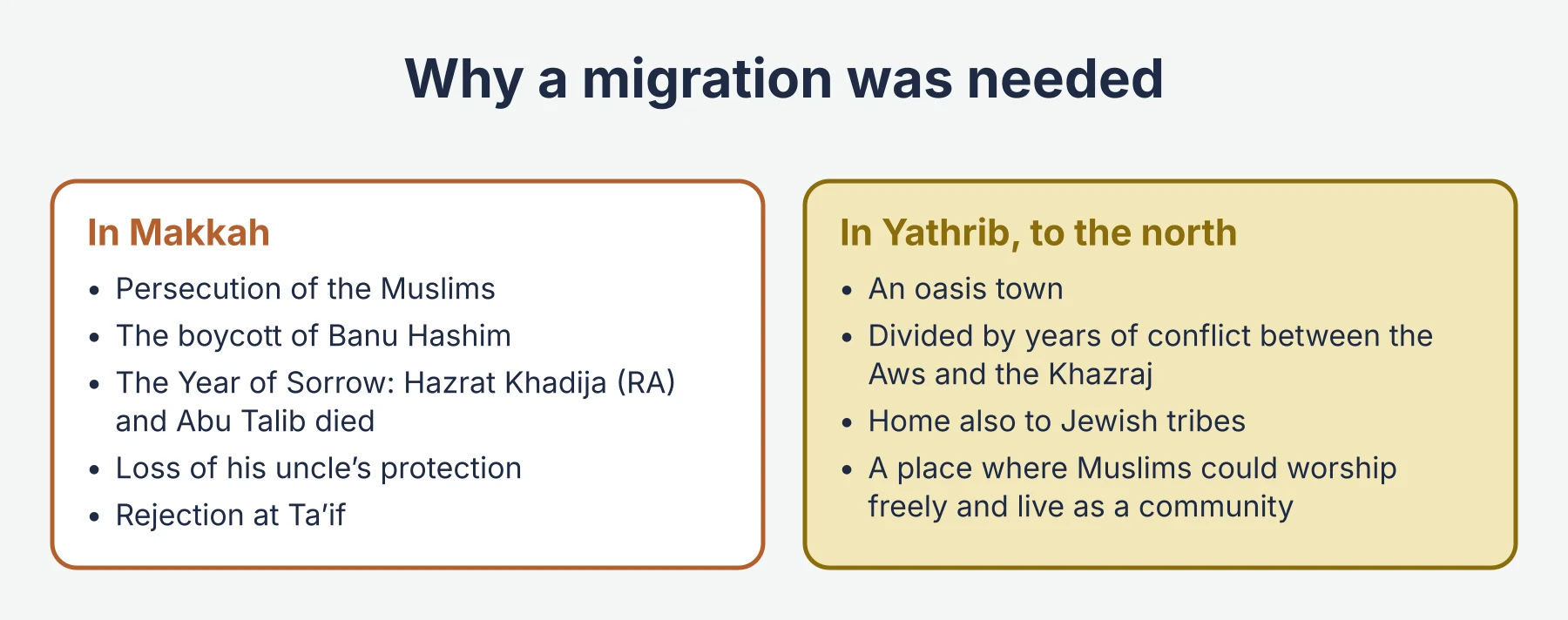
By the end of the Makkan period the Muslims had endured persecution, the boycott of Banu Hashim and the Year of Sorrow, in which Hazrat Khadija (RA) and Abu Talib died. The Prophet (pbuh) had lost his uncle’s protection, and the people of Ta’if had rejected him. Islam needed a place where Muslims could worship freely and live as a community. That place came from an unexpected direction: Yathrib, an oasis town to the north, divided by years of conflict between its two Arab tribes, the Aws and the Khazraj, and home also to Jewish tribes.
The pledges of Aqaba
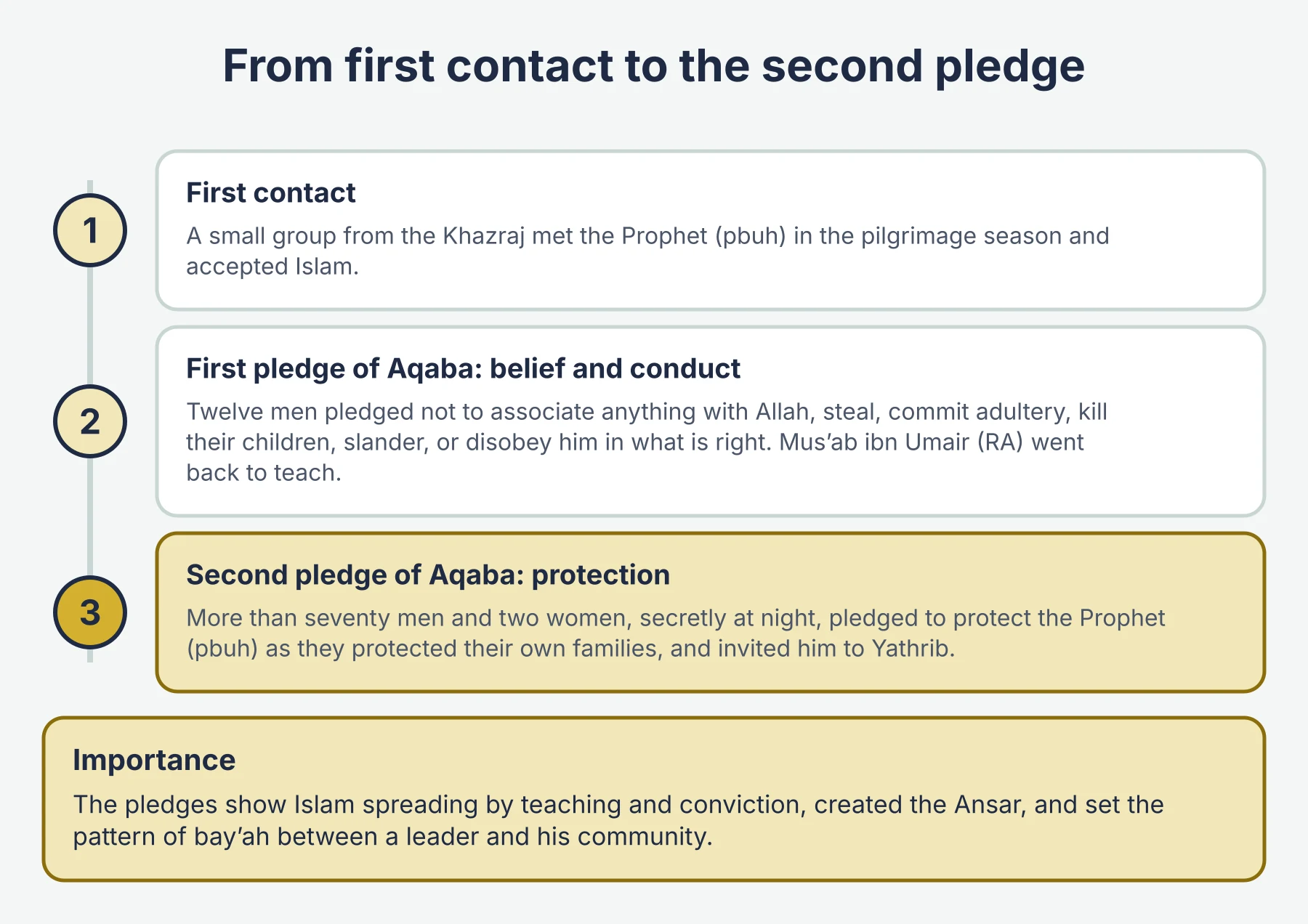
First contact. During the pilgrimage season a small group from the Khazraj met the Prophet (pbuh) near Makkah, listened to the Qur’an and accepted Islam. They had heard from the Jews of Yathrib that a prophet was expected.
The first pledge of Aqaba. The next year, twelve men from Yathrib met him at Aqaba, a valley near Mina, and pledged that they would not associate anything with Allah, steal, commit adultery, kill their children, slander, or disobey him in what is right. The Prophet (pbuh) sent Hazrat Mus’ab ibn Umair (RA) back with them to teach the Qur’an, and Islam spread quickly through Yathrib.
The second pledge of Aqaba. A year later, more than seventy men and two women came secretly at night. This time they pledged to protect the Prophet (pbuh) as they protected their own families, and invited him to come to Yathrib. The second pledge turned a religious commitment into a political and military alliance; it is why the Prophet (pbuh) could leave Makkah.
Importance of the pledges: they show Islam spreading by teaching and conviction; they created the Ansar; and they set the pattern of a pledge (bay’ah) between a leader and his community.
The journey
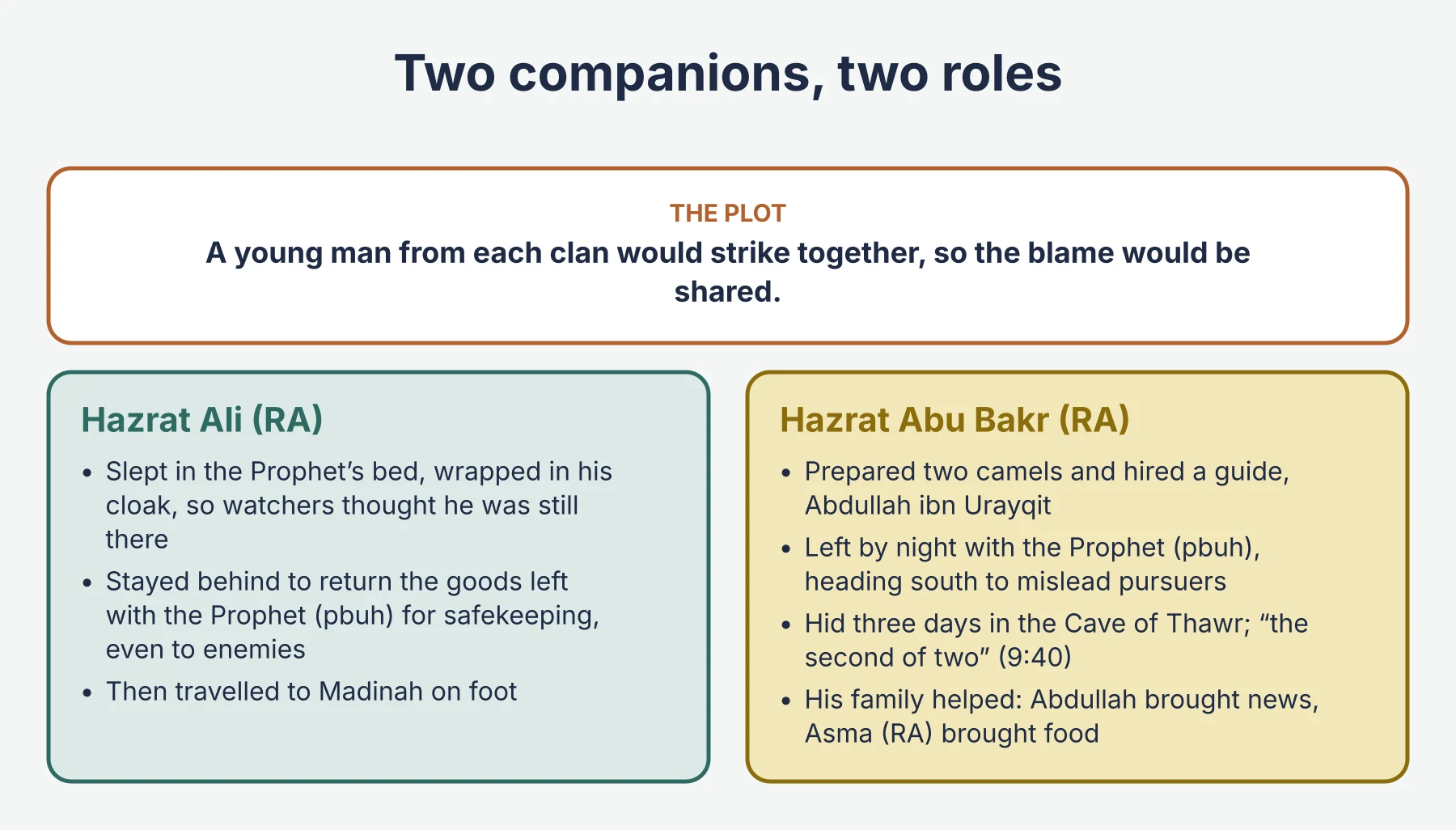
The plot. Seeing the Muslims leave in small groups, the Quraysh leaders met and agreed that a young man from each clan would strike the Prophet (pbuh) together, so that the blame would be shared and Banu Hashim could not take revenge on all.
Hazrat Ali (RA). On the night of the plot, Ali (RA) slept in the Prophet’s (pbuh) bed, wrapped in the Prophet’s (pbuh) cloak, so that the men watching the house would think he was still there. Next morning he stayed behind in Makkah to return the goods that people had left with the Prophet (pbuh) for safekeeping, even though many of those owners were his enemies. Ali (RA) then travelled to Madinah on foot.
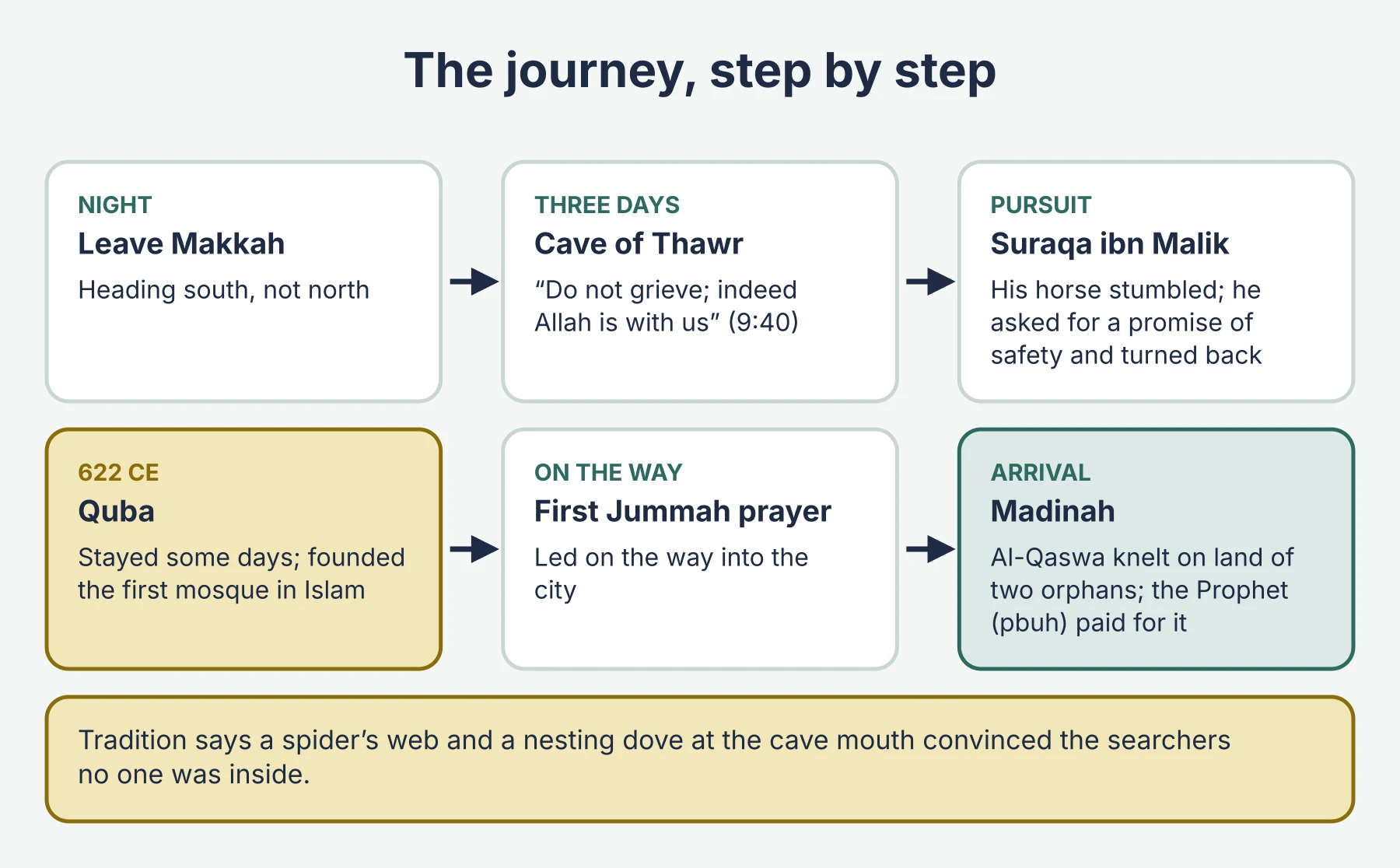
Hazrat Abu Bakr (RA). Abu Bakr (RA) had prepared two camels and hired a guide, Abdullah ibn Urayqit. He and the Prophet (pbuh) left by night, heading south rather than north to mislead the pursuers, and hid for three days in the Cave of Thawr. His son Abdullah brought news from Makkah, his daughter Asma (RA) brought food, and his servant grazed sheep over their tracks. When searchers came close, Abu Bakr (RA) feared for the Prophet (pbuh); the Qur’an records the Prophet’s (pbuh) words: “Do not grieve; indeed Allah is with us” (9:40), and calls Abu Bakr (RA) “the second of two”. According to tradition, a spider’s web and a nesting dove at the cave mouth convinced the searchers that no one was inside.
The pursuit. The Quraysh offered a reward for their capture. Suraqa ibn Malik caught up with them, but his horse stumbled repeatedly; he asked for a written promise of safety and turned back.
The first mosque: Quba
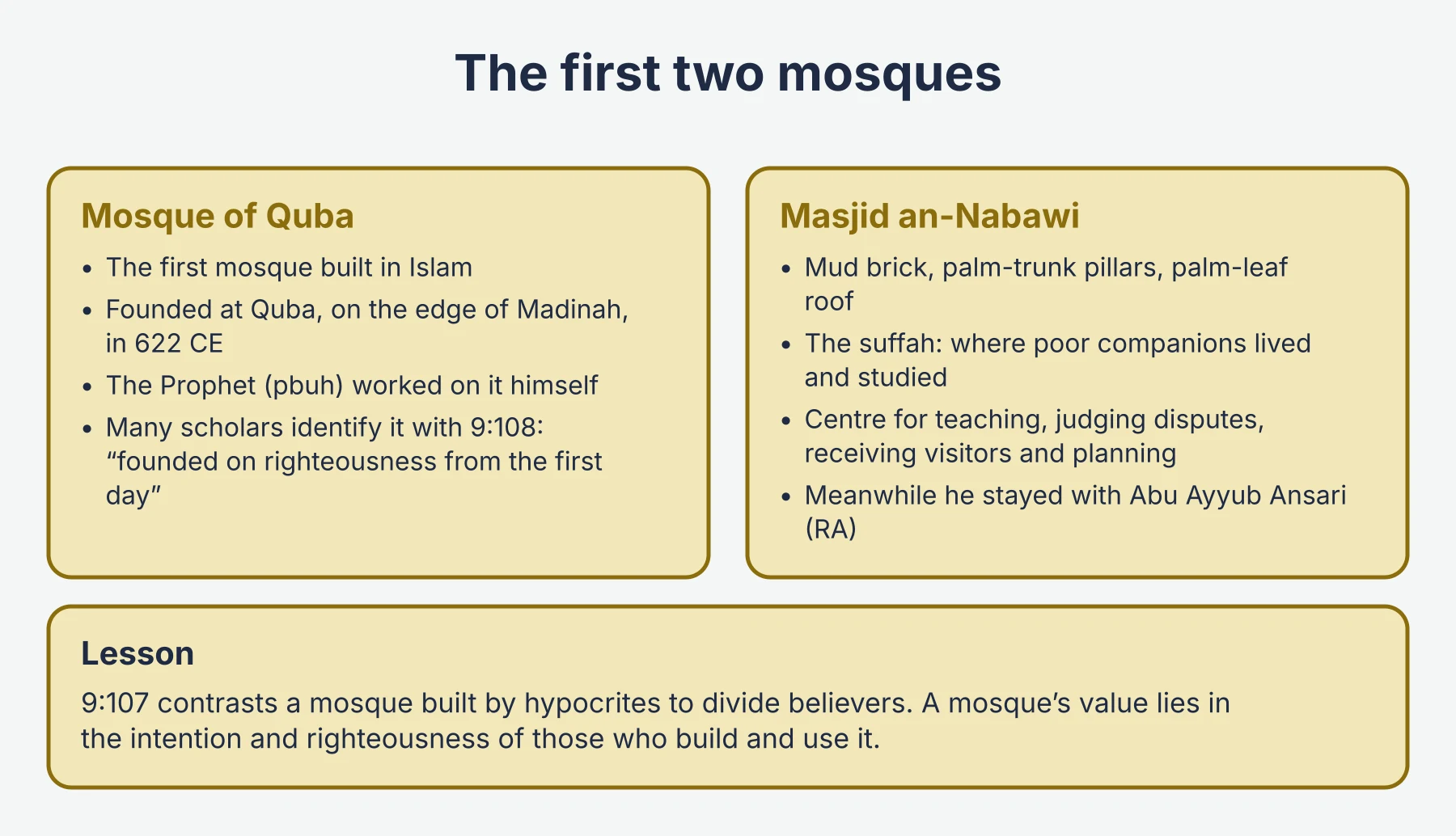
The Prophet (pbuh) arrived first at Quba, a village on the edge of Madinah, in 622 CE. He stayed there for some days and laid the foundation of the Mosque of Quba, the first mosque built in Islam, working on it himself with the companions.
The prescribed passage, Qur’an 9:108, refers to “a mosque founded on righteousness from the first day”, whose people “love to purify themselves”. Many scholars identify this mosque as Quba; some identify it with the Prophet (pbuh)’s Mosque in Madinah. The verse contrasts it with a mosque built by hypocrites to divide the believers (9:107), which the Prophet (pbuh) was told never to pray in. The lesson for Muslims is that a mosque’s value lies in the intention and righteousness of those who build and use it.
Arrival in Madinah and the Prophet (pbuh)’s Mosque
On the way into the city the Prophet (pbuh) led the first Jummah prayer. Every family wanted him to stay with them, so he let his camel, al-Qaswa, choose; it knelt on land belonging to two orphans. The Prophet (pbuh) insisted on paying for the land and built Masjid an-Nabawi there, of mud brick with palm-trunk pillars and a roof of palm leaves, again working alongside his companions. While it was built he stayed with Hazrat Abu Ayyub Ansari (RA). The mosque had a covered area, the suffah, where poor companions lived and studied.
The mosque was more than a place of prayer: it was where the Prophet (pbuh) taught, judged disputes, received visitors and planned for the community. Yathrib became known as Madinat an-Nabi, the City of the Prophet (pbuh).
The Prophet (pbuh) as statesman
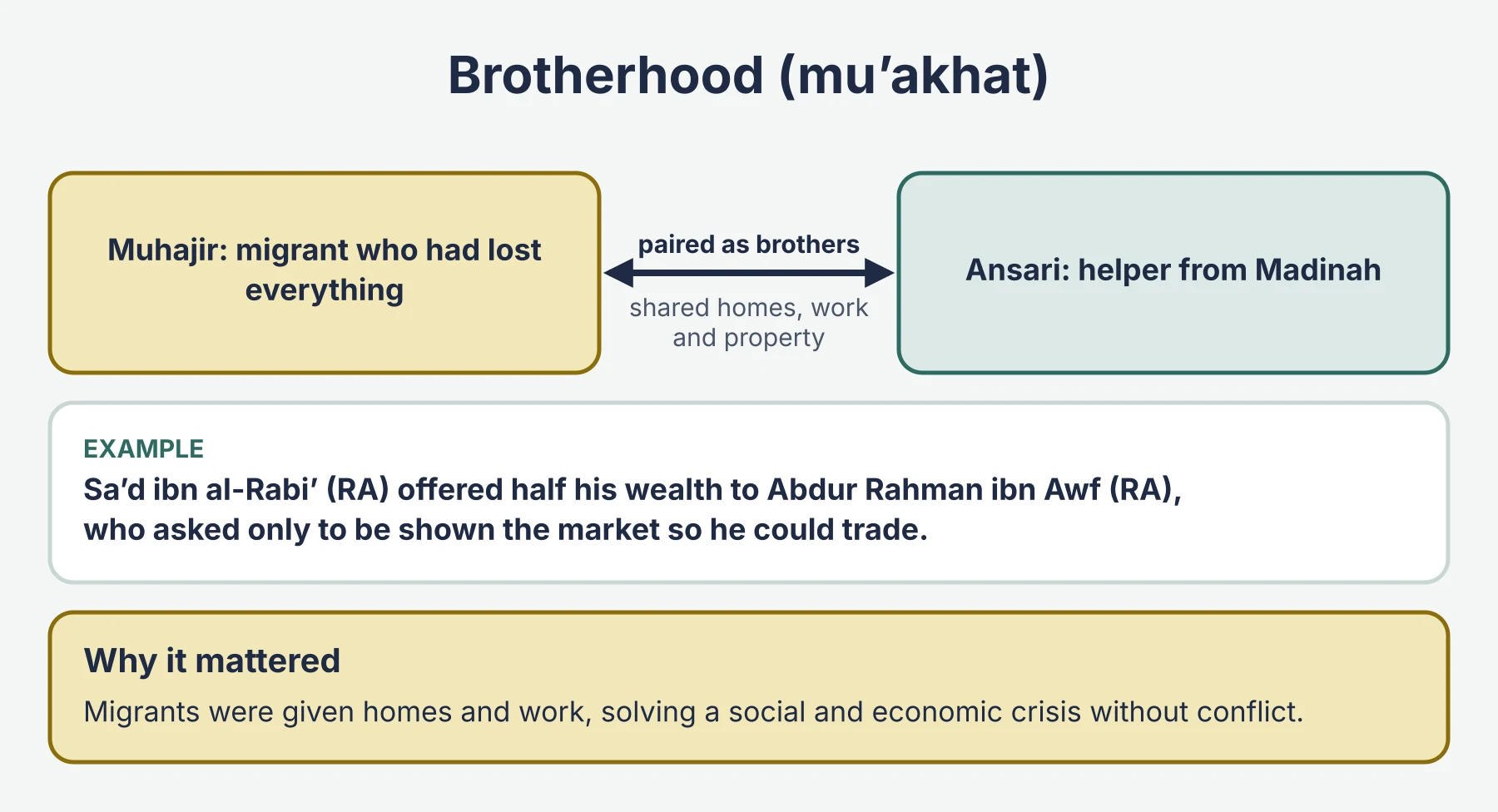
Brotherhood (mu’akhat). He paired each Muhajir with an Ansari as brothers, who shared homes, work and property. In a well-known example, Sa’d ibn al-Rabi’ (RA) offered half his wealth to Abdur Rahman ibn Awf (RA), who asked only to be shown the market so he could trade.
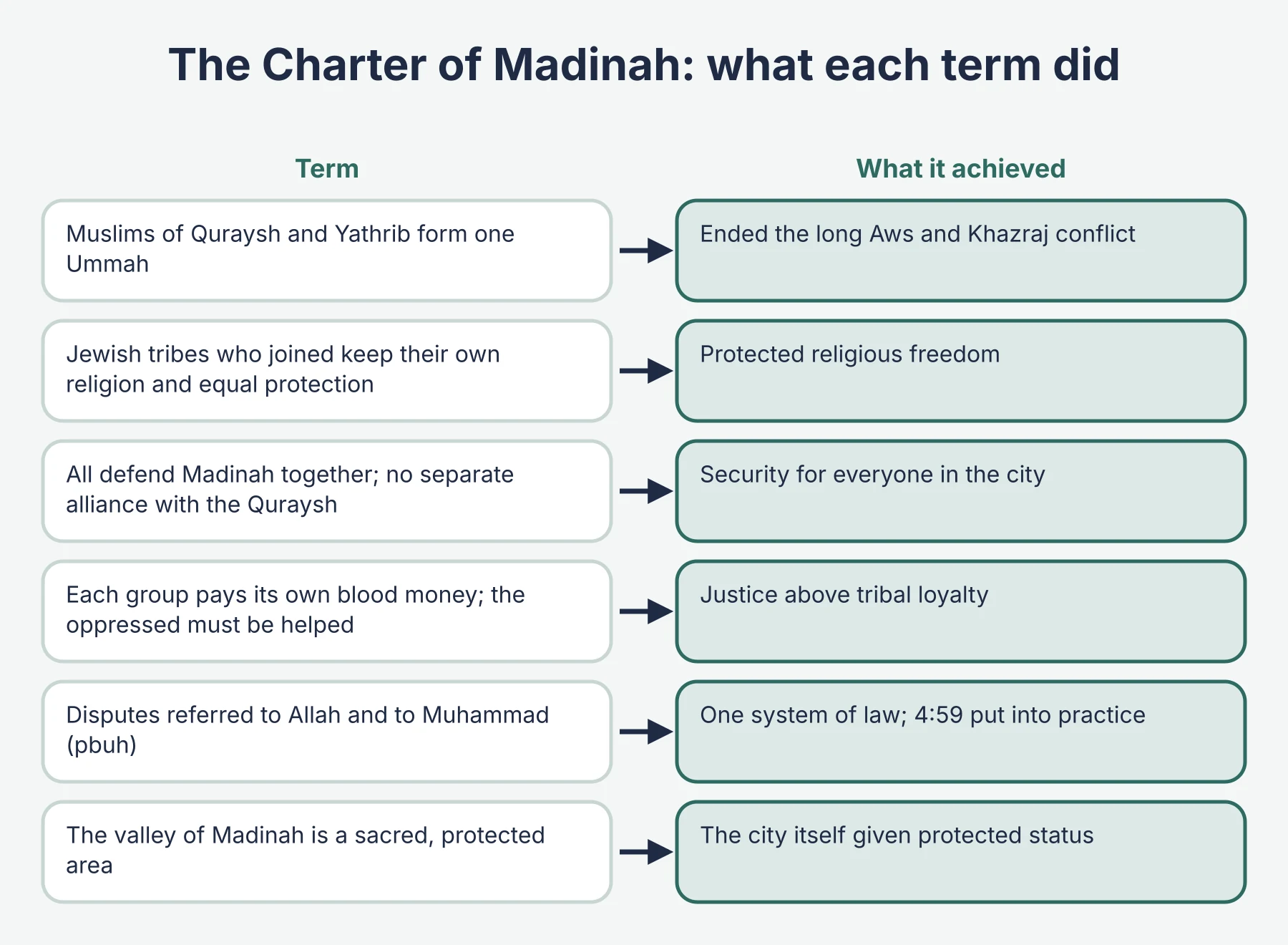
The Charter of Madinah. The Prophet (pbuh) drew up a written agreement for all the groups in the city. Its main terms:
- The Muslims of Quraysh and of Yathrib, and those who joined them, form one community (Ummah).
- The Jewish tribes who joined are part of the community, keep their own religion, and have the same right to help and protection.
- All parties defend Madinah together against attack and share the costs of war.
- No party makes a separate alliance with the Quraysh.
- Each group pays its own blood money and ransoms, and the oppressed must be helped.
- Disputes are referred to Allah and to Muhammad (pbuh).
- The valley of Madinah is a sacred, protected area.
Why it matters: it ended the long conflict between the Aws and the Khazraj, gave security to everyone in the city, protected religious freedom, and placed law above tribal loyalty. Many describe it as one of the earliest written constitutions.
Worked example: a 6-mark answer
Question: Explain two ways the Prophet (pbuh) acted as a statesman in his early years in Madinah. Apply one teaching from a source of authority in your answer. [6]
First, he drew up the Charter of Madinah [1], which made the Muslims, the Jewish tribes and others one community with shared defence and freedom of religion, so a divided city gained one system of law [1]. Second, he set up the brotherhood between the Muhajirun and the Ansar [1], so that migrants who had lost everything were given homes and work, solving a social and economic crisis without conflict [1]. The Qur’an tells believers to “obey Allah and obey the Messenger and those in authority among you” (4:59), and the Charter put this into practice by making the Prophet (pbuh) the final judge of disputes [2].
Common mistakes
- Mixing up the two pledges. The first was about belief and conduct; the second added protection of the Prophet (pbuh).
- Giving Ali (RA) only one role. He slept in the bed and returned the trusts.
- Saying the Prophet (pbuh) went straight to Madinah. He hid in Thawr, then stopped at Quba.
- Calling the Prophet (pbuh)’s Mosque the first mosque. Quba came first.
- Describing the Charter without its effects. Say what problem each term solved.
Exam technique
Give or name questions want a person, place or term (Mus’ab ibn Umair, Thawr, Quba). Explain questions want the role or term plus its significance. In the 12-mark answer on 3.2.1.7 use Qur’an 9:108: “founded on righteousness from the first day” for the purpose of the mosque, and “men who love to purify themselves” for the character of the community built around it.
Related pages
- Hijrah and the Madni period revision notes
- Hijrah and the Madni period practice questions
- Life and Teachings of Hazrat Muhammad (pbuh) revision notes
Source: OxfordAQA, International GCSE Islamiat (9237) specification, Version 1.1, content area 3.2.1.7 and Passage 23.
Related resources
-
Practice questions
OxfordAQA International GCSE Islamiat (9237): The Hijrah and the Madni Period – Practice Questions
Twelve original questions with mark guidance on the pledges of Aqaba, the Hijrah journey, the first mosque and the Charter of Madinah, for 9237 topic 3.2.1.7.
Islamiyat · OxfordAQA · IGCSE
Try questions -
Revision notes
OxfordAQA International GCSE Islamiat (9237): The Hijrah and the Madni Period – Revision Notes
Recall notes on the pledges of Aqaba, the Hijrah journey, the roles of Abu Bakr and Ali (RA), Quba, the Prophet's Mosque and the Charter of Madinah (9237).
Islamiyat · OxfordAQA · IGCSE
Revise topic -
Study guides
OxfordAQA International GCSE Islamiat (9237): Ijma and Qiyas as a Source of Shariah
The meaning, role and importance of Ijma (consensus) and Qiyas (analogy) in forming religious rulings, with worked examples, for 9237 topic 3.2.2.6.
Islamiyat · OxfordAQA · IGCSE
Read guide
Get free revision emails (optional)
Occasional emails with practice questions, worked explanations and links to free resources for the qualification and subjects you choose. No spam, and you can unsubscribe from any email. The free tools on this site never need an email.