
Revision Notes
OxfordAQA International GCSE Islamiat (9237): Life After Death and Muslim Death Rituals – Revision Notes
Recall notes on death, Barzakh, resurrection, judgement, Jannah, Jahannam and different Muslim death rituals for 9237 topic 3.1.1.6, with a self-test.
- Subject
- Islamiyat
- Level
- IGCSE
- Topic
- Paper 1 – Living the Muslim Life
- Author
- Marlbridge Academic Team
- Updated
- Reviewed by
- Azam Siddique (what this means)
Aligned to OxfordAQA IGCSE Islamiyat (9237), Version 1.1. Official specification .
Syllabus page (what it covers and how it is assessed): OxfordAQA IGCSE Islamiyat.
Syllabus points this page covers
9237
- 3.1.1 Islam: Beliefs and teachings
Found an error? Report a correction.
Need help with this topic? Request a free trial class for IGCSE Islamiyat (9237).
These notes condense content area 3.1.1.6 of 9237: “Muslim beliefs about death, Barzakh, resurrection, the Day of Judgement, Heaven and Hell. Different Muslim death rituals and their importance.” The full explanation is in the life after death and death rituals study guide; the topic overview is in the Islam: Beliefs and Teachings revision notes.
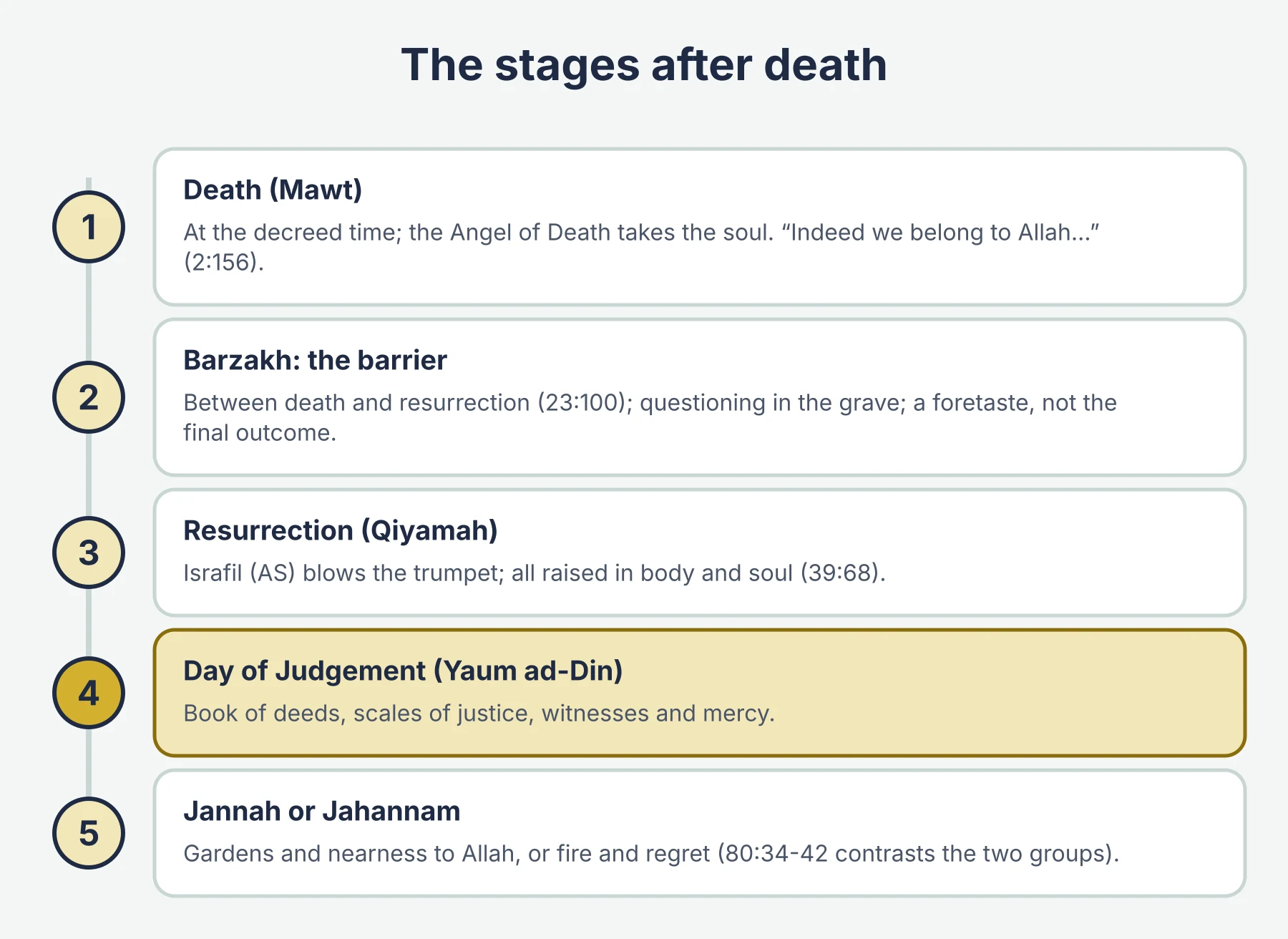
The sequence in one line
Death (Angel of Death takes the soul) → Barzakh (questioning in the grave) → trumpet blown by Israfil (AS) → resurrection of body and soul → judgement (book, scales, witnesses) → Jannah or Jahannam.
Each stage with one piece of evidence
| Stage | Key belief | Evidence to quote |
|---|---|---|
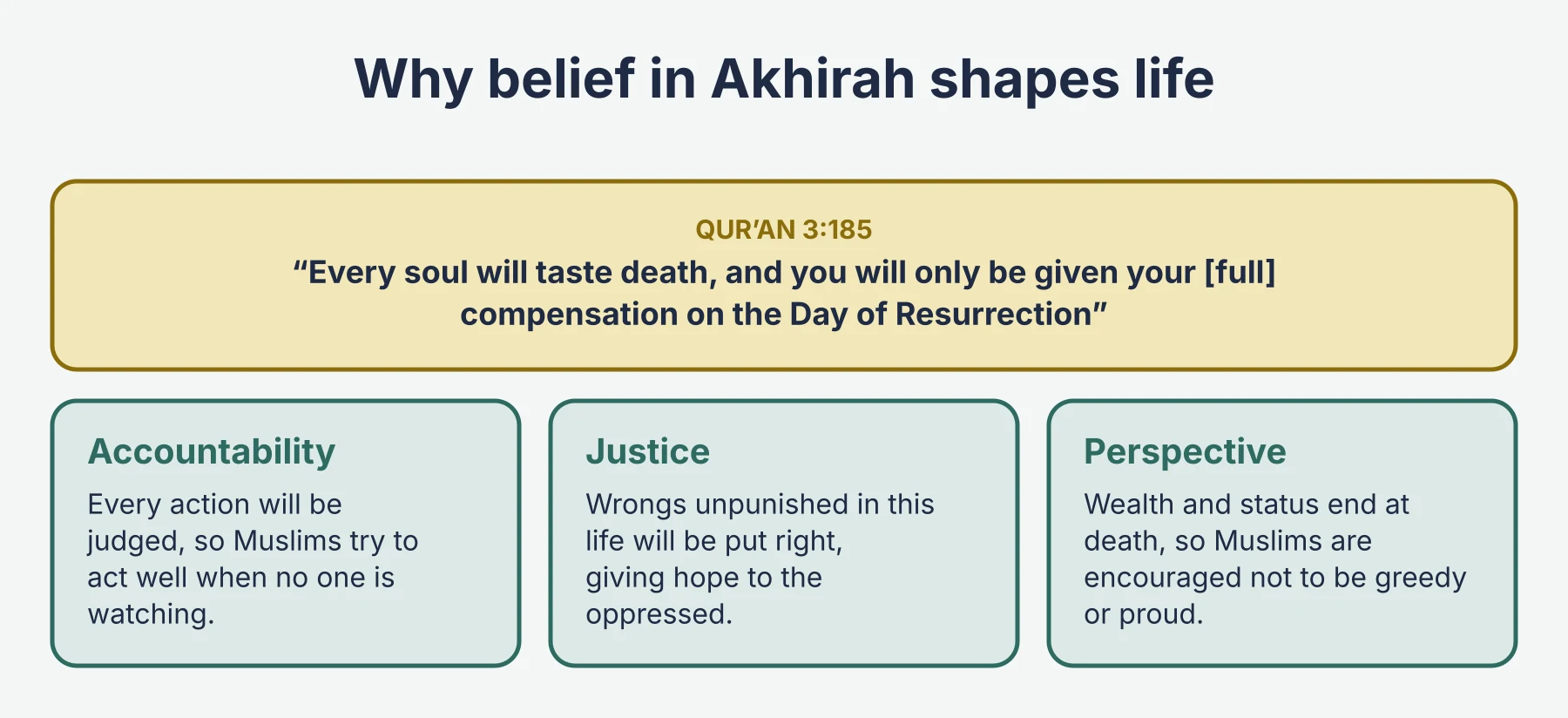
| Death | Fixed time decreed by Allah | “Every soul will taste death” (3:185) |
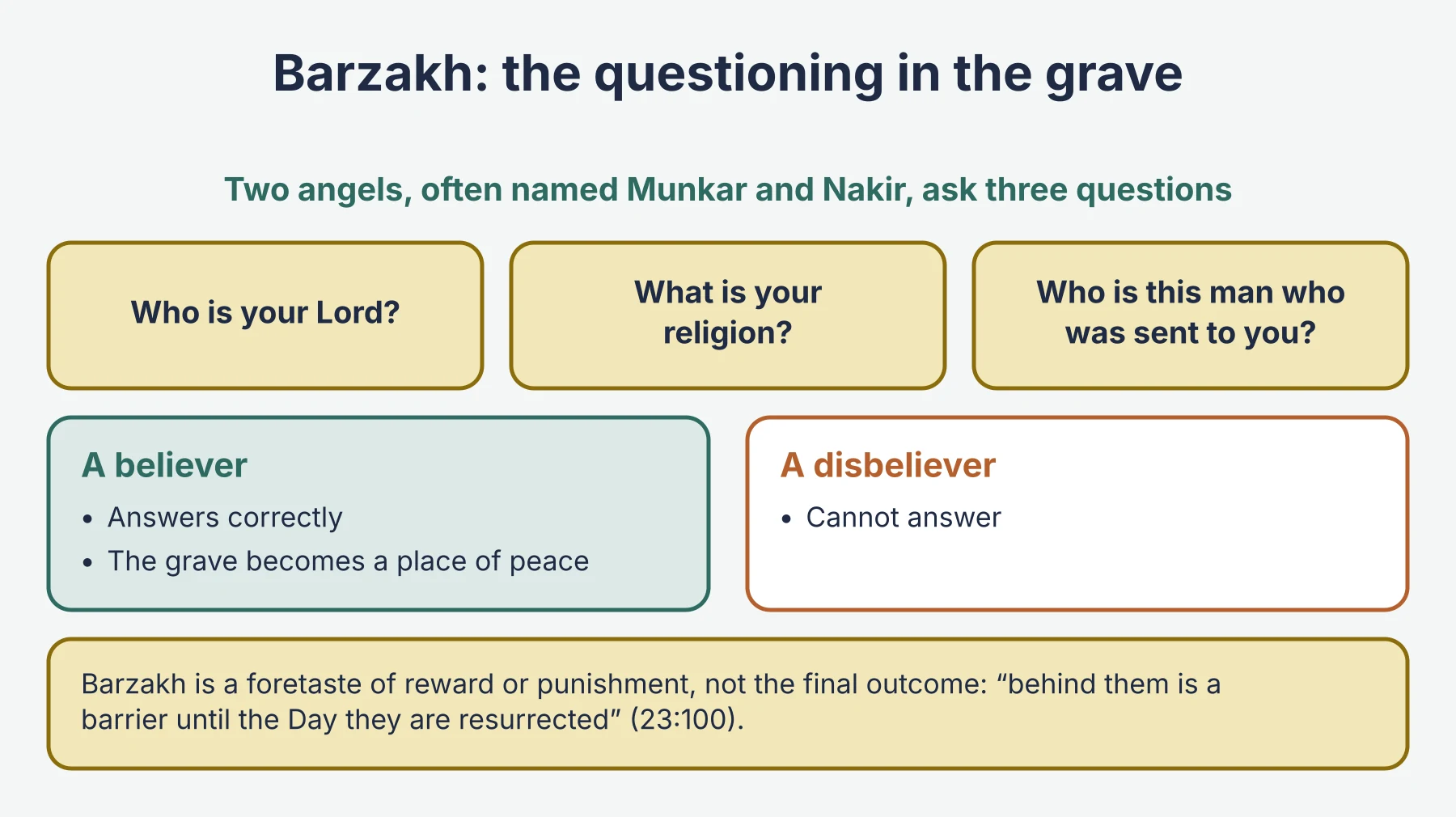
| Barzakh | A barrier; the soul is questioned and tastes reward or punishment | “Behind them is a barrier until the Day they are resurrected” (23:100) |
| Resurrection | All are raised when the Horn is blown | The Horn blown twice: all fall, then all stand (39:68) |
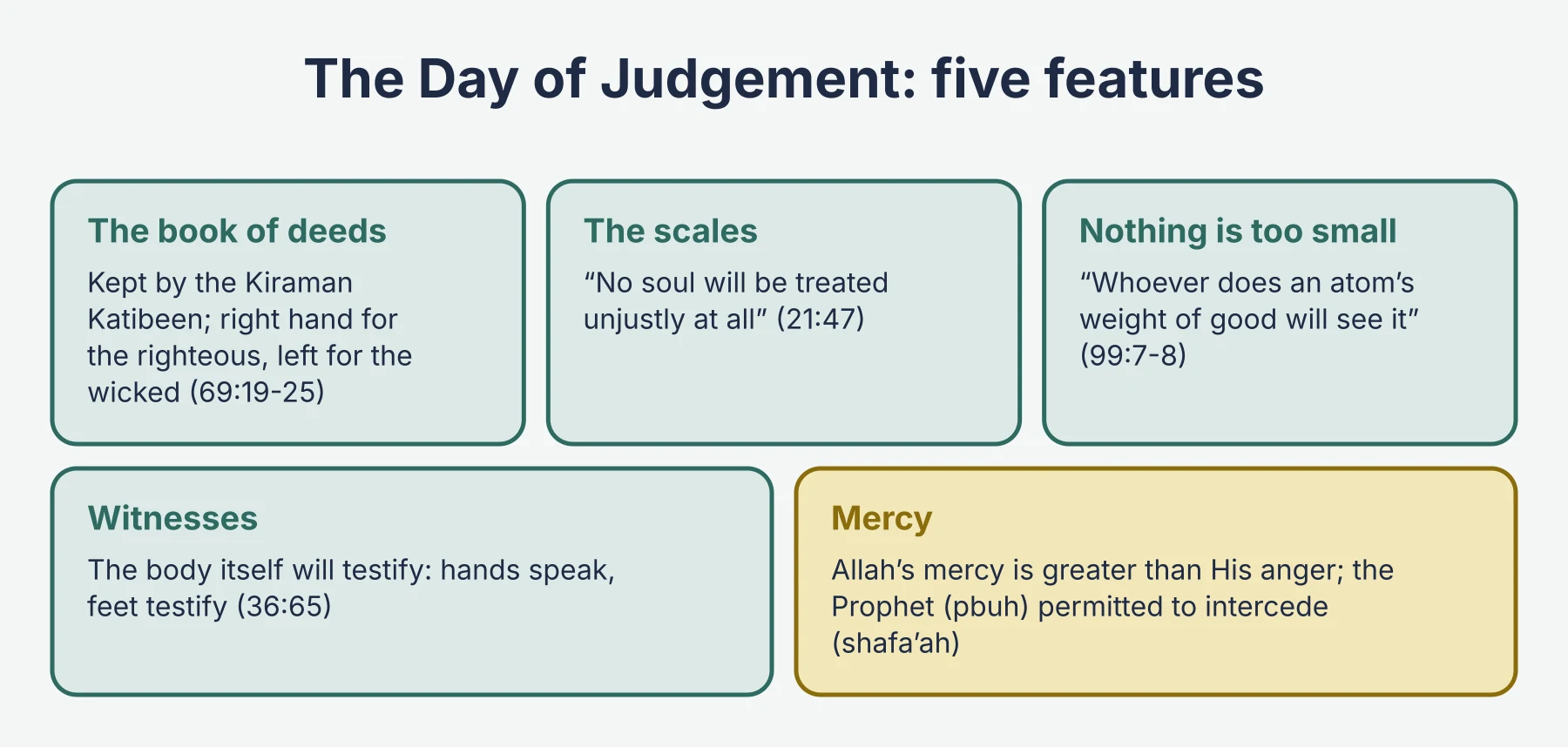
| Judgement | Every deed weighed with perfect justice | “An atom’s weight of good … an atom’s weight of evil” (99:7-8); the scales (21:47) |
| Witnesses | The body testifies | Hands speak and feet testify (36:65) |
| Book of deeds | Right hand for the saved, left for the lost | 69:19-25 |
| Jannah / Jahannam | Eternal reward; punishment for rejection and evil | The bright and the darkened faces (80:38-41) |
The prescribed passage: Qur’an 80:34-42
- A person flees from siblings, mother, father, wife and children: no one can carry another’s burden; each is judged alone.
- Some faces are bright, laughing, rejoicing: the reward of the righteous.
- Other faces have dust and blackness on them: “the disbelievers, the wicked ones”.
- Use it for: accountability, individual responsibility, the reality of reward and punishment, and why family loyalty cannot replace faith and deeds.
Death rituals checklist
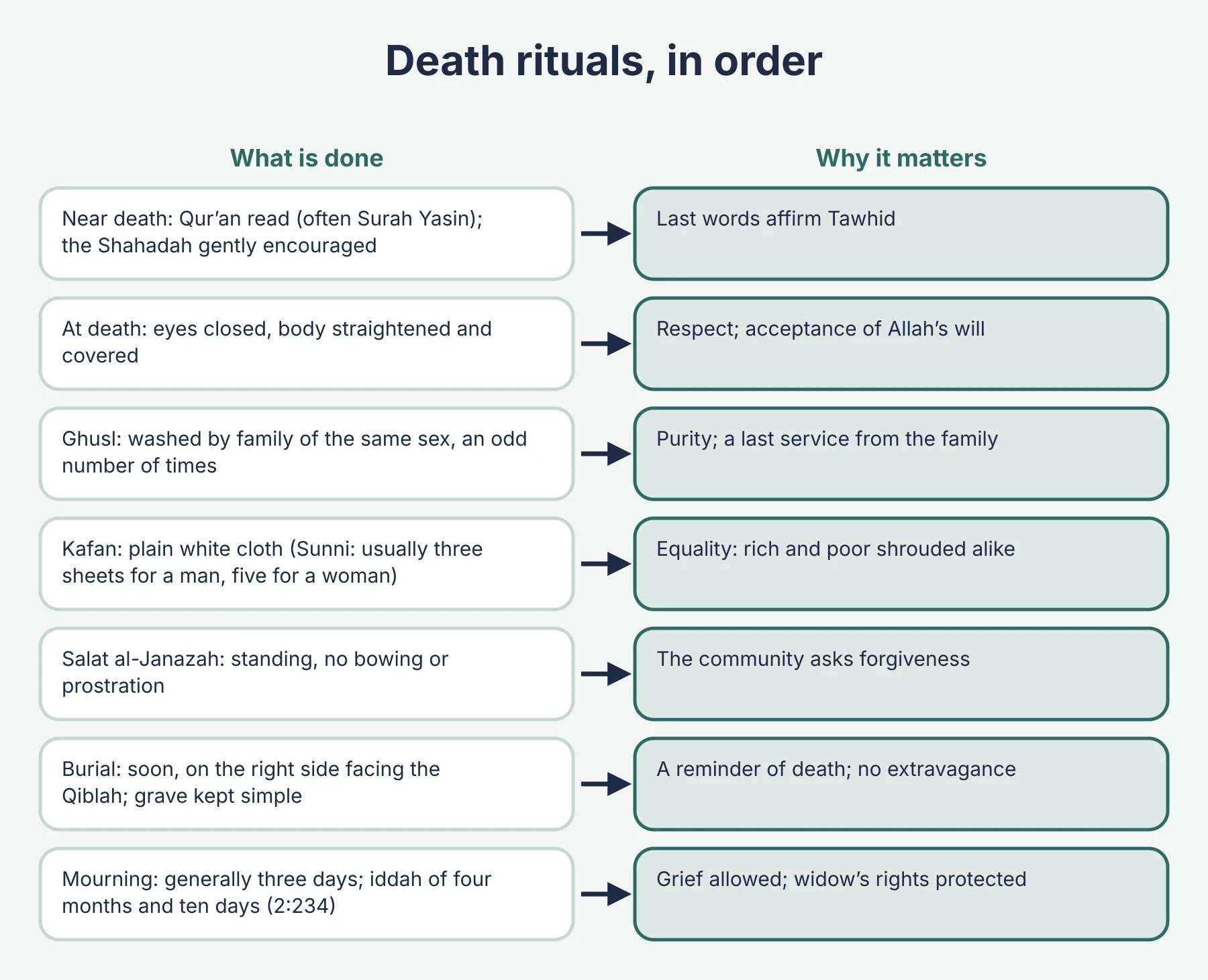
- Encourage the dying to say the Shahadah; recite Qur’an.
- Close the eyes, cover the body; say “To Allah we belong and to Him we return” (2:156).
- Ghusl by family of the same sex.
- Kafan: plain white cloth (Sunni custom: three sheets for men, five for women).
- Salat al-Janazah: standing only; no ruku or sujood.
- Burial quickly, on the right side, facing the Qiblah; simple grave; no cremation.
- Mourning about three days; widow’s iddah four months and ten days (2:234).
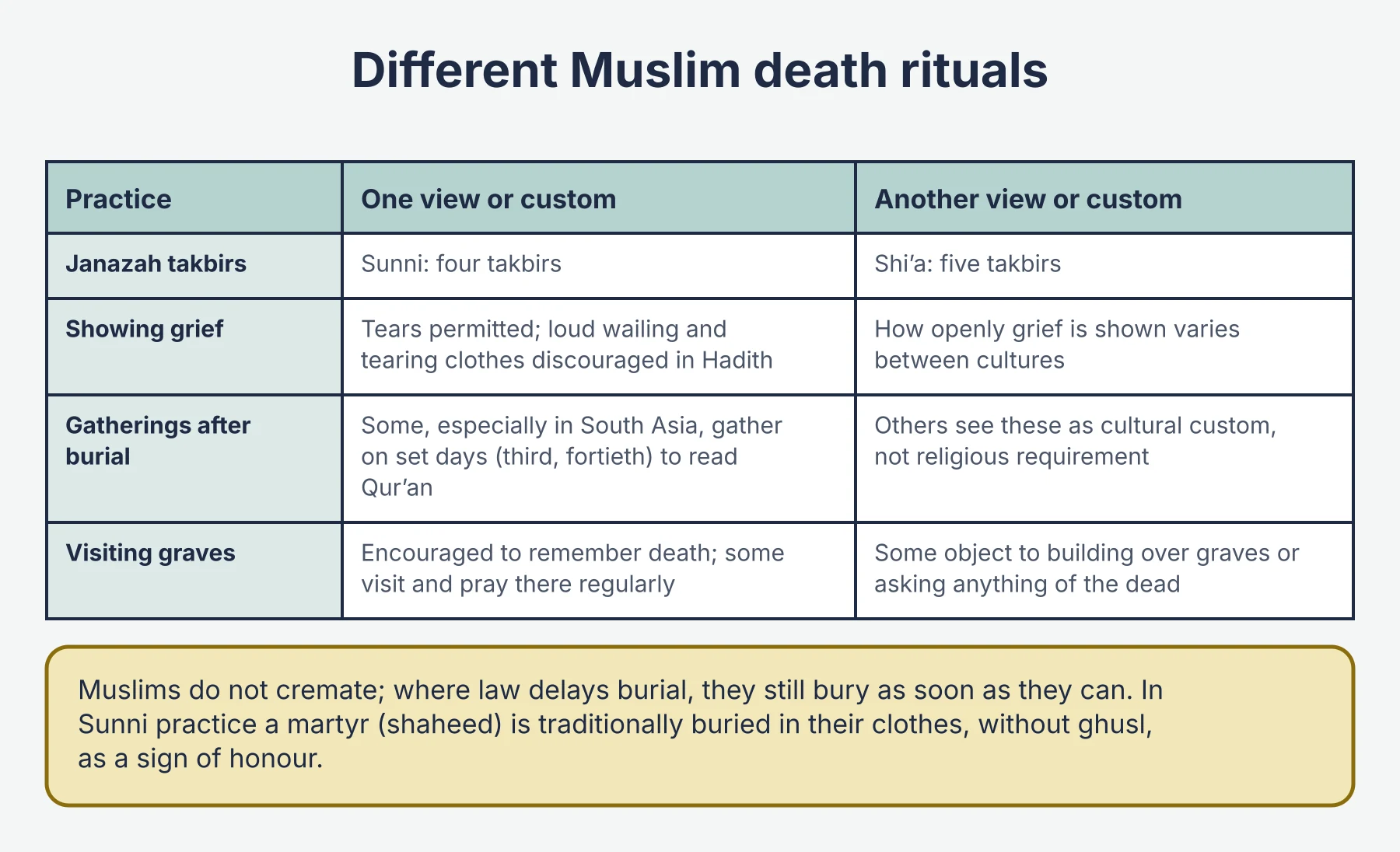
Differences you can name
- Takbirs in the Janazah: four (Sunni), five (Shi’a).
- Martyrs: in Sunni practice buried without ghusl, in the clothes they died in.
- Gatherings on set days (for example the third or fortieth day) in some communities; others see them as custom only.
- Visiting graves: encouraged by the Prophet (pbuh) as a reminder of death; communities differ on building over graves.
- Expressions of grief: tears are allowed; wailing and self-harm are discouraged, though cultural norms differ.
Key terms
| Term | Meaning |
|---|---|
| Akhirah | The life after death; the hereafter |
| Barzakh | The barrier or interval between death and resurrection |
| Qiyamah | The resurrection; the Day of Standing |
| Yaum ad-Din | The Day of Judgement (Recompense) |
| Mizan | The scales on which deeds are weighed |
| Shafa’ah | Intercession, by permission of Allah |
| Jannah | Paradise |
| Jahannam | Hell |
| Ghusl | Ritual washing, here of the dead body |
| Kafan | The white burial shroud |
| Salat al-Janazah | The funeral prayer |
| Iddah | A widow’s waiting period of four months and ten days |
| Shaheed | A martyr |
Importance: quick points
- Moral behaviour: knowing every deed is recorded and weighed encourages honesty and kindness.
- Comfort: the believer sees death as a return to Allah, not an end.
- Justice: unpunished wrongs will be judged; the oppressed are not forgotten.
- Equality: the same white kafan and simple grave for everyone.
- Community: the Janazah is a communal duty; if some perform it, the duty is met for all (fard kifayah).
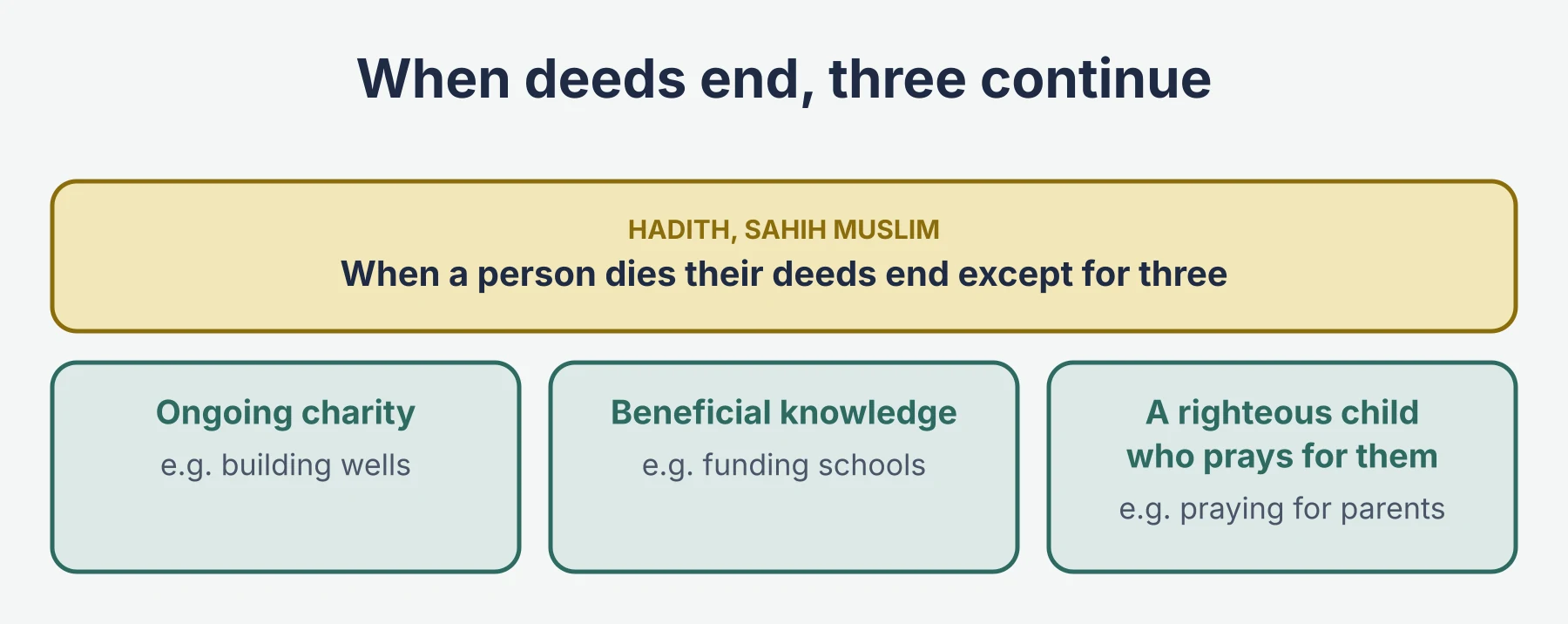
- Charity that lasts: ongoing charity, useful knowledge and a praying child continue to benefit the dead (Sahih Muslim).
Exam traps
- Barzakh is not the Day of Judgement; it comes before resurrection.
- The Angel of Death takes souls; Israfil (AS) blows the trumpet; the Kiraman Katibeen record deeds. Do not swap them.
- “Different rituals” needs real differences, not the same ritual described twice.
- Do not say Muslims are saved by deeds alone; mercy is central.
- Customs are not obligations: say “in some communities”.
Self-test
- What does Barzakh mean?
- Which angel takes the soul at death?
- Which angel blows the trumpet?
- What three questions are asked in the grave, according to the Hadith?
- Quote one verse showing that even the smallest deed is judged.
- How many takbirs do Shi’a Muslims say in the Janazah prayer?
- Why is the body wrapped in plain white cloth?
- In which direction is the body laid in the grave?
- How long is a widow’s iddah?
- Name three deeds that continue to benefit a person after death.
- In Qur’an 80:34-42, who does a person flee from?
- What is meant by fard kifayah, and how does it apply to the Janazah?
Answers: 1. A barrier; the interval between death and resurrection. 2. Malak-al-Mowth, the Angel of Death. 3. Israfil (AS). 4. Who is your Lord? What is your religion? Who is this man who was sent to you? 5. “Whoever does an atom’s weight of good will see it, and whoever does an atom’s weight of evil will see it” (99:7-8). 6. Five. 7. To show that all are equal before Allah, whatever their wealth or status. 8. On the right side, facing the Qiblah. 9. Four months and ten days (2:234). 10. Ongoing charity, beneficial knowledge, a righteous child who prays for them. 11. Siblings, mother, father, wife and children. 12. A communal obligation: if some Muslims perform it, the duty is fulfilled for the whole community; if none do, all are at fault.
Practise with the life after death and death rituals practice questions.
Source: OxfordAQA, International GCSE Islamiat (9237) specification, Version 1.1, content area 3.1.1.6.
Related resources
-
Study guides
OxfordAQA International GCSE Islamiat (9237): The Oneness of God (Tawhid) and Shirk
A close study of the types of Tawhid and Shirk, their meaning and their importance, with Surah al-Ikhlas, worked answers and common mistakes for 9237 topic 3.1.1.1.
Islamiyat · OxfordAQA · IGCSE
Read guide -
Practice questions
OxfordAQA International GCSE Islamiat (9237): The Oneness of God (Tawhid) and Shirk – Practice Questions
Nine original questions with mark guidance on the types of Tawhid, major and minor Shirk and the importance of Tawhid, for 9237 topic 3.1.1.1.
Islamiyat · OxfordAQA · IGCSE
Try questions -
Revision notes
OxfordAQA International GCSE Islamiat (9237): The Oneness of God (Tawhid) and Shirk – Revision Notes
Quick recall notes on the types of Tawhid, major and minor Shirk, why Tawhid matters and how to use Surah al-Ikhlas, for 9237 topic 3.1.1.1.
Islamiyat · OxfordAQA · IGCSE
Revise topic
Get free revision emails (optional)
Occasional emails with practice questions, worked explanations and links to free resources for the qualification and subjects you choose. No spam, and you can unsubscribe from any email. The free tools on this site never need an email.