
Study Guides
OxfordAQA International GCSE Islamiat (9237): Life After Death and Muslim Death Rituals
Death, Barzakh, resurrection, judgement, Jannah and Jahannam, and different Muslim death rituals and their importance, for 9237 topic 3.1.1.6.
- Subject
- Islamiyat
- Level
- IGCSE
- Topic
- Paper 1 – Living the Muslim Life
- Author
- Marlbridge Academic Team
- Updated
- Reviewed by
- Azam Siddique (what this means)
Aligned to OxfordAQA IGCSE Islamiyat (9237), Version 1.1. Official specification .
Syllabus page (what it covers and how it is assessed): OxfordAQA IGCSE Islamiyat.
Syllabus points this page covers
9237
- 3.1.1 Islam: Beliefs and teachings
Found an error? Report a correction.
Need help with this topic? Request a free trial class for IGCSE Islamiyat (9237).
This guide covers content area 3.1.1.6 of OxfordAQA International GCSE Islamiat (9237), Belief in life after death: “Muslim beliefs about death, Barzakh, resurrection, the Day of Judgement, Heaven and Hell” and “Different Muslim death rituals and their importance.” The Islam: Beliefs and Teachings study guide lists the stages in one short paragraph. This page explains each stage with its evidence, sets out the rituals from the moment of death to the period of mourning, and shows where Muslims differ, because the specification asks for different rituals.
Why Akhirah is a key belief
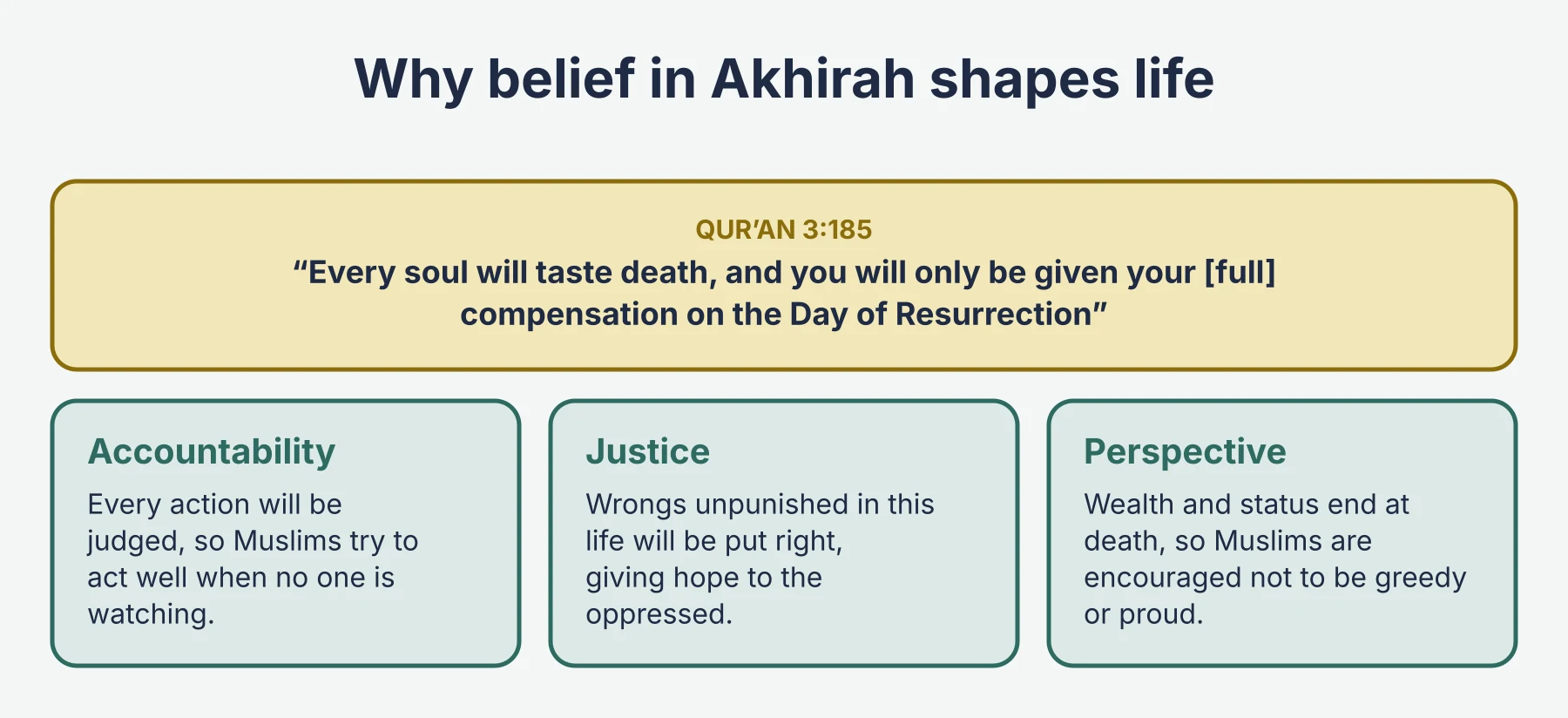
Belief in the Last Day (Yaum e Akhirah) is one of the key beliefs in 3.1.1.2. It answers the question of what life is for: this world is a test, and the next is permanent. “Every soul will taste death, and you will only be given your [full] compensation on the Day of Resurrection” (Qur’an 3:185). Three consequences follow, and they are the material for most “importance” answers:
- Accountability: every action will be judged, so Muslims try to act well when no one is watching.
- Justice: wrongs that go unpunished in this life will be put right, which gives hope to the oppressed.
- Perspective: wealth and status end at death, so Muslims are encouraged not to be greedy or proud.
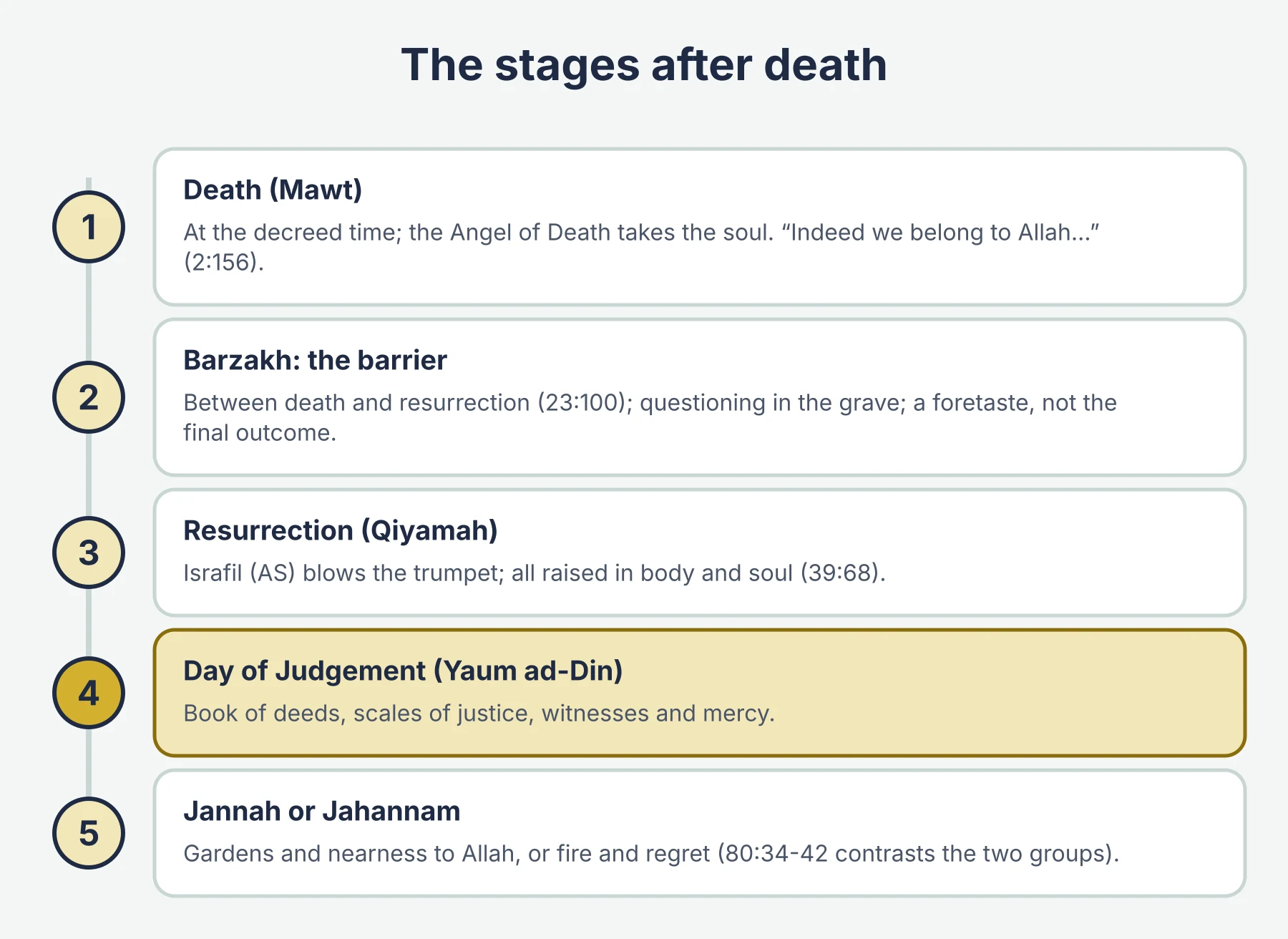
The stages after death
1. Death (Mawt)
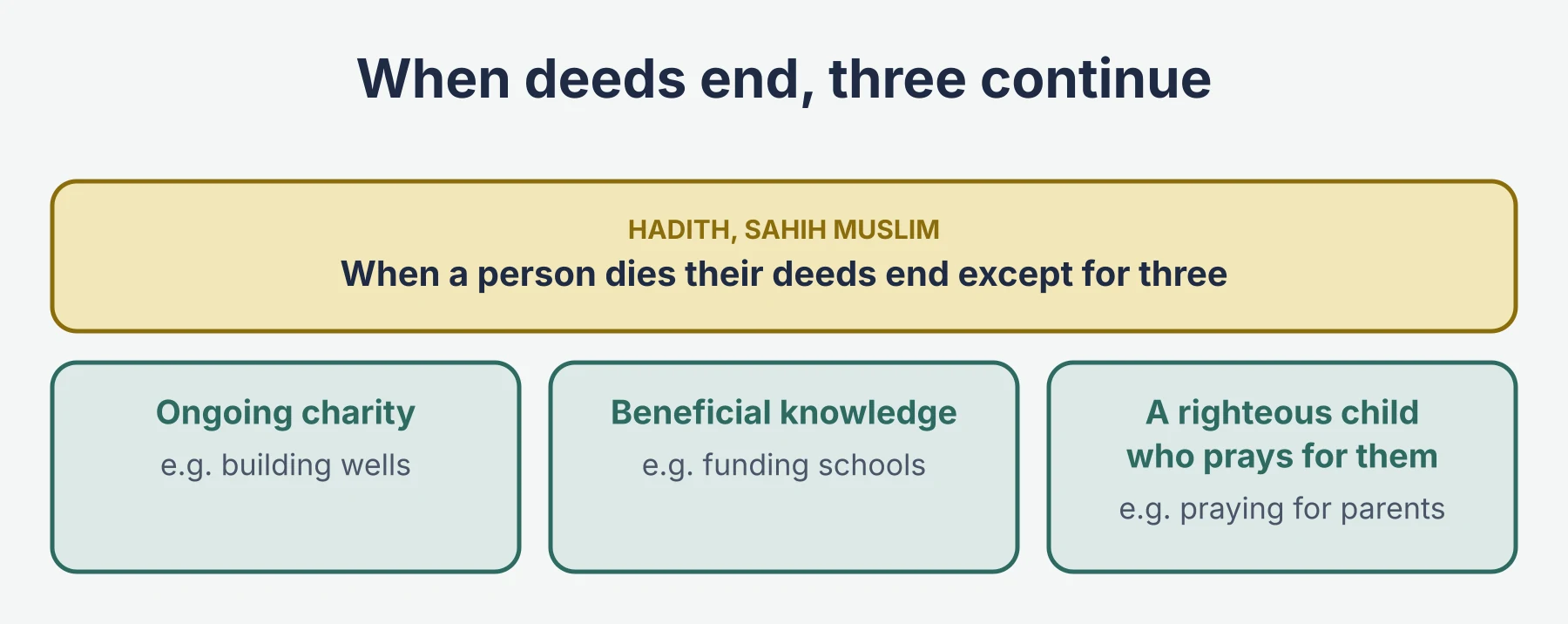
Every person dies at the time Allah has decreed; it cannot be brought forward or delayed. Malak-al-Mowth, the Angel of Death, takes the soul. Muslims are taught to say on hearing of a death, “Indeed we belong to Allah, and indeed to Him we will return” (2:156). A well-known Hadith in Sahih Muslim teaches that when a person dies their deeds end except for three: ongoing charity, knowledge that benefits others, and a righteous child who prays for them. This is why Muslims build wells, fund schools and pray for their parents.
2. Barzakh
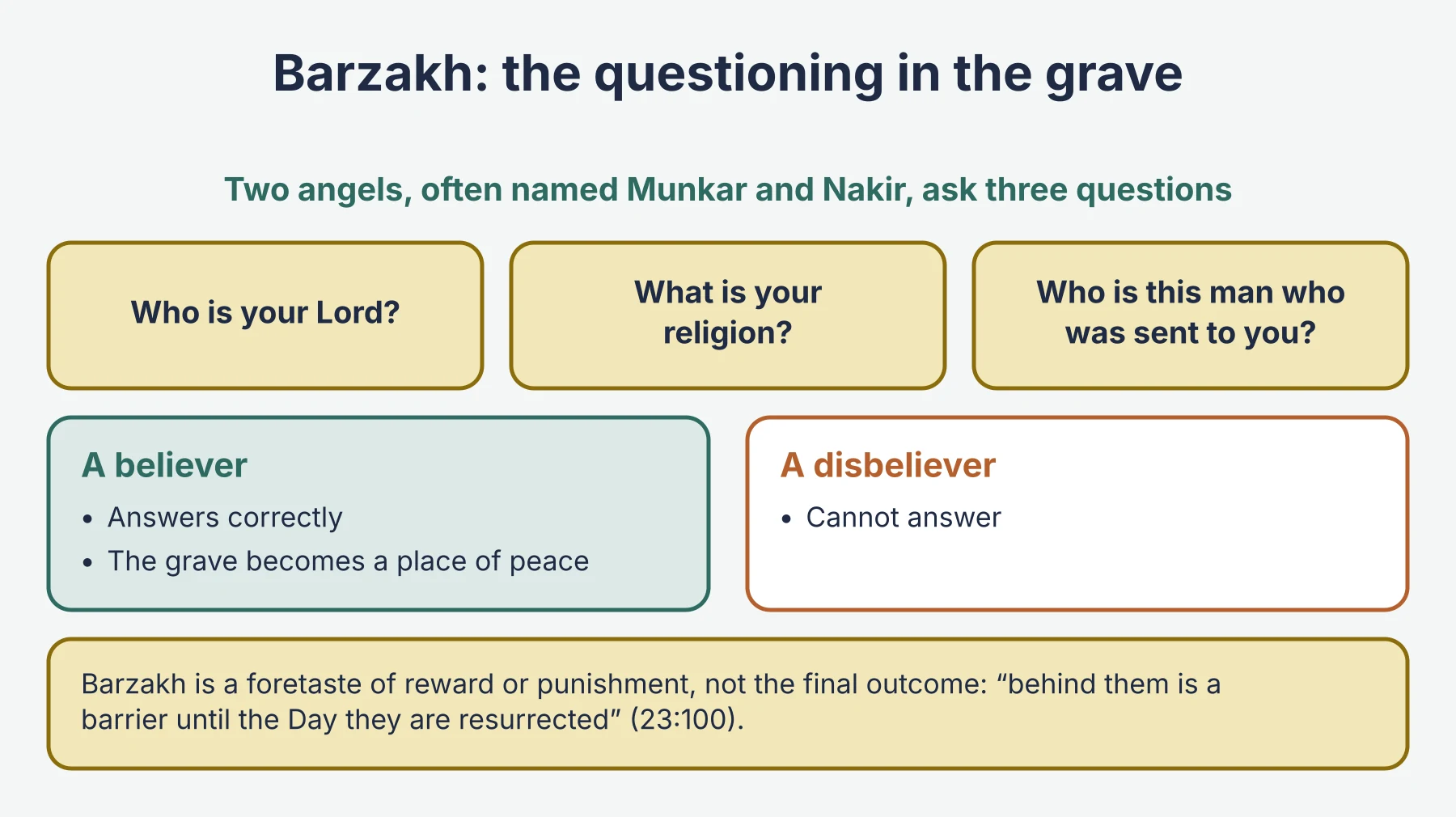
Barzakh means a barrier. The Qur’an says of the dead that “behind them is a barrier until the Day they are resurrected” (23:100). It is the stage between death and resurrection. According to the Hadith, two angels, often named Munkar and Nakir, question the dead person in the grave: Who is your Lord? What is your religion? Who is this man who was sent to you? A believer answers correctly and the grave becomes a place of peace; a disbeliever cannot answer. Barzakh is therefore a foretaste of reward or punishment, not the final outcome.
3. Resurrection (Qiyamah)
On a day only Allah knows, Israfil (AS) will blow the trumpet. “The Horn will be blown, and whoever is in the heavens and whoever is on the earth will fall dead … Then it will be blown again, and at once they will be standing, looking on” (39:68). All people are raised in body and soul. The prescribed passage, Qur’an 80:34-42, describes that day: a person will “flee from his own siblings … and his mother and his father” because each will be concerned only with his own fate.
4. The Day of Judgement (Yaum ad-Din)
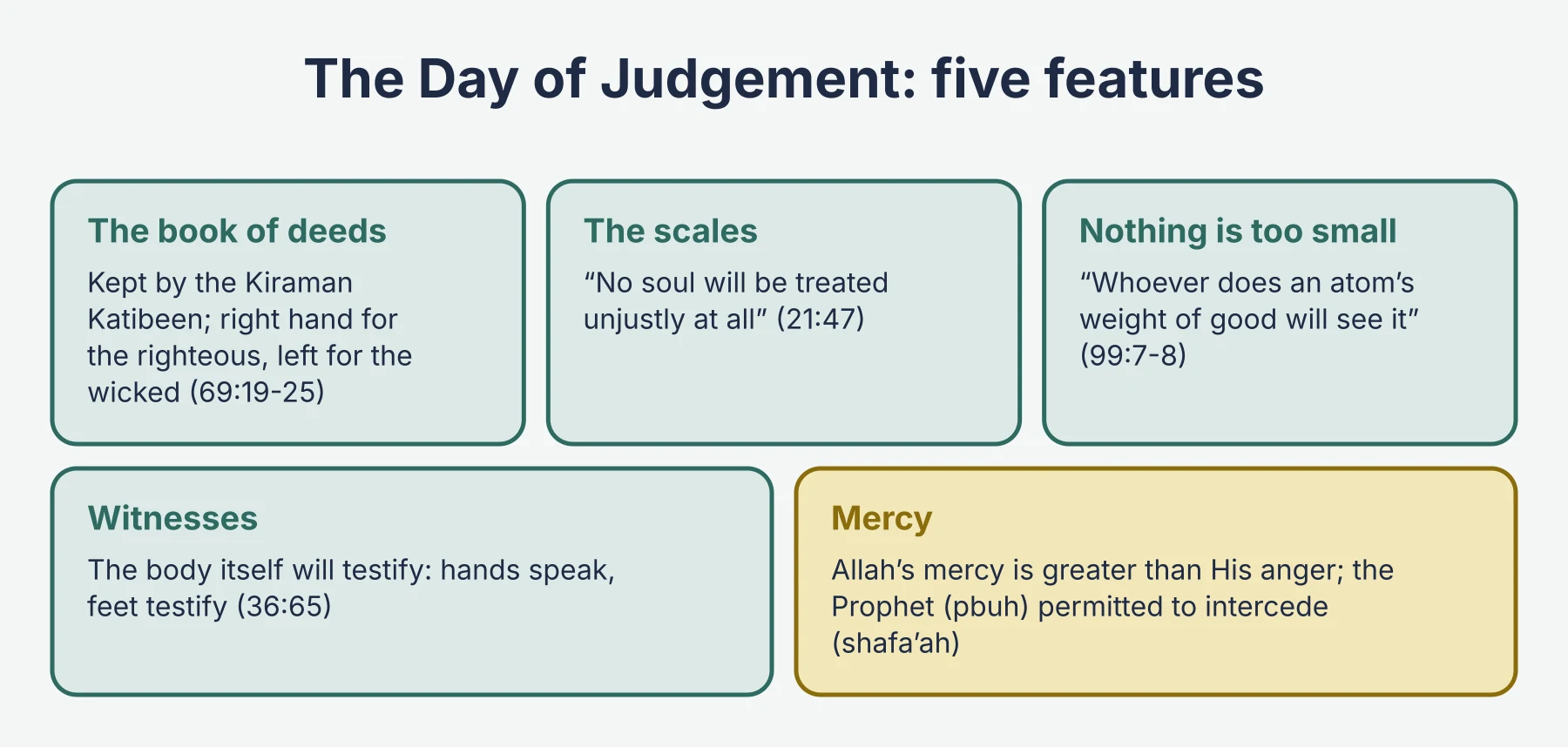
- The book of deeds: each person is given the record kept by the Kiraman Katibeen; the righteous receive it in the right hand, the wicked in the left (69:19-25).
- The scales: “We place the scales of justice for the Day of Resurrection, so no soul will be treated unjustly at all” (21:47).
- Nothing is too small: “Whoever does an atom’s weight of good will see it, and whoever does an atom’s weight of evil will see it” (99:7-8).
- Witnesses: the body itself will testify: “their hands will speak to Us, and their feet will testify” (36:65).
- Mercy: Allah’s mercy is greater than His anger, and Muslims believe the Prophet (pbuh) will be permitted to intercede (shafa’ah).
5. Jannah and Jahannam
Jannah (Paradise) is described as gardens beneath which rivers flow, with peace, reunion with loved ones and, above all, nearness to Allah. Jahannam (Hell) is a place of fire and regret for those who rejected Allah and did evil. The prescribed passage contrasts the two groups: some faces “bright, laughing, rejoicing”, others covered with dust and darkness. Many scholars teach that believers who are punished for their sins will eventually leave Jahannam through Allah’s mercy, while disbelief brings lasting punishment.
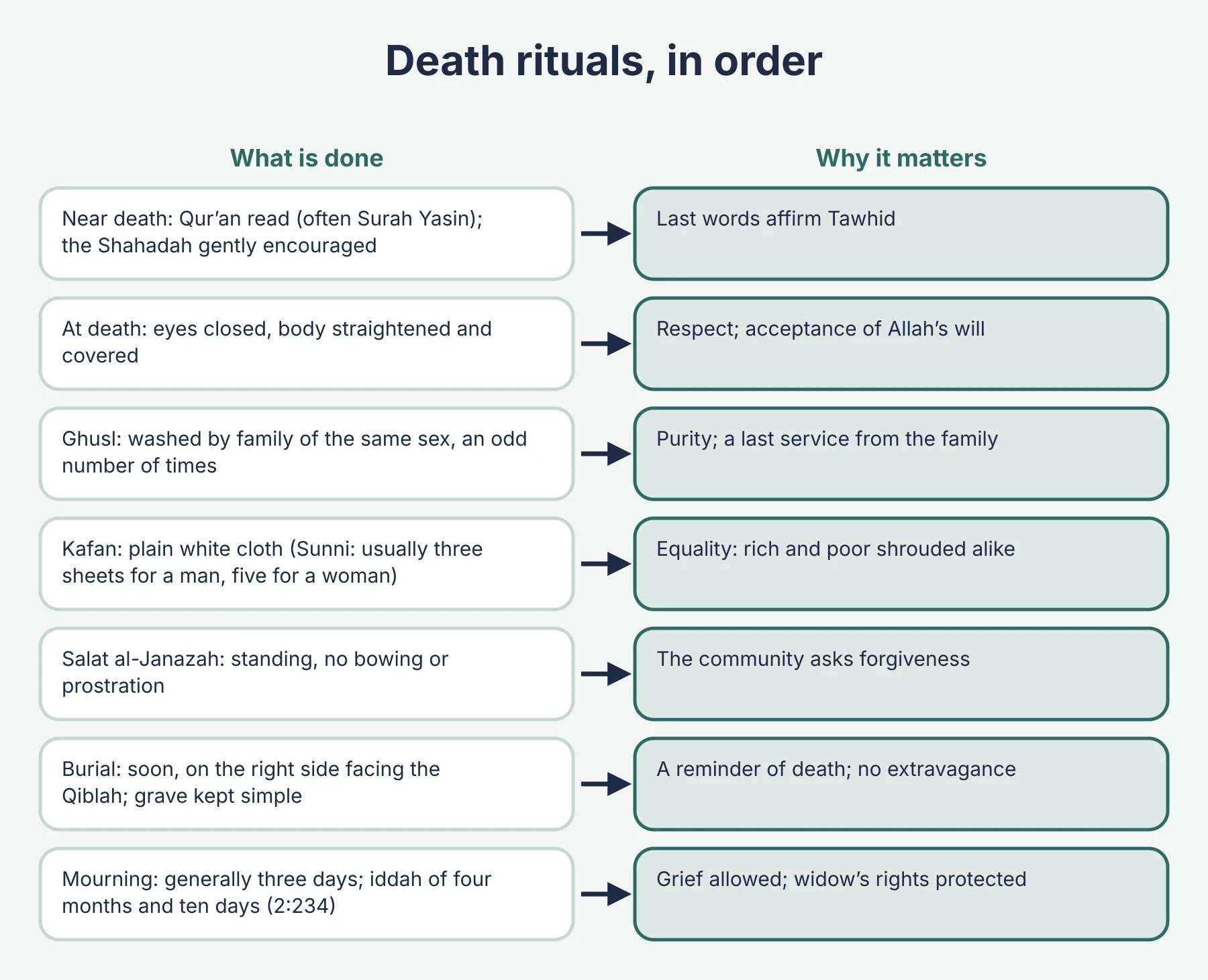
Death rituals, in order
| Stage | What is done | Why it matters |
|---|---|---|
| Near death | Family read Qur’an (often Surah Yasin), and gently encourage the dying person to say the Shahadah | So their last words affirm Tawhid |
| At death | The eyes are closed, the body is straightened and covered, and “To Allah we belong…” is said | Respect for the body and acceptance of Allah’s will |
| Ghusl | The body is washed, usually by family members of the same sex, an odd number of times | Purity before meeting Allah; a last service from the family |
| Kafan | The body is wrapped in plain white cloth; in Sunni practice usually three sheets for a man and five for a woman | Equality: rich and poor are shrouded alike |
| Salat al-Janazah | A congregational prayer offered standing, with no bowing or prostration | The community asks forgiveness for the dead person |
| Burial | As soon as possible, the body is laid on its right side facing the Qiblah; the grave is kept simple | Reminds the living of their own death; avoids extravagance |
| Mourning | Mourning is generally for three days; a widow observes a waiting period (iddah) of four months and ten days (2:234) | Grief is allowed, but life continues; the widow’s rights are protected |
Martyrs: in Sunni practice a person killed fighting in the way of Allah (a shaheed) is traditionally buried in the clothes they died in, without ghusl, as a sign of honour.
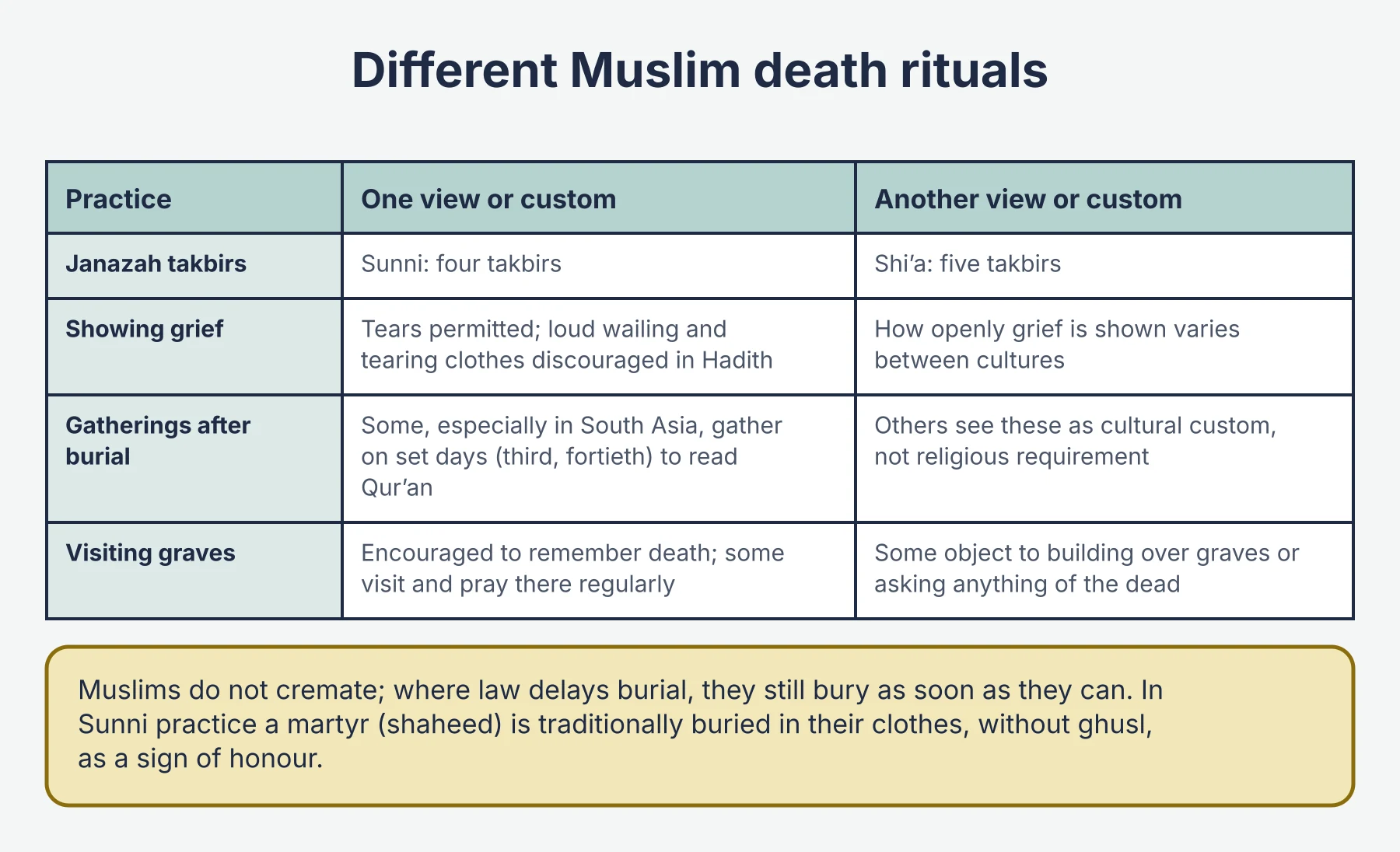
Different Muslim death rituals
The specification asks for different rituals, so you need examples of variation, not just one standard account.
- Number of takbirs: Sunni Muslims say four takbirs in the Janazah prayer; Shi’a Muslims say five.
- Wailing and expressions of grief: Islam permits tears; loud wailing, tearing clothes and striking oneself are discouraged in Hadith. Customs on how openly grief is shown still vary between cultures.
- Gatherings after burial: in some communities, especially in South Asia, families hold gatherings on set days, such as the third or fortieth day, to read Qur’an and pray for the deceased. Other Muslims regard these as cultural customs rather than religious requirements.
- Visiting graves: the Prophet (pbuh) encouraged visiting graves to remember death. Some Muslims visit regularly and pray there; some groups object to building over graves or asking anything of the dead.
- Cremation and delay: Muslims do not cremate. Where local law requires a post-mortem or delays burial, Muslims accept the delay but still bury as soon as they can.
Worked example: a 4-mark answer
Question: Explain two ways in which differences in Muslim death rituals show different understandings of Islam. [4]
Sunni and Shi’a Muslims both offer Salat al-Janazah, but Sunnis say four takbirs and Shi’a say five [1]. This shows that both traditions agree the community must pray for the dead, while following different chains of teaching about how the Prophet (pbuh) performed the prayer [1]. Some South Asian families gather on the fortieth day after a death to read the Qur’an [1]. Others do not, because they see such gatherings as local custom rather than Sunnah, which shows a difference over how far culture can shape worship [1].
Each difference is identified and then explained by what it reveals, rather than only being described.
Common mistakes
- Confusing Barzakh with the Day of Judgement. Barzakh comes first and is temporary; final judgement follows resurrection.
- Treating Jannah as earned by deeds alone. Muslims believe deeds matter, but entry is ultimately by Allah’s mercy.
- Giving one ritual only, or one tradition only. Show at least one difference, such as the number of takbirs.
- Stating customs as obligations. Gatherings on the fortieth day, for example, are custom in some places, not a rule of Islam.
- Forgetting the passage. In a 12-mark answer on akhirah, use Qur’an 80:34-42 directly: the fleeing from family and the two kinds of faces.
Exam technique
Give questions want a stage or a ritual. Explain questions want what the belief or ritual is plus its effect on a Muslim’s life. For the 12-mark question, plan three points (for example accountability, justice, equality in death), tie each to a phrase from the passage, then weigh a counter-view, such as whether fear of judgement or hope of reward motivates Muslims more.
Related pages
- Life after death and death rituals revision notes
- Life after death and death rituals practice questions
- Islam: Beliefs and Teachings revision notes
Source: OxfordAQA, International GCSE Islamiat (9237) specification, Version 1.1, content area 3.1.1.6 and Passage 6.
Related resources
-
Practice questions
OxfordAQA International GCSE Islamiat (9237): Life After Death and Muslim Death Rituals – Practice Questions
Twelve original questions with mark guidance on death, Barzakh, resurrection, judgement, Jannah, Jahannam and Muslim death rituals, 9237 topic 3.1.1.6.
Islamiyat · OxfordAQA · IGCSE
Try questions -
Revision notes
OxfordAQA International GCSE Islamiat (9237): Life After Death and Muslim Death Rituals – Revision Notes
Recall notes on death, Barzakh, resurrection, judgement, Jannah, Jahannam and different Muslim death rituals for 9237 topic 3.1.1.6, with a self-test.
Islamiyat · OxfordAQA · IGCSE
Revise topic -
Study guides
OxfordAQA International GCSE Islamiat (9237): The Oneness of God (Tawhid) and Shirk
A close study of the types of Tawhid and Shirk, their meaning and their importance, with Surah al-Ikhlas, worked answers and common mistakes for 9237 topic 3.1.1.1.
Islamiyat · OxfordAQA · IGCSE
Read guide
Get free revision emails (optional)
Occasional emails with practice questions, worked explanations and links to free resources for the qualification and subjects you choose. No spam, and you can unsubscribe from any email. The free tools on this site never need an email.