
Study Guides
OxfordAQA International GCSE Islamiat (9237): Prophets Adam, Ibraheem, Musa and Isa (AS)
The lives, roles and importance of Prophets Adam, Ibraheem, Musa and Isa (AS) for 9237 topic 3.1.1.7, with Qur'an references, a model answer and exam technique.
- Subject
- Islamiyat
- Level
- IGCSE
- Topic
- Paper 1 – Living the Muslim Life
- Author
- Marlbridge Academic Team
- Updated
- Reviewed by
- Azam Siddique (what this means)
Aligned to OxfordAQA IGCSE Islamiyat (9237), Version 1.1. Official specification .
Syllabus page (what it covers and how it is assessed): OxfordAQA IGCSE Islamiyat.
Syllabus points this page covers
9237
- 3.1.1 Islam: Beliefs and teachings
Found an error? Report a correction.
Need help with this topic? Request a free trial class for IGCSE Islamiyat (9237).
This guide covers one statement in content area 3.1.1.7 of OxfordAQA International GCSE Islamiat (9237): “The life, role, and importance of Prophets Adam (AS), Ibraheem (AS), Musa (AS) and Isa (AS).” The Islam: Beliefs and Teachings study guide gives each of these prophets a single line. This page goes through each life in turn, separates the three things the specification asks for (life, role, importance), and shows how to turn a story into marks in Paper 1 Section A.
What the specification is asking for
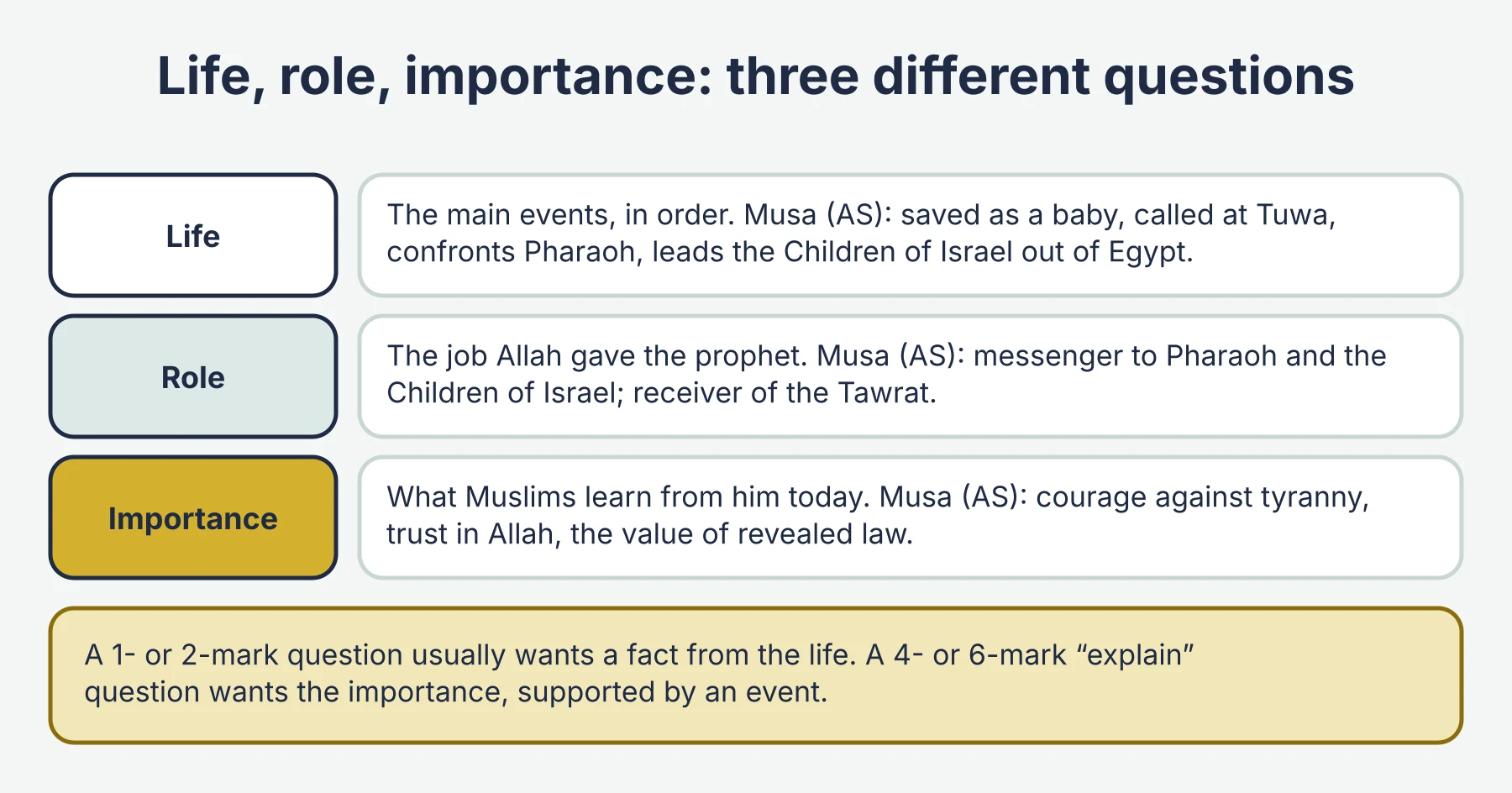
Each of the three words points to a different kind of answer:
| Word | What it asks | Example for Musa (AS) |
|---|---|---|
| Life | The main events, in order | Saved as a baby, called at Tuwa, confronts Pharaoh, leads the Children of Israel out of Egypt |
| Role | The job Allah gave the prophet | Messenger to Pharaoh and to the Children of Israel; receiver of the Tawrat |
| Importance | What Muslims learn from him today | Courage against tyranny, trust in Allah, the value of revealed law |
A 1- or 2-mark question usually wants a fact from the life. A 4- or 6-mark “explain” question wants the importance, supported by an event. Students lose marks by retelling the story when the question asks why the prophet matters.
All prophets share one core message, Tawhid, and Muslims “make no distinction between any of His messengers” (Qur’an 2:285). The prescribed passage for 3.1.1.7, Qur’an 9:128-129, describes the Prophet Muhammad (pbuh) as a messenger “from among yourselves” who is concerned for his people. That idea, a human messenger who cares about the people he is sent to, fits every prophet on this page.
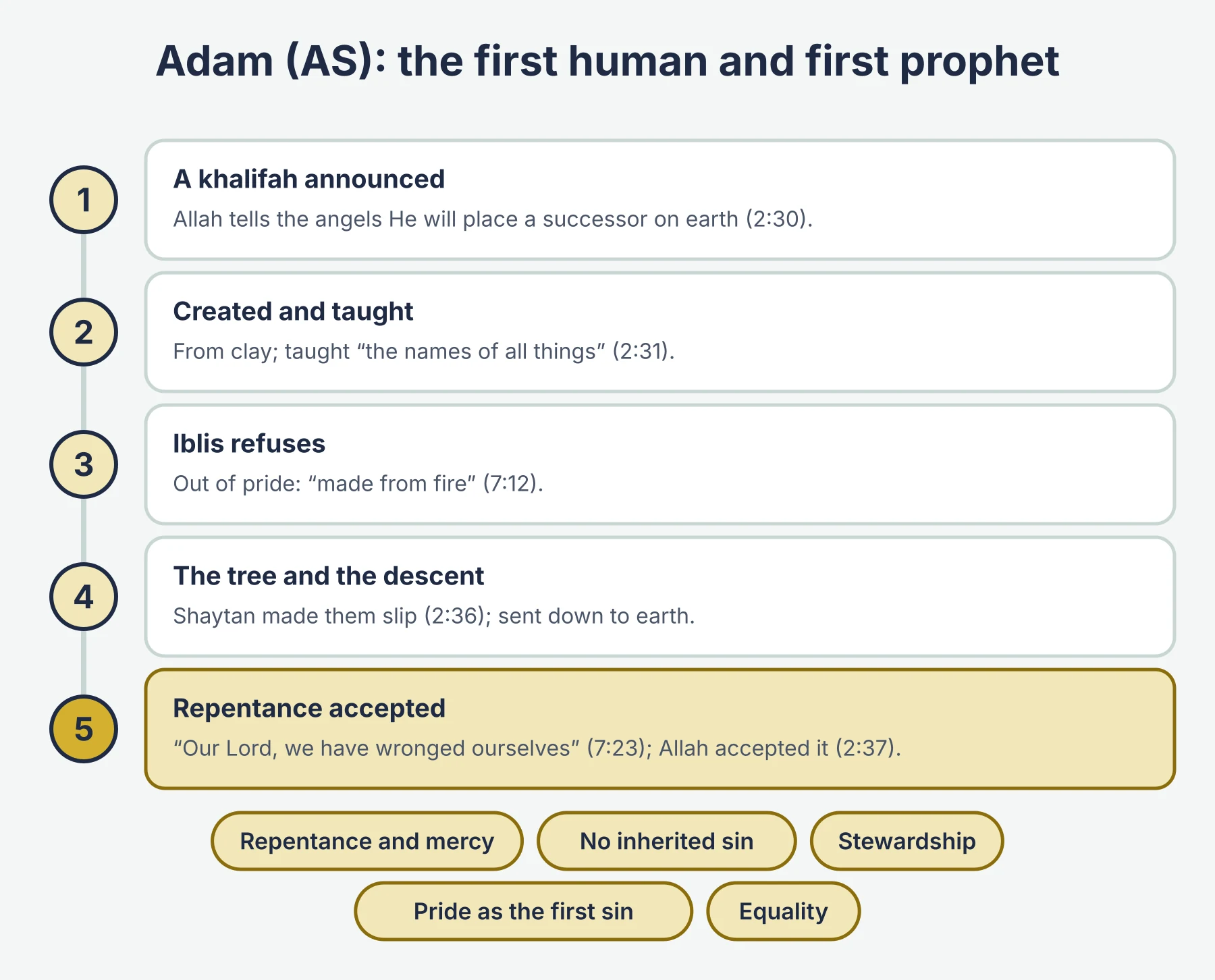
Adam (AS): the first human and the first prophet
Life. Allah announced to the angels that He would place a khalifah (successor or steward) on earth (2:30). Adam (AS) was created from clay and taught “the names of all things” (2:31), knowledge the angels did not have. The angels were commanded to prostrate to him; Iblis refused out of pride, saying he was better because he was made from fire (7:12). Adam and his wife lived in the Garden and were told not to approach one tree. Shaytan made them slip (2:36), they ate from it, and they were sent down to earth. They repented, saying “Our Lord, we have wronged ourselves” (7:23), and Allah accepted Adam’s repentance (2:37).
Role. He was the first prophet, the father of humanity, and the first khalifah, responsible for looking after the earth and teaching his children to worship Allah.
Importance.
- Repentance and mercy: Adam’s mistake was forgiven, so Muslims learn that no sin is too great for Allah’s mercy if a person sincerely turns back.
- No inherited sin: because Allah forgave Adam, Muslims do not believe that his descendants carry his sin.
- Stewardship: the khalifah role is the basis of Muslim teaching on caring for the environment.
- Pride as the first sin: Iblis’s refusal shows why arrogance is so serious.
- Equality: all people descend from one father, so no race is superior.
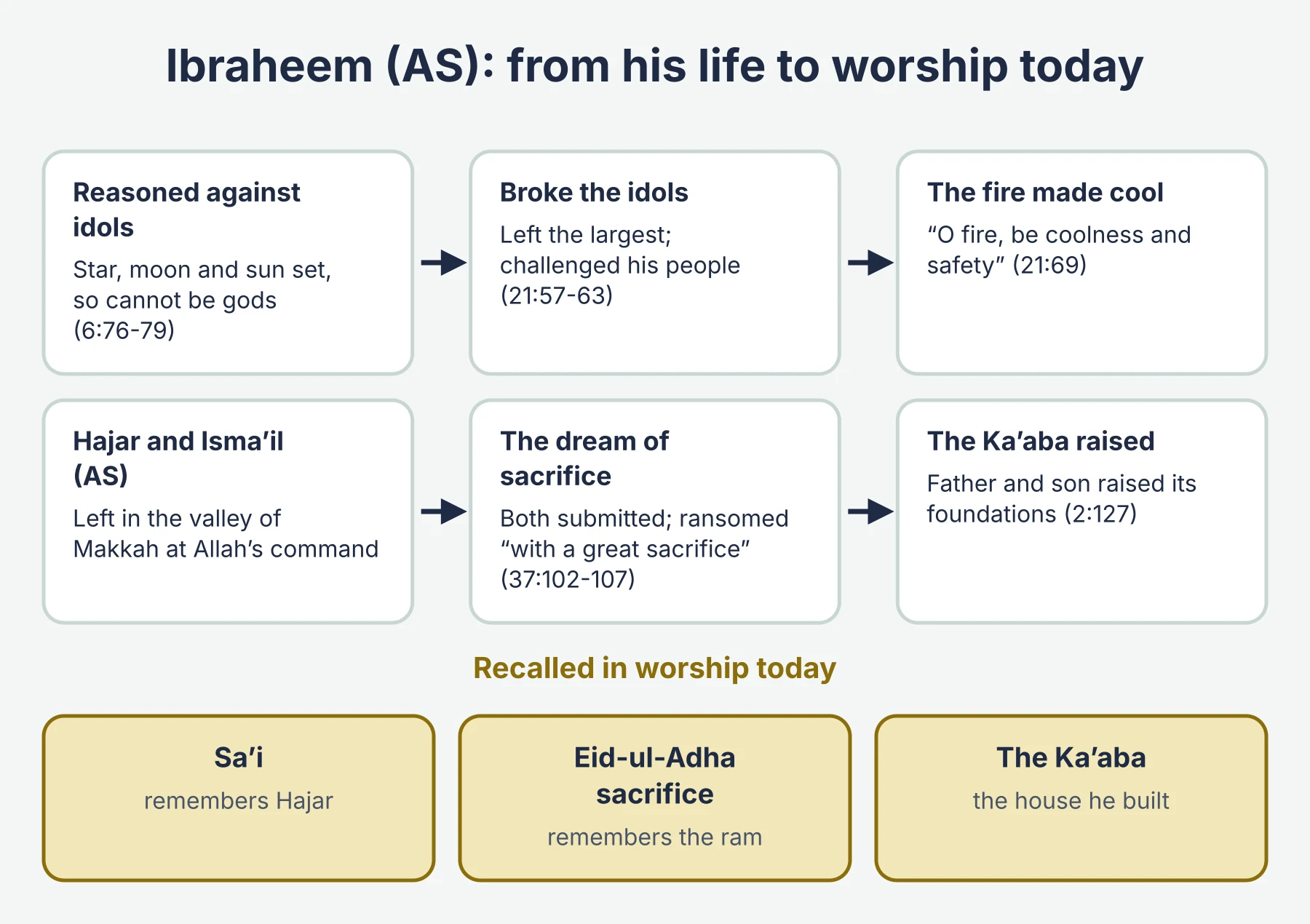
Ibraheem (AS): the friend of Allah
Life. Ibraheem (AS) grew up among people who worshipped idols, including his father Azar. He reasoned that the star, the moon and the sun could not be gods because they set (6:76-79). He broke the idols of his people, leaving the largest one, and challenged them to ask it who had done it (21:57-63). He was thrown into a fire, and Allah commanded, “O fire, be coolness and safety upon Ibraheem” (21:69). Later, at Allah’s command, he left his wife Hajar and their son Isma’il (AS) in the valley of Makkah. When Isma’il was older, Ibraheem saw in a dream that he was sacrificing him; both submitted, and Allah ransomed Isma’il “with a great sacrifice” (37:102-107). Father and son raised the foundations of the Ka’aba (2:127).
Role. He called his people and his descendants to Tawhid, received the Suhuf (scrolls) (87:18-19), and is the father of a line of prophets through Isma’il and Ishaq (AS). Allah “took Ibraheem as an intimate friend” (Khalilullah, 4:125).
Importance.
- Model of Tawhid: he used reason and courage to reject idol worship, even against his own family.
- Submission: his willingness to sacrifice his son is the meaning of the word “Islam” in action.
- Worship today: Hajj and Eid-ul-Adha recall his family: Sa’i remembers Hajar, the sacrifice remembers the ram, and the Ka’aba is the house he built.
- A shared father: Jews, Christians and Muslims all look to him, so he is a point of common ground.
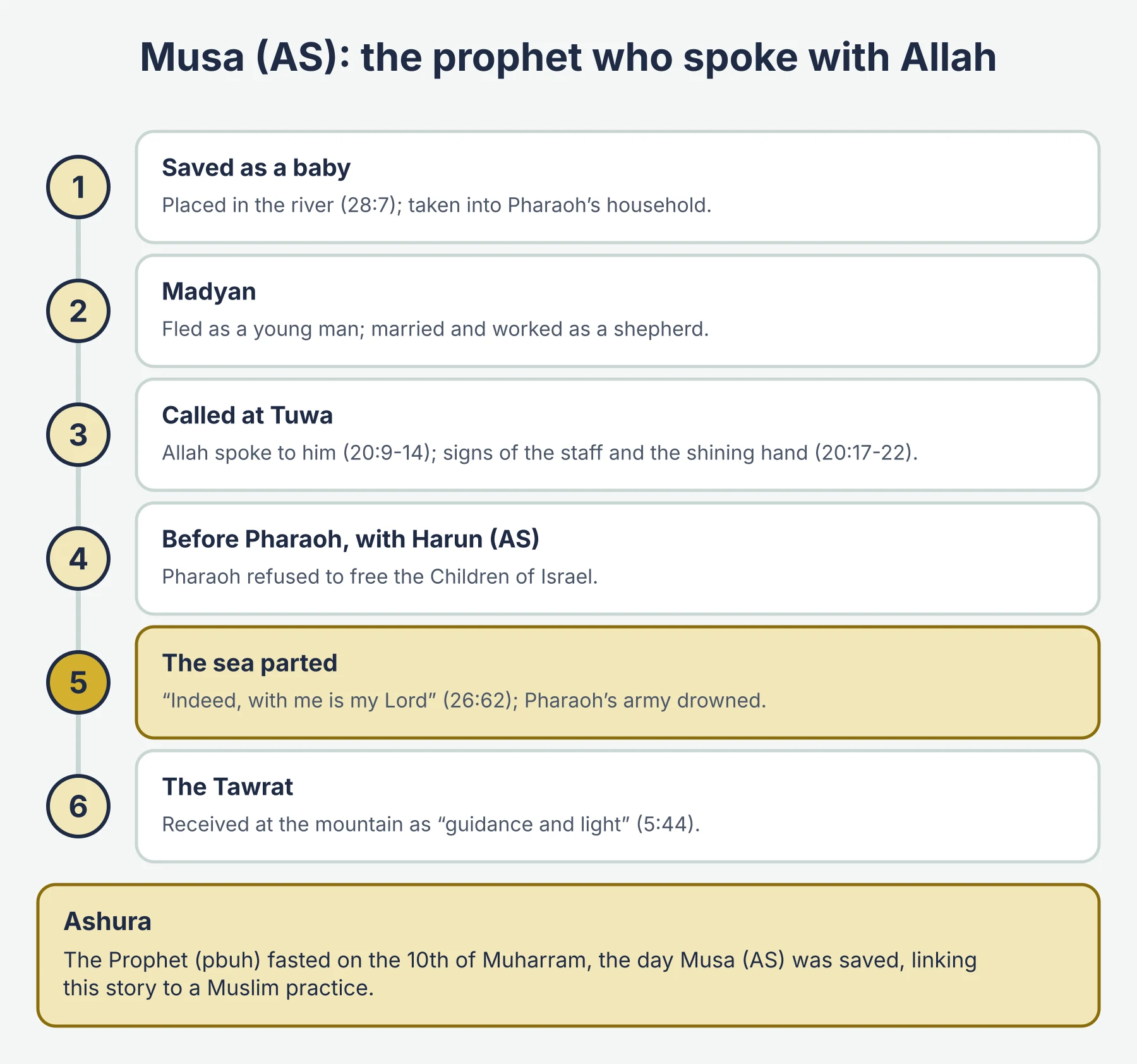
Musa (AS): the prophet who spoke with Allah
Life. Pharaoh was killing the baby boys of the Children of Israel, so Musa’s mother placed him in the river, as Allah inspired her (28:7); he was taken into Pharaoh’s own household. As a young man he fled to Madyan, where he married and worked as a shepherd. Returning, he saw a fire in the valley of Tuwa, where Allah spoke to him and made him a messenger (20:9-14). He was given signs, including his staff that became a snake and his hand that shone white (20:17-22), and was sent with his brother Harun (AS) to Pharaoh. Pharaoh refused to free the Children of Israel. Musa (AS) led them out, and at Allah’s command struck the sea with his staff so that it parted (26:63); Pharaoh’s army was drowned. At the mountain he received the Tawrat as “guidance and light” (5:44).
Role. Messenger to Pharaoh and to the Children of Israel, lawgiver through the Tawrat, and Kalimullah, the one to whom “Allah spoke directly” (4:164).
Importance.
- Standing up to injustice: he confronted the most powerful ruler of his time, so Muslims learn to speak against oppression.
- Trust in Allah: with the sea in front and an army behind, he said, “Indeed, with me is my Lord” (26:62).
- Revealed law: the Tawrat shows that Allah guides people with law as well as belief.
- Ashura: the Prophet (pbuh) fasted on the 10th of Muharram, the day Musa (AS) was saved, which links this story to a Muslim practice.
Isa (AS): the Messiah, son of Maryam
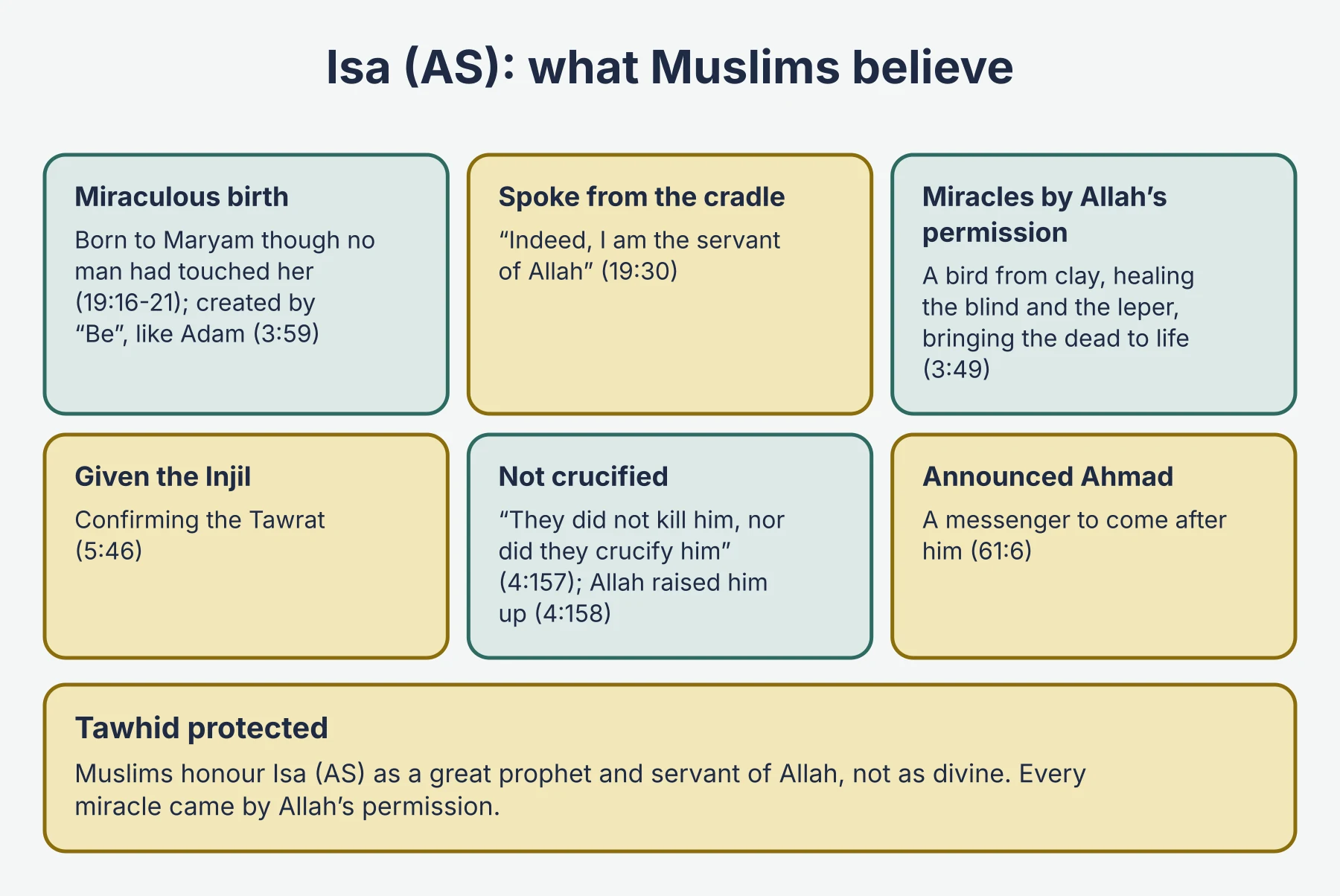
Life. The angel came to Maryam and told her she would have a son though no man had touched her (19:16-21). The Qur’an compares Isa’s creation to Adam’s: both were created by Allah’s command “Be” (3:59). As a baby Isa (AS) spoke from the cradle: “Indeed, I am the servant of Allah. He has given me the Scripture and made me a prophet” (19:30). He performed miracles “by permission of Allah”: making a bird from clay, healing the blind and the leper, and bringing the dead to life (3:49). He was given the Injil (5:46). Muslims believe that “they did not kill him, nor did they crucify him” (4:157) and that Allah raised him up (4:158).
Role. Messenger to the Children of Israel, confirming the Tawrat and bringing the Injil, and announcing a messenger to come after him “whose name is Ahmad” (61:6).
Importance.
- Tawhid protected: Muslims honour Isa (AS) as a great prophet but not as divine; his own words “I am the servant of Allah” support this.
- Miracles from Allah: every miracle came by Allah’s permission, which teaches that power belongs to Allah alone.
- Link to the final prophet: his announcement of Ahmad connects the earlier revelation to Hazrat Muhammad (pbuh), the Seal of the Prophets (33:40).
- Maryam’s honour: a whole surah carries her name, showing respect for a righteous woman.
Worked example: a 6-mark answer
Question: Explain two reasons why Prophet Ibraheem (AS) is important for Muslims. Apply one teaching from a source of authority in your answer. [6]
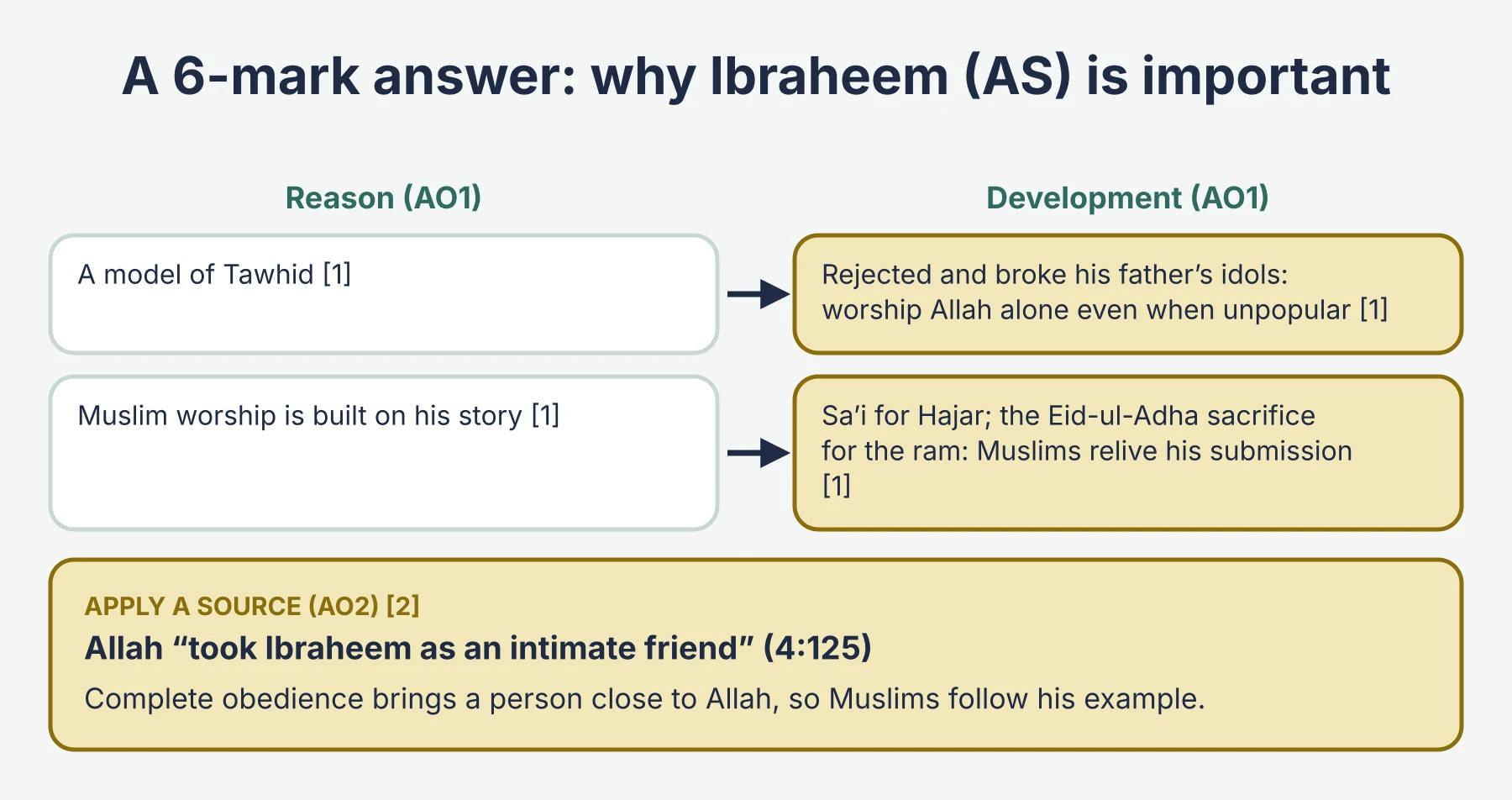
One reason is that Ibraheem (AS) is a model of Tawhid [1]. He rejected the idols his own father worshipped and broke them, showing that a Muslim must worship Allah alone even when it is difficult or unpopular [1]. A second reason is that Muslim worship today is built on his story [1]. During Hajj, pilgrims perform Sa’i in memory of Hajar and offer a sacrifice on Eid-ul-Adha in memory of the ram that replaced Isma’il (AS), so Muslims relive his submission every year [1]. The Qur’an says that Allah “took Ibraheem as an intimate friend” (4:125), which shows that complete obedience brings a person close to Allah, so Muslims try to follow his example [2].
Why it scores 6: two distinct reasons, each identified and developed with a specific event (AO1, 4 marks), and a source quoted accurately and applied to the question (AO2, 2 marks). A vague phrase such as “the Qur’an praises him” would earn only 1 of the AO2 marks.
Common mistakes
- Retelling without explaining. A full story of the fire earns nothing on its own in an “explain why important” question; say what it teaches.
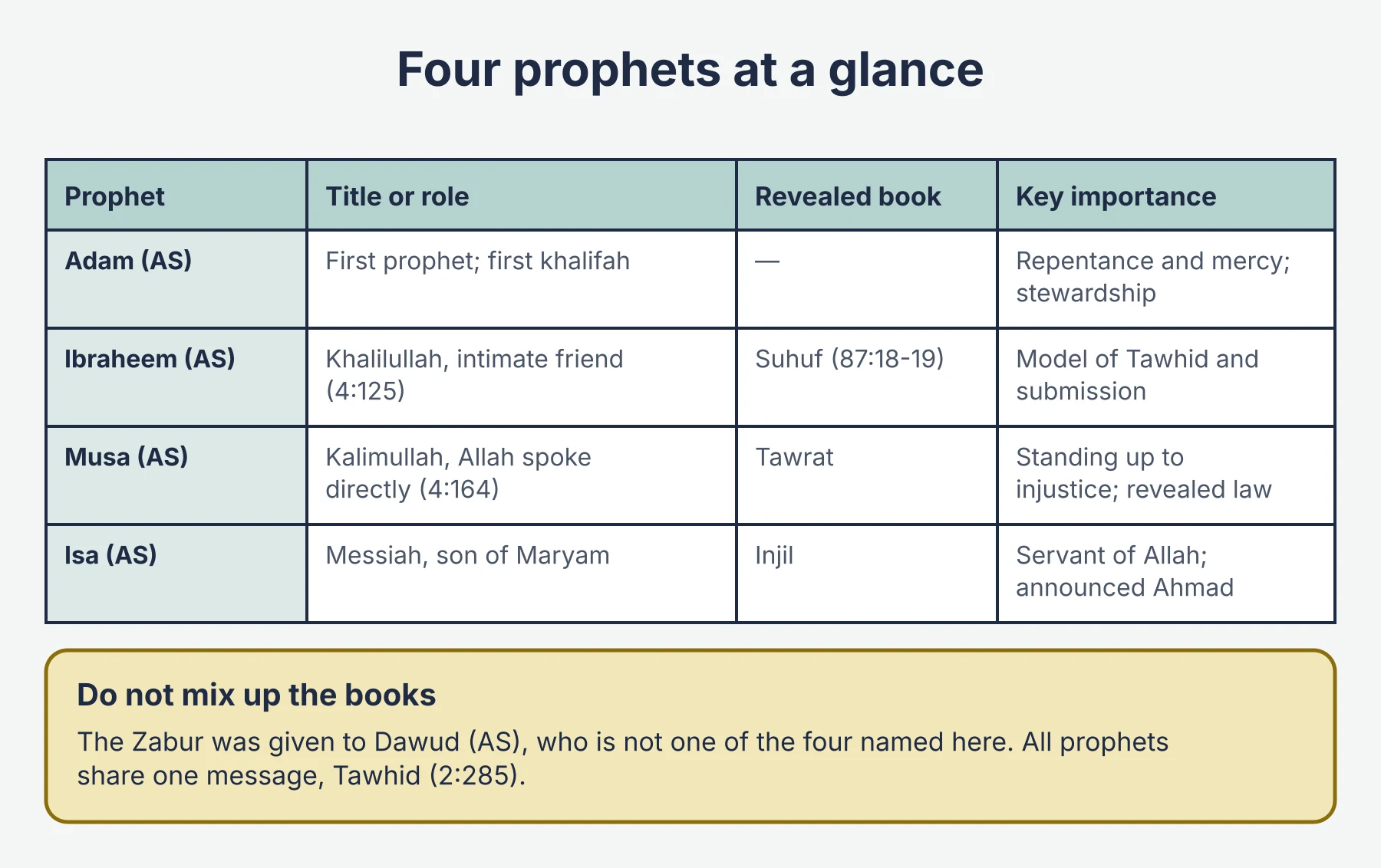
- Mixing up the books. Suhuf with Ibraheem, Tawrat with Musa, Injil with Isa (AS); the Zabur was given to Dawud (AS), who is not one of the four named here.
- Describing Isa (AS) in Christian terms. Use the Islamic belief: born miraculously, a prophet and servant of Allah, not crucified, raised by Allah.
- Forgetting “role”. If asked for a prophet’s role, give his task: messenger to a named people, receiver of a named book, or khalifah.
- Unsupported references. Learn a handful of verse numbers accurately rather than inventing them.
Exam technique for the command words
- Name / Give: a single fact, such as the book given to Musa (AS). Do not explain.
- Explain two…: two different points, each developed with an event or consequence for Muslims. Keep the two points clearly separate.
- Apply one teaching from a source of authority: quote or closely paraphrase a verse or Hadith, give its reference, and say how it answers the question.
- Examine why this statement is significant (12 marks): use the prescribed passage (Qur’an 9:128-129 for 3.1.1.7), give a range of points, and consider how far the statement is true.
Related pages
- Prophets Adam, Ibraheem, Musa and Isa (AS) revision notes
- Prophets Adam, Ibraheem, Musa and Isa (AS) practice questions
- Islam: Beliefs and Teachings revision notes
Source: OxfordAQA, International GCSE Islamiat (9237) specification, Version 1.1, content area 3.1.1.7 and Passage 7.
Related resources
-
Practice questions
OxfordAQA International GCSE Islamiat (9237): Prophets Adam, Ibraheem, Musa and Isa (AS) – Practice Questions
Twelve original questions with mark guidance on the lives, roles and importance of Prophets Adam, Ibraheem, Musa and Isa (AS), 9237 topic 3.1.1.7.
Islamiyat · OxfordAQA · IGCSE
Try questions -
Revision notes
OxfordAQA International GCSE Islamiat (9237): Prophets Adam, Ibraheem, Musa and Isa (AS) – Revision Notes
Recall notes on the lives, roles and importance of Prophets Adam, Ibraheem, Musa and Isa (AS) for 9237 topic 3.1.1.7, with key terms, traps and a self-test.
Islamiyat · OxfordAQA · IGCSE
Revise topic -
Study guides
OxfordAQA International GCSE Islamiat (9237): Salah
The meaning and importance of Salah: how and why Muslims pray, prayer at home and in the mosque, the role of Salah in daily life and Friday prayers (Jummah), for 9237 topic 3.1.2.3.
Islamiyat · OxfordAQA · IGCSE
Read guide
Get free revision emails (optional)
Occasional emails with practice questions, worked explanations and links to free resources for the qualification and subjects you choose. No spam, and you can unsubscribe from any email. The free tools on this site never need an email.