
Revision Notes
OxfordAQA International GCSE Islamiat (9237): Prophets Adam, Ibraheem, Musa and Isa (AS) – Revision Notes
Recall notes on the lives, roles and importance of Prophets Adam, Ibraheem, Musa and Isa (AS) for 9237 topic 3.1.1.7, with key terms, traps and a self-test.
- Subject
- Islamiyat
- Level
- IGCSE
- Topic
- Paper 1 – Living the Muslim Life
- Author
- Marlbridge Academic Team
- Updated
- Reviewed by
- Azam Siddique (what this means)
Aligned to OxfordAQA IGCSE Islamiyat (9237), Version 1.1. Official specification .
Syllabus page (what it covers and how it is assessed): OxfordAQA IGCSE Islamiyat.
Syllabus points this page covers
9237
- 3.1.1 Islam: Beliefs and teachings
Found an error? Report a correction.
Need help with this topic? Request a free trial class for IGCSE Islamiyat (9237).
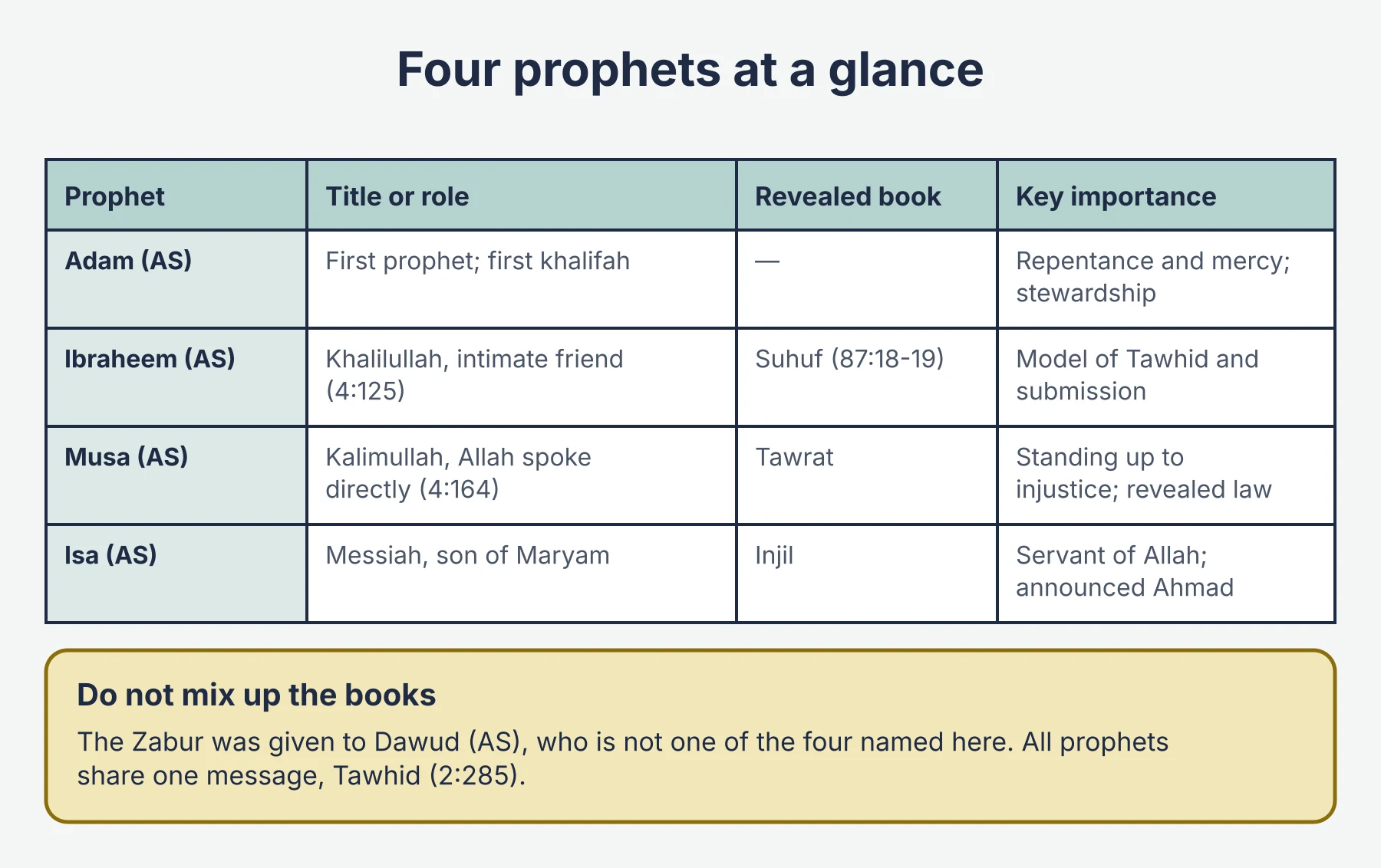
These notes condense one statement in 9237 content area 3.1.1.7: “The life, role, and importance of Prophets Adam (AS), Ibraheem (AS), Musa (AS) and Isa (AS).” For the full explanation and a model answer, use the Prophets Adam, Ibraheem, Musa and Isa (AS) study guide. The wider topic is summarised in the Islam: Beliefs and Teachings revision notes.
One-line summary of each
| Prophet | Title | Book | Sent to | One lesson |
|---|---|---|---|---|
| Adam (AS) | First human, first khalifah | None named in the specification | His descendants | Sincere repentance is accepted |
| Ibraheem (AS) | Khalilullah, friend of Allah | Suhuf | His people, who worshipped idols | Total submission to Allah |
| Musa (AS) | Kalimullah, Allah spoke to him | Tawrat | Pharaoh and the Children of Israel | Courage against tyranny |
| Isa (AS) | Al-Masih, son of Maryam | Injil | The Children of Israel | A prophet and servant, not divine |
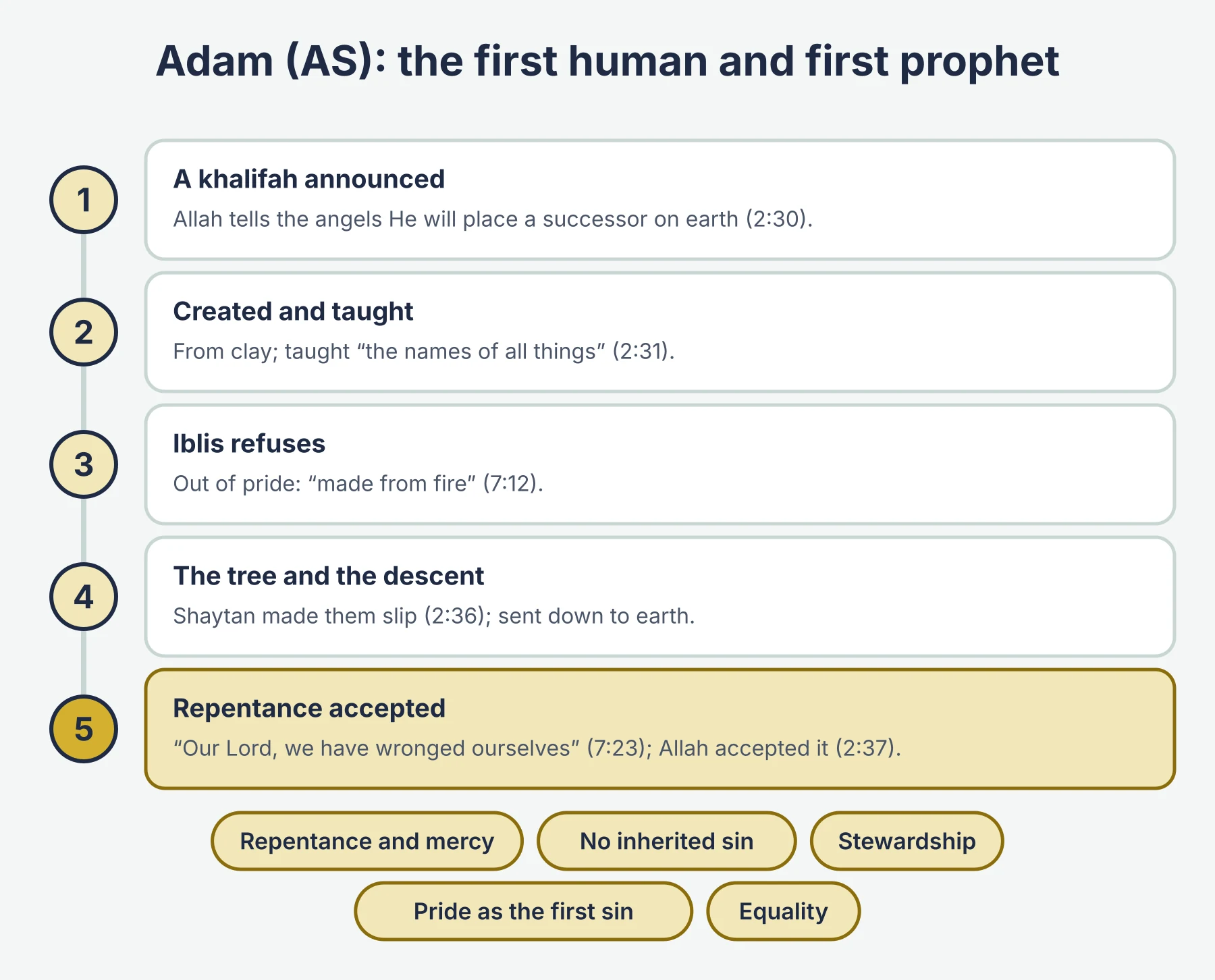
Adam (AS): recall chain
Announced as khalifah (2:30) → made from clay → taught the names (2:31) → angels prostrate, Iblis refuses from pride (2:34; 7:12) → the forbidden tree → Shaytan causes the slip (2:36) → “Our Lord, we have wronged ourselves” (7:23) → repentance accepted (2:37) → life on earth.
Importance in three words: repentance, stewardship, equality.
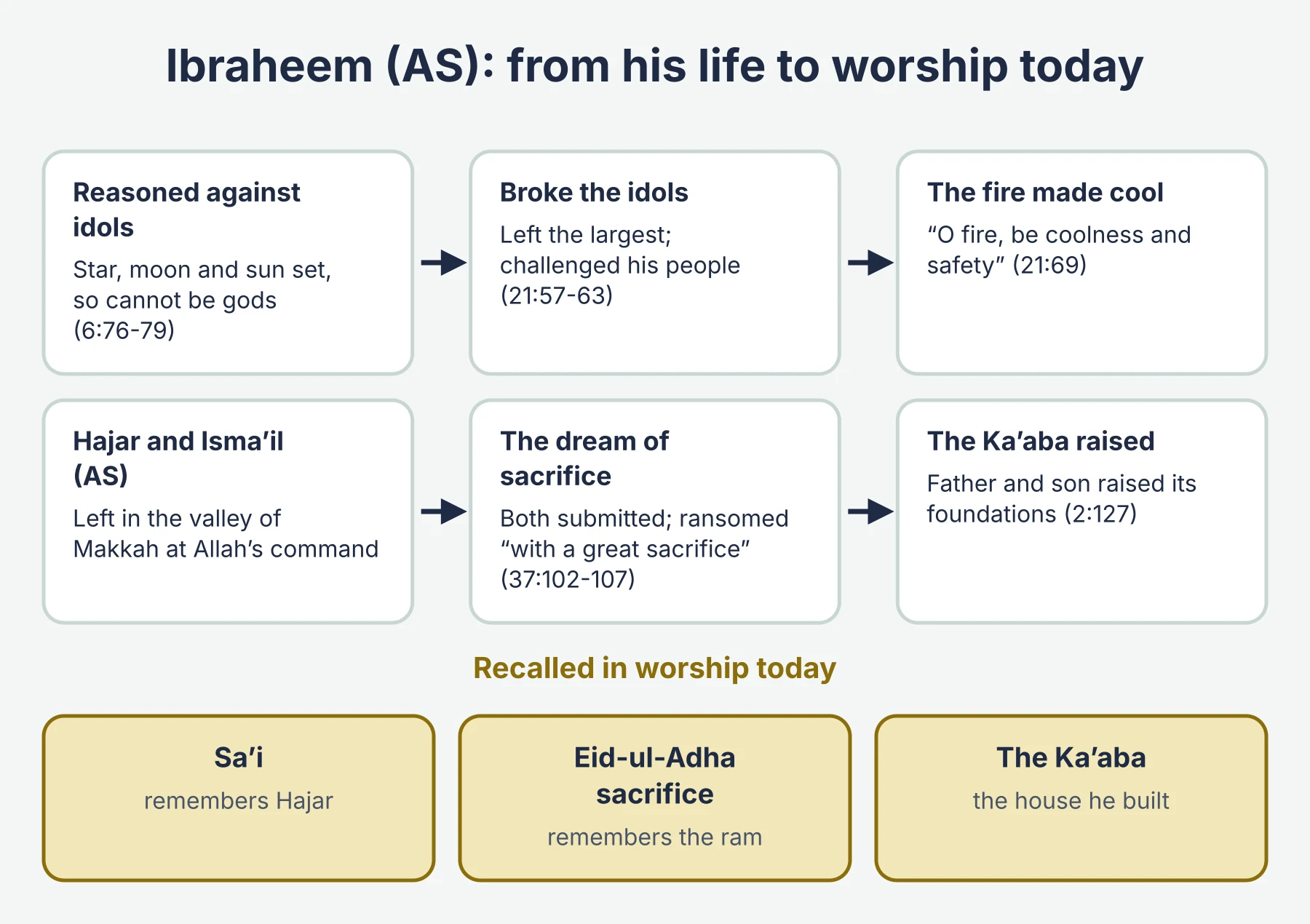
Ibraheem (AS): recall chain
Idol-worshipping people and father Azar → reasons from star, moon and sun (6:76-79) → breaks the idols, leaves the biggest (21:57-63) → thrown into the fire, made “coolness and safety” (21:69) → leaves Hajar and Isma’il in Makkah → dream of sacrifice, ransomed (37:102-107) → builds the Ka’aba with Isma’il (2:127) → Suhuf (87:18-19).
Link to practice: Hajj (Sa’i, the Ka’aba, the stoning at Mina) and Eid-ul-Adha all recall his family.
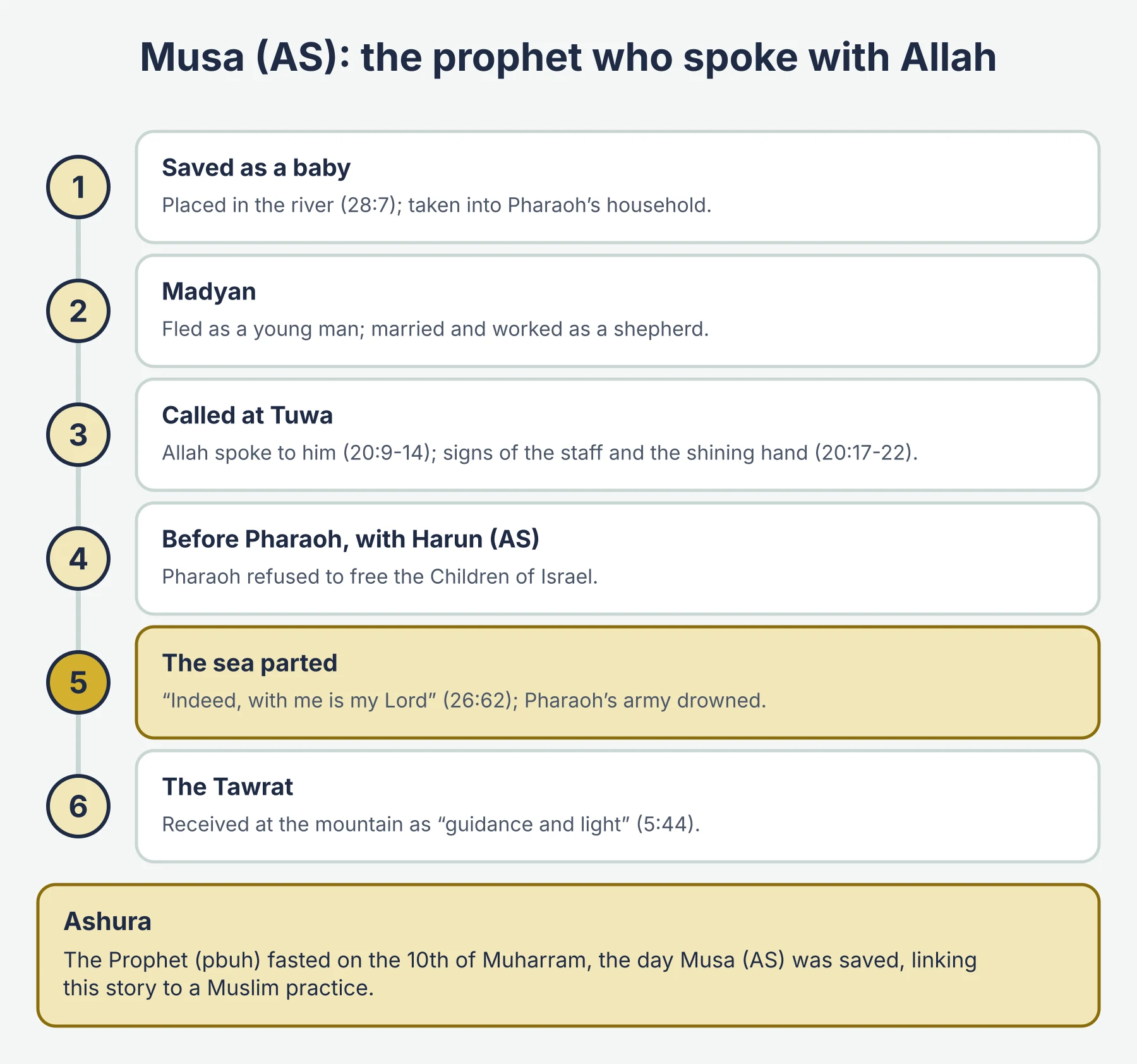
Musa (AS): recall chain
Pharaoh kills baby boys → placed in the river (28:7) → raised in Pharaoh’s palace → flees to Madyan → called at Tuwa (20:9-14) → staff and shining hand (20:17-22) → sent with Harun (AS) → Pharaoh refuses → sea parts (26:63) → Pharaoh drowned → Tawrat, “guidance and light” (5:44).
Link to practice: the Prophet (pbuh) fasted on Ashura, the day Musa (AS) was saved.
Isa (AS): recall chain
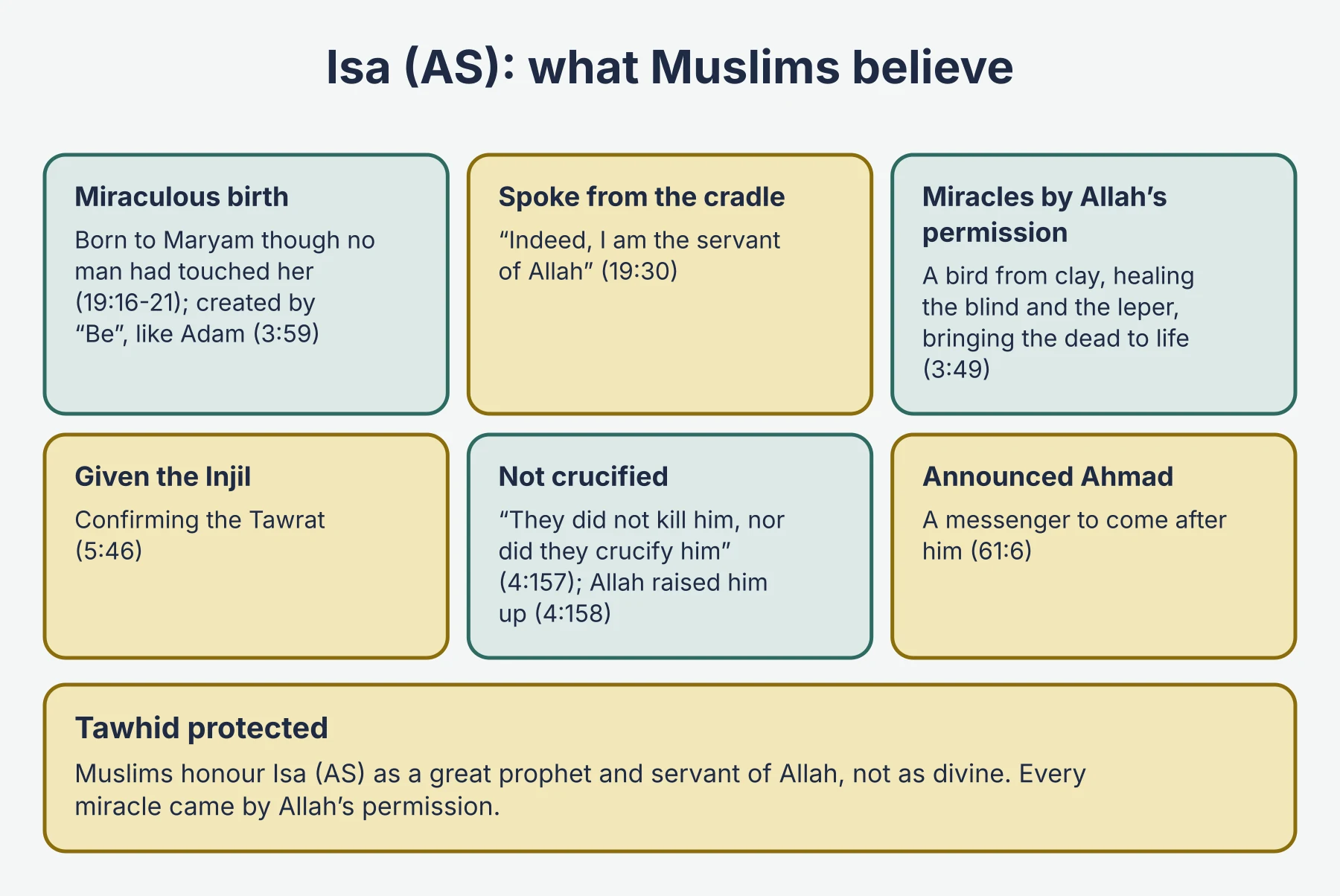
Angel visits Maryam (19:16-21) → born without a father, like Adam created by “Be” (3:59) → speaks from the cradle: “I am the servant of Allah” (19:30) → miracles by Allah’s permission (3:49) → Injil (5:46) → not killed or crucified (4:157) → raised by Allah (4:158) → foretells “Ahmad” (61:6).
Key terms
| Term | Meaning |
|---|---|
| Nabi | A prophet who receives revelation |
| Rasul | A messenger sent with a message, often with a book |
| Risalah | Prophethood, the channel of guidance from Allah |
| Khalifah | Successor or steward on earth |
| Khalilullah | “Friend of Allah”, title of Ibraheem (AS) |
| Kalimullah | “One to whom Allah spoke”, title of Musa (AS) |
| Al-Masih | The Messiah, title of Isa (AS) |
| Suhuf | The scrolls given to Ibraheem (AS) |
| Tawrat | The book given to Musa (AS) |
| Injil | The book given to Isa (AS) |
| Hanif | One who turns away from false gods to the one God |
| Mu’jizah | A miracle given to a prophet by Allah |
Importance: points ready for “explain two”
- Shared message: all four taught Tawhid, so Islam sees itself as the same religion they brought (2:285).
- Role models: each shows a quality Muslims copy: repentance (Adam), submission (Ibraheem), courage (Musa), humility as Allah’s servant (Isa).
- Practice: their stories are lived out in Hajj, Eid-ul-Adha and Ashura.
- Proof of Allah’s care: Allah sent guidance to every people, which Qur’an 9:128-129 shows reaching its fullest form in the Prophet Muhammad (pbuh).
- Interfaith common ground: Jews and Christians also honour these prophets.
Exam traps
- Writing “Ibraheem received the Tawrat” or “Musa received the Injil”. Learn the book table.
- Including Dawud (AS) and the Zabur in a question about the four named prophets; he belongs to the holy books statement, not this one.
- Saying Isa (AS) was crucified, or calling him the son of God; the Islamic belief is the opposite.
- Saying humanity inherits Adam’s sin; Muslims believe his repentance was accepted.
- Listing events for an “importance” question: every event must be turned into a lesson.
- Giving one prophet twice in a “two prophets” question.
Self-test
- Which prophet received the Suhuf?
- What was Iblis’s reason for refusing to prostrate to Adam (AS)?
- Name the valley where Allah first spoke to Musa (AS).
- Which verse says Adam’s repentance was accepted?
- What did Ibraheem (AS) conclude after watching the star, the moon and the sun?
- Give two miracles of Isa (AS) mentioned in Qur’an 3:49.
- What does khalifah mean, and why does it matter today?
- Which brother accompanied Musa (AS) to Pharaoh?
- How does the Qur’an compare the creation of Isa (AS) with that of Adam (AS)?
- Give two Muslim practices linked to Ibraheem (AS).
- What name does Isa (AS) give the messenger to come after him?
- What do Muslims believe happened to Isa (AS) at the end of his life on earth?
Answers: 1. Ibraheem (AS). 2. Pride: he claimed he was better because he was made from fire and Adam from clay (7:12). 3. Tuwa. 4. Qur’an 2:37. 5. That none of them could be God because they set and disappear; only their Creator deserves worship. 6. Any two: making a bird from clay that became a bird by Allah’s permission; healing the blind; healing the leper; bringing the dead to life. 7. A steward or successor; it gives humans responsibility to look after the earth. 8. Harun (AS). 9. Both were created by Allah’s command “Be”, Adam without father or mother and Isa without a father (3:59). 10. Any two: Sa’i during Hajj; the sacrifice at Eid-ul-Adha; Tawaf around the Ka’aba he built; the stoning of the pillars at Mina. 11. Ahmad (61:6). 12. He was not killed or crucified, and Allah raised him up (4:157-158).
How this is examined
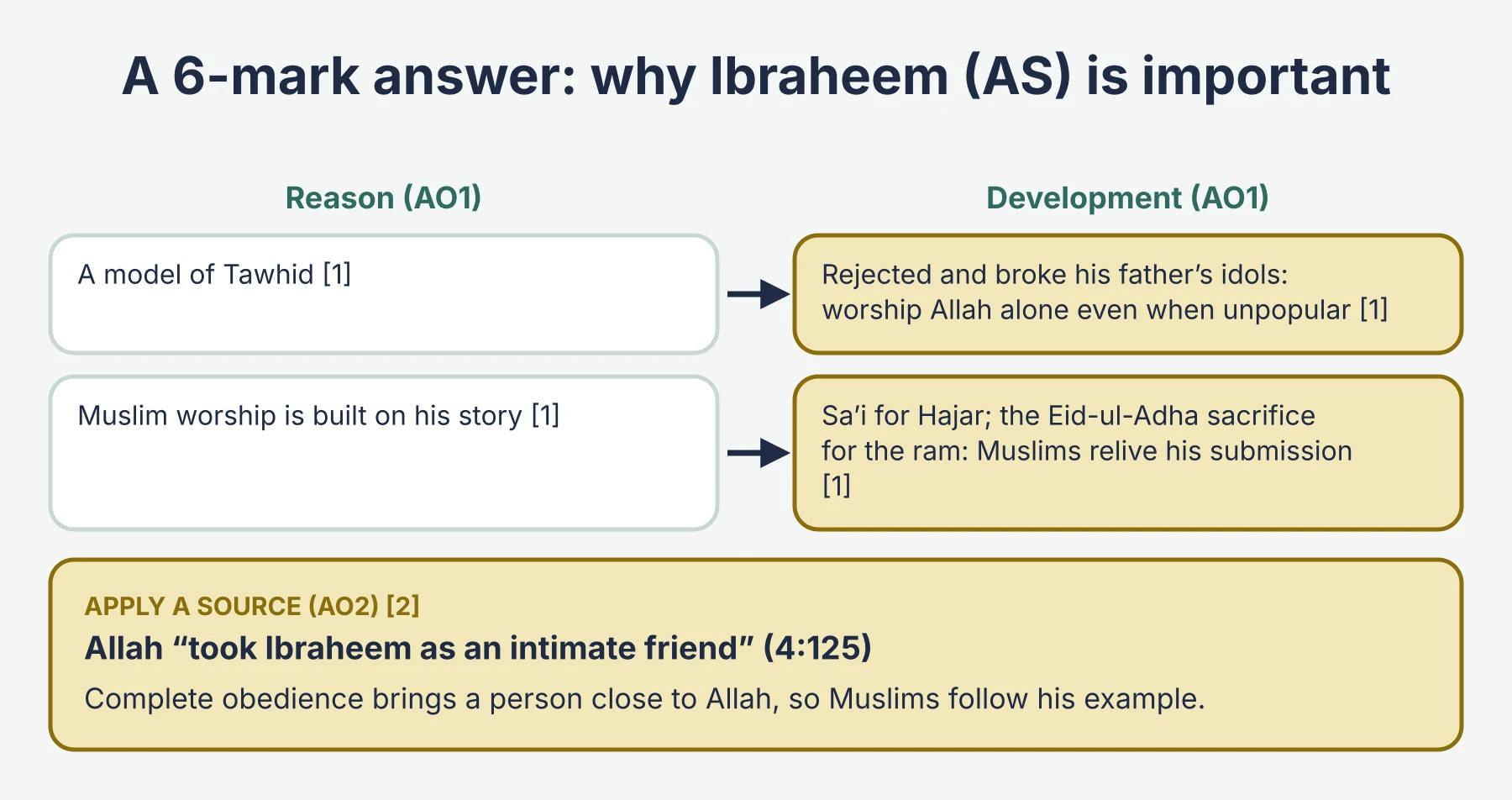
This statement sits in Paper 1 Section A. Expect a 1- or 2-mark recall item (a book, a title, an event), a 4-mark “explain two” item, a 6-mark item that also asks you to apply a source of authority, or a 12-mark answer using Qur’an 9:128-129, where you might compare the earlier prophets with the Seal of the Prophets.
Practise with the Prophets Adam, Ibraheem, Musa and Isa (AS) practice questions.
Source: OxfordAQA, International GCSE Islamiat (9237) specification, Version 1.1, content area 3.1.1.7.
Related resources
-
Study guides
OxfordAQA International GCSE Islamiat (9237): Salah
The meaning and importance of Salah: how and why Muslims pray, prayer at home and in the mosque, the role of Salah in daily life and Friday prayers (Jummah), for 9237 topic 3.1.2.3.
Islamiyat · OxfordAQA · IGCSE
Read guide -
Study guides
OxfordAQA International GCSE Islamiat (9237): Salah Conditions, Wudu, Azaan and Concessions
How and why Muslims pray: the conditions of Salah, times, Qiblah, Wudu, Azaan, recitation and concessions for travellers and the ill, for 9237 topic 3.1.2.3.
Islamiyat · OxfordAQA · IGCSE
Read guide -
Practice questions
OxfordAQA International GCSE Islamiat (9237): Salah Conditions, Wudu, Azaan and Concessions – Practice Questions
Twelve original questions with mark guidance on Salah: conditions, times, Qiblah, Wudu, Azaan, recitation, concessions, and prayer at home and in the mosque.
Islamiyat · OxfordAQA · IGCSE
Try questions
Get free revision emails (optional)
Occasional emails with practice questions, worked explanations and links to free resources for the qualification and subjects you choose. No spam, and you can unsubscribe from any email. The free tools on this site never need an email.