
Study Guides
OxfordAQA International GCSE Islamiat (9237): Salah Conditions, Wudu, Azaan and Concessions
How and why Muslims pray: the conditions of Salah, times, Qiblah, Wudu, Azaan, recitation and concessions for travellers and the ill, for 9237 topic 3.1.2.3.
- Subject
- Islamiyat
- Level
- IGCSE
- Topic
- Paper 1 – Living the Muslim Life
- Author
- Marlbridge Academic Team
- Updated
- Reviewed by
- Azam Siddique (what this means)
Aligned to OxfordAQA IGCSE Islamiyat (9237), Version 1.1. Official specification .
Syllabus page (what it covers and how it is assessed): OxfordAQA IGCSE Islamiyat.
Syllabus points this page covers
9237
- 3.1.2 Islam: Practices
Found an error? Report a correction.
Need help with this topic? Request a free trial class for IGCSE Islamiyat (9237).
This guide covers the first half of content area 3.1.2.3 of OxfordAQA International GCSE Islamiat (9237): “how and why Muslims pray, including the conditions of Salah, times, directions, ablution (Wudu), Azaan, recitation, and concessions for those that are travelling or for the ill”, together with “Salah at home and at the mosque”. The Living the Muslim Life study guide names the five prayers and their times. This page explains the practical rules a candidate needs for short-answer and “explain” questions, and the reasons behind each rule.
The conditions of Salah (shurut)
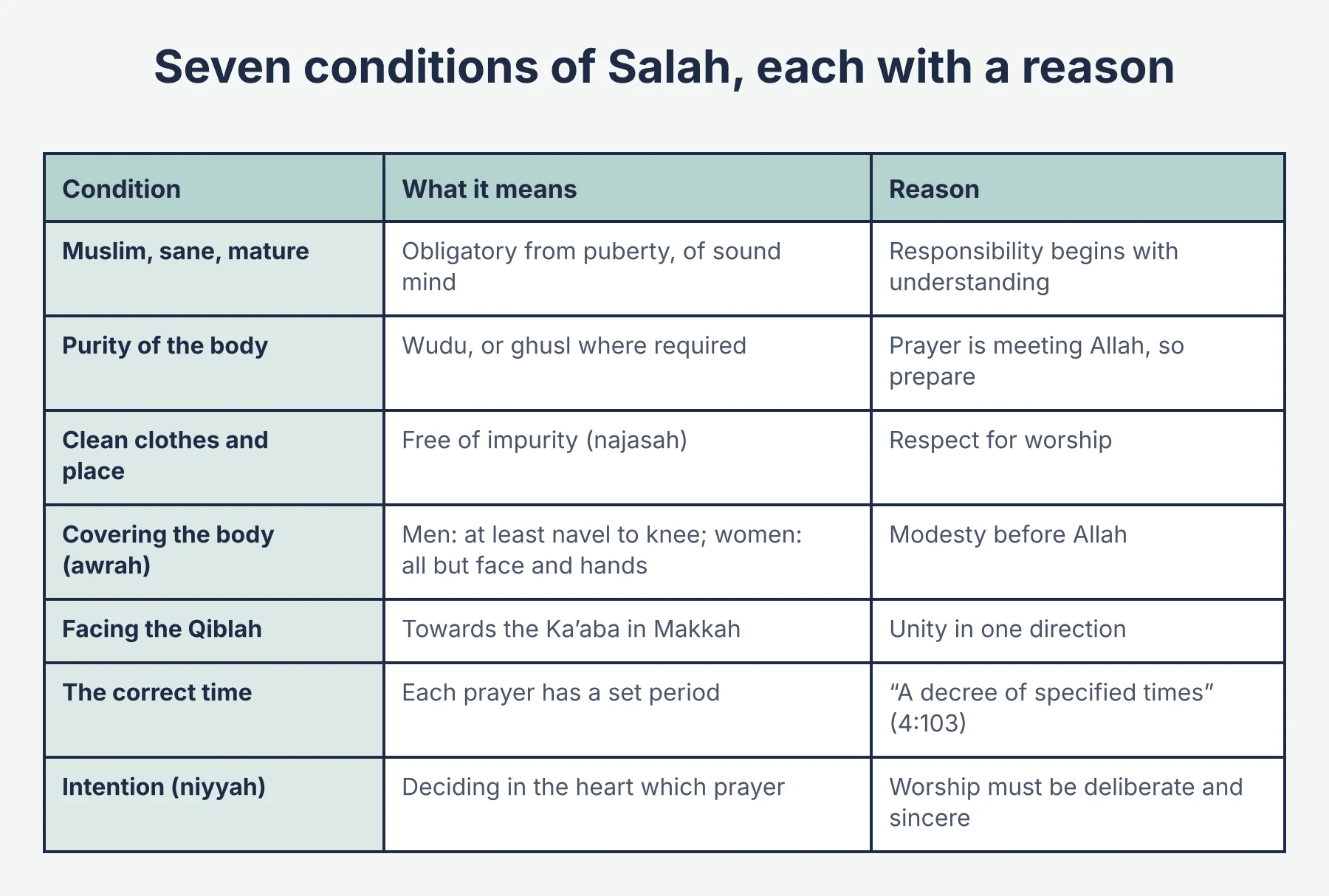
Before a prayer is valid, certain conditions must be met. Learn them as a list, then learn a reason for each:
| Condition | What it means | Reason |
|---|---|---|
| Being Muslim, sane and mature | Salah is obligatory from puberty for anyone of sound mind | Responsibility begins when a person can understand it |
| Purity of the body | Wudu, or ghusl where required | Prayer is meeting Allah, so the worshipper prepares |
| Clean clothes and place | Free of impurity (najasah); a prayer mat is common | Respect for worship |
| Covering the body (awrah) | Men at least from navel to knee; women all but face and hands | Modesty before Allah |
| Facing the Qiblah | Towards the Ka’aba in Makkah | Unity of all Muslims in one direction |
| The correct time | Each prayer has a set period | “Prayer has been decreed upon the believers a decree of specified times” (4:103) |
| Intention (niyyah) | Deciding in the heart which prayer is being offered | Worship must be deliberate and sincere |
Times
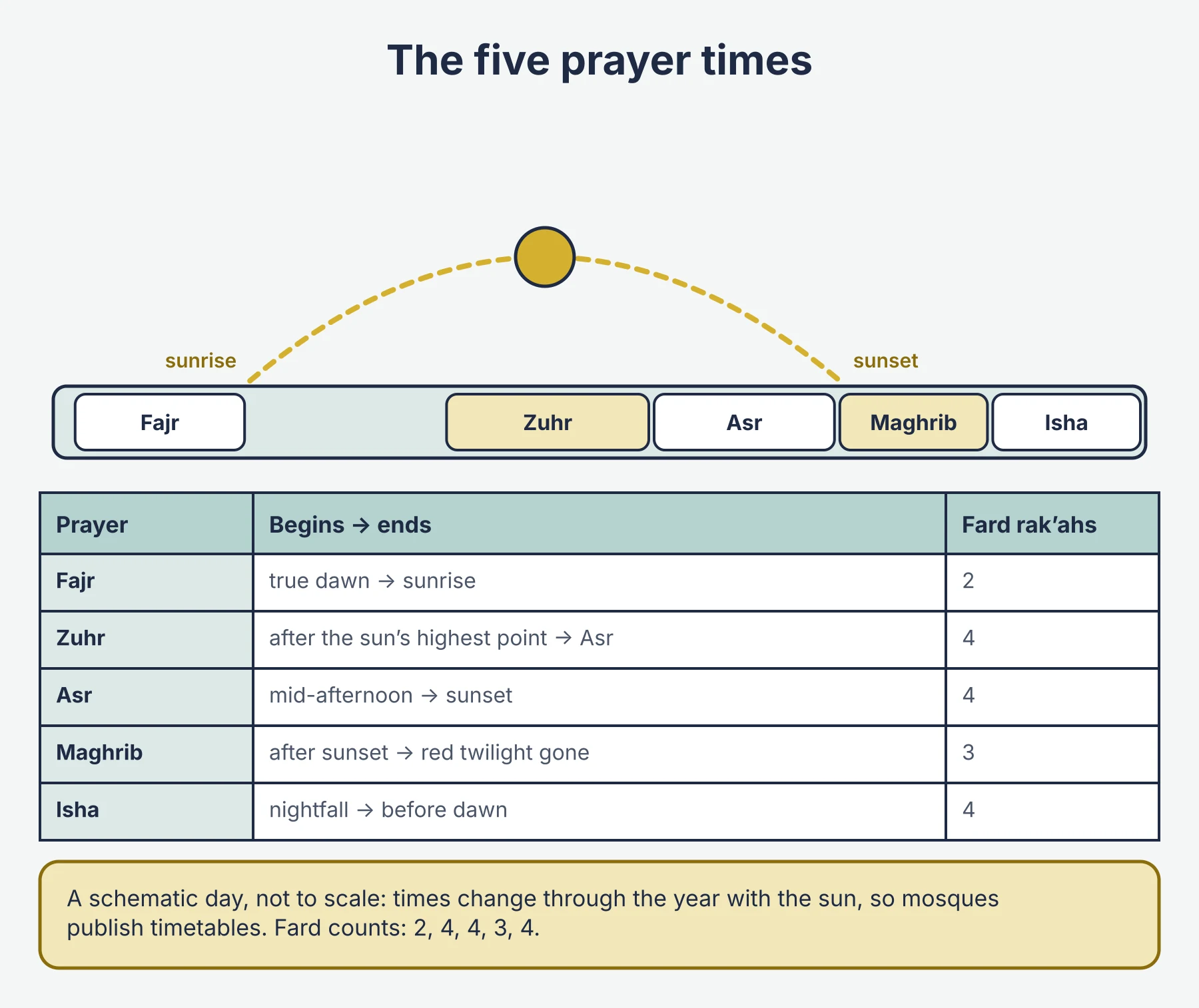
| Prayer | Begins | Ends | Fard rak’ahs |
|---|---|---|---|
| Fajr | True dawn | Sunrise | 2 |
| Zuhr | Just after the sun passes its highest point | When Asr begins | 4 |
| Asr | Mid-afternoon, when shadows lengthen | Sunset (delaying until the sun yellows is disliked) | 4 |
| Maghrib | Just after sunset | When the red twilight disappears | 3 |
| Isha | Nightfall | Before dawn (many scholars prefer before midnight) | 4 |
Prayer times change through the year with the sun, so mosques publish timetables. Praying at fixed times breaks up the day so that a Muslim never goes long without remembering Allah.
Direction: the Qiblah
At first the Muslims prayed towards Jerusalem. In Madinah the Qiblah was changed: “So turn your face toward al-Masjid al-Haram. And wherever you [believers] are, turn your faces toward it” (2:144). The Ka’aba is not worshipped; it is a focus that unites Muslims across the world, who form circles around it in Makkah and rows facing it everywhere else. If someone genuinely cannot work out the direction, they make their best judgement and their prayer is valid.
Ablution: Wudu
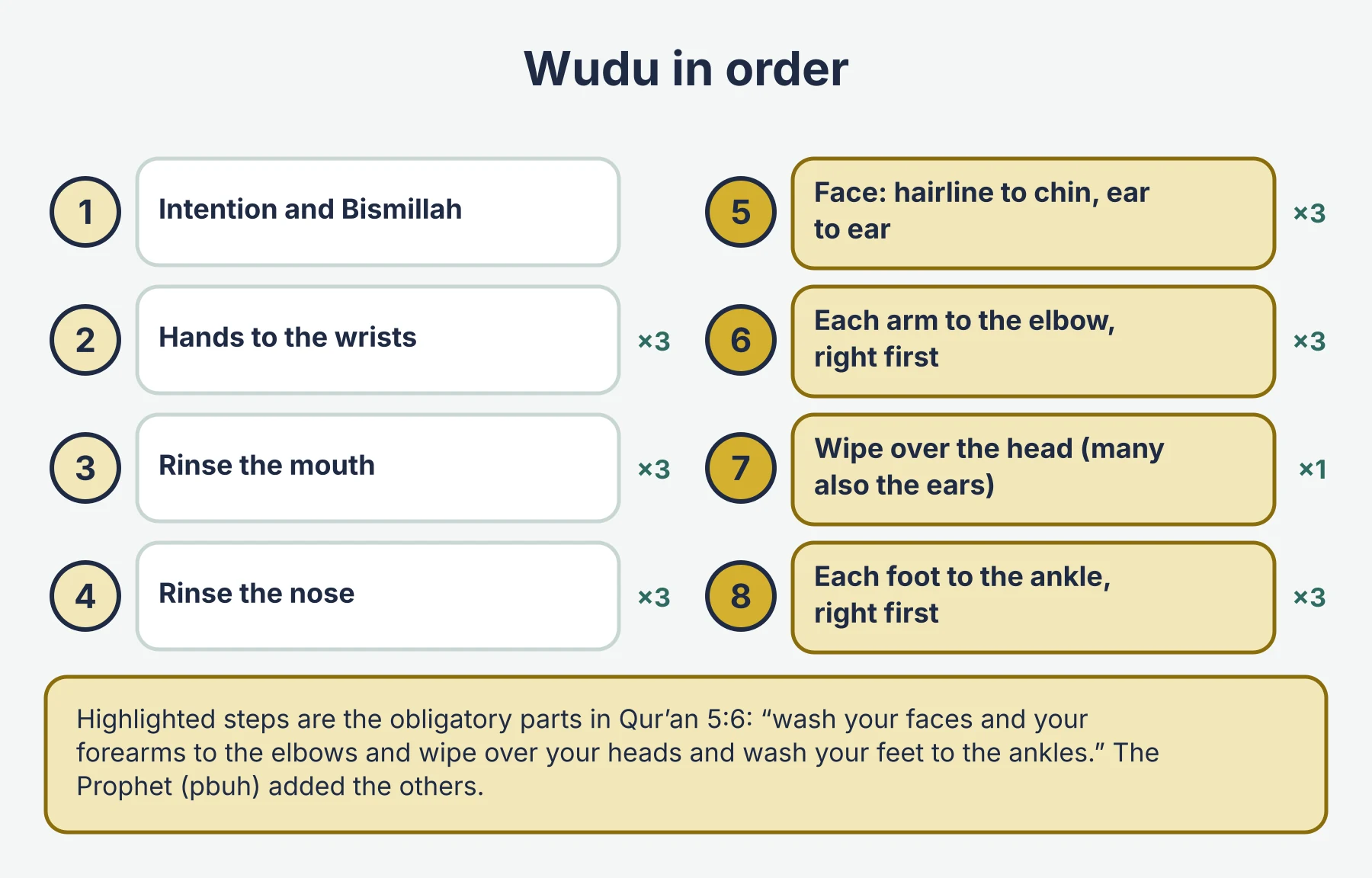
The obligatory parts of Wudu are in Qur’an 5:6: “wash your faces and your forearms to the elbows and wipe over your heads and wash your feet to the ankles.” The Prophet (pbuh) added further actions, so the usual order is:
- Make the intention and say Bismillah.
- Wash the hands to the wrists, three times.
- Rinse the mouth, three times.
- Rinse the nose, three times.
- Wash the face from hairline to chin and ear to ear, three times.
- Wash each arm to the elbow, right first, three times.
- Wipe over the head with wet hands, once (many also wipe the ears).
- Wash each foot to the ankle, right first, three times.
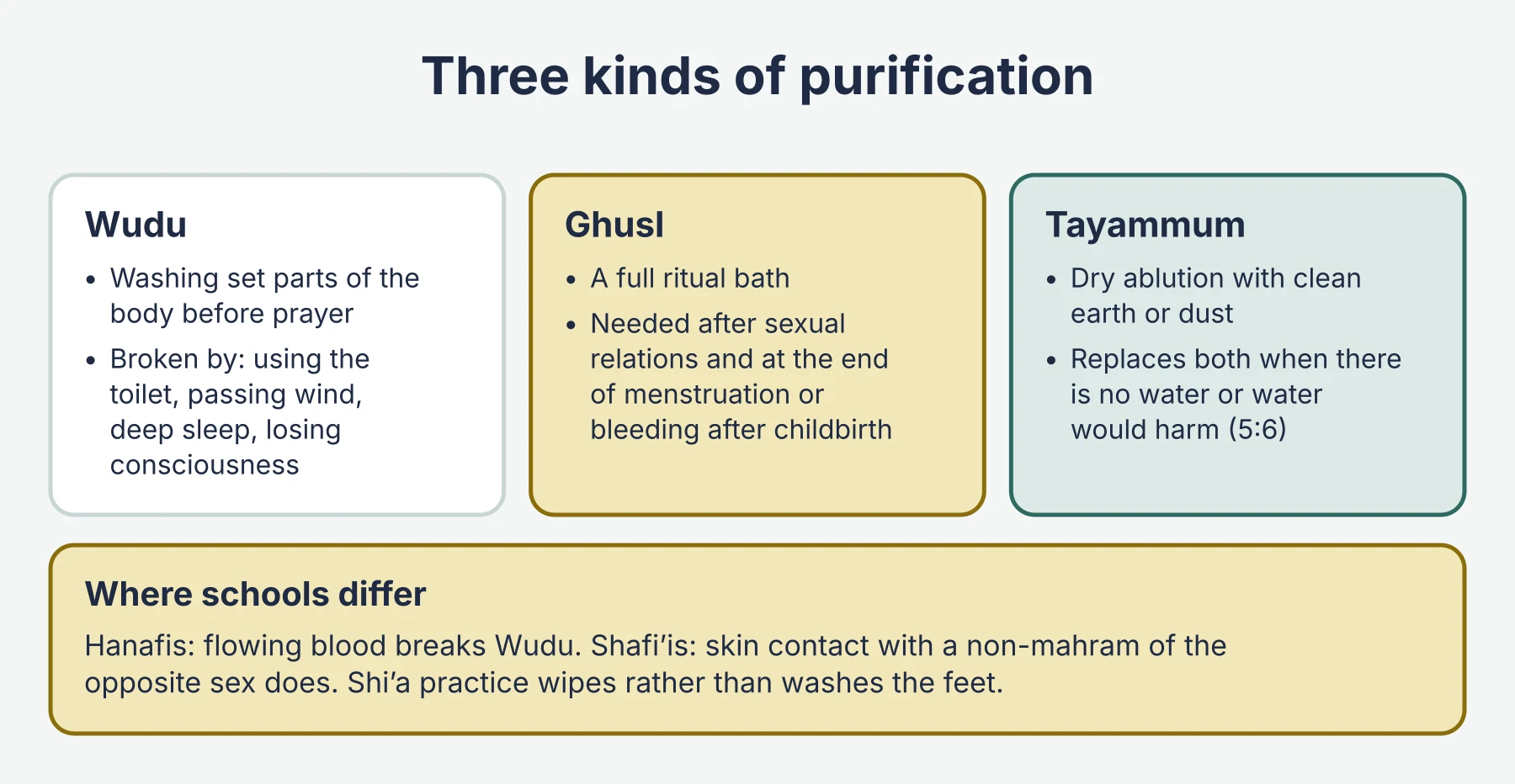
What breaks Wudu: using the toilet, passing wind, deep sleep and losing consciousness. Schools differ on others: for example, Hanafis hold that flowing blood breaks Wudu, while Shafi’is hold that skin contact with a non-mahram of the opposite sex does.
Ghusl (a full ritual bath) is needed after sexual relations and at the end of menstruation or bleeding after childbirth. Tayammum (dry ablution with clean earth or dust) replaces both when no water is available or water would cause harm (5:6). Shi’a practice differs in detail, for example wiping rather than washing the feet.
Azaan and Iqamah
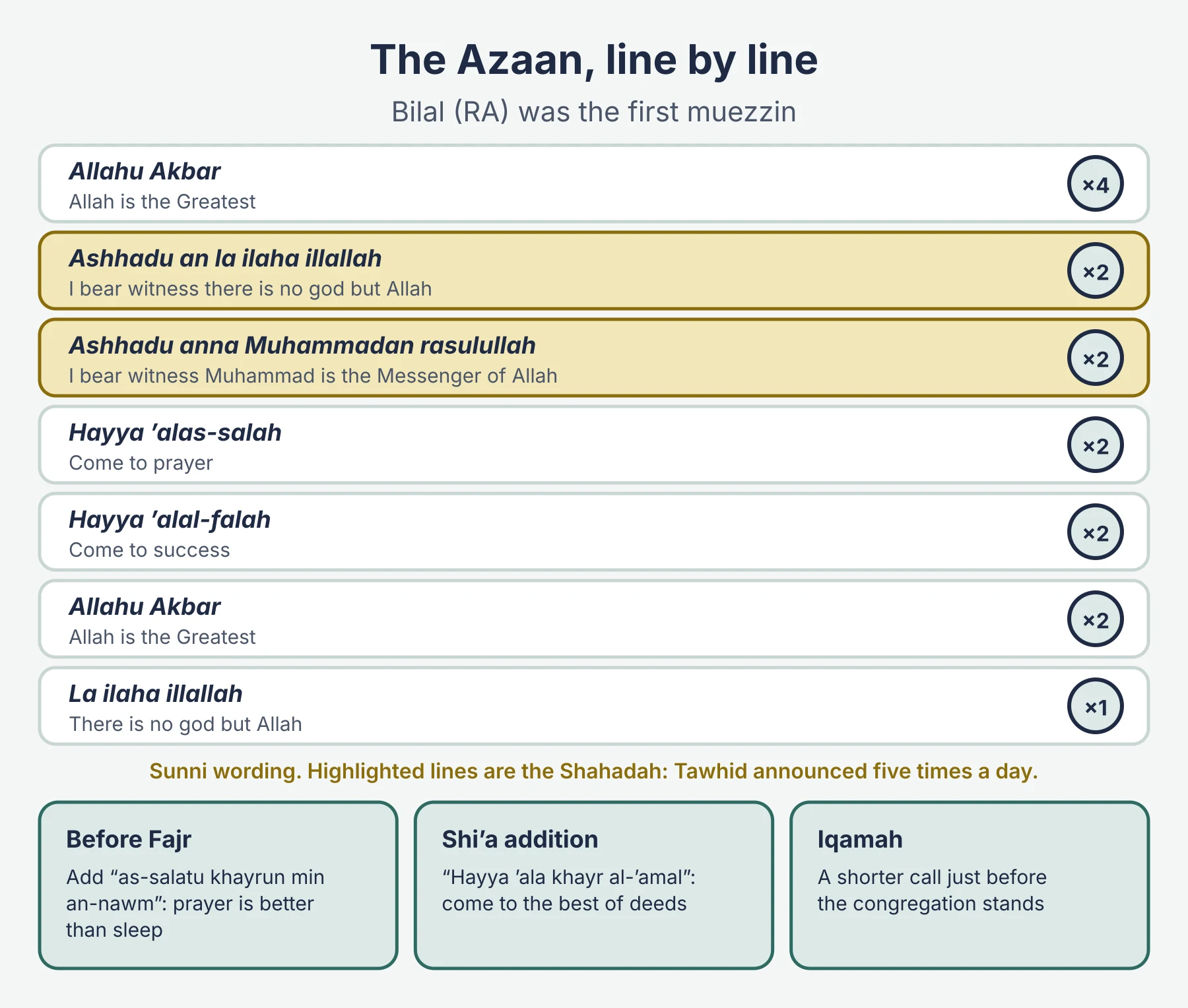
The Azaan calls Muslims to each prayer. Bilal (RA) was the first muezzin. The Sunni wording is:
- Allahu Akbar (Allah is the Greatest), four times
- Ashhadu an la ilaha illallah (I bear witness there is no god but Allah), twice
- Ashhadu anna Muhammadan rasulullah (I bear witness Muhammad is the Messenger of Allah), twice
- Hayya ’alas-salah (Come to prayer), twice
- Hayya ’alal-falah (Come to success), twice
- Allahu Akbar, twice
- La ilaha illallah, once
Before Fajr, as-salatu khayrun min an-nawm (prayer is better than sleep) is added. Shi’a Muslims add Hayya ’ala khayr al-’amal (come to the best of deeds). The Iqamah, a shorter call, is given just before the congregation stands. The Azaan contains the Shahadah, so it announces Tawhid publicly five times a day.
Recitation and movements
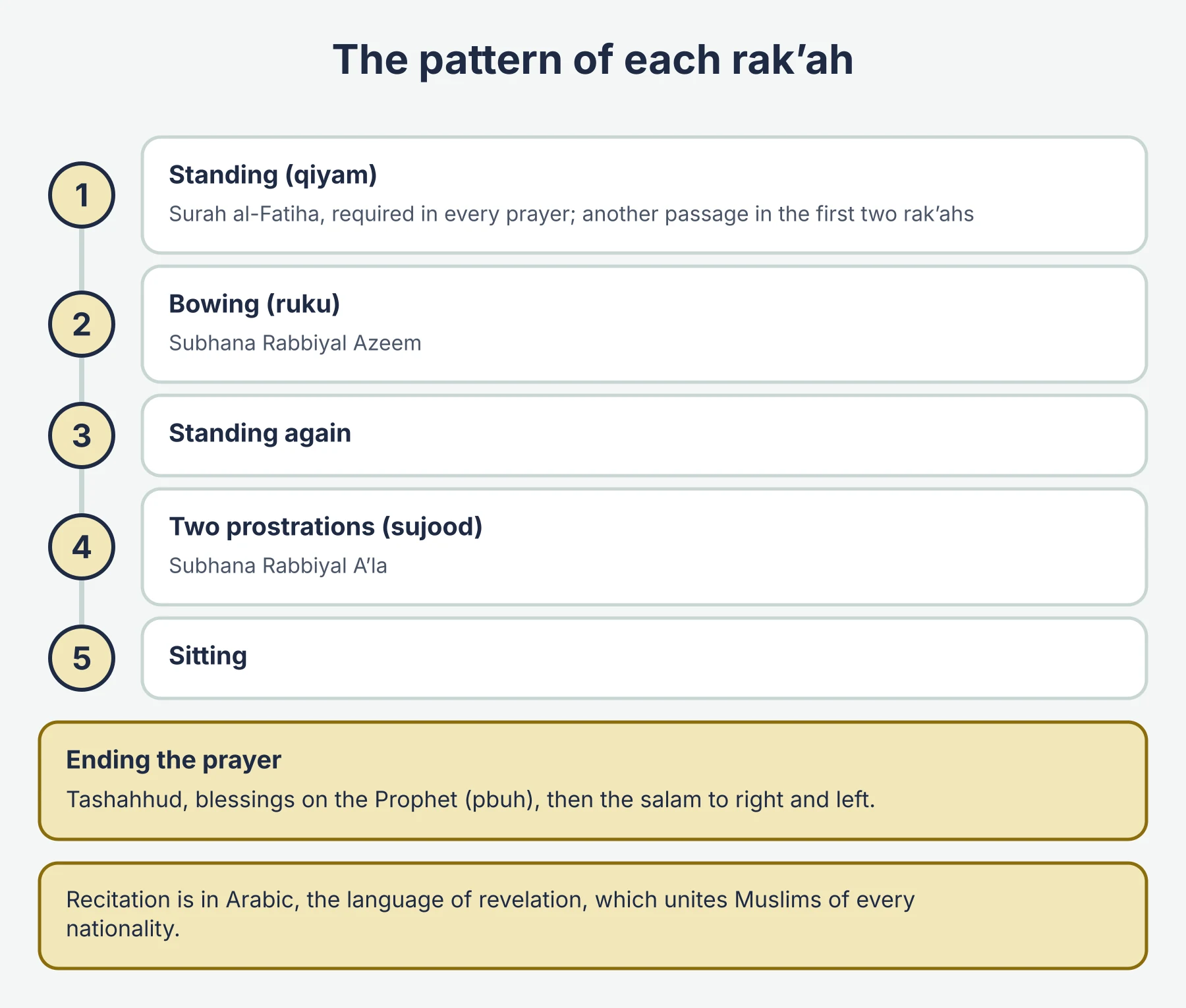
Each rak’ah follows the same pattern: standing (qiyam) and reciting Surah al-Fatiha, which the Prophet (pbuh) said is required in every prayer; another passage in the first two rak’ahs; bowing (ruku), saying Subhana Rabbiyal Azeem; standing again; two prostrations (sujood), saying Subhana Rabbiyal A’la; and sitting. The prayer ends with the tashahhud, blessings on the Prophet (pbuh) and the salam to right and left. Recitation is in Arabic, the language of revelation, which unites Muslims of every nationality.
Concessions (rukhsah)
Islam makes Salah possible in every situation rather than excusing people from it:
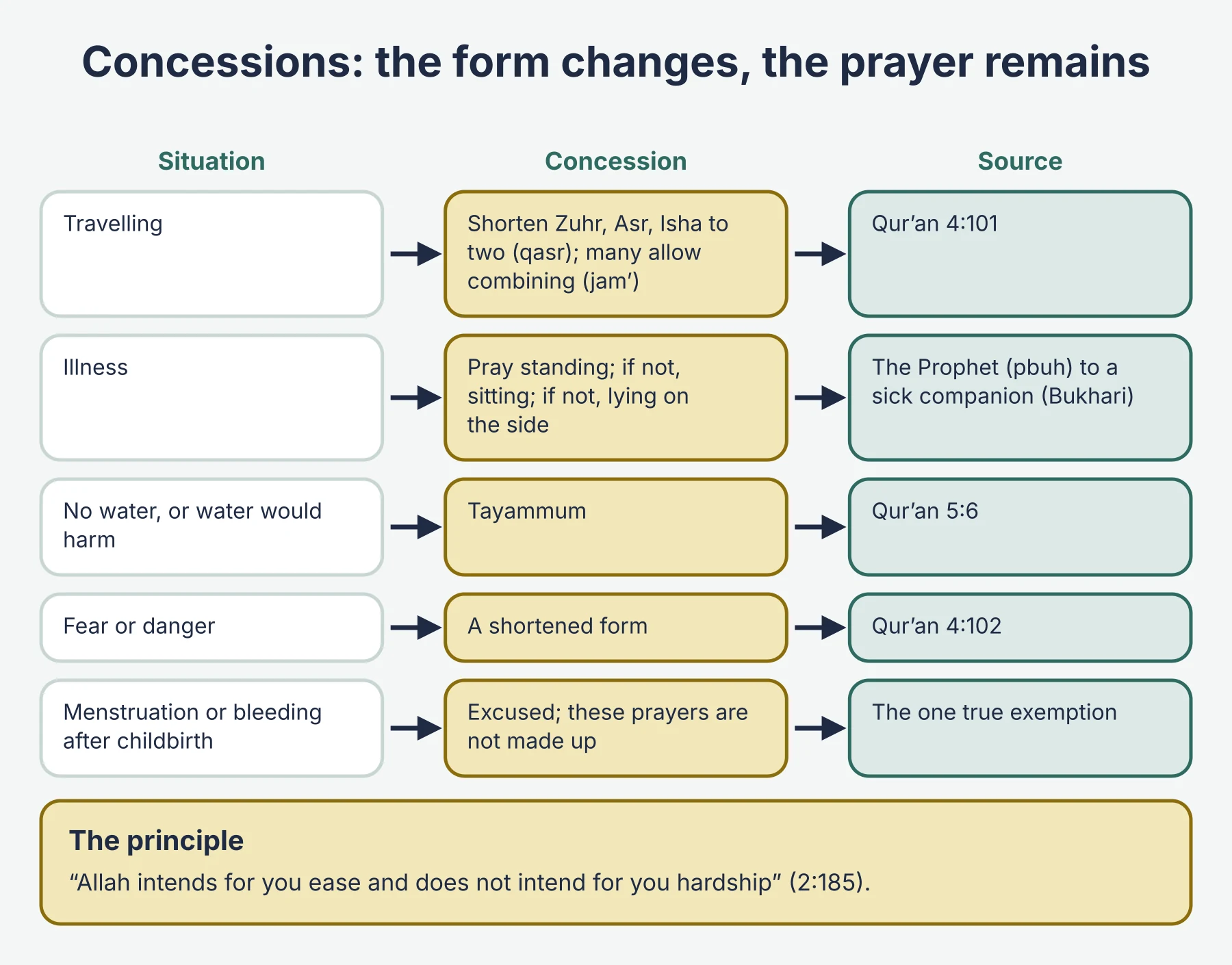
- Travellers: shorten four-rak’ah prayers (Zuhr, Asr, Isha) to two (qasr), as permitted in Qur’an 4:101. Many scholars also allow combining Zuhr with Asr and Maghrib with Isha (jam’); Hanafis generally allow combining only at Arafat and Muzdalifah during Hajj.
- The ill: the Prophet (pbuh) told a sick companion to pray standing, and if he could not, sitting, and if he could not, lying on his side (Sahih al-Bukhari). Movements can be shown with the head or eyes.
- No water, or water would harm: Tayammum.
- Women during menstruation or bleeding after childbirth: excused from Salah, and these prayers are not made up.
- Fear or danger: the Qur’an describes a shortened form for times of war (4:102).
The principle behind all of them is in the Sawm passage for 3.1.2.4: “Allah intends for you ease and does not intend for you hardship” (2:185).
Salah at home and at the mosque
- At the mosque: the Prophet (pbuh) said that prayer in congregation is twenty-seven times better than prayer alone (Sahih al-Bukhari and Sahih Muslim). The congregation stands shoulder to shoulder behind an imam, which teaches equality and discipline.
- At home: many Muslims pray at home, especially when far from a mosque. The Prophet (pbuh) told Muslims to offer some prayers at home and “not make your houses graves” (Sahih al-Bukhari), so voluntary prayers at home are encouraged. Women may attend the mosque, and many pray at home.
- Jummah: on Friday the midday prayer is replaced by Jummah, with a khutbah, in congregation (Qur’an 62:9-11).
Worked example: a 4-mark answer
Question: Explain two concessions in Salah for Muslims who are travelling or ill. [4]
A traveller may shorten the four-rak’ah prayers to two rak’ahs [1]. This shows that Allah does not want worship to become a burden on a journey, and the Qur’an allows it in 4:101 [1]. A Muslim who is ill may pray sitting down, or lying on their side if they cannot sit [1]. This means no one is excused from remembering Allah, but each person prays in the way their health allows, following the Prophet’s (pbuh) instruction to a sick companion [1].
Common mistakes
- Treating concessions as exemptions. The ill and travellers still pray; only the form changes. Women during menstruation are the exception.
- Confusing Azaan and Iqamah, or Wudu and Ghusl.
- Saying Muslims worship the Ka’aba. It is a direction, not an object of worship.
- Inventing a fixed number of rak’ahs for every prayer. Learn the fard counts: 2, 4, 4, 3, 4.
- Describing without explaining. A 4-mark answer needs a reason for each rule.
Exam technique
Give two conditions wants two items from the conditions list. Explain two ways Muslims prepare for prayer wants an action plus its meaning (Wudu, then purity of body and mind). For a 6-mark answer, quote 4:103, 5:6 or 29:45 (“prayer prohibits immorality and wrongdoing”) and say how the verse supports your point. The prescribed passage for the 12-mark question on 3.1.2.3 is Qur’an 62:9-11.
Related pages
- Salah conditions, Wudu, Azaan and concessions revision notes
- Salah conditions, Wudu, Azaan and concessions practice questions
- Islam: Practices practice questions
Source: OxfordAQA, International GCSE Islamiat (9237) specification, Version 1.1, content area 3.1.2.3 and Passage 11.
Related resources
-
Practice questions
OxfordAQA International GCSE Islamiat (9237): Salah Conditions, Wudu, Azaan and Concessions – Practice Questions
Twelve original questions with mark guidance on Salah: conditions, times, Qiblah, Wudu, Azaan, recitation, concessions, and prayer at home and in the mosque.
Islamiyat · OxfordAQA · IGCSE
Try questions -
Revision notes
OxfordAQA International GCSE Islamiat (9237): Salah Conditions, Wudu, Azaan and Concessions – Revision Notes
Recall notes on the conditions of Salah, prayer times, the Qiblah, Wudu, the Azaan, recitation and concessions for travellers and the ill, 9237 topic 3.1.2.3.
Islamiyat · OxfordAQA · IGCSE
Revise topic -
Practice questions
OxfordAQA International GCSE Islamiat (9237): Salah – Practice Questions
Nine original questions with mark guidance on Salah: how and why Muslims pray, prayer at home and in the mosque, Jummah and Qur'an 62:9-11 (9237 topic 3.1.2.3).
Islamiyat · OxfordAQA · IGCSE
Try questions
Get free revision emails (optional)
Occasional emails with practice questions, worked explanations and links to free resources for the qualification and subjects you choose. No spam, and you can unsubscribe from any email. The free tools on this site never need an email.