
Revision Notes
OxfordAQA International GCSE Islamiat (9237): Salah Conditions, Wudu, Azaan and Concessions – Revision Notes
Recall notes on the conditions of Salah, prayer times, the Qiblah, Wudu, the Azaan, recitation and concessions for travellers and the ill, 9237 topic 3.1.2.3.
- Subject
- Islamiyat
- Level
- IGCSE
- Topic
- Paper 1 – Living the Muslim Life
- Author
- Marlbridge Academic Team
- Updated
- Reviewed by
- Azam Siddique (what this means)
Aligned to OxfordAQA IGCSE Islamiyat (9237), Version 1.1. Official specification .
Syllabus page (what it covers and how it is assessed): OxfordAQA IGCSE Islamiyat.
Syllabus points this page covers
9237
- 3.1.2 Islam: Practices
Found an error? Report a correction.
Need help with this topic? Request a free trial class for IGCSE Islamiyat (9237).
These notes condense part of content area 3.1.2.3 of 9237: “how and why Muslims pray, including the conditions of Salah, times, directions, ablution (Wudu), Azaan, recitation, and concessions for those that are travelling or for the ill. Salah at home and at the mosque.” The full explanation is in the Salah conditions, Wudu, Azaan and concessions study guide; the wider practices topic is in the Living the Muslim Life revision notes.
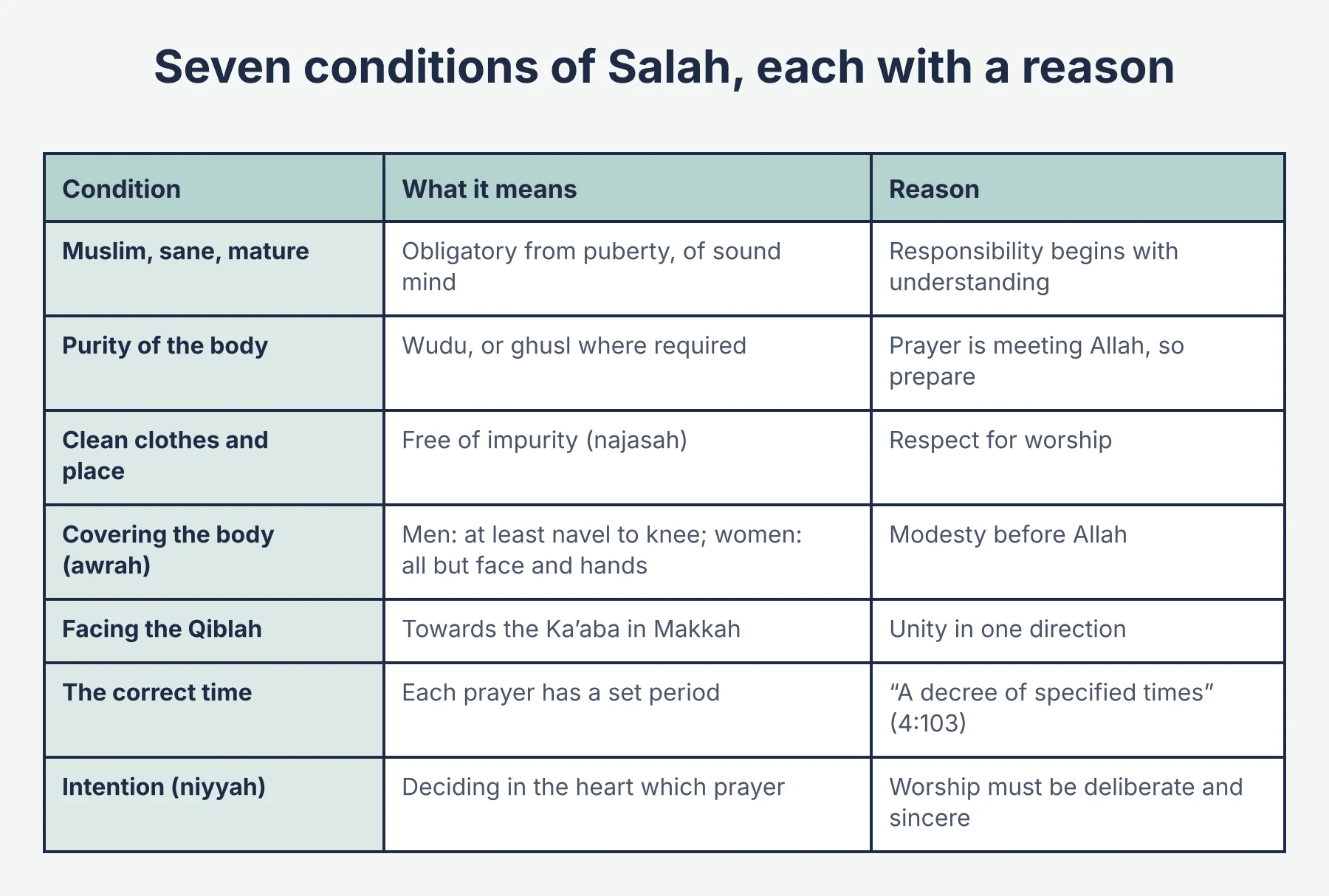
Conditions in seven words
Muslim, mature, pure, clean, covered, Qiblah, time, plus niyyah. If any one is missing (for example, Wudu has been broken), the prayer is not valid.
Times and rak’ahs
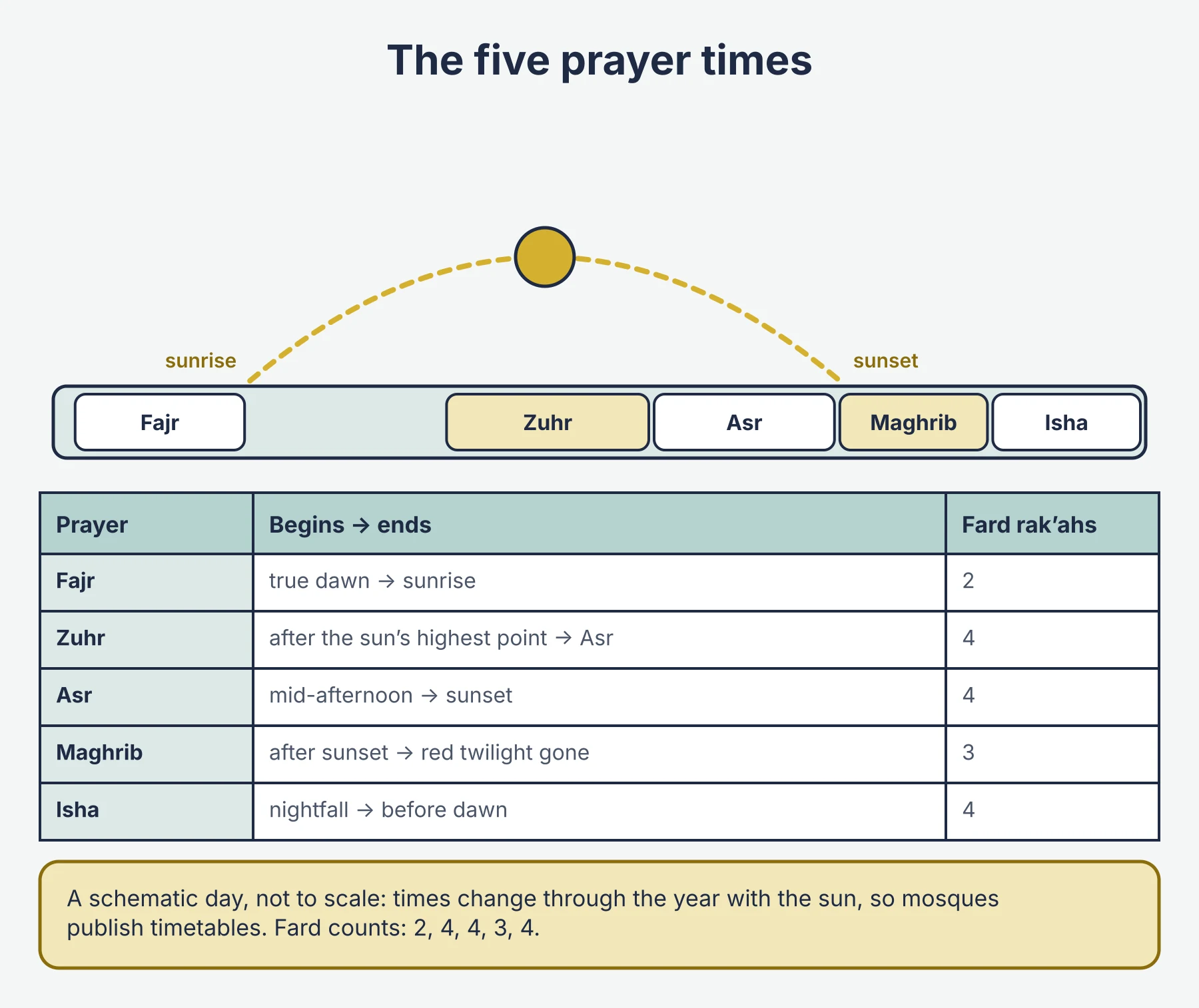
| Prayer | Window | Fard rak’ahs |
|---|---|---|
| Fajr | Dawn → sunrise | 2 |
| Zuhr | After midday → Asr | 4 |
| Asr | Afternoon → sunset | 4 |
| Maghrib | Sunset → twilight ends | 3 |
| Isha | Night → dawn | 4 |
Total: 17 fard rak’ahs a day. Evidence: “a decree of specified times” (4:103).
Wudu order
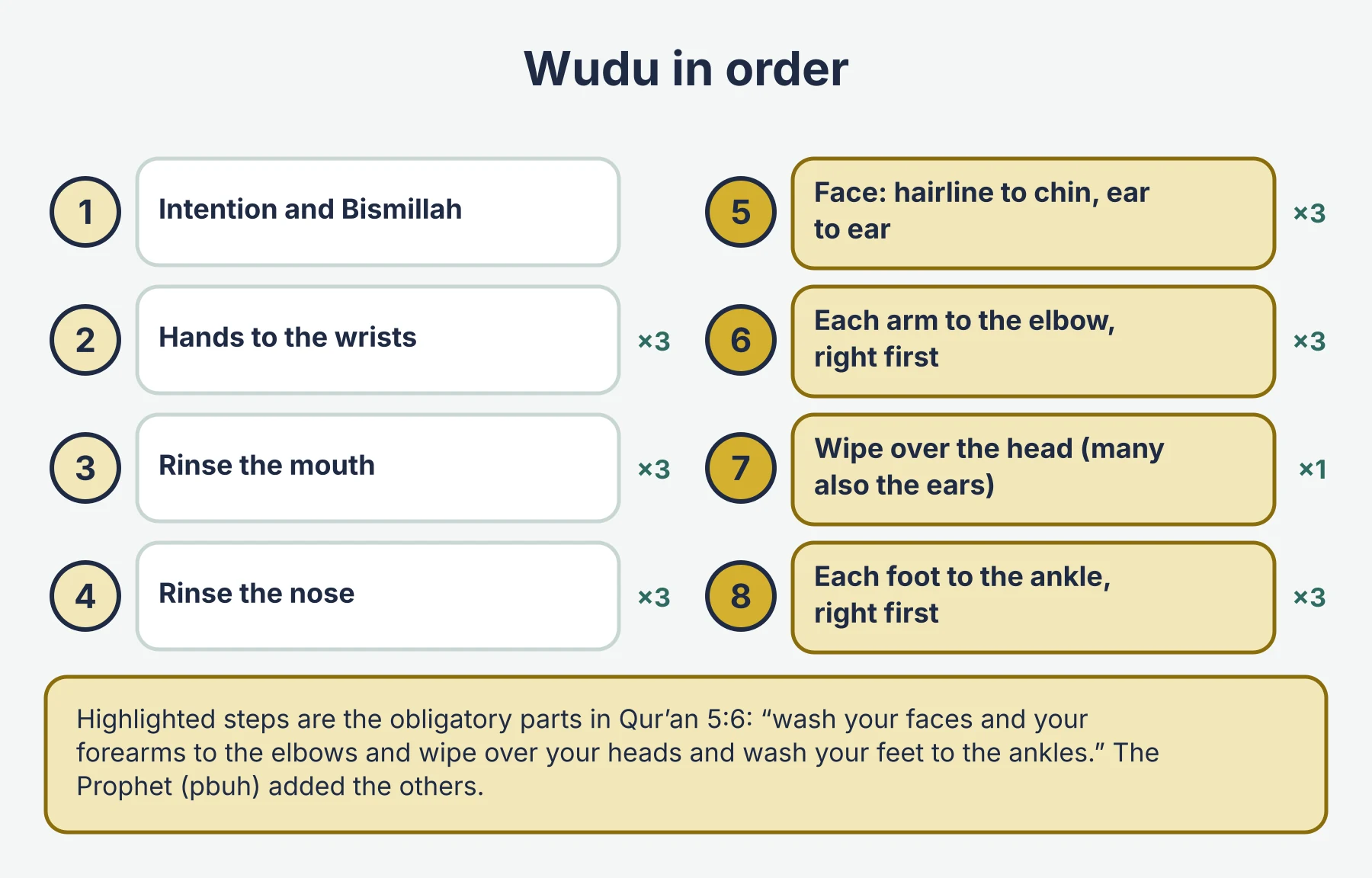
Niyyah and Bismillah → hands ×3 → mouth ×3 → nose ×3 → face ×3 → arms to elbows ×3, right first → wipe head (and ears) → feet to ankles ×3, right first.
- Qur’an basis: face, arms, wipe head, feet (5:6).
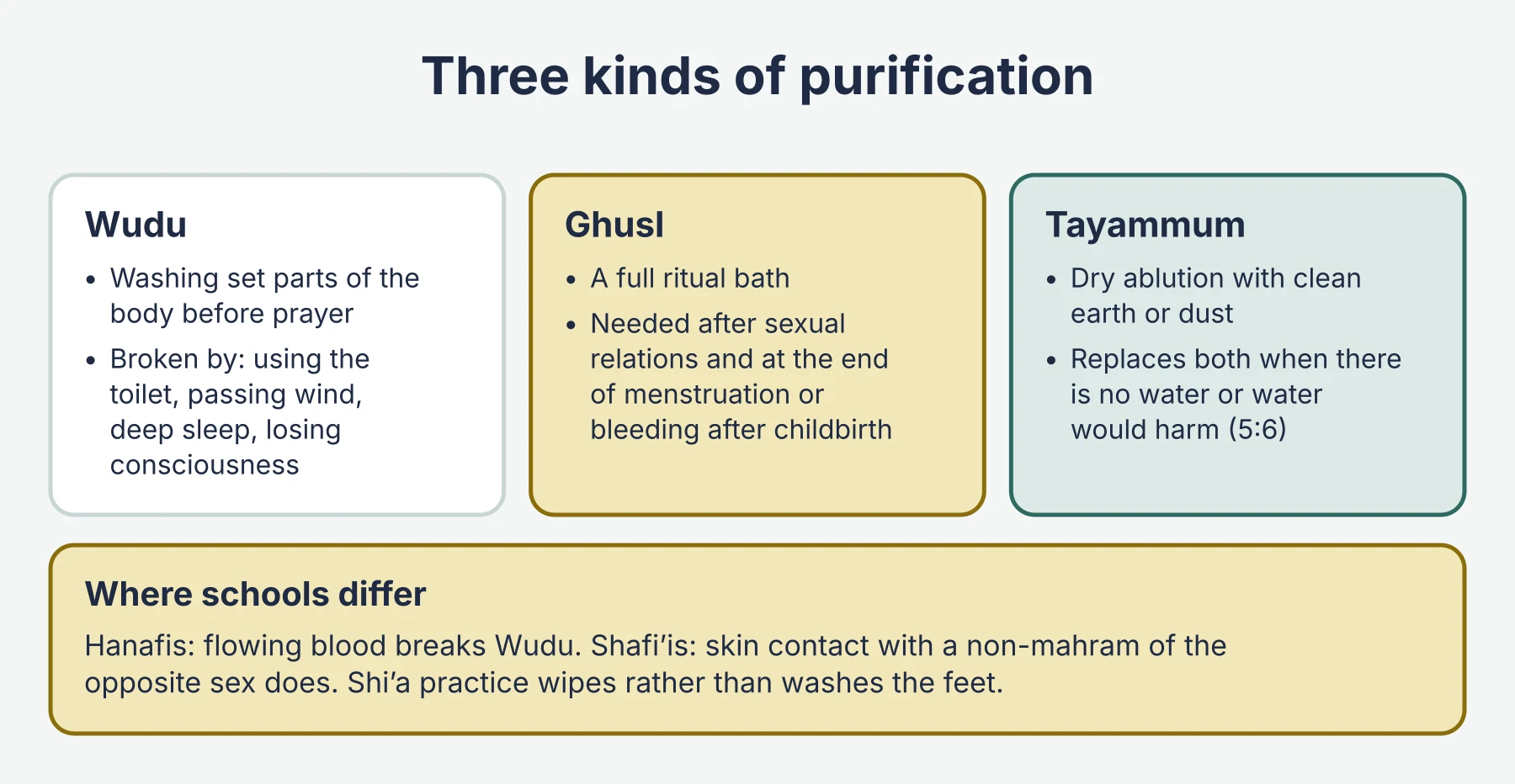
- Broken by: toilet, wind, deep sleep, unconsciousness. Schools add others (Hanafi: flowing blood; Shafi’i: touching the skin of a non-mahram of the opposite sex).
- Ghusl needed after sexual relations and after menstruation or post-natal bleeding.
- Tayammum if no water or water would harm (5:6).
Azaan
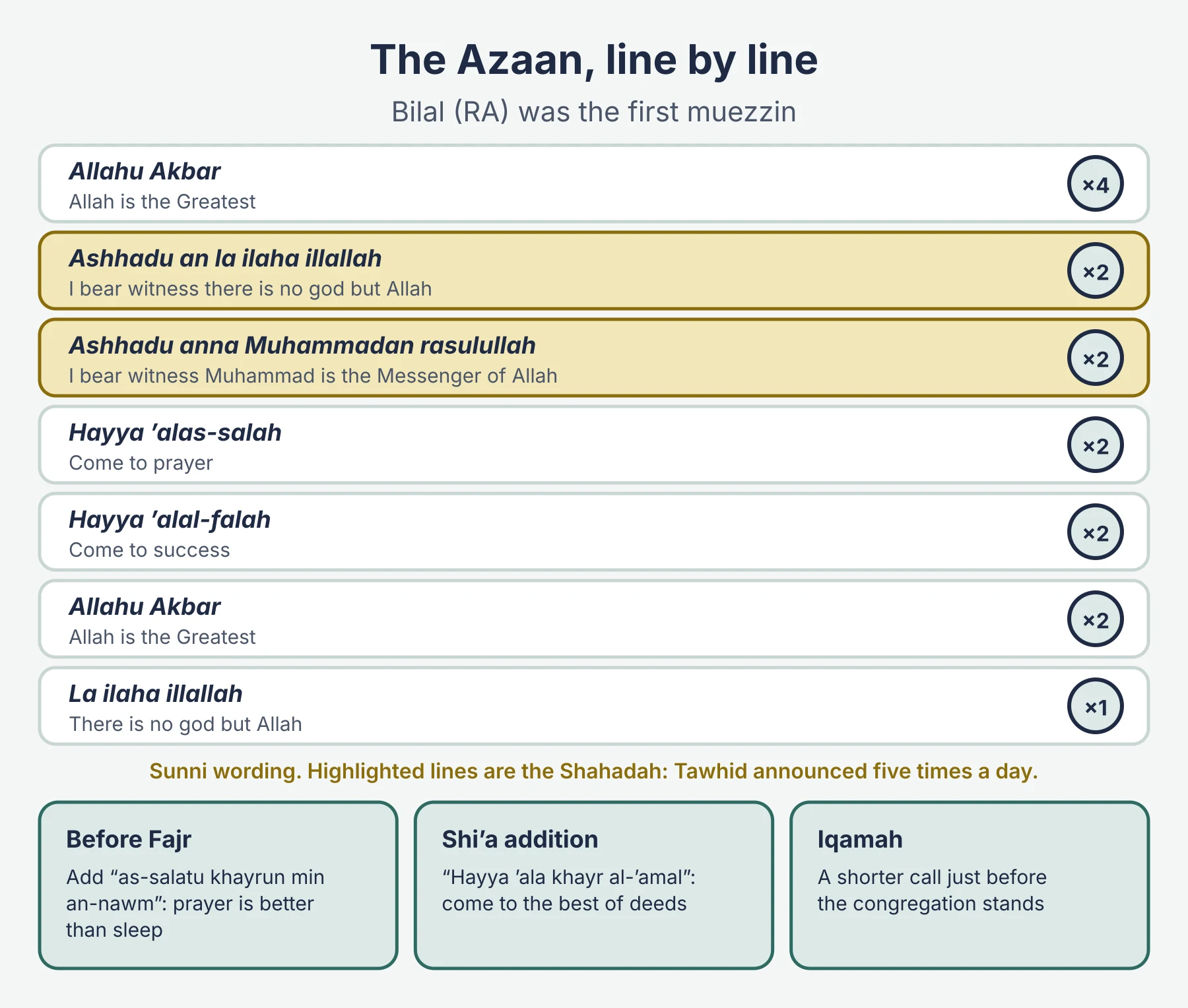
Allahu Akbar ×4 → Ashhadu an la ilaha illallah ×2 → Ashhadu anna Muhammadan rasulullah ×2 → Hayya ’alas-salah ×2 → Hayya ’alal-falah ×2 → Allahu Akbar ×2 → La ilaha illallah ×1.
- Fajr adds as-salatu khayrun min an-nawm.
- Shi’a add Hayya ’ala khayr al-’amal.
- Iqamah: shorter second call as the congregation stands.
- First muezzin: Bilal (RA).
One rak’ah
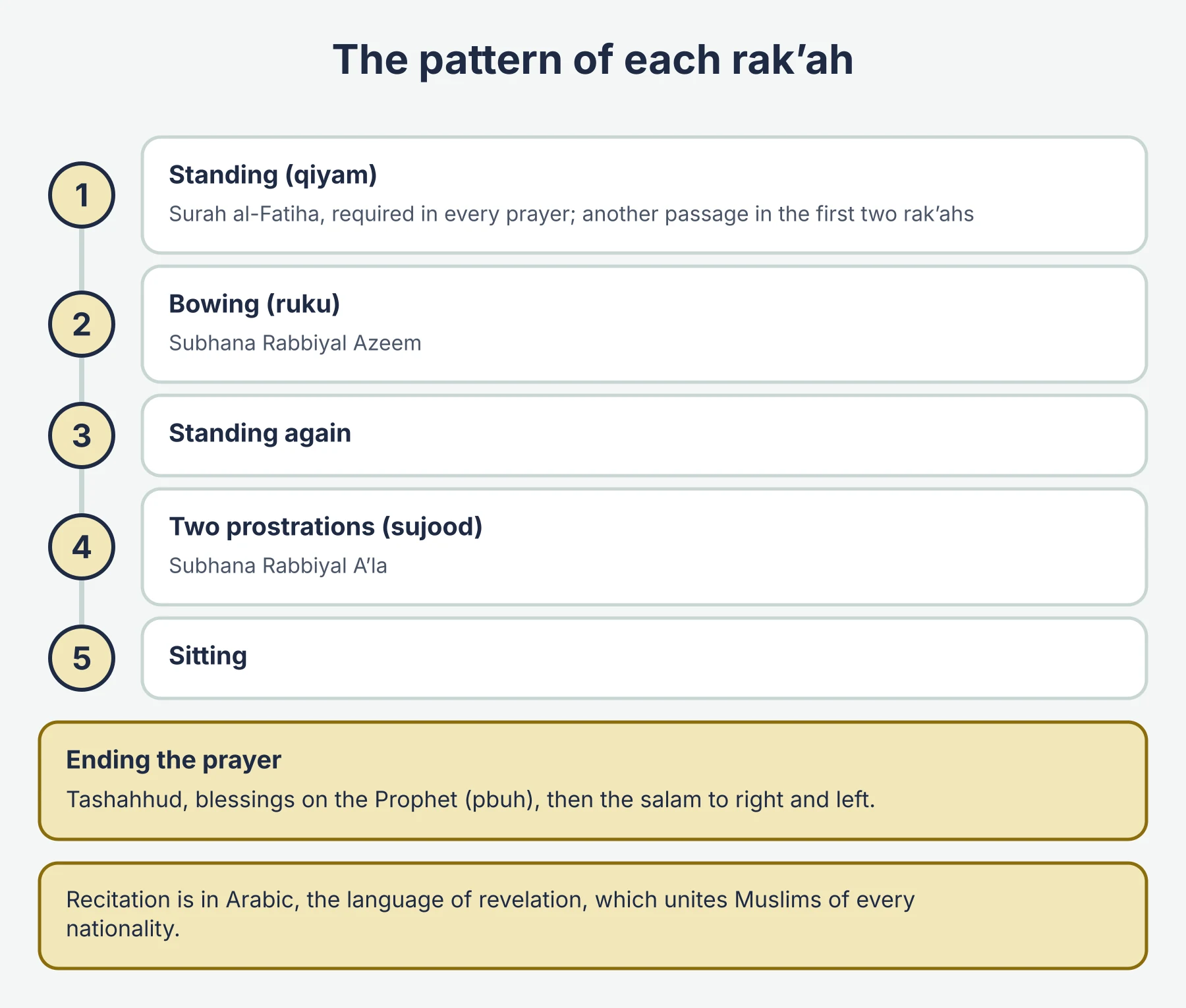
Takbir → qiyam with al-Fatiha (+ another passage in the first two rak’ahs) → ruku (Subhana Rabbiyal Azeem) → stand → sujood (Subhana Rabbiyal A’la) twice → sit. End: tashahhud → blessings on the Prophet (pbuh) → salam right and left.
Concessions
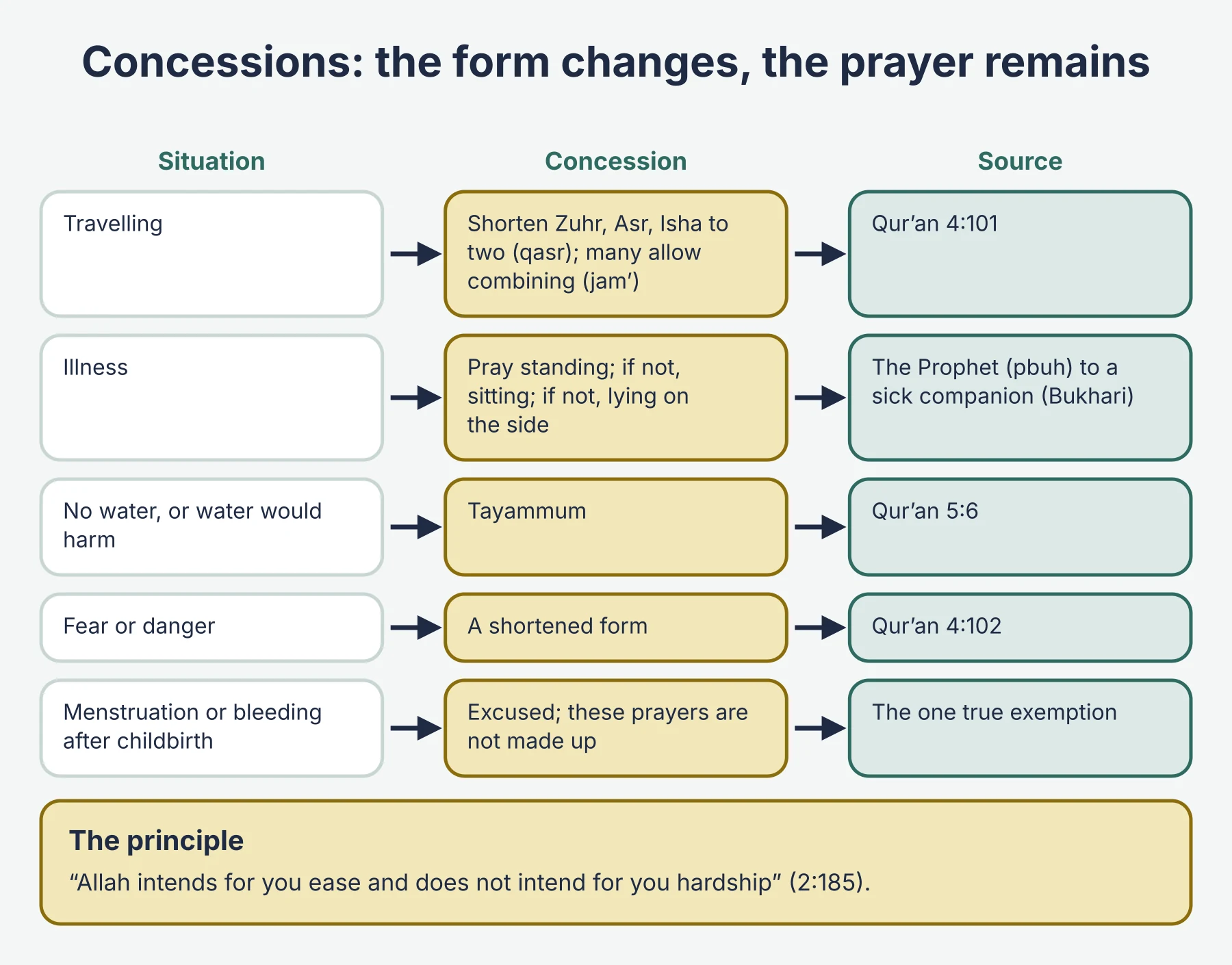
| Who | Concession | Source |
|---|---|---|
| Traveller | Shorten 4 rak’ahs to 2 (qasr); many schools allow combining (jam’) | Qur’an 4:101 |
| Ill | Pray sitting; if not, lying on the side; gestures for movements | Hadith in Sahih al-Bukhari |
| No safe water | Tayammum | Qur’an 5:6 |
| Menstruation / post-natal bleeding | Excused; not made up | Hadith |
| Danger in war | Shortened “fear prayer” | Qur’an 4:102 |
Principle: “Allah intends for you ease and does not intend for you hardship” (2:185).
Home and mosque
- Congregation is 27 times better than praying alone (Bukhari and Muslim).
- Pray some prayers at home and “do not make your houses graves” (Bukhari).
- Rows behind one imam → equality, discipline, unity.
- Jummah replaces Zuhr on Friday, with a khutbah (62:9-11).
Key terms
| Term | Meaning |
|---|---|
| Shurut | The conditions that must be met before Salah |
| Niyyah | Intention |
| Awrah | The parts of the body that must be covered |
| Najasah | Impurity |
| Wudu | Partial ablution before prayer |
| Ghusl | Full ritual bath |
| Tayammum | Dry ablution using clean earth |
| Qiblah | Direction of the Ka’aba |
| Azaan | The call to prayer |
| Iqamah | The second call as prayer begins |
| Rak’ah | One unit of prayer |
| Qasr | Shortening prayers when travelling |
| Jam’ | Combining two prayers |
| Rukhsah | A concession or allowance |
Why Salah matters: quick points
- Obedience: the second pillar, commanded at fixed times.
- Remembrance: five pauses keep Allah in mind all day.
- Purity: Wudu and clean clothes prepare body and mind.
- Behaviour: “prayer prohibits immorality and wrongdoing” (29:45).
- Unity: one Qiblah, one language of recitation, shared rows.
Using the prescribed passage (Qur’an 62:9-11)
The 12-mark question for 3.1.2.3 uses the Jummah passage. Learn three phrases and what each proves: “proceed to the remembrance of Allah and leave trade” (prayer comes first); “disperse within the land and seek from the bounty of Allah” (work resumes, so worship and daily life are balanced); “they rushed to it and left you standing” (a warning against putting trade or entertainment before prayer).
Exam traps
- Concessions change the form of prayer; they do not cancel it (except during menstruation).
- Wudu ≠ Ghusl; Azaan ≠ Iqamah; du’a ≠ Salah.
- Do not say the Ka’aba is worshipped.
- The Qiblah was once Jerusalem; it changed in Madinah (2:144).
- Name a difference between schools when the question invites “different” practice.
Self-test
- Give the verse that tells Muslims prayer has fixed times.
- Which parts of the body does Qur’an 5:6 say must be washed or wiped?
- What is added to the Fajr Azaan?
- How many fard rak’ahs are prayed at Maghrib?
- What is Tayammum, and when is it allowed?
- What does qasr mean?
- How should someone pray who cannot stand?
- Who was the first muezzin?
- Which surah must be recited in every rak’ah?
- Give one difference between the Sunni and Shi’a Azaan.
- How much more reward does congregational prayer bring, according to the Hadith?
- Towards which city did Muslims first pray?
Answers: 1. Qur’an 4:103. 2. The face, the arms to the elbows, the head (wiped) and the feet to the ankles. 3. As-salatu khayrun min an-nawm, “prayer is better than sleep”. 4. Three. 5. Dry ablution with clean earth or dust, allowed when no water is available or water would cause harm. 6. Shortening four-rak’ah prayers to two when travelling. 7. Sitting, or lying on the side if they cannot sit. 8. Bilal (RA). 9. Surah al-Fatiha. 10. Shi’a add Hayya ’ala khayr al-’amal. 11. Twenty-seven times. 12. Jerusalem.
Practise with the Salah conditions, Wudu, Azaan and concessions practice questions.
Source: OxfordAQA, International GCSE Islamiat (9237) specification, Version 1.1, content area 3.1.2.3.
Related resources
-
Practice questions
OxfordAQA International GCSE Islamiat (9237): Salah – Practice Questions
Nine original questions with mark guidance on Salah: how and why Muslims pray, prayer at home and in the mosque, Jummah and Qur'an 62:9-11 (9237 topic 3.1.2.3).
Islamiyat · OxfordAQA · IGCSE
Try questions -
Revision notes
OxfordAQA International GCSE Islamiat (9237): Salah – Revision Notes
Recall notes on why and how Muslims pray, Salah at home and in the mosque, Friday prayers (Jummah) and the role of Salah in daily life, for 9237 topic 3.1.2.3.
Islamiyat · OxfordAQA · IGCSE
Revise topic -
Study guides
OxfordAQA International GCSE Islamiat (9237): Sawm
The meaning and importance of fasting in Ramadhan: the rulings, the benefits, Taraweeh, Itikaaf and Laylat ul-Qadr, with Qur'an 2:183-185 and worked answers (9237 topic 3.1.2.4).
Islamiyat · OxfordAQA · IGCSE
Read guide
Get free revision emails (optional)
Occasional emails with practice questions, worked explanations and links to free resources for the qualification and subjects you choose. No spam, and you can unsubscribe from any email. The free tools on this site never need an email.