
Revision Notes
OxfordAQA International GCSE Islamiat (9237): Sawm Rulings, Taraweeh, Itikaaf and Laylat ul-Qadr – Revision Notes
Recall notes on the rulings of Sawm, exemptions, invalidating acts, qada and fidya, the benefits of fasting, Taraweeh, Itikaaf and Laylat ul-Qadr (9237).
- Subject
- Islamiyat
- Level
- IGCSE
- Topic
- Paper 1 – Living the Muslim Life
- Author
- Marlbridge Academic Team
- Updated
- Reviewed by
- Azam Siddique (what this means)
Aligned to OxfordAQA IGCSE Islamiyat (9237), Version 1.1. Official specification .
Syllabus page (what it covers and how it is assessed): OxfordAQA IGCSE Islamiyat.
Syllabus points this page covers
9237
- 3.1.2 Islam: Practices
Found an error? Report a correction.
Need help with this topic? Request a free trial class for IGCSE Islamiyat (9237).
These notes condense content area 3.1.2.4 of 9237: “The rulings around fasting including the exemptions to fasting and the acts that invalidate a fast. The spiritual, moral, and social benefits of fasting. The significance of the Taraweeh prayer (night prayer) and Itikaaf. The meaning and importance of Laylat ul-Qadr (Night of Power).” The full explanation is in the Sawm rulings, Taraweeh, Itikaaf and Laylat ul-Qadr study guide.
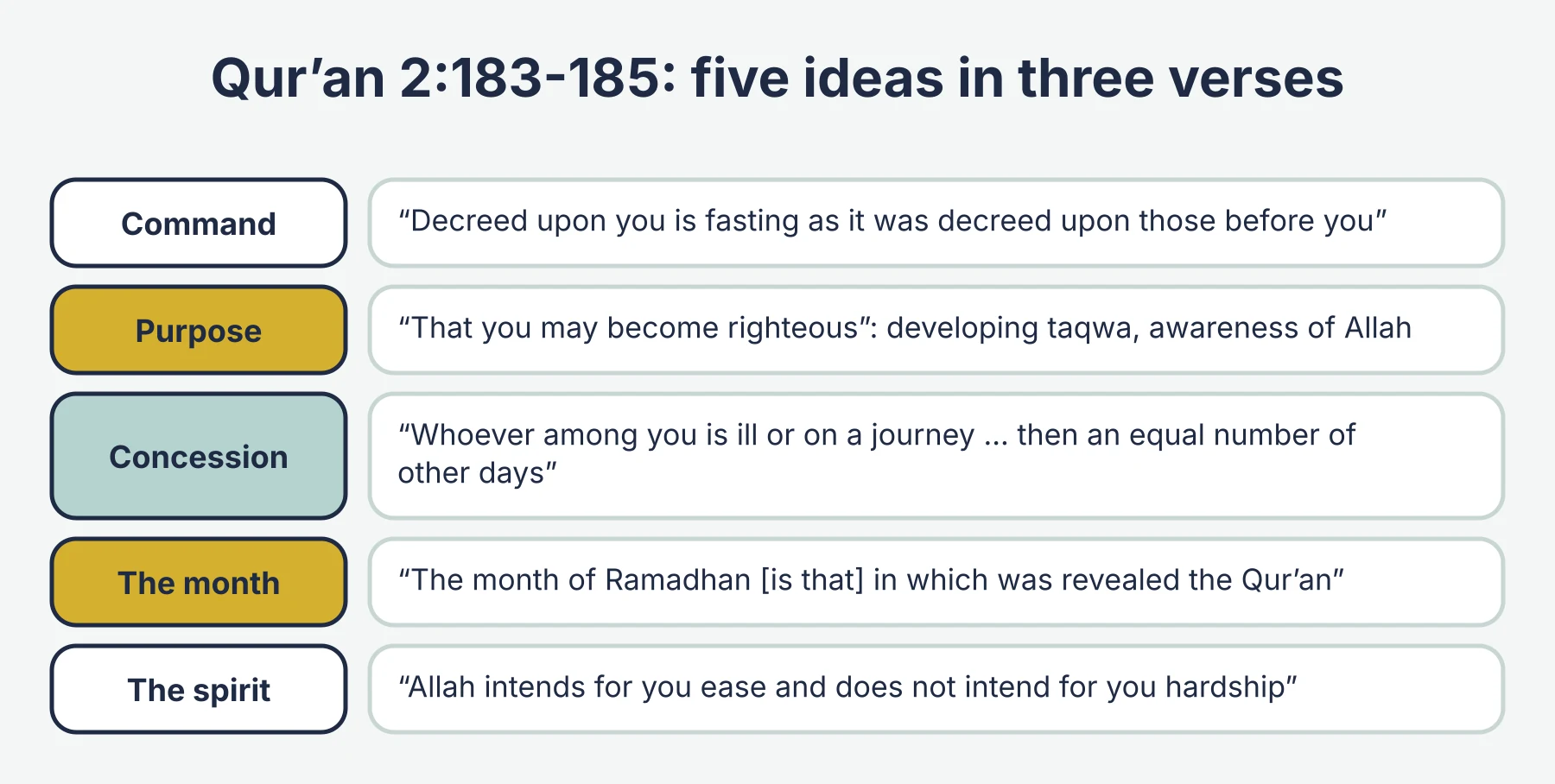
The prescribed passage: Qur’an 2:183-185
| Phrase | Use it for |
|---|---|
| “decreed upon you … as it was decreed upon those before you” | Fasting is an obligation with a long history |
| “that you may become righteous” | The spiritual purpose: taqwa |
| “whoever among you is ill or on a journey … an equal number of other days” | Exemptions and qada |
| “a ransom … of feeding a poor person” | Fidya |
| “the month of Ramadhan … in which was revealed the Qur’an” | Link to Laylat ul-Qadr and Taraweeh recitation |
| “Allah intends for you ease and does not intend for you hardship” | Mercy and balance |
| “perhaps you will be grateful” | Gratitude as an aim of fasting |
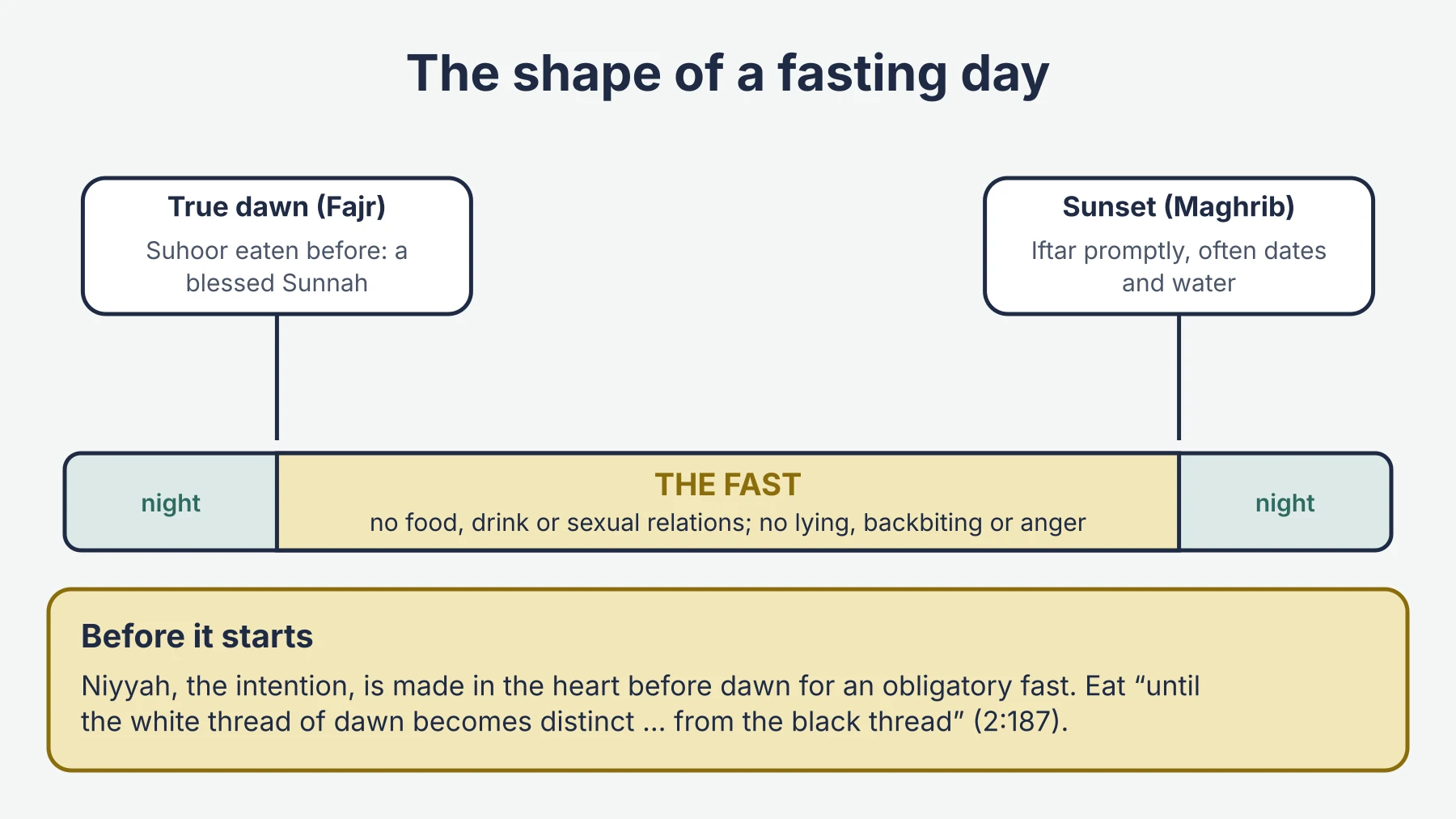
A valid fast
- Niyyah before dawn.
- Suhoor before Fajr (Sunnah, blessed); iftar promptly at Maghrib.
- Dawn to sunset: “until the white thread … from the black thread” (2:187).
- Abstain from food, drink and sexual relations; avoid lying, backbiting and anger, which ruin the reward.
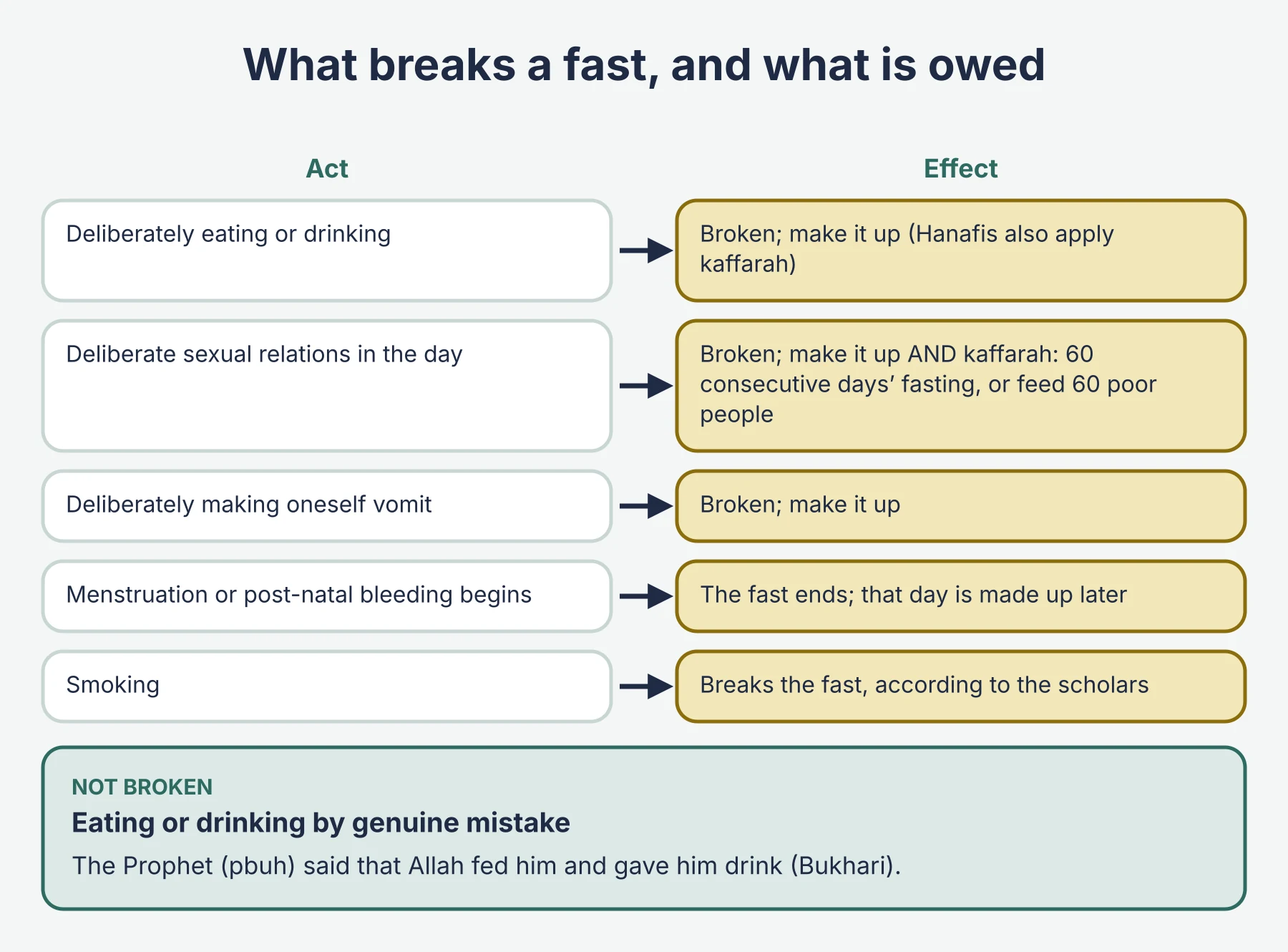
Invalidated by
Deliberate eating or drinking · deliberate sexual relations (qada plus kaffarah) · deliberate vomiting · start of menstruation or post-natal bleeding · smoking. Not invalidated by: forgetful eating or drinking (“Allah fed him and gave him drink”, Bukhari).
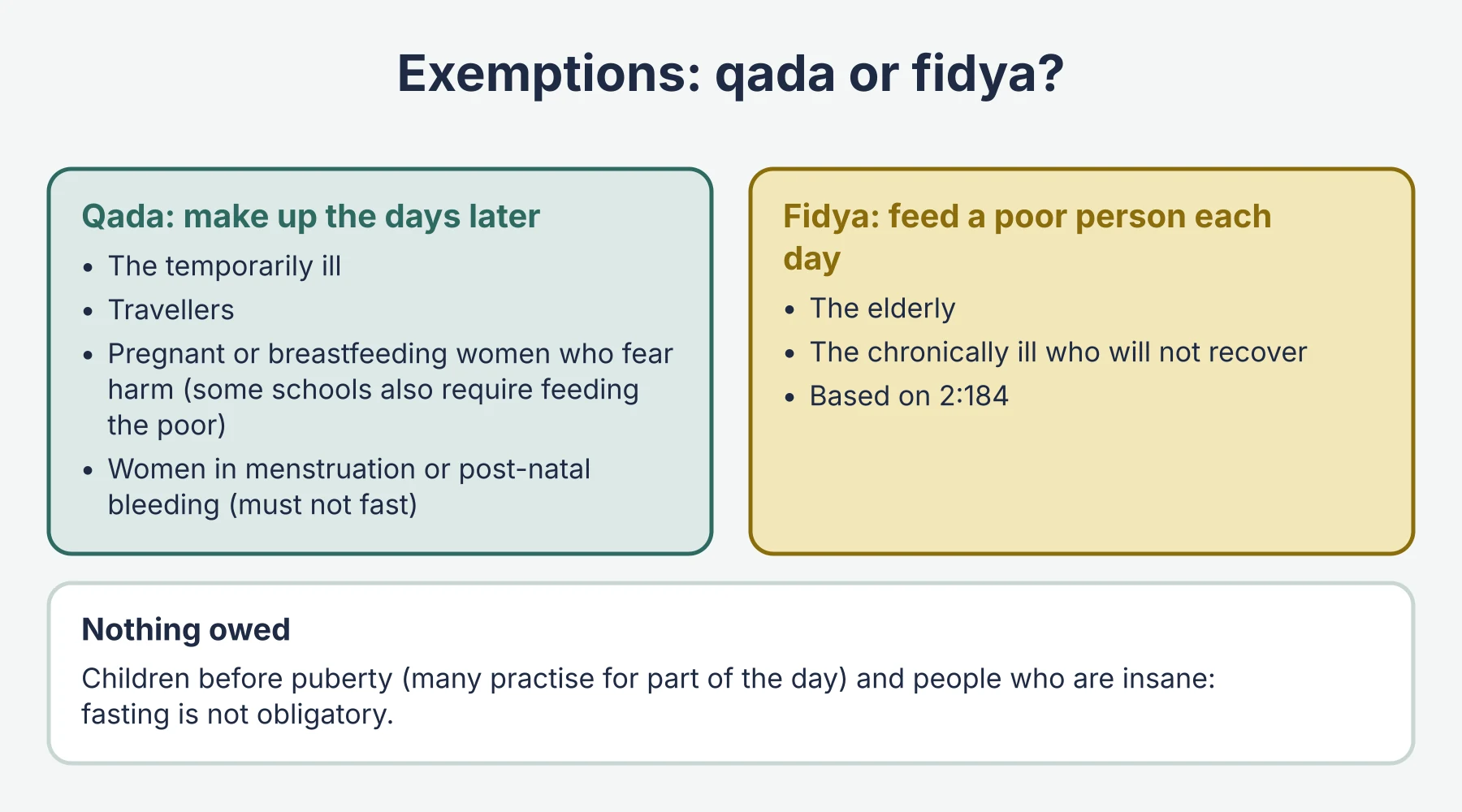
Exemptions: who owes what
| Group | Qada (make up) | Fidya (feed the poor) |
|---|---|---|
| Temporary illness | Yes | No |
| Travel | Yes | No |
| Menstruation / post-natal bleeding | Yes | No |
| Pregnancy or breastfeeding | Yes | In some schools, as well |
| Old age or permanent illness | No | Yes, one poor person per day |
| Children, the insane | No | No |
Kaffarah for deliberately breaking a fast by sexual relations: sixty consecutive days of fasting or, if unable, feeding sixty poor people.
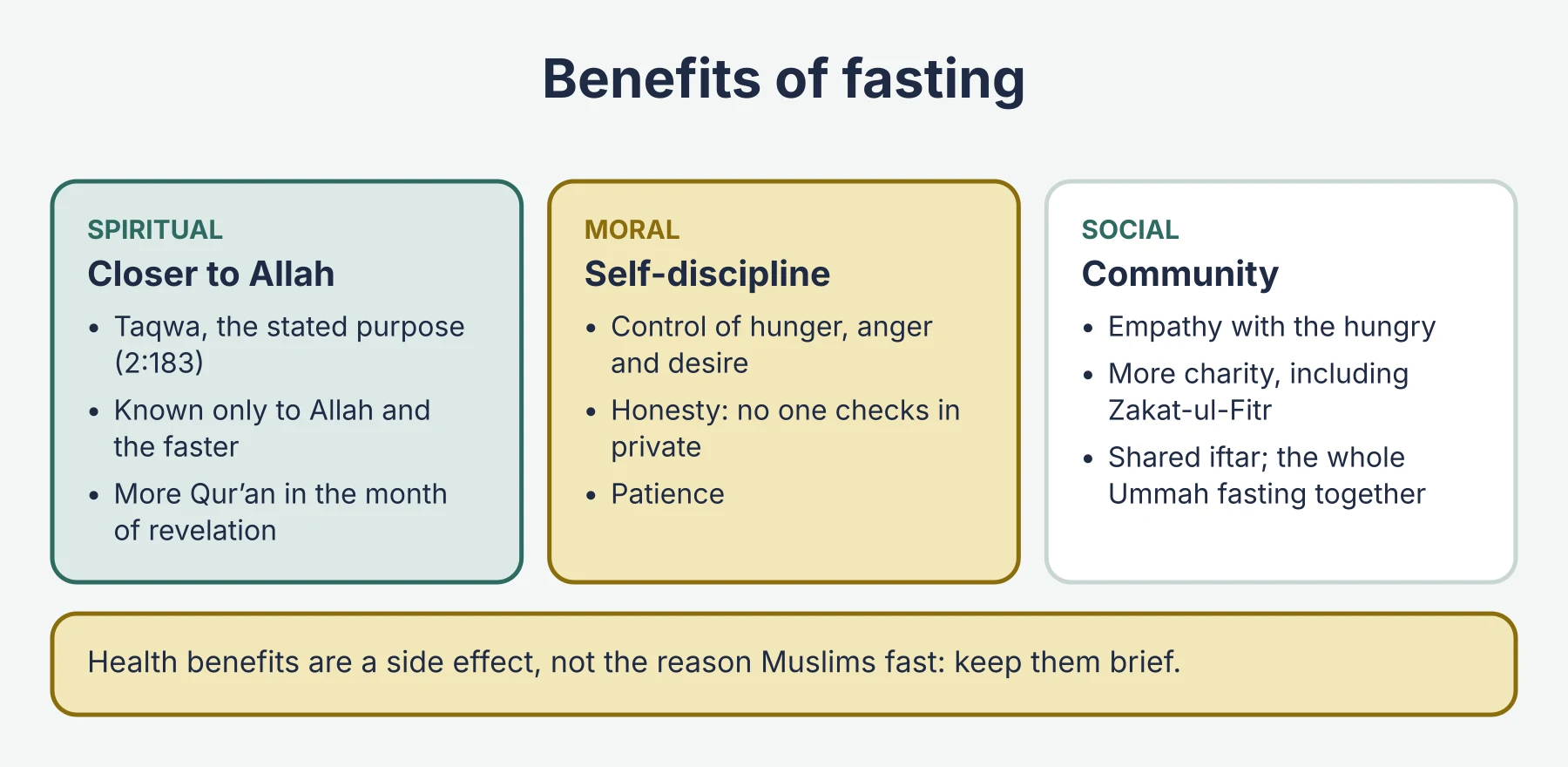
Benefits in three columns
| Spiritual | Moral | Social |
|---|---|---|
| Taqwa (2:183) | Self-discipline | Empathy with the hungry |
| Nearness to Allah | Honesty when unseen | More charity, Zakat-ul-Fitr |
| More Qur’an recitation | Patience | Shared iftar; one Ummah fasting together |
| Forgiveness of sins | Control of anger and speech | Equality of rich and poor in hunger |
Taraweeh
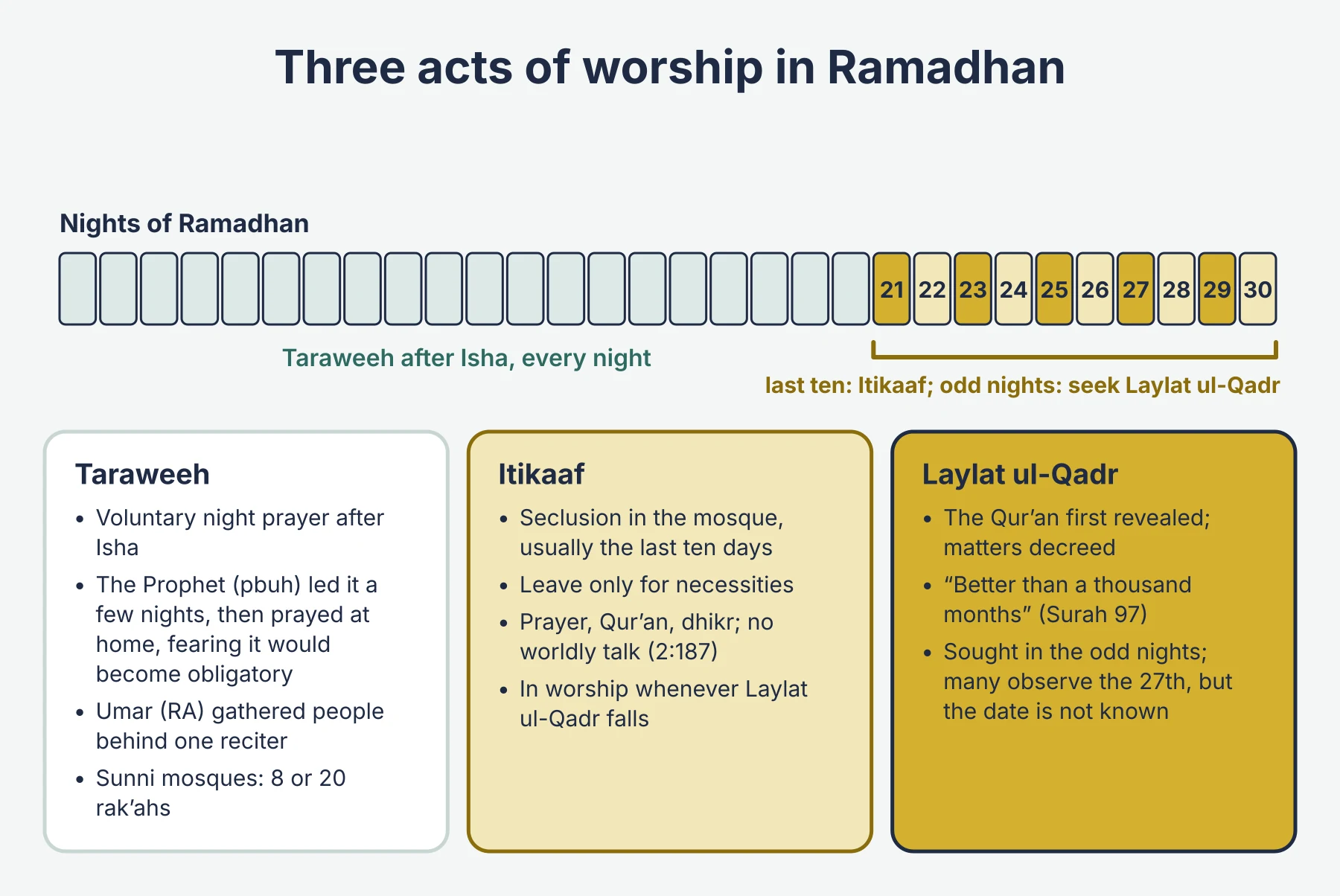
- Voluntary night prayer after Isha in Ramadhan.
- The Prophet (pbuh) led it for a few nights, then stopped in case it became obligatory (Bukhari).
- Hazrat Umar (RA) gathered the people behind one reciter.
- Sunni practice: 8 or 20 rak’ahs; many complete the Qur’an in the month.
- Shi’a Muslims generally do not pray it in congregation, but offer extra night prayers.
Itikaaf
- Seclusion in the mosque, usually the last ten days of Ramadhan.
- The Prophet (pbuh) observed it every year (Bukhari); mentioned in 2:187.
- Leave only for necessities; time spent on prayer, Qur’an and dhikr.
- Purpose: undivided worship and being ready for Laylat ul-Qadr.
Laylat ul-Qadr
- Surah 97: Qur’an sent down; “better than a thousand months”; angels and the Spirit descend; “Peace it is until the emergence of dawn”.
- “A blessed night” (44:3).
- Seek it in the odd nights of the last ten (Bukhari); the 27th is a common view, not a certainty.
- Du’a taught to Aisha (RA): “O Allah, You are pardoning and love to pardon, so pardon me” (Tirmidhi).
- Standing in prayer on it with faith and hope of reward forgives past sins (Bukhari).
Key terms
| Term | Meaning |
|---|---|
| Sawm | Fasting |
| Suhoor | Pre-dawn meal |
| Iftar | Meal that breaks the fast at sunset |
| Taqwa | God-consciousness, the purpose of fasting |
| Qada | Making up missed fasts |
| Fidya | Feeding a poor person for each fast that cannot be made up |
| Kaffarah | Expiation for deliberately breaking a fast |
| Taraweeh | Voluntary night prayer of Ramadhan |
| Itikaaf | Seclusion in the mosque for worship |
| Laylat ul-Qadr | The Night of Power or Decree |
| Zakat-ul-Fitr | Charity paid before the Eid prayer at the end of Ramadhan |
Exam traps
- Forgetful eating does not break the fast.
- Qada ≠ fidya ≠ kaffarah: learn which applies to whom.
- Taraweeh is voluntary, not a pillar.
- Laylat ul-Qadr’s date is not fixed; say “sought in the odd nights of the last ten”.
- Benefits need a category and an explanation, not a list of words.
Self-test
- What does Qur’an 2:183 give as the purpose of fasting?
- What is suhoor?
- Does eating by mistake break the fast?
- What must someone with a temporary illness do about missed fasts?
- What is fidya, and who pays it?
- What is the kaffarah for deliberately breaking a fast with sexual relations?
- Why did the Prophet (pbuh) stop leading Taraweeh in congregation?
- Which caliph gathered the people for Taraweeh behind one reciter?
- In which part of Ramadhan is Itikaaf usually observed?
- According to Surah 97, Laylat ul-Qadr is better than how long?
- When did the Prophet (pbuh) tell Muslims to seek Laylat ul-Qadr?
- Give one social benefit of fasting.
Answers: 1. “That you may become righteous”, that is, taqwa. 2. The meal eaten before dawn. 3. No; Allah fed him and gave him drink. 4. Make up the same number of days later (qada). 5. Feeding a poor person for each missed day, paid by those who can never fast, such as the very old or permanently ill. 6. Sixty consecutive days of fasting, or if unable, feeding sixty poor people. 7. He feared it would be made obligatory. 8. Hazrat Umar (RA). 9. The last ten days. 10. A thousand months. 11. In the odd nights of the last ten nights of Ramadhan. 12. Any one: empathy with the poor; more charity; shared iftar; unity of the Ummah; equality of rich and poor.
Practise with the Sawm rulings, Taraweeh, Itikaaf and Laylat ul-Qadr practice questions.
Source: OxfordAQA, International GCSE Islamiat (9237) specification, Version 1.1, content area 3.1.2.4.
Related resources
-
Study guides
OxfordAQA International GCSE Islamiat (9237): Shahadah
The meaning, importance and use of the Shahadah in a Muslim's life, with Qur'an 3:18-19, worked answers and common mistakes for 9237 topic 3.1.2.2.
Islamiyat · OxfordAQA · IGCSE
Read guide -
Practice questions
OxfordAQA International GCSE Islamiat (9237): Shahadah – Practice Questions
Nine original questions with mark guidance on the meaning, importance and use of the Shahadah, with Qur'an 3:18-19 (9237 topic 3.1.2.2).
Islamiyat · OxfordAQA · IGCSE
Try questions -
Revision notes
OxfordAQA International GCSE Islamiat (9237): Shahadah – Revision Notes
Recall notes on the meaning, importance and use of the Shahadah, and how to use Qur'an 3:18-19 in an answer, for 9237 topic 3.1.2.2.
Islamiyat · OxfordAQA · IGCSE
Revise topic
Get free revision emails (optional)
Occasional emails with practice questions, worked explanations and links to free resources for the qualification and subjects you choose. No spam, and you can unsubscribe from any email. The free tools on this site never need an email.