
Study Guides
OxfordAQA International GCSE Islamiat (9237): Sawm Rulings, Taraweeh, Itikaaf and Laylat ul-Qadr
The rulings of fasting in Ramadhan, exemptions and invalidating acts, the benefits of Sawm, Taraweeh, Itikaaf and Laylat ul-Qadr, for 9237 topic 3.1.2.4.
- Subject
- Islamiyat
- Level
- IGCSE
- Topic
- Paper 1 – Living the Muslim Life
- Author
- Marlbridge Academic Team
- Updated
- Reviewed by
- Azam Siddique (what this means)
Aligned to OxfordAQA IGCSE Islamiyat (9237), Version 1.1. Official specification .
Syllabus page (what it covers and how it is assessed): OxfordAQA IGCSE Islamiyat.
Syllabus points this page covers
9237
- 3.1.2 Islam: Practices
Found an error? Report a correction.
Need help with this topic? Request a free trial class for IGCSE Islamiyat (9237).
This guide covers content area 3.1.2.4 of OxfordAQA International GCSE Islamiat (9237), Sawm: “The rulings around fasting including the exemptions to fasting and the acts that invalidate a fast”, “The spiritual, moral, and social benefits of fasting”, “The significance of the Taraweeh prayer (night prayer) and Itikaaf” and “The meaning and importance of Laylat ul-Qadr (Night of Power).” The Living the Muslim Life study guide states the dawn-to-sunset rule and the main exemptions. This page sets out what makes a fast valid, what breaks it and what must be done afterwards, then explains the three special acts of worship of Ramadhan.
The command and its purpose
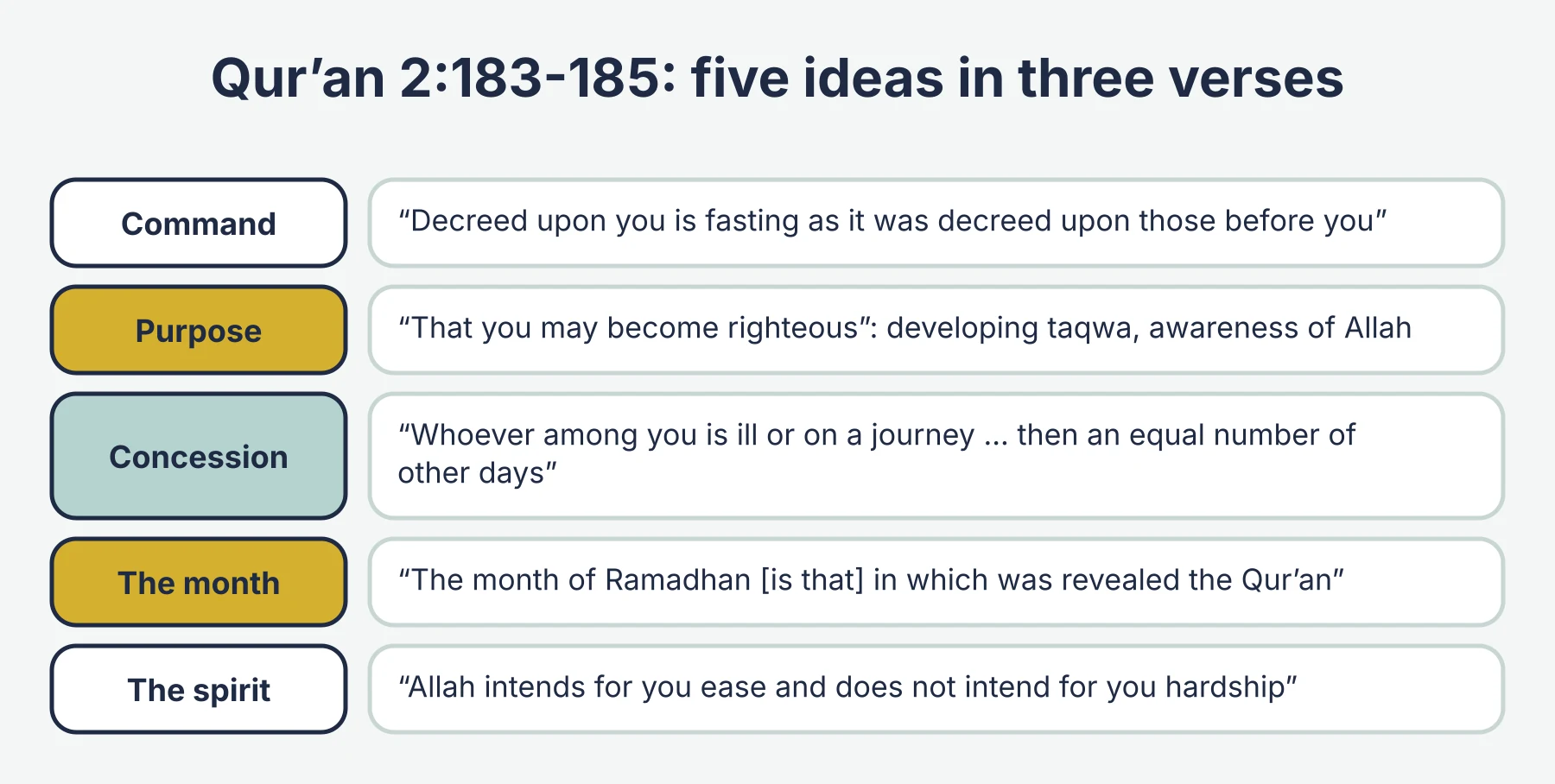
The prescribed passage for 3.1.2.4 is Qur’an 2:183-185. It contains the command, the purpose and the main concessions in three verses:
- Command: “decreed upon you is fasting as it was decreed upon those before you”.
- Purpose: “that you may become righteous”, that is, develop taqwa, awareness of Allah.
- Concession: “whoever among you is ill or on a journey … then an equal number of other days”.
- The month: “The month of Ramadhan [is that] in which was revealed the Qur’an”.
- The spirit: “Allah intends for you ease and does not intend for you hardship”.
The rulings of a valid fast
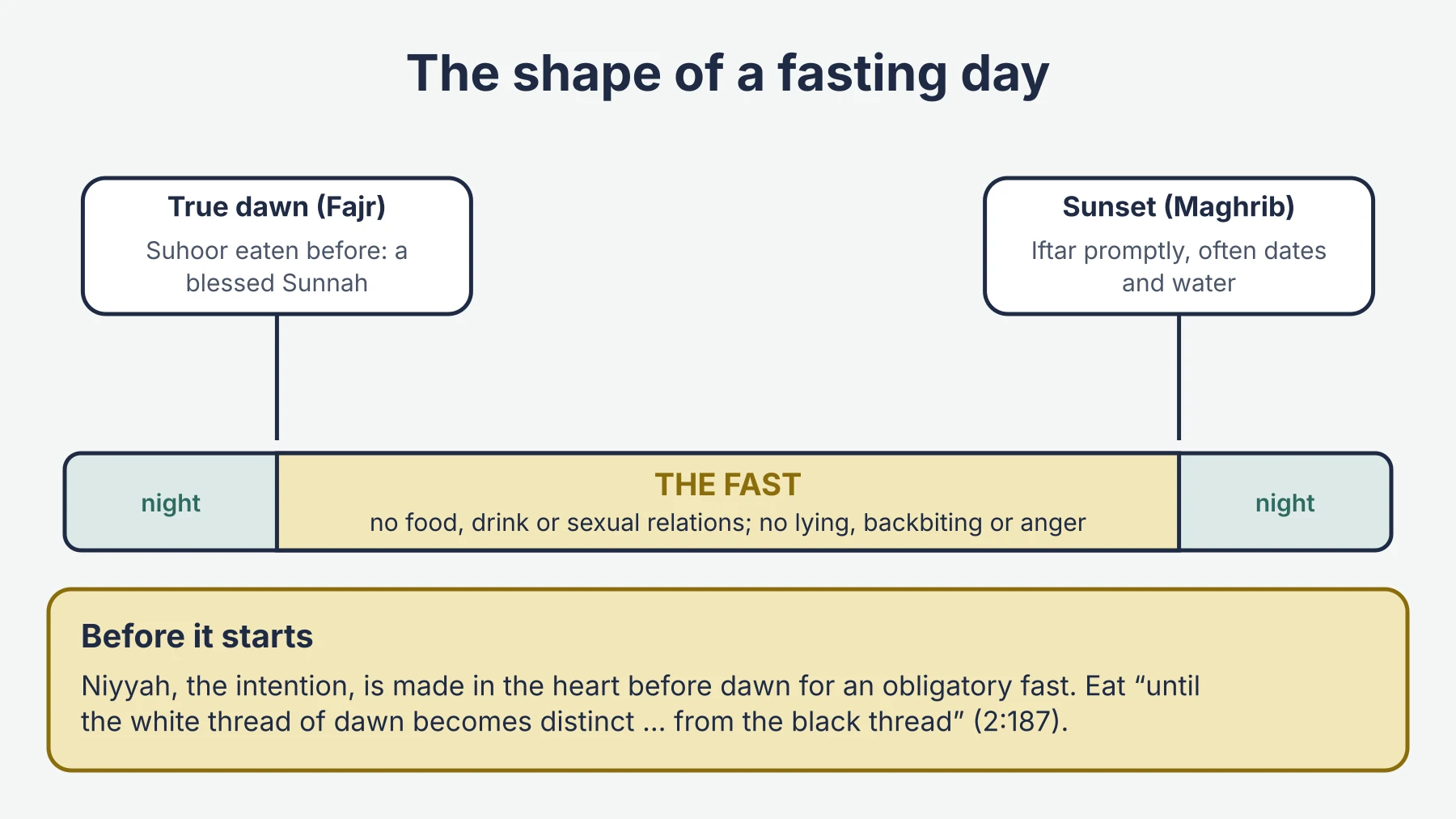
- Niyyah: the intention to fast, made before dawn for an obligatory fast. It is in the heart; saying it aloud is not required.
- The time: from true dawn (Fajr) until sunset (Maghrib). Muslims may eat “until the white thread of dawn becomes distinct to you from the black thread” (2:187).
- Suhoor: the meal before dawn, a Sunnah the Prophet (pbuh) said contains blessing.
- Iftar: breaking the fast promptly at sunset, often with dates and water, following the Sunnah.
- Abstaining: from food, drink and sexual relations during daylight, and from lying, backbiting and anger, which do not break the fast technically but destroy its reward.
Acts that invalidate a fast
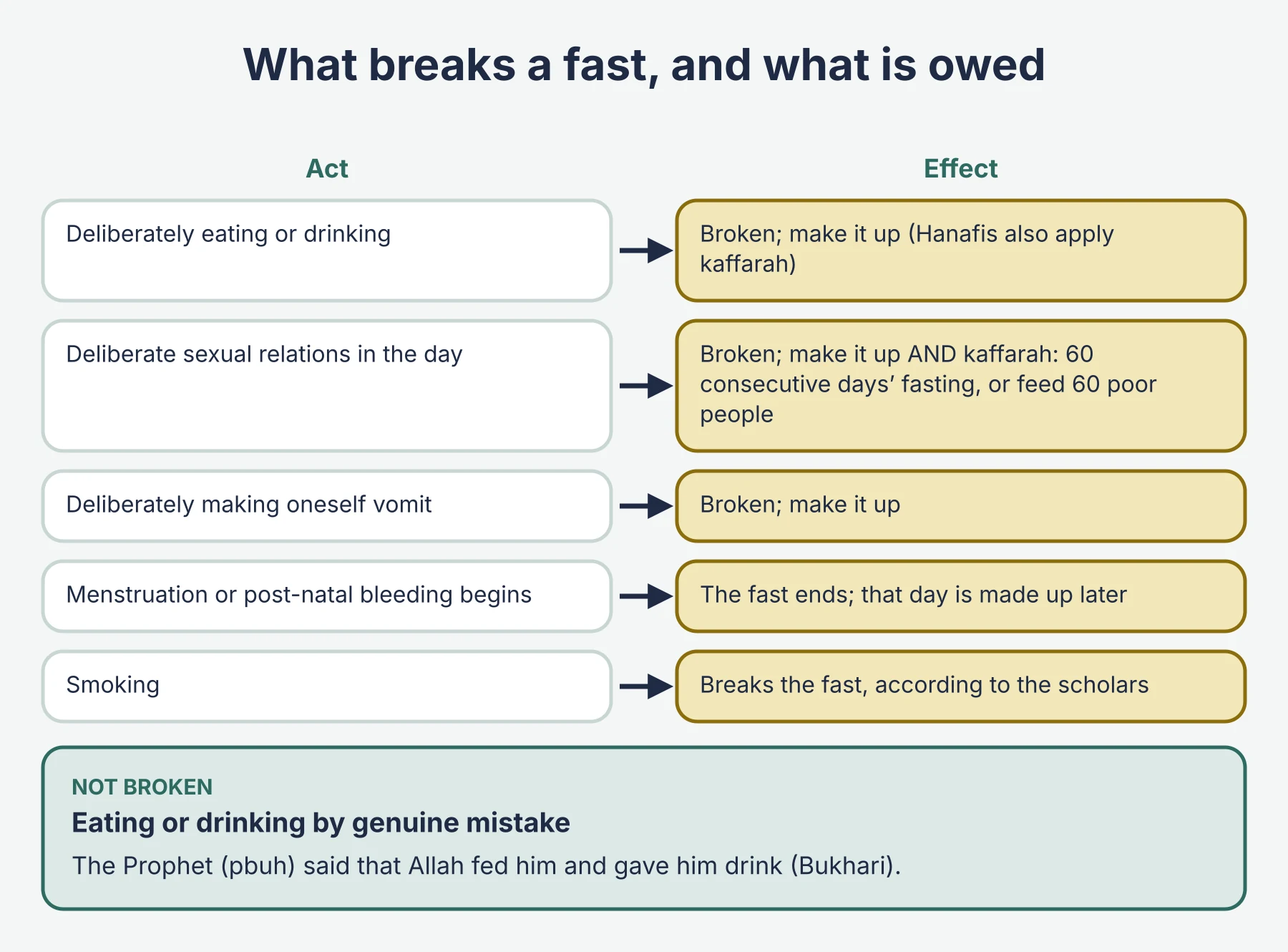
| Act | Effect |
|---|---|
| Deliberately eating or drinking | Fast broken; must be made up |
| Deliberate sexual relations during the day | Fast broken; must be made up and an expiation (kaffarah) is due |
| Deliberately making oneself vomit | Fast broken; must be made up |
| Start of menstruation or bleeding after childbirth | Fast ends; that day is made up later |
| Smoking | Breaks the fast, according to the scholars |
| Eating or drinking by genuine mistake | Not broken: the Prophet (pbuh) said that Allah fed him and gave him drink (Sahih al-Bukhari) |
The kaffarah for deliberately breaking a Ramadhan fast through sexual relations is to fast sixty consecutive days, or if that is impossible, to feed sixty poor people. Some schools, such as the Hanafi, apply kaffarah also to deliberate eating and drinking.
Exemptions and what is owed afterwards
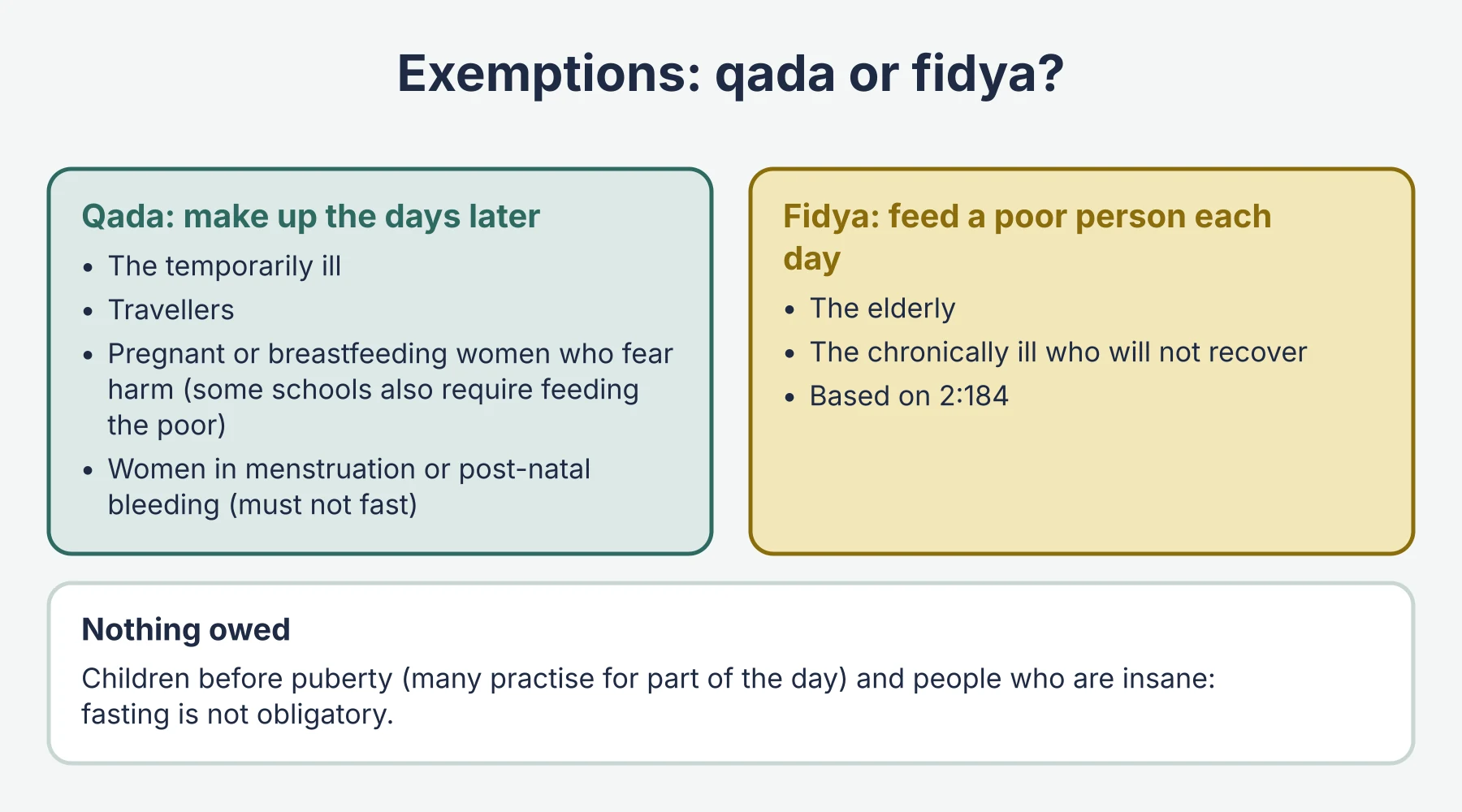
| Who | Rule | What is owed |
|---|---|---|
| The ill (temporary) | May break the fast | Make up the days (qada) later |
| Travellers | May break the fast | Make up the days later |
| Pregnant or breastfeeding women | May break the fast if they fear harm to themselves or the baby | Make up the days; some schools also require feeding the poor |
| Women in menstruation or post-natal bleeding | Must not fast | Make up the days later |
| The elderly or the chronically ill who will not recover | Excused | Feed a poor person for each day (fidya), as in 2:184 |
| Children before puberty | Not obligatory | Nothing; many practise for part of the day |
| People who are insane | Not obligatory | Nothing |
The distinction to learn is qada (making up the same number of days) versus fidya (feeding someone for each missed day when a person will never be able to fast).
Benefits of fasting
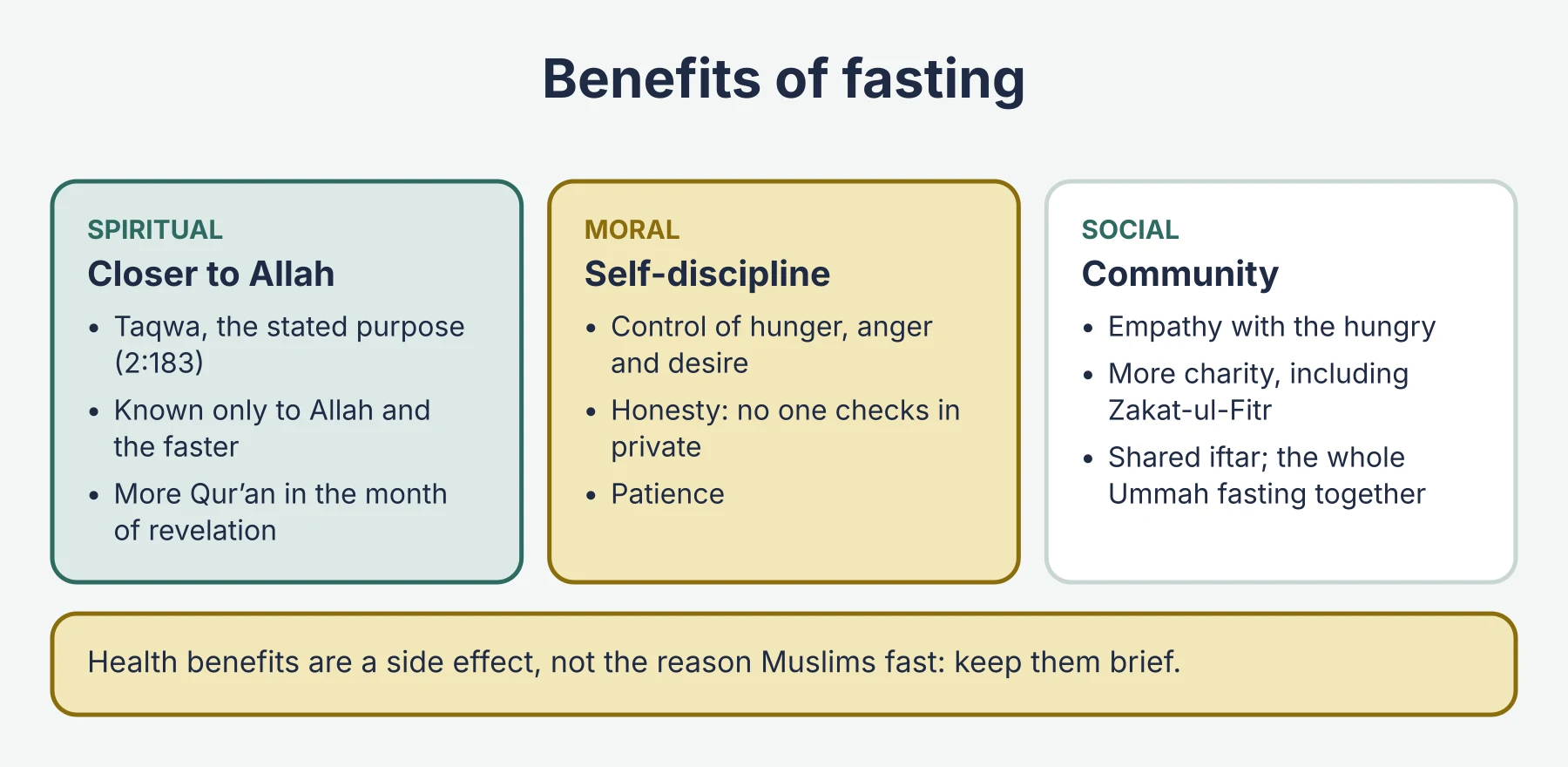
- Spiritual: taqwa, the stated purpose in 2:183; a closer relationship with Allah because the fast is known only to Him and the faster; more Qur’an recitation in the month it was revealed.
- Moral: self-discipline over hunger, anger and desire; honesty, since no one can check whether a person ate in private; patience.
- Social: empathy with the hungry; more charity, including Zakat-ul-Fitr before Eid; families and mosques sharing iftar; the whole Ummah fasting together.
Health benefits are sometimes mentioned, but they are a side effect, not the reason Muslims fast. Keep them brief.
Taraweeh
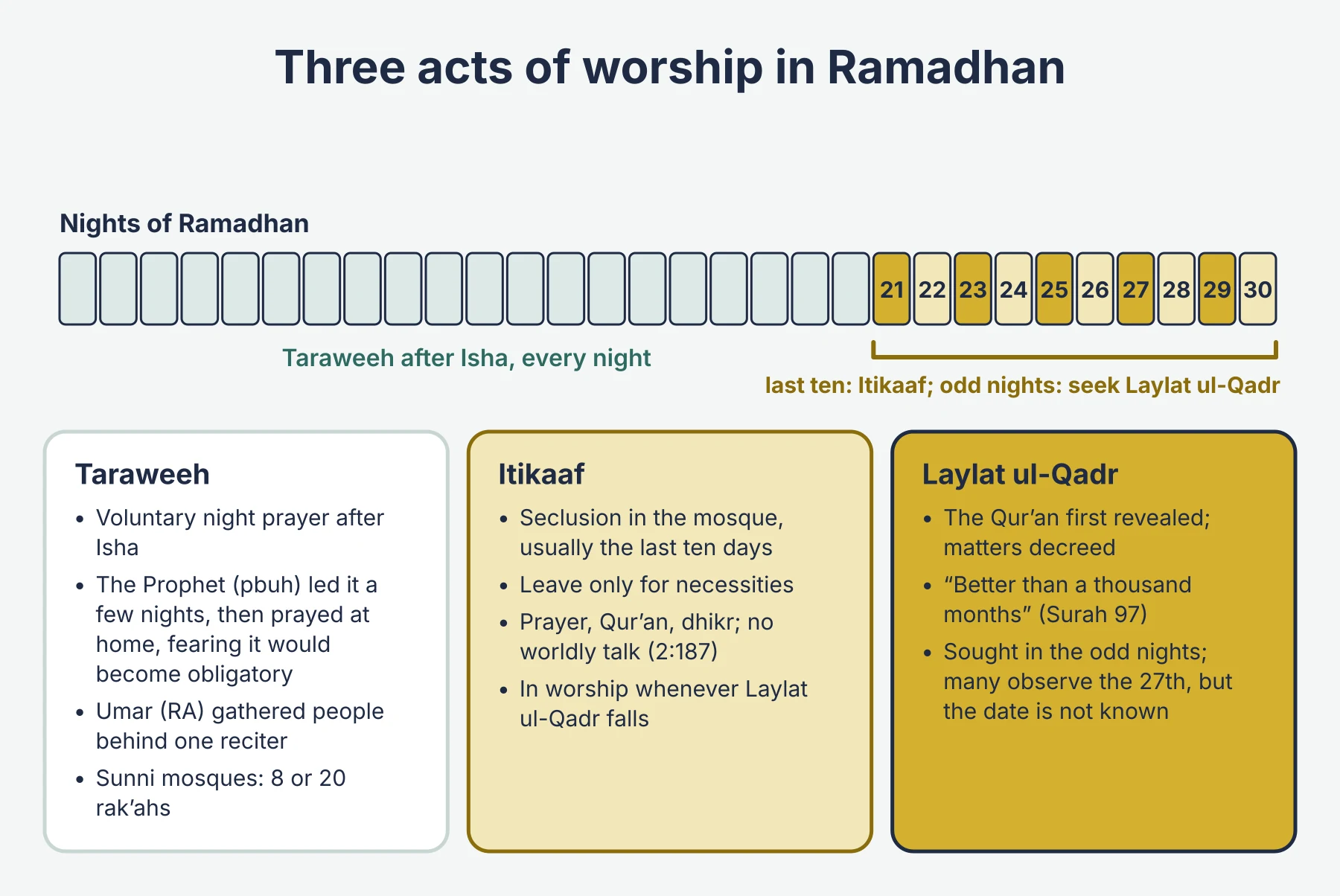
Taraweeh is a voluntary night prayer offered after Isha during Ramadhan. The Prophet (pbuh) led it in congregation on a few nights and then prayed at home, explaining that he feared it would be made obligatory for his community (Sahih al-Bukhari). Later, Hazrat Umar (RA) gathered the people behind one reciter. Sunni mosques now commonly pray eight or twenty rak’ahs, and many aim to complete a recitation of the whole Qur’an across the month. Shi’a Muslims generally do not pray Taraweeh as a congregational prayer, but they offer additional voluntary night prayers in Ramadhan.
Significance: it fills the nights of Ramadhan with Qur’an, unites the community in the mosque, and follows the Prophet’s (pbuh) teaching that whoever stands in prayer in Ramadhan with faith and hope of reward will be forgiven past sins (Sahih al-Bukhari).
Itikaaf
Itikaaf is a period of seclusion in the mosque for worship, usually during the last ten days of Ramadhan. The Prophet (pbuh) observed it every year in those days (Sahih al-Bukhari). The person in Itikaaf leaves the mosque only for necessities, spends the time in prayer, Qur’an and dhikr, and avoids worldly talk; the Qur’an mentions it: “do not have relations with them [your wives] as long as you are staying for worship in the mosques” (2:187). Women may also observe it; in some communities they do so in a set-aside space at home.
Significance: it cuts off distractions, gives undivided time to Allah, and positions the believer to be in worship on Laylat ul-Qadr.
Laylat ul-Qadr
Surah 97 is devoted to it: “Indeed, We sent the Qur’an down during the Night of Decree … The Night of Decree is better than a thousand months. The angels and the Spirit descend therein by permission of their Lord for every matter. Peace it is until the emergence of dawn.” It is also called “a blessed night” (44:3).
- Meaning: the night on which the Qur’an was first revealed, and on which, Muslims believe, matters for the coming year are decreed.
- When: the Prophet (pbuh) told Muslims to seek it in the odd nights of the last ten nights of Ramadhan (Sahih al-Bukhari). Many observe the 27th night especially, but its exact date is not known.
- What Muslims do: night prayer, Qur’an recitation and du’a, including the supplication the Prophet (pbuh) taught Aisha (RA): “O Allah, You are pardoning and love to pardon, so pardon me” (Tirmidhi).
- Importance: worship on that night is worth more than a thousand months, which is longer than a lifetime of eighty years; whoever stands in prayer on it with faith and hope of reward is forgiven past sins (Sahih al-Bukhari).
Worked example: a 4-mark answer
Question: Explain two ways Muslims try to gain the blessings of Laylat ul-Qadr. [4]
Many Muslims stay awake on the odd nights of the last ten days of Ramadhan to pray [1], because the Prophet (pbuh) told them to seek the night then and no one knows its exact date [1]. Some Muslims observe Itikaaf in the mosque for the last ten days [1], so that they are already in worship whenever the Night of Power falls and are not distracted by work or family business [1].
Common mistakes
- Saying any mistake breaks the fast. Eating or drinking by genuine forgetfulness does not.
- Mixing up qada and fidya. Qada means making up the days; fidya means feeding a poor person for each day when fasting will never be possible.
- Calling Taraweeh obligatory. It is a highly valued voluntary prayer.
- Fixing Laylat ul-Qadr on the 27th as a certainty. It is sought in the odd nights; the 27th is a popular view.
- Listing benefits without categories. The specification separates spiritual, moral and social benefits; use those headings.
Exam technique
Short questions ask you to name or give a ruling, an exemption or an invalidating act. “Explain” questions want the practice plus its purpose, for example Itikaaf plus its effect on concentration in worship. For a 12-mark answer on Sawm, the passage is Qur’an 2:183-185: use “that you may become righteous” for spiritual purpose, the ill and travellers for compassion, and “Allah intends for you ease” for the balance between obligation and mercy.
Related pages
- Sawm rulings, Taraweeh, Itikaaf and Laylat ul-Qadr revision notes
- Sawm rulings, Taraweeh, Itikaaf and Laylat ul-Qadr practice questions
- Living the Muslim Life revision notes
Source: OxfordAQA, International GCSE Islamiat (9237) specification, Version 1.1, content area 3.1.2.4 and Passage 12.
Related resources
-
Practice questions
OxfordAQA International GCSE Islamiat (9237): Sawm Rulings, Taraweeh, Itikaaf and Laylat ul-Qadr – Practice Questions
Twelve original questions with mark guidance on fasting rulings, exemptions, invalidating acts, benefits of Sawm, Taraweeh, Itikaaf and Laylat ul-Qadr (9237).
Islamiyat · OxfordAQA · IGCSE
Try questions -
Revision notes
OxfordAQA International GCSE Islamiat (9237): Sawm Rulings, Taraweeh, Itikaaf and Laylat ul-Qadr – Revision Notes
Recall notes on the rulings of Sawm, exemptions, invalidating acts, qada and fidya, the benefits of fasting, Taraweeh, Itikaaf and Laylat ul-Qadr (9237).
Islamiyat · OxfordAQA · IGCSE
Revise topic -
Study guides
OxfordAQA International GCSE Islamiat (9237): Shahadah
The meaning, importance and use of the Shahadah in a Muslim's life, with Qur'an 3:18-19, worked answers and common mistakes for 9237 topic 3.1.2.2.
Islamiyat · OxfordAQA · IGCSE
Read guide
Get free revision emails (optional)
Occasional emails with practice questions, worked explanations and links to free resources for the qualification and subjects you choose. No spam, and you can unsubscribe from any email. The free tools on this site never need an email.