
Study Guides
OxfordAQA International GCSE Psychology (9218): Memory
Memory processes, the multi-store and working memory models, Murdock, Baddeley and Hitch, Bartlett and memory accuracy for OxfordAQA IGCSE Psychology 9218.
- Subject
- Psychology
- Level
- IGCSE
- Topic
- Paper 1 – Cognition and Behaviour
- Author
- Marlbridge Academic Team
- Updated
- Reviewed by
- Kanwal Aslam (what this means)
Aligned to OxfordAQA IGCSE Psychology (9218), Version 1.1. Official specification .
Syllabus page (what it covers and how it is assessed): OxfordAQA IGCSE Psychology.
Syllabus points this page covers
9218
- 3.1.1 Memory
3.1.1 Memory opens Paper 1 (Cognition and Behaviour) of OxfordAQA International GCSE Psychology (9218), Version 1.1, and makes up Section A of that paper. It asks how information gets into memory, how it is held, why it is sometimes lost or distorted, and what three named studies tell us. Questions range from multiple-choice recall of capacity and duration to extended answers that describe and evaluate a model.
What the specification lists
- The processes of memory: encoding, storage and retrieval
- Types of memory: episodic, semantic and procedural
- The multi-store model: sensory register, short-term memory and long-term memory, with the coding, capacity and duration of each store
- The primacy and recency effects in recall, as investigated by Murdock
- The working memory model: central executive, phonological loop, visuo-spatial sketchpad and episodic buffer, with the coding and capacity of each component
- Dual processing tasks as investigated by Baddeley and Hitch
- The theory of reconstructive memory, including effort after meaning, and Bartlett’s War of the Ghosts study
- Factors affecting the accuracy of memory: interference, context and false memories
Processes and types of memory
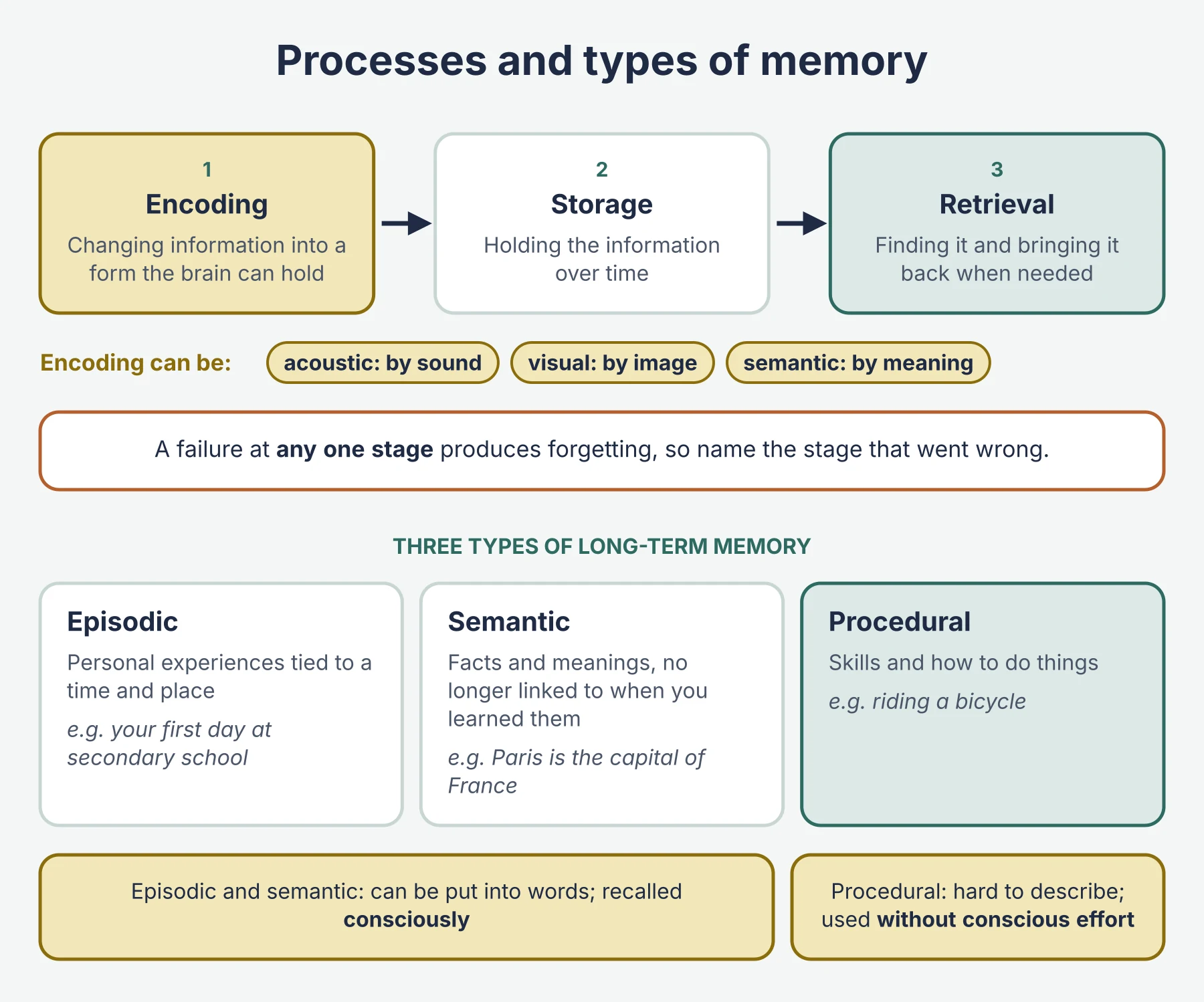
Encoding changes incoming information into a form the brain can hold: acoustic (by sound), visual (by image) or semantic (by meaning). Storage is holding that information over time. Retrieval is finding and bringing it back when needed. A failure at any one stage produces forgetting, so an exam answer about “why did Maya forget?” should name the stage that went wrong.
Long-term memory is not one thing. Episodic memory stores personal experiences tied to a time and place (your first day at secondary school). Semantic memory stores facts and meanings that are no longer linked to when you learned them (Paris is the capital of France). Procedural memory stores skills and how to do things (riding a bicycle). Episodic and semantic memories can be put into words and are recalled consciously; procedural memories are usually hard to describe and are used without conscious effort.
The multi-store model in more depth
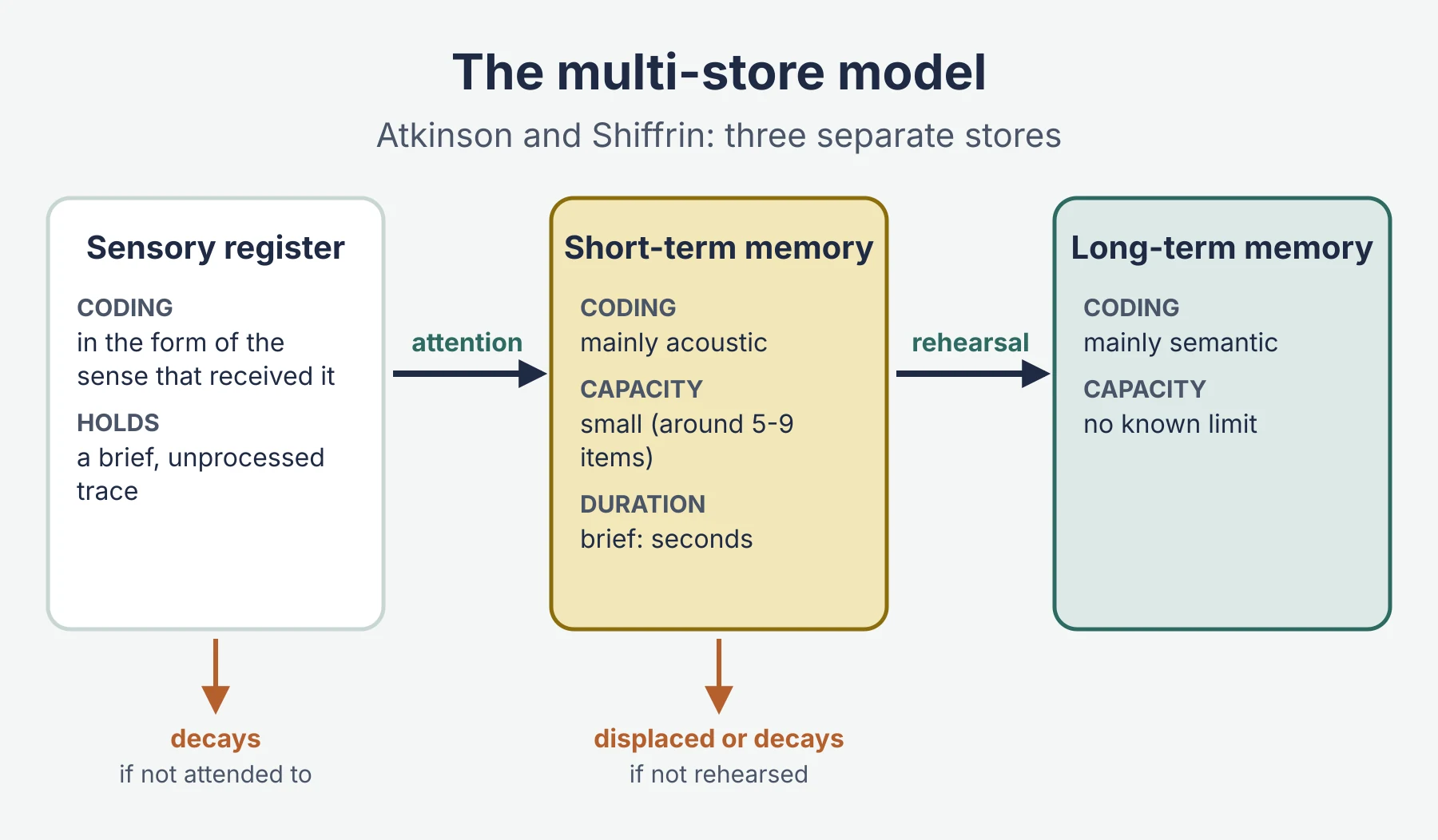
The multi-store model (Atkinson and Shiffrin) describes memory as a flow of information through three separate stores. The sensory register holds a brief, unprocessed trace in the form of the sense that received it. Only information that receives attention passes into short-term memory, which is small and brief and mainly acoustic. Information that is rehearsed transfers to long-term memory, which is mainly semantic and has no known limit. Information not attended to decays from the sensory register; information not rehearsed is displaced or decays from short-term memory.
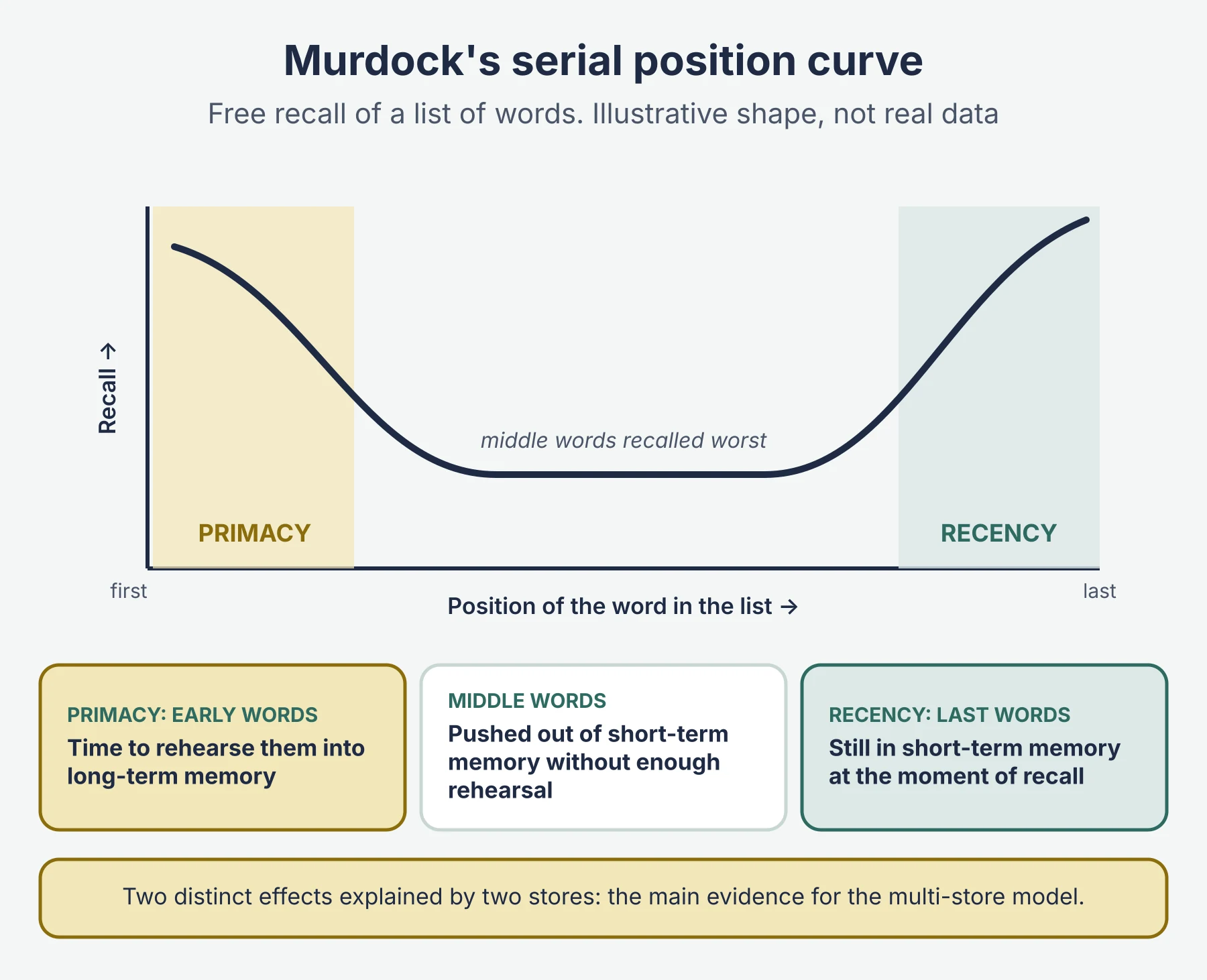
Murdock’s serial position study. Murdock presented participants with lists of words and asked them to recall as many as they could in any order (free recall). Plotting recall against each word’s position produced a U-shaped serial position curve. Early words were recalled well (primacy effect) because there was time to rehearse them into long-term memory. The last words were recalled well (recency effect) because they were still in short-term memory at the moment of recall. The middle words had been pushed out of short-term memory without enough rehearsal. Two distinct effects explained by two stores is the main evidence the model draws on.
Evaluating the model. Strengths: the study of the serial position curve and differences in coding between short-term and long-term memory support the idea of separate stores; the model is simple and testable. Limitations: it treats short-term memory as a single store, which dual-task research challenges; it overstates rehearsal, since we remember many things we never rehearsed; and it treats long-term memory as one store when there are at least three types.
The working memory model
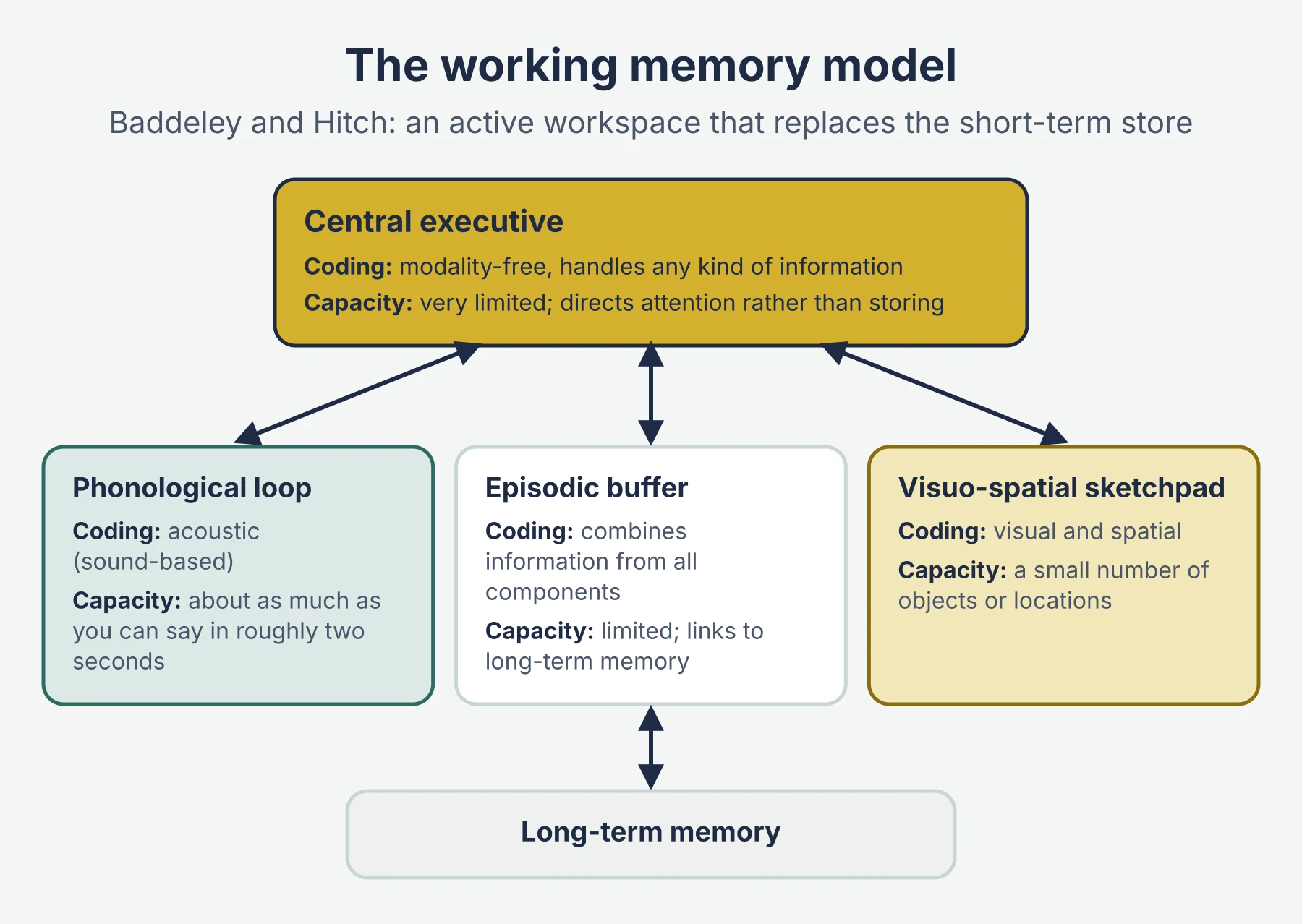
Baddeley and Hitch replaced the single short-term store with an active workspace of four components.
| Component | Coding | Capacity |
|---|---|---|
| Central executive | Modality-free: it handles any kind of information | Very limited; it directs attention rather than storing |
| Phonological loop | Acoustic (sound-based) | About as much as you can say in roughly two seconds |
| Visuo-spatial sketchpad | Visual and spatial | A small number of objects or locations |
| Episodic buffer | Combines information from all components | Limited; links to long-term memory |
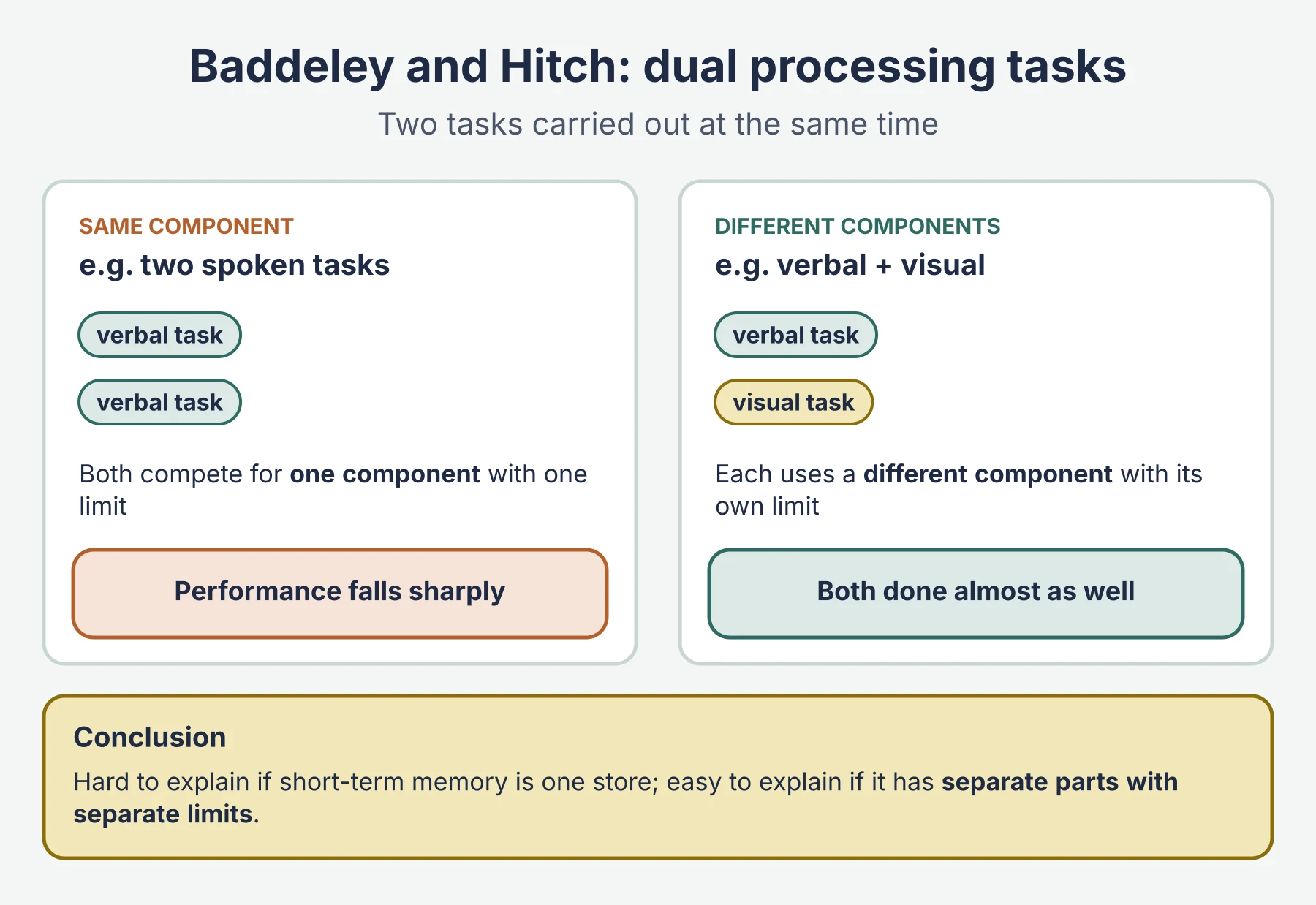
Baddeley and Hitch’s dual processing tasks. Participants carried out two tasks at the same time. When both tasks needed the same component, such as two tasks relying on spoken information, performance on one or both fell sharply. When the tasks used different components, such as one verbal and one visual task, both could be done almost as well together as separately. This is hard to explain if short-term memory is one store, but easy to explain if it has separate parts with separate limits.
Evaluating the model. It explains everyday multitasking, such as listening to directions while looking at a map, and it is supported by dual-task evidence. However, the central executive is vague: it is described as controlling attention, but its own capacity and workings are hard to test directly. The episodic buffer was added later to explain how the components connect with long-term memory, which shows the model has developed over time.
Reconstructive memory
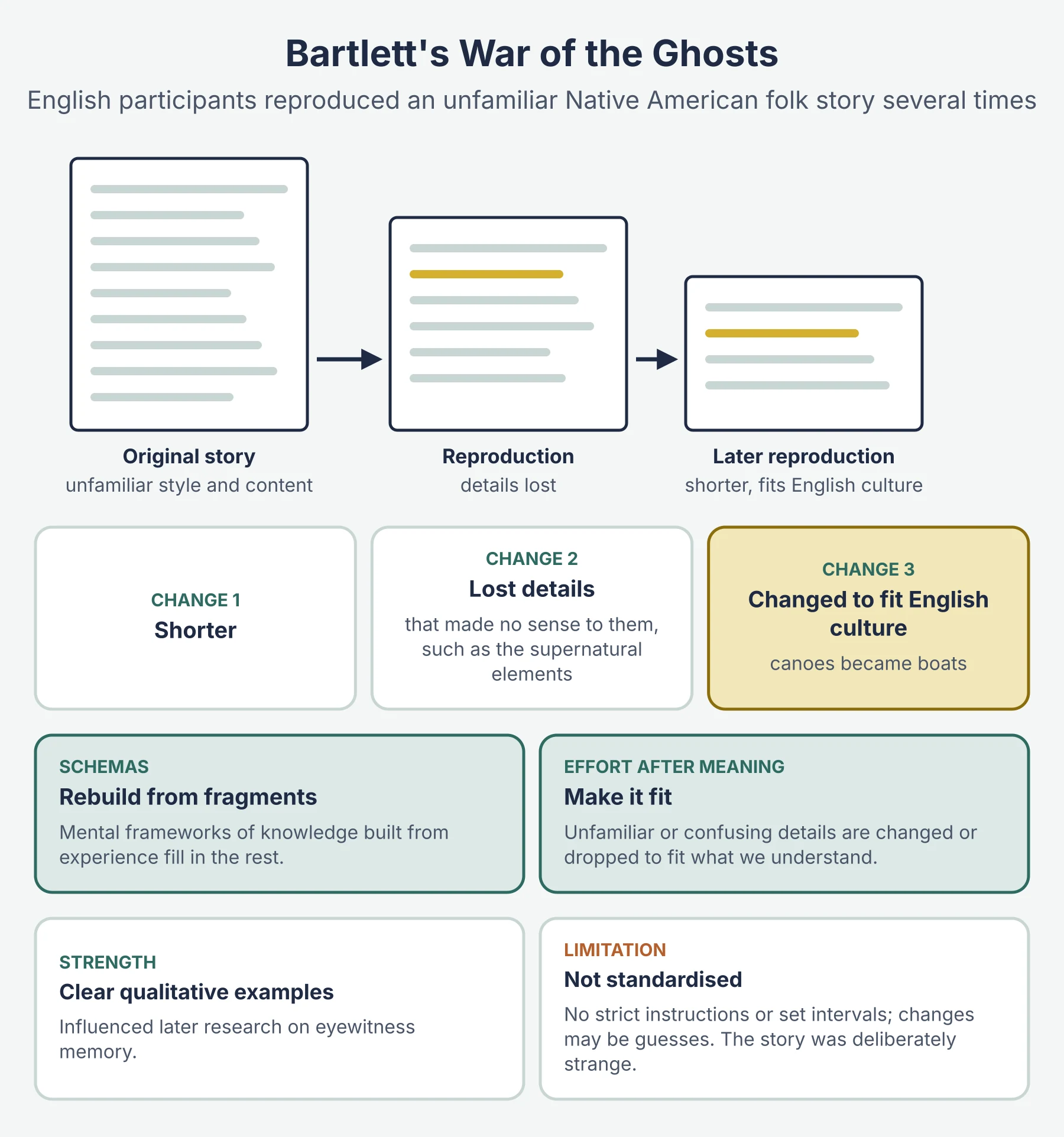
Bartlett’s theory says recall is not a recording but a reconstruction. We store fragments and rebuild the rest using schemas, which are mental frameworks of knowledge built from experience. Effort after meaning is the attempt to make what we remember fit what we already understand, so unfamiliar or confusing details are changed or dropped.
Bartlett’s War of the Ghosts study. English participants read a Native American folk story that was unfamiliar in style and content, then reproduced it several times over a period of time. Their versions became shorter, lost details that did not make sense to them (such as the supernatural elements), and changed details to fit English culture, for example canoes became boats. Bartlett concluded that memory is shaped by cultural expectations.
Evaluating the study. It supports the theory with clear qualitative examples and has influenced later research on eyewitness memory. However, the procedure was not standardised: participants were not given strict instructions or set time intervals, so some changes may have been guesses rather than memory distortions, and the story was deliberately strange, so it may exaggerate how much everyday memory is distorted.
Factors affecting the accuracy of memory
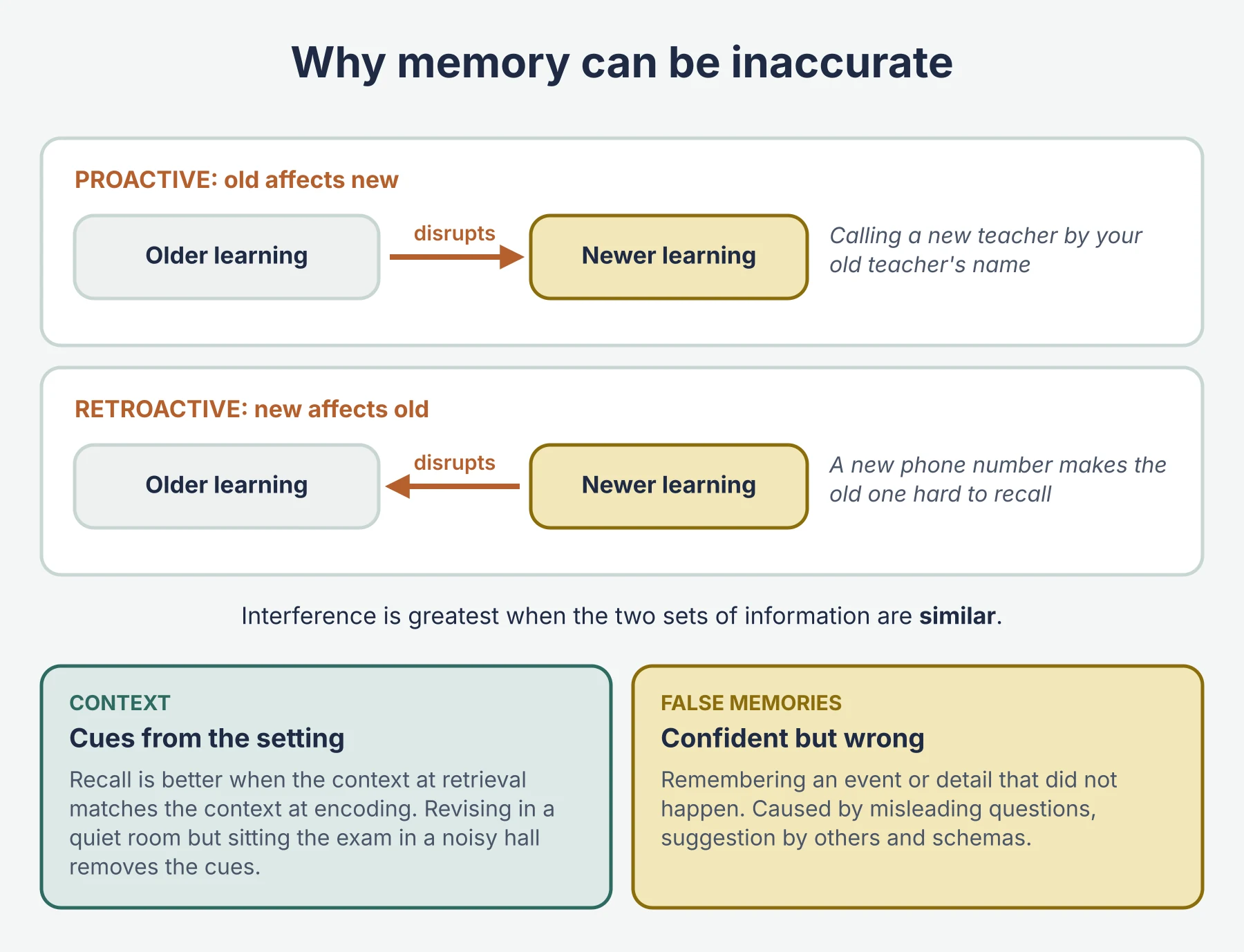
- Interference. Similar memories compete. Proactive interference is when older learning disrupts recall of newer learning (calling a new teacher by your old teacher’s name). Retroactive interference is when newer learning disrupts recall of older learning (learning a new phone number makes the old one hard to recall). Interference is greatest when the two sets of information are similar.
- Context. Recall is better when the context at retrieval matches the context at encoding, because features of the setting act as cues. Revising in a quiet room but sitting the exam in a noisy hall removes those cues.
- False memories. A person can confidently remember an event, or a detail, that did not happen. Misleading questions, suggestion by others and schemas can all create them, which is why reconstructive memory matters for eyewitness testimony.
Worked example: applying the multi-store model
Kwame looks up a six-digit verification code on his phone, repeats it under his breath, and types it in. Ten minutes later he cannot recall it. Use the multi-store model to explain this. [4 marks]
1. Attending to the code moved it from the sensory register into
   short-term memory.                                           [1]
2. Repeating it under his breath is maintenance rehearsal, which
   kept it in STM long enough to type it.                       [1]
3. Six digits fits STM capacity (around 5-9 items), so he could
   hold all of it briefly.                                      [1]
4. He stopped rehearsing once it was typed, so it did not transfer
   to LTM and was lost from STM well within ten minutes.        [1]
Each point names a feature of the model and links it to Kwame. A list of model features with no reference to the scenario would not earn application marks.
Annotated model answer: an evaluation point
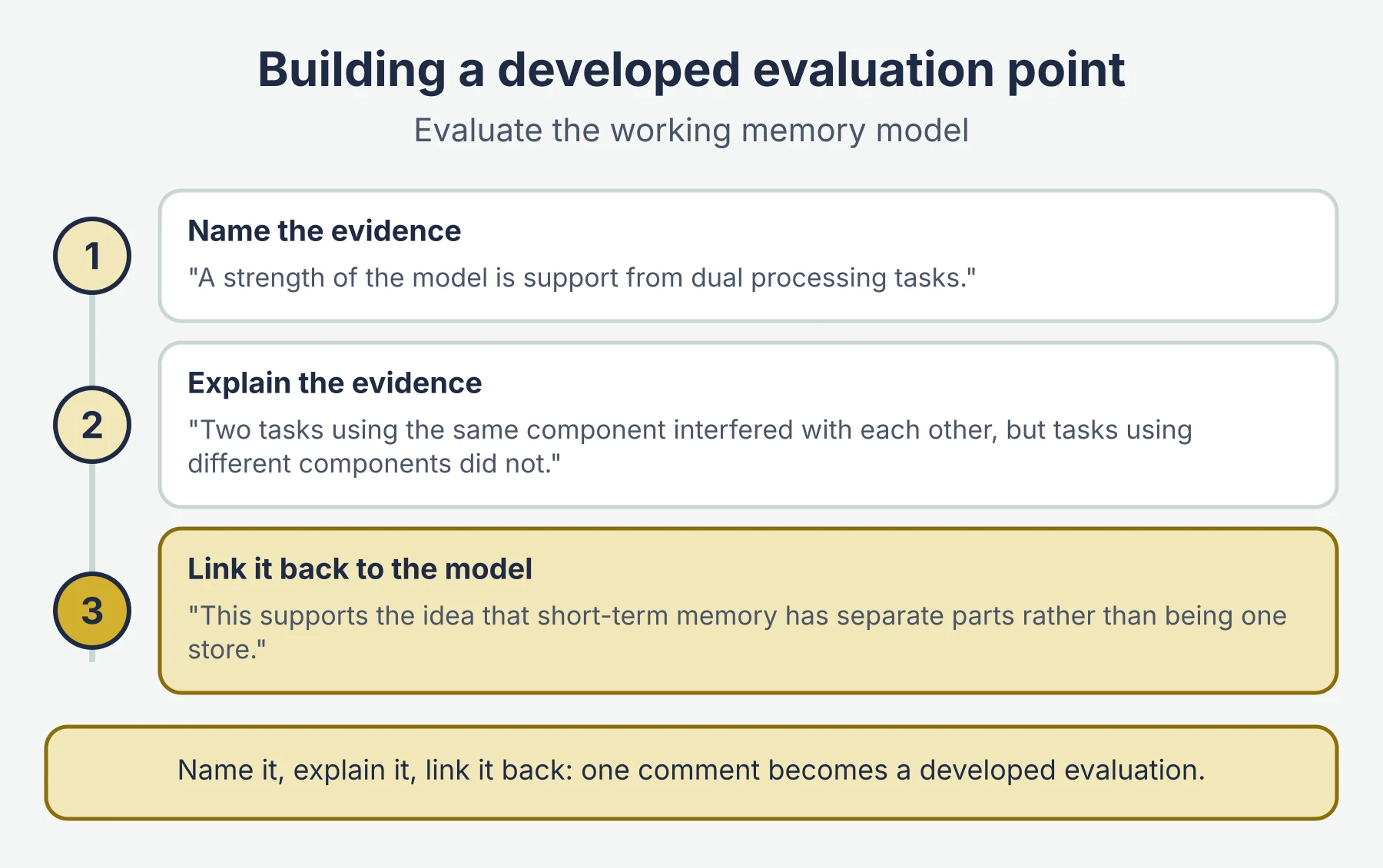
Evaluate the working memory model. One developed point:
“A strength of the model is support from dual processing tasks (evidence named). Baddeley and Hitch found that two tasks using the same component interfered with each other, but tasks using different components did not (evidence explained). This supports the idea that short-term memory has separate parts rather than being one store as the multi-store model claims (linked back to the model).”
Name it, explain it, link it back: that pattern turns a one-mark comment into a developed evaluation.
Common mistakes
- Giving short-term memory a duration in minutes; it is measured in seconds.
- Saying the recency effect comes from long-term memory; it reflects short-term memory.
- Describing the working memory model as the multi-store model with extra boxes; it replaces short-term memory only.
- Writing “effort after meaning” as “trying hard to remember”; it means making memories fit existing schemas.
- Mixing up proactive and retroactive interference. Proactive works forwards (old affects new).
Exam technique for 9218 command words
- Identify / Name / State: a single term, no explanation (e.g. “phonological loop”).
- Outline: the main features briefly, one sentence per mark.
- Describe: give detail of what happened or what the model says, without evaluating.
- Explain: say how or why, using “because” or “so”.
- Evaluate: strengths and limitations, each supported and linked back, ideally ending with a judgement.
- Apply / Use your knowledge to explain: every point must refer to the scenario.
More resources on this topic
- Memory revision notes
- Memory practice questions
- Cognition and Behaviour overview guide
- Perception study guide
Official syllabus
OxfordAQA International GCSE Psychology (9218) specification, Version 1.1, section 3.1.1 — oxfordaqa.com.
Related resources
-
Practice questions
OxfordAQA International GCSE Psychology (9218): Memory – Practice Questions
Original memory questions with mark-scheme answers for OxfordAQA IGCSE Psychology 9218: memory models, Murdock, Baddeley and Hitch, Bartlett and accuracy.
Psychology · OxfordAQA · IGCSE
Try questions -
Revision notes
OxfordAQA International GCSE Psychology (9218): Memory – Revision Notes
Condensed notes on memory for OxfordAQA IGCSE Psychology 9218: store and component features, three named studies, memory accuracy, exam traps and a self-test.
Psychology · OxfordAQA · IGCSE
Revise topic -
Study guides
OxfordAQA International GCSE Psychology (9218): Perception
Depth cues, Gibson and Gregory, six visual illusions and perceptual set with four named studies, explained for OxfordAQA International GCSE Psychology 9218.
Psychology · OxfordAQA · IGCSE
Read guide
Studying Psychology?
This page is free and stays free. Marlbridge is not offering Psychology classes at the moment, so there is no tuition to book for it. The free study resources stay open to everyone.
Get free revision emails (optional)
Occasional emails with practice questions, worked explanations and links to free resources for the qualification and subjects you choose. No spam, and you can unsubscribe from any email. The free tools on this site never need an email.