
Study Guides
OxfordAQA International GCSE Psychology (9218): Perception
Depth cues, Gibson and Gregory, six visual illusions and perceptual set with four named studies, explained for OxfordAQA International GCSE Psychology 9218.
- Subject
- Psychology
- Level
- IGCSE
- Topic
- Paper 1 – Cognition and Behaviour
- Author
- Marlbridge Academic Team
- Updated
- Reviewed by
- Kanwal Aslam (what this means)
Aligned to OxfordAQA IGCSE Psychology (9218), Version 1.1. Official specification .
Syllabus page (what it covers and how it is assessed): OxfordAQA IGCSE Psychology.
Syllabus points this page covers
9218
- 3.1.2 Perception
3.1.2 Perception is Section B of Paper 1 (Cognition and Behaviour) in OxfordAQA International GCSE Psychology (9218), Version 1.1. It asks how the brain turns raw sensory input into a meaningful picture of the world, whether that happens directly or through inference, why we are fooled by illusions, and how our expectations, culture, motivation and emotions shape what we see.
What the specification lists
- The difference between sensation and perception
- Visual cues and constancies: monocular depth cues (height in plane, relative size, occlusion, linear perspective) and binocular depth cues (retinal disparity, convergence)
- Gibson’s direct theory, and the role of motion parallax in everyday perception
- Explanations for visual illusions (ambiguity, misinterpreted depth cues, fiction, size constancy) and six examples: the Ponzo, the Müller-Lyer, Rubin’s vase, the Ames Room, the Kanizsa triangle and the Necker cube
- Gregory’s constructivist theory: perception uses inferences from visual cues and past experience to construct a model of reality
- Perceptual set and the effects of culture, motivation, emotion and expectation
- The investigations of Nisbett and Miyamoto, Gilchrist and Nesberg, Kunst-Wilson and Zajonc and Bruner and Minturn
Sensation and perception
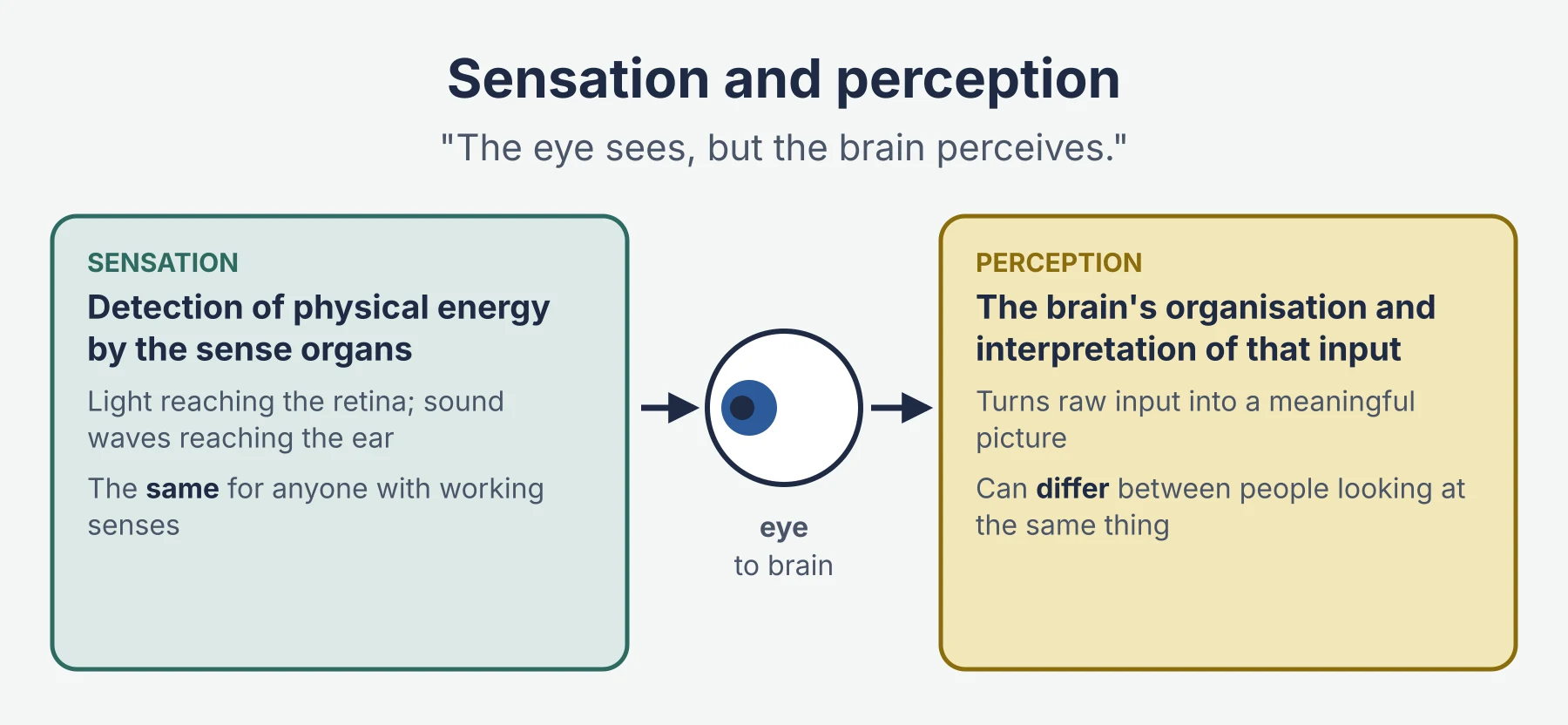
Sensation is the detection of physical energy by the sense organs: light reaching the retina, sound waves reaching the ear. It is the same for anyone with working senses. Perception is the brain’s organisation and interpretation of that input, and it can differ between people looking at the same thing. A useful exam line: the eye sees, but the brain perceives.
Depth cues and size constancy
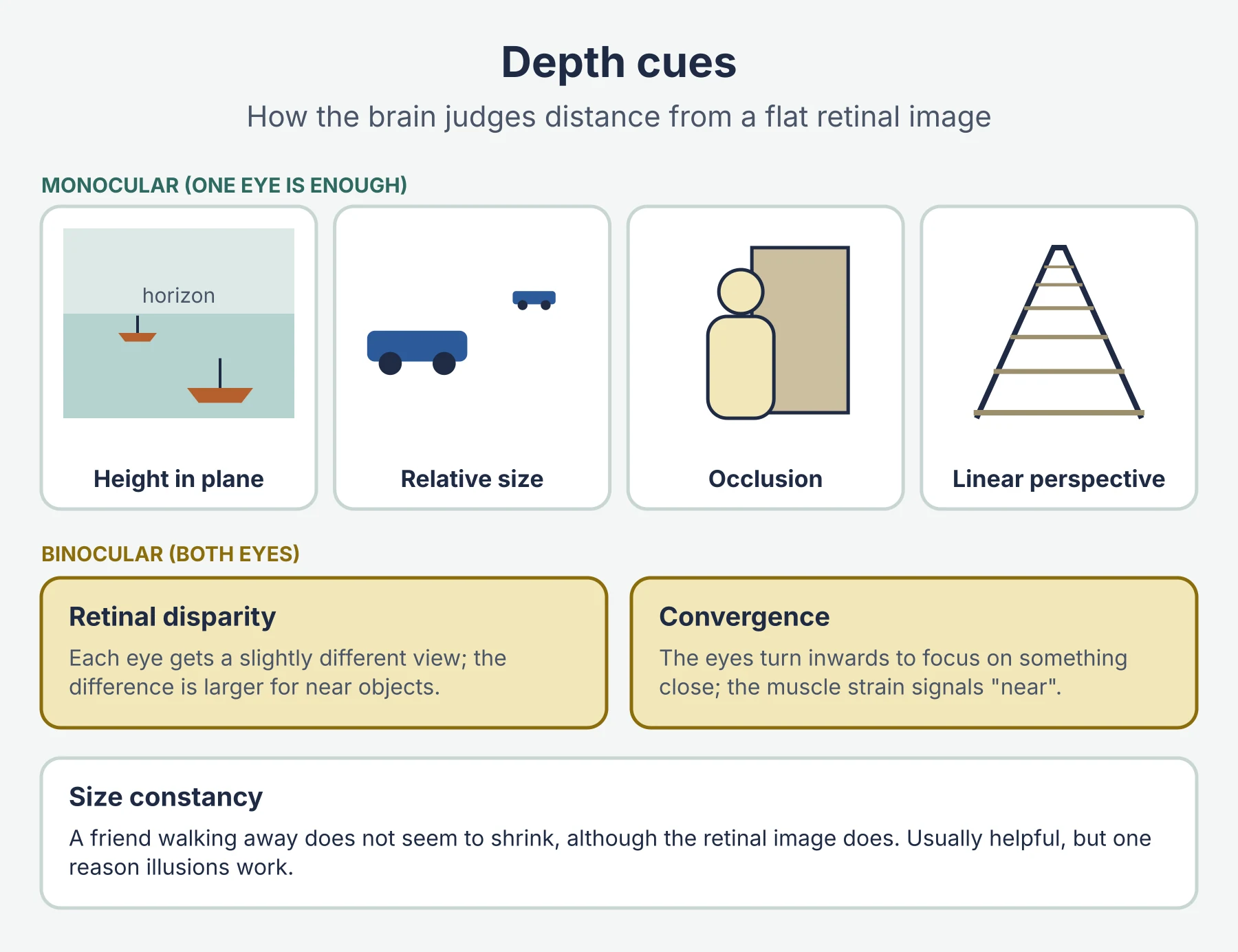
The retina is a flat surface, so the brain must work out distance from cues.
| Cue | Type | How it signals depth | Everyday example |
|---|---|---|---|
| Height in plane | Monocular | Objects nearer the horizon appear further away | Boats near the horizon look distant |
| Relative size | Monocular | Of two objects known to be similar, the smaller image is further away | A far-off car looks tiny |
| Occlusion | Monocular | An object partly blocking another is nearer | A tree in front of a house |
| Linear perspective | Monocular | Parallel lines appear to converge with distance | Railway tracks meeting in the distance |
| Retinal disparity | Binocular | Each eye gets a slightly different image; the greater the difference, the nearer the object | Closing one eye then the other makes a near finger “jump” |
| Convergence | Binocular | Eyes turn inwards more for close objects, and the brain reads the muscle effort | Eyes strain when focusing on the tip of your nose |
Monocular cues work with one eye, which is why artists can show depth on a flat canvas. Binocular cues need both eyes and are most useful for nearby objects.
Size constancy is perceiving an object as staying the same size even though its image on the retina shrinks as it moves away. A friend walking away does not seem to shrink, because the brain scales the image up using distance information.
Gibson’s direct theory
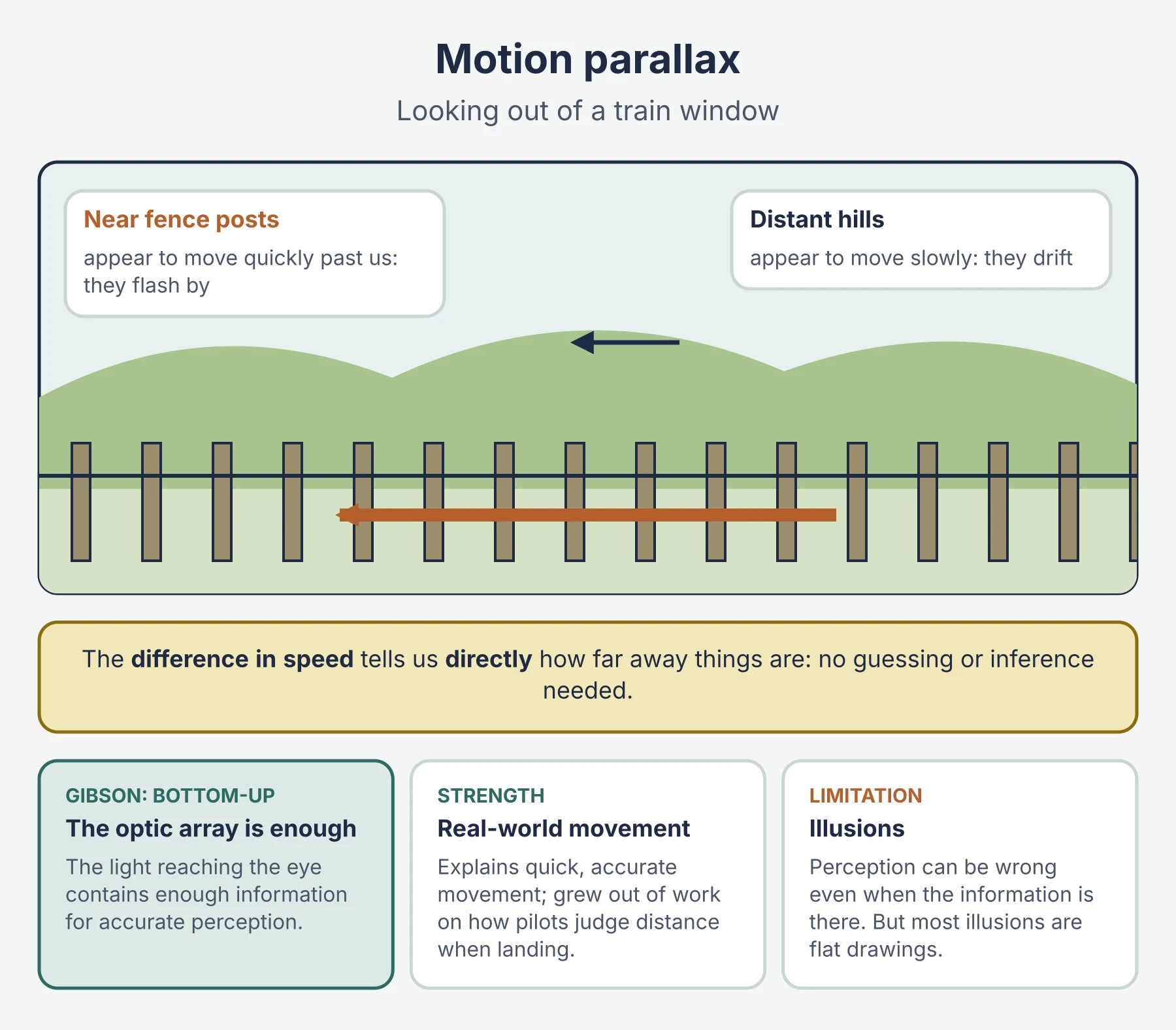
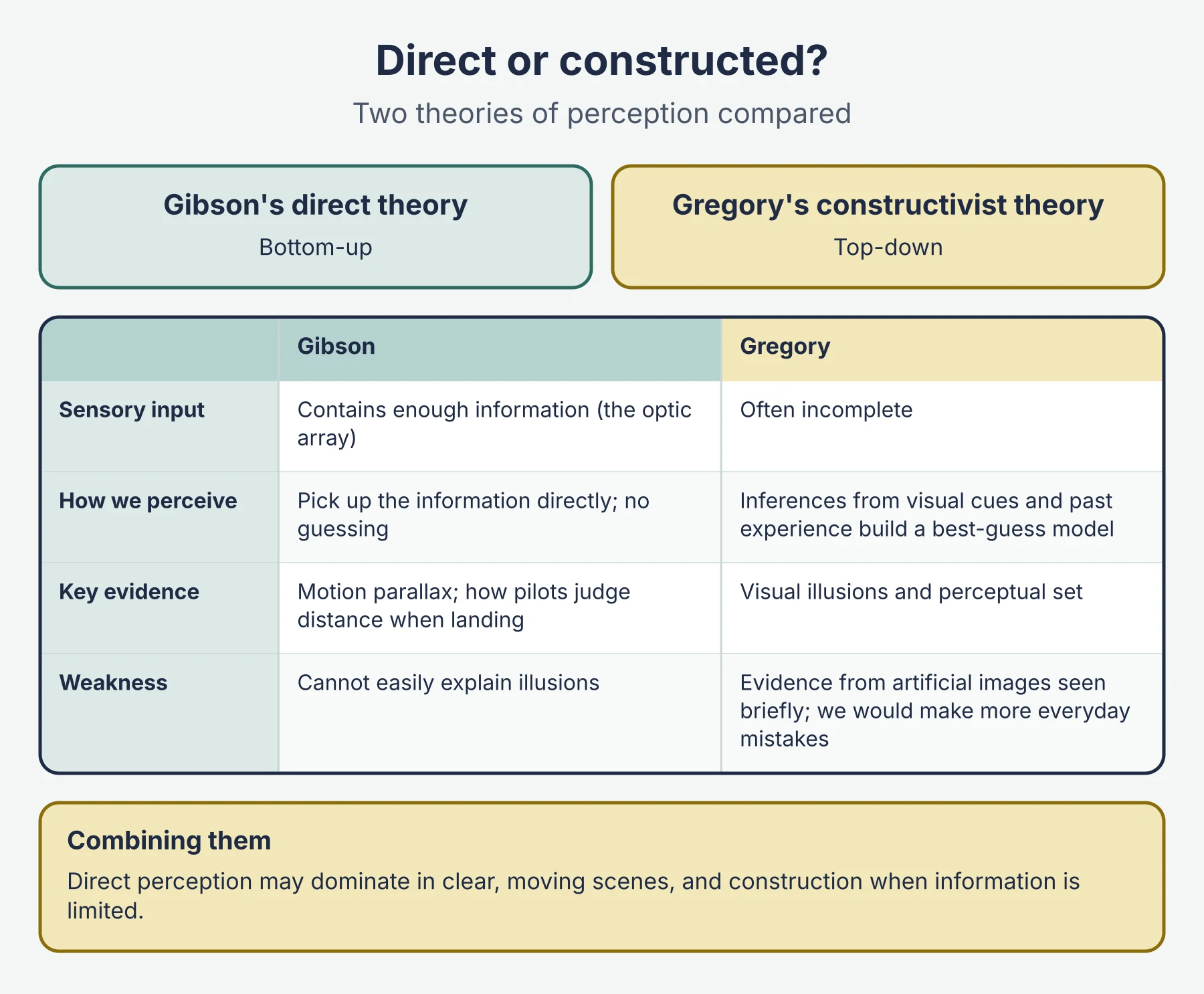
Gibson argued that perception is bottom-up: the light reaching the eye (the optic array) contains enough information for accurate perception, with no need to guess or infer. Motion parallax is a key source of that information: when we move, near objects appear to move quickly past us, while distant objects appear to move slowly. From a train window, fence posts flash by while distant hills drift. The difference in speed tells us directly how far away things are.
Evaluation. Strength: it explains how we move around the real world quickly and accurately, and it grew out of practical work on how pilots judge distance when landing. Limitation: it cannot easily explain illusions, where perception is wrong even though the information is in front of us. A counter-point is that most illusions are flat drawings, which lack the movement and depth information Gibson said real scenes provide.
Visual illusions and their explanations
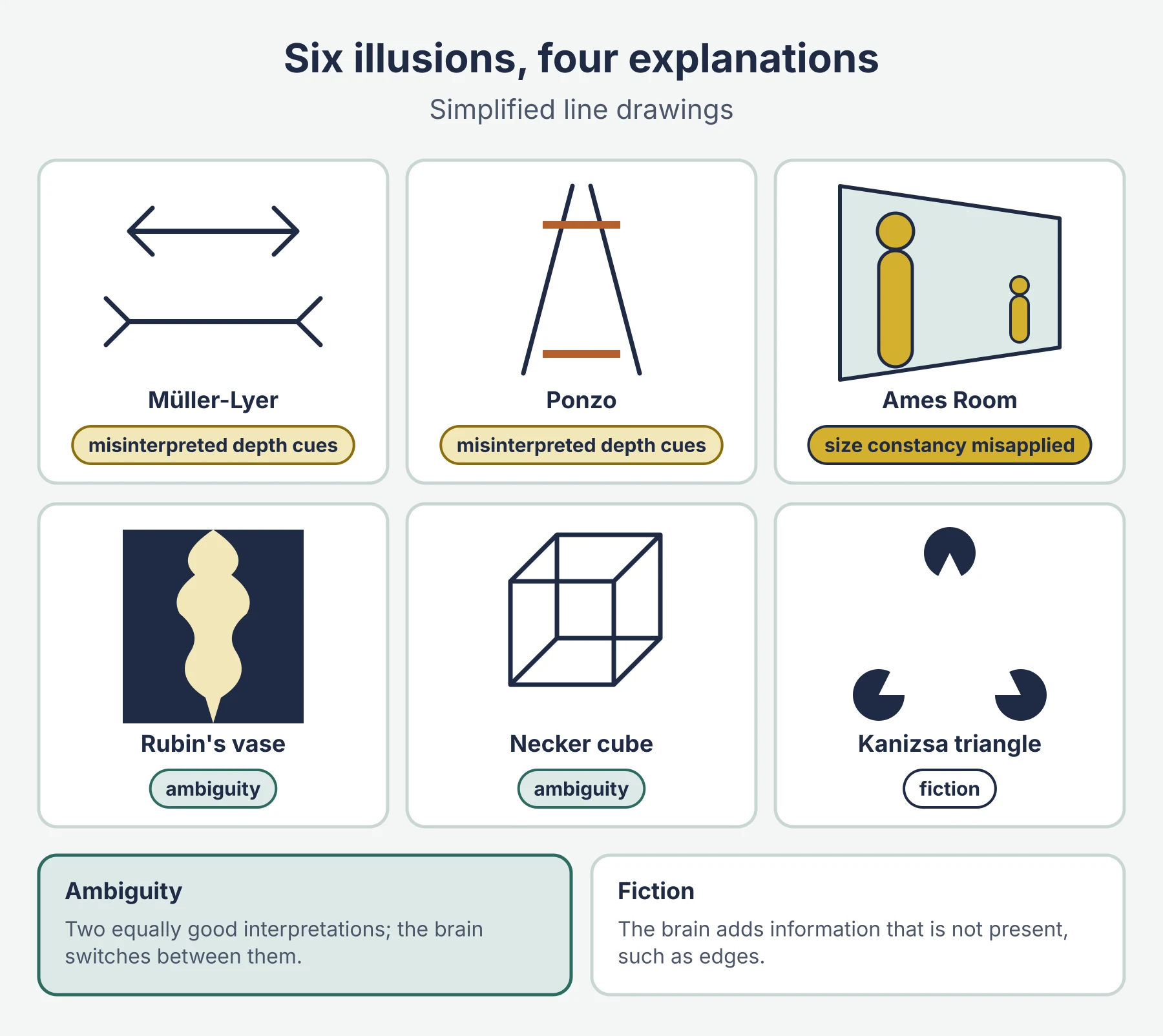
| Illusion | What you see | Explanation |
|---|---|---|
| Müller-Lyer | Two equal lines; the one with outward-pointing fins looks longer | Misinterpreted depth cues |
| Ponzo | Two equal bars between converging lines; the upper bar looks longer | Misinterpreted depth cues (linear perspective) |
| Ames Room | Two people of similar height look very different in size | Size constancy misapplied |
| Rubin’s vase | A vase or two faces in profile, never both at once | Ambiguity |
| Necker cube | A wire cube that flips between two orientations | Ambiguity |
| Kanizsa triangle | A bright white triangle with edges that are not drawn | Fiction |
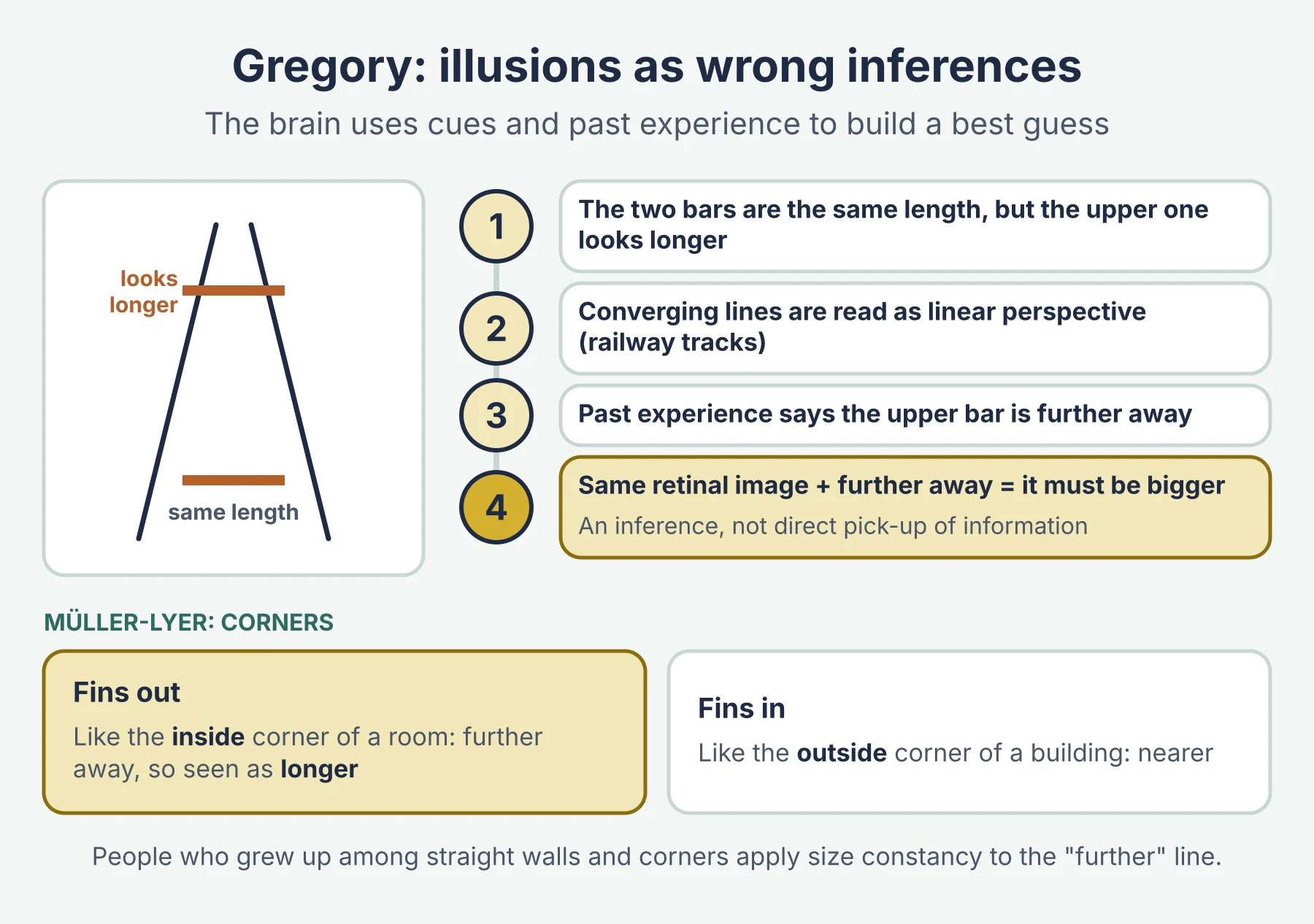
In the Ponzo illusion the converging lines act like railway tracks, so the upper bar is read as further away; since its retinal image is the same as the lower bar’s, the brain concludes it must be bigger. In the Ames Room the brain assumes the room is an ordinary rectangle, so it treats both people as being at the same distance and judges the one in the far corner, whose retinal image is smaller, to be smaller. Ambiguous figures give the brain two equally good interpretations and it switches between them. Fiction means the brain adds information, such as the edges of the Kanizsa triangle, that is not present.
Gregory’s constructivist theory
Gregory argued that perception is top-down: sensory input is often incomplete, so the brain makes inferences using visual cues and past experience to build a best-guess model of reality. Illusions are his key evidence. In the Müller-Lyer illusion, the fins-out line resembles the inside corner of a room, which would be further away, while the fins-in line resembles the outside corner of a building, which would be nearer. People who have grown up among straight walls and corners apply size constancy to the “further” line and see it as longer.
Evaluation. Strength: it explains illusions and perceptual set, both of which show that expectation changes what we see. Limitation: much of the evidence comes from artificial images seen briefly; if perception were always guesswork, we would make far more mistakes in everyday life than we do. The two theories can be combined: direct perception may dominate in clear, moving scenes, and construction when information is limited.
Perceptual set and the four named studies
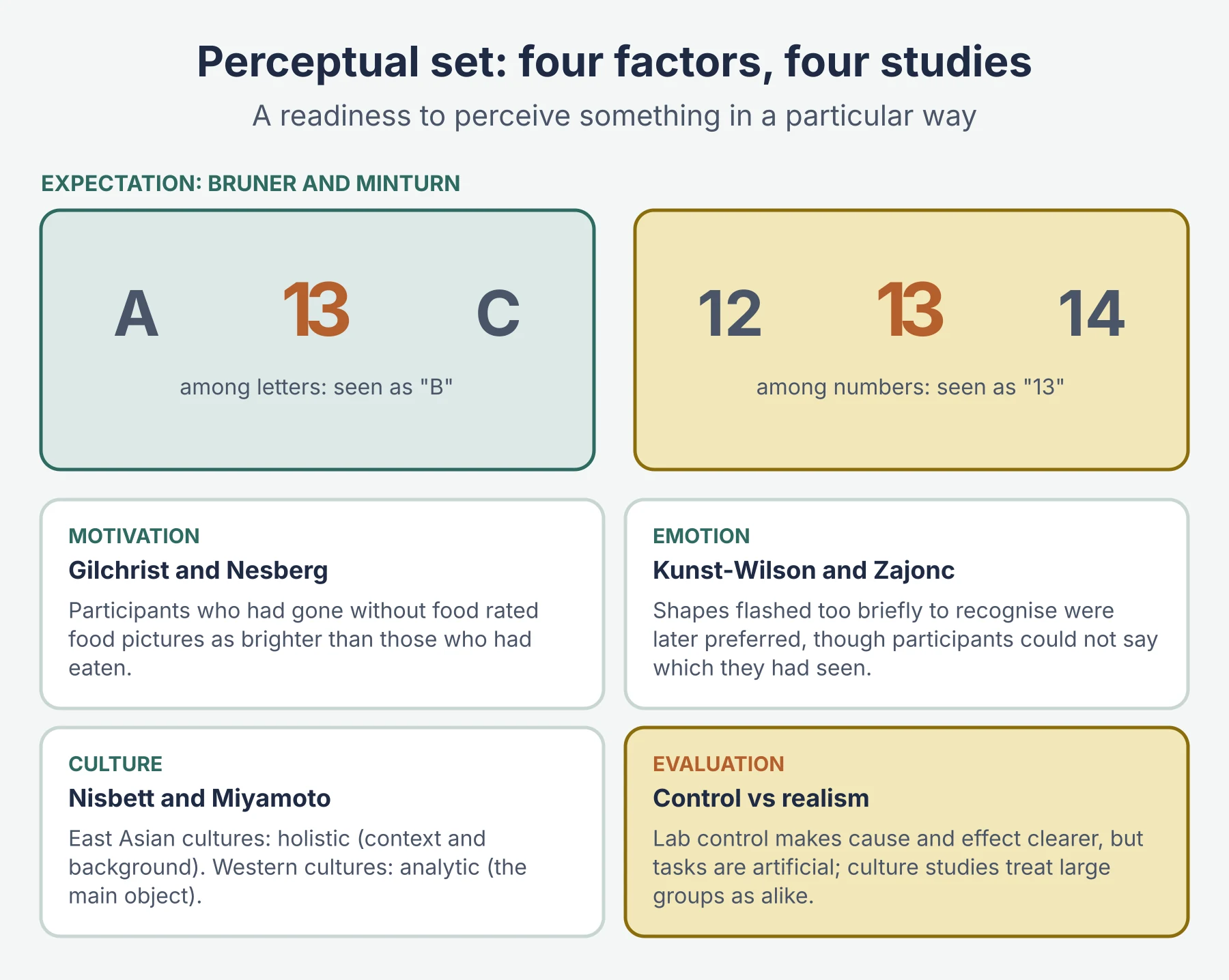
Perceptual set is a readiness to perceive something in a particular way. Four factors create it.
| Factor | Study | What it found |
|---|---|---|
| Expectation | Bruner and Minturn | An ambiguous figure was seen as “B” among letters and as “13” among numbers |
| Motivation | Gilchrist and Nesberg | Participants who had gone without food rated pictures of food as brighter than those who had eaten |
| Emotion | Kunst-Wilson and Zajonc | Shapes flashed too briefly to be recognised were later preferred, though participants could not say which they had seen |
| Culture | Nisbett and Miyamoto | People from East Asian cultures tended to perceive holistically (attending to context and background), people from Western cultures analytically (attending to the main object) |
Evaluating the studies. Most were laboratory studies with high control, so cause and effect is clearer. However, the tasks (rating brightness, judging briefly flashed shapes) are artificial, so they may not reflect everyday perception. Cultural comparisons are useful but treat large groups as if everyone in them perceives the same way.
Worked example
Explain how the Ponzo illusion supports Gregory’s constructivist theory. [3 marks]
1. The two horizontal bars are the same length, but the upper one
   looks longer.                                                [1]
2. The converging lines are read as linear perspective, so past
   experience tells the brain the upper bar is further away.    [1]
3. The brain infers that a far object with the same retinal image
   must be larger - an inference from cues and experience, as
   Gregory claims, rather than direct pick-up of information.   [1]
Common mistakes
- Calling retinal disparity a monocular cue; it needs both eyes.
- Describing Gibson’s theory as top-down or Gregory’s as bottom-up.
- Giving the Necker cube or Rubin’s vase “misinterpreted depth cues” as the explanation; both are ambiguity.
- Mixing up the four perceptual set studies: Bruner and Minturn tested expectation, not motivation.
- Saying perceptual set means people see what they want; expectation, culture and emotion also count.
Exam technique
- Identify the explanation for an illusion: use the specification’s exact four terms.
- Explain how an illusion supports a theory: describe the illusion, state the cue involved, then say what that shows about inference.
- Describe a study: method plus results; evaluate it with control, artificiality and sample.
- Apply: in a scenario (a hungry shopper, a reader expecting a word), name the factor and the matching study.
More resources on this topic
- Perception revision notes
- Perception practice questions
- Memory study guide
- Cognition and Behaviour overview guide
Official syllabus
OxfordAQA International GCSE Psychology (9218) specification, Version 1.1, section 3.1.2 — oxfordaqa.com.
Related resources
-
Practice questions
OxfordAQA International GCSE Psychology (9218): Perception – Practice Questions
Original perception questions with full answers for OxfordAQA IGCSE Psychology 9218: depth cues, illusions, Gibson and Gregory, and perceptual set studies.
Psychology · OxfordAQA · IGCSE
Try questions -
Revision notes
OxfordAQA International GCSE Psychology (9218): Perception – Revision Notes
Perception recall notes for OxfordAQA IGCSE Psychology 9218: depth cues, illusion explanations, Gibson versus Gregory, perceptual set studies and a self-test.
Psychology · OxfordAQA · IGCSE
Revise topic -
Study guides
OxfordAQA International GCSE Psychology (9218): Research Methods (Paper 1)
Planning experiments for OxfordAQA IGCSE Psychology 9218 Paper 1: hypotheses, variables, designs, controls, sampling and BPS ethics, with cognitive examples.
Psychology · OxfordAQA · IGCSE
Read guide
Studying Psychology?
This page is free and stays free. Marlbridge is not offering Psychology classes at the moment, so there is no tuition to book for it. The free study resources stay open to everyone.
Get free revision emails (optional)
Occasional emails with practice questions, worked explanations and links to free resources for the qualification and subjects you choose. No spam, and you can unsubscribe from any email. The free tools on this site never need an email.