
Revision Notes
OxfordAQA International GCSE Psychology (9218): Memory – Revision Notes
Condensed notes on memory for OxfordAQA IGCSE Psychology 9218: store and component features, three named studies, memory accuracy, exam traps and a self-test.
- Subject
- Psychology
- Level
- IGCSE
- Topic
- Paper 1 – Cognition and Behaviour
- Author
- Marlbridge Academic Team
- Updated
- Reviewed by
- Kanwal Aslam (what this means)
Aligned to OxfordAQA IGCSE Psychology (9218), Version 1.1. Official specification .
Syllabus page (what it covers and how it is assessed): OxfordAQA IGCSE Psychology.
Syllabus points this page covers
9218
- 3.1.1 Memory
Quick-recall notes for 3.1.1 Memory, Section A of Paper 1 in OxfordAQA International GCSE Psychology (9218). For full explanations and worked answers, use the Memory study guide.
Key terms
| Term | Meaning |
|---|---|
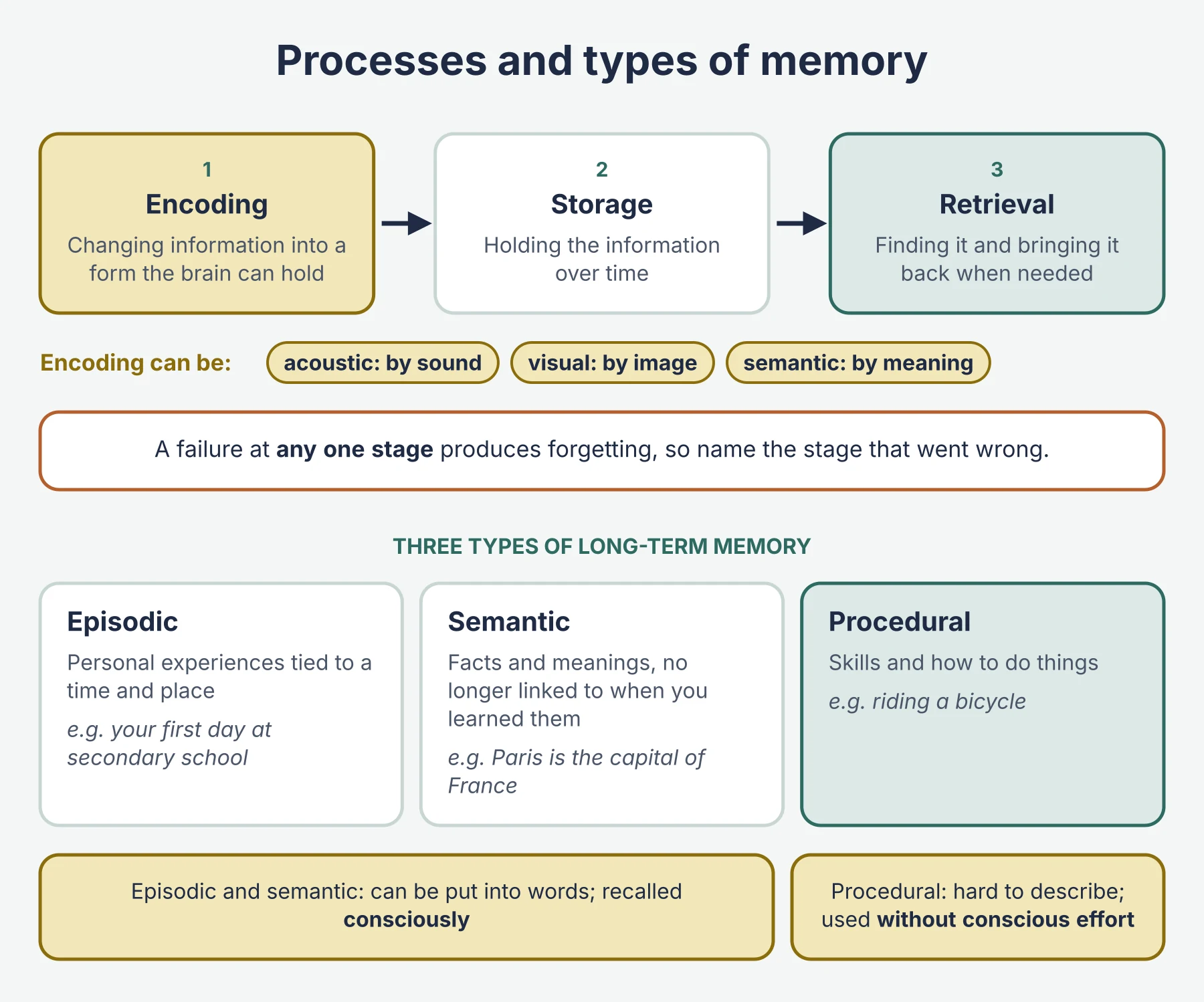
| Encoding | Converting information into a form memory can hold (acoustic, visual, semantic) |
| Storage | Keeping information over time |
| Retrieval | Recovering stored information when needed |
| Episodic memory | Personal events, linked to a time and place |
| Semantic memory | Facts and meanings, not tied to when they were learned |
| Procedural memory | Skills and actions, used without conscious effort |
| Primacy effect | Better recall of the first items in a list |
| Recency effect | Better recall of the last items in a list |
| Dual processing task | Doing two tasks at once to see whether they compete for the same component |
| Schema | A mental framework of knowledge built from experience |
| Effort after meaning | Changing a memory so it fits what we already understand |
| Proactive interference | Old learning disrupts recall of new learning |
| Retroactive interference | New learning disrupts recall of old learning |
| False memory | A confident recollection of something that did not happen |
Multi-store model at a glance
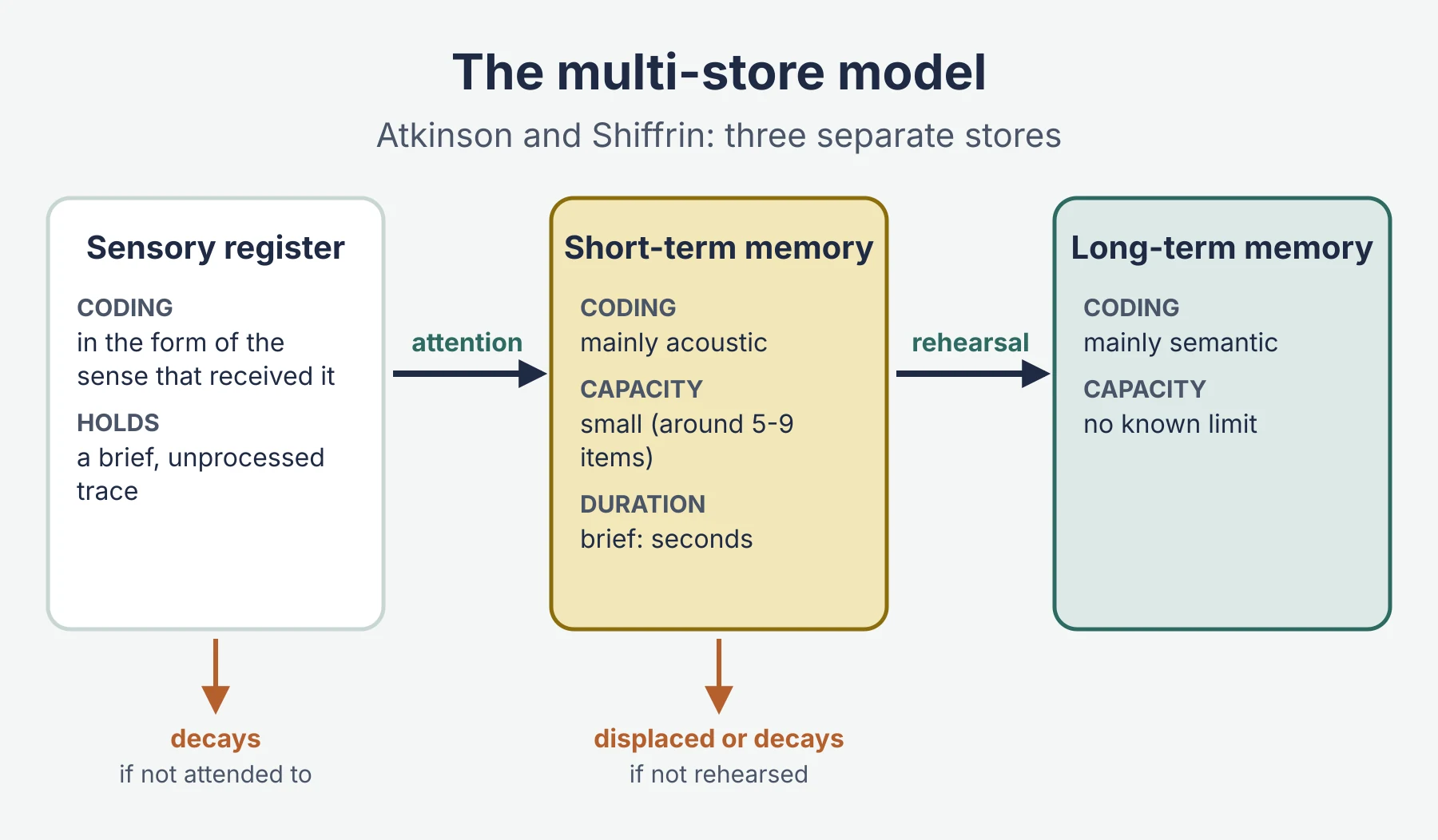
| Store | Coding | Capacity | Duration |
|---|---|---|---|
| Sensory register | Modality-specific (in the form of the sense) | Very large | Under about two seconds |
| Short-term memory | Mainly acoustic | Around 5-9 items | Around 18-30 seconds without rehearsal |
| Long-term memory | Mainly semantic | Unlimited | Up to a lifetime |
- Attention moves information from the sensory register to short-term memory.
- Rehearsal moves it from short-term to long-term memory.
- Without rehearsal, information in short-term memory is lost through decay or displacement.
For: separate coding and the serial position curve point to separate stores. Against: short-term memory seems to have several parts; some information enters long-term memory without rehearsal; long-term memory has at least three types.
Murdock: serial position
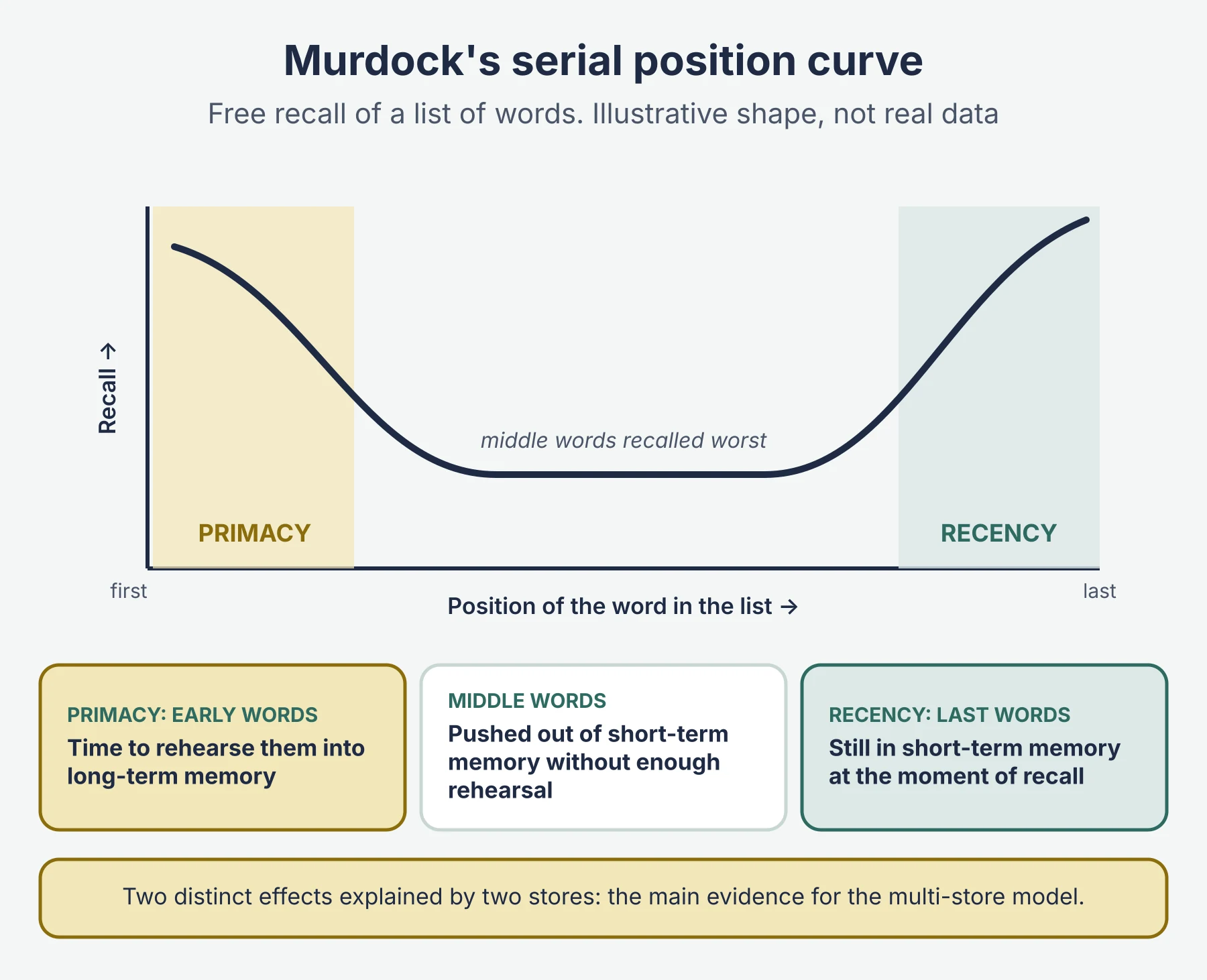
- Method: word lists presented one at a time; free recall in any order.
- Result: U-shaped curve, with high recall at the start and end and low in the middle.
- Explanation: primacy = early words rehearsed into long-term memory; recency = last words still in short-term memory.
- Use in exams: evidence that short-term and long-term memory are separate stores.
Working memory model at a glance
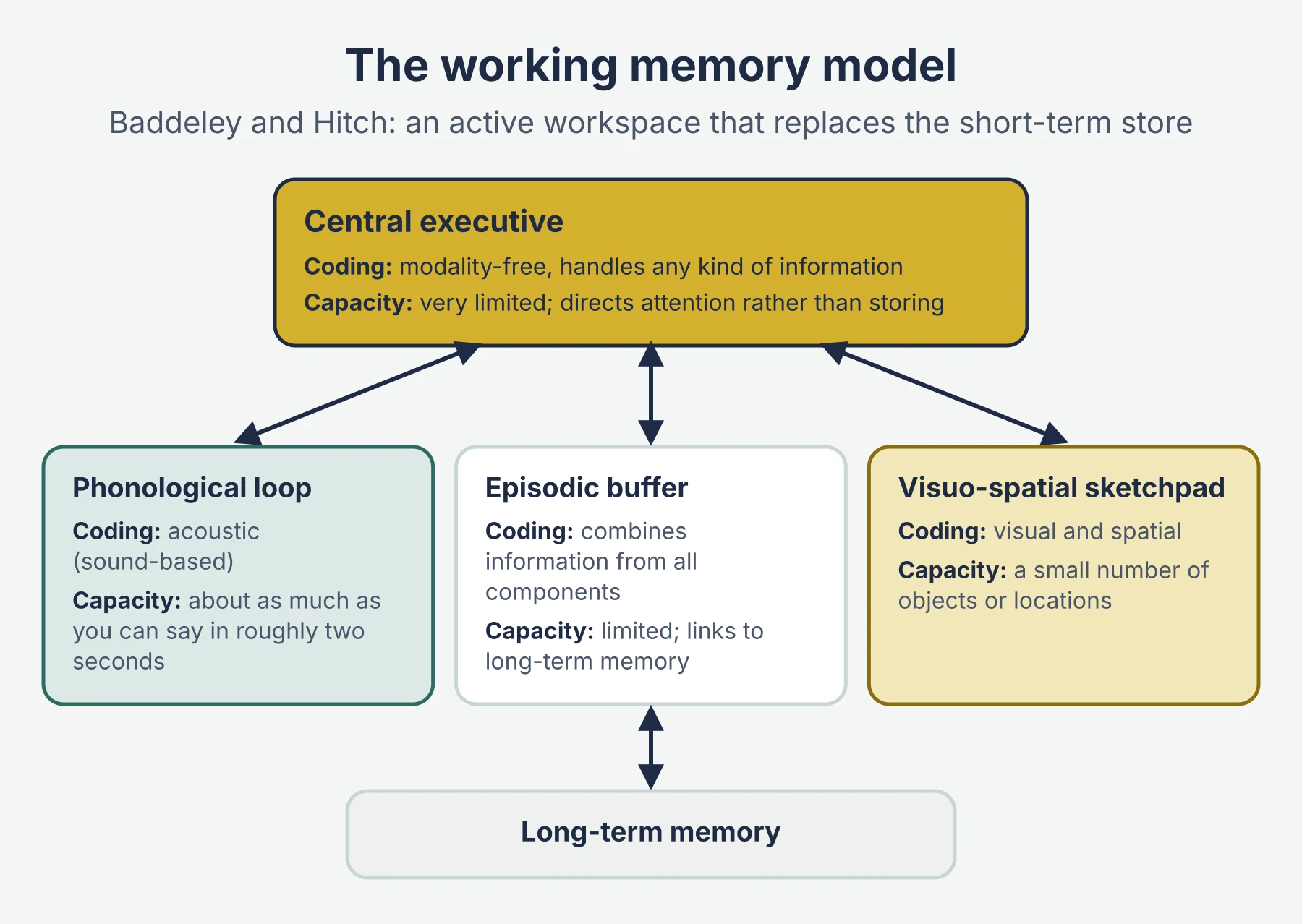
| Component | Coding | Capacity / role |
|---|---|---|
| Central executive | Modality-free | Very limited; directs attention and allocates tasks |
| Phonological loop | Acoustic | Roughly two seconds’ worth of speech |
| Visuo-spatial sketchpad | Visual and spatial | A few objects or locations |
| Episodic buffer | All types combined | Limited; links the components to long-term memory |
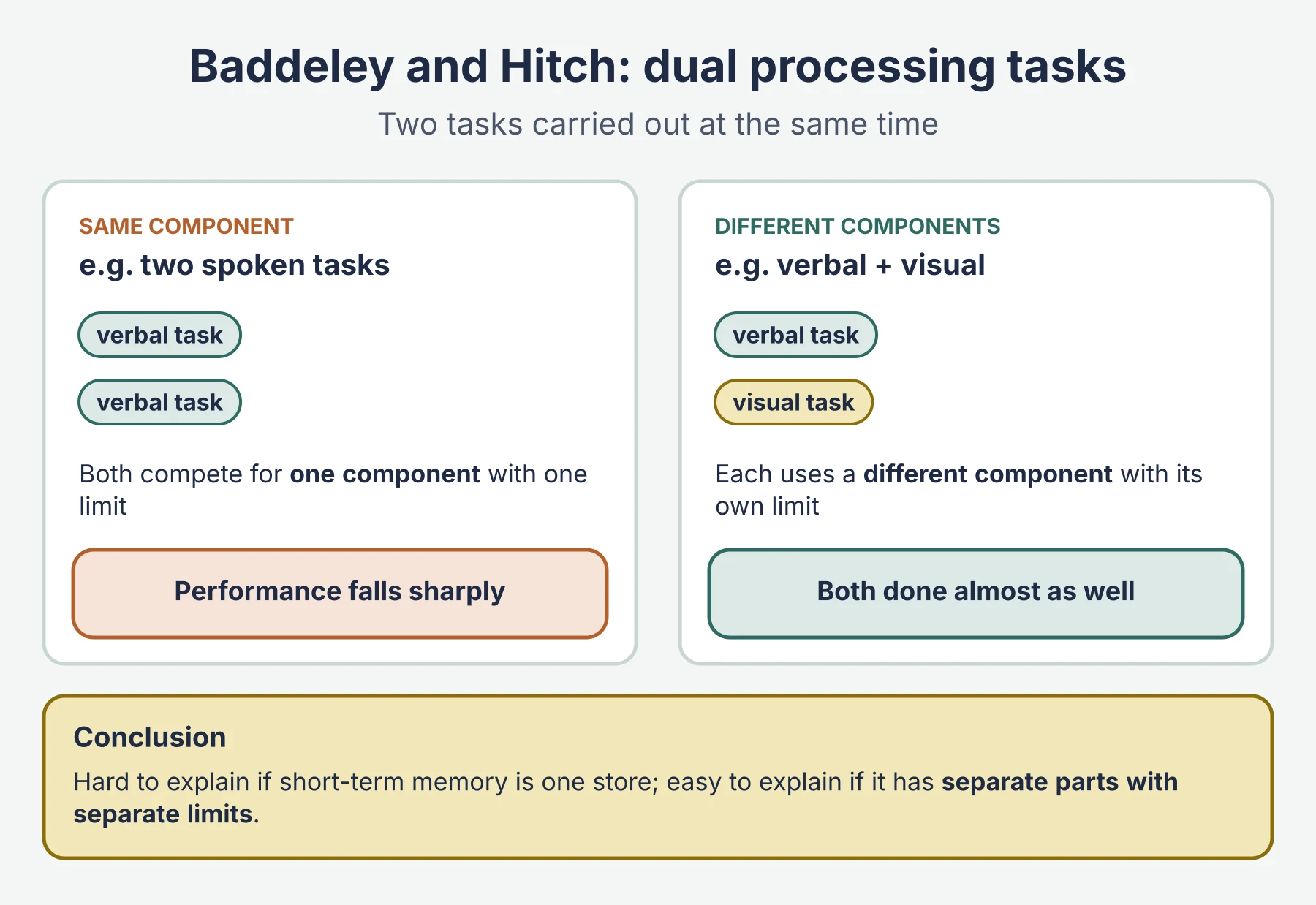
Baddeley and Hitch: two tasks using the same component interfere; two tasks using different components can be done together with little loss. So short-term memory is not one store.
For: explains multitasking; supported by dual-task evidence. Against: the central executive is vaguely defined and hard to test.
Reconstructive memory
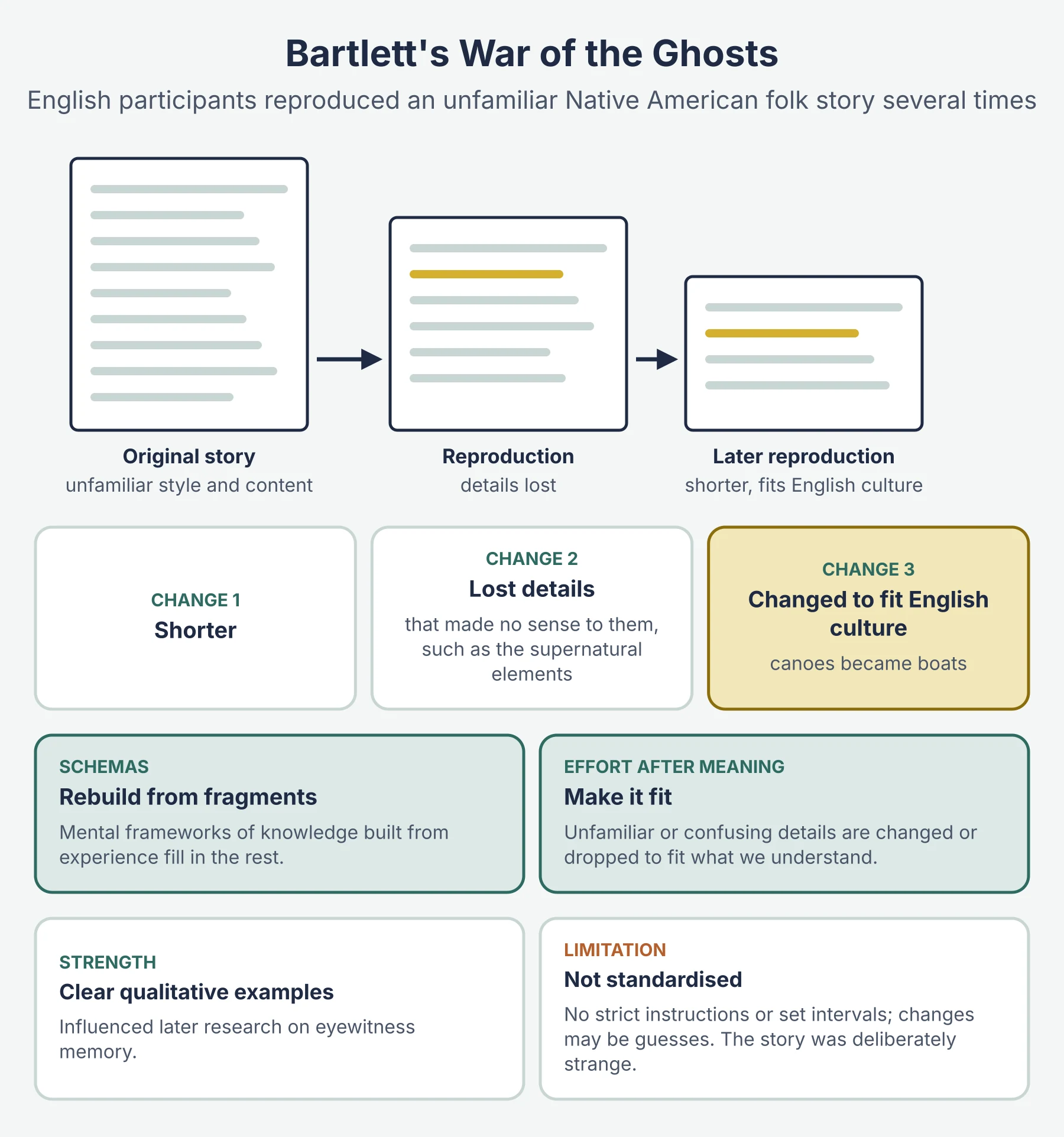
- Memories are rebuilt from fragments using schemas, not replayed like a recording.
- Effort after meaning: unfamiliar details are changed or dropped to make sense.
- Bartlett, War of the Ghosts: English participants repeatedly reproduced an unfamiliar Native American story. Versions became shorter, lost strange details and were changed to fit English culture (canoes became boats).
- Evaluation: rich qualitative support; but no standardised instructions or fixed delays, and a deliberately odd story.
Accuracy of memory
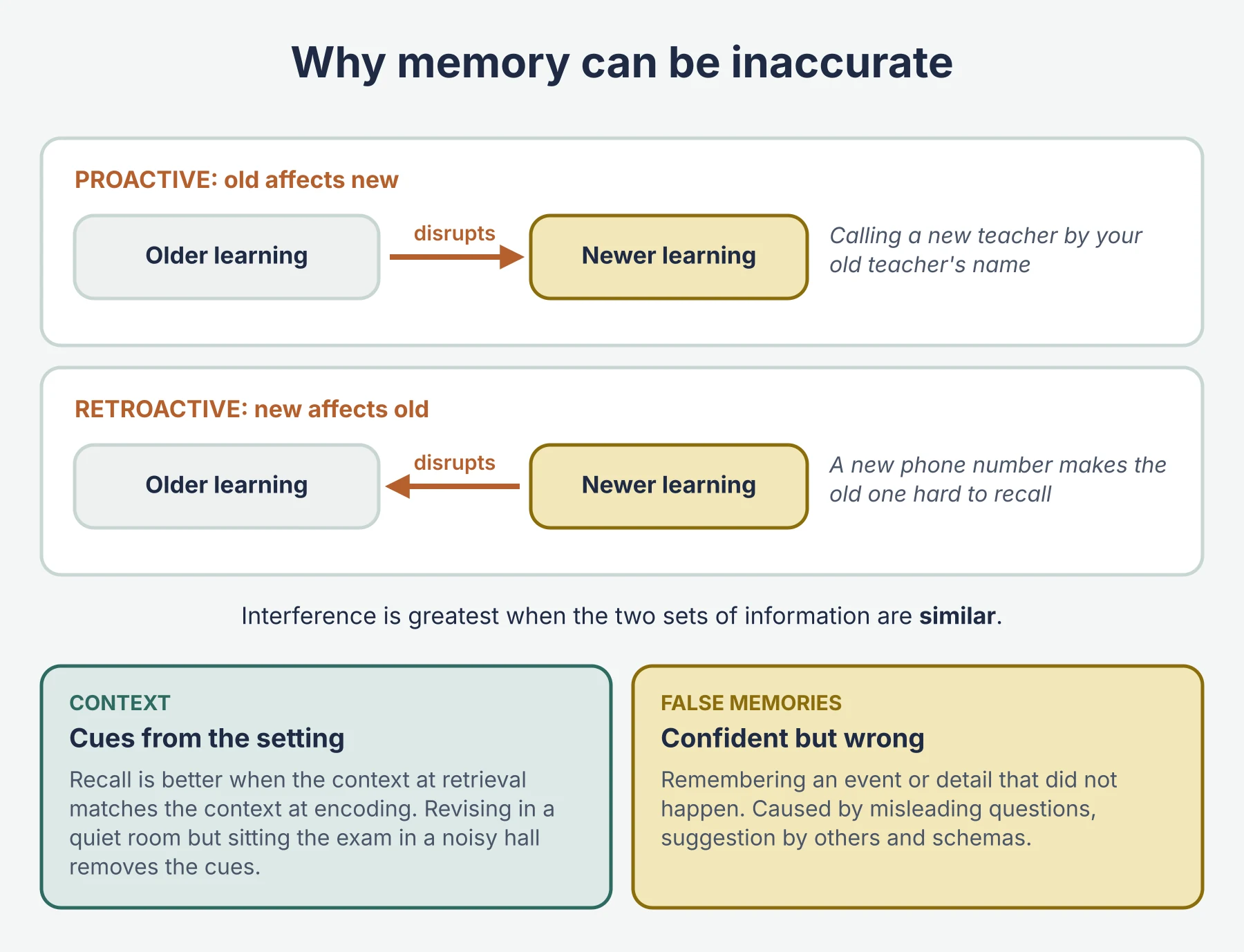
| Factor | How it reduces accuracy | Everyday example |
|---|---|---|
| Interference | Similar memories compete and get confused | Mixing up two similar sets of vocabulary |
| Context | Missing cues from the original setting make retrieval harder | Forgetting why you walked into a room |
| False memories | Suggestion or schemas add details that never happened | “Remembering” a detail a friend described |
Exam traps
- Short-term memory duration is in seconds, not minutes.
- Capacity of short-term memory is around 5-9 items, often written as 7 plus or minus 2.
- Recency is a short-term memory effect; primacy is a long-term memory effect.
- The working memory model replaces short-term memory only, not the whole multi-store model.
- Coding and capacity are named for working memory components; duration is not.
- Murdock is evidence for the multi-store model; Baddeley and Hitch are evidence for the working memory model; Bartlett is evidence for reconstructive memory. Do not swap them.
- In “apply” questions, every point must mention the person in the scenario.
Linking the three explanations
| Question type | Best explanation to use |
|---|---|
| Why someone forgot a list after being distracted | Multi-store model (no rehearsal; displacement) |
| Why someone can drive and talk but not text and talk | Working memory model (same versus different components) |
| Why a story changed in the retelling | Reconstructive memory (schemas, effort after meaning) |
| Why recall improved back in the original room | Context (retrieval cues) |
Self-test
- Name the three processes of memory.
- Which type of long-term memory stores knowing how to tie a shoelace?
- What is the main coding of long-term memory in the multi-store model?
- What moves information from short-term to long-term memory?
- What is the recency effect, and which store explains it?
- Name the four components of the working memory model.
- What is the coding of the visuo-spatial sketchpad?
- What did Baddeley and Hitch find when two tasks used the same component?
- Define effort after meaning.
- Give two changes Bartlett’s participants made to the War of the Ghosts.
- Distinguish proactive from retroactive interference.
- Why might recall be better in the room where you learned the material?
Answers:
- Encoding, storage and retrieval.
- Procedural memory.
- Semantic (by meaning).
- Rehearsal.
- Better recall of the last items in a list; short-term memory, because they are still held there at recall.
- Central executive, phonological loop, visuo-spatial sketchpad, episodic buffer.
- Visual and spatial.
- Performance fell, because the tasks competed for the same limited component.
- Changing a memory so that it fits existing knowledge and makes sense to the person.
- Any two: the story became shorter; supernatural or unfamiliar details were left out; details were changed to fit English culture, such as canoes becoming boats.
- Proactive: old learning disrupts new. Retroactive: new learning disrupts old.
- Features of the room act as retrieval cues that match those present at encoding.
More resources on this topic
Related resources
-
Study guides
OxfordAQA International GCSE Psychology (9218): Perception
Depth cues, Gibson and Gregory, six visual illusions and perceptual set with four named studies, explained for OxfordAQA International GCSE Psychology 9218.
Psychology · OxfordAQA · IGCSE
Read guide -
Practice questions
OxfordAQA International GCSE Psychology (9218): Perception – Practice Questions
Original perception questions with full answers for OxfordAQA IGCSE Psychology 9218: depth cues, illusions, Gibson and Gregory, and perceptual set studies.
Psychology · OxfordAQA · IGCSE
Try questions -
Revision notes
OxfordAQA International GCSE Psychology (9218): Perception – Revision Notes
Perception recall notes for OxfordAQA IGCSE Psychology 9218: depth cues, illusion explanations, Gibson versus Gregory, perceptual set studies and a self-test.
Psychology · OxfordAQA · IGCSE
Revise topic
Studying Psychology?
This page is free and stays free. Marlbridge is not offering Psychology classes at the moment, so there is no tuition to book for it. The free study resources stay open to everyone.
Get free revision emails (optional)
Occasional emails with practice questions, worked explanations and links to free resources for the qualification and subjects you choose. No spam, and you can unsubscribe from any email. The free tools on this site never need an email.