
Revision Notes
OxfordAQA International GCSE Psychology (9218): Perception – Revision Notes
Perception recall notes for OxfordAQA IGCSE Psychology 9218: depth cues, illusion explanations, Gibson versus Gregory, perceptual set studies and a self-test.
- Subject
- Psychology
- Level
- IGCSE
- Topic
- Paper 1 – Cognition and Behaviour
- Author
- Marlbridge Academic Team
- Updated
- Reviewed by
- Kanwal Aslam (what this means)
Aligned to OxfordAQA IGCSE Psychology (9218), Version 1.1. Official specification .
Syllabus page (what it covers and how it is assessed): OxfordAQA IGCSE Psychology.
Syllabus points this page covers
9218
- 3.1.2 Perception
Quick-recall notes for 3.1.2 Perception, Section B of Paper 1 in OxfordAQA International GCSE Psychology (9218). For full explanations and a worked example, use the Perception study guide.
Key terms
| Term | Meaning |
|---|---|
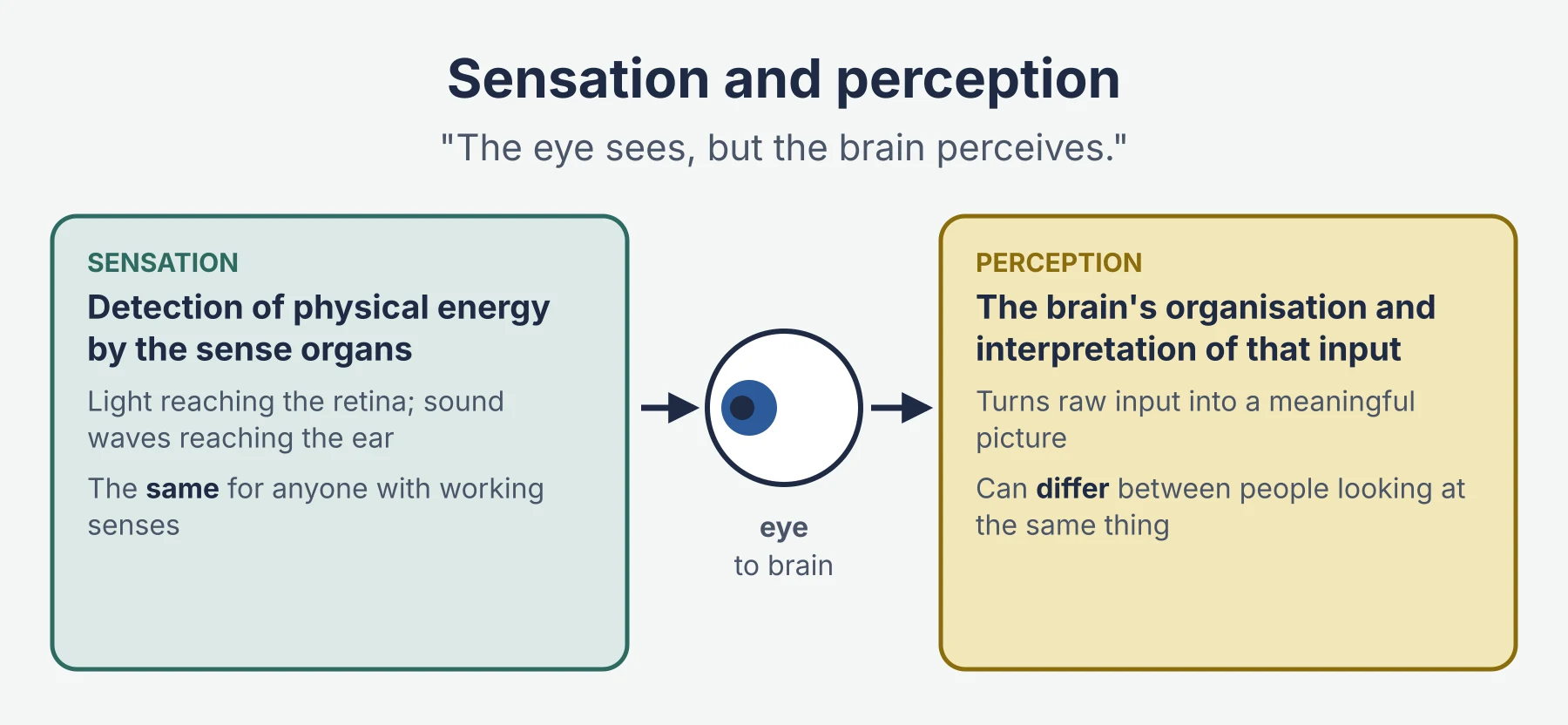
| Sensation | Detecting physical energy (light, sound) with the sense organs |
| Perception | The brain organising and interpreting sensory information |
| Monocular depth cue | A distance cue that works with one eye |
| Binocular depth cue | A distance cue that needs both eyes |
| Size constancy | Seeing an object as the same size despite its retinal image changing with distance |
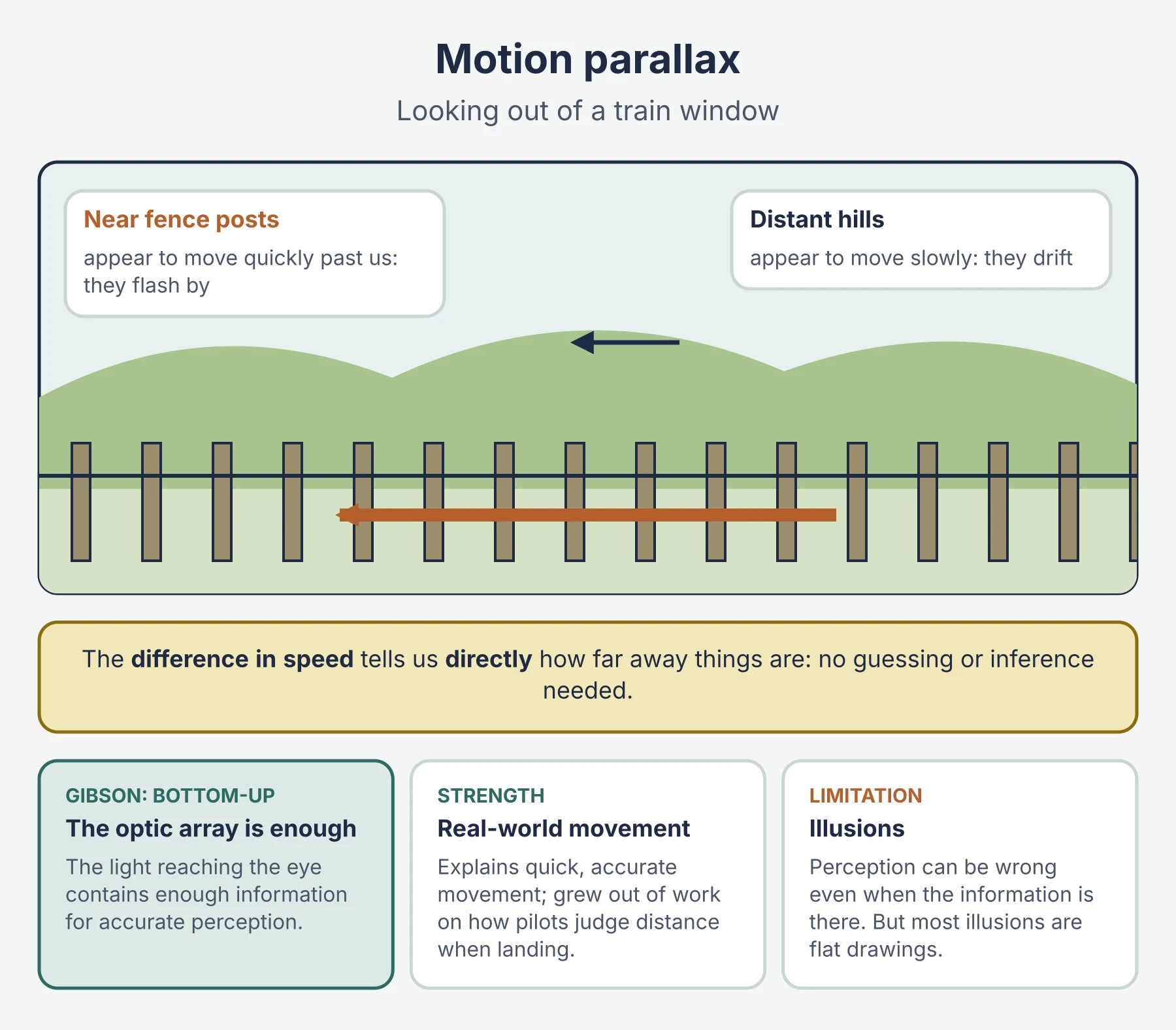
| Motion parallax | Near objects seem to move faster than far objects as we move |
| Bottom-up processing | Perception driven by incoming sensory data (Gibson) |
| Top-down processing | Perception driven by expectations and past experience (Gregory) |
| Ambiguity | A figure with two equally valid interpretations |
| Fiction | The brain perceives something that is not physically there |
| Perceptual set | A readiness to perceive things in a particular way |
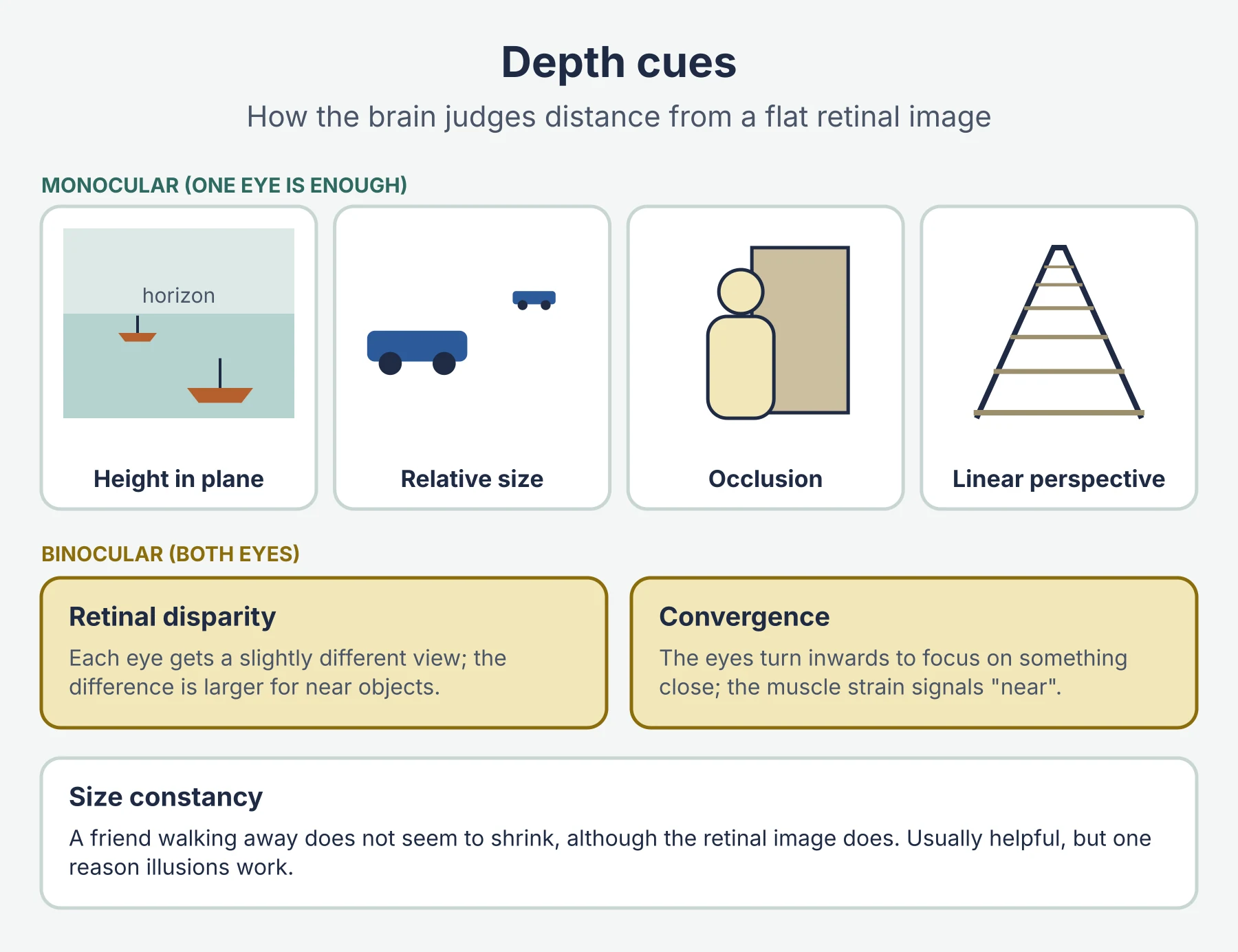
Depth cues
| Monocular | Binocular |
|---|---|
| Height in plane: higher in view, nearer horizon = further | Retinal disparity: two slightly different images; bigger difference = nearer |
| Relative size: smaller image of a familiar object = further | Convergence: eyes turn in more for near objects |
| Occlusion: the object in front is nearer | |
| Linear perspective: parallel lines converge with distance |
Memory hook for the monocular four: Height, Relative size, Occlusion, Linear perspective.
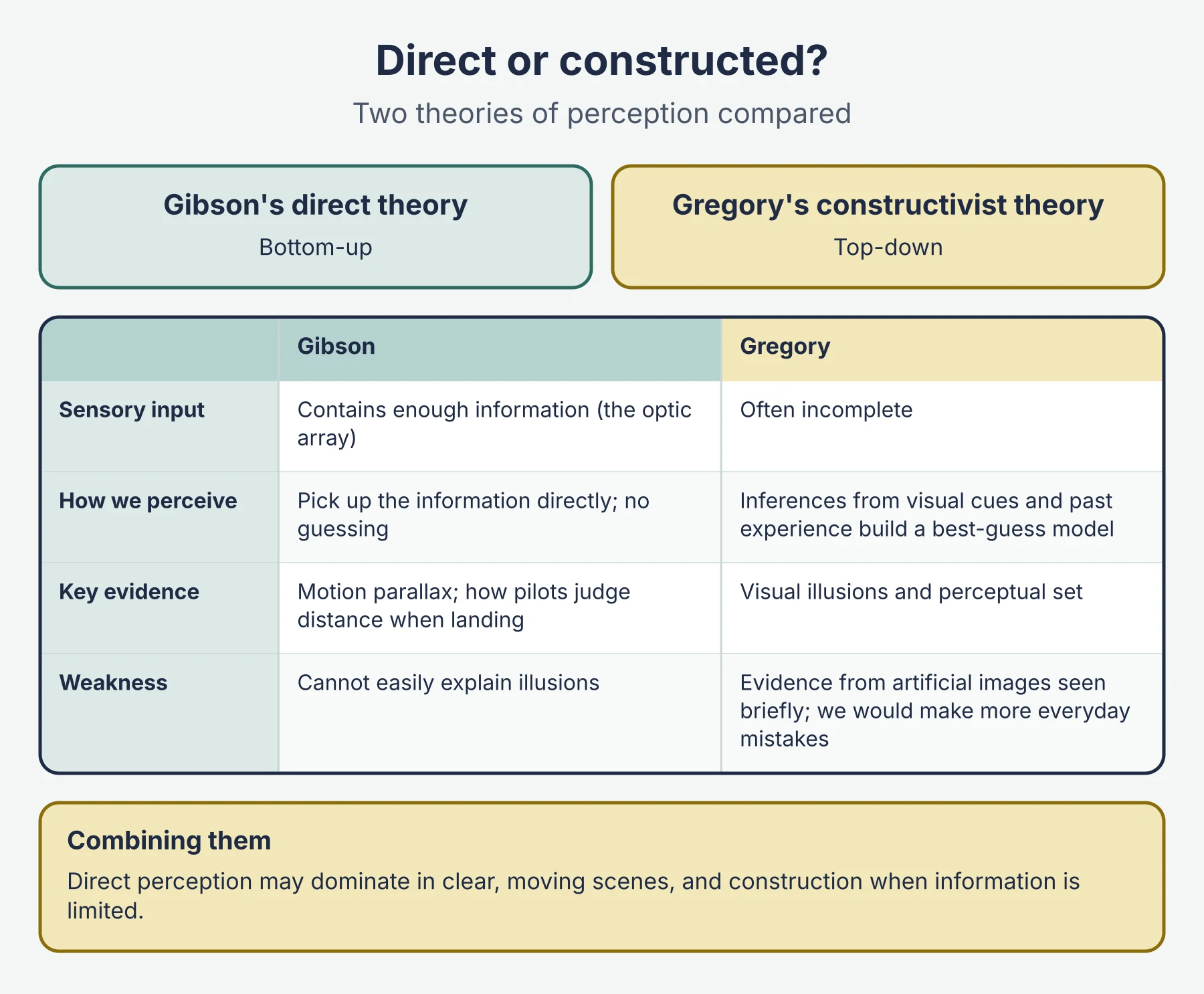
Two theories compared
| Gibson: direct | Gregory: constructivist | |
|---|---|---|
| Direction | Bottom-up | Top-down |
| Key claim | The optic array holds enough information; no inference needed | Brain infers a model of reality from cues and past experience |
| Key concept | Motion parallax | Hypotheses; misapplied size constancy |
| Explains well | Fast, accurate perception when moving in the real world | Illusions and perceptual set |
| Struggles with | Illusions | Why everyday perception is usually accurate |
Illusions and explanations
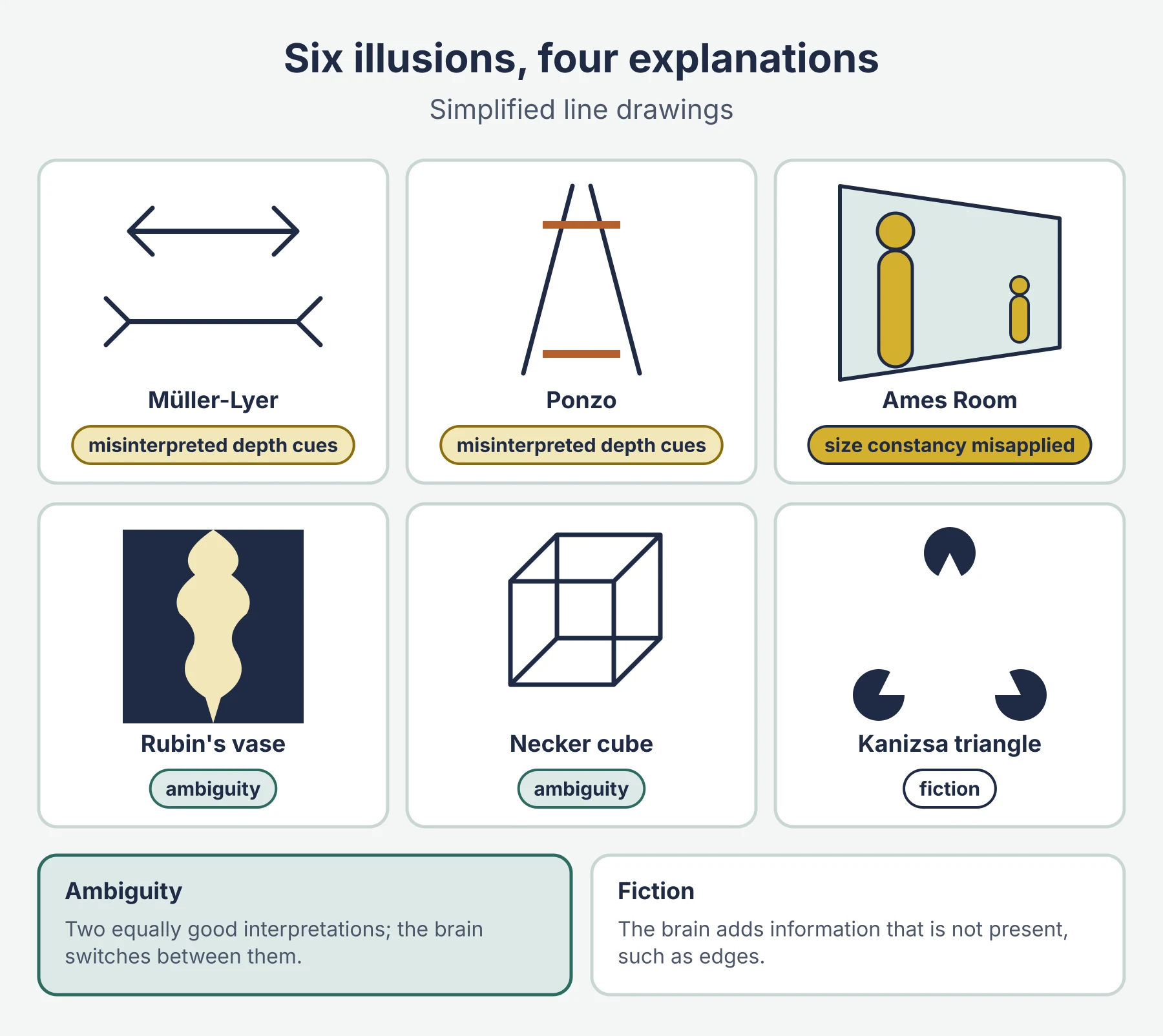
| Illusion | Explanation | One-line reason |
|---|---|---|
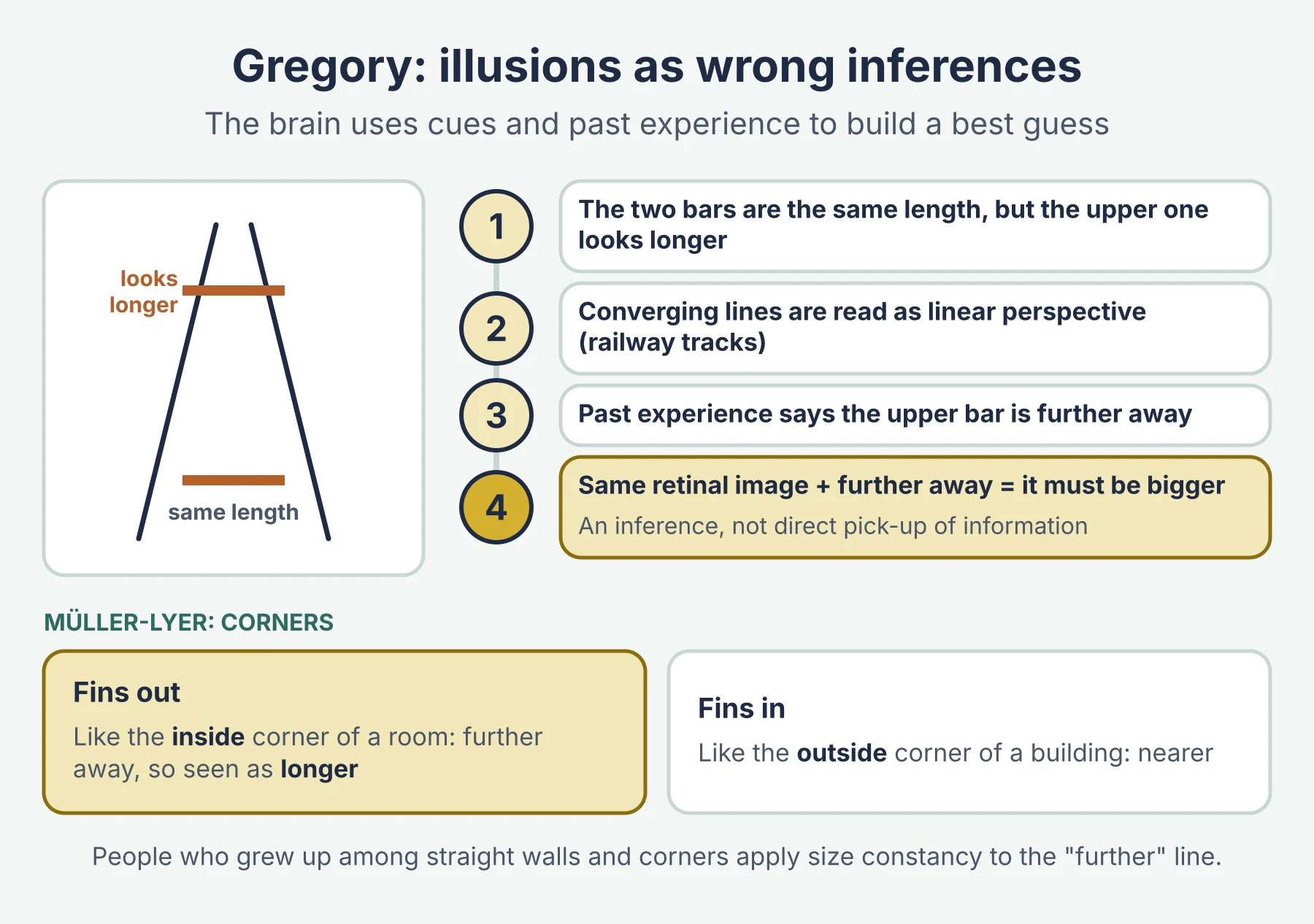
| Müller-Lyer | Misinterpreted depth cues | Fins look like corners; the “further” line is scaled up |
| Ponzo | Misinterpreted depth cues | Converging lines read as perspective; upper bar seems further, so bigger |
| Ames Room | Size constancy | Room assumed rectangular, so the person in the far corner looks smaller |
| Rubin’s vase | Ambiguity | Vase or faces; figure and background swap |
| Necker cube | Ambiguity | Two equally likely front faces |
| Kanizsa triangle | Fiction | Edges of a triangle are seen that are not drawn |
Perceptual set studies
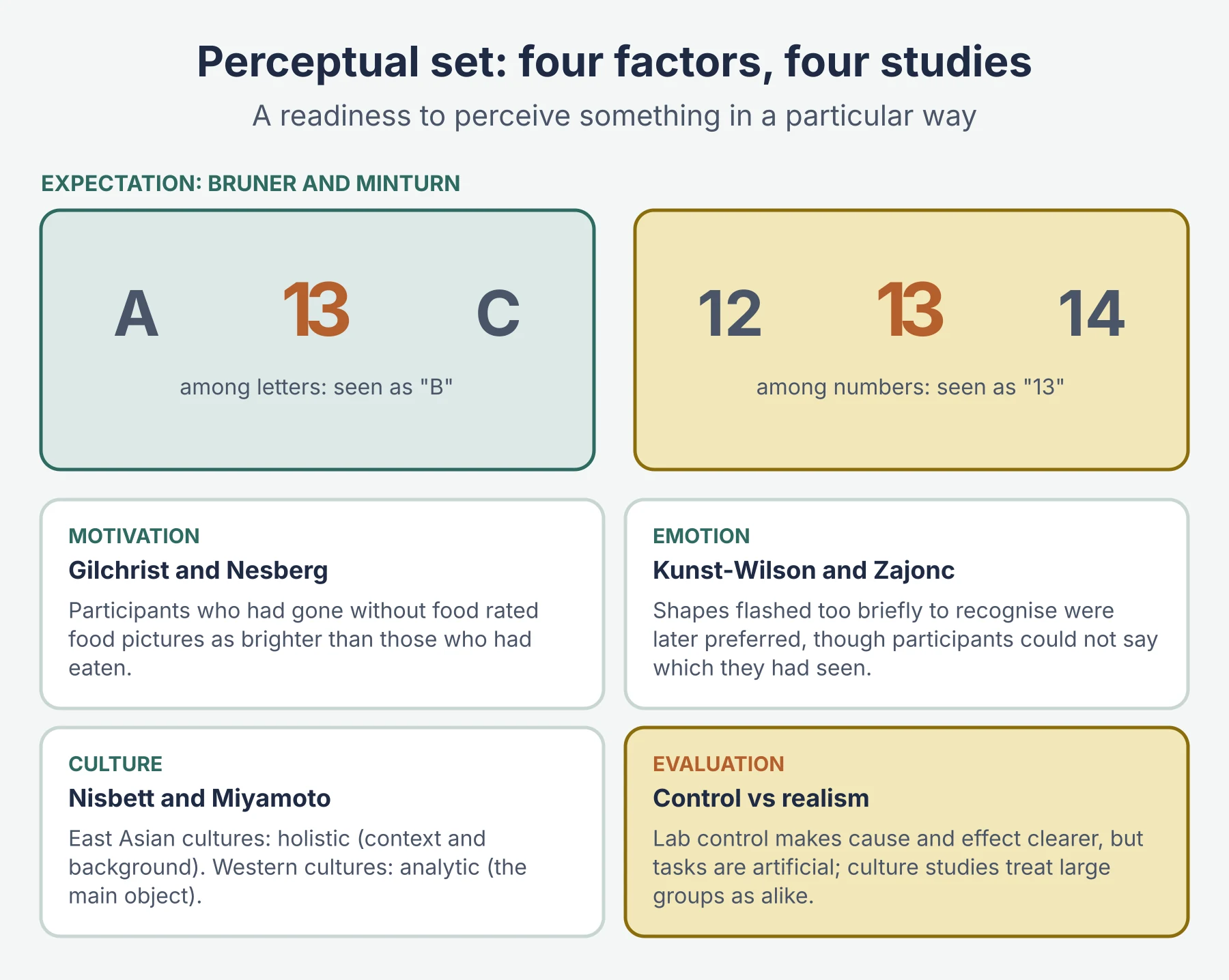
| Factor | Study | Key finding | Use in exams |
|---|---|---|---|
| Expectation | Bruner and Minturn | Same figure read as “B” among letters, “13” among numbers | Context sets up what we expect |
| Motivation | Gilchrist and Nesberg | Food-deprived participants rated food pictures brighter | Needs change perception |
| Emotion | Kunst-Wilson and Zajonc | Briefly flashed shapes preferred without being recognised | Liking can form without conscious recognition |
| Culture | Nisbett and Miyamoto | East Asian participants more holistic, Western participants more analytic | Culture shapes what we attend to |
Evaluation shortcuts: high control in laboratory studies; artificial stimuli reduce real-life relevance; cultural groups are not uniform.
Spotting the factor in a scenario
| Scenario clue | Factor | Study to cite |
|---|---|---|
| A proofreader misses a typo because they “read” the word they expected | Expectation | Bruner and Minturn |
| A thirsty hiker sees a shimmer on the road as water | Motivation | Gilchrist and Nesberg |
| A shopper prefers a logo they glimpsed but cannot remember seeing | Emotion | Kunst-Wilson and Zajonc |
| Two tourists describe the same street photo, one listing the main building, one the whole scene | Culture | Nisbett and Miyamoto |
How illusions fit the theories
Illusions are evidence for Gregory: the information on the page is correct, yet perception is wrong, so the brain must be adding inferences. Gibson would reply that illusions are flat, still images lacking motion parallax and other real-world information, so they are an unfair test of everyday perception.
Exam traps
- Retinal disparity and convergence are the only binocular cues on the specification.
- Ambiguity explains Rubin’s vase and the Necker cube; fiction explains the Kanizsa triangle.
- The Ames Room is explained by size constancy, not ambiguity.
- Gibson is bottom-up; Gregory is top-down. Illusions support Gregory.
- Match each perceptual set study to its factor; swapping them loses the mark.
- “Sensation” and “perception” are not interchangeable in definitions.
Self-test
- Define sensation.
- Name the two binocular depth cues.
- Which monocular cue is shown when a lamp hides part of a sofa?
- What is motion parallax?
- Is Gregory’s theory top-down or bottom-up?
- Which explanation accounts for the Kanizsa triangle?
- Name two illusions explained by ambiguity.
- Why does the upper bar in the Ponzo illusion look longer?
- Which study is evidence for the effect of motivation on perception?
- What did Bruner and Minturn’s ambiguous figure look like in a sequence of numbers?
- What does Kunst-Wilson and Zajonc’s study show about emotion?
- Give one limitation of Gibson’s theory.
Answers:
- Detecting physical energy, such as light or sound, with the sense organs.
- Retinal disparity and convergence.
- Occlusion.
- As we move, near objects appear to move faster across our view than distant objects, which gives information about distance.
- Top-down.
- Fiction.
- Rubin’s vase and the Necker cube.
- The converging lines are read as linear perspective, so the upper bar seems further away and is perceived as larger.
- Gilchrist and Nesberg.
- The number 13.
- People can develop a liking for something without consciously recognising it, so feelings affect perception.
- It cannot easily explain visual illusions, where perception is wrong despite the information being present.
More resources on this topic
Related resources
-
Study guides
OxfordAQA International GCSE Psychology (9218): Research Methods (Paper 1)
Planning experiments for OxfordAQA IGCSE Psychology 9218 Paper 1: hypotheses, variables, designs, controls, sampling and BPS ethics, with cognitive examples.
Psychology · OxfordAQA · IGCSE
Read guide -
Practice questions
OxfordAQA International GCSE Psychology (9218): Research Methods (Paper 1) – Practice Questions
Original research methods questions with full answers for OxfordAQA IGCSE Psychology 9218 Paper 1, built around a memory experiment and its design choices.
Psychology · OxfordAQA · IGCSE
Try questions -
Revision notes
OxfordAQA International GCSE Psychology (9218): Research Methods (Paper 1) – Revision Notes
Recall notes on experiments for OxfordAQA IGCSE Psychology 9218 Paper 1: hypotheses, variables, designs, controls, sampling, ethics and a 12-question self-test.
Psychology · OxfordAQA · IGCSE
Revise topic
Studying Psychology?
This page is free and stays free. Marlbridge is not offering Psychology classes at the moment, so there is no tuition to book for it. The free study resources stay open to everyone.
Get free revision emails (optional)
Occasional emails with practice questions, worked explanations and links to free resources for the qualification and subjects you choose. No spam, and you can unsubscribe from any email. The free tools on this site never need an email.