
Study Guides
OxfordAQA International GCSE Psychology (9218): Research Methods (Paper 1)
Planning experiments for OxfordAQA IGCSE Psychology 9218 Paper 1: hypotheses, variables, designs, controls, sampling and BPS ethics, with cognitive examples.
- Subject
- Psychology
- Level
- IGCSE
- Topic
- Paper 1 – Cognition and Behaviour
- Author
- Marlbridge Academic Team
- Updated
- Reviewed by
- Kanwal Aslam (what this means)
Aligned to OxfordAQA IGCSE Psychology (9218), Version 1.1. Official specification .
Syllabus page (what it covers and how it is assessed): OxfordAQA IGCSE Psychology.
Syllabus points this page covers
9218
- 3.1.4 Research Methods
3.1.4 Research Methods is Section D of Paper 1 (Cognition and Behaviour) in OxfordAQA International GCSE Psychology (9218), Version 1.1, and research-methods questions also appear inside the memory, perception and biopsychology sections. The same content is examined again in Paper 2 as 3.2.4. This guide concentrates on planning and controlling an experiment, using the cognitive topics of Paper 1 as examples. Its companion, the Research Methods (Paper 2) study guide, concentrates on non-experimental methods and data handling. You need both for either paper.
What the specification lists
- Null and alternative hypotheses
- Independent, dependent and extraneous variables
- Target populations, samples, and random, opportunity, systematic and stratified sampling, with strengths and weaknesses
- The experimental method: independent groups, repeated measures and matched pairs; laboratory, field and natural experiments
- Interviews, questionnaires, case studies and observation studies; correlation
- Standardised procedures, instructions to participants, randomisation, random allocation, counterbalancing and control of extraneous variables
- Planning research with attention to reliability and validity
- Ethical issues in the British Psychological Society (BPS) guidelines and ways of dealing with them
- Data handling (3.1.4.1)
Hypotheses
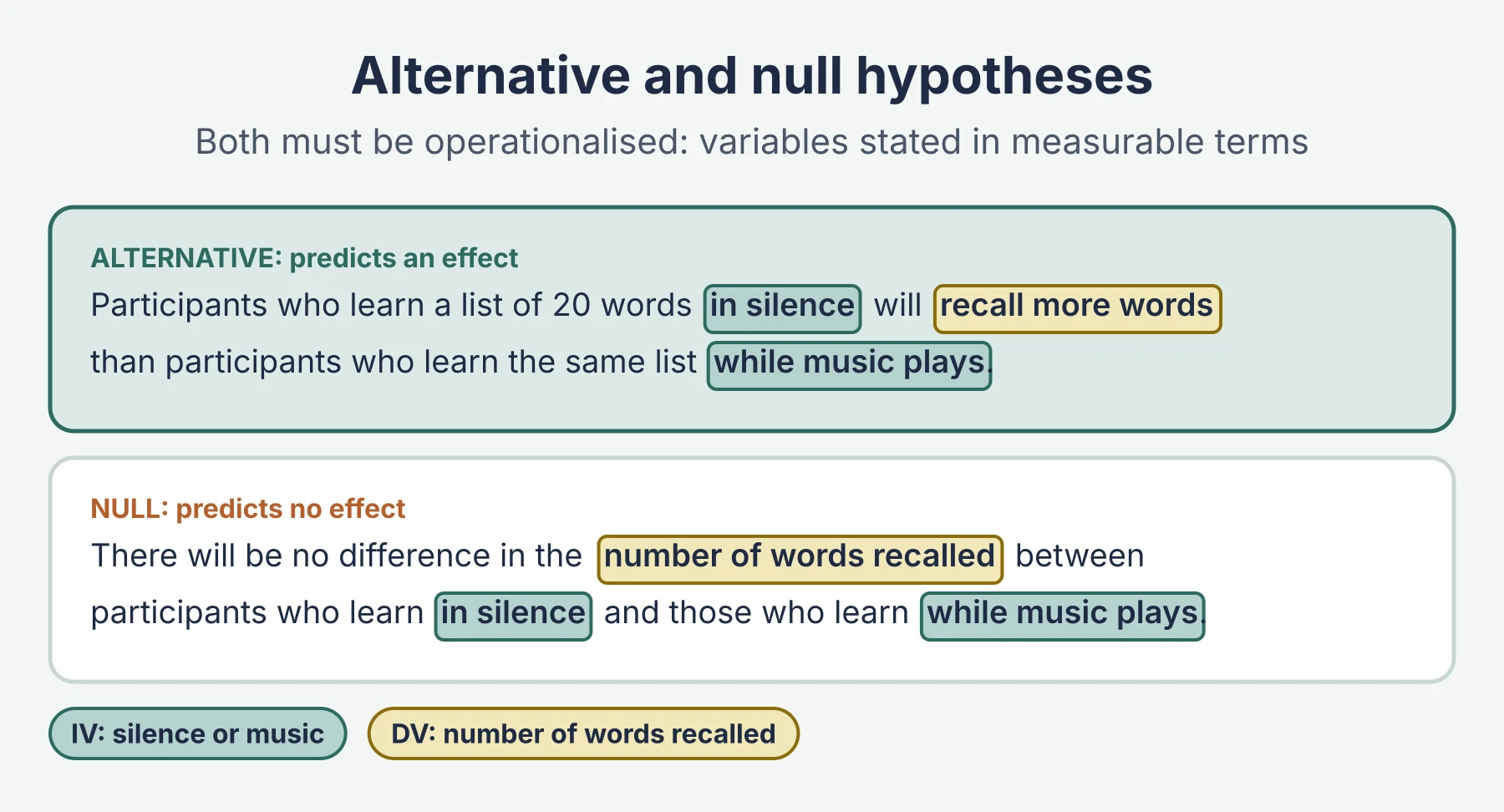
An alternative hypothesis predicts that the independent variable will have an effect on the dependent variable (or that two variables are related). A null hypothesis predicts no effect or relationship. Both must be operationalised: the variables are stated in measurable terms.
Alternative: “Participants who learn a list of 20 words in silence will recall more words than participants who learn the same list while music plays.” Null: “There will be no difference in the number of words recalled between participants who learn in silence and those who learn while music plays.”
Variables
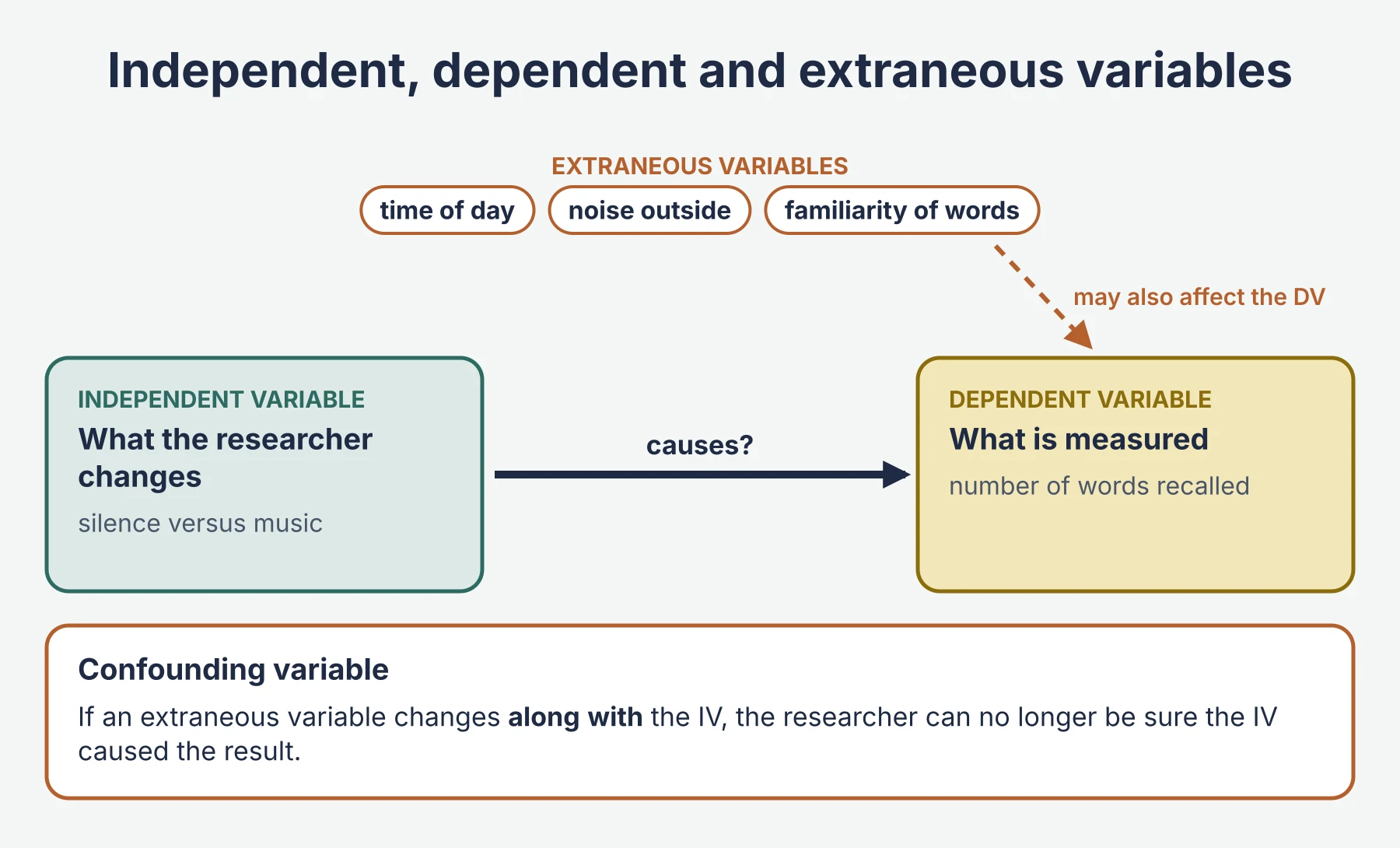
- Independent variable (IV): what the researcher changes (silence versus music).
- Dependent variable (DV): what is measured (number of words recalled).
- Extraneous variables: anything else that might affect the DV, such as time of day, noise outside the room or how familiar the words are. If an extraneous variable changes along with the IV, it becomes a confounding variable and the researcher can no longer be sure the IV caused the result.
Types of experiment
| Type | What it is | Strength | Weakness | Paper 1 example |
|---|---|---|---|---|
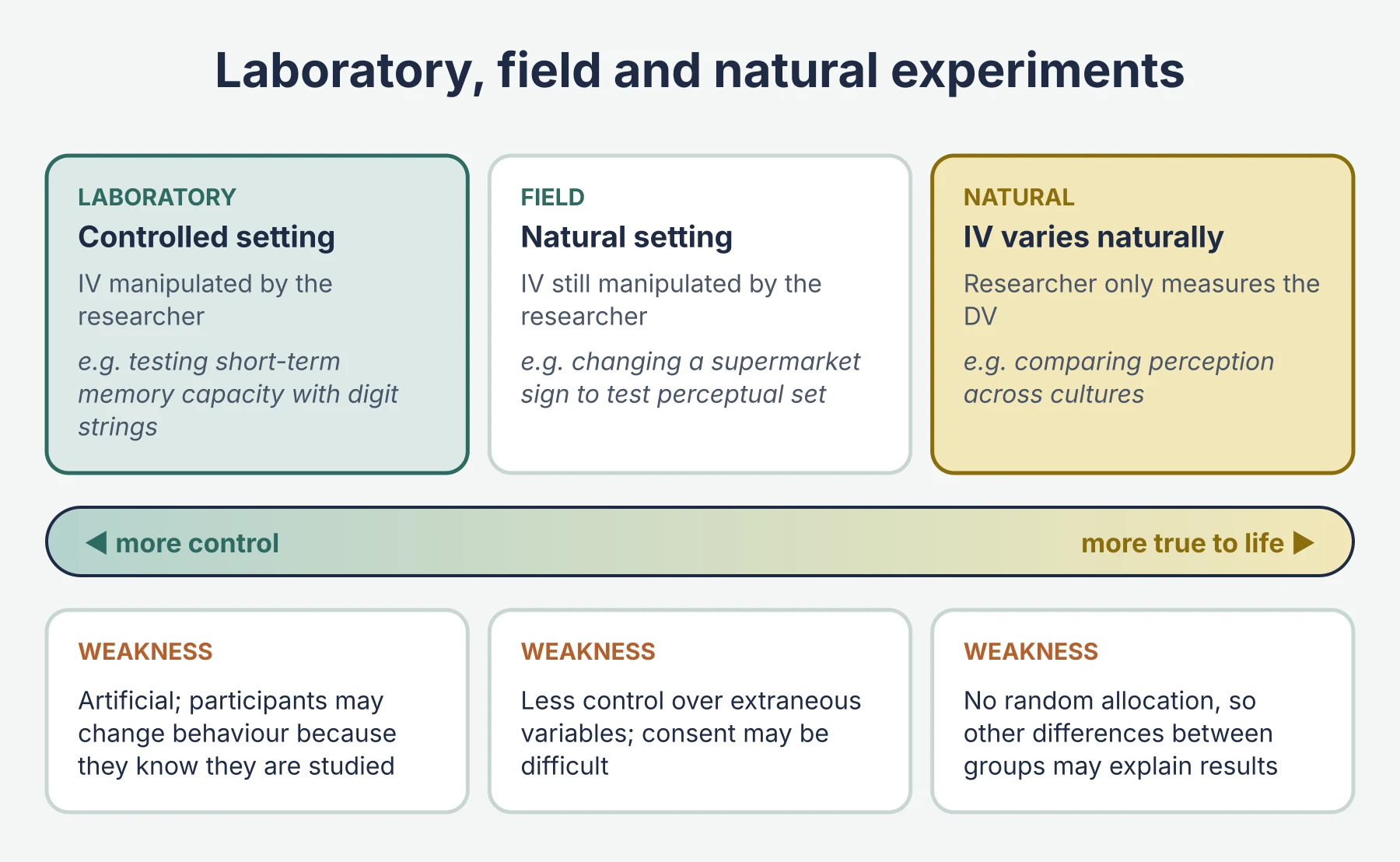
| Laboratory | Controlled setting; IV manipulated by researcher | High control, so cause and effect is clearer; easy to replicate | Artificial; participants may change behaviour because they know they are studied | Testing short-term memory capacity with digit strings |
| Field | Natural setting; IV still manipulated by researcher | More true to life | Less control over extraneous variables; consent may be difficult | Changing the layout of a supermarket sign to test perceptual set |
| Natural | IV varies naturally; researcher only measures the DV | Allows study of variables that could not ethically be manipulated | No random allocation, so other differences between groups may explain results | Comparing perception in people from different cultures |
Experimental designs
| Design | How it works | Strength | Weakness | Control |
|---|---|---|---|---|
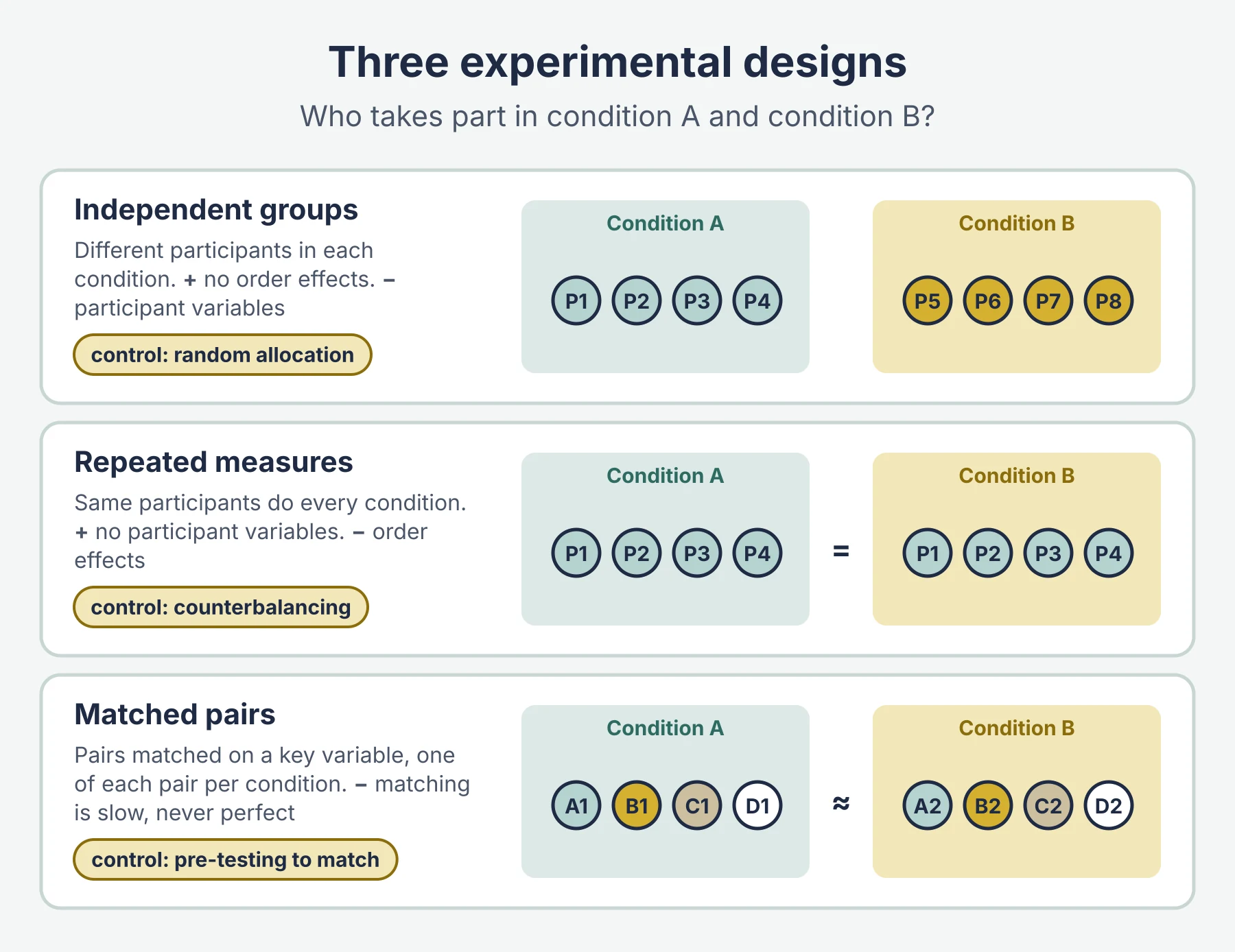
| Independent groups | Different participants in each condition | No order effects | Participant variables may differ between groups | Random allocation |
| Repeated measures | Same participants do every condition | No participant variables between conditions | Order effects such as practice or fatigue | Counterbalancing |
| Matched pairs | Participants matched on a key variable, then one of each pair goes into each condition | Reduces participant variables and no order effects | Matching is time-consuming and never perfect | Pre-testing to match |
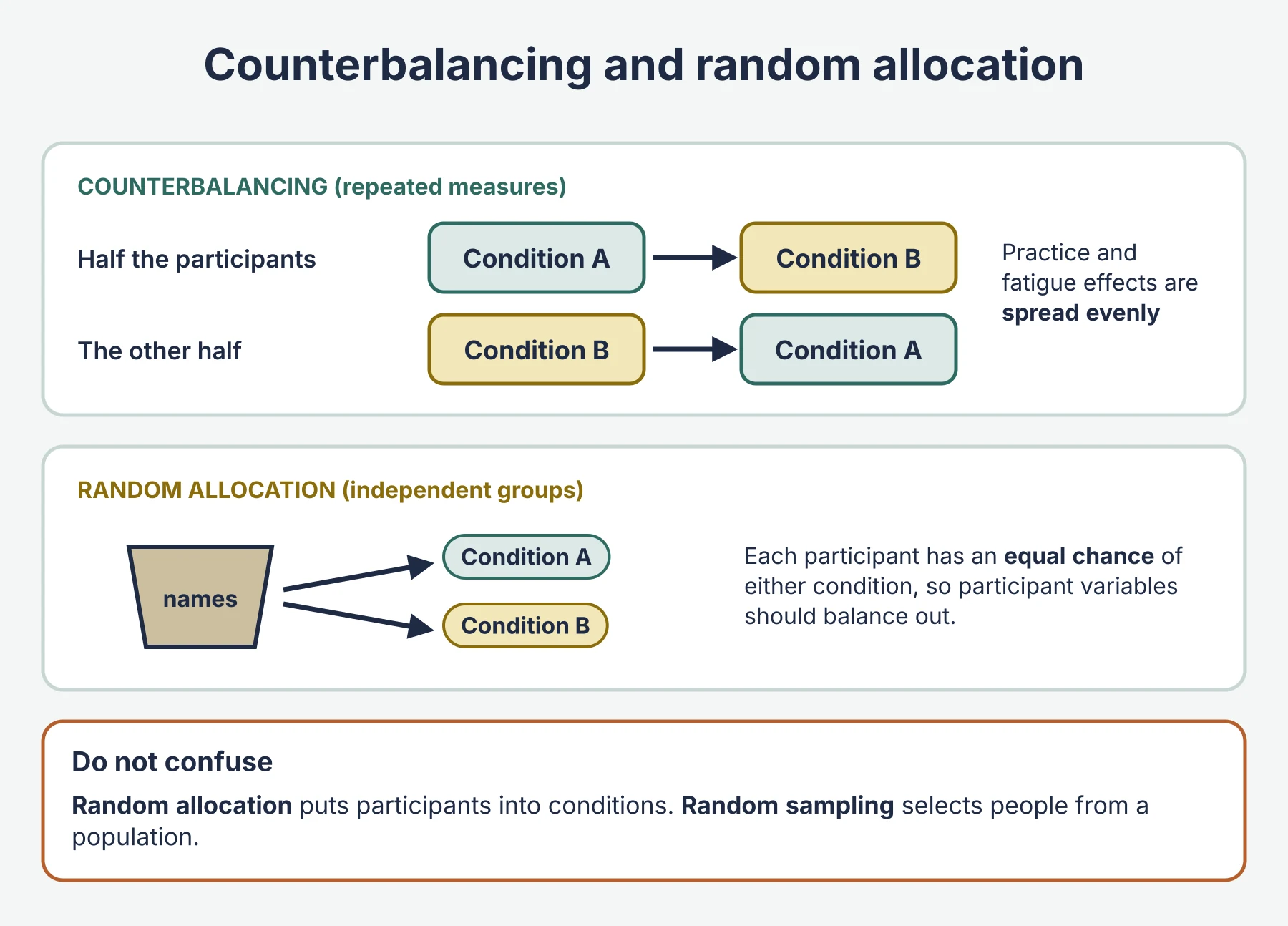
Counterbalancing means half the participants do condition A then B, and half do B then A, so practice and fatigue effects are spread evenly across conditions. Random allocation (for example, drawing names from a hat) means each participant has an equal chance of being in either condition, so participant variables should balance out.
Controls that improve validity
- Standardised procedures: every participant has the same task, timings and materials.
- Standardised instructions: every participant hears identical instructions, often read from a script.
- Randomisation: using chance to decide the order of materials, such as the order of words in a list, so the researcher’s choices cannot bias results.
Controls make a study reliable (it could be repeated and give the same results) and help it be valid (it measures what it intends to measure because only the IV is changing).
Sampling
The target population is the group the researcher wants to draw conclusions about; the sample is the people actually studied.
| Method | How to select | Strength | Weakness |
|---|---|---|---|
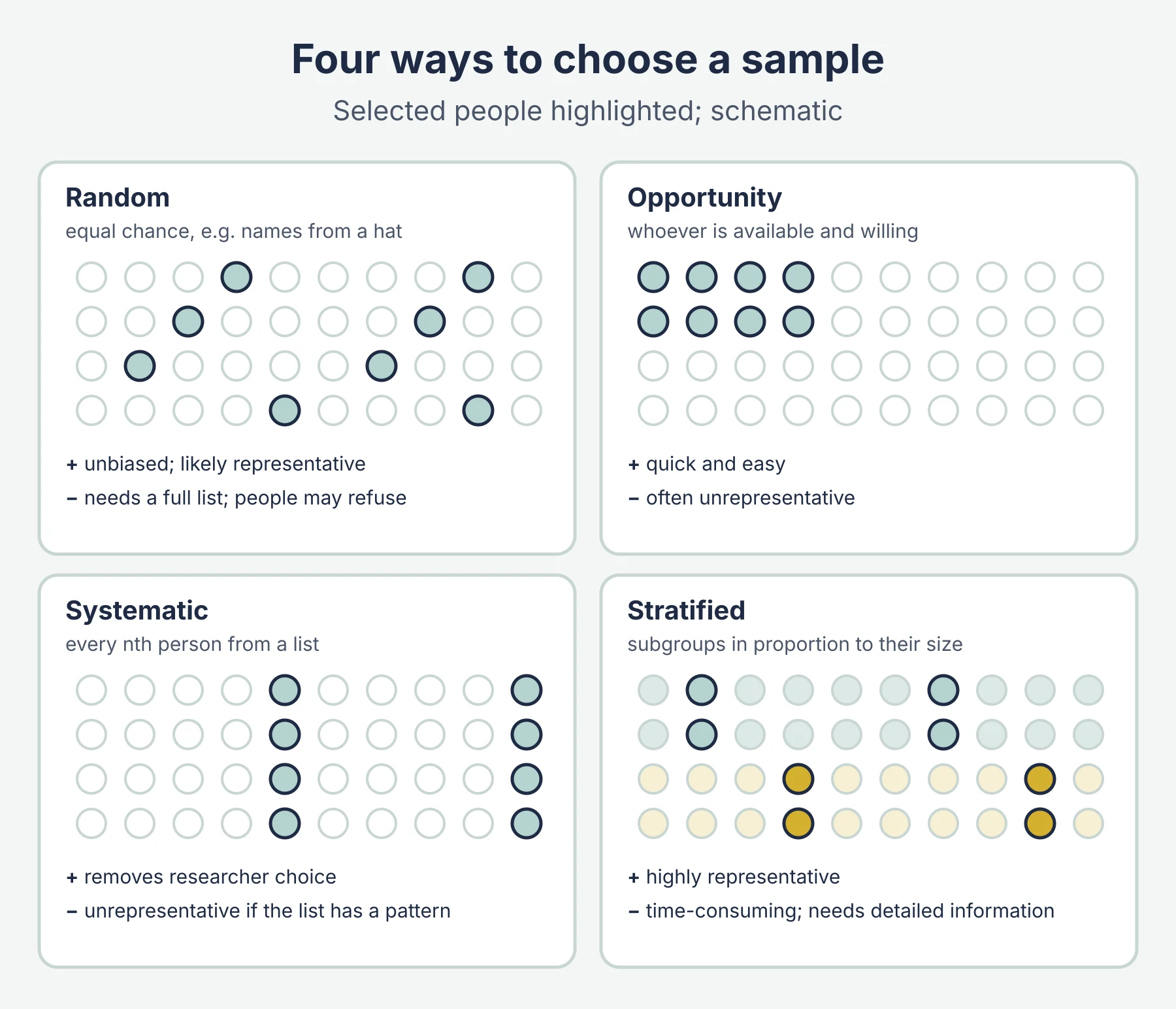
| Random | Every member of the population has an equal chance, e.g. names drawn from a hat | Unbiased; likely to be representative | Needs a full list of the population; chosen people may refuse |
| Opportunity | Whoever is available and willing at the time | Quick and easy | Often unrepresentative; researcher may choose people who look helpful |
| Systematic | Every nth person from a list, e.g. every 10th student on the register | Removes researcher choice | Can be unrepresentative if the list has a pattern |
| Stratified | Subgroups sampled in proportion to their size in the population | Highly representative | Time-consuming; needs detailed information about the population |
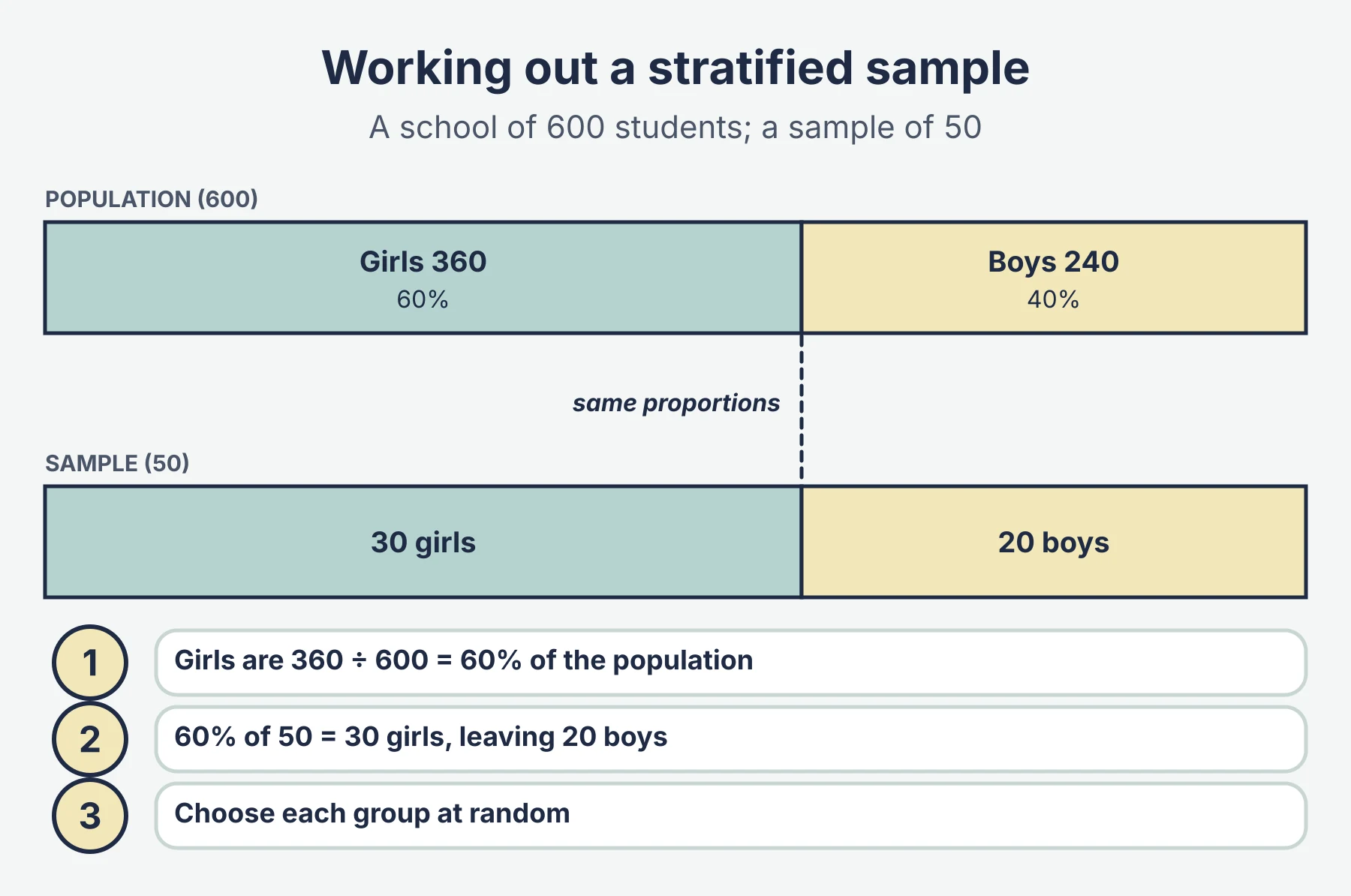
Worked selection: a school has 600 students, 360 girls and 240 boys. For a stratified sample of 50, girls make up 360 ÷ 600 = 60% of the population, so select 60% of 50 = 30 girls and 20 boys, then choose each group at random.
Ethics (BPS guidelines)
| Issue | What it means | How to deal with it |
|---|---|---|
| Informed consent | Participants agree knowing what the study involves | Consent form; parental consent for under-16s |
| Deception | Misleading participants about the aim | Only if justified; full debrief as soon as possible |
| Protection from harm | No greater risk than in everyday life | Stop the study if distress appears; offer support |
| Confidentiality | Personal data kept private | Use numbers instead of names; store data securely |
| Right to withdraw | Participants can leave at any point, and remove their data | State this clearly at the start and in the debrief |
| Debriefing | Explaining the true aim afterwards | Reassure participants and answer questions |
Worked example: designing a Paper 1 experiment
A psychologist wants to test whether context affects recall. Outline how she could carry out a laboratory experiment using a repeated measures design. [6 marks]
- IV: learning and recall in the same room vs a different room.
- DV: number of words correctly recalled from a 20-word list.
- Each participant does both conditions, with a different but
  equally difficult word list in each, so they cannot simply
  remember words from the first condition.
- Counterbalance: half do "same room" first, half "different room"
  first, to spread practice and fatigue effects.
- Standardised instructions and the same time to learn (e.g. 2
  minutes) in both conditions.
- Opportunity sample of students who give informed consent; debrief
  and tell them they can withdraw their results.
Each line gives a design decision and a reason, which is what “outline how” rewards.
Common mistakes
- Writing a hypothesis without operationalising the variables.
- Saying a natural experiment has no IV; it has one, but the researcher does not control it.
- Using “random sampling” to mean “picking people at random in the street”; that is opportunity sampling.
- Confusing random allocation (to conditions) with random sampling (from a population).
- Saying deception is never allowed; it is permitted when justified and followed by a debrief.
More resources on this topic
- Research Methods (Paper 1) revision notes
- Research Methods (Paper 1) practice questions
- Research Methods (Paper 2) study guide
- Memory study guide
Official syllabus
OxfordAQA International GCSE Psychology (9218) specification, Version 1.1, section 3.1.4 — oxfordaqa.com.
Related resources
-
Practice questions
OxfordAQA International GCSE Psychology (9218): Research Methods (Paper 1) – Practice Questions
Original research methods questions with full answers for OxfordAQA IGCSE Psychology 9218 Paper 1, built around a memory experiment and its design choices.
Psychology · OxfordAQA · IGCSE
Try questions -
Revision notes
OxfordAQA International GCSE Psychology (9218): Research Methods (Paper 1) – Revision Notes
Recall notes on experiments for OxfordAQA IGCSE Psychology 9218 Paper 1: hypotheses, variables, designs, controls, sampling, ethics and a 12-question self-test.
Psychology · OxfordAQA · IGCSE
Revise topic -
Study guides
OxfordAQA International GCSE Psychology: Cognition and Behaviour (9218)
Study guide to OxfordAQA International GCSE Psychology (9218) Paper 1: memory, perception, biopsychology and research methods, with key studies and examples.
Psychology · OxfordAQA · IGCSE
Read guide
Studying Psychology?
This page is free and stays free. Marlbridge is not offering Psychology classes at the moment, so there is no tuition to book for it. The free study resources stay open to everyone.
Get free revision emails (optional)
Occasional emails with practice questions, worked explanations and links to free resources for the qualification and subjects you choose. No spam, and you can unsubscribe from any email. The free tools on this site never need an email.