
Revision Notes
OxfordAQA International GCSE Psychology (9218): Research Methods (Paper 1) – Revision Notes
Recall notes on experiments for OxfordAQA IGCSE Psychology 9218 Paper 1: hypotheses, variables, designs, controls, sampling, ethics and a 12-question self-test.
- Subject
- Psychology
- Level
- IGCSE
- Topic
- Paper 1 – Cognition and Behaviour
- Author
- Marlbridge Academic Team
- Updated
- Reviewed by
- Kanwal Aslam (what this means)
Aligned to OxfordAQA IGCSE Psychology (9218), Version 1.1. Official specification .
Syllabus page (what it covers and how it is assessed): OxfordAQA IGCSE Psychology.
Syllabus points this page covers
9218
- 3.1.4 Research Methods
Quick-recall notes for 3.1.4 Research Methods in Paper 1 of OxfordAQA International GCSE Psychology (9218), focused on experiments. For full explanations, use the Research Methods (Paper 1) study guide. Non-experimental methods and data handling are condensed in the Research Methods (Paper 2) revision notes; both sets of content can be examined on either paper.
Key terms
| Term | Meaning |
|---|---|
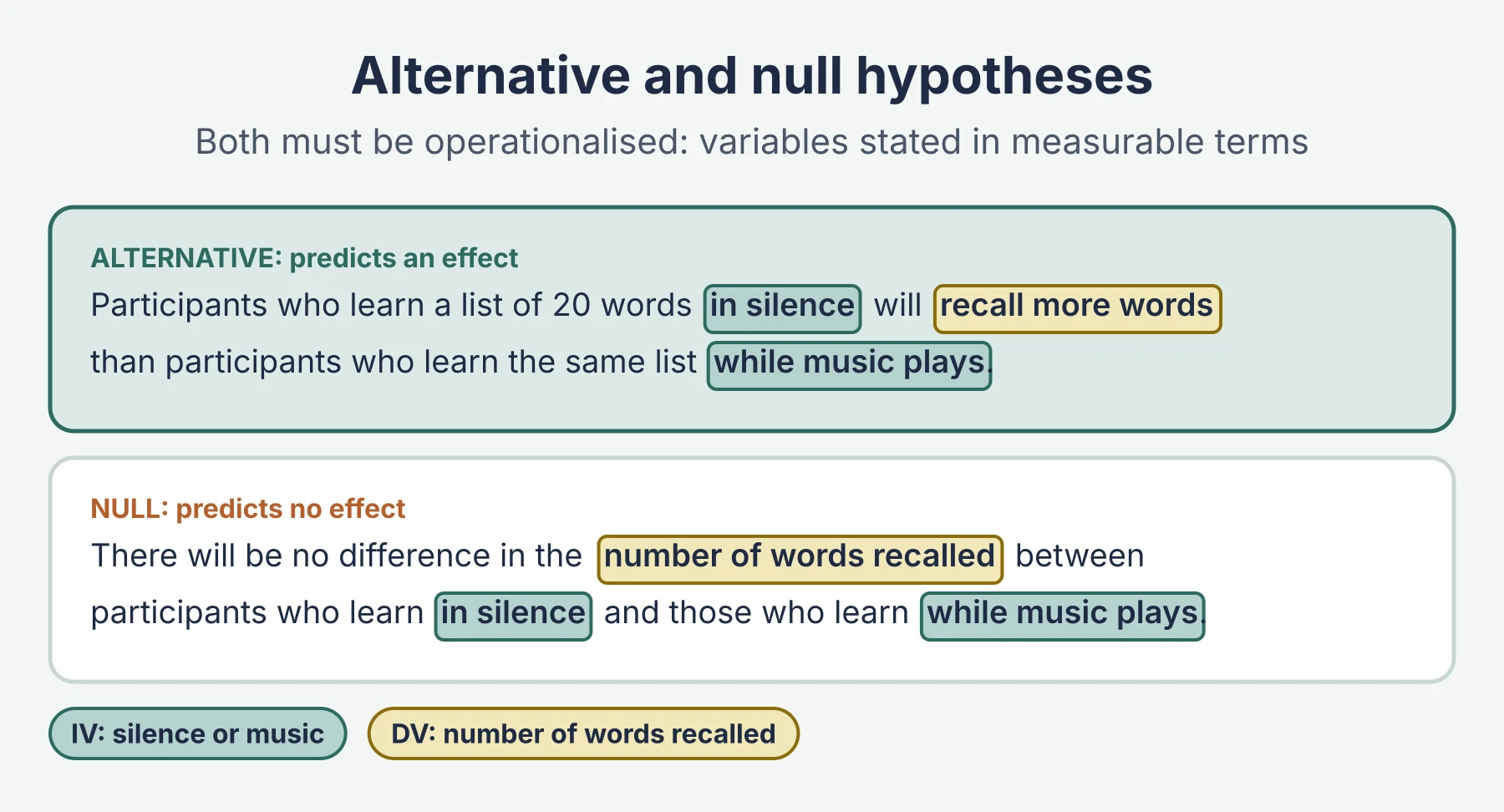
| Alternative hypothesis | Predicts an effect of the IV on the DV, or a relationship |
| Null hypothesis | Predicts no effect or relationship |
| Operationalise | State a variable in a measurable way |
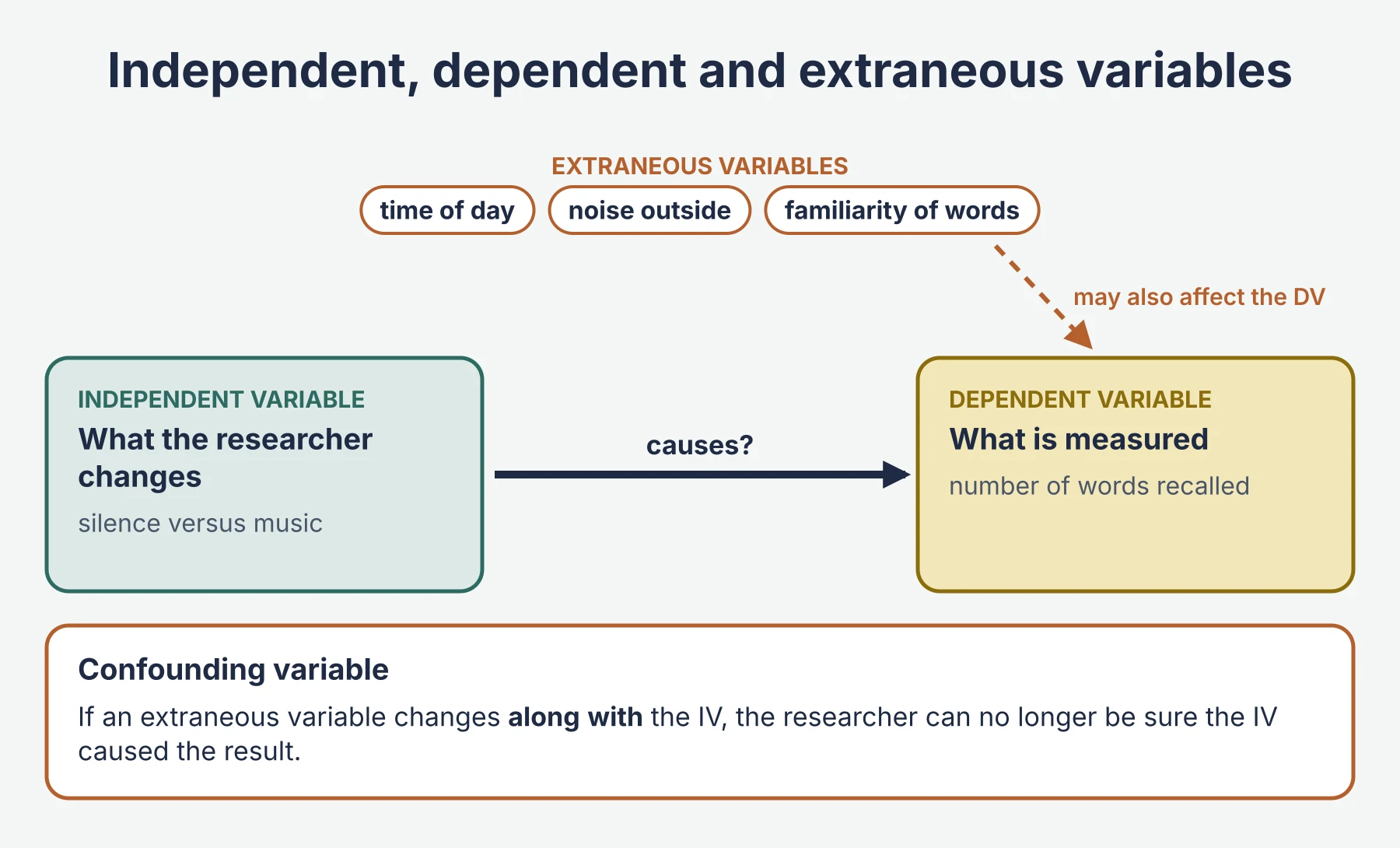
| Independent variable | The variable the researcher changes or compares |
| Dependent variable | The variable measured |
| Extraneous variable | Any other variable that might affect the DV |
| Target population | The group a researcher wants to generalise to |
| Standardised procedure | Same method, timings and materials for every participant |
| Randomisation | Using chance to decide the order of materials or trials |
| Random allocation | Using chance to put participants into conditions |
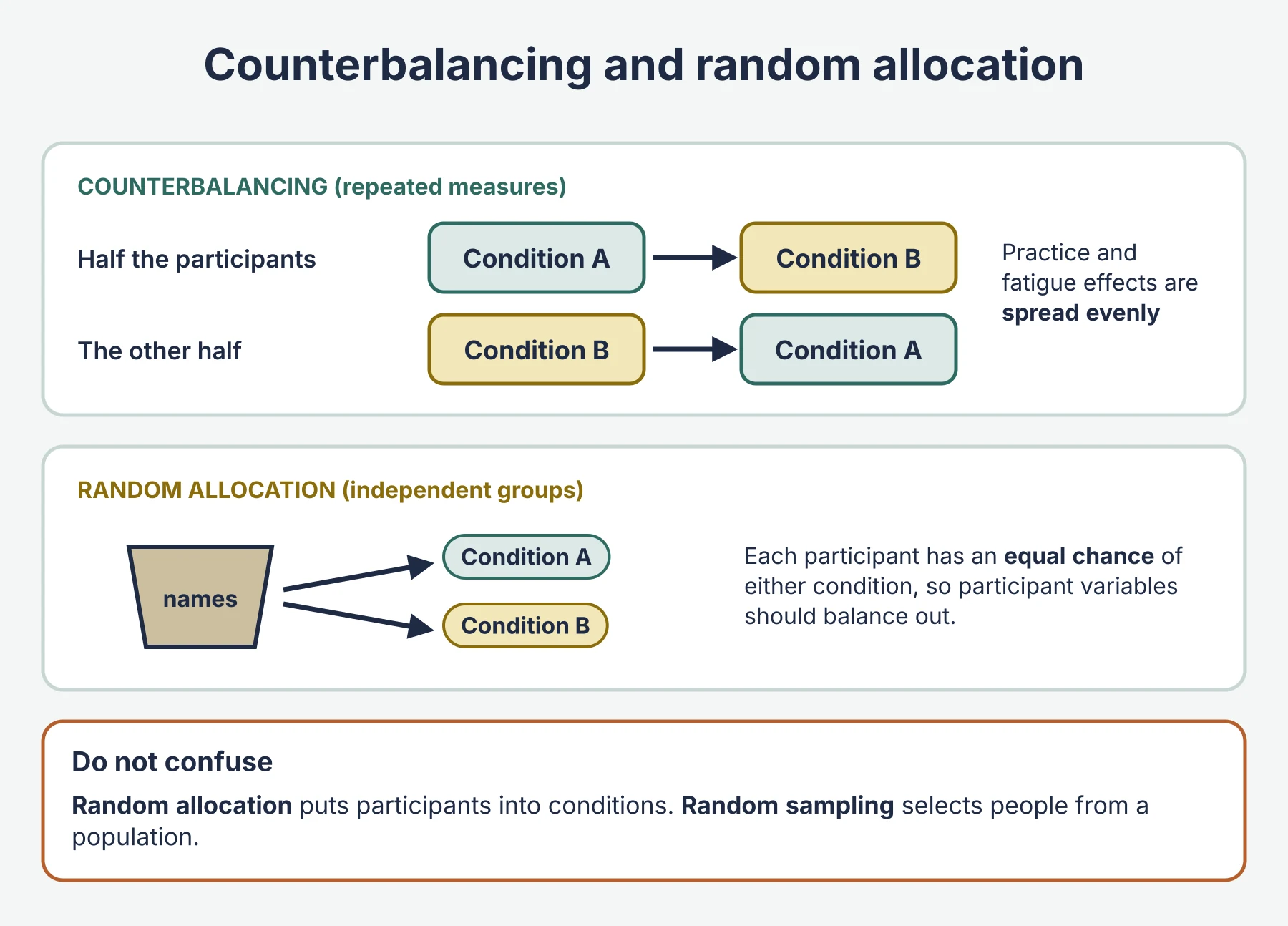
| Counterbalancing | Half do A then B, half do B then A |
| Reliability | Consistency: repeating the study would give similar results |
| Validity | Accuracy: the study measures what it claims to measure |
Writing hypotheses: a three-step check
- Name both conditions of the IV.
- Say exactly how the DV is measured.
- For the null, say “there will be no difference” (or “no relationship”).
Weak: “Music affects memory.” Strong: “Students who revise with music playing will recall fewer of 20 key terms than students who revise in silence.”
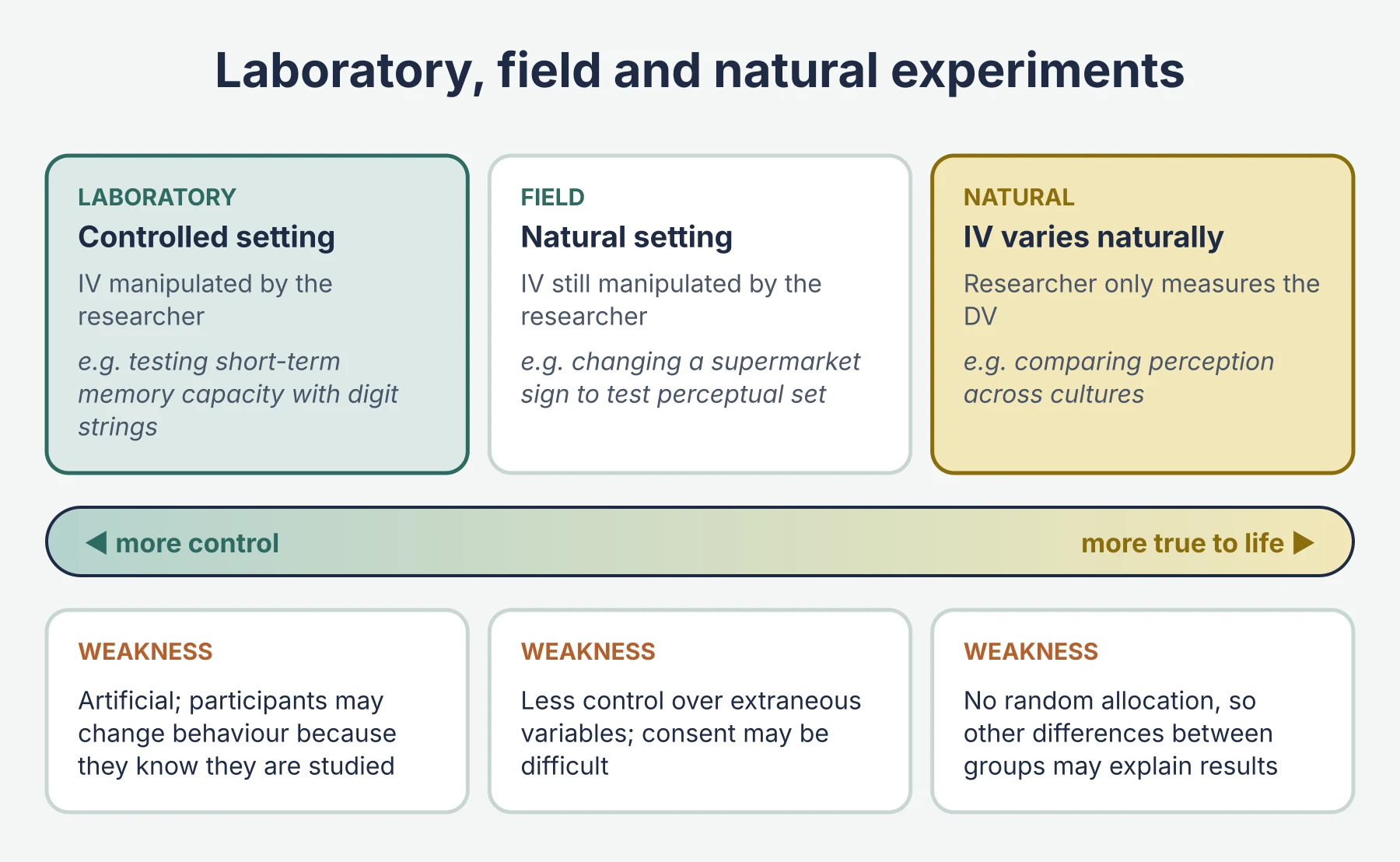
Experiments
| Laboratory | Field | Natural | |
|---|---|---|---|
| Setting | Controlled | Everyday | Everyday or controlled |
| IV | Manipulated | Manipulated | Occurs naturally |
| Control | High | Lower | Lowest |
| Realism | Lower | Higher | Higher |
| Main issue | Artificial tasks | Extraneous variables | Groups may differ in other ways |
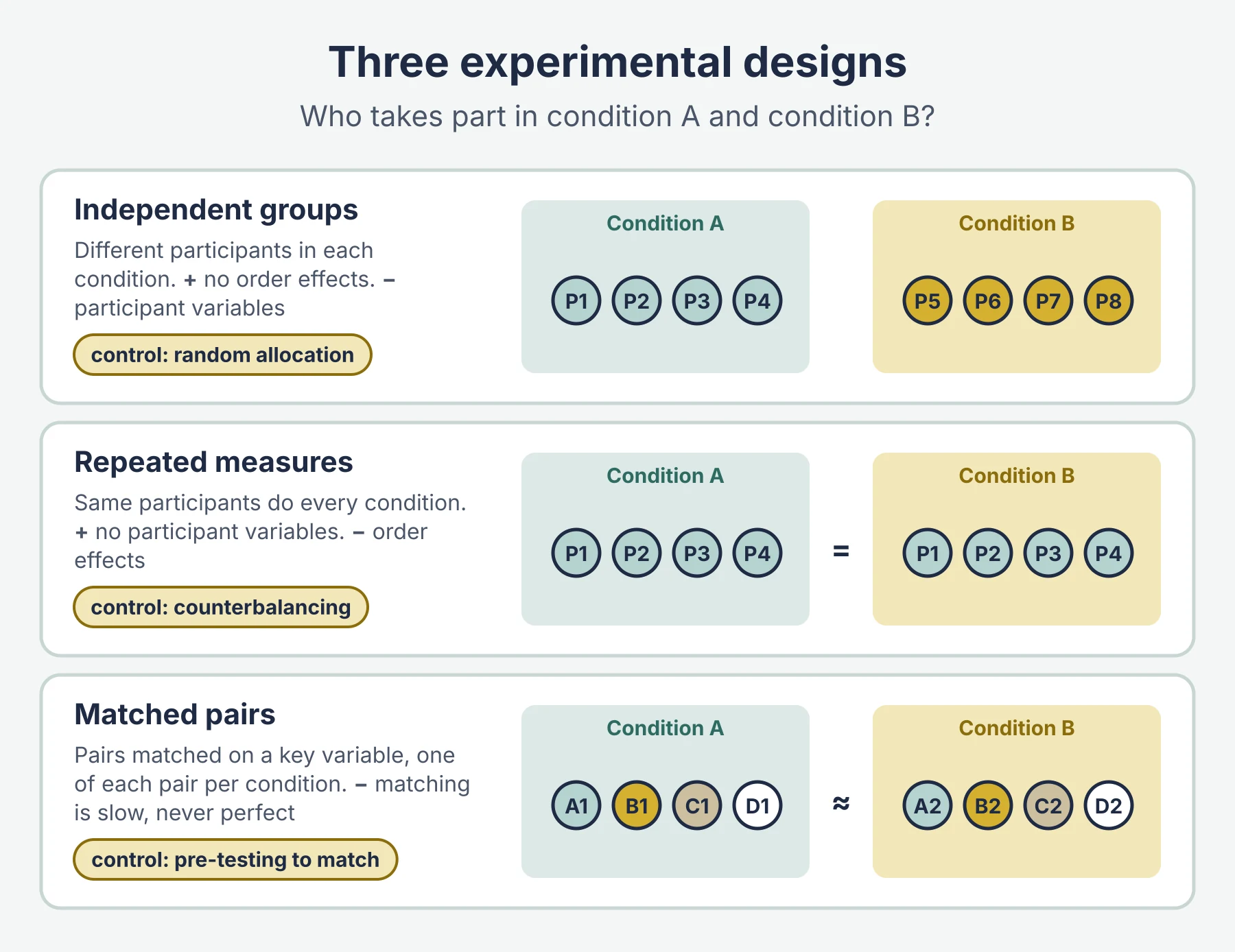
Experimental designs
| Design | Main problem | Solution |
|---|---|---|
| Independent groups | Participant variables | Random allocation |
| Repeated measures | Order effects (practice, fatigue) | Counterbalancing |
| Matched pairs | Imperfect, time-consuming matching | Pre-test on the key variable |
Sampling
| Method | One-line how | Plus | Minus |
|---|---|---|---|
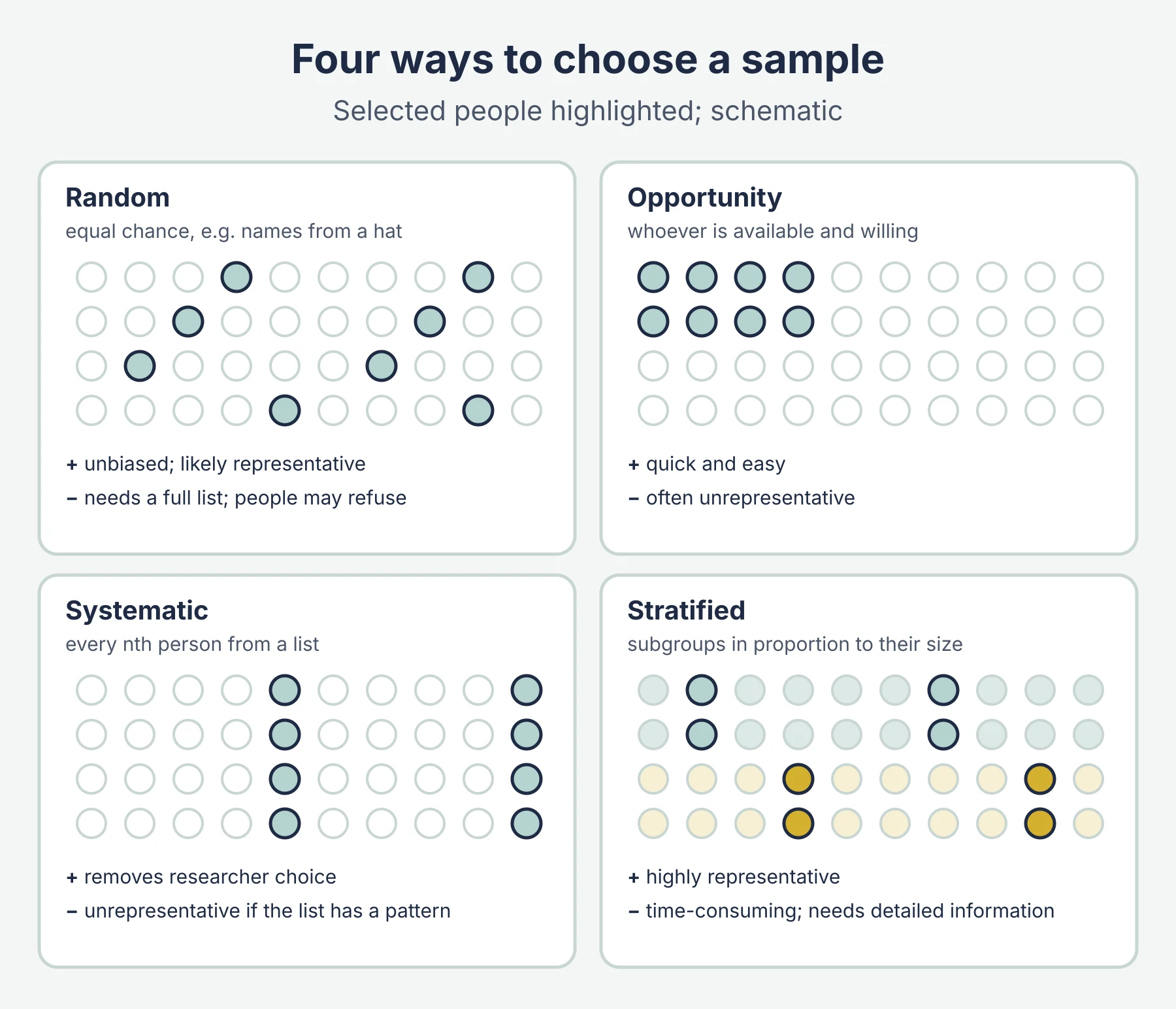
| Random | Equal chance for all, e.g. names from a hat | Unbiased | Needs full list |
| Opportunity | Whoever is available | Quick | Unrepresentative |
| Systematic | Every nth from a list | No researcher choice | Can hit a pattern |
| Stratified | Subgroups in proportion | Representative | Time-consuming |
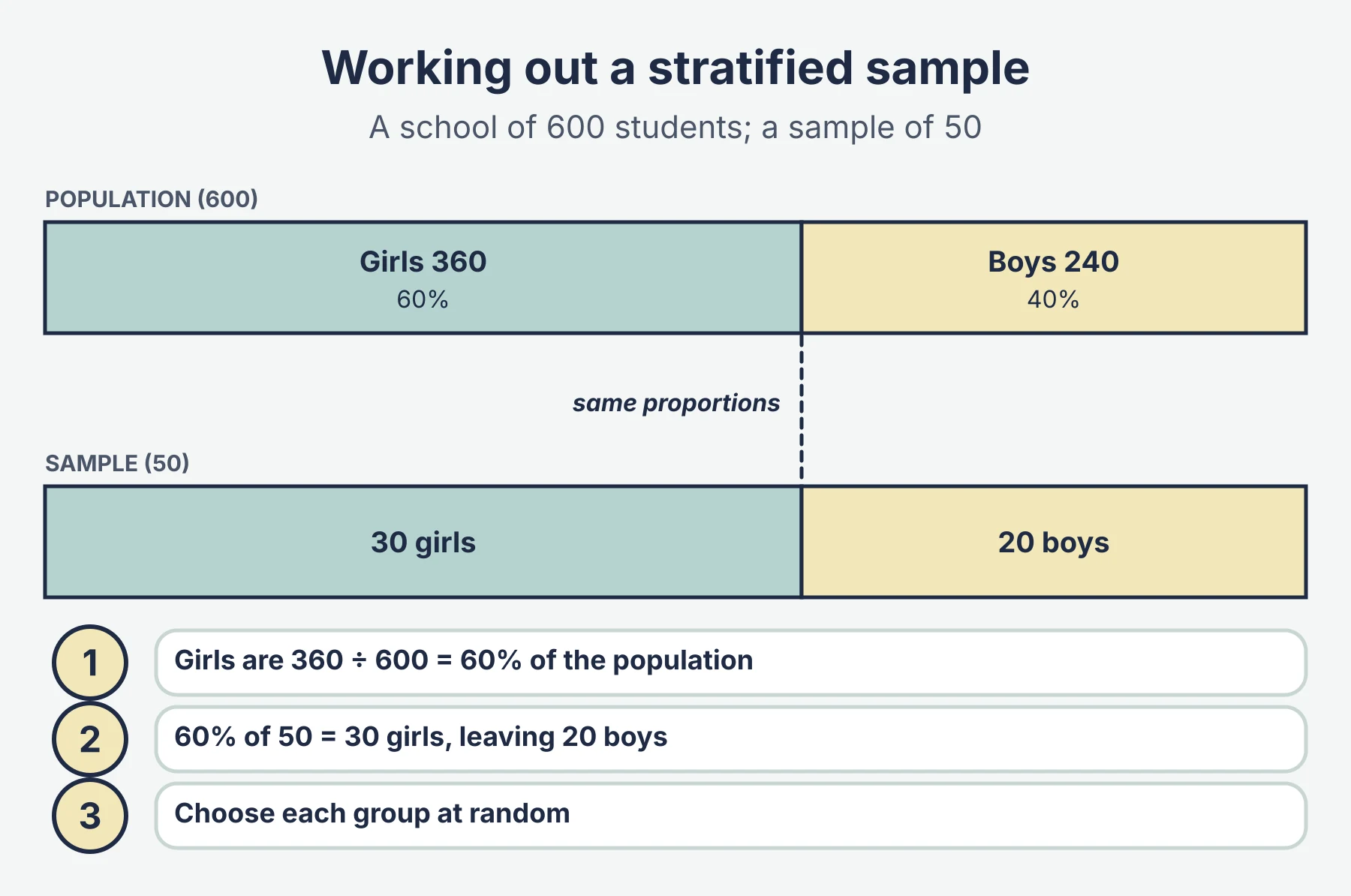
Stratified maths: proportion of subgroup in population × sample size. Example: 25% of employees are managers; sample of 40 → 0.25 × 40 = 10 managers.
Ethics (BPS)
| Issue | Deal with it by |
|---|---|
| Informed consent | Consent form; parents for children |
| Deception | Only when justified; full debrief |
| Protection from harm | Stop if distressed; offer support |
| Confidentiality | Anonymise; store data securely |
| Right to withdraw | Tell participants at the start; allow data removal |
| Debriefing | Explain aims; reassure |
Exam traps
- Random sampling is about choosing participants; random allocation is about assigning them to conditions.
- Opportunity samples are not random, even if the researcher “picked at random”.
- A natural experiment still has an IV, but the researcher does not manipulate it.
- Order effects are only a problem in repeated measures.
- Counterbalancing spreads order effects; it does not remove them.
- High control improves reliability, but artificial tasks can lower validity.
- Name the specific extraneous variable in the scenario (for example, “noise from the corridor”), not just “extraneous variables”.
Paper 1 scenario prompts
| Paper 1 study type | IV | DV |
|---|---|---|
| Memory: effect of rehearsal on recall | Rehearse versus no rehearsal | Words recalled |
| Perception: effect of expectation | Letter context versus number context | Whether “B” or “13” is reported |
| Biopsychology: effect of caffeine on reaction time | Caffeine versus no caffeine | Reaction time in milliseconds |
Self-test
- Write a null hypothesis for a study of whether background noise affects recall.
- What is the difference between an IV and a DV?
- Give one example of an extraneous variable in a memory experiment.
- Which experiment type has an IV that the researcher does not control?
- Which design has the problem of order effects?
- What does counterbalancing involve?
- Which sampling method selects every nth person?
- A college has 200 science and 300 arts students. How many arts students should be in a stratified sample of 50?
- Give one weakness of opportunity sampling.
- What should happen after a study that used deception?
- What does reliability mean?
- Give one way to protect confidentiality.
Answers:
- “There will be no difference in the number of words recalled between participants who learn with background noise and those who learn in silence.”
- The IV is changed or compared by the researcher; the DV is the variable measured.
- Any one, such as time of day, word familiarity, tiredness or noise outside the room.
- A natural experiment.
- Repeated measures.
- Half the participants do condition A then B and half do B then A.
- Systematic sampling.
- 300 ÷ 500 = 60%; 60% of 50 = 30 arts students.
- It is often unrepresentative, because only available people are included.
- Participants should be fully debriefed as soon as possible and offered the chance to withdraw their data.
- Consistency: the same results would be found if the study were repeated.
- Use participant numbers instead of names, or store data securely.
More resources on this topic
Related resources
-
Study guides
OxfordAQA International GCSE Psychology: Cognition and Behaviour (9218)
Study guide to OxfordAQA International GCSE Psychology (9218) Paper 1: memory, perception, biopsychology and research methods, with key studies and examples.
Psychology · OxfordAQA · IGCSE
Read guide -
Practice questions
IGCSE Psychology: Cognition and Behaviour — Practice Questions
Original exam-style practice questions with full worked answers on memory, perception, biopsychology, research methods and psychological explanations.
Psychology · OxfordAQA · IGCSE
Try questions -
Revision notes
IGCSE Psychology: Cognition and Behaviour — Revision Notes
Condensed recall notes on memory, perception, biopsychology, research methods and ethics for International GCSE Psychology.
Psychology · OxfordAQA · IGCSE
Revise topic
Studying Psychology?
This page is free and stays free. Marlbridge is not offering Psychology classes at the moment, so there is no tuition to book for it. The free study resources stay open to everyone.
Get free revision emails (optional)
Occasional emails with practice questions, worked explanations and links to free resources for the qualification and subjects you choose. No spam, and you can unsubscribe from any email. The free tools on this site never need an email.