
Revision Notes
OxfordAQA International GCSE Sociology (9292): Research methods (also assessed in Paper 1) – Revision Notes
Revision notes on applying research methods to Paper 2 topics in OxfordAQA IGCSE Sociology 9292: measuring class, crime, socialisation and control.
- Subject
- Sociology
- Level
- IGCSE
- Topic
- Paper 2 – Exploring Sociology
- Author
- Marlbridge Academic Team
- Updated
- Reviewed by
- Naqiya Yousaf (what this means)
Aligned to OxfordAQA IGCSE Sociology (9292), Version 1.0. Official specification .
Syllabus page (what it covers and how it is assessed): OxfordAQA IGCSE Sociology.
Syllabus points this page covers
9292
- 3.1.3 Research methods (also assessed in Paper 1)
Found an error? Report a correction.
Need help with this topic? Request a free trial class for IGCSE Sociology (9292).
Condensed notes on 3.1.3 Research methods as applied in Paper 2 Exploring Sociology (Section C, 16 marks, short and extended response questions) for OxfordAQA International GCSE Sociology (9292). For the full explanations, see the Paper 2 research methods study guide; for definitions of every method and sample type, see the research methods revision notes.
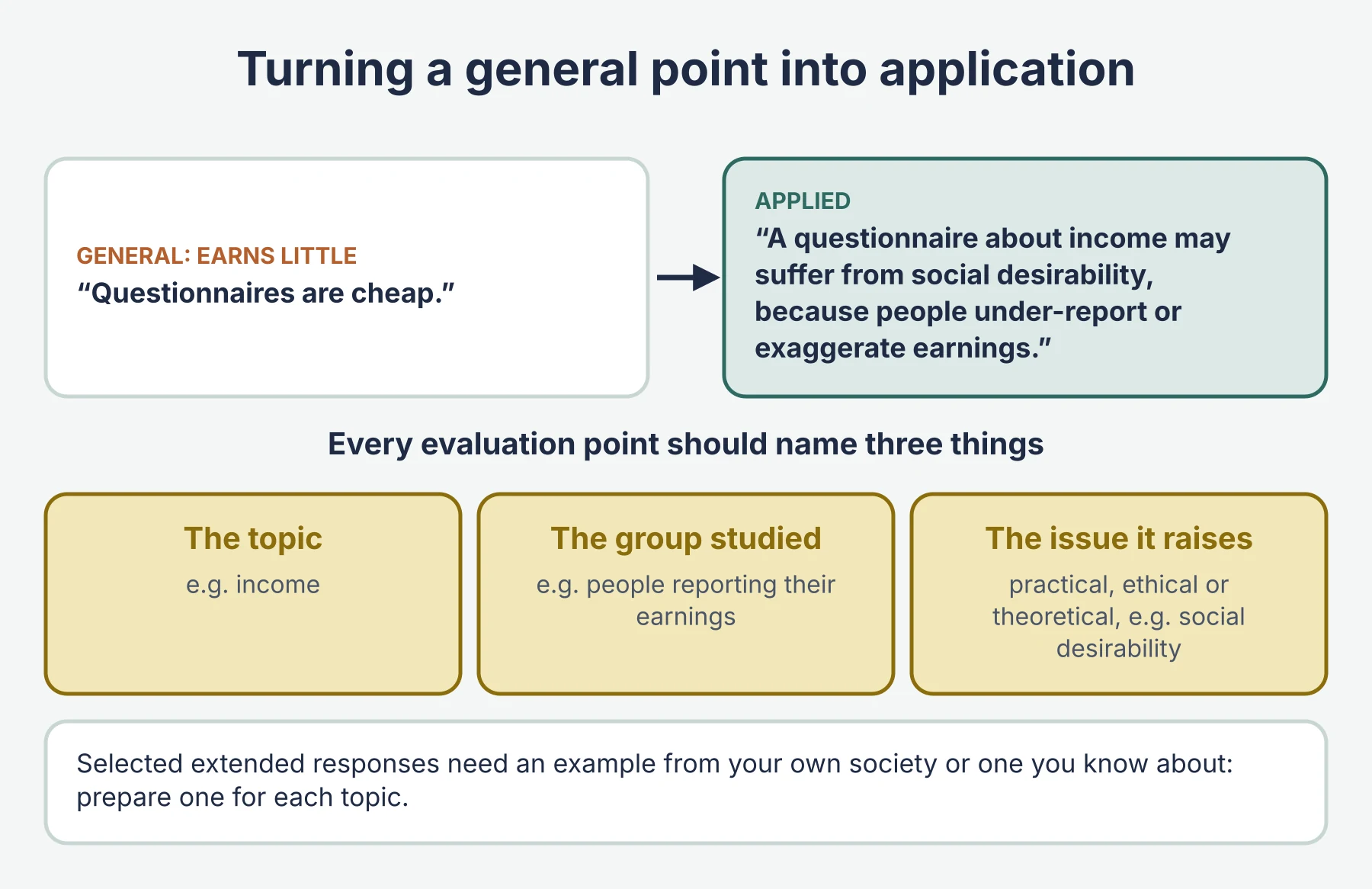
The Paper 2 formula
Method + topic + group + issue. For every point, say which method, which Paper 2 topic, which people, and which practical, ethical or theoretical issue arises. Add an example from your own society where the question asks for one.
Key terms
| Term | Meaning |
|---|---|
| Operationalisation | Turning a concept, such as class, into something measurable |
| Occupational scale | A classification of people by the type of job they do |
| Subjective class | The class a person believes they belong to |
| Self-identification | Recording ethnicity or religion as people define it themselves |
| Retrospective question | Asking people to recall the past, such as a parent’s job |
| Cohort study | A longitudinal study following people born at the same time |
| Content analysis | Systematically counting or interpreting media content |
| Ethnography | Studying a group’s way of life in its natural setting |
| Total institution | Goffman’s term for places such as asylums that control every part of life |
| Gatekeeper | A person who controls access to a group or organisation |
| Victim survey | Asking people which crimes they have experienced |
| Self-report study | Asking people which crimes they have committed |
| Triangulation | Combining methods or data to check findings |
Researching differences and inequalities (3.2.1)
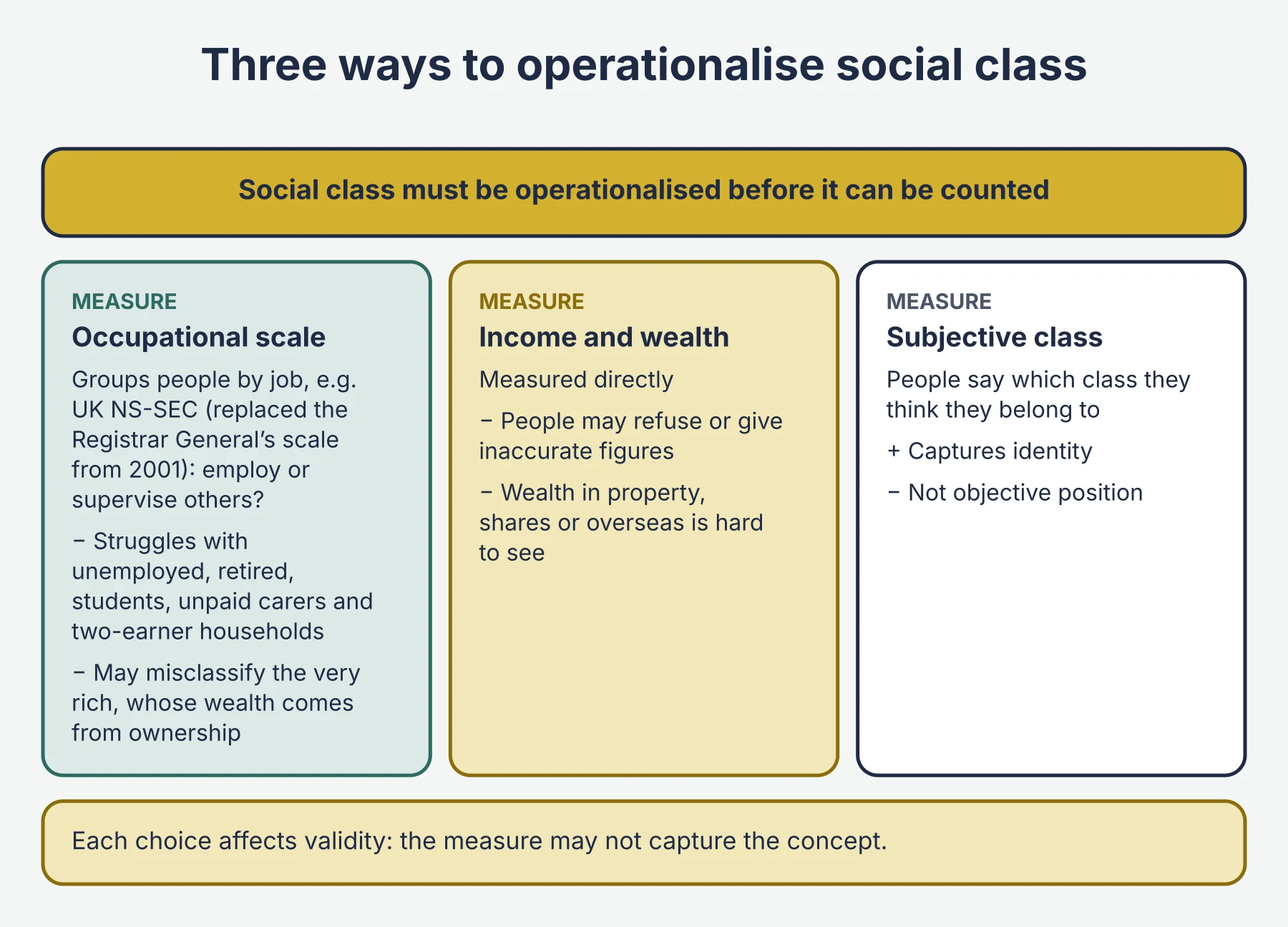
- Measuring class: occupational scales (in the United Kingdom, NS-SEC replaced the Registrar General’s scale from 2001); income and wealth; subjective class.
- Problems: unemployed, retired, students and carers are hard to classify; dual-earner households; the very rich own rather than work; people under-report or exaggerate income.
- Gender: secondary data such as UK employers’ gender pay gap reports (required of larger employers since 2017) show the size of gaps, not causes.
- Ethnicity and religion: self-identification; categories differ between countries and censuses, limiting comparison.
- Caste and hidden discrimination: people may deny practices; indirect questions or observation may help.
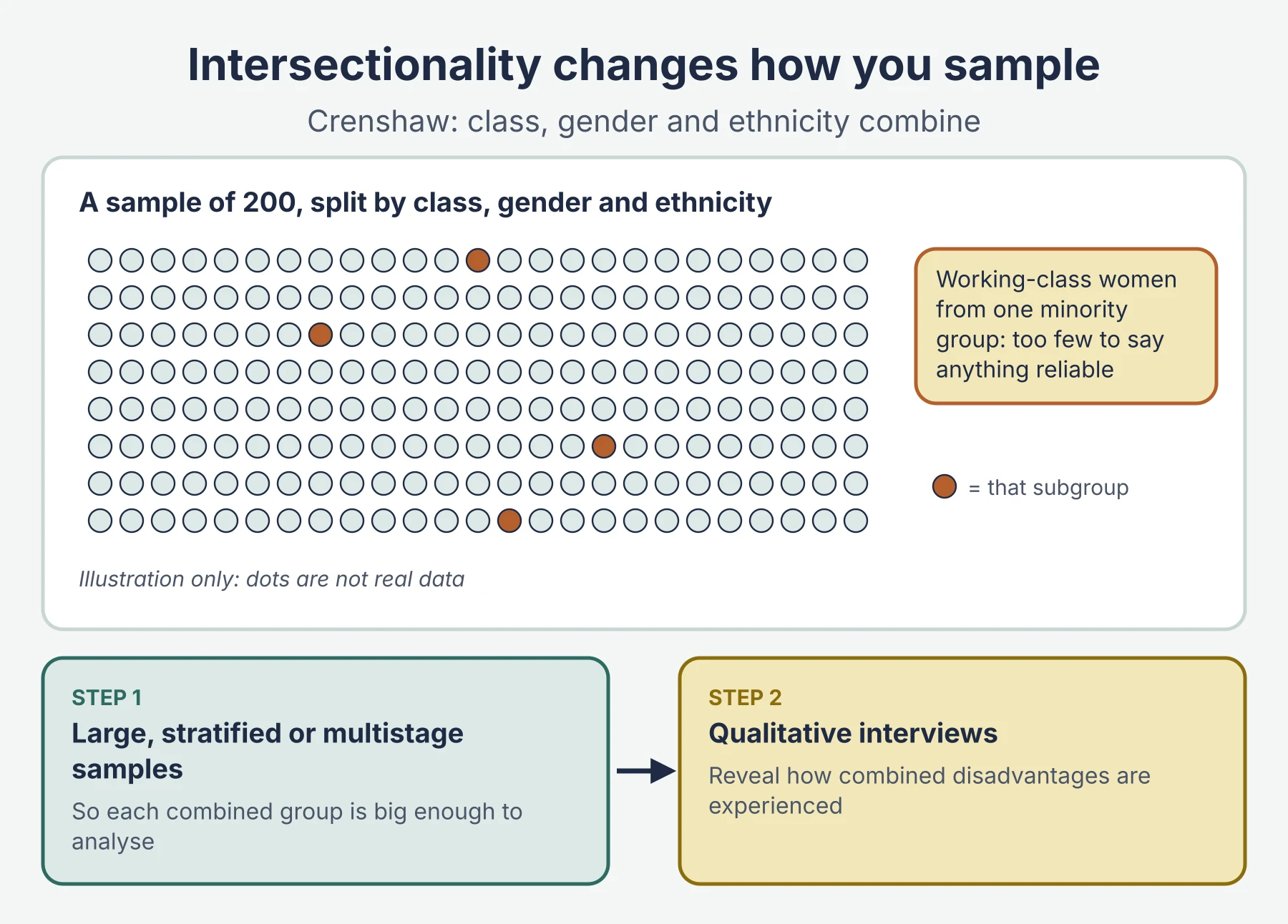
- Intersectionality (Crenshaw): needs large stratified or multistage samples to study combined groups; interviews capture lived experience.
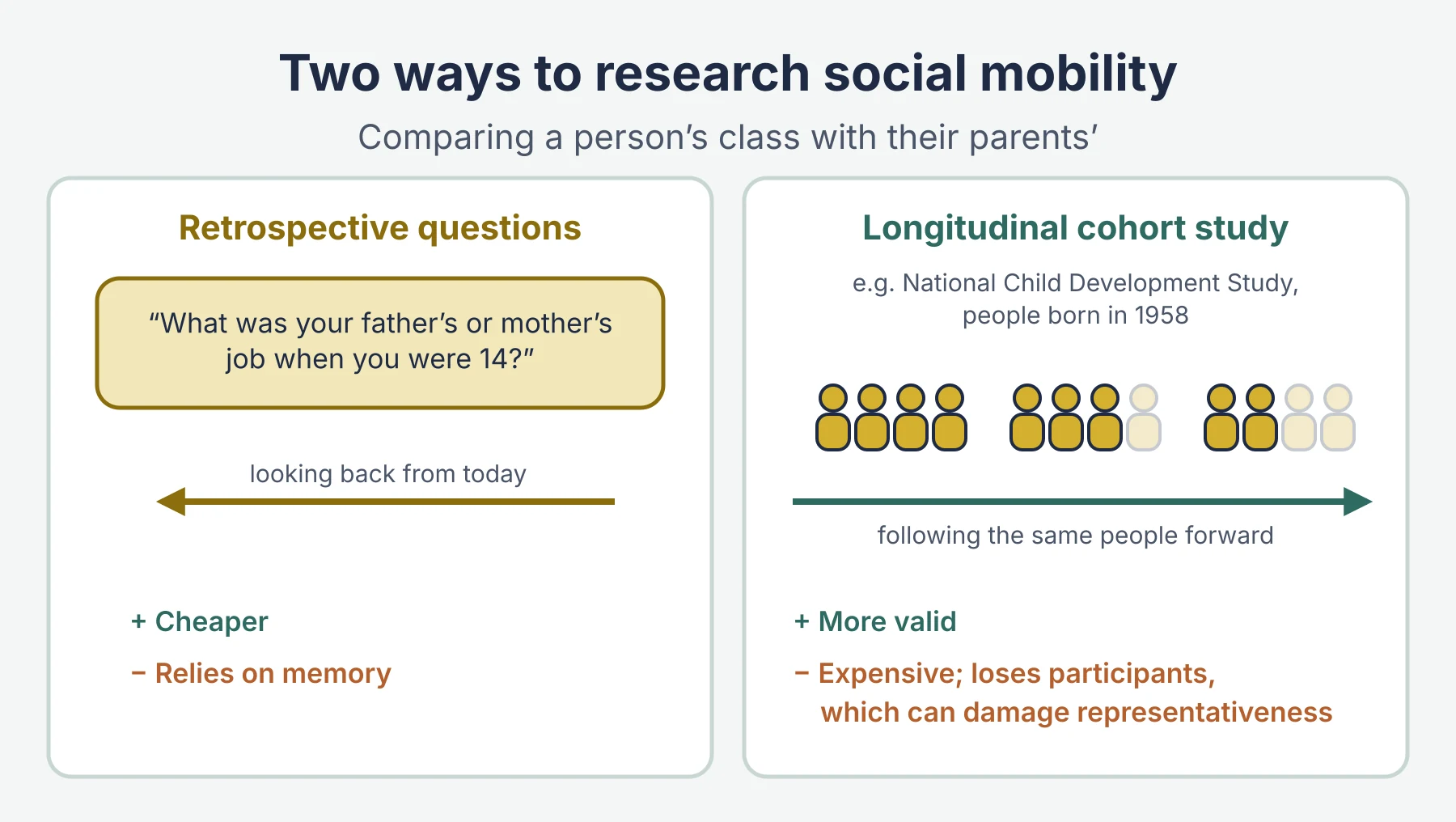
- Social mobility: retrospective questions (cheap, rely on memory) v cohort studies, such as Britain’s 1958 National Child Development Study (valid, costly, people drop out).
- The powerful: gatekeepers, refusals and polished images make elites hard to study, so inequality research may be one-sided.
Researching socialisation and social control (3.2.2)
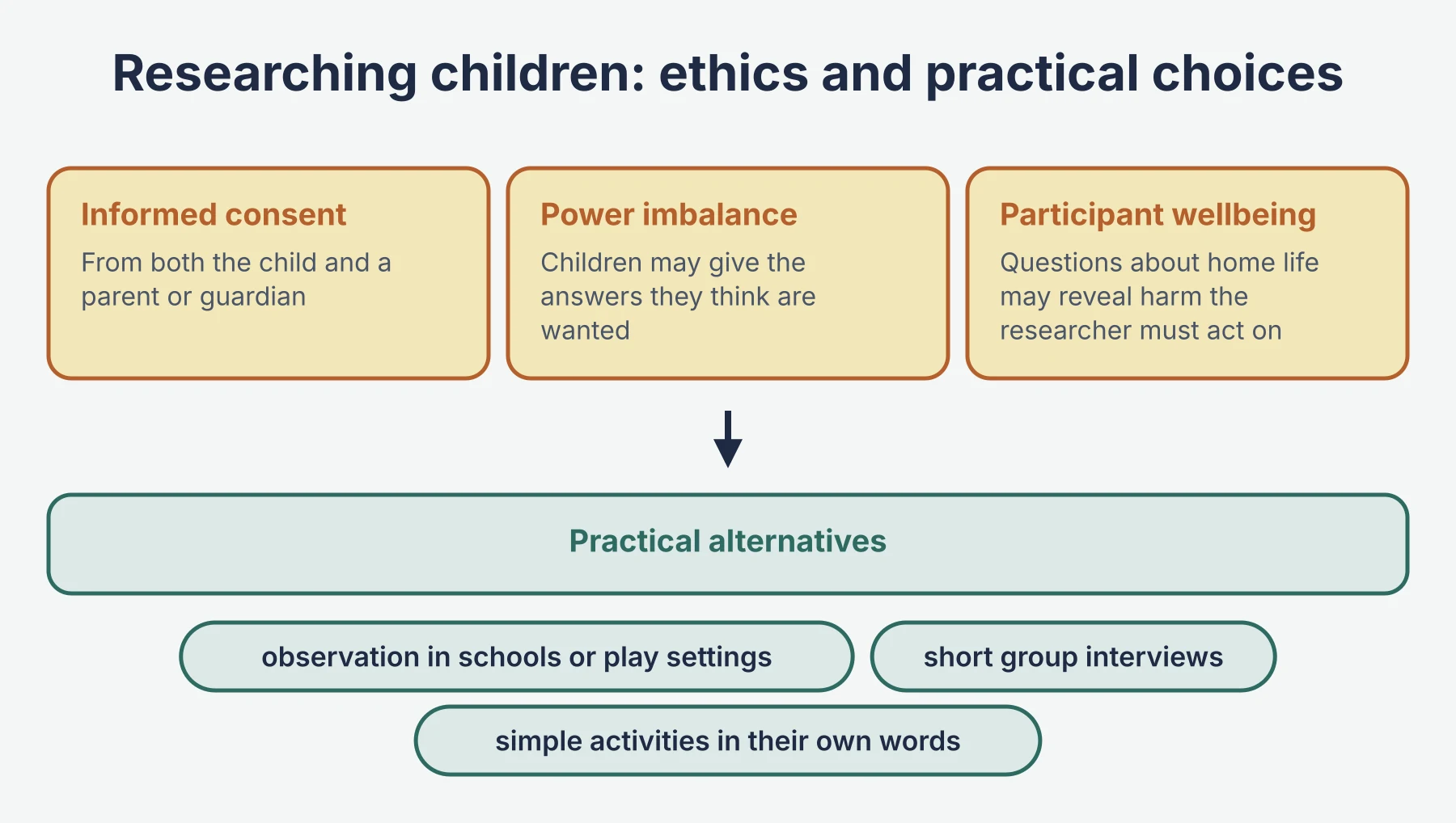
- Children: consent from child and parent or guardian; power imbalance; wellbeing and safeguarding; use observation, group interviews and simple activities.
- Media: content analysis is reliable and quantitative but does not show audience interpretation; Stanley Cohen used newspaper coverage to show a moral panic.
- Institutions: Goffman’s Asylums (1961) used ethnographic fieldwork in a psychiatric hospital to show how total institutions strip and reshape identity; one setting limits generalisation.
- Digital data: Zuboff’s surveillance capitalism; online data gives scale, but consent and representativeness are problems.
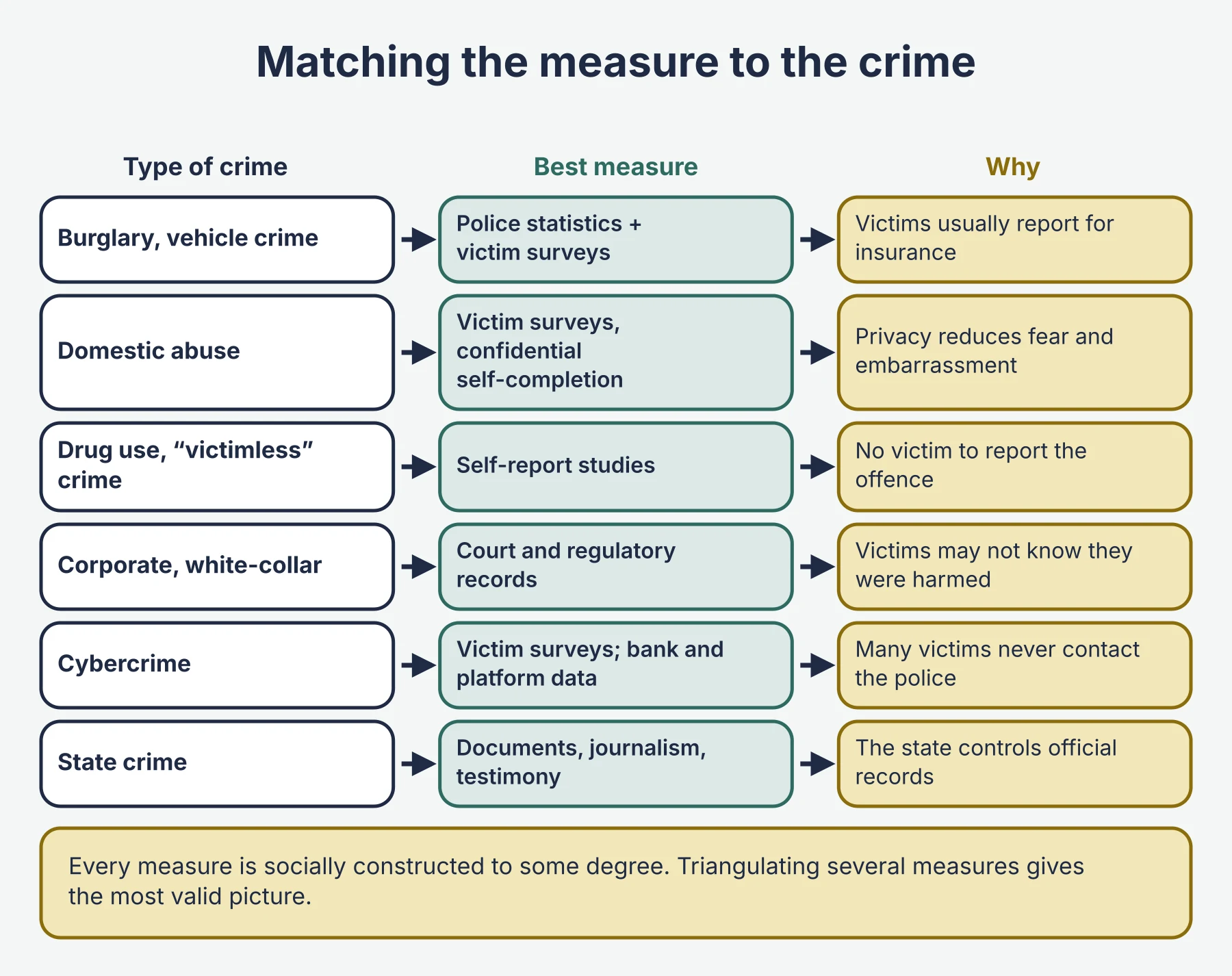
Measuring crime (3.2.2.4): match the measure to the crime
| Crime | Measure | Watch out for |
|---|---|---|
| Burglary, vehicle crime | Police statistics, checked with victim surveys | Some unreported incidents |
| Domestic abuse | Victim surveys with confidential self-completion | Non-disclosure |
| Drug use, other “victimless” crime | Self-report studies | Honesty; minor offences only |
| Corporate, white-collar | Court and regulatory records | Only discovered cases |
| Cybercrime | Victim surveys; bank and platform data | Victims unaware |
| State crime | Documents, journalism, testimony | State controls records |
Evaluation checklist
- Practical: time, funding, access, gatekeepers, researcher skills.
- Ethical: informed consent, confidentiality, anonymity, wellbeing; extra care with children and with illegal behaviour.
- Theoretical: validity, reliability, representativeness, generalisability; positivist or interpretivist preference.
- Improvement: triangulation; confidential self-completion; trained interviewers; stratified samples.
Exam traps
- Topic-free evaluation: “interviews take time” without linking to the group studied scores little.
- Class is not obvious: always say how it is measured.
- Secondary data shows what, not why: pay gap figures do not explain the glass ceiling.
- Victim surveys are not complete: they miss victimless, corporate and state crime.
- Children need double consent and attention to power imbalance.
- Own-society examples: prepare one for class, gender, ethnicity, socialisation and crime.
Self-test
- Name three ways of measuring social class.
- Give two groups that occupational scales struggle to classify.
- Why does intersectional research need large samples?
- What is a retrospective question? Give one problem.
- Give one strength and one limitation of cohort studies for researching social mobility.
- Why is self-identification used to record ethnicity?
- Give two ethical issues in researching children’s socialisation.
- What is content analysis, and what can it not show?
- What method did Goffman use in Asylums?
- Which measure is best for drug use, and why?
- Why are victim surveys poor at measuring corporate crime?
- Why is it difficult to research powerful groups?
Answers: 1. Occupation (occupational scales), income or wealth, and subjective class. 2. Any two: unemployed people; retired people; students; unpaid carers; the very rich living on wealth. 3. Combined groups, such as working-class women from one minority, may otherwise be too small to analyse reliably. 4. A question asking people to recall the past, such as a parent’s job; it relies on memory, which may be inaccurate. 5. Strength: follows the same people, giving valid data on change; limitation: costly and people drop out, reducing representativeness. 6. Ethnicity is an identity people define themselves, so their own answer is more valid than an observer’s guess. 7. Any two: consent from child and parent or guardian; power imbalance; wellbeing and safeguarding; confidentiality. 8. Systematically counting or interpreting media content; it cannot show how audiences interpret or are affected by it. 9. Ethnographic fieldwork (participant observation) in a psychiatric hospital, taking a staff role. 10. Self-report studies, because there is no victim to report the crime. 11. Victims often do not know they have been harmed, and many victims are organisations or the public at large. 12. Elites can refuse access, use gatekeepers and lawyers, and present a controlled public image.
Apply these notes in the Paper 2 research methods practice questions, and review crime and control content in the socialisation revision notes.
Related resources
-
Study guides
OxfordAQA International GCSE Sociology (9292): The Social Construction and Types of Crime
Section 3.2.2.4 of OxfordAQA IGCSE Sociology 9292: how crime and deviance are socially constructed, moral panics, and the eight named types of crime.
Sociology · OxfordAQA · IGCSE
Read guide -
Practice questions
OxfordAQA International GCSE Sociology (9292): The Social Construction and Types of Crime – Practice Questions
Original practice questions on 9292 section 3.2.2.4: crime and deviance, social construction, moral panics and the eight types of crime, with full answers.
Sociology · OxfordAQA · IGCSE
Try questions -
Revision notes
OxfordAQA International GCSE Sociology (9292): The Social Construction and Types of Crime – Revision Notes
Revision notes for 9292 section 3.2.2.4: crime versus deviance, social construction across societies and time, Cohen's moral panics and eight types of crime.
Sociology · OxfordAQA · IGCSE
Revise topic
Related articles
Get free revision emails (optional)
Occasional emails with practice questions, worked explanations and links to free resources for the qualification and subjects you choose. No spam, and you can unsubscribe from any email. The free tools on this site never need an email.