
Study Guides
OxfordAQA International GCSE Sociology (9292): Research methods (also assessed in Paper 1)
Research methods as Paper 2 of OxfordAQA IGCSE Sociology 9292 applies them: researching class, gender, ethnicity, socialisation, social control and crime.
- Subject
- Sociology
- Level
- IGCSE
- Topic
- Paper 2 – Exploring Sociology
- Author
- Marlbridge Academic Team
- Updated
- Reviewed by
- Naqiya Yousaf (what this means)
Aligned to OxfordAQA IGCSE Sociology (9292), Version 1.0. Official specification .
Syllabus page (what it covers and how it is assessed): OxfordAQA IGCSE Sociology.
Syllabus points this page covers
9292
- 3.1.3 Research methods (also assessed in Paper 1)
Found an error? Report a correction.
Need help with this topic? Request a free trial class for IGCSE Sociology (9292).
This guide covers section 3.1.3 Research methods as it is examined in Paper 2 Exploring Sociology of OxfordAQA International GCSE Sociology (9292), Version 1.0, first examined in May/June 2028. Research methods is Section C of both papers: in Paper 2 it carries 16 marks of “short and extended response questions”, while the other two sections cover 3.2.1 Differences and inequalities and 3.2.2 Socialisation and social control. The research methods study guide explains every method, sample type and research issue in the specification; this page assumes that vocabulary and shows how to apply it to the Paper 2 topics.
Why application matters in Paper 2
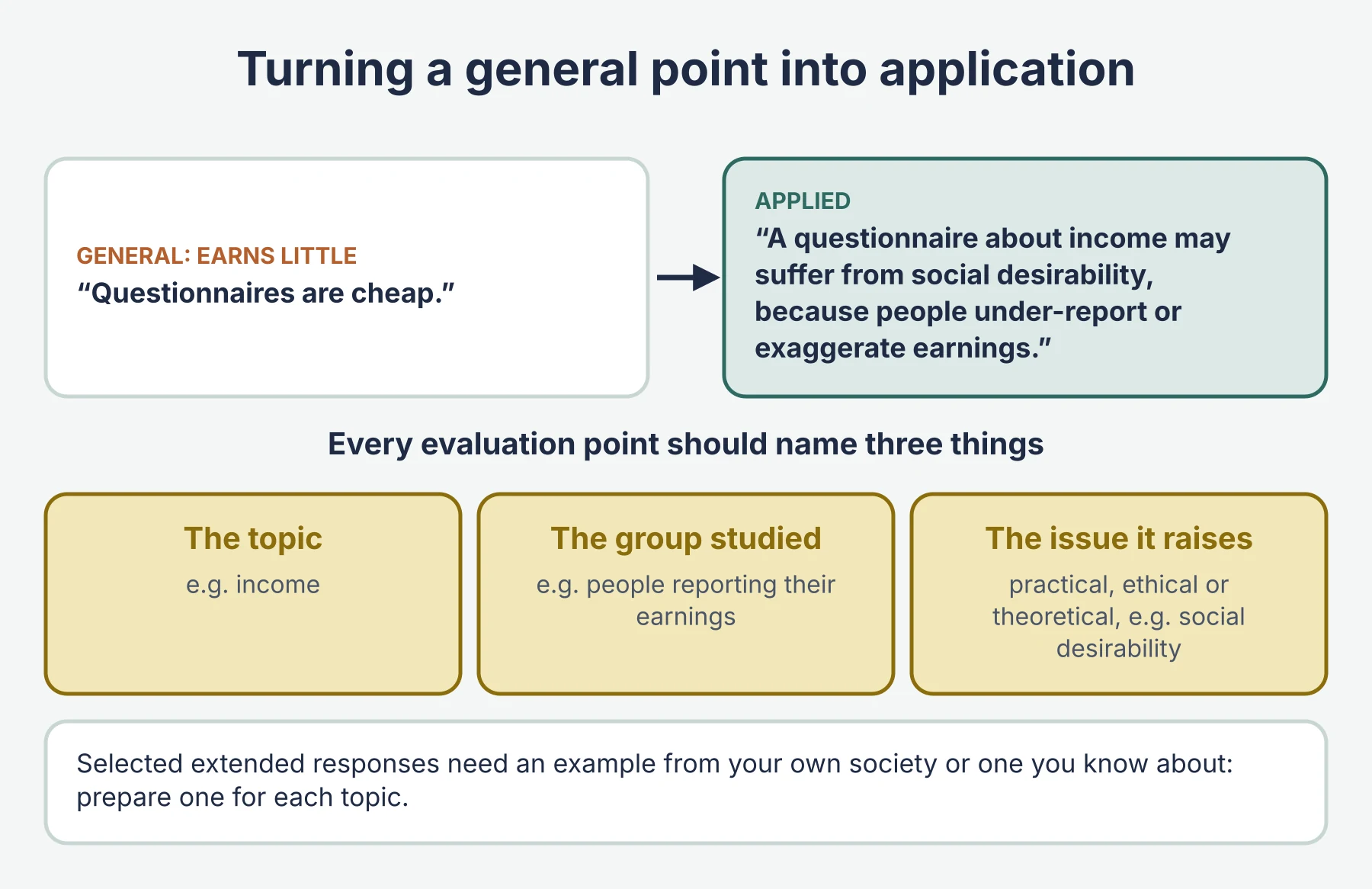
The specification content is identical in both papers, but an extended Paper 2 answer is judged on how well you fit a method to a particular topic and group. “Questionnaires are cheap” earns little; “a questionnaire about income may suffer from social desirability, because people under-report or exaggerate earnings” shows application. Every evaluation point should name the topic, the group being studied and the practical, ethical or theoretical issue it raises.
The specification also says students must use examples from their own society or a society they know about in selected extended responses, so prepare at least one local example for each section below.
Researching differences and inequalities (3.2.1)
Operationalising social class
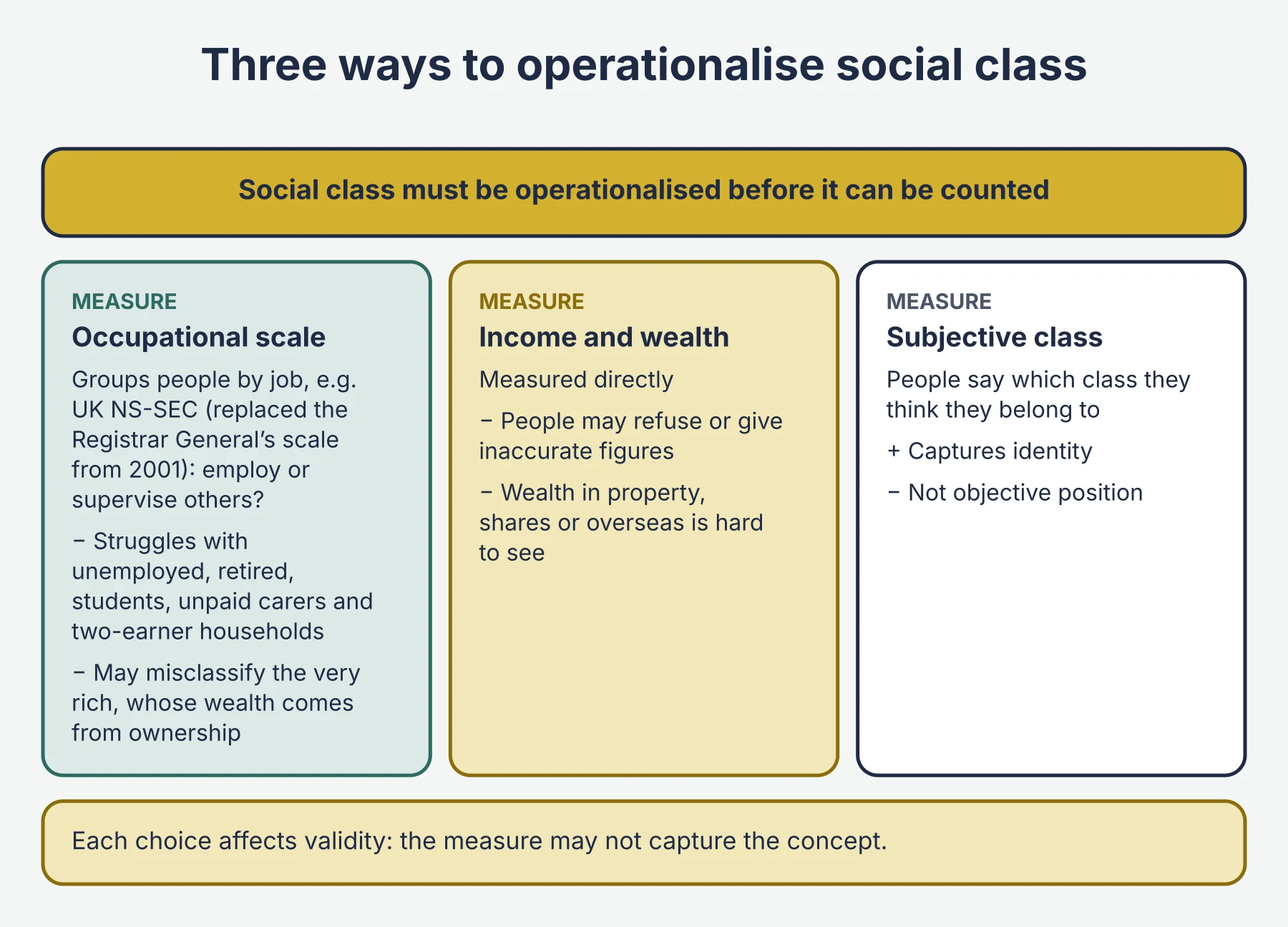
Section 3.2.1.3 includes ways of measuring social class, which is a research methods problem in disguise: class must be operationalised before it can be counted.
- Occupational scales group people by the job they do. In the United Kingdom, for example, the National Statistics Socio-economic Classification (NS-SEC) replaced the older Registrar General’s scale from 2001; it groups occupations by employment relations, such as whether people employ others or supervise them.
- Income and wealth can be measured directly, but people may refuse to answer or give inaccurate figures, and wealth held in property, shares or overseas is hard to see.
- Subjective class asks people which class they think they belong to, which captures identity but not objective position.
Each choice affects validity. Occupational scales struggle with people who are unemployed, retired, students or unpaid carers, and with households containing two earners in different occupations. A study that defines class only by occupation may misclassify the very rich, whose wealth comes from ownership rather than a job.
Researching gender, ethnicity, caste and other differences
- Secondary data is often the starting point. In the United Kingdom, larger employers have had to publish gender pay gap figures since 2017, giving researchers quantitative data on the glass ceiling. Its limitation is that it shows the size of a gap, not the reasons for it.
- Self-identification is the usual way to record ethnicity or religion, because these are identities people define themselves. But categories differ between countries and censuses, so comparisons across societies or over time may not be valid.
- Caste and other sensitive differences may be hidden or denied in interviews where discrimination is illegal, so indirect questions or observation of everyday practices, such as marriage choices, may be needed.
Intersectionality and sampling
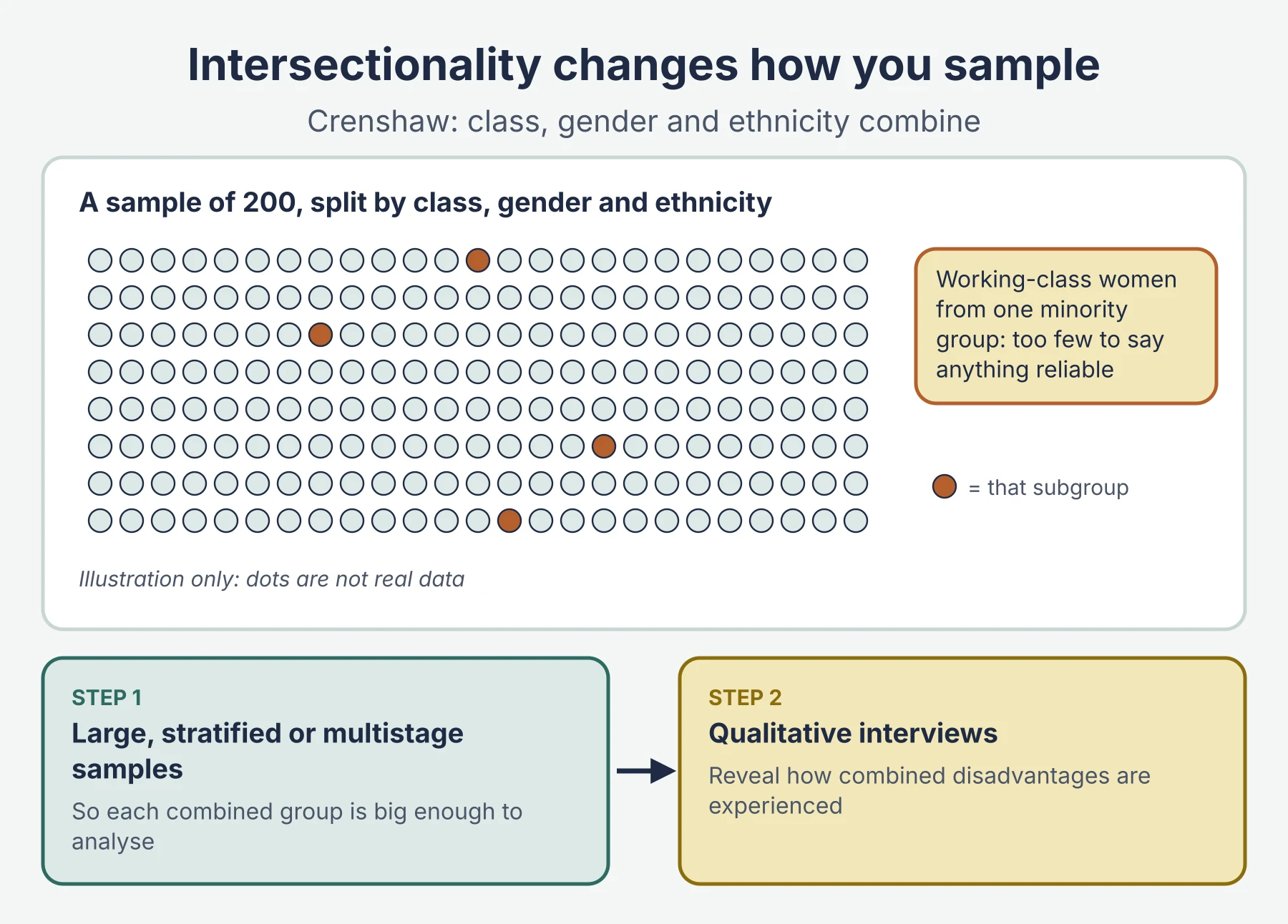
Kimberlé Crenshaw’s concept of intersectionality means differences such as class, gender and ethnicity combine. For research, this has two consequences. Quantitative studies need large, stratified or multistage samples, because a sample of 200 may contain too few working-class women from one minority group to say anything reliable about them. Qualitative interviews then help reveal how combined disadvantages are experienced.
Researching social mobility
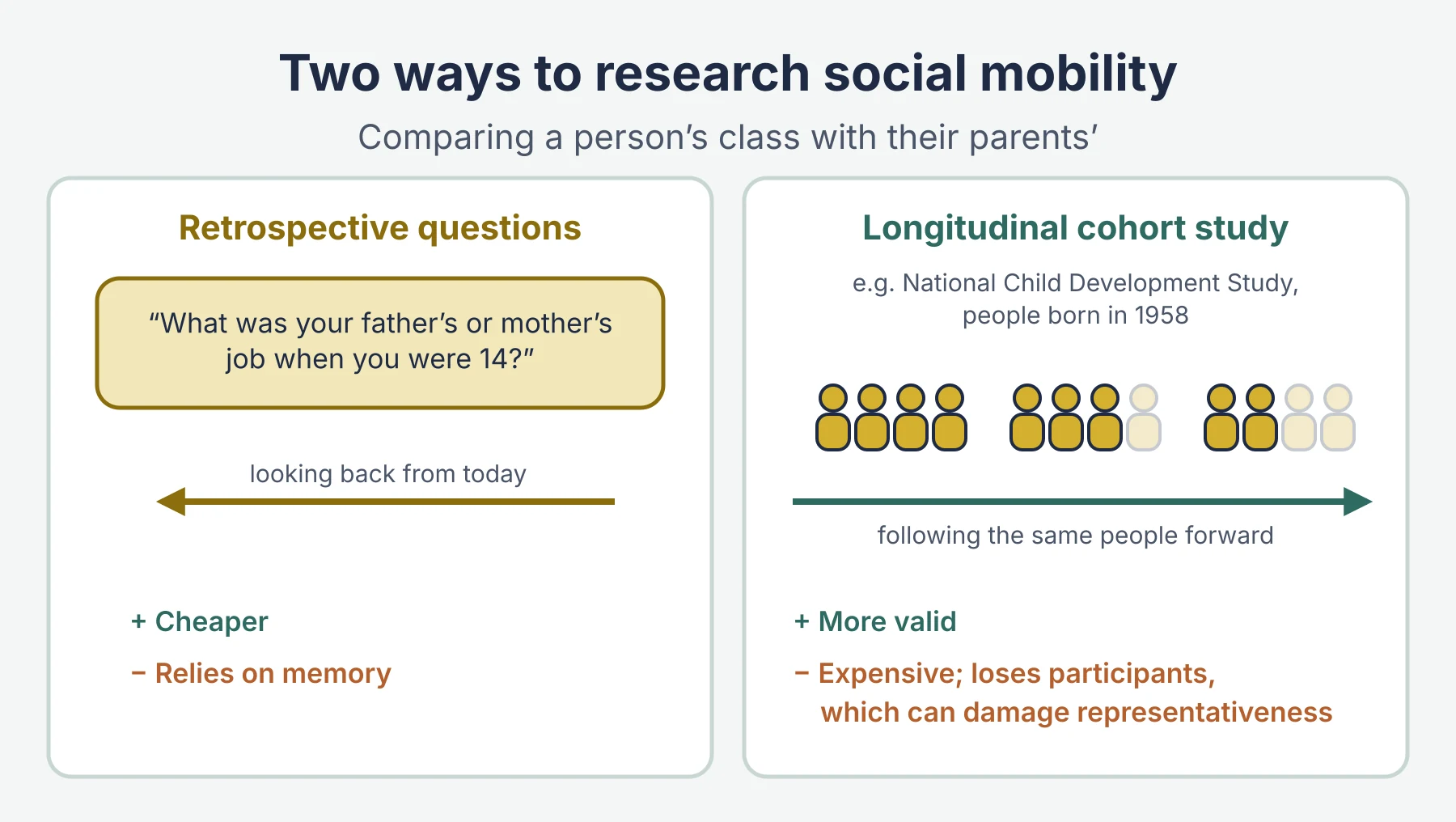
Comparing a person’s class with their parents’ (intergenerational mobility) can be done with retrospective questions (“What was your father’s or mother’s job when you were 14?”) or with longitudinal cohort studies that follow people born in the same year, such as Britain’s National Child Development Study of people born in 1958. Retrospective questions are cheaper but rely on memory; cohort studies are more valid but expensive and lose participants over time, which can damage representativeness.
Researching the powerful
Sociologists often find it easier to study the poor than the wealthy. Elites can refuse access, employ gatekeepers and lawyers, and present a polished public image. This is a practical issue with theoretical consequences: if the powerful are under-researched, our picture of inequality is incomplete.
Researching socialisation and social control (3.2.2)
Children and young people
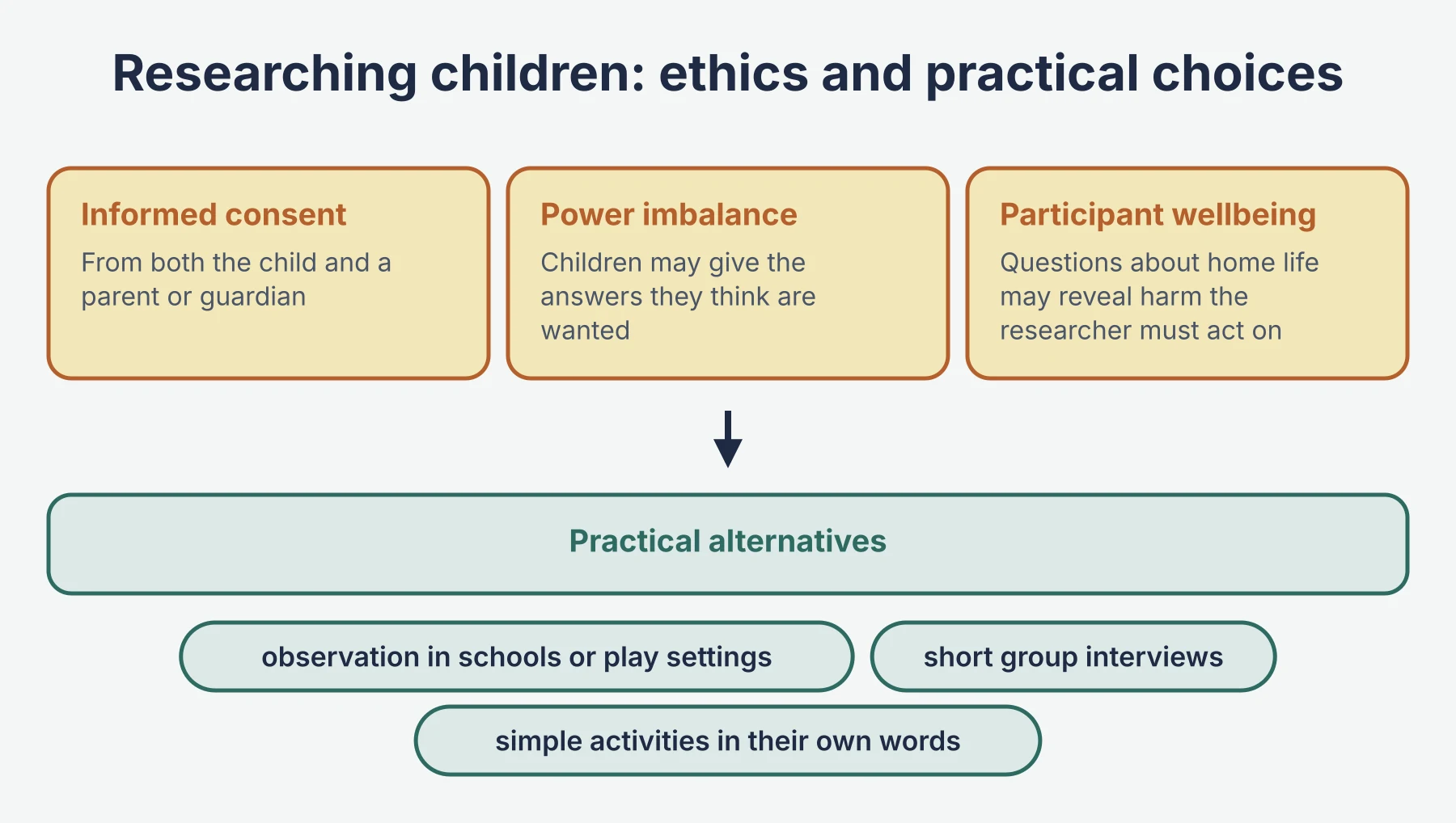
Research on primary and secondary socialisation often involves children, which raises specific ethical issues: informed consent from both child and parent or guardian; the power imbalance between adult researcher and child, which can push children to give the answers they think are wanted; and participant wellbeing, since questions about home life may reveal harm the researcher must act on. Practical alternatives include observation in schools or play settings, short group interviews, and simple activities that let children express views in their own words.
Media as a source
Media is an agency of socialisation in 3.2.2.2. Content analysis counts how often groups or behaviours appear, for example how often women are shown as experts in news programmes, giving reliable, quantitative data. Qualitative analysis looks at the meanings in how stories are framed. Stanley Cohen’s study of the mods and rockers used newspaper coverage as a key source to show how the press created a moral panic. The limitation is that content analysis shows what media contain, not how audiences interpret them.
Institutions and stigmatised identities
Erving Goffman’s Asylums (1961) was based on fieldwork in a large psychiatric hospital in Washington, D.C., where he took a staff role that let him observe patients’ daily lives. It shows how ethnography can reveal the hidden rules of a “total institution” and how stigmatised identities are produced, but it also raises questions about consent and about generalising from one institution.
Digital data and surveillance
Shoshana Zuboff’s work on surveillance capitalism describes how technology companies collect vast amounts of behavioural data. For researchers, online data, such as public posts, can show patterns of behaviour on a huge scale. But it raises ethical questions, because users rarely give informed consent to being studied, and representativeness problems, because platform users differ from the whole population.
Measuring and researching crime (3.2.2.4)
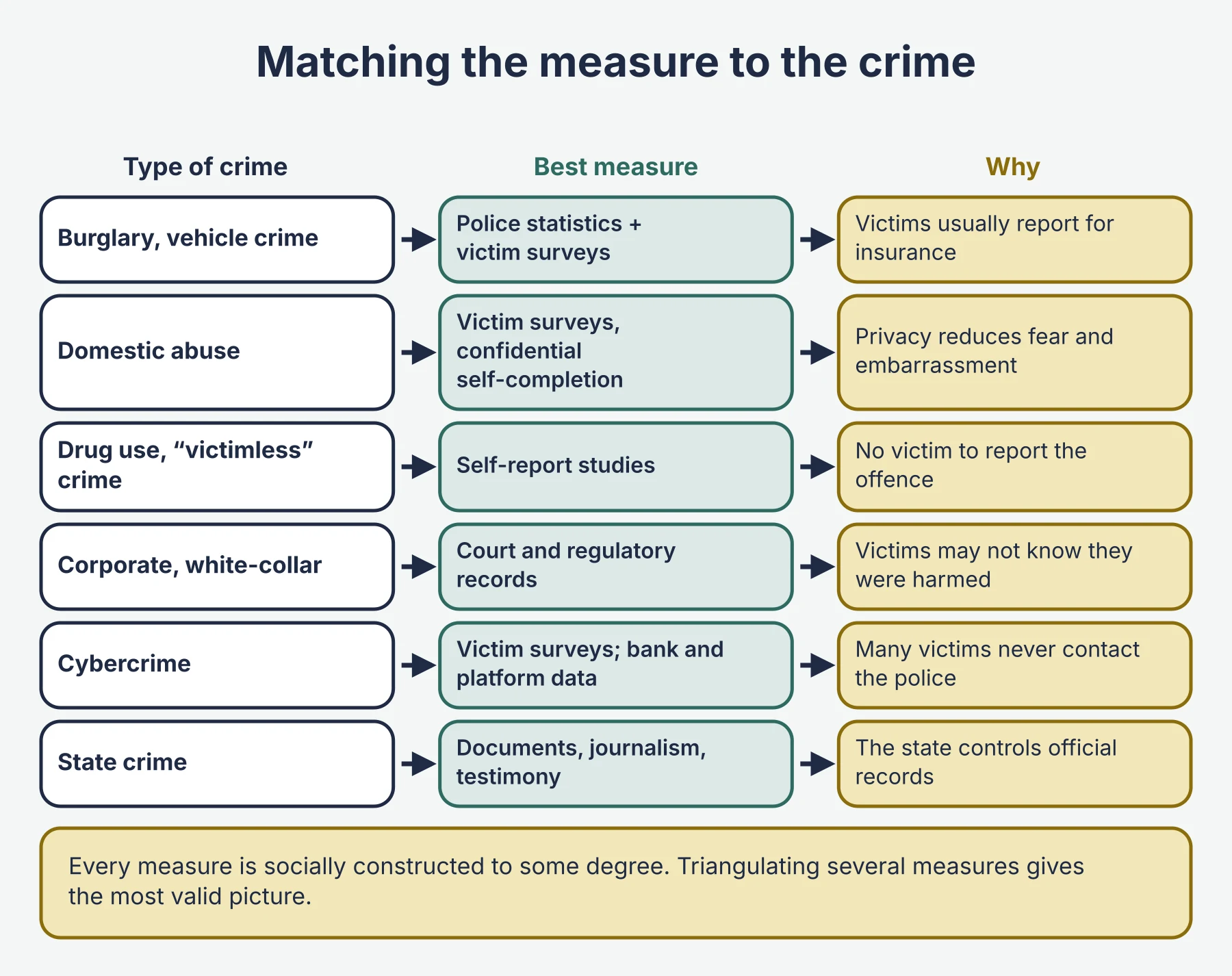
The specification names official/police statistics, self-report studies and victim surveys. In Paper 2, the skill is matching the measure to the type of crime.
| Type of crime | Best measure | Why | Main problem |
|---|---|---|---|
| Burglary and vehicle crime | Police statistics, checked against victim surveys | Victims usually report for insurance | Still misses some unreported incidents |
| Domestic abuse | Victim surveys with confidential self-completion sections | Private setting reduces fear and embarrassment | Some victims still do not disclose |
| Drug use and other “victimless” crimes | Self-report studies | There is no victim to report the offence | Honesty and memory; mainly minor offences |
| Corporate and white-collar crime | Secondary documents, such as court and regulatory records | Victims may not know they were harmed | Only cases that are discovered appear |
| Cybercrime | Victim surveys and data from banks or online platforms | Many victims never contact the police | Victims may not recognise fraud |
| State crime | Documents, journalism, testimony | The state controls official records | Access is restricted and evidence may be hidden |
Two points earn high marks. First, every measure is socially constructed to some degree: what counts depends on how crime is defined and recorded. Second, triangulating several measures gives the most valid picture.
Worked example: an extended response plan
Evaluate the usefulness of victim surveys for studying patterns of victimisation by gender.
Strengths    reveal crime not reported to police, e.g. domestic abuse;
             large samples allow comparison of men's and women's risk;
             repeated surveys show trends over time
Limitations  disclosure depends on trust and privacy (interviewer
             effect, social desirability); miss victims who cannot be
             reached, e.g. people without a fixed address; rely on memory;
             some victims do not define experiences as crime
Methods fix  confidential self-completion section; trained interviewers;
             triangulate with police data and qualitative interviews
Judgement    more useful than police statistics for hidden, gendered
             crimes, but still an underestimate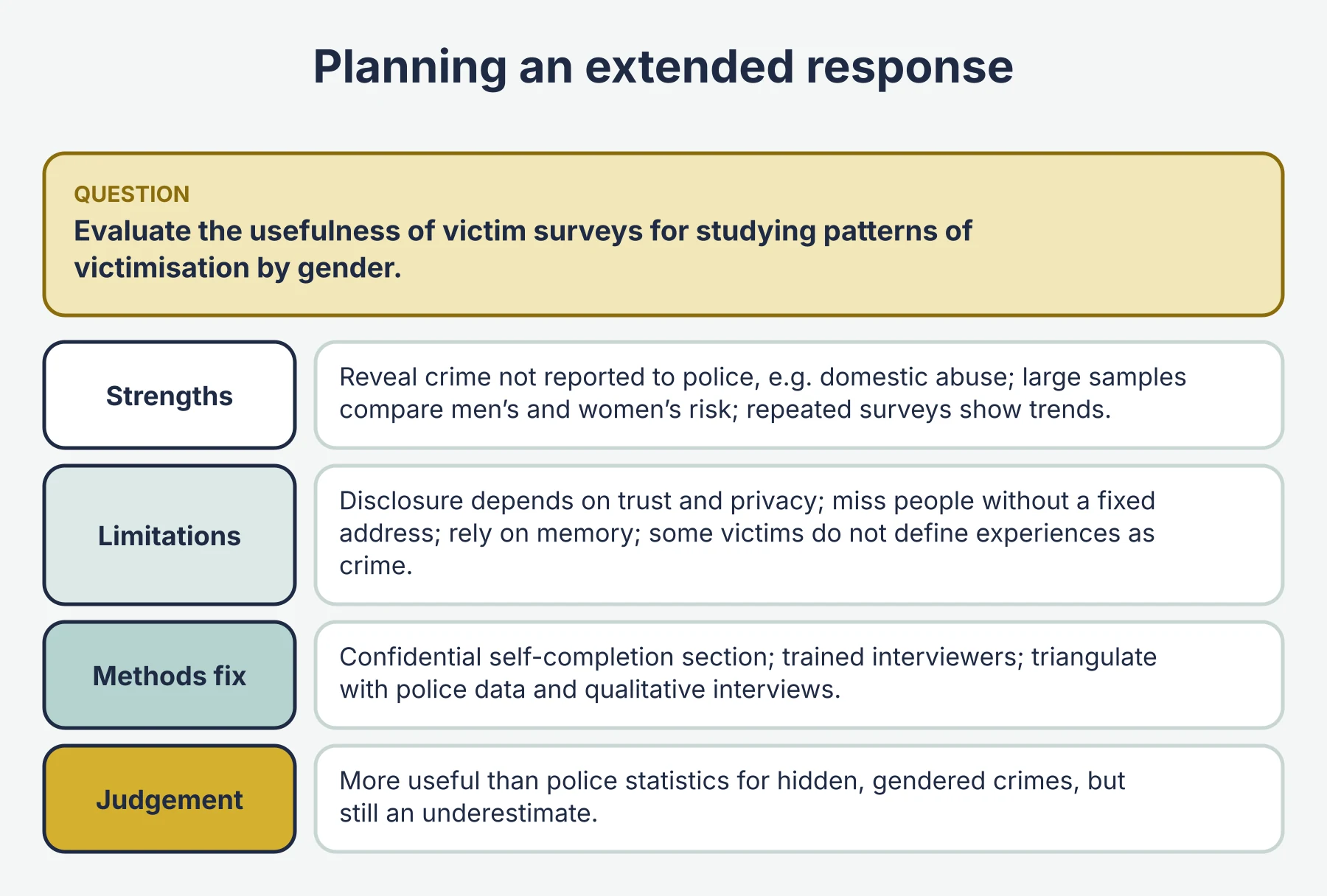
Common mistakes
- Evaluating a method in general instead of for the topic and group in the question.
- Saying “class” without explaining how it would be operationalised.
- Forgetting that ethics with children involve parents or guardians as well.
- Treating victim surveys or self-report studies as complete; each misses certain crimes.
- Offering no example from your own society when an extended question asks for one.
Condense this guide with the Paper 2 research methods revision notes and practise with the Paper 2 research methods practice questions. For the Paper 2 topic content these methods are applied to, see the differences and inequalities guide and the socialisation guide.
Related resources
-
Practice questions
OxfordAQA International GCSE Sociology (9292): Research methods (also assessed in Paper 1) – Practice Questions
Original Paper 2 style research methods practice for OxfordAQA IGCSE Sociology 9292, applied to class, gender, socialisation and crime, with full answers.
Sociology · OxfordAQA · IGCSE
Try questions -
Revision notes
OxfordAQA International GCSE Sociology (9292): Research methods (also assessed in Paper 1) – Revision Notes
Revision notes on applying research methods to Paper 2 topics in OxfordAQA IGCSE Sociology 9292: measuring class, crime, socialisation and control.
Sociology · OxfordAQA · IGCSE
Revise topic -
Study guides
OxfordAQA International GCSE Sociology (9292): The Social Construction and Types of Crime
Section 3.2.2.4 of OxfordAQA IGCSE Sociology 9292: how crime and deviance are socially constructed, moral panics, and the eight named types of crime.
Sociology · OxfordAQA · IGCSE
Read guide
Related articles
Get free revision emails (optional)
Occasional emails with practice questions, worked explanations and links to free resources for the qualification and subjects you choose. No spam, and you can unsubscribe from any email. The free tools on this site never need an email.