
Revision Notes
OxfordAQA International GCSE History (9245): The Great Patriotic War and Late Stalinism, 1941-53 – Revision Notes
Revision notes for 9245 Life in the USSR, 1941-53: wartime economy and society, Stalin as war leader, women, reconstruction, High Stalinism and a self-test.
- Subject
- World History
- Level
- IGCSE
- Topic
- Paper 2 – Studies in Change
- Author
- Marlbridge Academic Team
- Updated
- Reviewed by
- Azam Siddique (what this means)
Aligned to OxfordAQA IGCSE World History (9245), Version 1.1. Official specification .
Syllabus page (what it covers and how it is assessed): OxfordAQA IGCSE World History.
Syllabus points this page covers
9245
- 3.2.1 Section A – Societies in change
- 3.2.1.2 Life in Russia and the USSR, 1914-1953
Found an error? Report a correction.
Need help with this topic? Request a free trial class for IGCSE World History (9245).
Condensed notes on “The ‘Great Patriotic War’ and the final years of Stalinism, 1941-1953”, the last part of Life in Russia and the USSR, 1914-1953. The specification names the war’s “economic and social problems; Stalin’s wartime leadership; the role and contribution of women… including Lyudmila Pavlichenko” and “Post-war reconstruction: agricultural policies and stagnation; the extent of industrial rebuilding and peoples’ standard of living by 1953; High Stalinism… Terror and purges; Beria and the NKVD; the death of Stalin.” Full explanations are in the Great Patriotic War and late Stalinism study guide; earlier parts of the option are in the Paper 2 Section A revision notes.
Timeline
| Date | Event |
|---|---|
| 22 June 1941 | German invasion (Operation Barbarossa) |
| July 1941 | Stalin’s “brothers and sisters” broadcast |
| 1941 | Over 1,500 factories moved east; Volga Germans deported |
| September 1941 | Siege of Leningrad begins; encirclement at Kiev |
| 7 November 1941 | Red Square parade; troops march to the front |
| July 1942 | Order No. 227, “Not one step back” |
| 1942 | Pavlichenko’s tour of Allied countries |
| 1942-43 | Victory at Stalingrad |
| 1943 | Kursk; Orthodox Church allowed to elect a patriarch |
| 1944 | Leningrad siege lifted (January); Chechens, Ingush and Crimean Tatars deported |
| May 1945 | Victory in Europe |
| 1946 | Fourth Five-Year Plan; Zhdanov’s attacks on writers |
| 1946-47 | Famine |
| December 1947 | Rationing ends; currency reform |
| 1948 | Campaign against “cosmopolitans” begins |
| 1949 | Soviet atomic bomb; Leningrad Affair begins; Stalin’s seventieth birthday |
| January 1953 | Doctors’ Plot announced |
| 5 March 1953 | Stalin dies |
| June / December 1953 | Beria arrested / executed |
Wartime problems
| Economic | Social |
|---|---|
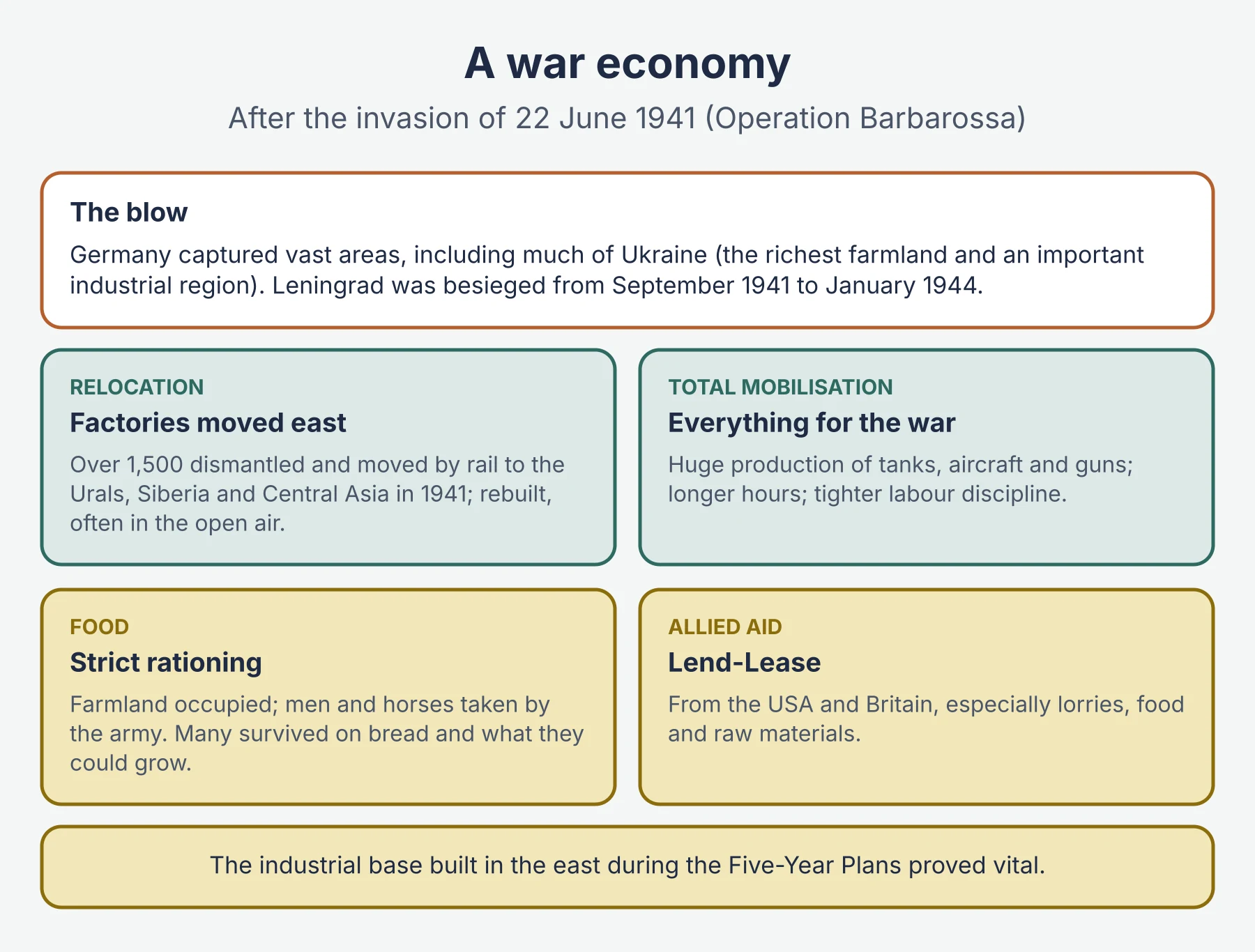
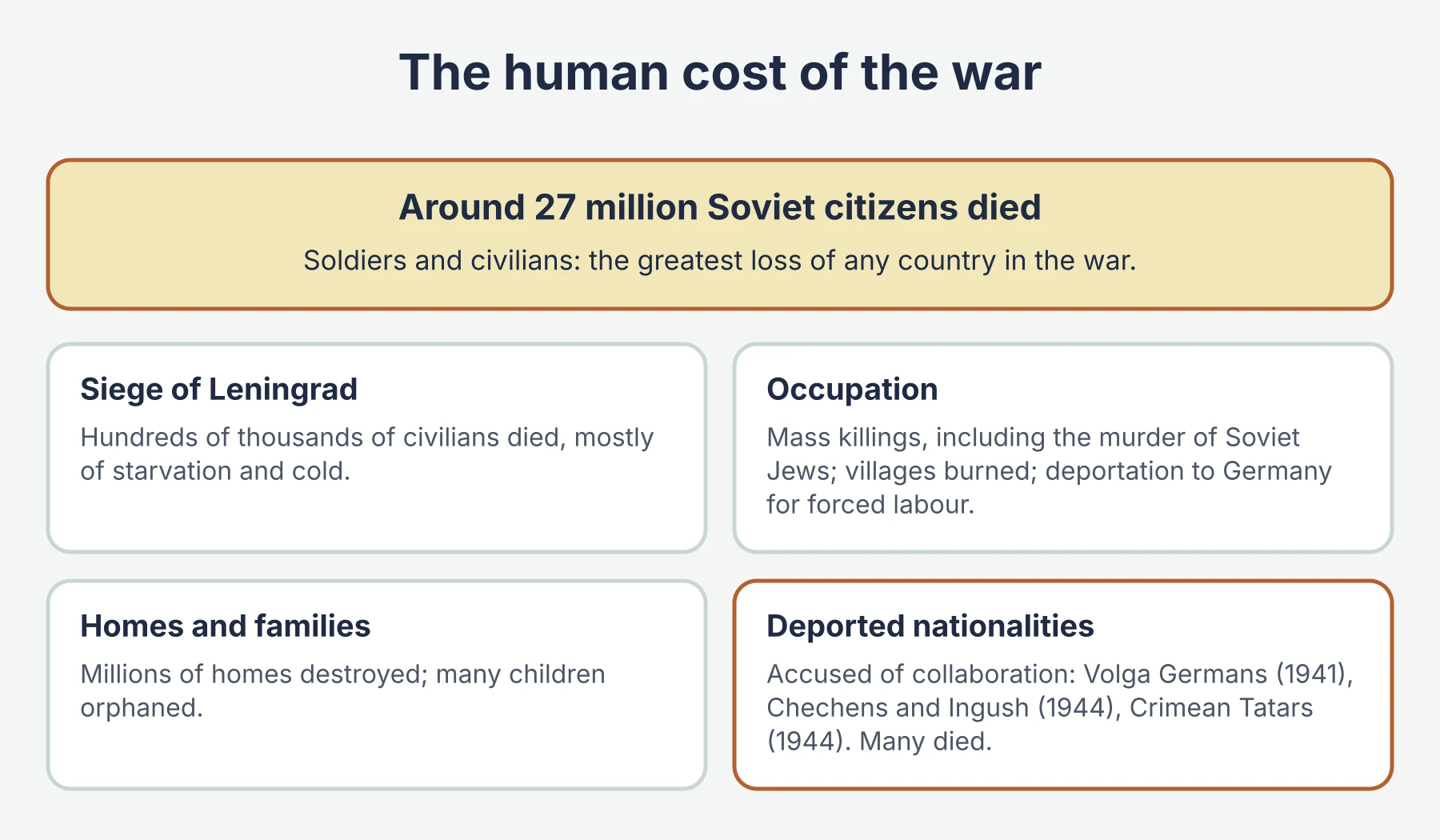
| Ukraine and other rich regions occupied | About 27 million Soviet dead |
| Industry moved east and restarted | Leningrad siege: mass starvation |
| Total war production; longer hours | Mass killings and deportations in occupied areas |
| Strict food rationing | Millions homeless; many orphans |
| Lend-Lease aid from the USA and Britain | Whole nationalities deported |
Stalin as war leader
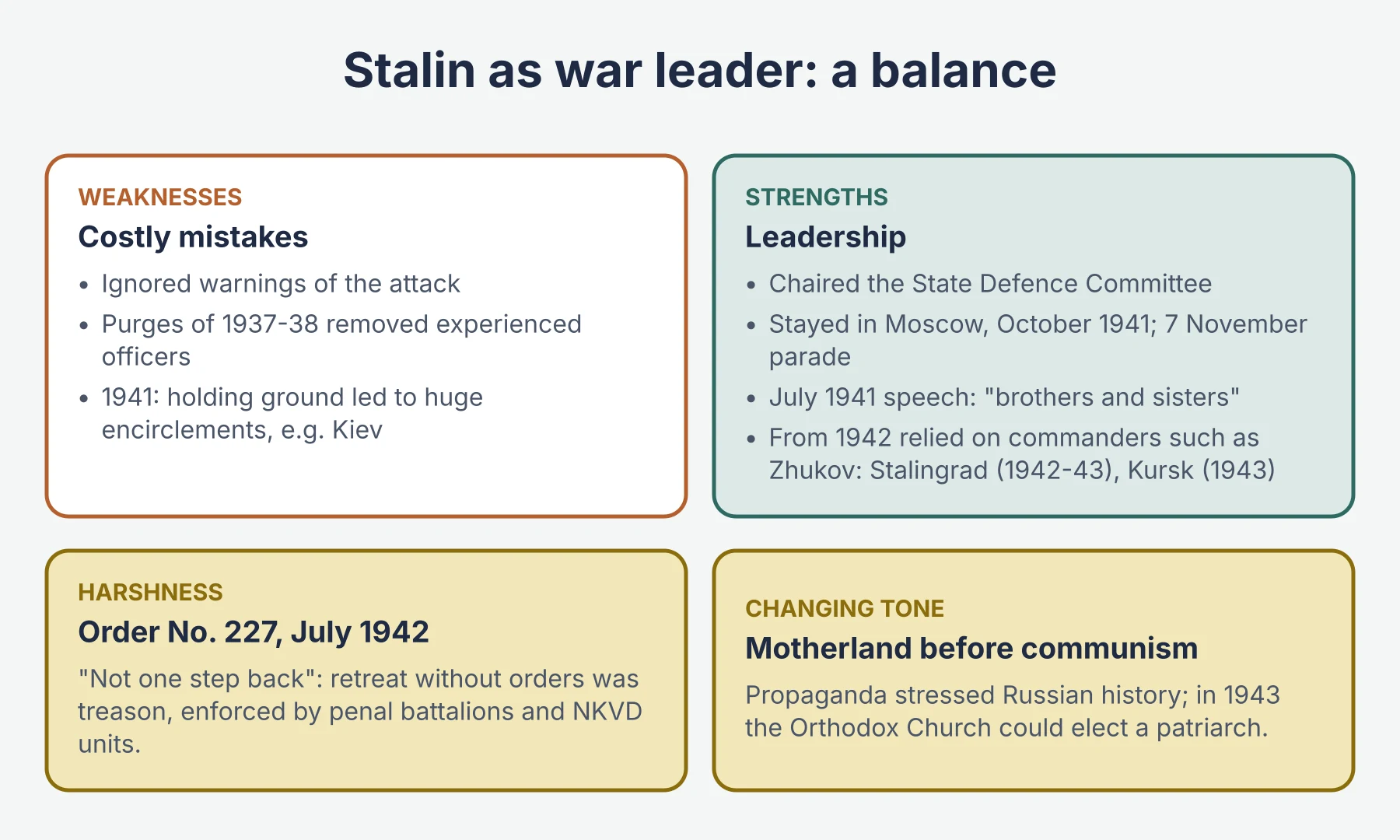
- Failures: ignored warnings; purged officers; early encirclements such as Kiev.
- Successes: State Defence Committee; stayed in Moscow; 7 November parade; patriotic appeals; trusted commanders such as Zhukov after 1942; Stalingrad and Kursk.
- Methods: Order No. 227; penal battalions; NKVD behind the lines.
- Tone: patriotism and Russian history over communism; concessions to the Church.
Women’s contribution
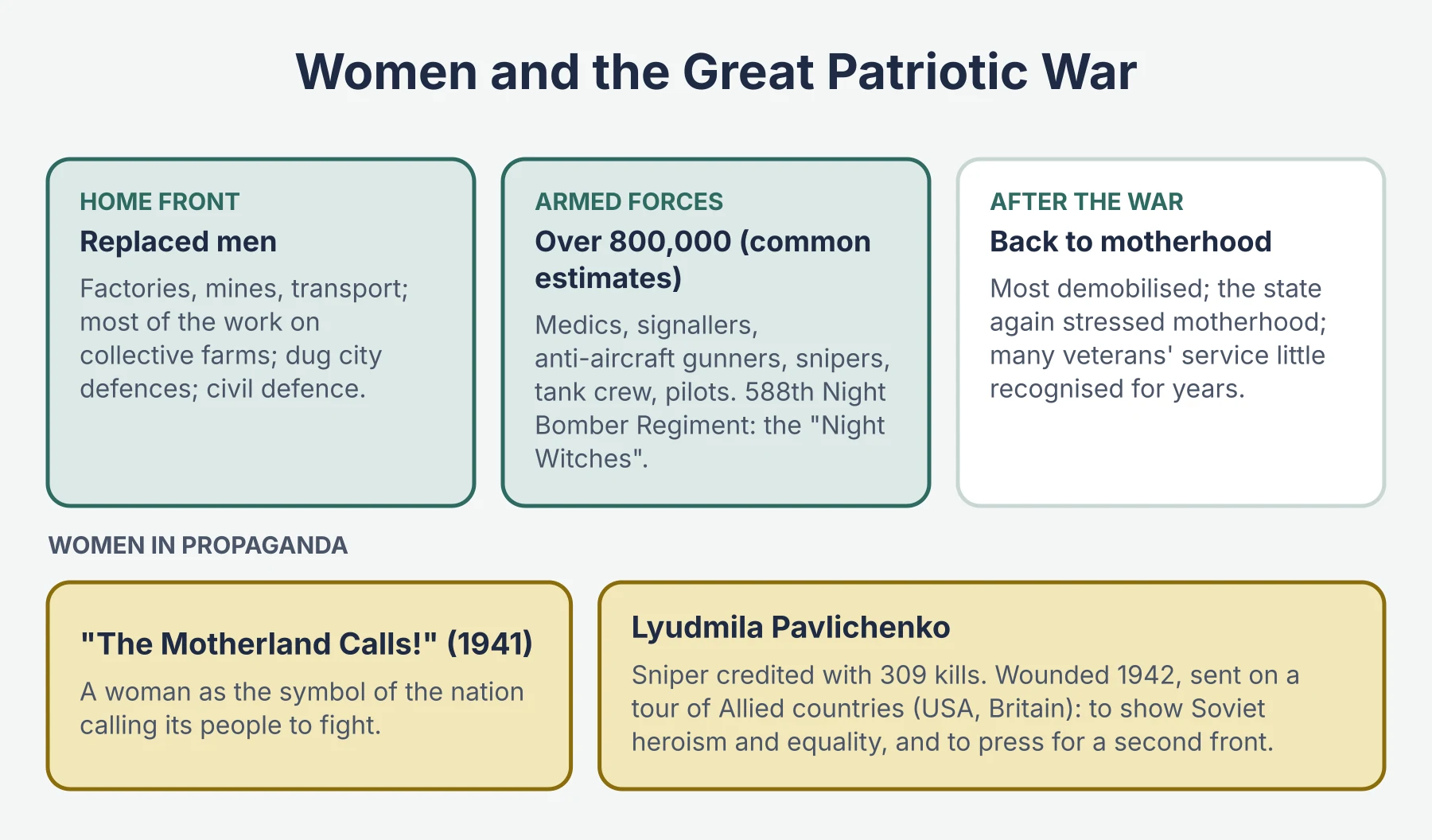
- Home front: factories, mines, transport; most collective-farm work; digging defences.
- Armed forces: hundreds of thousands (commonly over 800,000) as medics, signallers, anti-aircraft gunners, snipers, tank crew, pilots; the “Night Witches”.
- Propaganda: The Motherland Calls! (1941); Lyudmila Pavlichenko, sniper credited with 309 kills, toured Allied countries in 1942, meeting Eleanor Roosevelt.
- After 1945: demobilisation; return to stress on motherhood; veterans’ service little recognised.
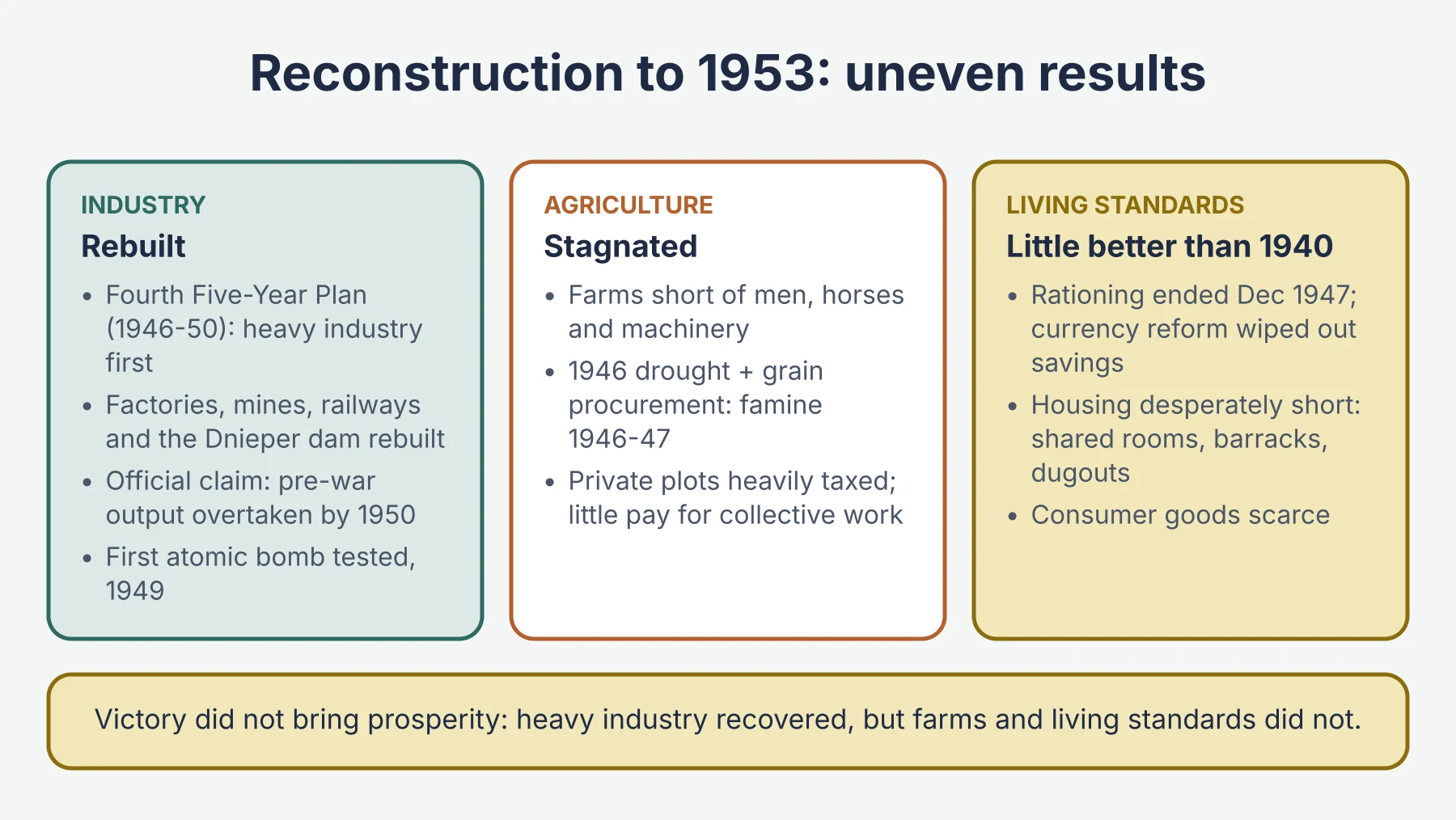
Reconstruction to 1953
- Industry: Fourth Five-Year Plan; heavy industry first; Dnieper dam rebuilt; official claim of beating pre-war output by 1950; atomic bomb 1949.
- Agriculture: famine 1946-47; taxes on private plots; low pay on collective farms; stagnation.
- Living standards: rationing ended December 1947 with a currency reform that wiped out savings; severe housing shortage; few consumer goods.
High Stalinism
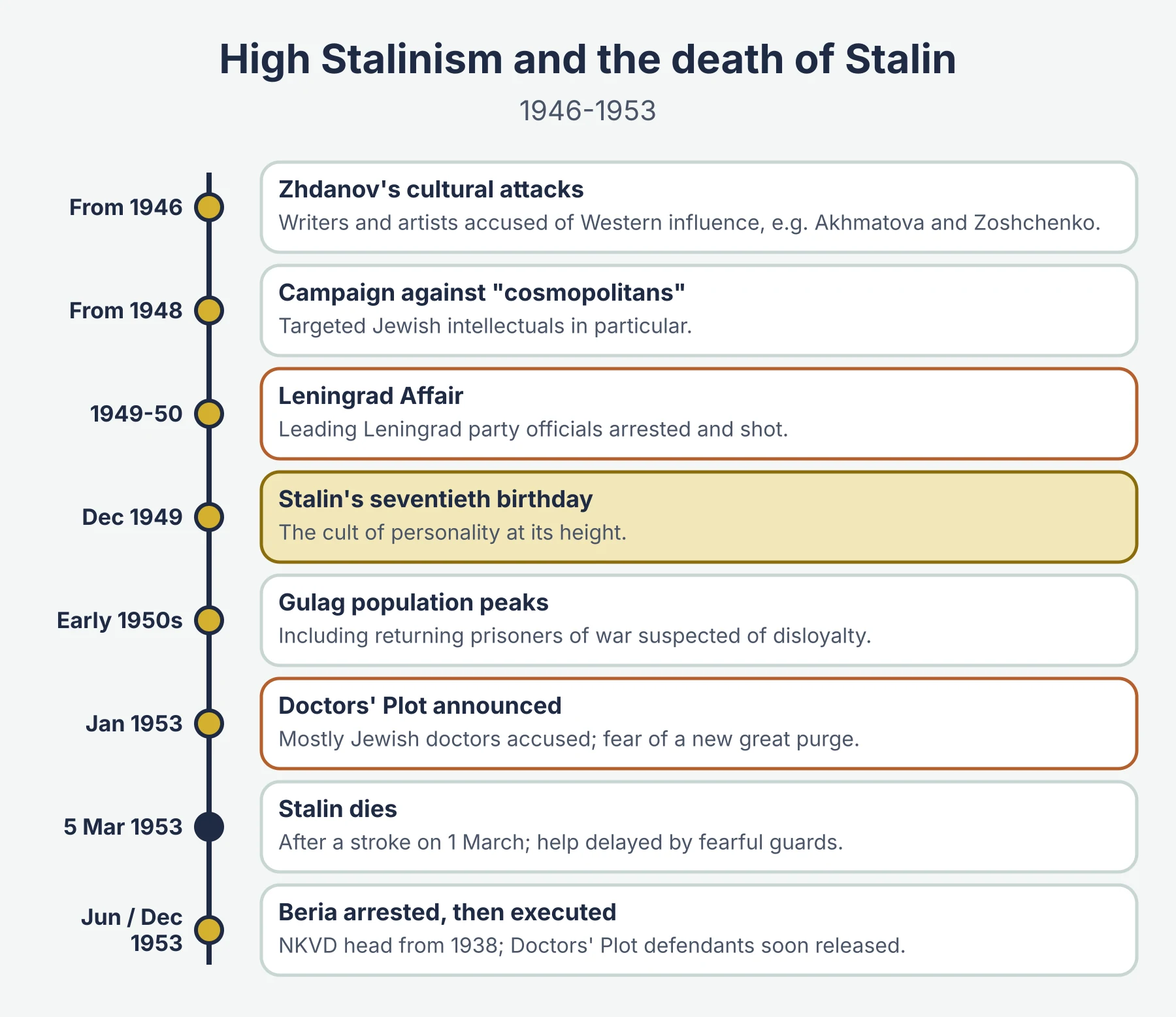
- Cult: victory credited to Stalin; seventieth birthday celebrations (1949).
- Culture: Zhdanov’s attacks (Akhmatova, Zoshchenko); anti-“cosmopolitan” campaign.
- Terror: returning prisoners of war sent to the Gulag; Leningrad Affair; Doctors’ Plot; Gulag at its peak in the early 1950s.
- Beria: NKVD chief from 1938; security and the atomic project after 1945; executed December 1953.
- Death: stroke 1 March, death 5 March 1953; mass mourning; crushes at the lying-in-state.
Key terms
| Term | Meaning |
|---|---|
| Great Patriotic War | Soviet name for the war against Germany, 1941-45 |
| State Defence Committee | Body chaired by Stalin that ran the war effort |
| Order No. 227 | “Not one step back” order of July 1942 |
| Lend-Lease | US scheme supplying war materials to allies |
| NKVD | Soviet secret police under Beria |
| Gulag | System of labour camps |
| High Stalinism | Stalin’s rule 1945-53: cult, cultural control and renewed terror |
| Zhdanovshchina | Zhdanov’s campaign against Western influence in culture |
| Doctors’ Plot | 1953 false accusation against mostly Jewish doctors |
Exam traps
- Describing battles rather than their effects on people.
- One-sided verdicts on Stalin’s leadership.
- Pavlichenko named without explaining her propaganda role.
- Assuming victory brought better living standards.
- Forgetting that terror rose again after 1945.
Self-test
- When did Germany invade the USSR?
- Why was moving factories east so important?
- Roughly how many Soviet citizens died in the war?
- Name one nationality deported during the war.
- What was Order No. 227?
- Give one weakness and one strength of Stalin’s wartime leadership.
- Name three roles women performed in the armed forces.
- Why was Pavlichenko sent on a tour of Allied countries?
- What happened to Soviet agriculture in 1946-47?
- What happened in December 1947?
- What was the Leningrad Affair?
- When did Stalin die, and what happened to Beria afterwards?
Answers
- 22 June 1941.
- Much industry in the west was about to be captured; rebuilt in the Urals and beyond, it kept producing weapons.
- About 27 million.
- Any one: Volga Germans; Chechens; Ingush; Crimean Tatars.
- The July 1942 “Not one step back” order treating retreat without orders as treason.
- Weakness: ignored warnings, purged officers or caused early encirclements. Strength: stayed in Moscow, ran the State Defence Committee, appealed to patriotism or trusted able generals.
- Any three: medics; signallers; anti-aircraft gunners; snipers; tank crew; pilots.
- To show Soviet heroism and equality and to press the Allies to open a second front.
- Drought and grain procurement caused famine; agriculture stagnated.
- Rationing ended, and a currency reform wiped out many savings.
- The arrest and shooting of leading Leningrad party officials in 1949-50.
- 5 March 1953; Beria was arrested in June and executed in December 1953.
Test yourself with the Great Patriotic War and late Stalinism practice questions.
Related resources
-
Study guides
OxfordAQA International GCSE History (9245): Life in the USA, 1920-1968
Study guide to Life in the USA, 1920-1968 for 9245 Paper 2 Section A: the 1920s boom, the Depression and New Deal, the Second World War, post-war America and civil rights.
World History · OxfordAQA · IGCSE
Read guide -
Practice questions
OxfordAQA International GCSE History (9245): Life in the USA, 1920-1968 – Practice Questions
Twelve original 9245 Paper 2 questions on Life in the USA, 1920-1968, from 3-mark recall to 12-mark judgements on the boom, the New Deal and civil rights.
World History · OxfordAQA · IGCSE
Try questions -
Revision notes
OxfordAQA International GCSE History (9245): Life in the USA, 1920-1968 – Revision Notes
Condensed notes on Life in the USA, 1920-1968 for 9245 Paper 2 Section A: timeline, the boom, Depression, New Deal, post-war America, civil rights and exam traps.
World History · OxfordAQA · IGCSE
Revise topic
Get free revision emails (optional)
Occasional emails with practice questions, worked explanations and links to free resources for the qualification and subjects you choose. No spam, and you can unsubscribe from any email. The free tools on this site never need an email.