
Study Guides
OxfordAQA International GCSE History (9245): The Great Patriotic War and Late Stalinism, 1941-53
Life in the USSR 1941-53 for 9245 Paper 2: wartime problems, Stalin's leadership, women and Pavlichenko, reconstruction, High Stalinism and Stalin's death.
- Subject
- World History
- Level
- IGCSE
- Topic
- Paper 2 – Studies in Change
- Author
- Marlbridge Academic Team
- Updated
- Reviewed by
- Azam Siddique (what this means)
Aligned to OxfordAQA IGCSE World History (9245), Version 1.1. Official specification .
Syllabus page (what it covers and how it is assessed): OxfordAQA IGCSE World History.
Syllabus points this page covers
9245
- 3.2.1 Section A – Societies in change
- 3.2.1.2 Life in Russia and the USSR, 1914-1953
Found an error? Report a correction.
Need help with this topic? Request a free trial class for IGCSE World History (9245).
This guide covers the final part of the Section A option Life in Russia and the USSR, 1914-1953: “The ‘Great Patriotic War’ and the final years of Stalinism, 1941-1953”. The specification names “The impact of the Second World War on the USSR: economic and social problems; Stalin’s wartime leadership; the role and contribution of women to the ‘Great Patriotic War’; women in wartime propaganda, including Lyudmila Pavlichenko” and “Post-war reconstruction: agricultural policies and stagnation; the extent of industrial rebuilding and peoples’ standard of living by 1953; High Stalinism, including the role of propaganda; Terror and purges; Beria and the NKVD; the death of Stalin.” The Paper 2 Section A study guide summarises this in a few lines; this page explains how war and its aftermath changed life for Soviet people.
The impact of the war: economic problems
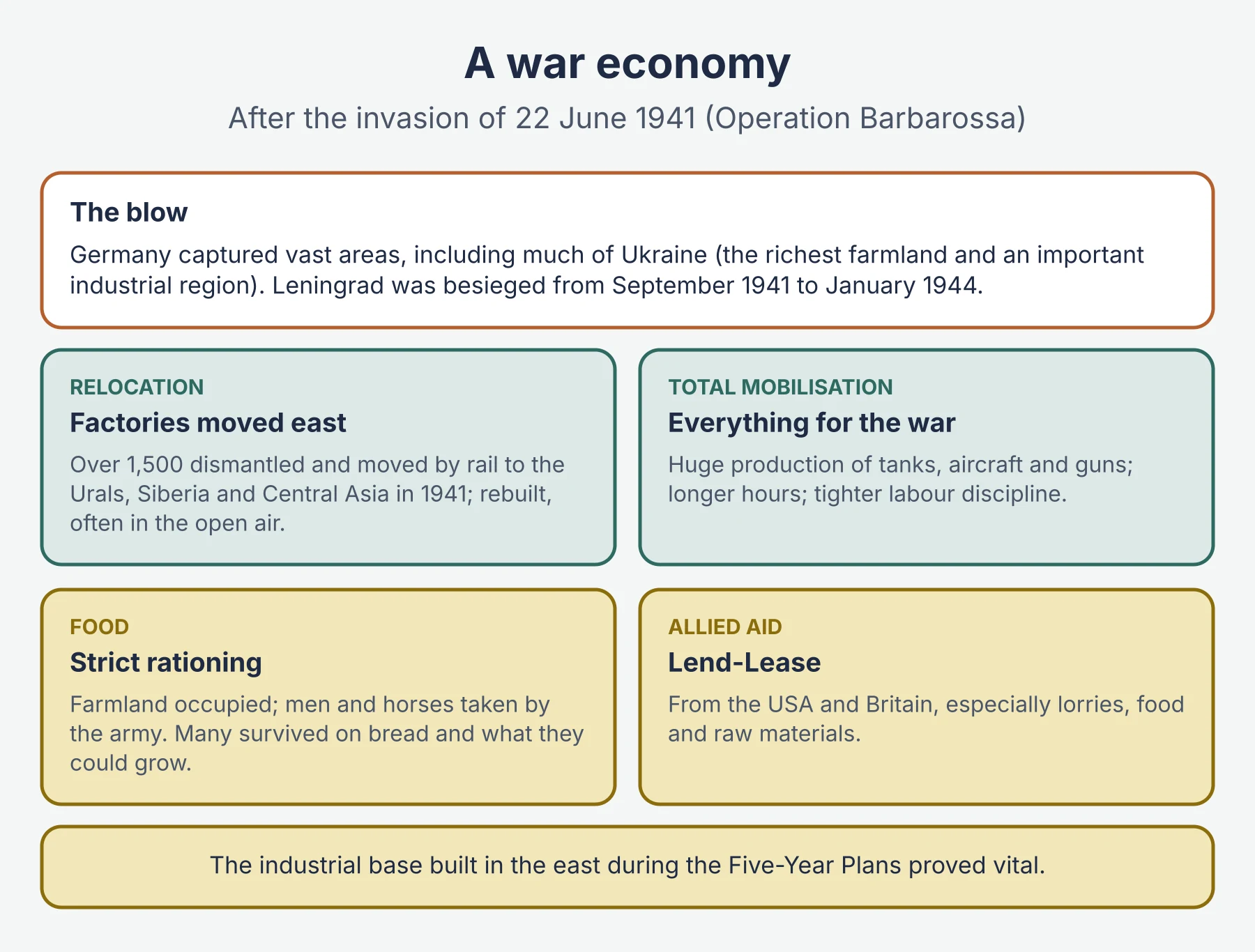
Germany invaded on 22 June 1941 (Operation Barbarossa). In the first months the Germans captured vast areas, including much of Ukraine, the USSR’s richest farmland and an important industrial region, and besieged Leningrad from September 1941 until January 1944.
- Relocation of industry. Over 1,500 factories were dismantled and moved by rail to the Urals, Siberia and Central Asia in 1941, then rebuilt, often in the open air, and restarted. The industrial base built in the east during the Five-Year Plans proved vital.
- Total mobilisation. The economy was turned over to war production; tanks, aircraft and guns were produced in huge numbers. Working hours were lengthened and labour discipline tightened.
- Food. With farmland occupied and men and horses taken by the army, food was strictly rationed. Many people survived on bread and what they could grow.
- Allied aid. Lend-Lease supplies from the USA and Britain, especially lorries, food and raw materials, helped the war effort.
Social problems
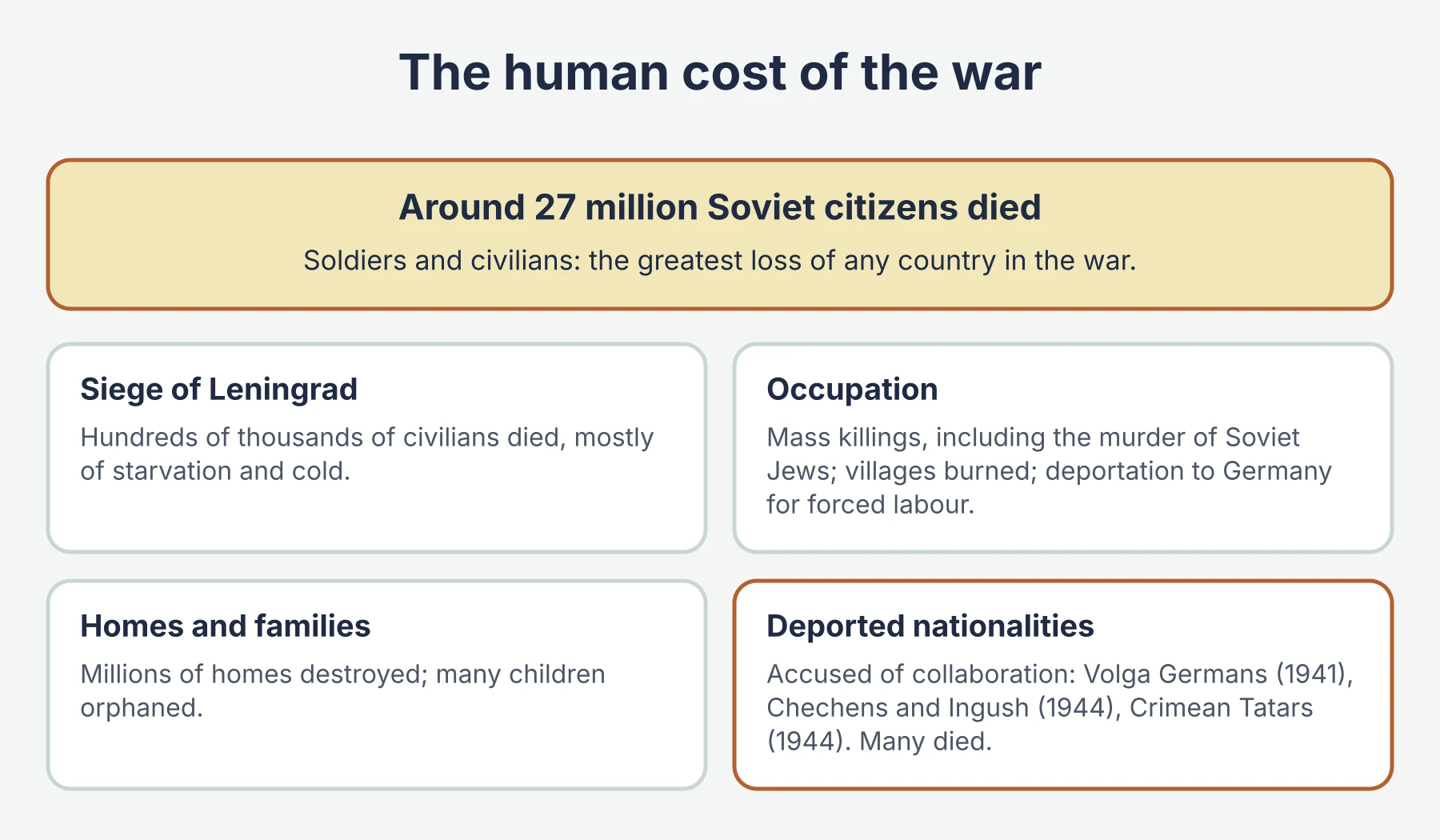
- Loss of life. Around 27 million Soviet citizens died, soldiers and civilians, the greatest loss of any country in the war.
- Leningrad. During the siege hundreds of thousands of civilians died, mostly of starvation and cold.
- Occupation. In occupied areas people suffered mass killings, including the murder of Soviet Jews, the burning of villages and deportation to Germany for forced labour.
- Homelessness and orphans. Millions of homes were destroyed, and many children lost their parents.
- Deportation of nationalities. Stalin accused whole peoples of collaboration: the Volga Germans (1941), the Chechens and Ingush (1944) and the Crimean Tatars (1944) were deported to Central Asia and Siberia, and many died.
Stalin’s wartime leadership
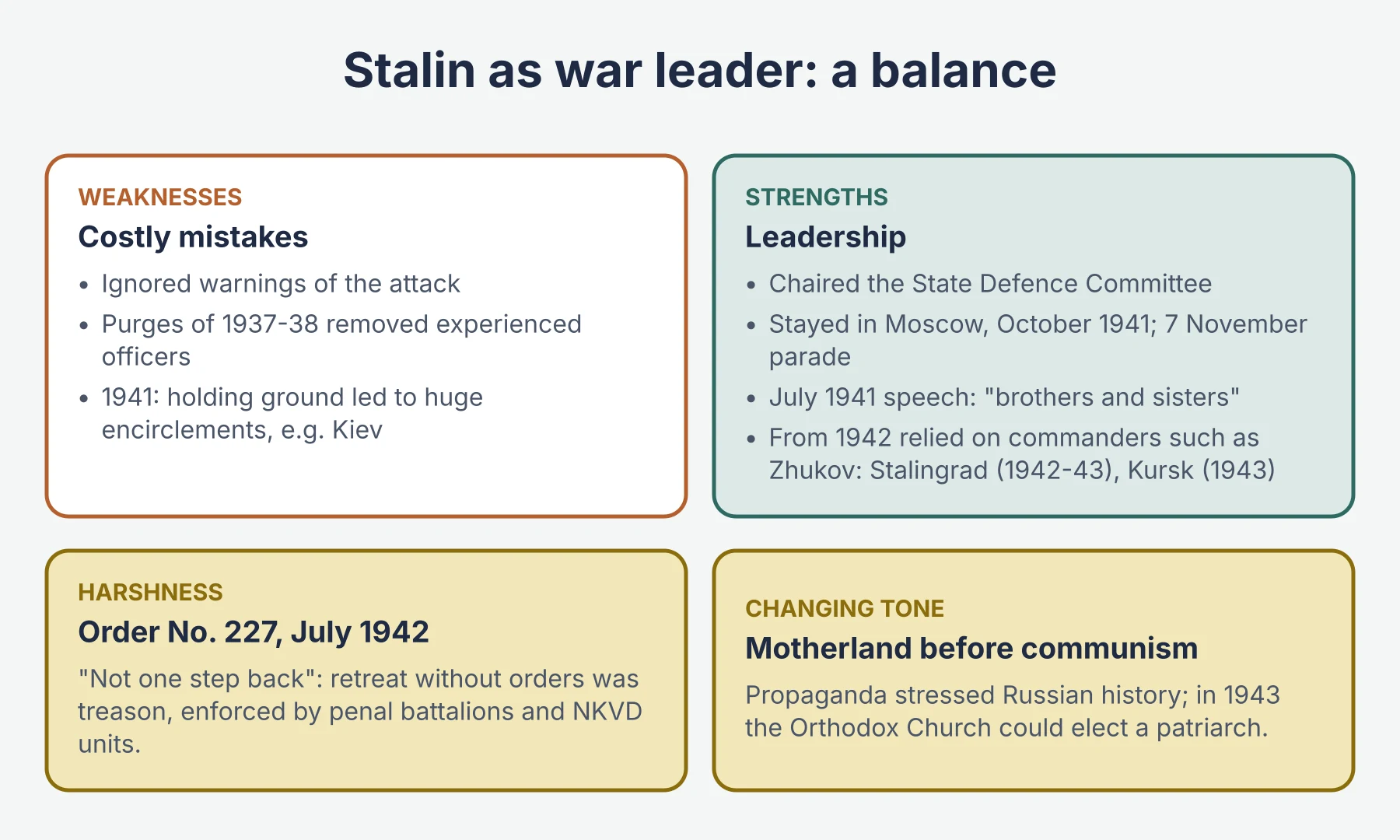
Weaknesses. Stalin ignored warnings of the German attack; the purges of 1937-38 had removed many experienced officers; and in 1941 his insistence on holding ground led to huge encirclements, such as at Kiev, where hundreds of thousands of soldiers were captured.
Strengths. He chaired the State Defence Committee, which controlled the whole war effort. He stayed in Moscow in October 1941 when the Germans approached, and the 7 November parade in Red Square, with troops marching straight to the front, became a symbol of defiance. His speech of July 1941 addressed the people as “brothers and sisters”, appealing to patriotism. From 1942 he relied more on able commanders such as Georgy Zhukov, and the Red Army won at Stalingrad (1942-43) and Kursk (1943).
Harshness. Order No. 227 of July 1942, “Not one step back”, treated retreat without orders as treason; penal battalions and NKVD units behind the lines enforced it.
Changing tone. Propaganda stressed Russian history and the defence of the motherland more than communism; in 1943 the Orthodox Church was allowed to elect a patriarch.
Women in the Great Patriotic War
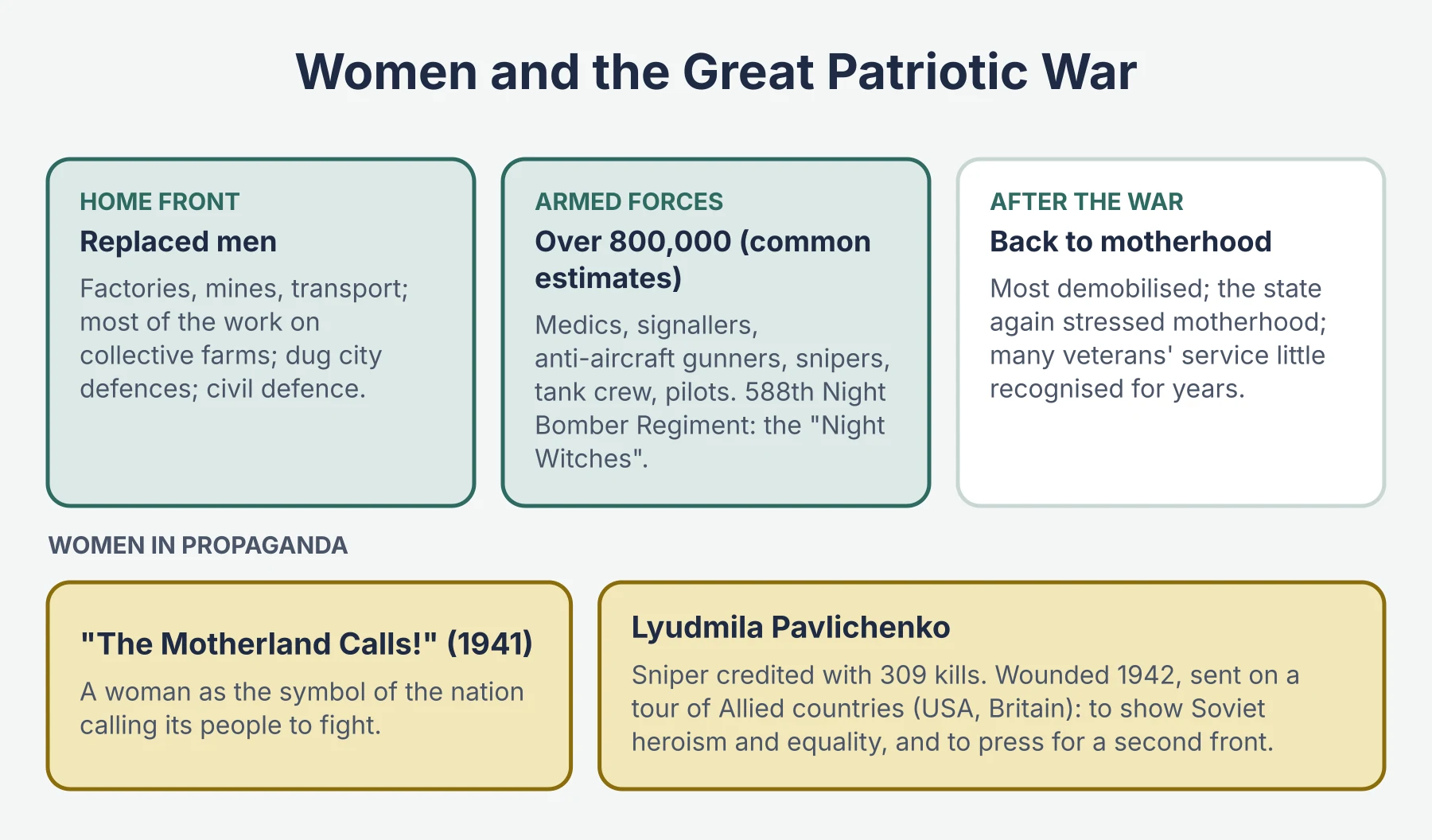
On the home front, women replaced men in factories, mines, transport and on the collective farms, where they did most of the work. They dug defences around cities and served in civil defence.
In the armed forces, hundreds of thousands of women served, by common estimates over 800,000, as medics, signallers, anti-aircraft gunners, snipers, tank crew and pilots. The 588th Night Bomber Regiment, whose all-female crews flew slow biplanes on night raids, became known to the Germans as the “Night Witches”.
Women in propaganda. The poster The Motherland Calls! (1941) presented a woman as the symbol of the nation calling its people to fight. Lyudmila Pavlichenko, a sniper credited with 309 kills, was withdrawn from the front after being wounded in 1942 and sent on a tour of Allied countries, including the USA, where she met Eleanor Roosevelt, and Britain. She was used to show Soviet heroism and equality, and to press the Allies to open a second front.
After the war, most women in the forces were demobilised, and the state again stressed motherhood; many women veterans found their service little recognised for years.
Post-war reconstruction
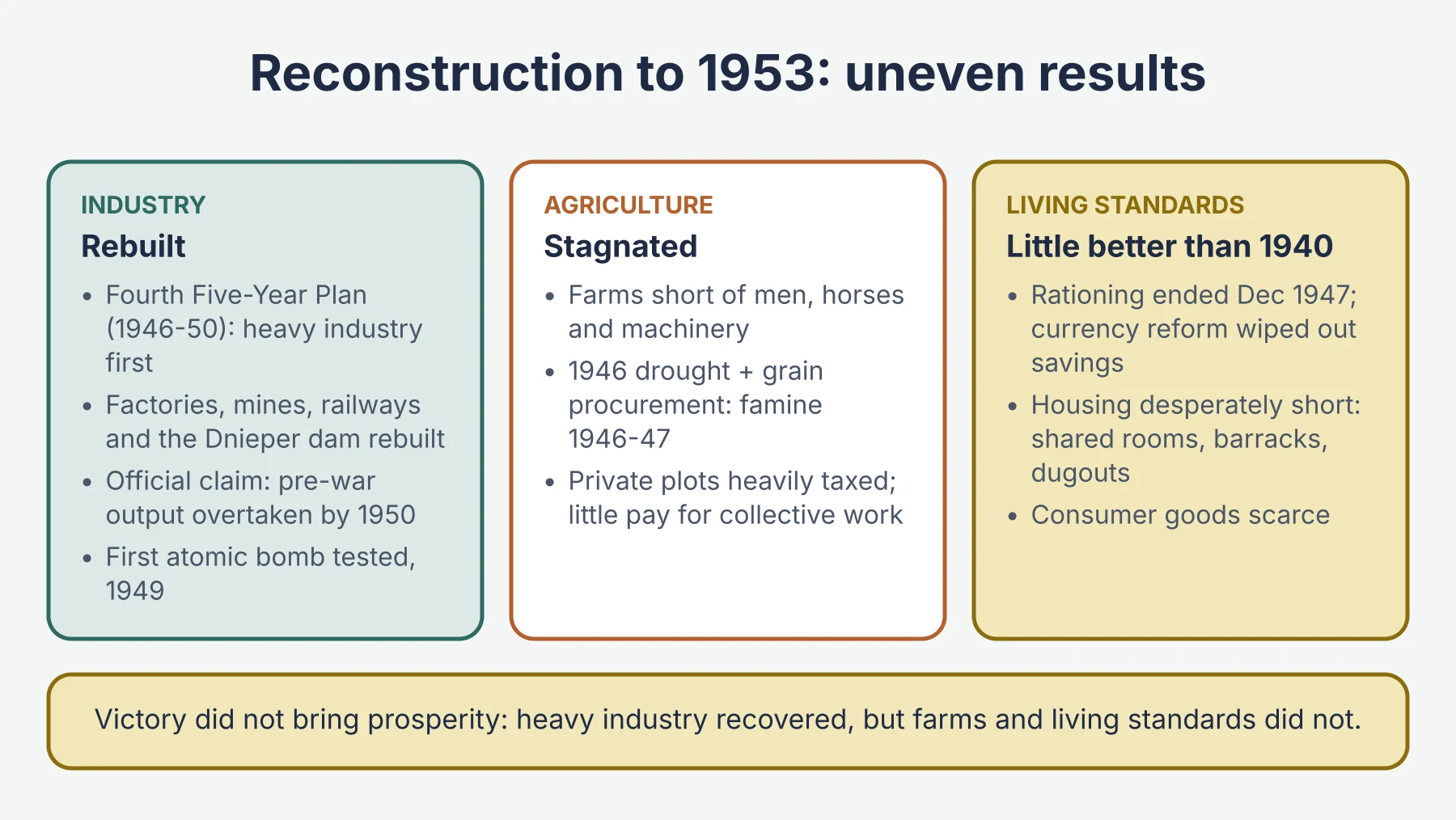
Industry. The Fourth Five-Year Plan (1946-50) again put heavy industry first. Factories, mines, railways and the Dnieper dam were rebuilt, and official figures claimed that industrial output had overtaken pre-war levels by 1950. Resources were also poured into the atomic project: the USSR tested its first atomic bomb in 1949.
Agriculture and stagnation. Collective farms were short of men, horses and machinery. In 1946 drought combined with continued grain procurement caused a famine in 1946-47. Peasants were heavily taxed on their private plots, and collective farmers received little for their work, so agriculture stagnated.
Standard of living by 1953. Rationing ended in December 1947, alongside a currency reform that wiped out many people’s savings. Housing remained desperately short; many families shared rooms in communal flats or lived in barracks and dugouts. Consumer goods were scarce. Living standards for most people were little better than in 1940.
High Stalinism
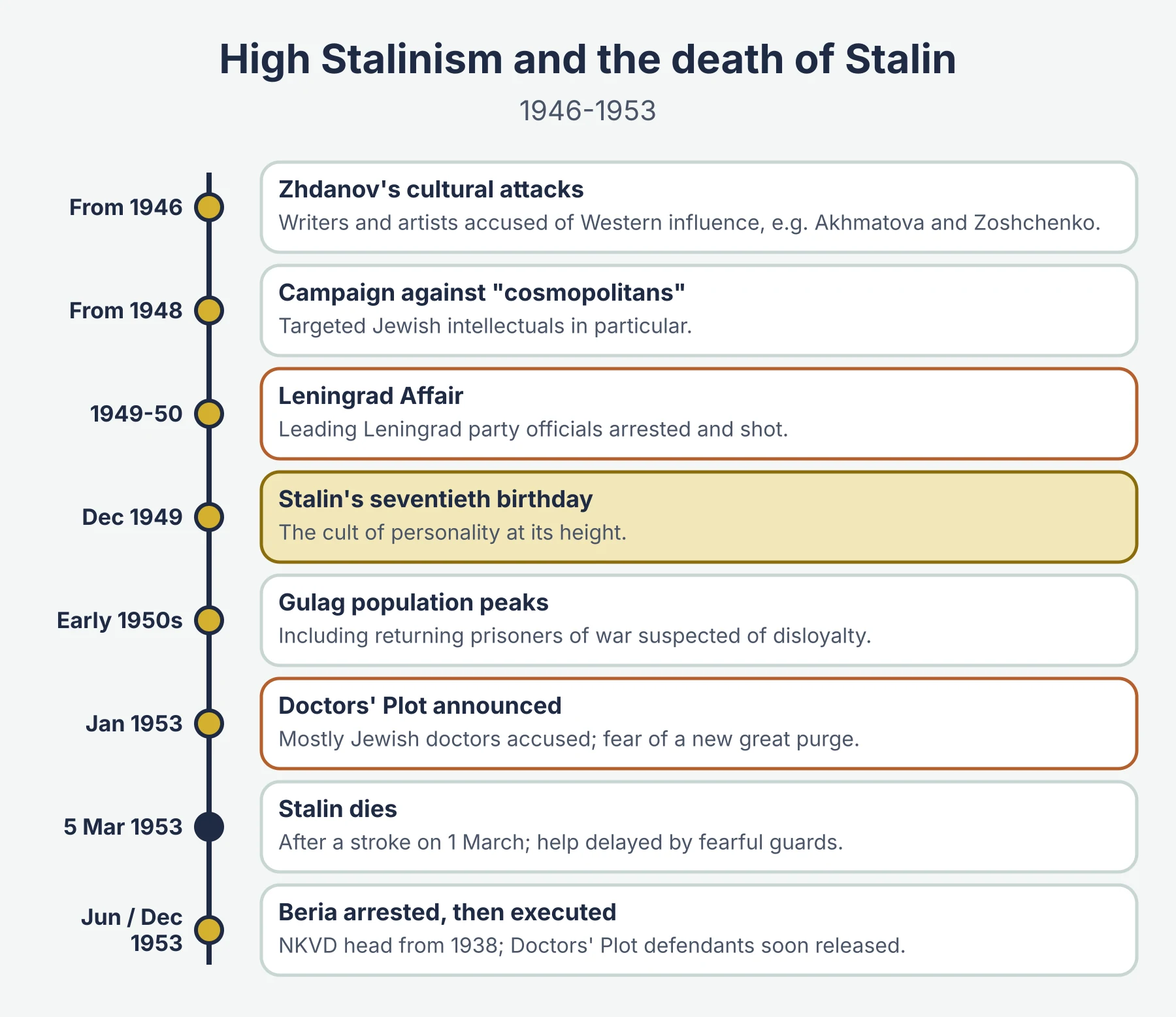
Propaganda and the cult. The victory was presented as Stalin’s personal achievement; the cult of personality reached its height with the celebrations of his seventieth birthday in December 1949.
Cultural control. From 1946 Andrei Zhdanov led attacks on writers and artists accused of Western influence, including the poet Anna Akhmatova and the satirist Mikhail Zoshchenko. A campaign against “cosmopolitans” from 1948 targeted Jewish intellectuals in particular.
Terror and purges. Returning prisoners of war, suspected of disloyalty for having surrendered, were screened, and many were sent to the Gulag, whose population reached its peak in the early 1950s. In the Leningrad Affair (1949-50), leading Leningrad party officials were arrested and shot. In January 1953 the Doctors’ Plot was announced: mostly Jewish doctors were accused of planning to murder Soviet leaders, and many feared a new great purge.
Beria and the NKVD. Lavrentiy Beria had headed the NKVD, the secret police, from 1938. After the war he oversaw the security organs as deputy prime minister and directed the atomic bomb project. He was one of the most feared men in the USSR.
The death of Stalin
Stalin suffered a stroke at his dacha near Moscow on 1 March 1953; his guards, afraid to disturb him, delayed help. He died on 5 March 1953. Millions mourned, and crowds at his lying-in-state were so large that people were crushed to death. His successors soon released the Doctors’ Plot defendants; Beria was arrested in June 1953 and executed in December.
Worked example: a 6-mark answer
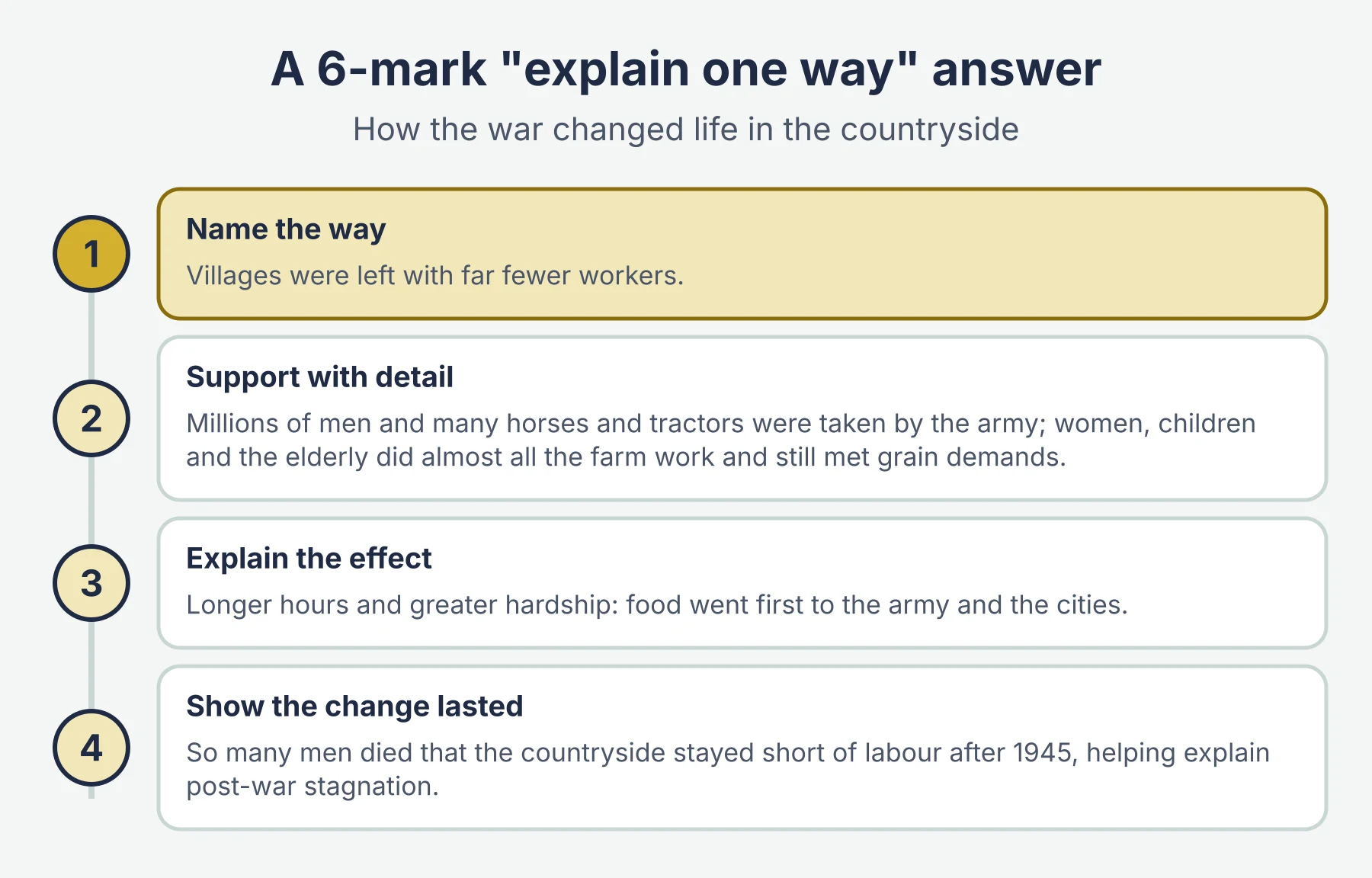
Explain one way in which the Second World War changed the lives of Soviet people living in the countryside. [6]
One way was that villages were left with far fewer workers. Millions of men and many horses and tractors were taken by the army, so women, children and the elderly had to do almost all the work on the collective farms while still meeting the state’s demands for grain. This meant longer hours and greater hardship, as the food they produced went first to the army and the cities. The change lasted beyond 1945: so many men had died that the countryside remained short of labour, which helps explain why agriculture stagnated after the war.
Common mistakes
- Describing battles in detail instead of their effect on people.
- Presenting Stalin’s leadership as wholly good or wholly bad.
- Mentioning Pavlichenko without explaining her use in propaganda.
- Assuming victory brought prosperity: living standards stayed low.
- Forgetting that terror increased again after 1945.
Further practice
- Great Patriotic War and late Stalinism revision notes
- Great Patriotic War and late Stalinism practice questions
- Paper 2 Section A practice
Specification
OxfordAQA International GCSE History (9245) specification, Version 1.1, section 3.2.1.2 – oxfordaqa.com.
Related resources
-
Practice questions
OxfordAQA International GCSE History (9245): The Great Patriotic War and Late Stalinism, 1941-53 – Practice Questions
Twelve original 9245 Paper 2 questions on the USSR 1941-53: wartime problems, Stalin's leadership, women, reconstruction and High Stalinism, with guides.
World History · OxfordAQA · IGCSE
Try questions -
Revision notes
OxfordAQA International GCSE History (9245): The Great Patriotic War and Late Stalinism, 1941-53 – Revision Notes
Revision notes for 9245 Life in the USSR, 1941-53: wartime economy and society, Stalin as war leader, women, reconstruction, High Stalinism and a self-test.
World History · OxfordAQA · IGCSE
Revise topic -
Study guides
OxfordAQA International GCSE History (9245): Life in the USA, 1920-1968
Study guide to Life in the USA, 1920-1968 for 9245 Paper 2 Section A: the 1920s boom, the Depression and New Deal, the Second World War, post-war America and civil rights.
World History · OxfordAQA · IGCSE
Read guide
Get free revision emails (optional)
Occasional emails with practice questions, worked explanations and links to free resources for the qualification and subjects you choose. No spam, and you can unsubscribe from any email. The free tools on this site never need an email.