
Revision Notes
Cambridge International AS & A Level Geography (9696): 6.1 Changes in rural settlements – Revision Notes
Revision notes for Cambridge 9696 Geography 6.1 Changes in rural settlements: key terms, processes, worked examples, exam traps and a self-test with answers.
- Subject
- Geography
- Level
- AS LEVEL
- Topic
- Topic 6 – Settlement dynamics
- Author
- Marlbridge Academic Team
- Updated
- Reviewed by
- Azam Siddique (what this means)
Aligned to Cambridge A Level Geography (9696), 2025-2026. Official specification .
Syllabus page (what it covers and how it is assessed): Cambridge A Level Geography.
Syllabus points this page covers
9696 (AS Level)
- 6.1 Changes in rural settlements
Condensed recall for 6.1 Changes in rural settlements (depopulation, service provision and a required case study). For full explanations, read the Core Human Geography study guide.
Key terms
| Term | Meaning |
|---|---|
| Rural settlement | Village, hamlet or farm outside urban areas |
| Rural depopulation | Fall in rural population, usually through out-migration |
| Counterurbanisation | Movement from cities to rural areas |
| Commuter village | Village whose residents work in a nearby town |
| Service provision | Shops, schools, health, transport, broadband |
| Gentrification | Wealthier incomers raise property prices |
| Nucleated / dispersed / linear | Clustered / scattered / along a route |
| Threshold population | Minimum number of customers a service needs to stay open |
| Second home | A property used for holidays, empty for much of the year |
| Rural-urban fringe | Zone where city and countryside meet, with mixed land uses |
Contrasting contexts
| LIC / MIC | HIC | |
|---|---|---|
| Main trend | Rural-urban migration, depopulation, farmland pressure | Counterurbanisation near cities; depopulation in remote areas |
| Issues | Poor services, low incomes, remittances, ageing left-behind households | Ageing, house prices, service closures, second homes |
In many LICs and MICs the rural population can still be growing in absolute numbers even while young adults leave, because birth rates remain high. Pressure on land then leads to subdivision of farms and farming of marginal land. In HICs the key divide is accessibility: villages within commuting range of a city tend to gain people, while remote upland and island areas tend to lose them.
Cycle of rural decline
Out-migration of young adults, fewer children, school or shop closes, services decline, further out-migration. In accessible areas the reverse can occur: incomers raise demand and prices, which can price out local residents.
The cycle works through threshold population. When population falls below the threshold for a service, it closes, which makes the place less attractive and pushes the population lower still. This is a form of cumulative causation: decline feeds on itself.
Impacts of internal migration and urban growth
The syllabus asks how internal migration and urban growth change rural settlements.
- Out-migration: ageing population, labour shortages on farms, abandoned land and houses, unbalanced sex ratios where men leave first, but also remittances that fund housing and education.
- In-migration (counterurbanisation): rising house prices, new housing estates, more cars and commuting, a rise in demand for some services but often fewer that serve everyday local needs, since incomers shop and work in town.
- Urban growth at the edge: farmland lost to housing, roads and industry; villages absorbed into the city; higher land values; informal settlements on the fringe of cities in LICs and MICs.
Service provision
| Service | Why it declines | Possible response |
|---|---|---|
| School | Too few children; cost per pupil rises | Merging schools; school transport |
| Shop and post office | Car owners shop in town; online shopping | Community-owned shop; mobile shop |
| Bus | Low demand, high cost per passenger | Demand-responsive or community transport |
| Health care | Difficult to recruit staff | Mobile clinics, telemedicine |
| Broadband | High cost of reaching scattered homes | Public subsidy for rural networks |
Responses
Affordable housing, community-run shops and transport, broadband, rural business support, planning policy to protect services, and development of tourism with careful limits. Evaluate: schemes can be costly, depend on volunteers and may not reverse population loss.
In LICs and MICs, responses include rural electrification, roads to markets, micro-credit, irrigation and land reform, and better rural schools and clinics, which aim to reduce the push factors behind out-migration.
Required case study
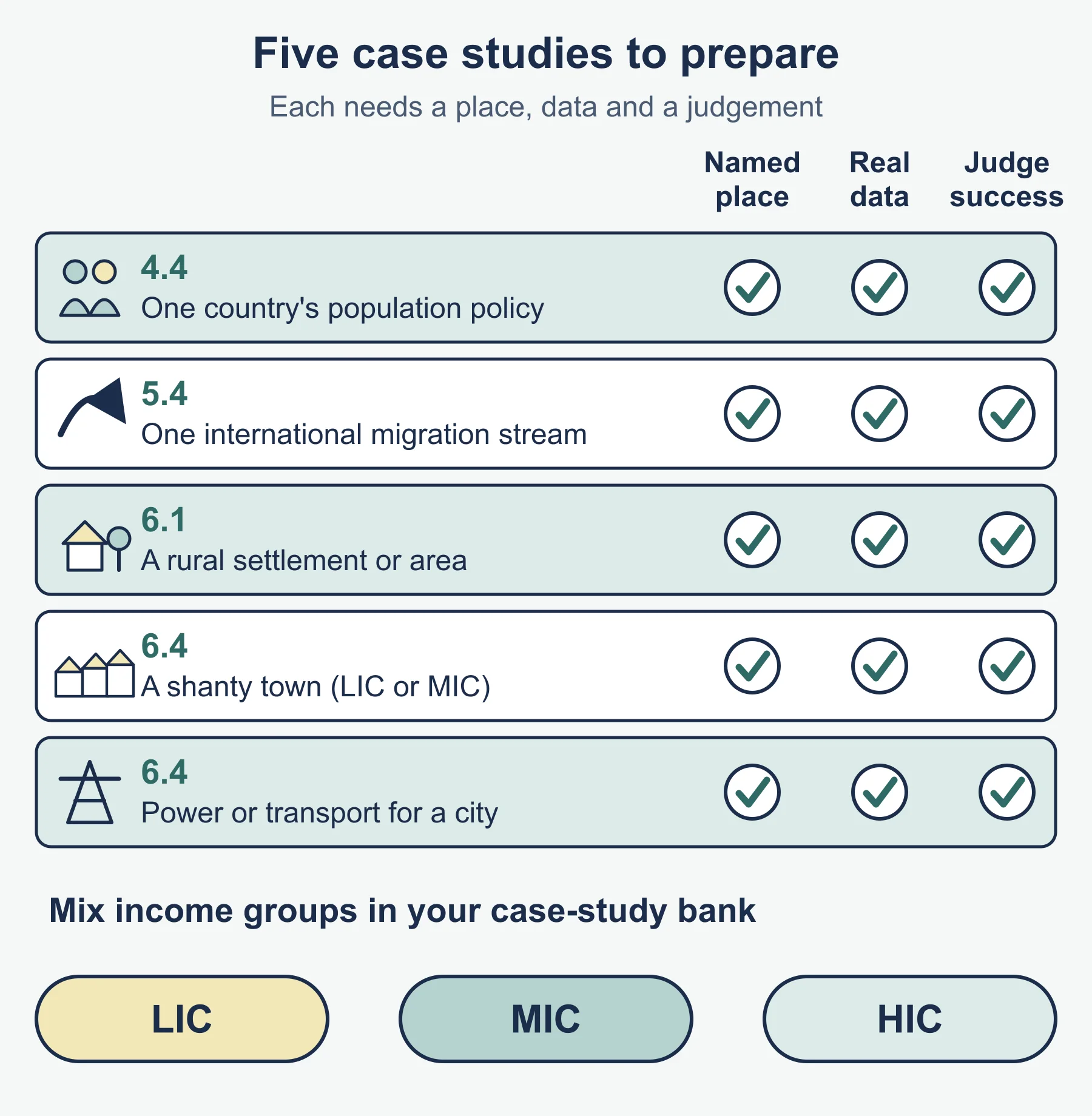
The syllabus requires a case study of a rural settlement or area. Cover: location, recent population and economic change, causes (migration, urban growth), impacts on people and services, and responses with an evaluation. Use only facts you have checked.
Worked case study outline: rural depopulation in Japan
Japan is a well-documented HIC example of rural decline. Many rural and mountain municipalities have lost population for decades as young people moved to Tokyo, Osaka and other cities, while the national birth rate fell.
- Change: an ageing population and falling numbers; many schools have closed or merged; abandoned houses (akiya) and farmland; some villages described as “marginal settlements”, where over half the residents are aged 65 or over and community life is hard to sustain.
- Causes: few jobs beyond small-scale farming and forestry; better-paid work and education in cities; low national fertility, so fewer children to replace those who leave.
- Impacts: services lose their threshold; public transport and shops close; older residents struggle to reach health care; festivals and local traditions lapse; land and forests are left unmanaged.
- Responses: the national government’s regional revitalisation policy from 2014; the “hometown tax” (furusato nozei), which lets people send part of their tax to a municipality of their choice; schemes placing young urban volunteers in rural areas; and local projects such as Kamiyama in Tokushima Prefecture, which used fast broadband to attract satellite offices of city-based firms and creative workers.
- Evaluation: projects like Kamiyama attracted new residents and businesses and raised the town’s profile, but in-migration was small compared with the scale of national rural decline, and overall population in many areas keeps falling. Success depended on local leadership and infrastructure, so it is hard to copy everywhere.
A contrasting LIC or MIC case, such as villages in inland China that lost young workers to coastal cities, shows remittances and new houses alongside “left-behind” children and older people.
Annotated model paragraph
“Evaluate responses to the decline of rural services in one area.”
In Kamiyama, broadband attracted firms and new residents (success). However, the numbers moving in were small compared with national rural loss (limitation). The scheme relied on strong local organisation (condition for success). So responses can slow decline in some places but rarely reverse it (judgement).
Exam traps
- Distinguish depopulation (loss) from counterurbanisation (gain).
- Do not claim all rural areas decline: accessibility matters.
- Impacts differ for long-standing residents and newcomers.
- Population growth from counterurbanisation does not guarantee better services; incomers may use urban ones.
- Name the place and give its context (LIC, MIC or HIC); a generic “village” earns little credit.
Self-test
- Define rural depopulation.
- What is a commuter village?
- Why might house prices rise in accessible rural areas?
- Give one response to service decline.
- Name three rural settlement patterns.
- Why does rural-urban migration cause ageing?
- What is a threshold population?
- Explain how the cycle of rural decline is self-reinforcing.
- Why can rural population still grow in an LIC despite out-migration?
- What is a “marginal settlement” in the Japanese case?
- Give one strength and one limitation of the Kamiyama approach.
Answers: 1. Loss of rural population, usually by out-migration. 2. A village whose residents work in a nearby town or city. 3. Incomers with higher incomes increase demand. 4. Community-run shops, rural transport, broadband or affordable housing. 5. Nucleated, dispersed, linear. 6. Young adults leave, so a larger share of those remaining are old. 7. The minimum number of customers needed to keep a service open. 8. Population loss pushes services below threshold, closures make the area less attractive, so more people leave. 9. High birth rates can outweigh out-migration. 10. A village where over half the residents are 65 or older and community life is hard to sustain. 11. Strength: attracted firms and residents through broadband. Limitation: small numbers, hard to copy without local leadership.
More resources on this topic
Related resources
-
Revision notes
Cambridge International AS & A Level Geography (9696): 6.3 The changing structure of urban settlements – Revision Notes
Revision notes for Cambridge 9696 Geography 6.3 The changing structure of urban settlements: key terms, processes, exam traps and a self-test with answers.
Geography · Cambridge · AS Level
Revise topic -
Revision notes
Cambridge International AS & A Level Geography (9696): 6.4 The management of urban settlements – Revision Notes
Revision notes for Cambridge 9696 Geography 6.4 The management of urban settlements: key terms, processes, exam traps and a self-test with answers.
Geography · Cambridge · AS Level
Revise topic -
Revision notes
Cambridge International AS & A Level Geography (9696): 6.2 Urban trends and issues of urbanisation – Revision Notes
Revision notes for Cambridge 9696 Geography 6.2 Urban trends and issues of urbanisation: key terms, processes, exam traps and a self-test with answers.
Geography · Cambridge · AS Level
Revise topic
Studying Geography?
This page is free and stays free. Marlbridge is not offering Geography classes at the moment, so there is no tuition to book for it. The free study resources stay open to everyone.
Get free revision emails (optional)
Occasional emails with practice questions, worked explanations and links to free resources for the qualification and subjects you choose. No spam, and you can unsubscribe from any email. The free tools on this site never need an email.