
Revision Notes
Cambridge International AS & A Level Geography (9696): 5.2 Internal migration (within a country) – Revision Notes
Revision notes for Cambridge 9696 Geography 5.2 Internal migration (within a country): key terms, processes, exam traps and a self-test with answers.
- Subject
- Geography
- Level
- AS LEVEL
- Topic
- Topic 5 – Migration
- Author
- Marlbridge Academic Team
- Updated
- Reviewed by
- Azam Siddique (what this means)
Aligned to Cambridge A Level Geography (9696), 2025-2026. Official specification .
Syllabus page (what it covers and how it is assessed): Cambridge A Level Geography.
Syllabus points this page covers
9696 (AS Level)
- 5.2 Internal migration (within a country)
Condensed recall for 5.2 Internal migration (within a country). For full explanations, read the Core Human Geography study guide.
Key terms
| Term | Meaning |
|---|---|
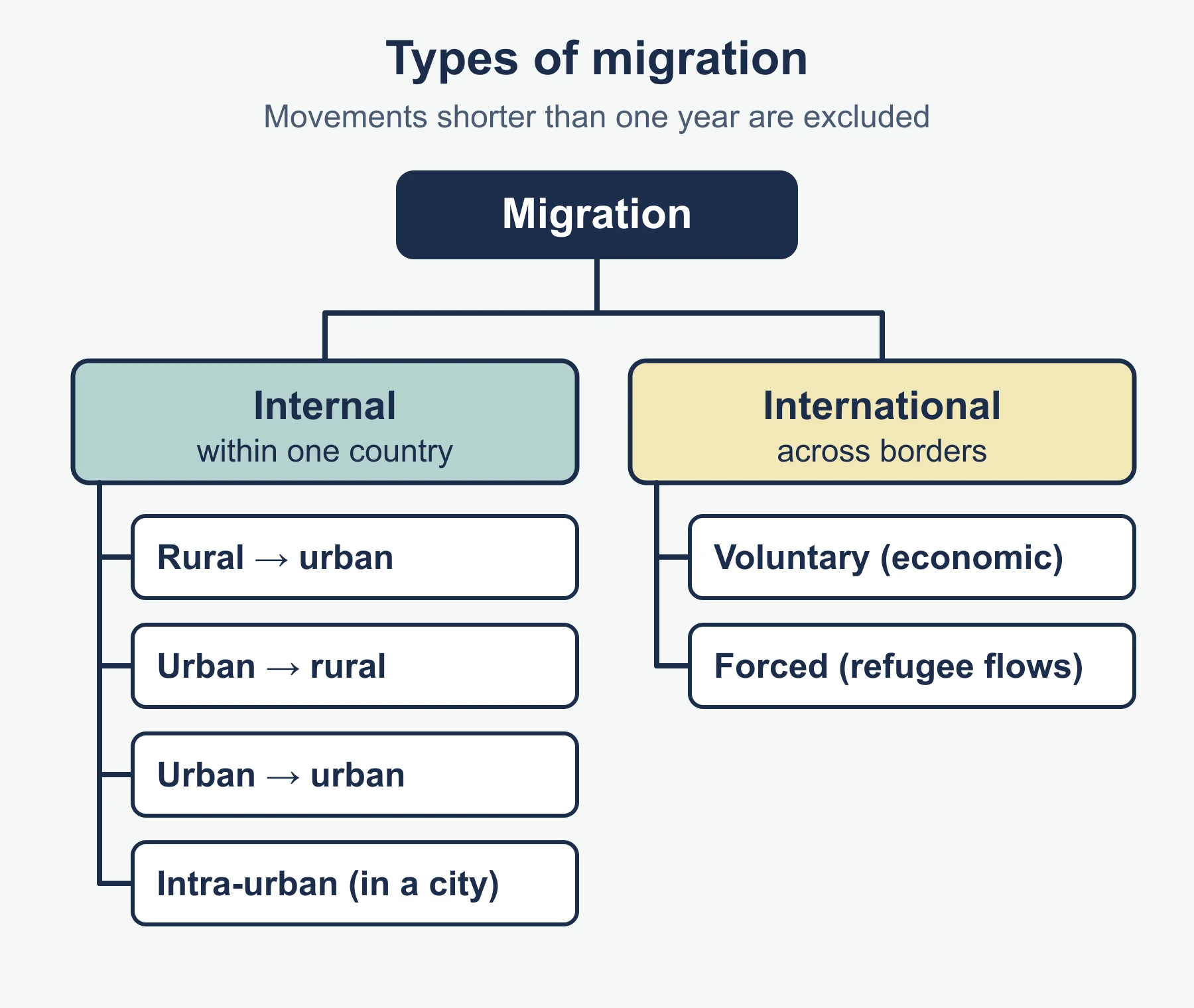
| Internal migration | Movement within one country |
| Rural-urban migration | Countryside to town or city |
| Urban-rural migration | City to countryside (counterurbanisation) |
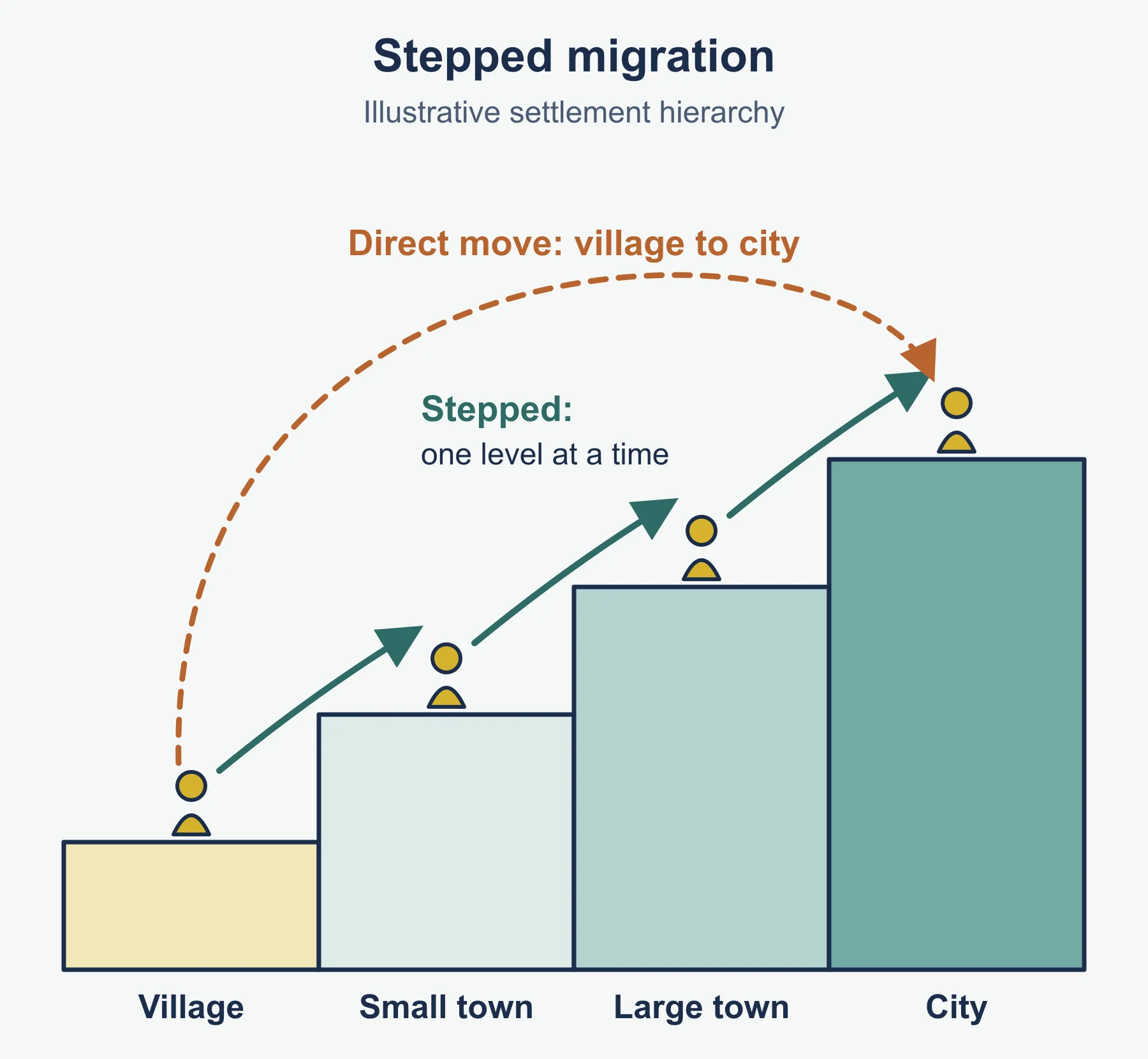
| Stepped migration | Moving up the settlement hierarchy in stages, such as village, town, city |
| Urban-urban migration | Between towns and cities |
| Intra-urban movement | Within a city, for example centre to suburbs |
| Remittances | Money sent home by migrants |
| Settlement hierarchy | Ranking of settlements by size and number of services |
| Circular migration | Repeated moves between home area and city, for example seasonal work |
| Return migration | Migrants going back to their place of origin |
Rural-urban migration: causes
- Push: shortage of jobs, low farm income, land shortage, mechanisation, poor services, drought or conflict.
- Pull: jobs and higher wages, education and health care, perceived opportunities, links with earlier migrants.
- Most common in LICs and MICs, where urban growth is rapid.
Why perception matters: migrants often move on what they believe the city offers. Many arrive to find only informal work and housing, but still stay because even an uncertain urban income can be higher than rural earnings, and because family at home depends on remittances.
Example: rural-urban migration in China
China’s economic reforms from 1978 created huge demand for factory and construction labour in coastal cities. Shenzhen, made a Special Economic Zone in 1980, grew from a small border town into one of the country’s largest cities, largely through in-migration. The hukou (household registration) system tied access to housing, schools and health care to a person’s registered home, so many migrants lived in cities without full access to urban services. Millions of children stayed in villages with grandparents as “left-behind children”, a clear impact on the source area. Gradual reforms have eased hukou rules, especially in smaller cities.
Stepped migration
Migrants move up the hierarchy in stages: hamlet or village to a small town, then to a regional city, then to the capital or a major city. Each move builds savings, skills and contacts that make the next possible. Stepped migration helps explain why small towns in LICs and MICs often grow quickly as well as megacities.
Impacts
| Area | Positive | Negative |
|---|---|---|
| Source (rural) | Remittances, less pressure on land | Loss of young adults, ageing population, labour shortages, closing services |
| Destination (urban) | Labour supply, economic growth, diversity | Pressure on housing, jobs, water and transport; informal settlements; pollution |
Impacts are uneven within each area. In the source area, remittances may pay for school fees, better housing or a tractor, but households without a migrant gain nothing and may struggle to find farm labour. Because young men often move first, sex ratios in villages can become unbalanced and women take on more farm work. In the destination, employers gain cheap labour while low-paid residents may face competition for jobs and housing.
Urban-rural and other flows
Counterurbanisation: people leave large cities for quality of life, lower housing costs, remote working or retirement. Effects on rural destinations are covered in 6.1. Urban-urban and intra-urban moves reflect changing life stage, housing and jobs; they shape suburbs and inner city areas.
| Flow | Typical movers | Main reasons | Typical effect |
|---|---|---|---|
| Urban-rural | Families, retirees, remote workers | Space, cheaper housing, environment | Rising house prices and commuting in villages |
| Urban-urban | Graduates and skilled workers | Jobs, promotion, education | Growth of leading cities; decline of some industrial towns |
| Intra-urban (outwards) | Families | Larger homes and gardens, schools | Suburban growth, longer commutes |
| Intra-urban (inwards) | Young single adults, students | Nightlife, jobs, short commutes | City-centre apartments, gentrification |
Life-cycle stage is a useful way to explain these flows: young adults move towards central areas, families move outwards, and some older people move to the coast or countryside on retirement.
Interpreting internal migration data
- On a flow-line map, line width shows the size of each flow; identify the main corridors and look for the smaller counter-streams that Ravenstein predicted.
- Net internal migration for a region is arrivals from other regions minus departures to them. A city can gain young adults from rural areas while losing families to places beyond its boundary, so its net figure hides two opposite flows.
- Check the boundary used. If a city is defined by its official limits, it may appear to lose population when growth has simply spread past the edge into suburbs that are counted separately.
Annotated model paragraph
“Explain the impacts of rural-urban migration on source areas.”
Rural-urban migration is age-selective, so young adults leave (process). This leaves an ageing population and fewer workers for farming (demographic and economic impact). However, remittances can raise household incomes and fund education (positive impact). The balance depends on whether migrants keep links with home (qualification).
Exam traps
- Stepped migration is an up-the-hierarchy process, not simply “migration to a town”.
- Rural-urban migration is not the same as urbanisation; it is one cause of it.
- Give impacts for both the source and the destination.
- Counterurbanisation is internal movement, not emigration.
- “Internal” means within one country, so a move from one province to another is internal migration.
- Avoid saying all migrants end up in shanty towns: many find formal work and housing.
Self-test
- What is stepped migration?
- Give two rural push factors.
- Name one effect on the source area.
- What are remittances?
- Give an effect on city destinations.
- Define counterurbanisation.
- What is the hukou system and why does it matter to migrants?
- What is circular migration?
- Why do young adults tend to move towards city centres?
- Why can rural-urban migration change the sex ratio of villages?
- Name the four internal flows the syllabus lists.
Answers: 1. Moving up the settlement hierarchy in stages. 2. Unemployment, low farm incomes, poor services, land shortage. 3. Loss of young adults or an ageing population. 4. Money sent home by migrants. 5. Pressure on housing and services or growth of informal settlements. 6. Movement from large cities to smaller towns and rural areas. 7. China’s household registration system; it links access to services to a registered home, so migrants may lack urban services. 8. Repeated moves between home and city, such as seasonal work. 9. Jobs, education, nightlife and short commutes suit their life stage. 10. Young men often migrate first, leaving more women and older people. 11. Rural-urban, urban-rural, urban-urban and intra-urban.
More resources on this topic
Related resources
-
Revision notes
Cambridge International AS & A Level Geography (9696): 5.3 International migration – Revision Notes
Revision notes for Cambridge 9696 Geography 5.3 International migration: key terms, processes, worked examples, exam traps and a self-test with answers.
Geography · Cambridge · AS Level
Revise topic -
Revision notes
Cambridge International AS & A Level Geography (9696): 5.4 The management of international migration – Revision Notes
Revision notes for Cambridge 9696 Geography 5.4 The management of international migration: key terms, processes, exam traps and a self-test with answers.
Geography · Cambridge · AS Level
Revise topic -
Revision notes
Cambridge International AS & A Level Geography (9696): 5.1 Migration as a component of population change – Revision Notes
Revision notes for Cambridge 9696 Geography 5.1 Migration as a component of population change: key terms, processes, exam traps and a self-test with answers.
Geography · Cambridge · AS Level
Revise topic
Studying Geography?
This page is free and stays free. Marlbridge is not offering Geography classes at the moment, so there is no tuition to book for it. The free study resources stay open to everyone.
Get free revision emails (optional)
Occasional emails with practice questions, worked explanations and links to free resources for the qualification and subjects you choose. No spam, and you can unsubscribe from any email. The free tools on this site never need an email.