
Revision Notes
Cambridge International AS & A Level Geography (9696): 3.1 Plate tectonics – Revision Notes
Revision notes for Cambridge 9696 Geography 3.1 Plate tectonics: key terms, processes, worked examples, exam traps and a self-test with answers.
- Subject
- Geography
- Level
- AS LEVEL
- Topic
- Topic 3 – Rocks and weathering
- Author
- Marlbridge Academic Team
- Updated
- Reviewed by
- Azam Siddique (what this means)
Aligned to Cambridge A Level Geography (9696), 2025-2026. Official specification .
Syllabus page (what it covers and how it is assessed): Cambridge A Level Geography.
Syllabus points this page covers
9696 (AS Level)
- 3.1 Plate tectonics
Condensed recall for 3.1 Plate tectonics (plates, boundary types and associated landforms). For full explanations, read the Core Physical Geography study guide.
Key terms
| Term | Meaning |
|---|---|
| Lithosphere | Crust plus the rigid uppermost mantle, broken into plates |
| Asthenosphere | Weaker, partly molten mantle layer on which plates move |
| Oceanic crust | Thin, dense, basaltic |
| Continental crust | Thicker, less dense, granitic |
| Sea floor spreading | New oceanic crust formed at ocean ridges as plates diverge |
| Subduction | Denser plate sinks beneath another at a convergent boundary |
| Island arc | Curved chain of volcanoes above a subduction zone |
| Benioff zone | Sloping zone of earthquakes along the subducting plate |
| Rift valley | Valley formed where crust is stretched and blocks drop between parallel faults |
| Hotspot | Fixed plume of hot mantle that melts the plate above it |
| Palaeomagnetism | The record of the Earth’s past magnetic field locked into rocks |
Layers
Crust, mantle, liquid outer core, solid inner core. Plates move a few centimetres a year. Driving mechanisms: mantle convection, ridge push and slab pull.
- Mantle convection: heat from the core and from radioactive decay drives slow convection currents in the mantle that were long thought to drag plates along.
- Ridge push: new lithosphere at ridges is hot and elevated; as it cools it becomes denser and slides away from the ridge under gravity.
- Slab pull: the cold, dense edge of a subducting plate sinks into the mantle and pulls the rest of the plate behind it. Many geologists now see slab pull as the strongest force, which is why plates with long subducting edges tend to move fastest.
Boundary types
| Boundary | Movement | Processes and landforms |
|---|---|---|
| Divergent (constructive) | Plates move apart | Magma rises; sea floor spreading; ocean ridges, rift valleys; basaltic volcanoes; shallow earthquakes |
| Convergent: ocean-continent | Oceanic plate subducts | Ocean trench; fold mountains and volcanoes on the continent; deep earthquakes |
| Convergent: ocean-ocean | One oceanic plate subducts | Trench and volcanic island arc |
| Convergent: continent-continent (collision) | Neither subducts easily | Crust folded and uplifted into fold mountains; earthquakes |
| Conservative | Plates slide past each other | Friction builds then releases as earthquakes; no volcanoes; landforms are offset along the fault |
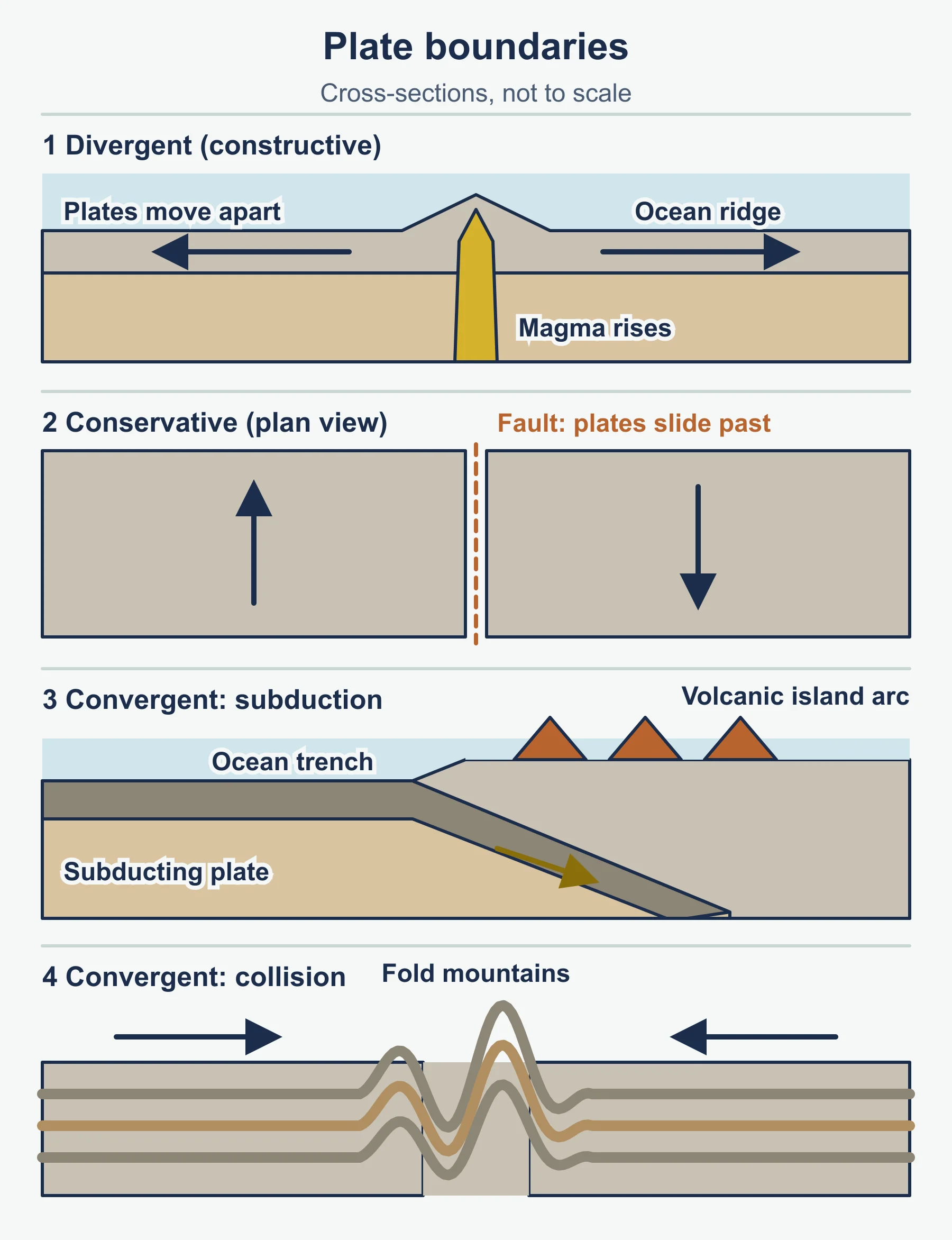
Named examples
| Boundary | Example |
|---|---|
| Divergent, oceanic | Mid-Atlantic Ridge, with Iceland as a section raised above sea level |
| Divergent, continental | East African Rift Valley |
| Ocean-continent | Nazca Plate beneath the South American Plate: Peru-Chile Trench and the Andes |
| Ocean-ocean | Pacific Plate beneath the Philippine Sea Plate: Mariana Trench and the Mariana island arc; also Japan and the Aleutians |
| Collision | Indian Plate meeting the Eurasian Plate: Himalayas and Tibetan Plateau |
| Conservative | San Andreas Fault in California (Pacific and North American Plates) |
| Hotspot | Hawaiian Islands, in the middle of the Pacific Plate |
Processes explained
Sea floor spreading: at an ocean ridge, plates pull apart and pressure falls in the hot mantle below, so it partly melts. Basaltic magma rises, erupts or cools in the gap, and forms new oceanic crust. The ridge stands high because the new rock is hot and buoyant; it is cut by transform faults, which offset sections of the ridge.
Subduction and volcanic activity: oceanic lithosphere is denser, so it sinks beneath the less dense plate and forms a trench. As the slab descends, water released from its minerals lowers the melting point of the mantle above, producing magma. This magma is more viscous and gas-rich than ridge basalt, so eruptions tend to be explosive and build steep composite volcanoes.
Fold mountains: at ocean-continent boundaries, sediments scraped off the subducting plate and the edge of the continent are compressed and uplifted. In collision zones, continental crust is too buoyant to subduct, so it crumples, thickens and rises, which is why the Himalayas are still rising and have frequent earthquakes but little volcanic activity.
Hotspots: a plate moves over a fixed plume, so a chain of volcanoes forms, with the oldest furthest from the plume. In Hawaii the active volcanoes are at the south-east end of the chain.
Pattern
Earthquakes and volcanoes cluster along plate boundaries; the Pacific margins are heavily affected. Some volcanic activity occurs away from boundaries over hotspots.
The ring of subduction zones around the Pacific is known as the Pacific Ring of Fire. Earthquake depth is a clue to the boundary type: shallow at ridges and conservative faults, but shallow to deep along the Benioff zone of a subducting plate.
Evidence for plate movement
Jigsaw fit of continents, matching rocks and fossils across oceans, sea-floor age increasing away from ridges, magnetic stripes (paleomagnetism), and the distribution of earthquakes and volcanoes.
- Continental drift was proposed by Alfred Wegener in the early twentieth century, using fit, fossils and rock matches, but he could not explain the mechanism.
- Sea floor spreading was proposed by Harry Hess in the early 1960s.
- Magnetic stripes: the Earth’s magnetic field reverses from time to time. Basalt cooling at a ridge records the field at that time, so stripes of normal and reversed magnetism form a matching pattern on each side of the ridge, as described by Vine and Matthews in 1963.
Annotated model paragraph
“Explain the formation of an island arc.”
Where two oceanic plates converge, the older, colder, denser plate subducts and a trench forms (process). Water released from the sinking slab lowers the melting point of the mantle above (melting). Magma rises to erupt as a curved chain of volcanoes parallel to the trench (landform), such as the Mariana Islands (example).
Exam traps
- Plates are lithosphere, not just crust.
- Oceanic plate is denser and so subducts beneath continental.
- Conservative boundaries produce earthquakes but not volcanoes.
- “Constructive” and “divergent” are the same; “destructive” and “convergent” are the same, but collision zones do not destroy crust in the same way.
- Magma at subduction zones comes from melting of the mantle above the slab, helped by water, not simply from the slab “melting by friction”.
- Hotspots are not plate boundaries; do not use Hawaii as an example of subduction.
Self-test
- What is the lithosphere?
- Name two mechanisms moving plates.
- What forms at an ocean-ocean convergent boundary?
- Why is there no volcanic activity at a conservative boundary?
- Give one piece of evidence for sea floor spreading.
- What landform results from continental collision?
- Explain slab pull.
- Why do subduction zone volcanoes tend to erupt explosively?
- Name an example of a continental divergent boundary.
- What is the Benioff zone?
- How does a hotspot produce a chain of islands?
- Why do the Himalayas have earthquakes but few volcanoes?
Answers: 1. The crust and rigid upper mantle, divided into plates. 2. Slab pull, ridge push or mantle convection. 3. An ocean trench and a volcanic island arc. 4. No magma source: plates slide past without subduction or divergence. 5. Age of ocean floor increasing away from ridges, or magnetic stripes. 6. Fold mountains. 7. The cold, dense edge of a subducting plate sinks and pulls the plate after it. 8. Their magma is viscous and gas-rich. 9. The East African Rift Valley. 10. The sloping zone of earthquakes along a subducting plate. 11. The plate moves over a fixed plume, so new volcanoes form while older ones are carried away. 12. Continental crust is too buoyant to subduct, so there is compression but little melting.
More resources on this topic
Related resources
-
Revision notes
Cambridge International AS & A Level Geography (9696): 3.3 Slope processes – Revision Notes
Revision notes for Cambridge 9696 Geography 3.3 Slope processes: key terms, processes, worked examples, exam traps and a self-test with answers.
Geography · Cambridge · AS Level
Revise topic -
Revision notes
Cambridge International AS & A Level Geography (9696): 3.4 The human impact – Revision Notes
Revision notes for Cambridge 9696 Geography 3.4 The human impact: key terms, processes, worked examples, exam traps and a self-test with answers.
Geography · Cambridge · AS Level
Revise topic -
Revision notes
Cambridge International AS & A Level Geography (9696): 3.2 Weathering – Revision Notes
Revision notes for Cambridge 9696 Geography 3.2 Weathering: key terms, processes, worked examples, exam traps and a self-test with answers.
Geography · Cambridge · AS Level
Revise topic
Studying Geography?
This page is free and stays free. Marlbridge is not offering Geography classes at the moment, so there is no tuition to book for it. The free study resources stay open to everyone.
Get free revision emails (optional)
Occasional emails with practice questions, worked explanations and links to free resources for the qualification and subjects you choose. No spam, and you can unsubscribe from any email. The free tools on this site never need an email.