
Revision Notes
AQA A-Level Business: Analysing the strategic position of a business (7132) – Revision Notes
Condensed AQA A-Level Business 7132 revision notes on topic 7: formulas, models, definitions and a self-test covering all eight sections.
- Subject
- Business
- Level
- A LEVELS
- Topic
- Analysing the strategic position of a business
- Author
- Marlbridge Academic Team
- Updated
- Reviewed by
- Salman Ahmad (what this means)
Aligned to AQA A Level Business (7132), For first teaching from September 2023. Official specification .
Syllabus page (what it covers and how it is assessed): AQA A Level Business.
Syllabus points this page covers
7132
- 7 Analysing the strategic position of a business (whole topic)
Found an error? Report a correction.
Need help with this topic? Request a free trial class for A Level Business (7132).
These notes condense topic 3.7, Analysing the strategic position of a business (A-level only), from the AQA AS and A-level Business specification (7131 and 7132). For full explanations and worked examples, read the study guide, then test yourself with the practice questions. Course hub: AQA A-level Business. Checklist: printable checklist. Find your weak spots with a free diagnostic.
3.7.1 Mission, objectives and strategy
| Term | Meaning |
|---|---|
| Mission | Purpose of the business: why it exists |
| Corporate objectives | Measurable goals for the whole business |
| Strategy | Long-term plan to reach the objectives |
| Tactics | Short-term actions that carry out the strategy |
- Chain: mission, then corporate objectives, then strategy, then tactics, then functional decisions.
- Influences on objectives: short termism, business ownership, internal environment, external environment.
- Strategy sets what each function must do; for example a low-cost strategy pushes operations to cut waste and marketing to stress price.
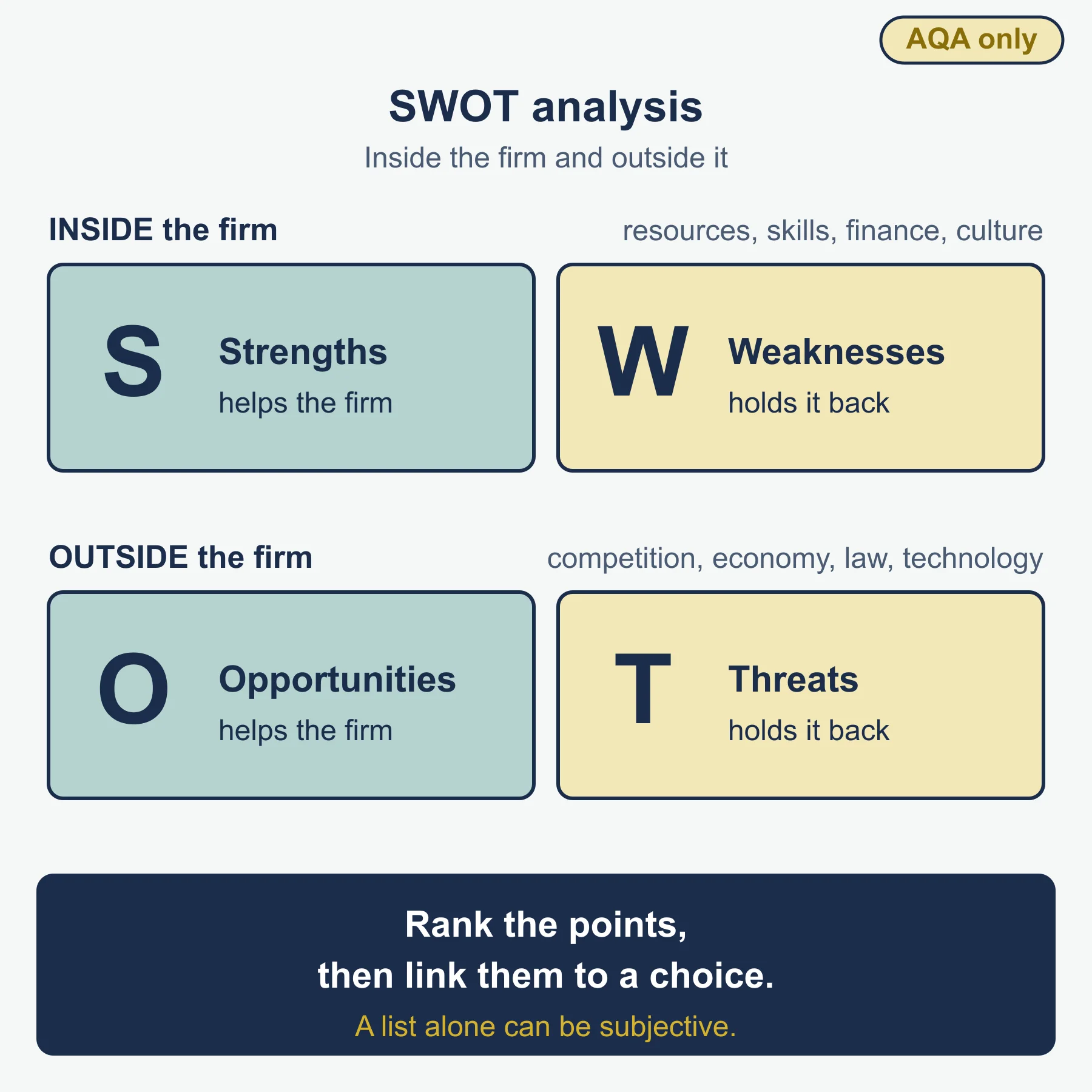
- SWOT: internal strengths and weaknesses, external opportunities and threats. Useful for organising evidence; weak because it is a list, subjective and dated. Always rank points and reach a choice.
3.7.2 Financial ratio analysis
| Ratio | Standard form | High or rising means |
|---|---|---|
| ROCE | operating profit / capital employed x 100 | Better return on funds used |
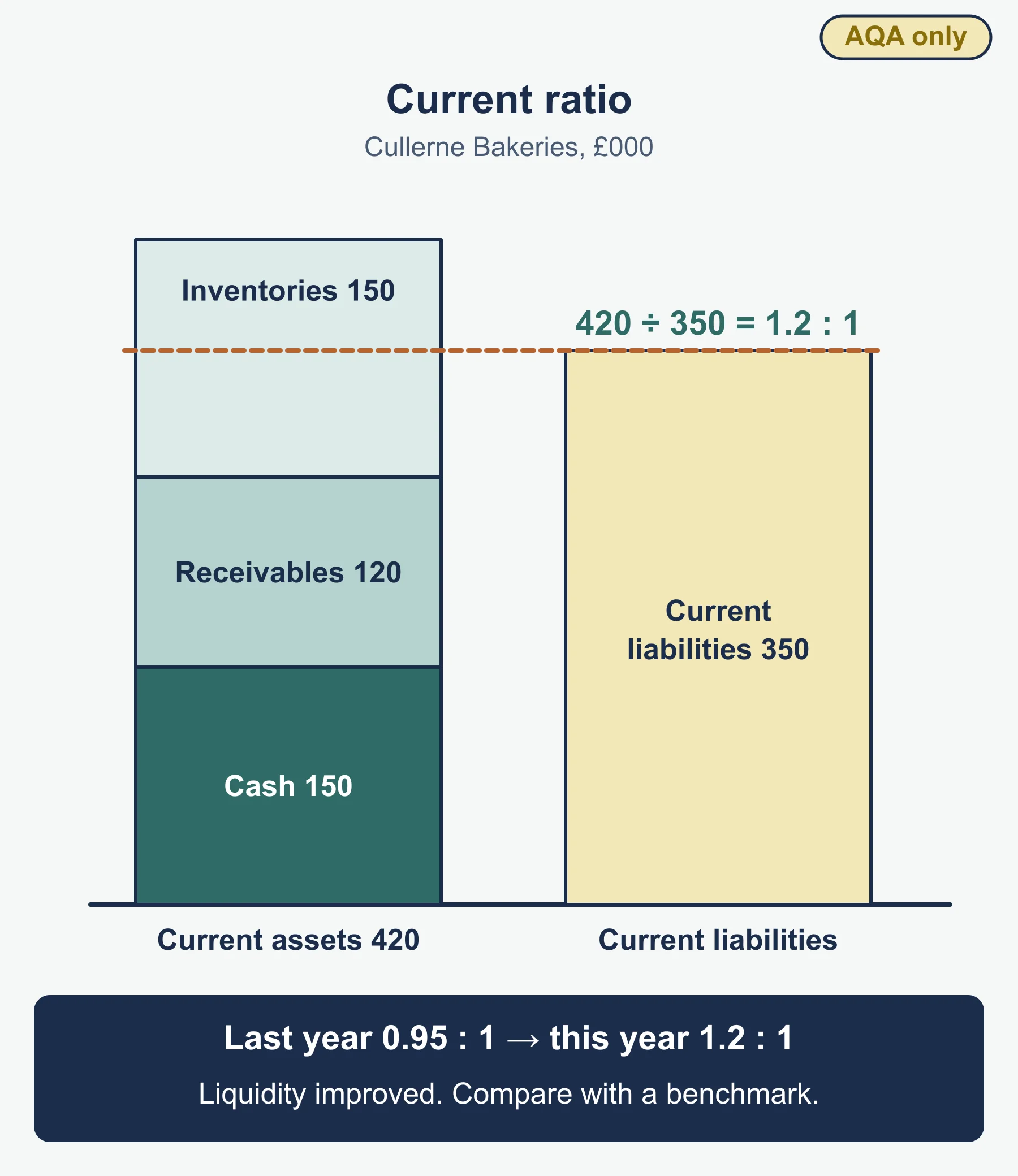
| Current ratio | current assets : current liabilities | Better liquidity (too high may mean idle assets) |
| Gearing | non-current liabilities / capital employed x 100 | More reliance on debt, more risk |
| Receivables days | receivables / revenue x 365 | Slower collection from customers |
| Payables days | payables / cost of sales x 365 | Longer taking credit from suppliers |
| Inventory turnover | cost of sales / inventories | Stock sells faster |
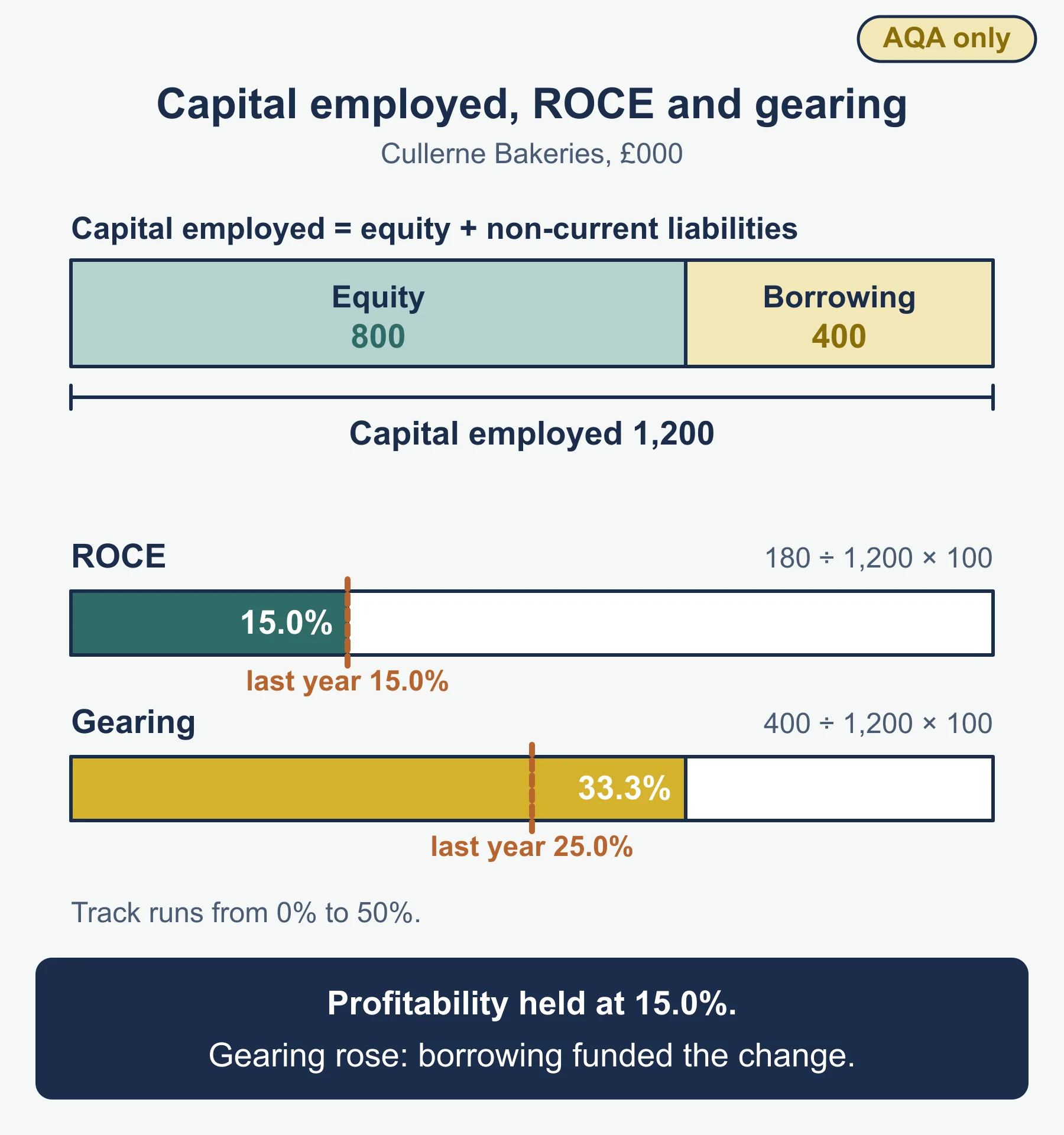
Capital employed = total equity + non-current liabilities. The specification names these ratios without formulas, so these are the standard forms.
Worked reminder. Norbrook Cafes (£000): operating profit 54; equity 300; non-current liabilities 100; current assets 150; current liabilities 120; revenue 600; cost of sales 360; receivables 50; payables 36; inventories 45.
- Capital employed 400, so ROCE = 54 / 400 x 100 = 13.5% and gearing = 100 / 400 x 100 = 25.0%.
- Current ratio = 150 / 120 = 1.25 : 1.
- Receivables days = 50 / 600 x 365 = 30.4; payables days = 36 / 360 x 365 = 36.5.
- Inventory turnover = 360 / 45 = 8.0 times.
Method for a ratio question: write the formula, substitute, give units (%, days, times), compare with last year or a rival, then say what it means and what else you would want to know.
Value of ratios: allow comparison over time and with other businesses; but backward-looking, depend on accounting choices, ignore non-financial factors, need a like-for-like benchmark.
3.7.3 Overall performance
- Non-financial data: operations (capacity utilisation, productivity, defects, delivery times), human resources (labour turnover, absenteeism, training), marketing (market share, satisfaction, retention). Analyse over time or against other businesses.
- Core competences: things done well that are hard to copy and valued by customers; source of competitive advantage.
- Short term (profit, cash) against long term (market position, skills, reputation). Cutting training lifts short-term profit and risks the long term.
| Model | Content | Value | Limit |
|---|---|---|---|
| Kaplan and Norton’s Balanced Scorecard | Financial; customer; internal business processes; learning and growth | Balances short and long term | Time to design; weighting measures |
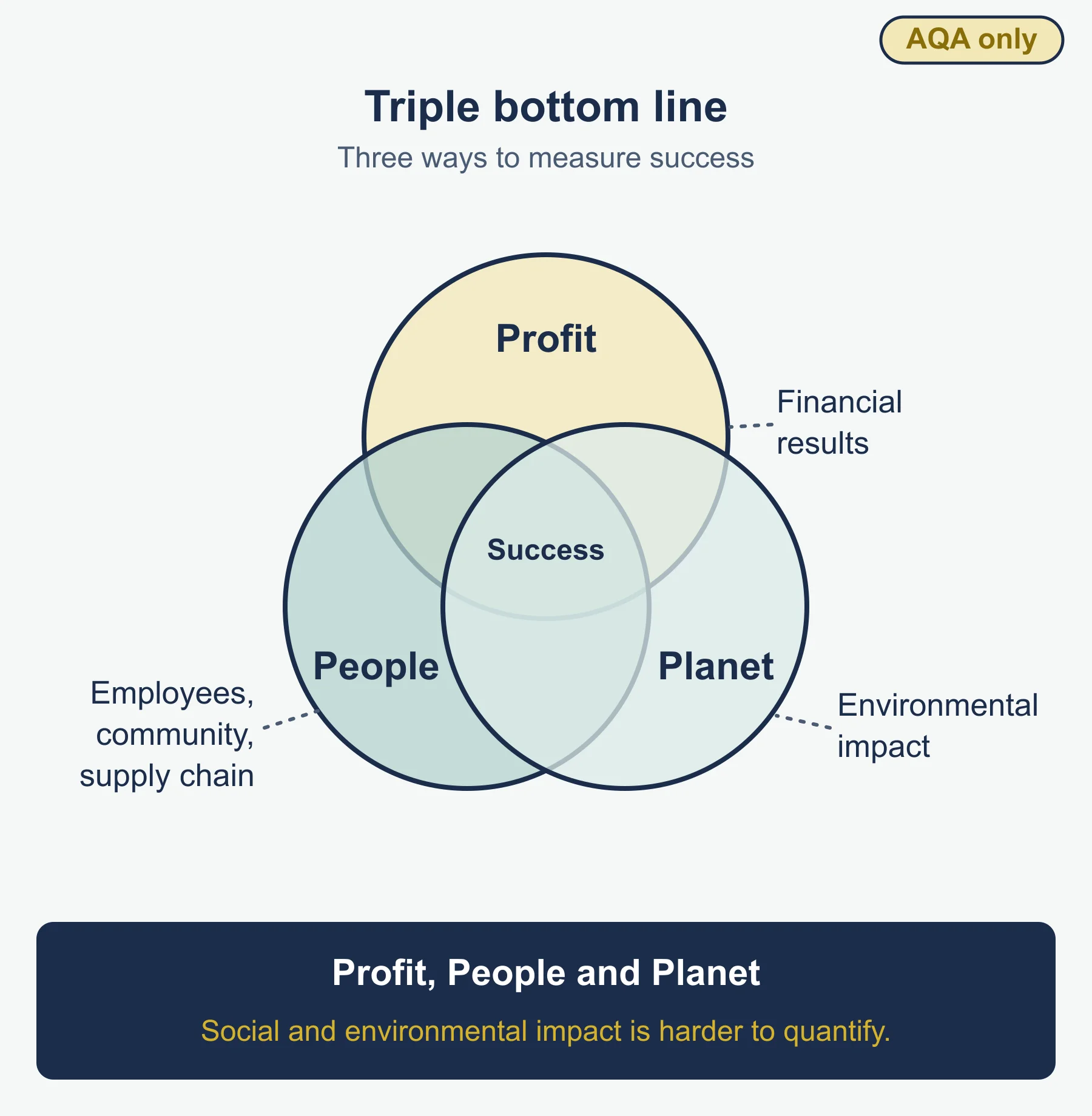
| Elkington’s Triple Bottom Line | Profit, People, Planet | Broader view of success | Social and environmental impact hard to measure |
3.7.4 Political and legal change
- Law (UK and EU, in general terms): competition, labour market, environment.
- Policy: enterprise, regulators, infrastructure, environment, international trade.
- Effect on strategy: where to operate, which products, whether to enter or leave a market. Effect on functions: labour costs, production methods, marketing rules, financing.
- Evaluation prompts: how big, how soon, how long to adapt, do rivals face the same rule, is there an opportunity as well as a threat?
3.7.5 Economic change
| Factor | Typical effect on business |
|---|---|
| GDP | Growth lifts demand, especially for luxuries |
| Taxation | Corporation tax cuts retained profit; income tax and VAT cut spending |
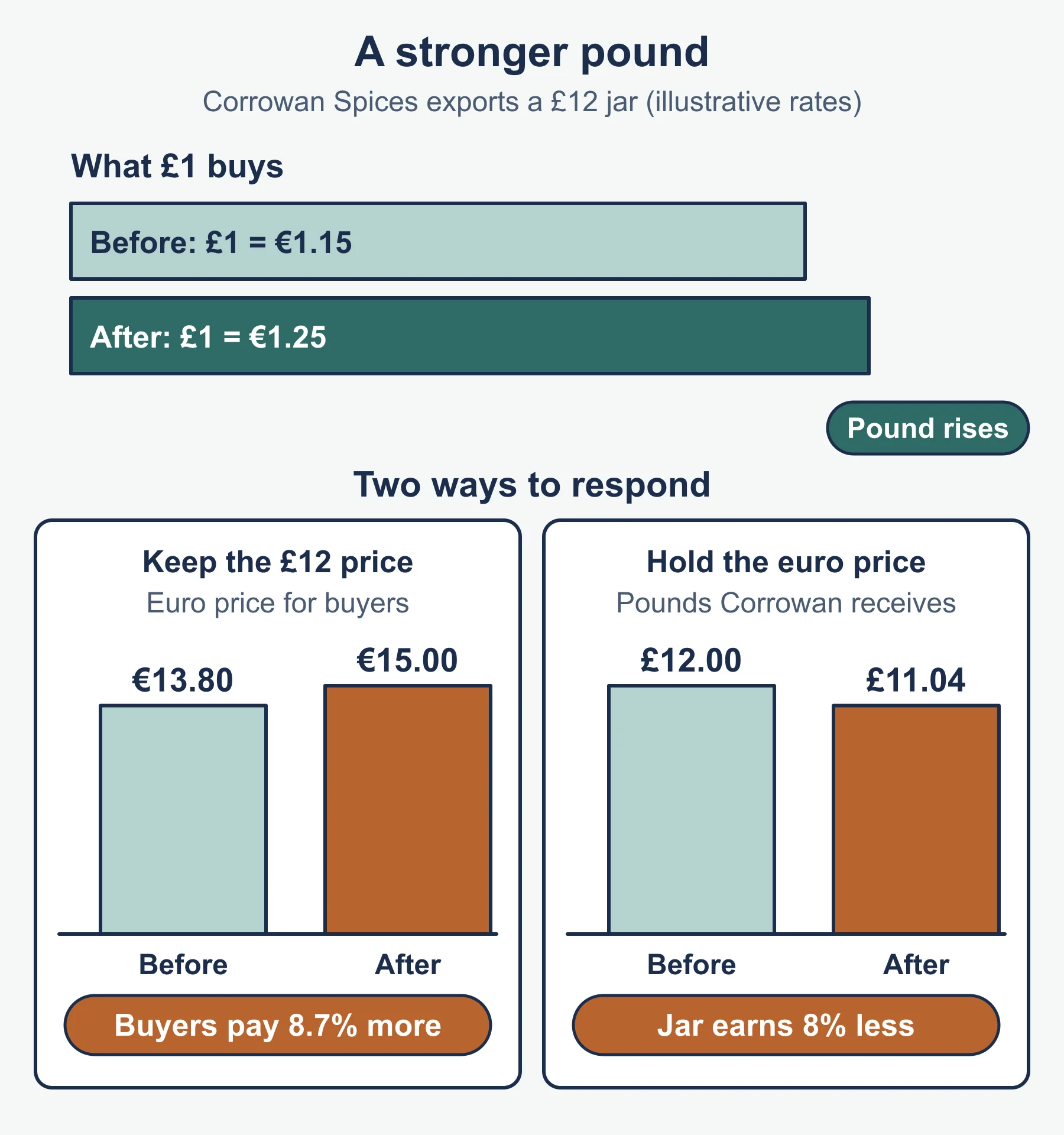
| Exchange rates | Stronger pound: exports dearer, imports cheaper. Weaker: the reverse |
| Inflation | Rising costs; pricing power matters |
| Fiscal and monetary policy | Taxes and spending; interest rates change borrowing cost and demand |
| Open trade v protectionism | Wider markets and rivals v shelter and higher import costs |
Exchange rate reminder. An export priced at €910 earns £700 at €1.30 per pound but only £650 at €1.40. A stronger pound lowers the sterling revenue, or forces a price rise that cuts sales.
- Data skill: state the change, size it, say who is affected, give implications for the UK, European Union or global market.
- Globalisation: reasons are cheaper transport and communication, freer trade, search for lower costs and bigger markets. Importance: markets, inputs, scale economies, but more rivals and currency risk.
- Emerging economies: fast-growing demand and production base; political and infrastructure risk.
3.7.6 Social and technological change
- Demographics and movement: ageing population, urbanisation and migration.
- Lifestyle and buying behaviour: convenience, health, ethical choices; growth of online businesses.
- CSR: for (reputation, loyalty, avoiding regulation) and against (cost, lower short-term profit).
- Shareholder concept: serve owners’ returns. Stakeholder concept: balance all affected groups.
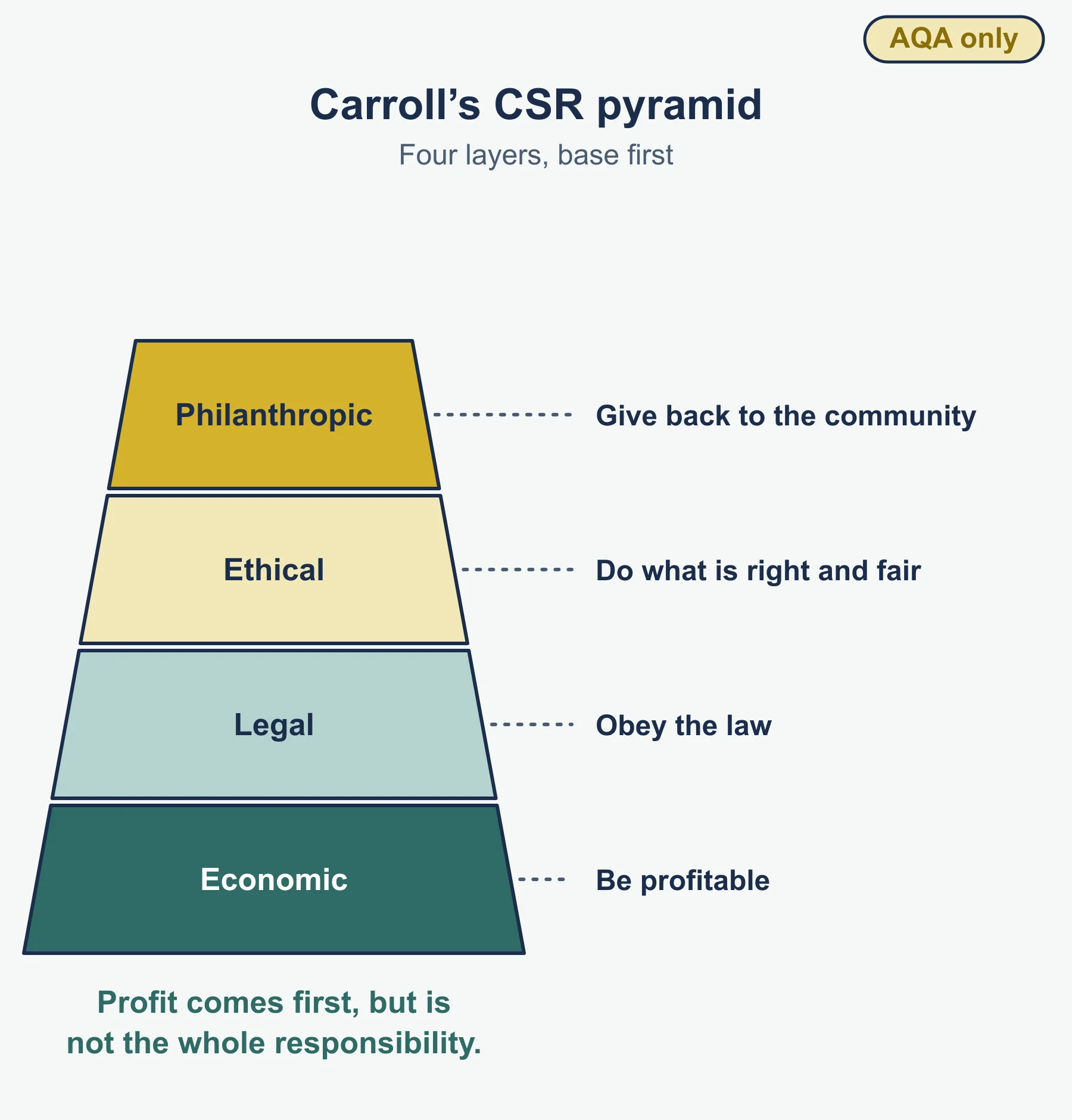
- Carroll’s pyramid, base to top: economic, legal, ethical, philanthropic.
- Pressures for socially responsible behaviour: consumers, pressure groups, social media, employees, investors, regulators.
- Technology: affects every function and strategy; creates markets, ends products, lowers entry barriers.
3.7.7 Porter’s five forces
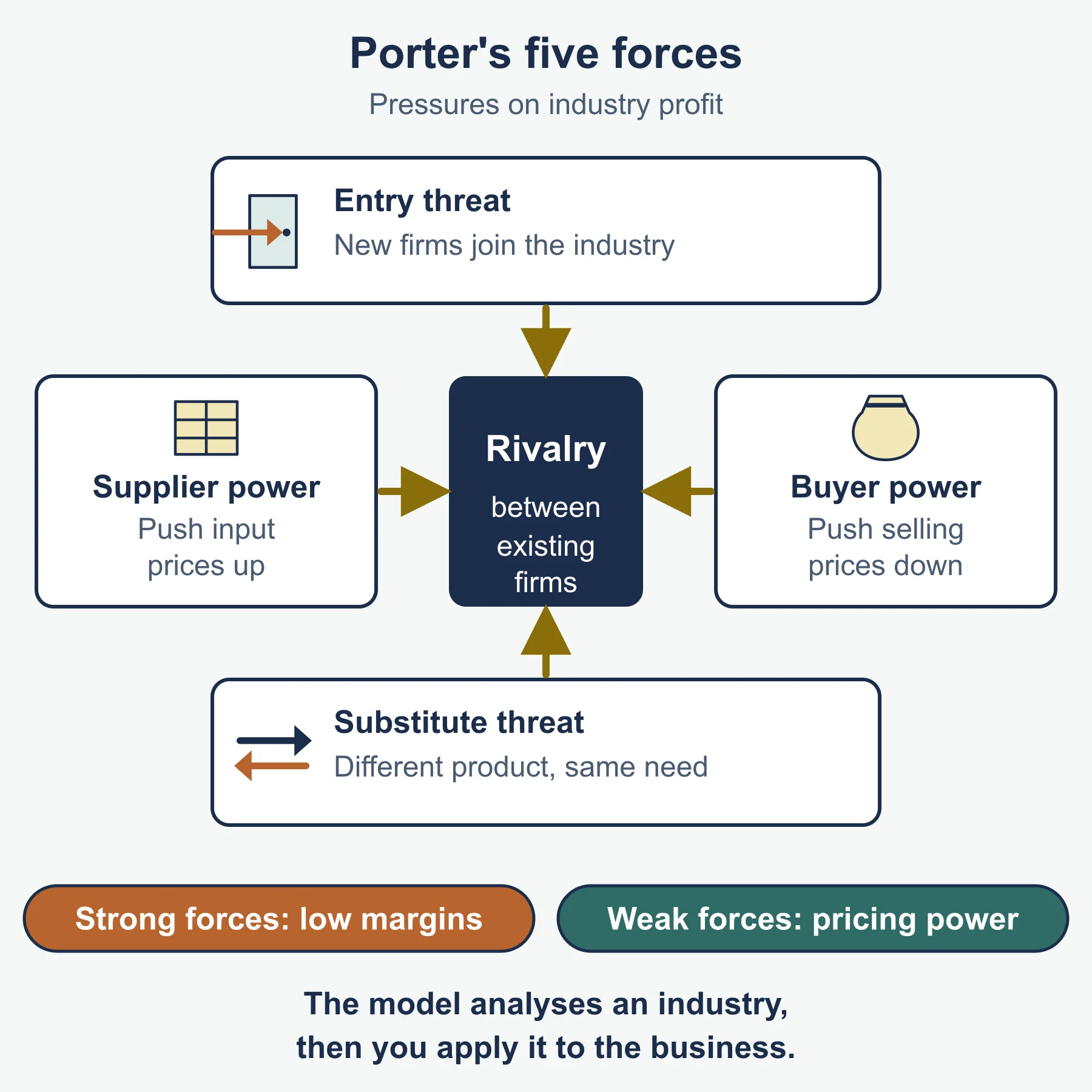
| Force | Strong when | Effect |
|---|---|---|
| Entry threat | Low barriers to entry | Profit competed away |
| Buyer power | Few or large buyers, easy switching | Lower prices |
| Supplier power | Few suppliers, specialised inputs | Higher costs |
| Rivalry | Many similar rivals, slow growth | Price competition, high promotion spend |
| Substitute threat | Easy alternatives | Price ceiling |
Forces change with technology, mergers, regulation and new products. Weak forces mean higher profit potential. Forces shape competitive strategy: build barriers, differentiate, secure customers or suppliers.
3.7.8 Investment appraisal
| Method | Formula or rule | Strength | Weakness |
|---|---|---|---|
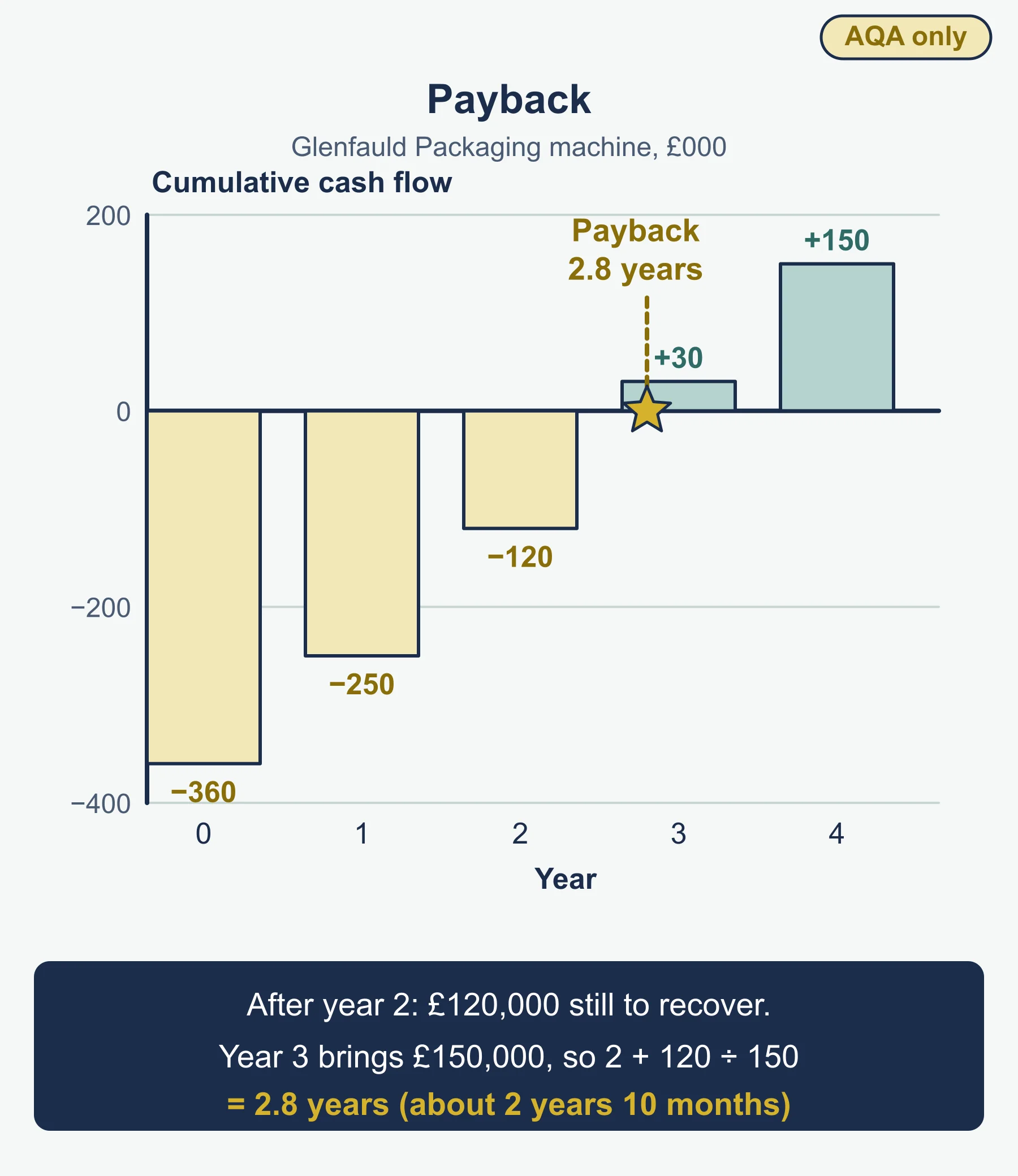
| Payback | Time to recover the initial cost | Simple; stresses risk | Ignores later cash and timing |
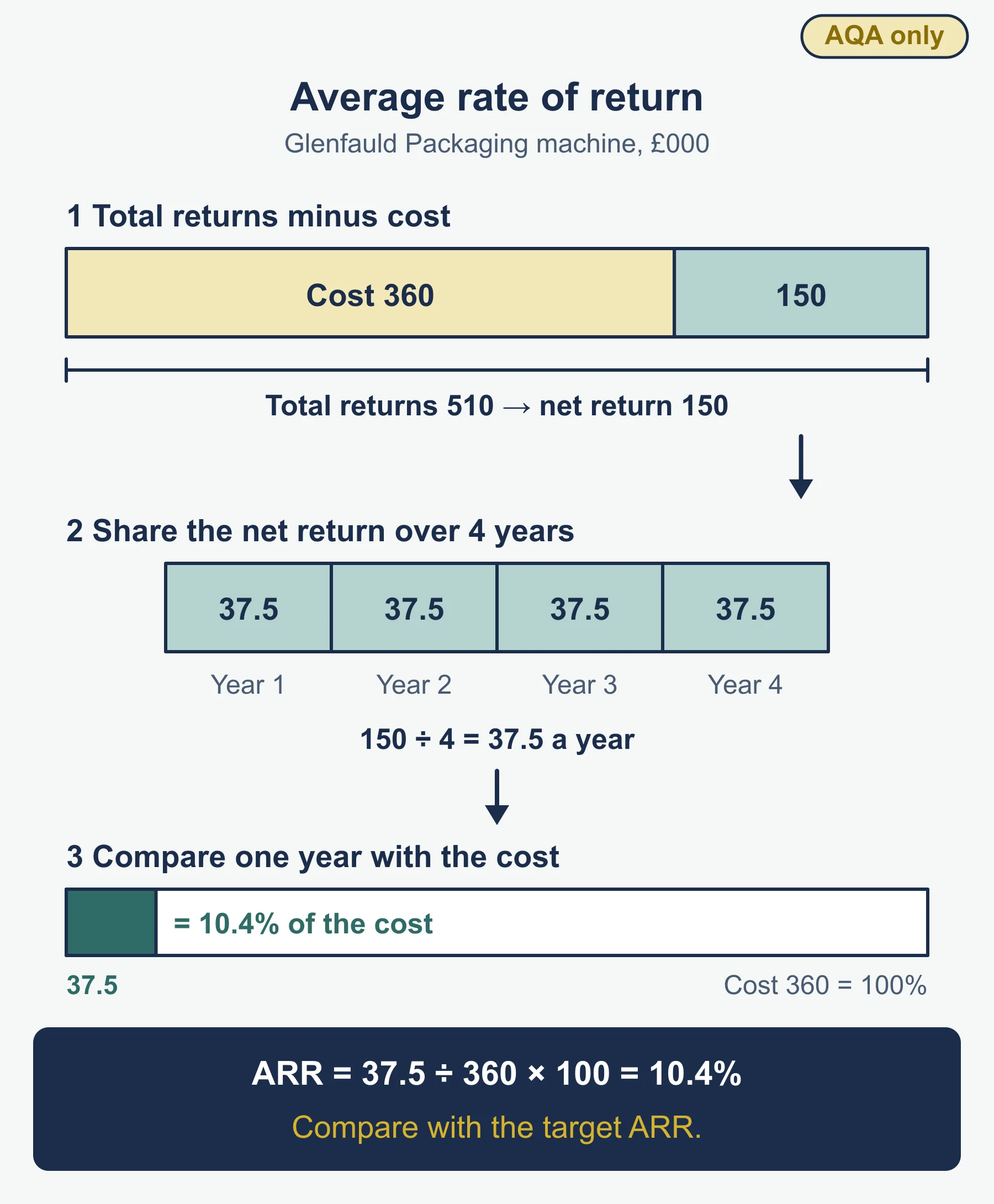
| Average rate of return | (total returns - cost) / years / cost x 100 | Uses all returns | Ignores timing |
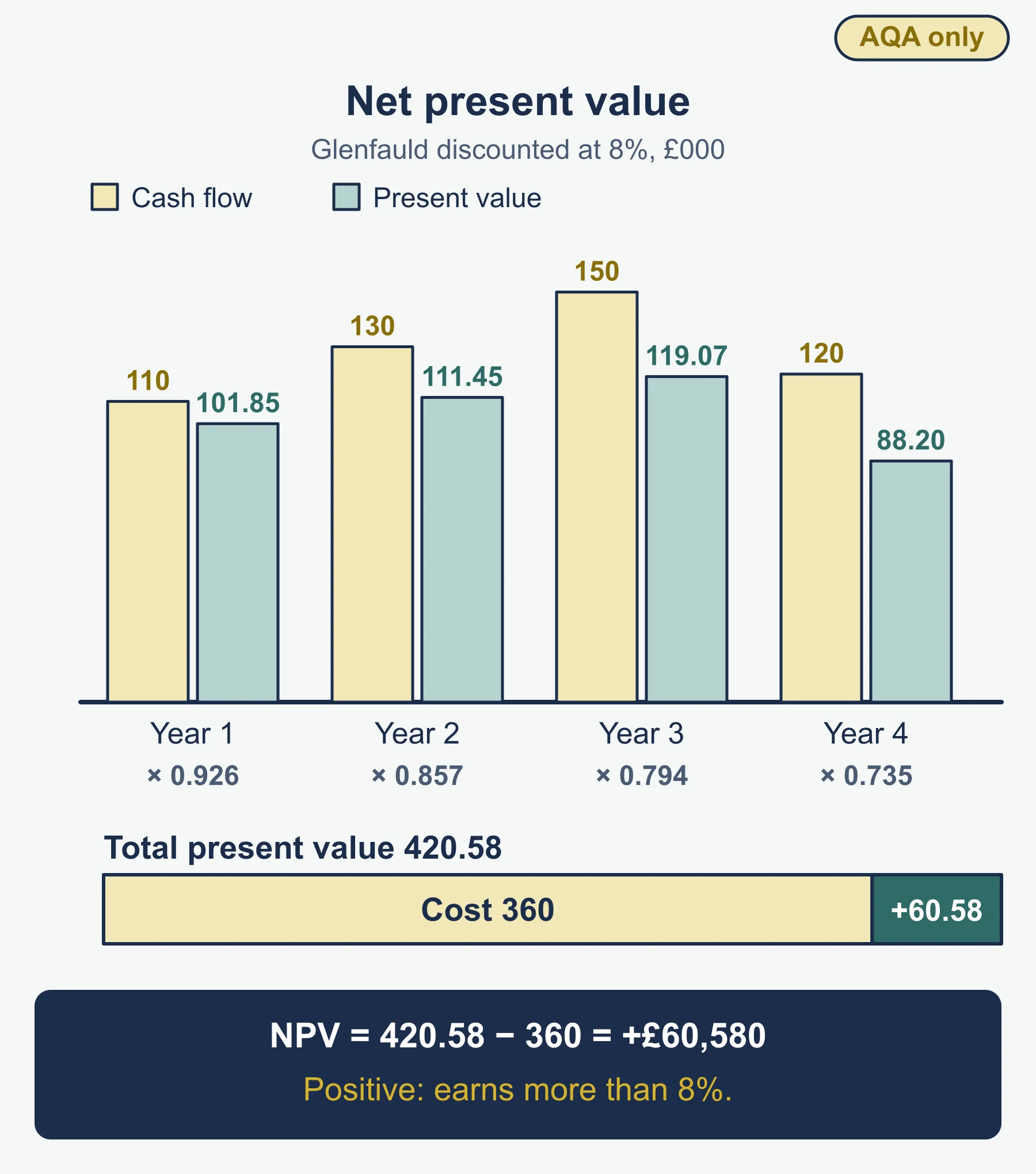
| Net present value | Sum of discounted cash flows - cost | Allows for time value of money | Depends on discount rate and forecasts |
Worked reminder. Norbrook Cafes spends £50,000 on a new oven; cash flows are £20,000, £25,000 and £30,000 in years 1 to 3; the discount rate is 10%.
- Payback: after year 2, £45,000 recovered, so 2 + 5/30 = 2.17 years (about 2 years 2 months).
- ARR: total returns £75,000, net £25,000, so 25,000 / 3 / 50,000 x 100 = 16.7%.
- NPV: 20/1.1 + 25/1.21 + 30/1.331 = 18.18 + 20.66 + 22.54 = 61.38, so NPV = 61.38 - 50 = +£11,380.
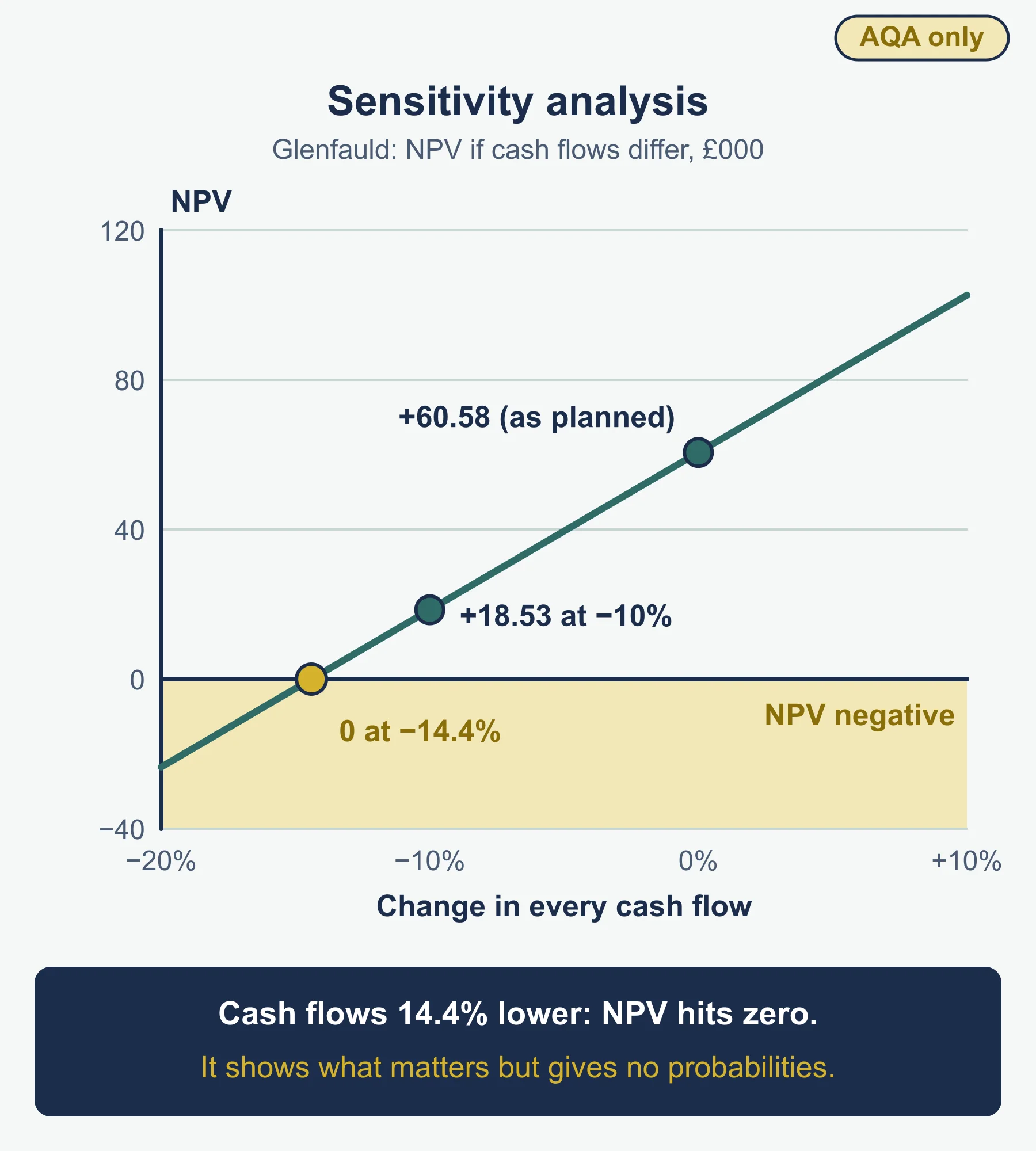
- Sensitivity: with cash flows 10% lower, NPV falls to about +£5,240.
Factors influencing the decision: investment criteria, non-financial factors, risk and uncertainty. Sensitivity analysis changes one assumption at a time to see how much the result depends on it; it shows which forecasts matter but gives no probabilities.
Quick self-test
- Distinguish corporate objectives from tactics.
- A business has operating profit £45,000, equity £250,000 and non-current liabilities £50,000. Calculate ROCE.
- Using the same figures, calculate gearing.
- Receivables are £40,000 and revenue is £480,000. Calculate receivables days to 1 decimal place.
- Cost of sales is £420,000 and inventories £60,000. Calculate inventory turnover.
- Name the four perspectives of the Balanced Scorecard.
- What are the three Ps of the Triple Bottom Line?
- Why might a stronger pound hurt an exporter?
- Name Porter’s five forces.
- A £90,000 project returns £30,000, £40,000 and £50,000 in years 1 to 3. Calculate payback.
- What does a positive NPV tell you?
Answers
- Corporate objectives are measurable, whole-business goals; tactics are short-term actions that carry out the strategy.
- Capital employed = 300,000, so ROCE = 45,000 / 300,000 x 100 = 15.0%.
- 50,000 / 300,000 x 100 = 16.7%.
- 40,000 / 480,000 x 365 = 30.4 days.
- 420,000 / 60,000 = 7 times.
- Financial; customer; internal business processes; learning and growth.
- Profit, People, Planet.
- Its goods cost more abroad or its sterling revenue falls, reducing competitiveness or margins.
- Entry threat, buyer power, supplier power, rivalry, substitute threat.
- After year 2, £70,000 is recovered; £20,000 of £50,000 remains in year 3, so 2 + 20/50 = 2.4 years (about 2 years 5 months).
- The project earns more than the discount rate, so it adds value on this measure.
Where marks are usually lost
- Stating a ratio result without a comparison or an explanation of what it means.
- Mixing up gearing (non-current liabilities over capital employed) with the current ratio.
- Writing days for payables using revenue instead of cost of sales.
- Describing a model such as Porter or Carroll without applying it to the business in the question.
- Treating every external change as a threat, with no opportunity or no judgement of size and timing.
- Discounting wrongly in NPV, or forgetting to subtract the initial investment.
- Recommending an investment on one method only, with no mention of risk, non-financial factors or sensitivity.
- Long definitions of CSR with no link to the business’s stakeholders.
Frequently asked questions
What are the four perspectives of the Balanced Scorecard? Financial; customer; internal business processes; and learning and growth.
What is Carroll’s pyramid of corporate social responsibility? Carroll’s pyramid sets out responsibilities from base to top: economic, legal, ethical and philanthropic.
What is sensitivity analysis in investment appraisal? Sensitivity analysis changes one assumption at a time, such as cutting every cash flow by 10%, to see how much the result depends on it. It shows which forecasts matter but gives no probabilities.
Why might a stronger pound hurt a UK exporter? A stronger pound means the exporter’s goods cost more abroad, or its sterling revenue falls if it keeps foreign prices the same, reducing its competitiveness or its margins.
What are core competences? Core competences are things a business does well that are hard to copy and are valued by customers, so they are a source of competitive advantage.
Official syllabus
AQA, AS and A-level Business (7131 and 7132) specification, section 3.7 (A-level only).
Get free revision emails (optional)
Occasional emails with practice questions, worked explanations and links to free resources for the qualification and subjects you choose. No spam, and you can unsubscribe from any email. The free tools on this site never need an email.
Related resources
-
Study guides
AQA A-Level Business: Analysing the strategic position of a business (7132)
Study guide to AQA A-Level Business 7132 topic 7: mission and strategy, ratios, performance, external change, Porter and investment appraisal.
Business · AQA · A Level
Read guide -
Practice questions
AQA A-Level Business: Analysing the strategic position of a business (7132) – Practice Questions
Original AQA A-Level Business 7132 practice questions on topic 7, with worked answers: ratios, models, external change and investment appraisal.
Business · AQA · A Level
Try questions -
Study guides
AQA A-Level Business: Choosing strategic direction (7132)
Study guide to AQA A-Level Business 7132 topic 8: Ansoff matrix, Porter's generic strategies, Bowman's strategic clock and competitive advantage.
Business · AQA · A Level
Read guide
Related articles
-
teaching
A Level tuition in Dubai: Cambridge or Pearson Edexcel International A Level?
Schools in Dubai and Abu Dhabi teach either Cambridge International AS & A Level or Pearson Edexcel International A Level. How the two are structured, why it matters for tuition, and how online classes from Lahore work.
9 October 2026
-
curriculum guides
Choosing subjects at IGCSE and A Level
How subject choices at 14 and 16 affect university options later, and how to keep pathways open without overloading a timetable.
28 July 2026
Studying this with a teacher
Working through Business A LEVELS?
This page is free and stays free. If you would rather be taught it, Marlbridge runs Business classes one-to-one and in small groups of up to 15, online in your own time zone. The first trial class is free. WhatsApp replies within an hour (8am–11pm Pakistan time, every day); email the same day.
AQA Business teachers at Marlbridge
