
Study Guides
AQA A-Level Business: Choosing strategic direction (7132)
Study guide to AQA A-Level Business 7132 topic 8: Ansoff matrix, Porter's generic strategies, Bowman's strategic clock and competitive advantage.
- Subject
- Business
- Level
- A LEVELS
- Topic
- Choosing strategic direction
- Author
- Marlbridge Academic Team
- Updated
- Reviewed by
- Salman Ahmad (what this means)
Aligned to AQA A Level Business (7132), For first teaching from September 2023. Official specification .
Syllabus page (what it covers and how it is assessed): AQA A Level Business.
Syllabus points this page covers
7132
- 8 Choosing strategic direction (whole topic)
Found an error? Report a correction.
Need help with this topic? Request a free trial class for A Level Business (7132).
This guide covers topic 8, Choosing strategic direction, of the AQA A-level Business (7132) specification (the AQA AS and A-level Business specification, A-level only content, sections 3.8.1 and 3.8.2). The specification lists all of its content as assessable in each of the three A-level papers, so expect this topic to appear inside case studies, data responses and essays alongside other topics. Use it with the revision notes and the practice set. The course hub is AQA A-level Business and the printable checklist tracks your progress. To find weak spots first, try the free 10-minute diagnostics.
Map of the topic
| Section | What the specification asks for | Where in this guide |
|---|---|---|
| 3.8.1 | Factors influencing which markets to compete in and which products to offer | Part 1 |
| 3.8.1 | The Ansoff matrix: market penetration, market development, new product development, diversification | Part 2 |
| 3.8.1 | Reasons for choosing, and the value of, different strategic directions | Part 3 |
| 3.8.2 | How to compete in terms of benefits and price; Porter’s low cost, differentiation and focus strategies | Part 4 |
| 3.8.2 | Bowman’s strategic clock | Part 5 |
| 3.8.2 | Influences on the choice of positioning strategy; value of different strategies | Part 6 |
| 3.8.2 | Benefits of competitive advantage; difficulties of maintaining it | Part 7 |
Strategic direction answers “where do we compete?” (which markets, which products). Strategic positioning answers “how do we compete?” (on benefits, on price, or both). A good case-study answer keeps the two ideas apart and then links them.
Part 1: Factors influencing which markets and products
A business cannot chase every market. The choice depends on factors such as:
- Market size, growth and profitability. A large, growing market offers room to expand; a shrinking one may justify moving away.
- Competition. Strong rivals, high barriers to entry and price wars make a market less attractive.
- Resources and finance. Entering a new market needs cash for marketing, staff and stock. Weak cash flow limits the options.
- Core competencies. The skills and assets a business already has (brand, technology, supply chain, staff expertise) make some moves easier than others.
- Attitude to risk. Owners and managers differ in how much uncertainty they accept. Shareholder pressure for quick returns can push towards safer choices.
- Corporate objectives. A goal of fast growth points to different choices from a goal of stable profit.
- Information. Market research, forecasts and your analysis of the external environment (topic 7) reduce guesswork.
- The existing product portfolio. A business with ageing products may need new ones; one with strong cash cows may fund bolder moves.
Part 2: The Ansoff matrix
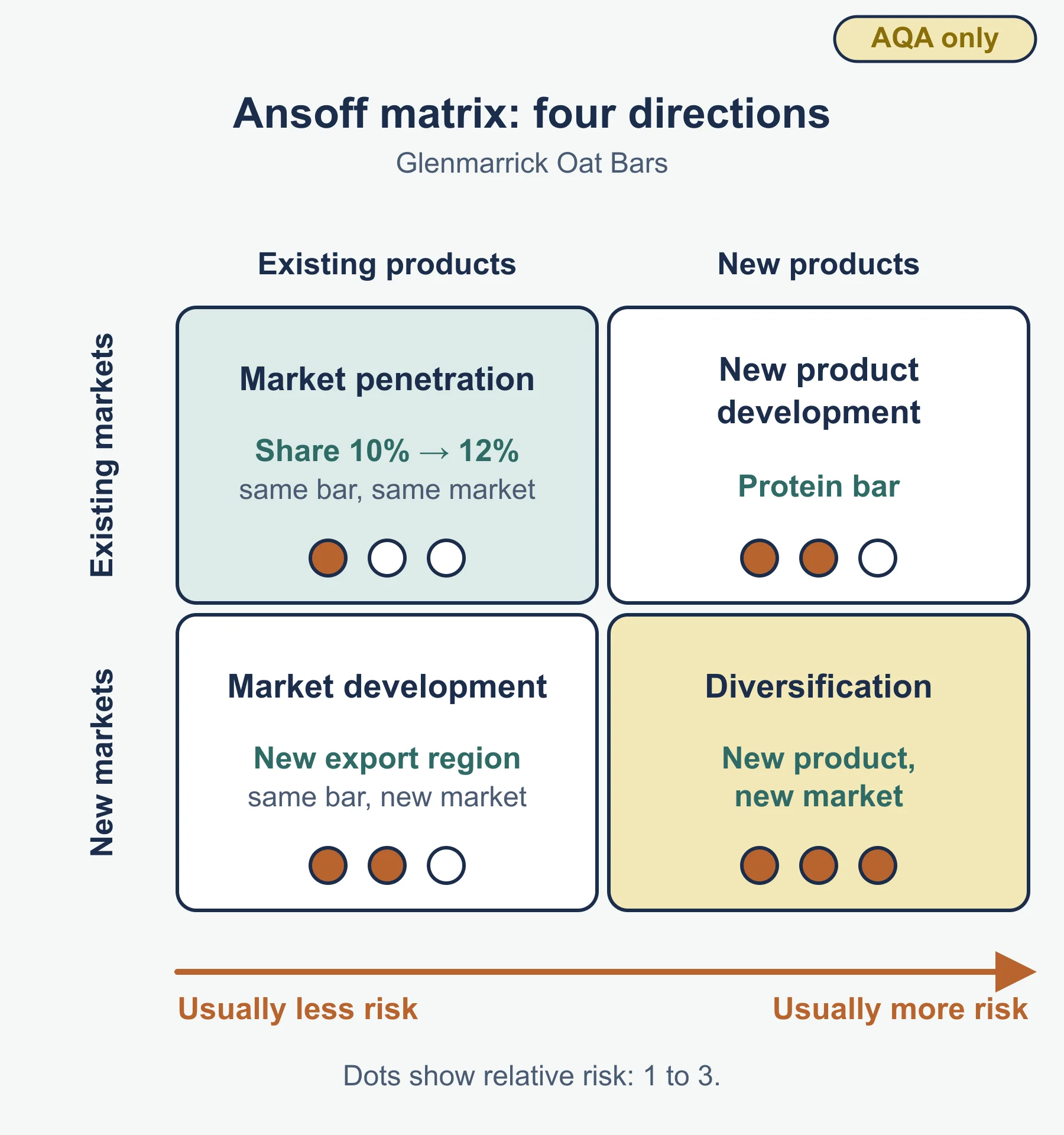
Ansoff’s matrix plots products (existing or new) against markets (existing or new). The four boxes are the four strategic directions the specification names.
| Existing products | New products | |
|---|---|---|
| Existing markets | Market penetration | New product development |
| New markets | Market development | Diversification |
The further a business moves from its current products and customers, the greater the risk. Market penetration is usually least risky, diversification most risky, with the other two between them.
Market penetration
Selling more of the same products in the same markets, by raising market share. Methods include promotion, price cuts, loyalty schemes and wider distribution. Value: low risk, uses existing skills, builds on knowledge of customers. Limit: growth is capped if the market is saturated, and rivals can retaliate.
Market development
Selling existing products in new markets, such as new regions, countries or customer segments. Value: opens extra sales without redesigning the product. Limit: unfamiliar customers, regulation, culture and distribution; research and set-up costs.
New product development
Launching new products in existing markets. Value: refreshes the portfolio, keeps customers loyal, can earn premium prices. Limit: research and development costs, and the risk that the product fails.
Diversification
New products in new markets. It can spread risk across unrelated activities and open high-growth areas, but the business lacks experience in both product and market, so failure is more likely and costs are high.
Worked example: comparing the options
Glenmarrick Oat Bars sells £4.0m a year in a £40m market, so market share is 4.0 / 40 = 10%. Contribution is 35% of sales revenue. Three proposals:
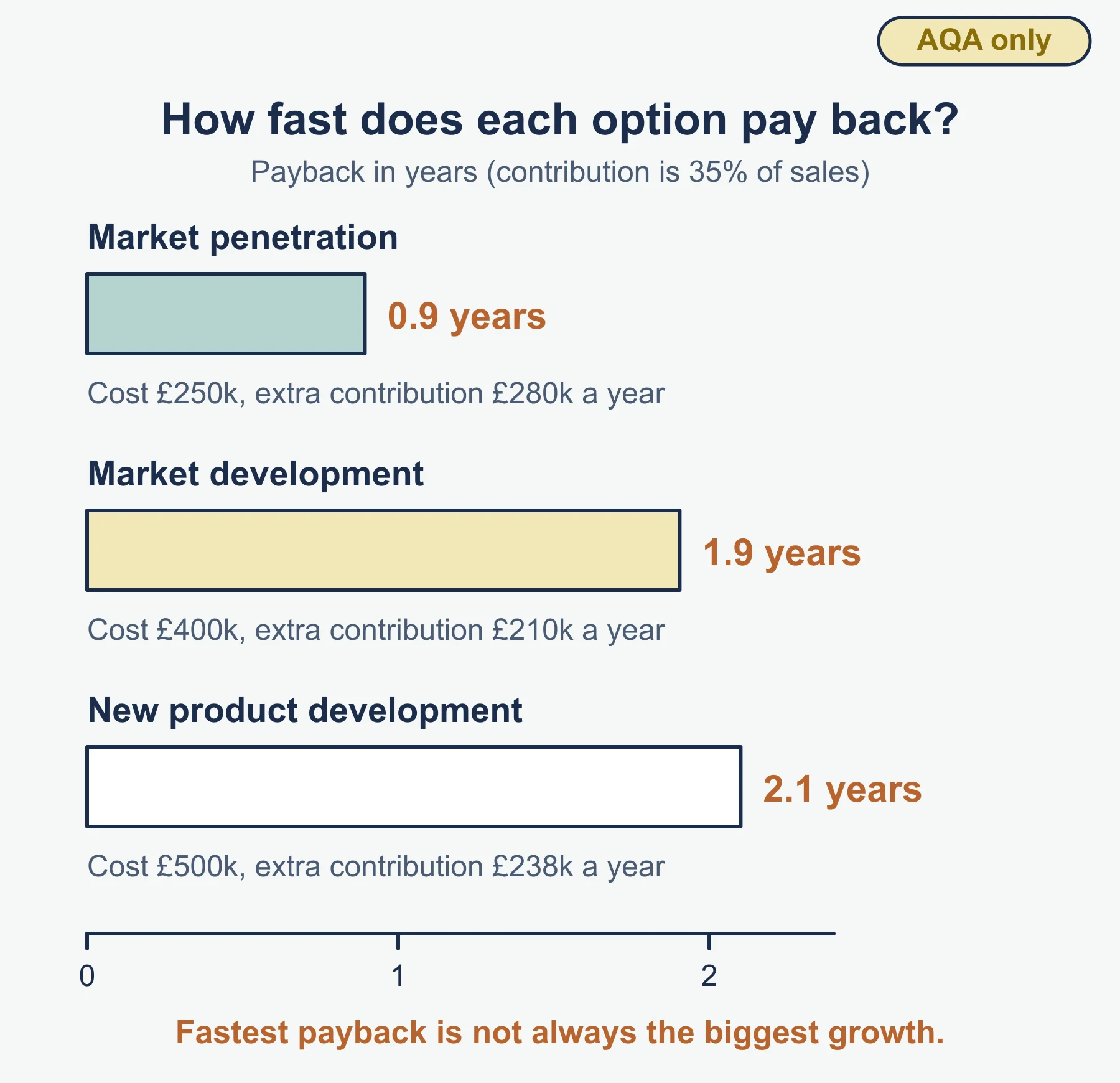
- Penetration. A £250,000 campaign lifts share to 12% in a flat market. Sales rise to 0.12 × 40 = £4.8m, an increase of £0.8m. Extra contribution is £0.8m × 35% = £280,000. Net gain in year 1 is £280,000 - £250,000 = £30,000.
- Market development. Entry to a new export region of £15m, aiming for a 4% share, costs £400,000 to set up. Sales are 0.04 × 15 = £0.6m; contribution is £210,000 a year. Year 1 net is -£190,000. Payback is 400 / 210 = 1.9 years.
- New product development. A protein bar costs £500,000 to develop. Management estimates a 60% chance of £1.0m sales and a 40% chance of £0.2m. Expected sales are 0.6 × 1.0 + 0.4 × 0.2 = £0.68m, expected contribution £238,000 a year, payback 500 / 238 = 2.1 years.
Penetration pays back fastest and with least uncertainty, but its ceiling is low. The other two take about two years to repay but offer larger long-term growth. Numbers alone do not decide: a good answer also weighs risk, finance and the owners’ objectives.
Part 3: Reasons for choosing, and value of, each direction
The specification asks you to explain why a business picks an option and how valuable it is. Use the context.
- Penetration suits a business with spare capacity, a strong brand and a market that still has room. It is a sensible response to limited cash.
- Market development suits a business whose home market is saturated or in decline, and whose product has proven appeal.
- New product development suits a business in a fast-changing market where customers expect novelty, or one with strong research and development capability.
- Diversification suits a business needing to reduce reliance on one market, or with surplus funds and a management team ready for new challenges.
Value depends on time horizon. Penetration gives quick, modest gains. Diversification may give no profit for years yet protect the business from a single market collapsing. When you evaluate, state the criterion (risk, cost, speed, fit with objectives) and reach a judgement.
Part 4: Strategic positioning and Porter’s generic strategies
Positioning is how a business competes in terms of benefits and price. Porter set out three strategies.
| Strategy | Basis | Typical features |
|---|---|---|
| Low cost (cost leadership) | Lowest unit costs in a broad market | Economies of scale, tight cost control, standard products, efficient processes |
| Differentiation | Products seen as unique in a broad market | Strong brand, quality, design, service; price premium |
| Focus | A narrow segment of the market | Either low cost or differentiation, aimed at one niche |
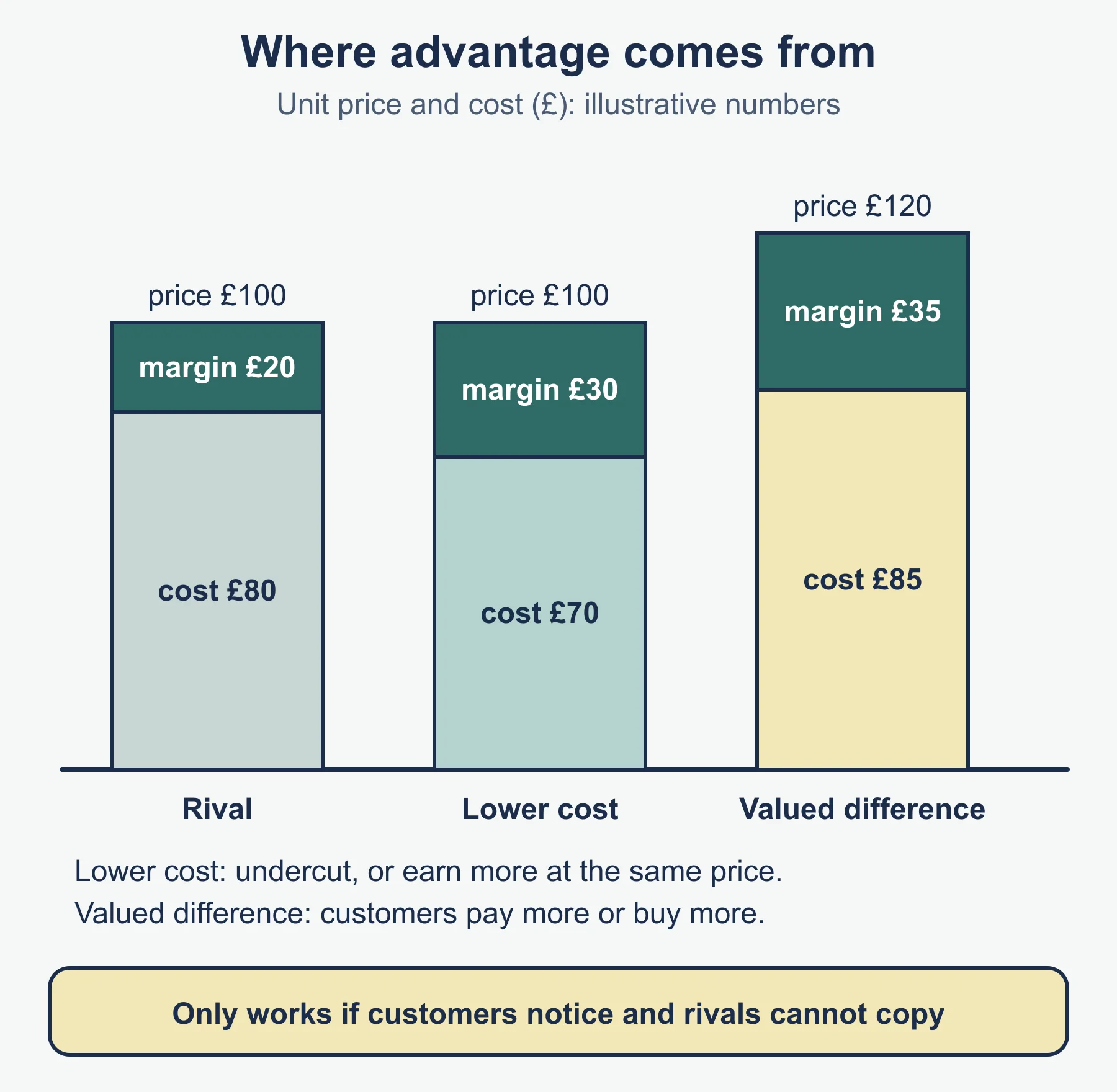
Cost leadership does not have to mean the lowest price. The business can charge the market price and keep a wider margin. Differentiation only works if customers value the difference enough to pay for it. Focus lets a small firm serve a niche better than large rivals, but demand can be limited. Porter warned of being “stuck in the middle”: a business with neither the lowest costs nor a clear point of difference.
Worked example: low cost versus differentiation
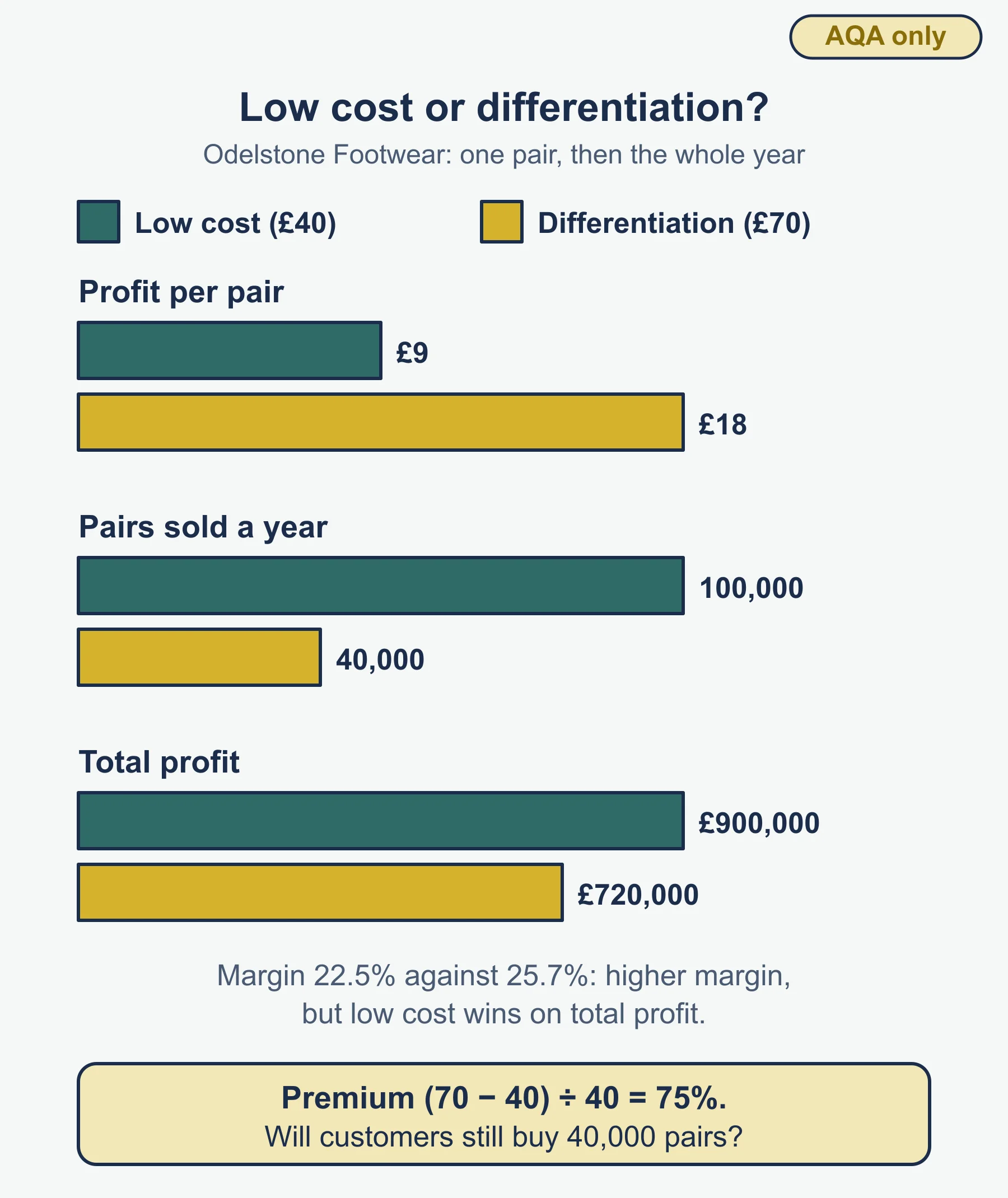
Odelstone Footwear can follow either route.
| Low cost | Differentiation | |
|---|---|---|
| Price per pair | £40 | £70 |
| Unit cost | £31 | £52 |
| Profit per pair | £9 | £18 |
| Profit margin | 22.5% | 25.7% |
| Pairs sold a year | 100,000 | 40,000 |
| Total profit before fixed costs | £900,000 | £720,000 |
Differentiation earns a higher margin and double the profit per pair, but low cost wins on total profit because volume is 2.5 times higher. The premium is (70 - 40) / 40 = 75%, which customers must value for 40,000 sales to hold. The choice rests on whether the brand can deliver that premium.
Part 5: Bowman’s strategic clock
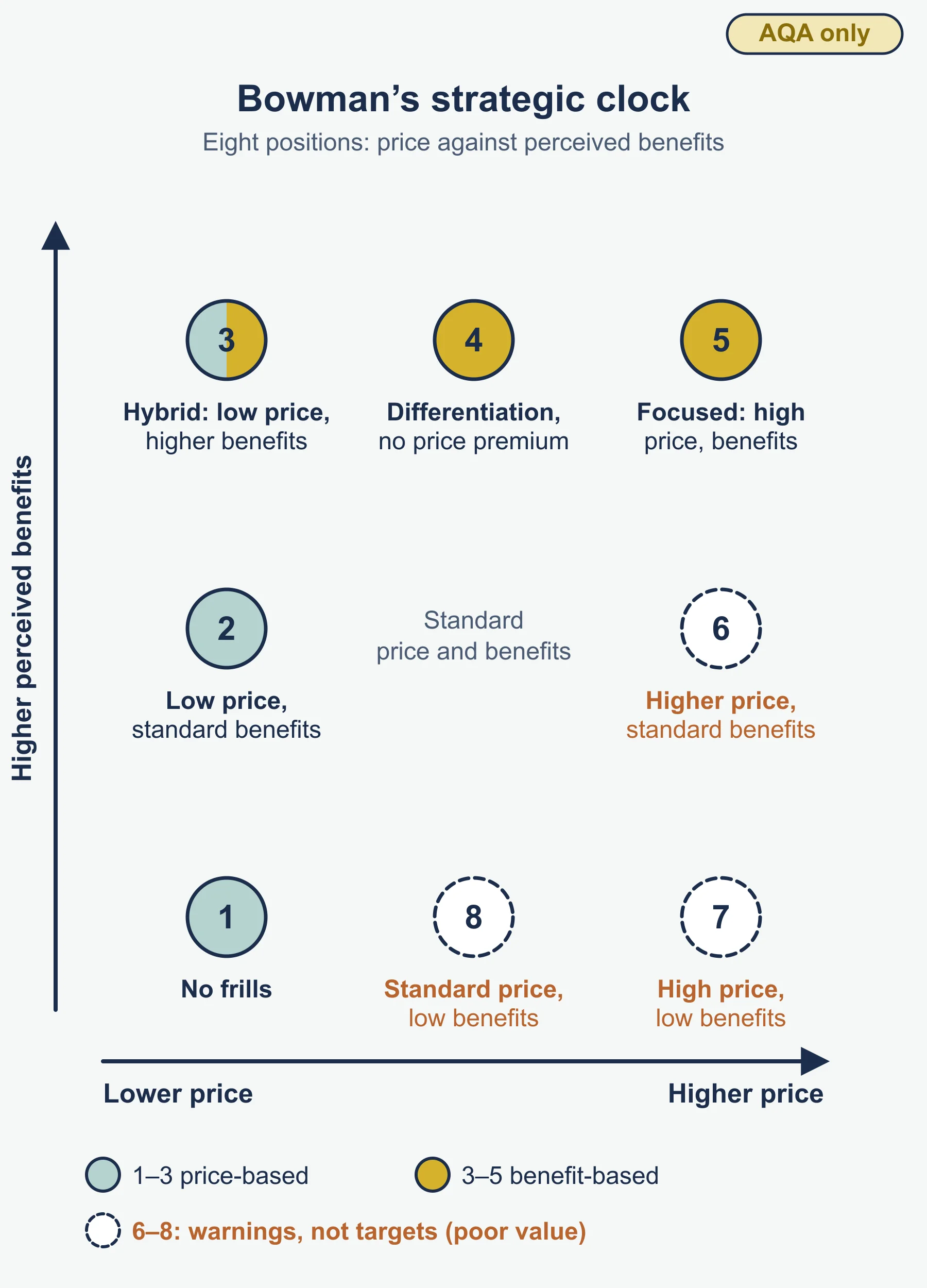
Bowman’s clock plots price (horizontal) against perceived benefits (vertical) and gives eight positions. The numbering below is the standard form.
| Position | Price / benefit | Comment |
|---|---|---|
| 1 | Low price, low benefits | No frills; small niche |
| 2 | Low price, standard benefits | Cost-based; price war risk |
| 3 | Hybrid: low price with higher benefits | Needs very low costs |
| 4 | Differentiation without a price premium | Strong market share route |
| 5 | Focused differentiation: high price, high benefits | Niche, premium |
| 6 | Higher price, standard benefits | Works only with monopoly-like power |
| 7 | High price, low benefits | Likely to fail |
| 8 | Standard price, low benefits | Likely to fail |
Positions 1 to 3 are price-based, 3 to 5 benefit-based, and 6 to 8 are generally seen as unsustainable because customers receive poor value. Unlike Porter, the clock allows hybrid strategies and shows how a move in price or benefits shifts the position.
Part 6: Influences on the choice, and value of each strategy
Influences include the size and nature of the market, customer sensitivity to price, the business’s cost structure and resources, competitors’ positions, brand strength, technology and the owners’ objectives. A business with no scale economies should not pick cost leadership. A business in a market where customers care little about quality gains little from differentiation.
Value: cost leadership can build high volume and withstand price wars; differentiation can give loyalty and pricing power; focus can protect a business from large rivals; hybrid strategies can win share but are hard to sustain. Each has costs: low cost may mean lower quality, differentiation needs spending on design and promotion, and a niche limits growth.
Part 7: Competitive advantage
Competitive advantage is something a business does better than rivals that customers value, such as lower costs or a superior product.
Benefits: higher market share, higher margins or price premiums, customer loyalty, resilience in downturns, and an attractive base for investors and talented staff.
Difficulties of maintaining it: rivals copy successful ideas; technology changes quickly; customer tastes shift; costs such as wages and materials rise; patents and brand loyalty may fade; and holding an advantage takes continuing investment in innovation, training and marketing. An advantage that rests on one supplier, one product or one person is fragile.
Common errors
- Naming an Ansoff box without applying it. Say what the product and market are, and why this box follows.
- Treating cost leadership as “cheap”. It means lowest cost; price can still equal rivals’.
- Using the clock’s positions 6 to 8 as targets. They are warnings.
- Judging the options on profit alone and ignoring risk or fit with objectives.
- Listing difficulties of keeping an advantage without ranking which is most serious in the case.
Frequently asked questions
Does cost leadership mean charging the lowest price? No. Cost leadership means having the lowest costs; the business can charge the market price and keep a wider margin. Treating it as simply being cheap is a common error.
Why is market penetration usually the least risky Ansoff option? Market penetration sells more of the same products in the same markets, so the business relies on what it already knows. Risk rises the further a business moves from its current products and customers.
Why is competitive advantage hard to maintain? Rivals copy successful ideas, technology changes quickly, customer tastes shift and costs such as wages and materials rise, so an advantage can fade unless the business keeps renewing it.
What factors influence which markets a business competes in? Factors include market size, growth and profitability, competition, resources and finance, core competencies, attitude to risk, corporate objectives, available information and the existing product portfolio.
Which section of the AQA Business specification covers choosing strategic direction? Section 3.8, Choosing strategic direction (A-level only), covering 3.8.1 strategic direction and 3.8.2 strategic positioning, examined in AQA A-level Business 7132.
Official syllabus
AQA AS and A-level Business specification (7131 and 7132), section 3.8 Choosing strategic direction (A-level only), covering 3.8.1 and 3.8.2.
Get free revision emails (optional)
Occasional emails with practice questions, worked explanations and links to free resources for the qualification and subjects you choose. No spam, and you can unsubscribe from any email. The free tools on this site never need an email.
Related resources
-
Practice questions
AQA A-Level Business: Choosing strategic direction (7132) – Practice Questions
Original practice questions with worked answers for AQA A-Level Business 7132 topic 8: Ansoff, Porter's strategies, Bowman's clock, competitive advantage.
Business · AQA · A Level
Try questions -
Revision notes
AQA A-Level Business: Choosing strategic direction (7132) – Revision Notes
Condensed revision notes for AQA A-Level Business 7132 topic 8: Ansoff, Porter, Bowman's clock, competitive advantage, with a quick self-test.
Business · AQA · A Level
Revise topic -
Study guides
AQA A-Level Business: Financial management (7132)
Study guide to financial management for AQA A-Level Business (7132): objectives, budgets, break-even, profit ratios, cash timing and finance.
Business · AQA · A Level
Read guide
Related articles
-
teaching
A Level tuition in Dubai: Cambridge or Pearson Edexcel International A Level?
Schools in Dubai and Abu Dhabi teach either Cambridge International AS & A Level or Pearson Edexcel International A Level. How the two are structured, why it matters for tuition, and how online classes from Lahore work.
9 October 2026
-
curriculum guides
Choosing subjects at IGCSE and A Level
How subject choices at 14 and 16 affect university options later, and how to keep pathways open without overloading a timetable.
28 July 2026
Studying this with a teacher
Working through Business A LEVELS?
This page is free and stays free. If you would rather be taught it, Marlbridge runs Business classes one-to-one and in small groups of up to 15, online in your own time zone. The first trial class is free. WhatsApp replies within an hour (8am–11pm Pakistan time, every day); email the same day.
AQA Business teachers at Marlbridge
