
Study Guides
AQA A-Level Business: Financial management (7132)
Study guide to financial management for AQA A-Level Business (7132): objectives, budgets, break-even, profit ratios, cash timing and finance.
- Subject
- Business
- Level
- A LEVELS
- Topic
- Financial management
- Author
- Marlbridge Academic Team
- Updated
- Reviewed by
- Salman Ahmad (what this means)
Aligned to AQA A Level Business (7132), For first teaching from September 2023. Official specification .
Syllabus page (what it covers and how it is assessed): AQA A Level Business.
Syllabus points this page covers
7132
- 5 Financial management (whole topic)
Found an error? Report a correction.
Need help with this topic? Request a free trial class for A Level Business (7132).
This guide covers the whole of section 3.5, Decision making to improve financial performance, in the AQA AS and A-level Business specification text (7131/7132), numbered 3.5.1 to 3.5.4. It uses the specification’s own terms: profit from operations, profit for the year, payables and receivables. The text says all of its content can be assessed at A-level, so treat every point below as live.
Use it with the revision notes and the practice questions. The A-level business hub, the printable checklist and the free diagnostics help you find weak spots. An AS financial management guide covers the same content points with different examples.
Map of the topic
| Section | Content | Where in this guide |
|---|---|---|
| 3.5.1 Setting financial objectives | Value of objectives, return on investment, debt share of long-term funding, cash flow versus profit, three profit measures, objective types, influences | Parts 1 and 2 |
| 3.5.2 Analysing financial performance | Budgets, variance analysis, cash flow forecasts, break-even, profitability ratios, timing of cash, use of data | Parts 3 to 7 |
| 3.5.3 Sources of finance | Internal and external sources, short and long term uses | Part 8 |
| 3.5.4 Improving cash flow and profits | Methods, assessment, difficulties | Part 9 |
| Throughout the section | Technology, market conditions, ethics and the environment, competitiveness, links to other functions | Part 10 |
The value of budgeting and the use of data are covered most briefly.
1. Setting financial objectives
Financial objectives turn the owners’ aims into numbers. Their value is that they give targets, allow progress to be measured and coordinate departments.
Cash flow and profit differ. Cash flow is money actually moving in and out of the bank. Profit is revenue minus costs, counted when sales and costs happen, not when the money moves. A firm can sell on credit, show a profit and still run out of cash.
Three profit measures:
- Gross profit = revenue − cost of sales.
- Profit from operations (operating profit) = gross profit − operating expenses.
- Profit for the year = profit from operations − finance costs − tax.
Types of objective:
- Revenue, costs and profit: for example raise revenue by 8%, hold unit costs, reach a target margin.
- Cash flow: for example keep the closing balance above a set floor each month.
- Capital expenditure (investment) levels: how much to spend on long-term assets.
- Capital structure: the mix of debt and share capital.
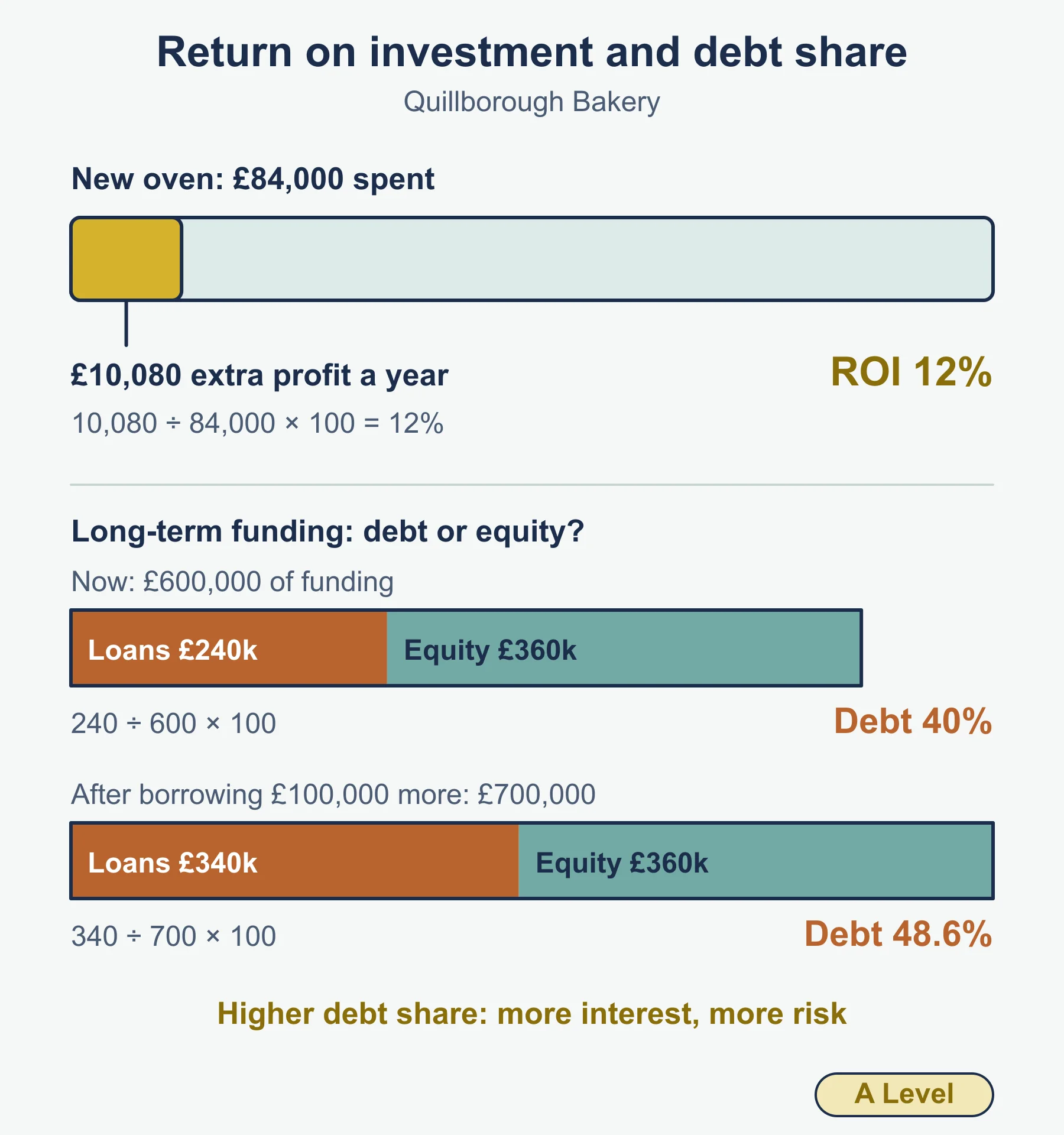
Return on investment. The standard form is ROI (%) = profit gained ÷ amount invested × 100.
Debt as a proportion of long-term funding. The standard form is long-term debt ÷ (long-term debt + equity) × 100. A higher figure means more interest commitments and more risk.
Worked example 1. Quillborough Bakery buys a new oven for £84,000 that adds £10,080 to annual profit. ROI = 10,080 ÷ 84,000 × 100 = 12%. Its long-term funding is £240,000 of loans and £360,000 of equity, so debt is 240 ÷ 600 = 40%. If it borrows another £100,000 for expansion, debt becomes 340 ÷ 700 = 48.6%. Whether this is wise depends on how stable its profits are.
2. Influences on objectives and decisions
Internal: business size, owners’ attitude to risk, available cash and the aims of other functions.
External: interest rates, competitors’ pricing, the state of the economy, shareholder expectations, and legal and ethical pressures. High interest rates may lead a firm to lower its debt target.
3. Budgets and variance analysis
A budget is a financial plan for a period, with targets for income and spending. Its value lies in setting targets, controlling spending, giving managers responsibility, coordinating plans and flagging problems early.
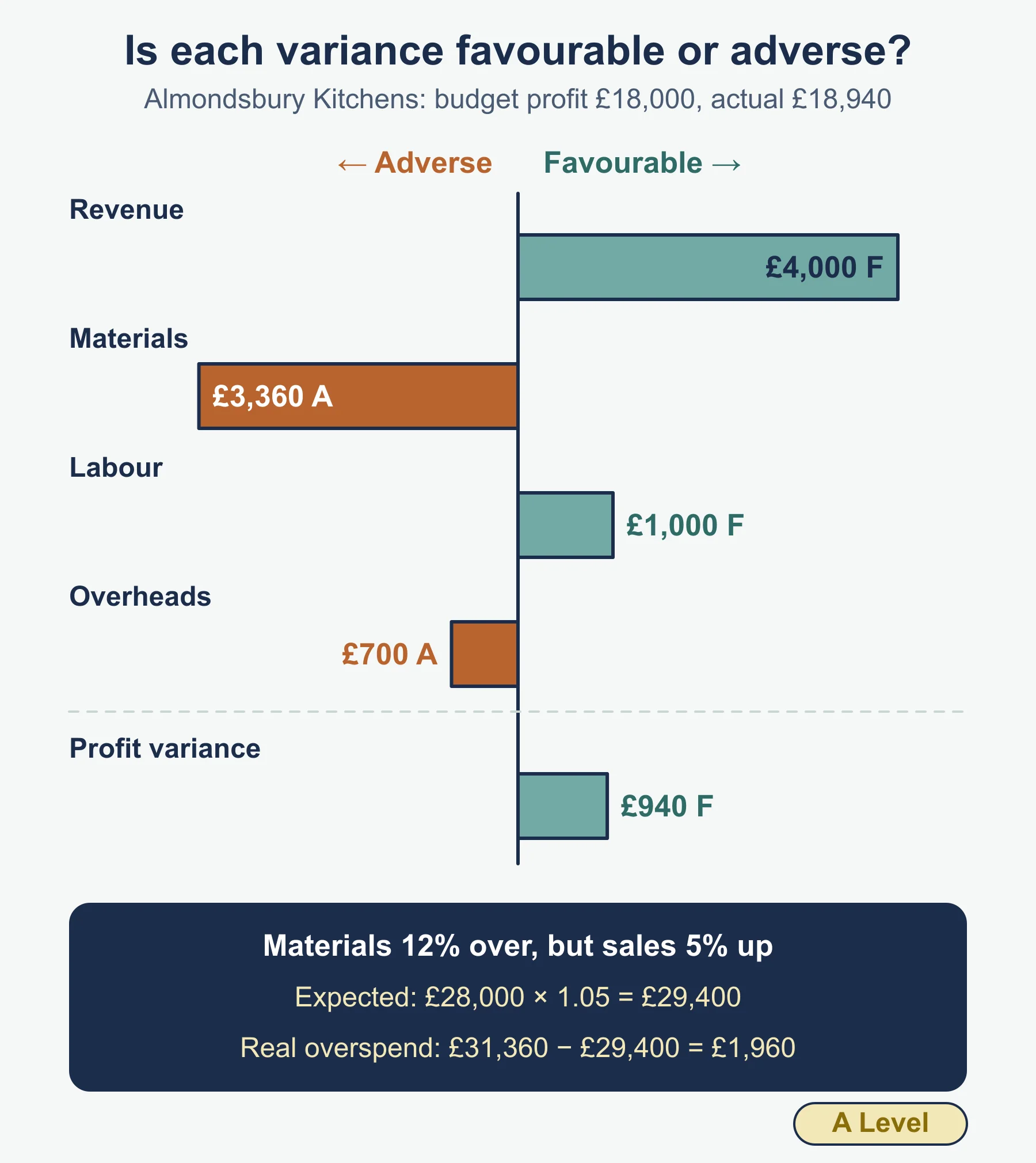
Variance analysis compares actual with budget. A variance is favourable if it increases profit (higher revenue or lower cost) and adverse if it reduces profit.
Worked example 2. Almondsbury Kitchens budgets for one month and records these results.
| Item | Budget (£) | Actual (£) | Variance (£) | Type |
|---|---|---|---|---|
| Revenue | 80,000 | 84,000 | 4,000 | Favourable |
| Materials | 28,000 | 31,360 | 3,360 | Adverse |
| Labour | 20,000 | 19,000 | 1,000 | Favourable |
| Overheads | 14,000 | 14,700 | 700 | Adverse |
Budgeted profit = 80,000 − 28,000 − 20,000 − 14,000 = £18,000. Actual profit = 84,000 − 31,360 − 19,000 − 14,700 = £18,940. The profit variance is £940 favourable. Materials were 12% over budget, but revenue was 5% higher, so about £29,400 was expected; the real overspend is about £1,960. Ask why, not just the sign.
4. Cash flow forecasts
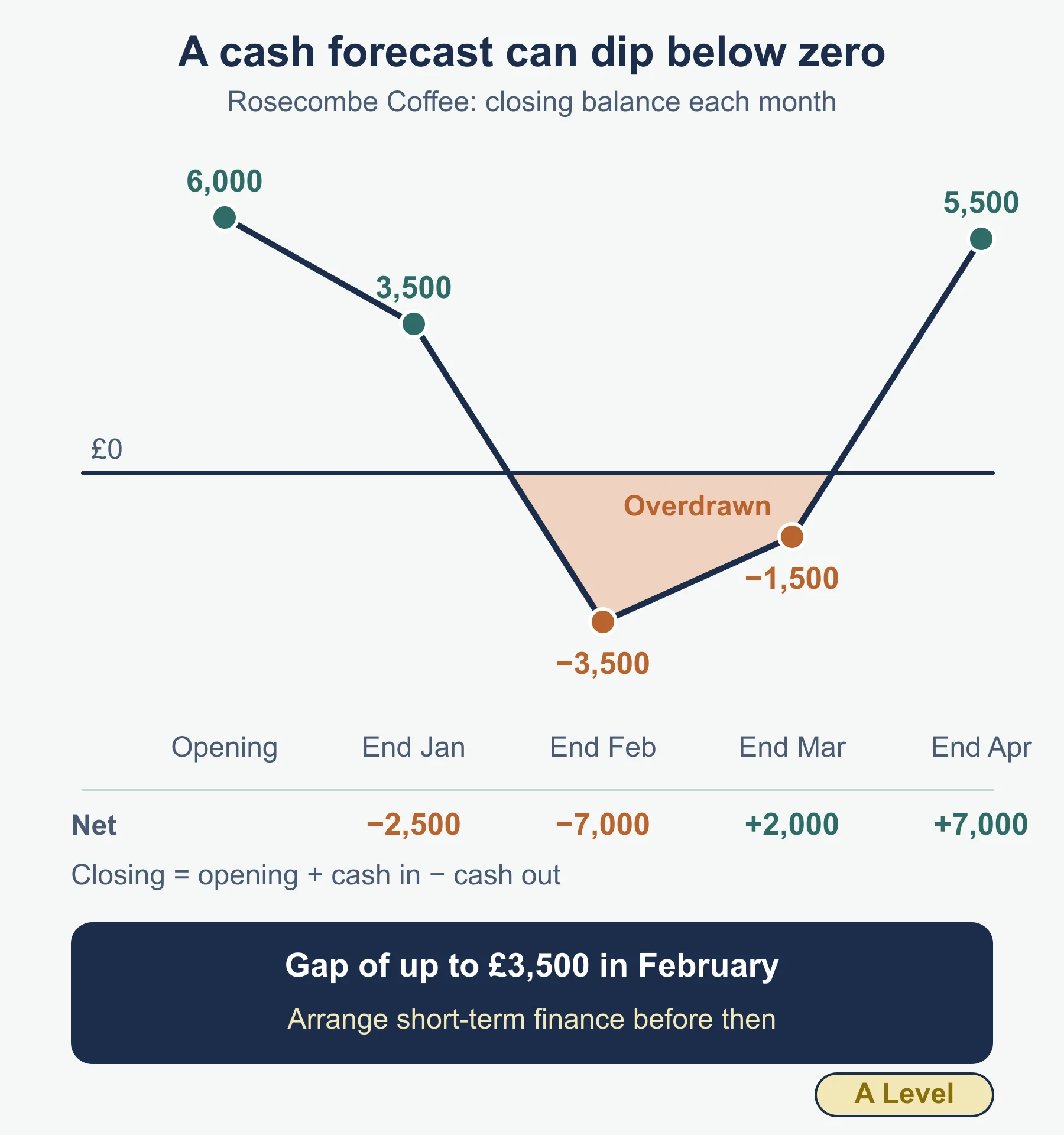
A cash flow forecast lists expected cash in and cash out by month. Net cash flow = cash in − cash out. Closing balance = opening balance + net cash flow, and becomes next month’s opening balance.
Worked example 3. Rosecombe Coffee begins January with £6,000.
| Jan | Feb | Mar | Apr | |
|---|---|---|---|---|
| Opening balance | 6,000 | 3,500 | −3,500 | −1,500 |
| Cash in | 22,000 | 19,000 | 25,000 | 31,000 |
| Cash out | 24,500 | 26,000 | 23,000 | 24,000 |
| Net cash flow | −2,500 | −7,000 | 2,000 | 7,000 |
| Closing balance | 3,500 | −3,500 | −1,500 | 5,500 |
The forecast shows a gap of up to £3,500 in February, so the owner should arrange short-term finance before then. Forecasts rely on estimates, so a pessimistic version is a sensible check.
5. Break-even analysis
Break-even output is where total revenue equals total costs. The formulas below are the standard forms.
- Contribution per unit = selling price − variable cost per unit.
- Break-even output = fixed costs ÷ contribution per unit.
- Margin of safety = planned (or actual) output − break-even output.
- Total contribution = contribution per unit × output.
- Profit = total contribution − fixed costs.
- Output for target profit = (fixed costs + target profit) ÷ contribution per unit.
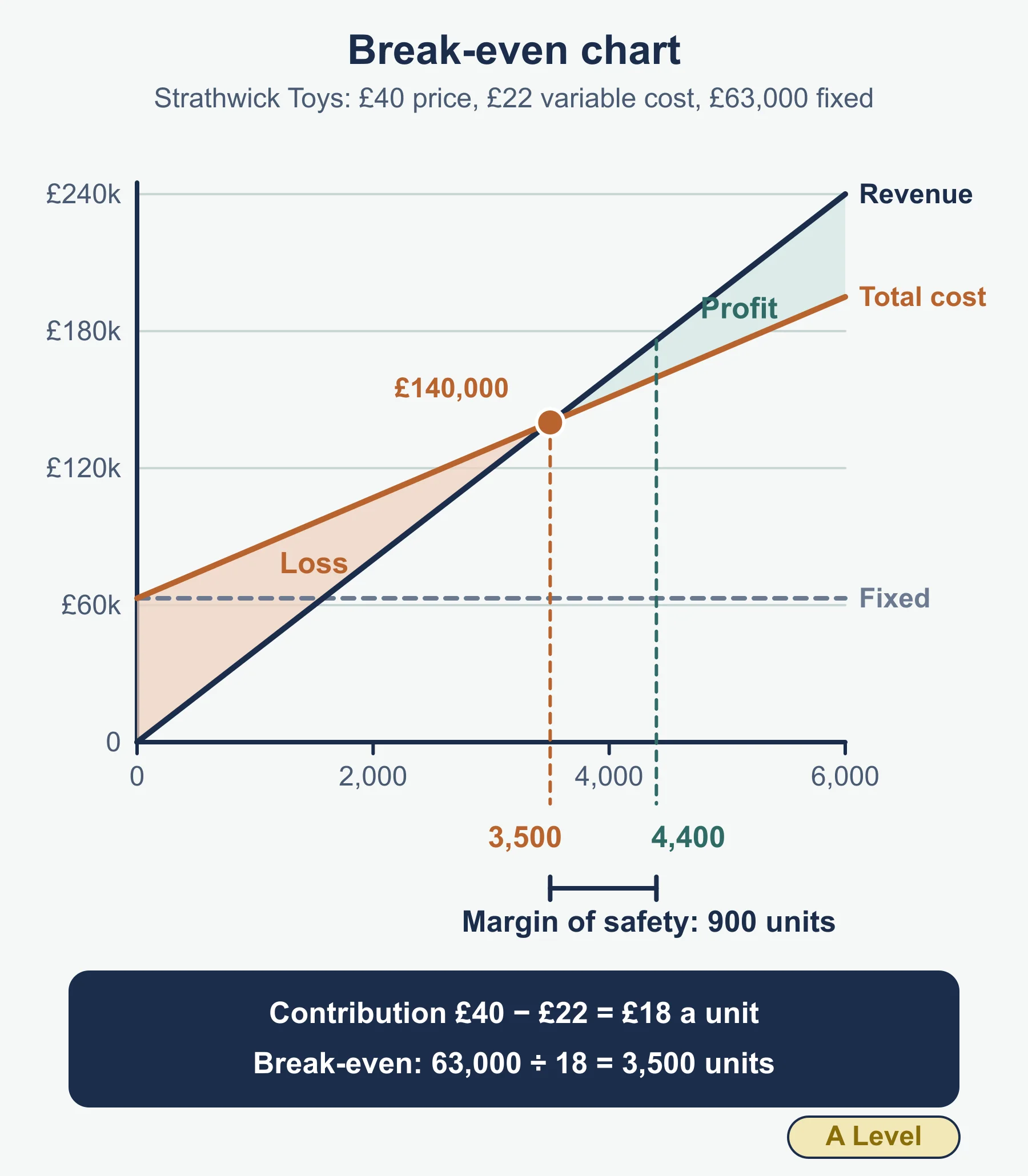
Worked example 4. Strathwick Toys sells at £40, with variable cost £22 and fixed costs £63,000. It plans to sell 4,400.
- Contribution per unit = 40 − 22 = £18.
- Break-even output = 63,000 ÷ 18 = 3,500.
- Margin of safety = 4,400 − 3,500 = 900 (about 20% of planned output).
- Total contribution = 18 × 4,400 = £79,200; profit = 79,200 − 63,000 = £16,200.
- Output for £27,000 profit = (63,000 + 27,000) ÷ 18 = 5,000.
Drawing the chart. Output goes on the horizontal axis and £ on the vertical. Draw the fixed cost line (flat at £63,000), the total cost line (from £63,000, rising £22 per unit) and the revenue line (from the origin, rising £40 per unit). They cross at 3,500 units, where both equal £140,000. Below that output is a loss; above it, a profit. The horizontal gap from break-even to planned output is the margin of safety.
Effects of changes (each from the original figures):
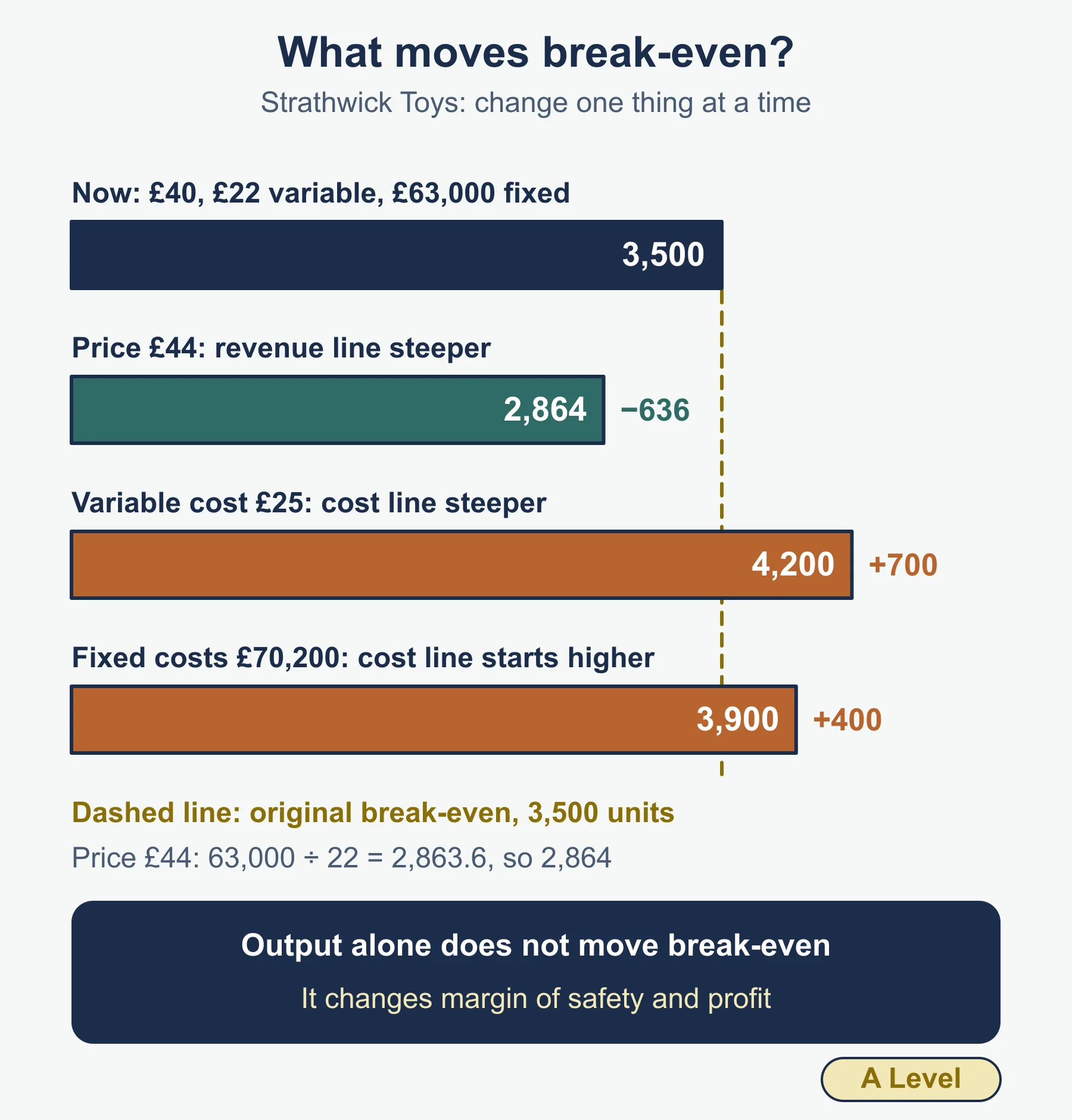
- Price rises to £44: contribution £22, break-even 63,000 ÷ 22 = 2,863.6, so 2,864 units. The revenue line is steeper.
- Variable cost rises to £25: contribution £15, break-even 4,200. The total cost line is steeper.
- Fixed costs rise to £70,200: break-even 3,900. The total cost line starts higher with the same slope.
- A change in output alone does not move break-even; it changes the margin of safety and profit.
Value of break-even analysis. It is simple and shows risk. It assumes constant price, straight-line costs, that all output is sold and that demand ignores price changes.
6. Analysing profitability
Profit in pounds says little until it is compared with revenue or with earlier years. The text names gross profit, profit from operations and profit for the year. The margin formulas are the standard form: profit measure ÷ revenue × 100.
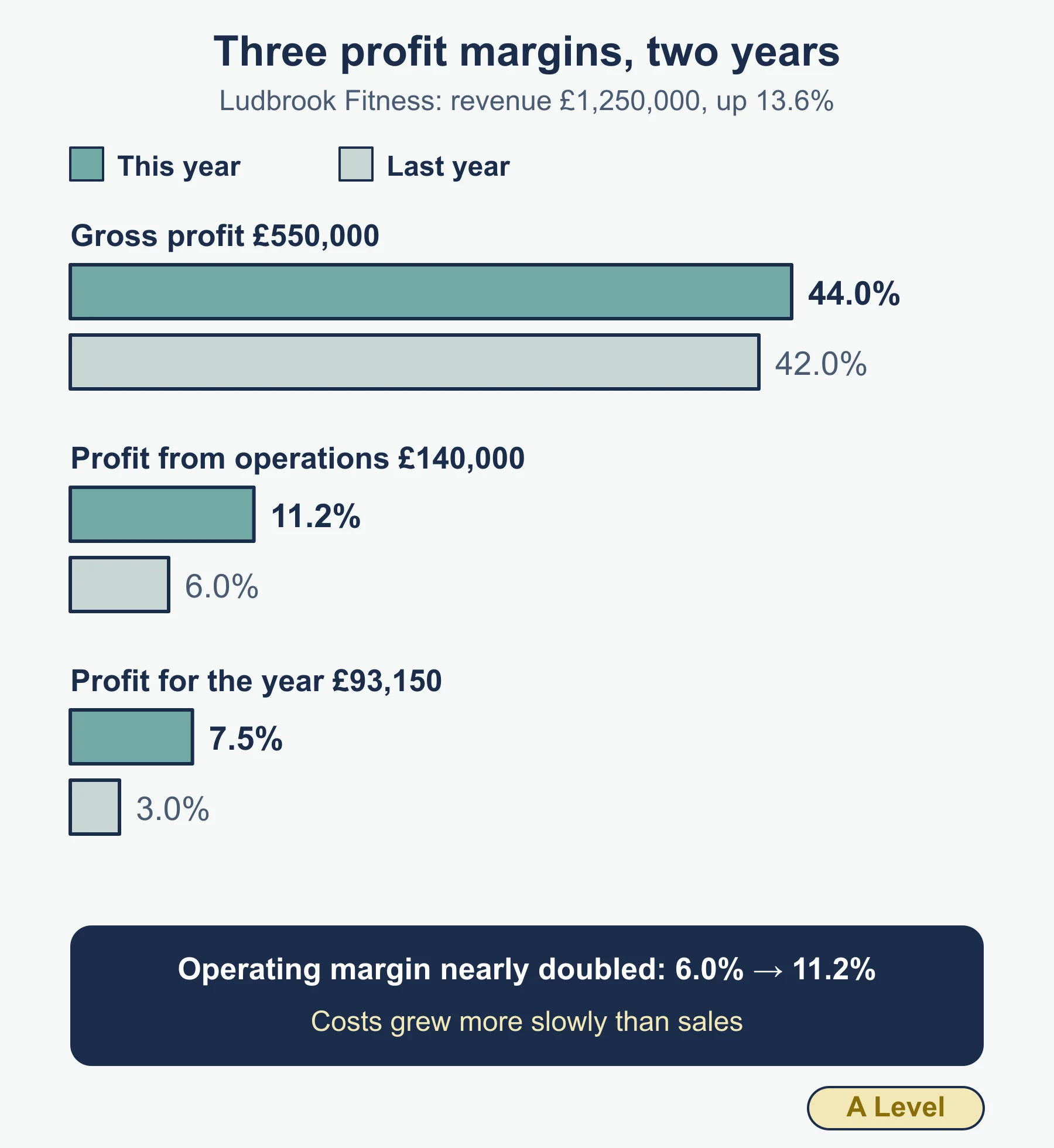
Worked example 5. Ludbrook Fitness has revenue £1,250,000, cost of sales £700,000, operating expenses £410,000, finance costs £25,000 and tax at 19% of profit before tax.
| Measure | This year (£) | Margin | Last year margin |
|---|---|---|---|
| Gross profit | 550,000 | 44.0% | 42.0% |
| Profit from operations | 140,000 | 11.2% | 6.0% |
| Profit before tax | 115,000 | ||
| Profit for the year | 93,150 | 7.5% | 3.0% |
Last year’s revenue was £1,100,000, so revenue grew 13.6%. The operating margin nearly doubled, so operating expenses grew far more slowly than sales. Economies of scale or tight cost control are possible causes to check.
7. Timing of cash flows, and the use of data
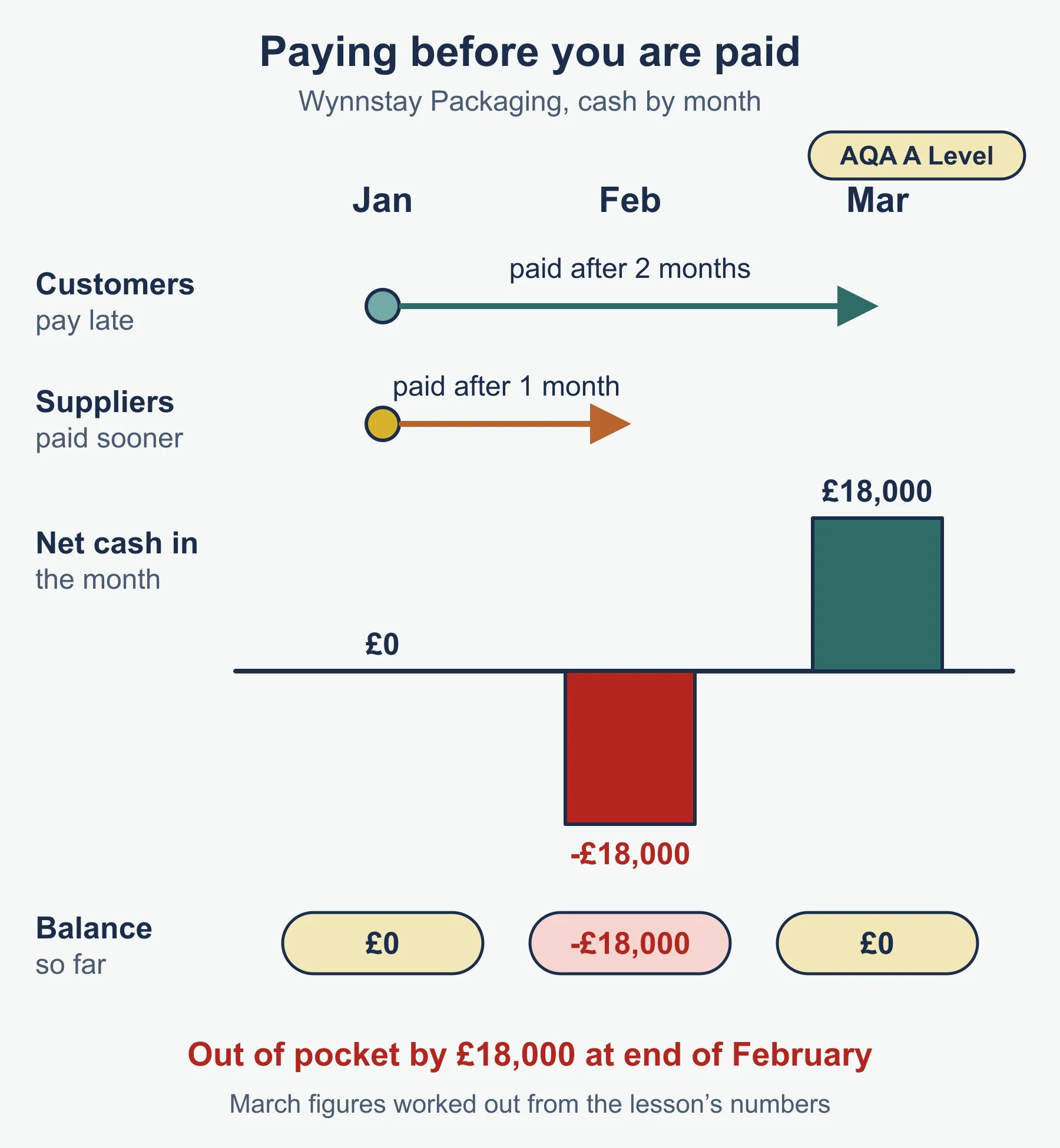
Receivables are customers who owe money for goods already supplied. Payables are suppliers the business owes. If a firm pays suppliers quickly but waits for customers, it finances its customers.
Worked example 6. Wynnstay Packaging sells £36,000 of goods a month and its customers pay after two months. It buys £18,000 of materials a month and pays suppliers after one month. In January nothing moves. In February it pays £18,000 for January’s materials with no cash in. In March £36,000 arrives from January sales while another £18,000 goes out. On these items alone it is £18,000 out of pocket at the end of February.
Use of data. Managers use sales histories, cost records, forecasts, market data and ratios to set objectives, price, invest and choose finance. Good use asks how recent and reliable the data is.
8. Sources of finance
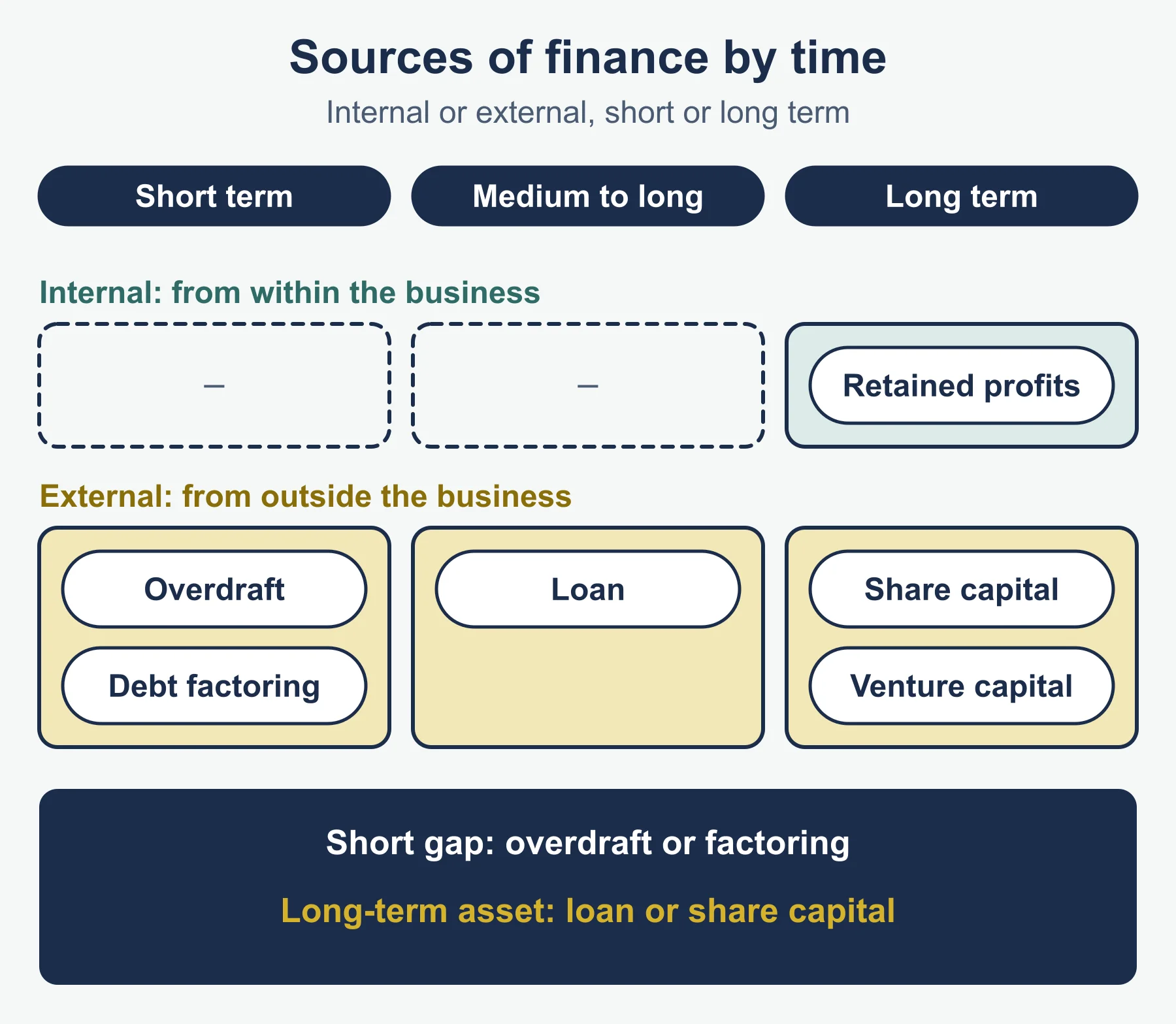
Internal sources come from inside the business. External sources come from outside.
| Source | Type | Typical use | Points to weigh |
|---|---|---|---|
| Overdraft | External | Short term | Flexible and quick; interest only on the amount used; can be withdrawn and costly if left in place |
| Debt factoring | External | Short term | Cash from unpaid invoices at once; a fee is charged and the factor deals with customers |
| Loans | External | Medium to long | Planned repayments; interest is a fixed commitment and security may be needed |
| Retained profits | Internal | Long term | No interest, no new owners; limited to profits earned and not paid out |
| Share capital | External | Long term | No repayment or interest; existing owners are diluted and dividends may be expected |
| Venture capital | External | Long term | Large sums and expertise for risky firms; the investor takes a stake and wants a say |
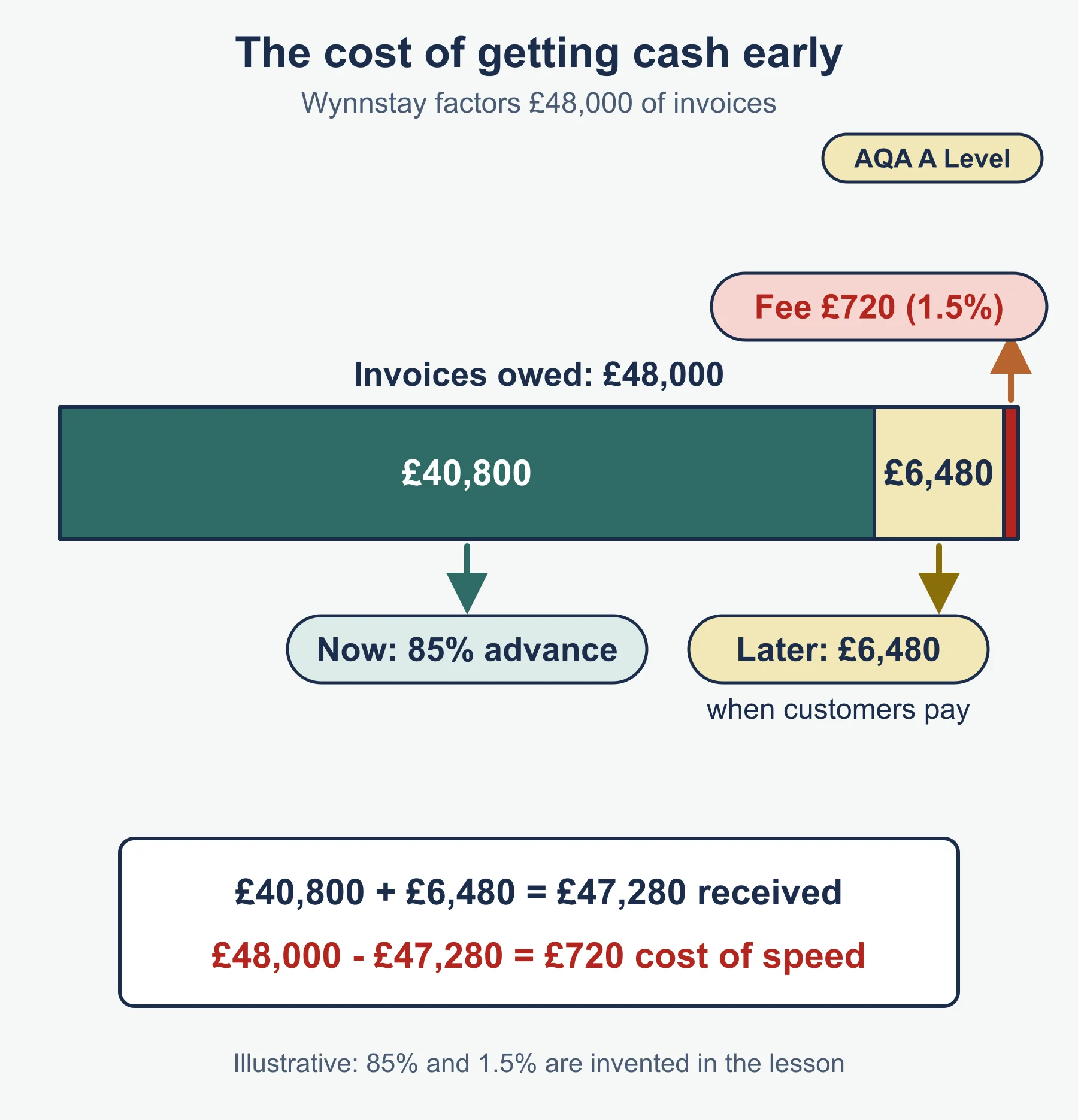
Worked example 7. Wynnstay factors £48,000 of invoices. The 85% advance and 1.5% fee are invented for this example. It receives 0.85 × 48,000 = £40,800 now; the fee is £720; when customers pay, it receives the remaining £6,480, so £47,280 in total. The cost of speed is £720. Match the source to the need: factoring suits a short gap; a loan, share capital or retained profit suits a long-lived asset.
9. Improving cash flow and profits
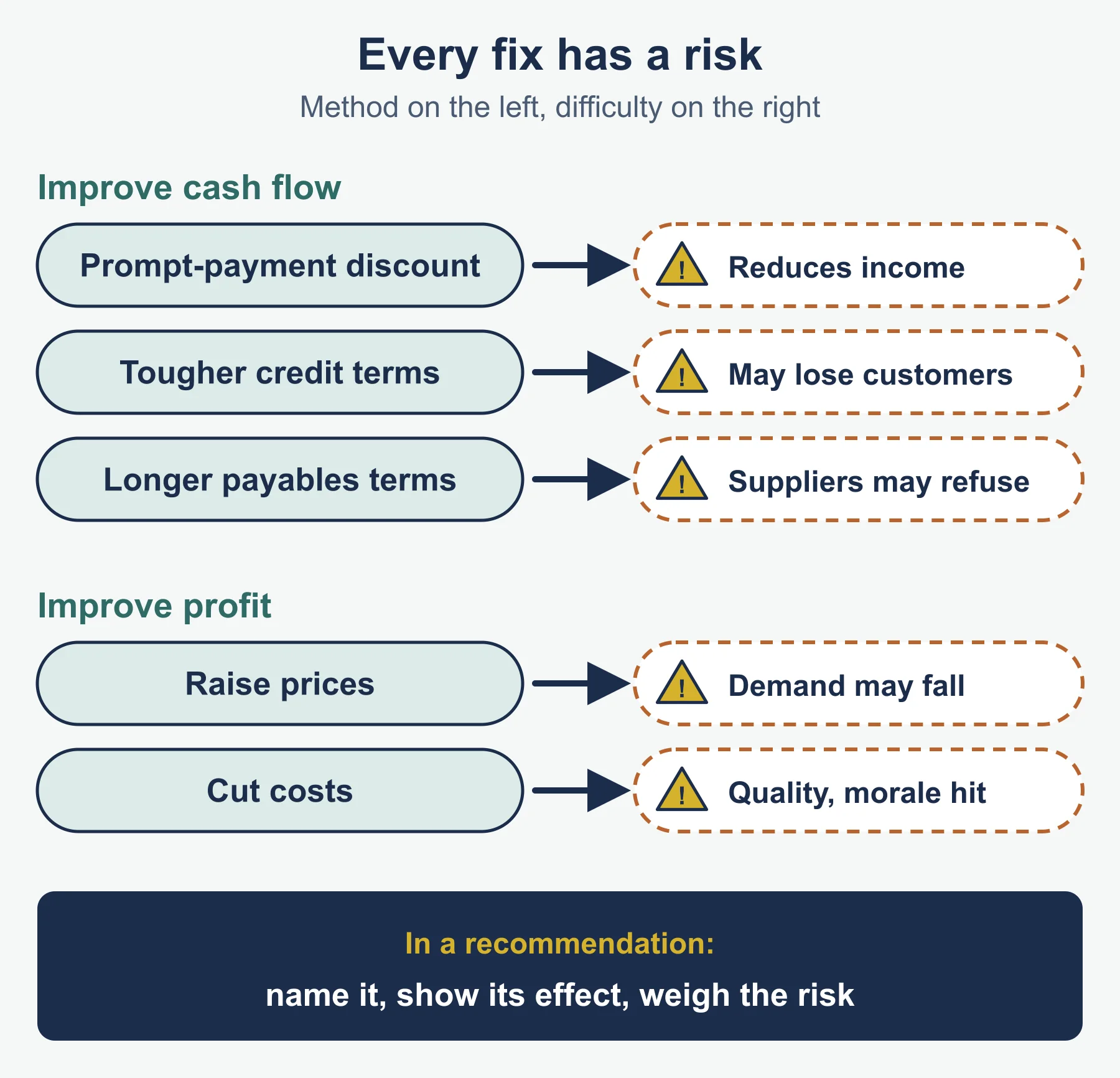
Cash flow methods: chase receivables, offer early-payment discounts, use factoring, negotiate longer payment terms with suppliers, reduce stock, delay capital spending, arrange an overdraft, sell unused assets.
Profit and profitability methods: raise price, increase volume, cut variable or fixed costs, change supplier, raise productivity, shift sales to higher-margin lines.
Worked example 8. Sudbourne Pet Foods has revenue £600,000, variable costs £360,000 and fixed costs £180,000, so profit is £60,000 (a 10% margin). A 5% price rise cuts volume by 4%. Revenue becomes 600,000 × 1.05 × 0.96 = £604,800, variable costs 360,000 × 0.96 = £345,600, and profit £79,200 (13.1% margin).
Difficulties: discounts reduce income; stricter credit may lose customers; price rises may reduce demand more than expected; cost cuts may damage quality or morale; suppliers may refuse longer terms; and profit and cash aims can conflict. A strong answer weighs methods and recommends one.
10. Wider influences
Throughout section 3.5 the text asks you to consider these.
- Technology: crowd funding raises small sums from many people online; software speeds up forecasting.
- Market conditions and competition: price wars squeeze margins; a downturn slows receivables.
- Ethics and the environment: greener equipment may pay back more slowly; harsh debt chasing may be questioned.
- Competitiveness: sound finance lets a firm invest and price sharply.
- Other functions: marketing and operations plans all draw on the finance budget.
Common errors
- Treating profit and cash as the same.
- Not rounding break-even output up to a whole unit.
- Using total variable cost instead of cost per unit in contribution.
- Listing finance sources without matching them to the firm’s need and time horizon.
Frequently asked questions
What are the three profit measures in AQA Business? Gross profit = revenue − cost of sales; profit from operations = gross profit − operating expenses; and profit for the year = profit from operations − finance costs − tax.
How do you calculate return on investment? ROI (%) = profit gained ÷ amount invested × 100. For example, an oven costing £84,000 that adds £10,080 to annual profit gives an ROI of 12%.
What are the limitations of break-even analysis? Break-even analysis assumes a constant price, straight-line costs and that all output is sold, so it is only as reliable as those assumptions.
What types of financial objective can a business set? Objectives can cover revenue, costs and profit; cash flow, such as keeping the closing balance above a set floor; capital expenditure levels; and capital structure, the mix of debt and share capital.
Which section of the AQA Business specification covers financial management? Section 3.5, Decision making to improve financial performance, subsections 3.5.1 to 3.5.4, in AQA AS and A-level Business (7131 and 7132).
Official syllabus
AQA AS and A-level Business (7131/7132), section 3.5 Decision making to improve financial performance, subsections 3.5.1 to 3.5.4, published by AQA.
Get free revision emails (optional)
Occasional emails with practice questions, worked explanations and links to free resources for the qualification and subjects you choose. No spam, and you can unsubscribe from any email. The free tools on this site never need an email.
Related resources
-
Practice questions
AQA A-Level Business: Financial management (7132) – Practice Questions
Twelve original practice questions with worked answers on financial management for AQA A-Level Business (7132), mixing calculations and case studies.
Business · AQA · A Level
Try questions -
Revision notes
AQA A-Level Business: Financial management (7132) – Revision Notes
Condensed revision notes on financial management for AQA A-Level Business (7132): formulas, methods, finance sources, self-test and common slips.
Business · AQA · A Level
Revise topic -
Study guides
AQA A-Level Business: Human resource management (7132)
Study guide to AQA A-level Business 7132 section 3.6: HR objectives, HR data, job and organisational design, motivation and employer-employee relations.
Business · AQA · A Level
Read guide
Related articles
-
teaching
A Level tuition in Dubai: Cambridge or Pearson Edexcel International A Level?
Schools in Dubai and Abu Dhabi teach either Cambridge International AS & A Level or Pearson Edexcel International A Level. How the two are structured, why it matters for tuition, and how online classes from Lahore work.
9 October 2026
-
curriculum guides
Choosing subjects at IGCSE and A Level
How subject choices at 14 and 16 affect university options later, and how to keep pathways open without overloading a timetable.
28 July 2026
Studying this with a teacher
Working through Business A LEVELS?
This page is free and stays free. If you would rather be taught it, Marlbridge runs Business classes one-to-one and in small groups of up to 15, online in your own time zone. The first trial class is free. WhatsApp replies within an hour (8am–11pm Pakistan time, every day); email the same day.
AQA Business teachers at Marlbridge
