
Revision Notes
AQA A-Level Business: Financial management (7132) – Revision Notes
Condensed revision notes on financial management for AQA A-Level Business (7132): formulas, methods, finance sources, self-test and common slips.
- Subject
- Business
- Level
- A LEVELS
- Topic
- Financial management
- Author
- Marlbridge Academic Team
- Updated
- Reviewed by
- Salman Ahmad (what this means)
Aligned to AQA A Level Business (7132), For first teaching from September 2023. Official specification .
Syllabus page (what it covers and how it is assessed): AQA A Level Business.
Syllabus points this page covers
7132
- 5 Financial management (whole topic)
Found an error? Report a correction.
Need help with this topic? Request a free trial class for A Level Business (7132).
These notes condense section 3.5, Decision making to improve financial performance (subsections 3.5.1 to 3.5.4), of the AQA AS and A-level Business specification text (7131/7132). For full explanations and worked examples, read the study guide, then test yourself with the practice questions. Find weak spots with the free diagnostics, and use the course hub and the printable checklist to track progress.
Map of the topic
| Section | Points |
|---|---|
| 3.5.1 Setting financial objectives | Value of objectives; return on investment; debt share of long-term funding; cash flow versus profit; gross profit, profit from operations, profit for the year; revenue, cost and profit objectives; cash flow objectives; capital expenditure; capital structure; internal and external influences |
| 3.5.2 Analysing financial performance | Budgets and variances; cash flow forecasts; value of budgeting; break-even charts and calculations; effects of changes; value of break-even; profitability ratios; timing of cash flows with payables and receivables; use of data |
| 3.5.3 Sources of finance | Internal and external; debt factoring, overdrafts, retained profits, share capital, loans, venture capital; short and long term uses |
| 3.5.4 Improving cash flow and profits | Methods; assessing them; difficulties |
| Throughout | Technology, market conditions and competition, ethics and the environment, competitiveness, links to other functions |
Key definitions
- Financial objective: a numerical target for money, such as revenue, profit, cash, spending on assets or the debt level.
- Cash flow: money moving into and out of the business.
- Profit: revenue minus costs, counted when earned or incurred.
- Receivables: money owed to the business by customers.
- Payables: money the business owes to suppliers.
- Budget: a financial plan for a period with targets for income and spending.
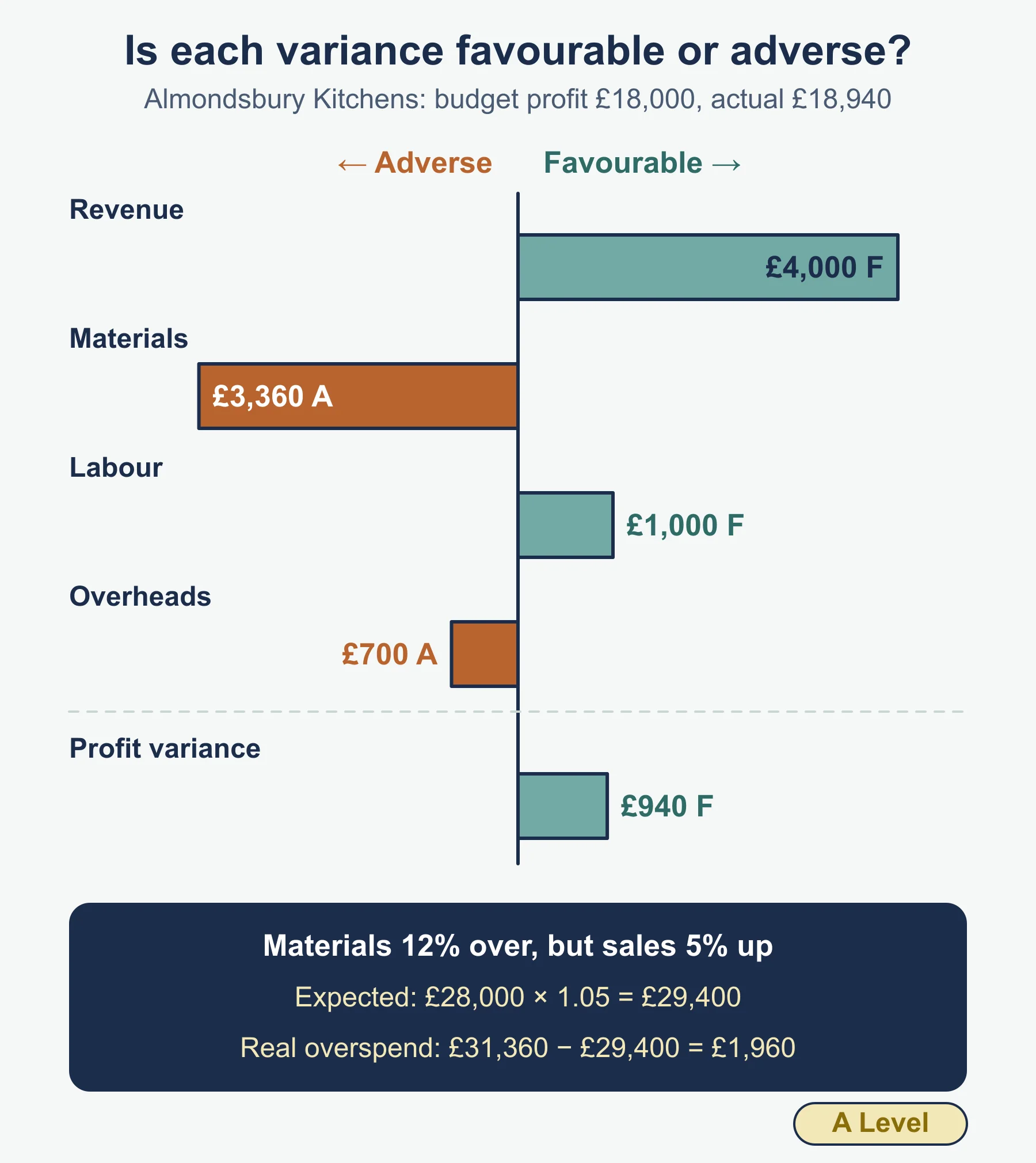
- Variance: actual minus budget, labelled favourable (improves profit) or adverse (reduces profit).
- Contribution per unit: price minus variable cost per unit.
- Margin of safety: how far planned output is above break-even.
Formulas (standard forms)
| Measure | Formula |
|---|---|
| Gross profit | Revenue − cost of sales |
| Profit from operations | Gross profit − operating expenses |
| Profit for the year | Profit from operations − finance costs − tax |
| Margin | Profit measure ÷ revenue × 100 |
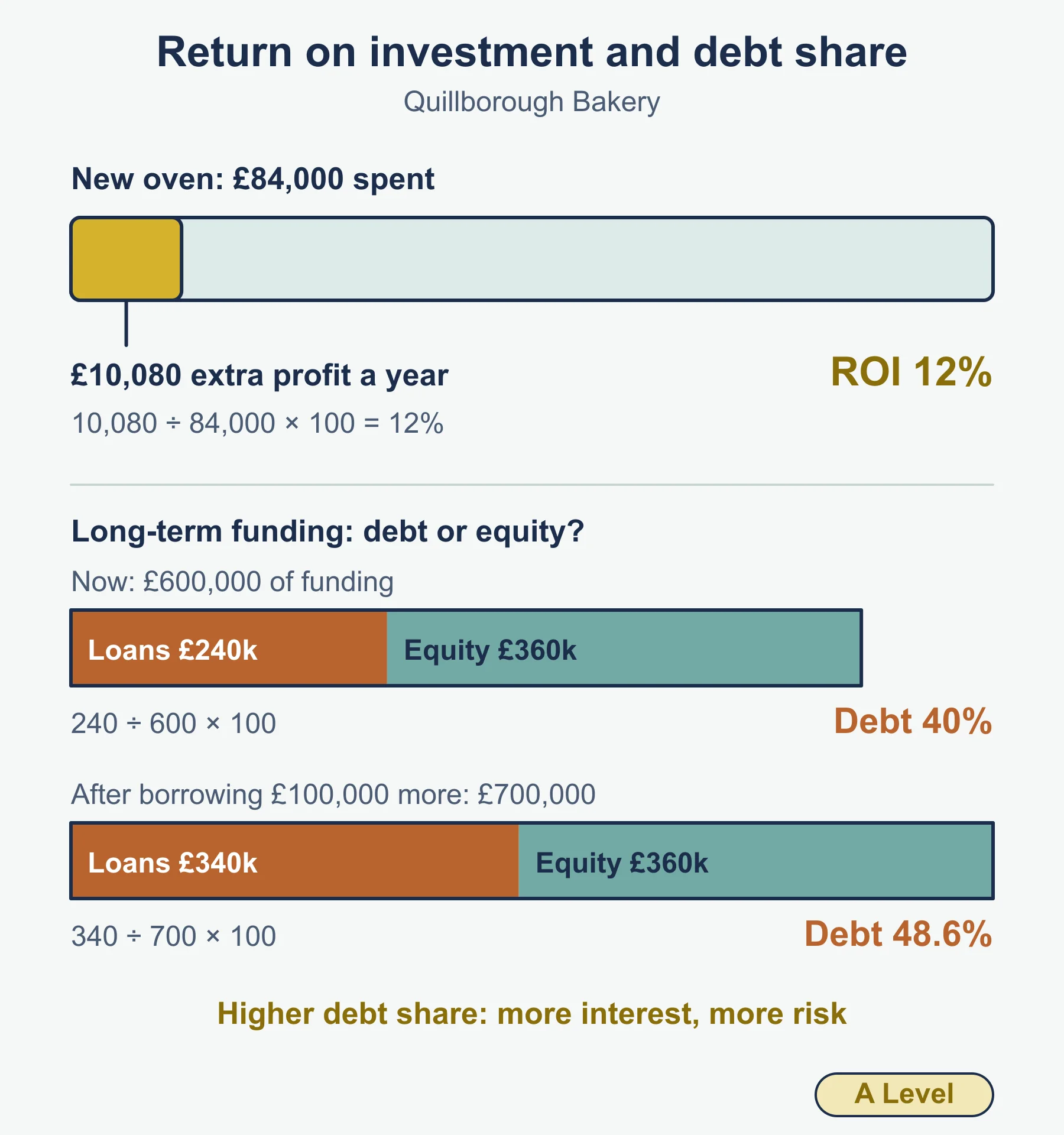
| Return on investment | Profit gained ÷ amount invested × 100 |
| Debt share of long-term funding | Long-term debt ÷ (long-term debt + equity) × 100 |
| Net cash flow | Cash in − cash out |
| Closing balance | Opening balance + net cash flow |
| Contribution per unit | Selling price − variable cost per unit |
| Break-even output | Fixed costs ÷ contribution per unit |
| Margin of safety | Planned output − break-even output |
| Total contribution | Contribution per unit × output |
| Profit | Total contribution − fixed costs |
| Output for target profit | (Fixed costs + target profit) ÷ contribution per unit |
Method boxes
Variance analysis in steps
- Subtract budget from actual for each line.
- Label it. Revenue above budget is favourable; costs above budget are adverse; costs below budget are favourable.
- Work out the profit variance by comparing actual and budgeted profit.
- Ask whether volume explains it, then suggest a cause and an action.
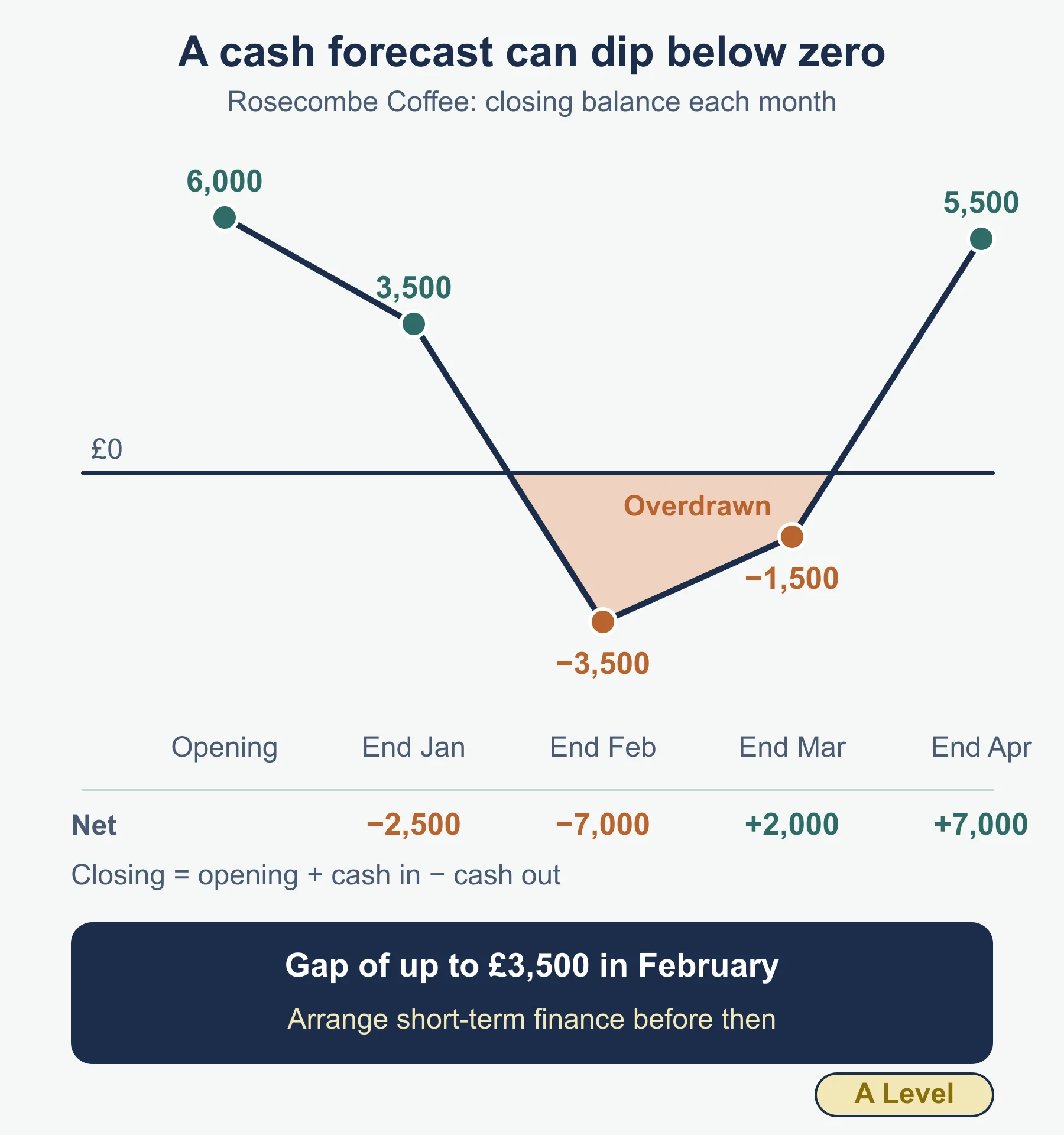
Cash flow forecast in steps
- Enter cash in and cash out for each month, not revenue and costs.
- Net cash flow = in − out.
- Closing = opening + net; copy it forward as next opening.
- Circle the months below zero or below the safety floor and propose finance.
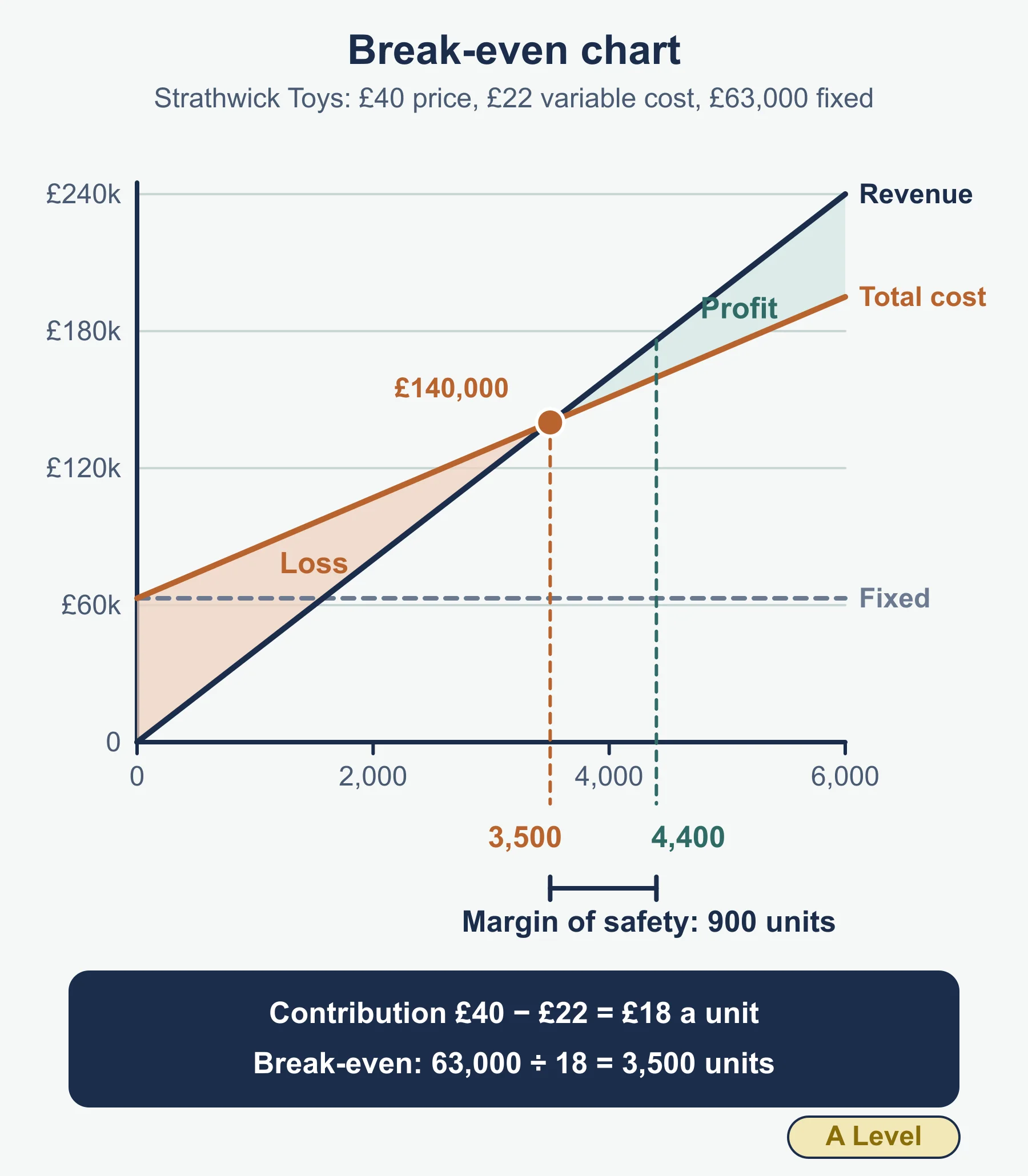
Break-even chart in steps
- Axes: output across, £ up.
- Fixed cost line, flat.
- Total cost line from the fixed cost level, rising by variable cost per unit.
- Revenue line from the origin, rising by price.
- The crossing point is break-even output. The gap between break-even and planned output is the margin of safety.
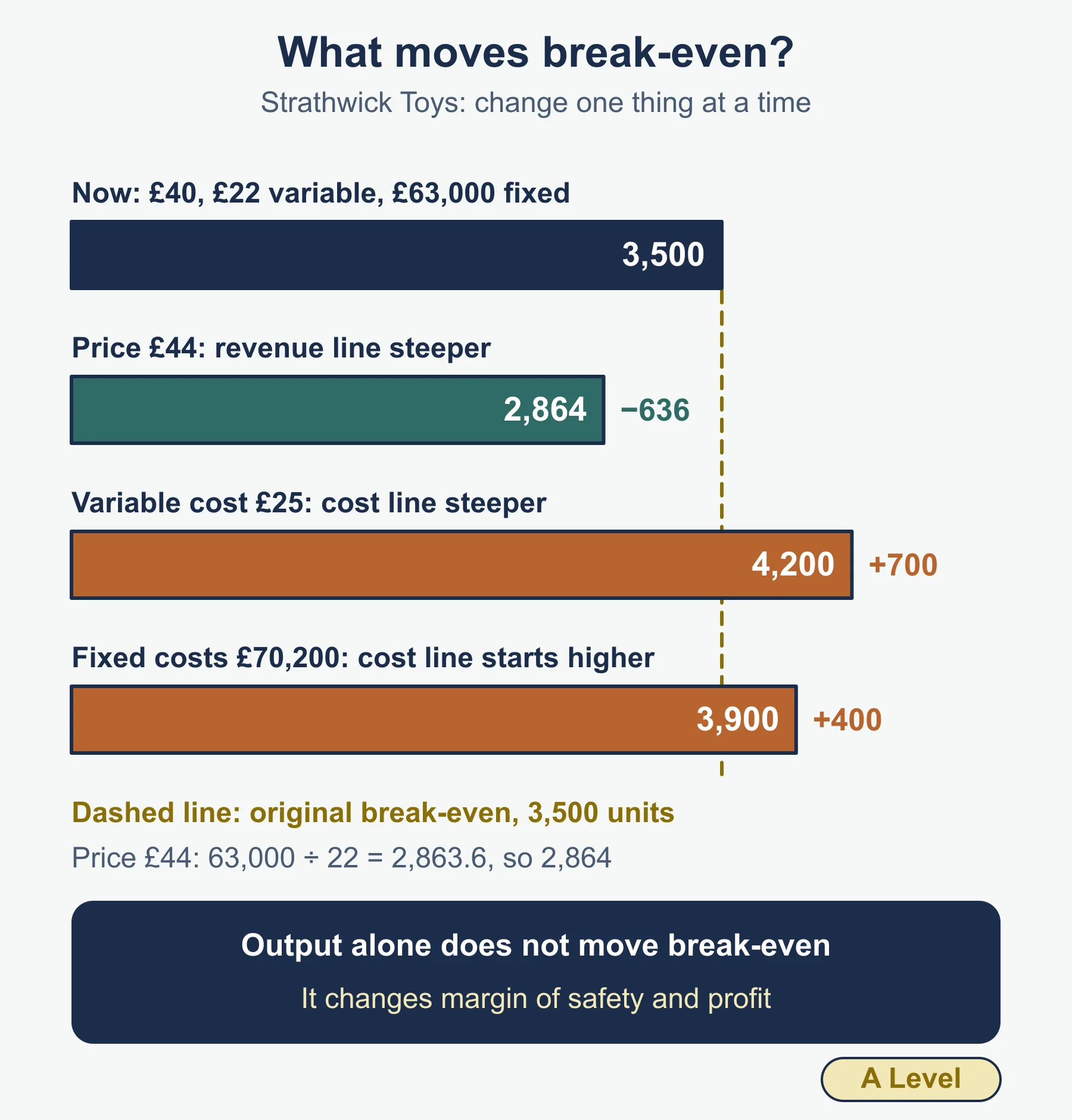
Effects of changes on the chart
- Higher price: revenue line steeper; break-even falls.
- Higher variable cost: total cost line steeper; break-even rises.
- Higher fixed costs: total cost line starts higher, same slope; break-even rises.
Small worked reminders
Return on investment and debt. Raithby Print spends £50,000 on a press that adds £6,500 to profit a year. ROI = 6,500 ÷ 50,000 × 100 = 13%. With £90,000 of loans and £210,000 of equity, debt is 90 ÷ 300 = 30% of long-term funding.
Variance. Raithby budgets £15,000 for materials and spends £16,200: £1,200 adverse (8% over). Revenue budget is £40,000 and actual £37,000: £3,000 adverse. Budgeted profit before other costs is 40,000 − 15,000 = £25,000; actual is 37,000 − 16,200 = £20,800.
Break-even. Umberleigh Cards sells at £15 with variable cost £6 and fixed costs £27,000. Contribution = £9; break-even = 27,000 ÷ 9 = 3,000. At 3,600 planned, margin of safety = 600 and profit = 9 × 3,600 − 27,000 = £5,400. At a £17 price, contribution is £11 and break-even is 2,454.5, so 2,455.
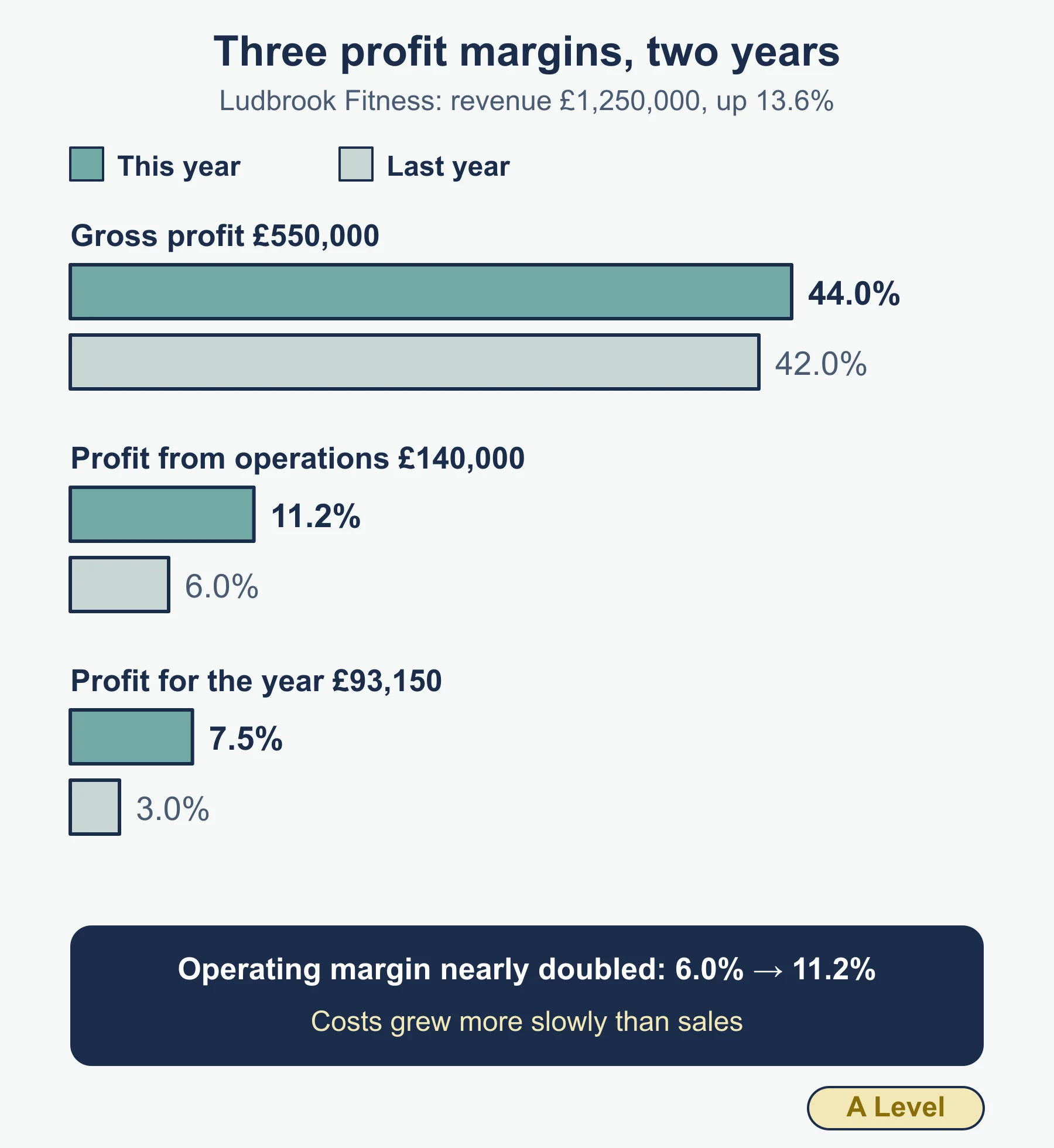
Margins. Revenue £200,000, cost of sales £120,000, operating expenses £52,000, finance costs £6,000, tax 20% of profit before tax. Gross profit £80,000 (40.0%). Profit from operations £28,000 (14.0%). Profit before tax £22,000, tax £4,400, profit for the year £17,600 (8.8%).
Sources of finance at a glance
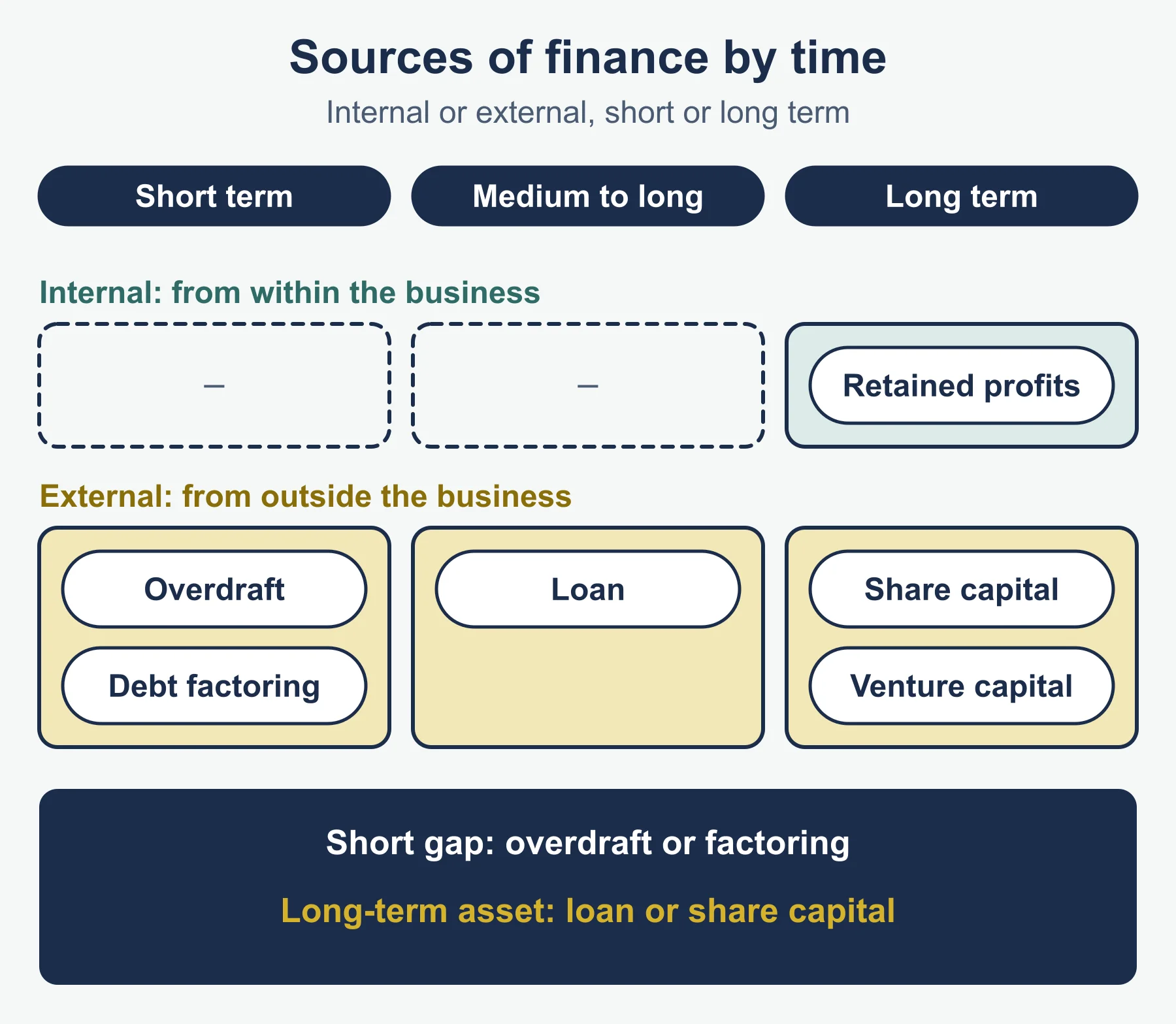
| Source | Internal or external | Use | Main advantage | Main disadvantage |
|---|---|---|---|---|
| Retained profits | Internal | Long | No interest, no new owners | Limited by past profit |
| Overdraft | External | Short | Flexible, pay interest on use only | Can be recalled; dear if long |
| Debt factoring | External | Short | Immediate cash from invoices | Fee; factor handles customers |
| Loans | External | Medium to long | Fixed repayments, ownership kept | Interest and security |
| Share capital | External | Long | No repayment or interest | Dilutes ownership |
| Venture capital | External | Long | Large sums and advice | Investor takes a stake and say |
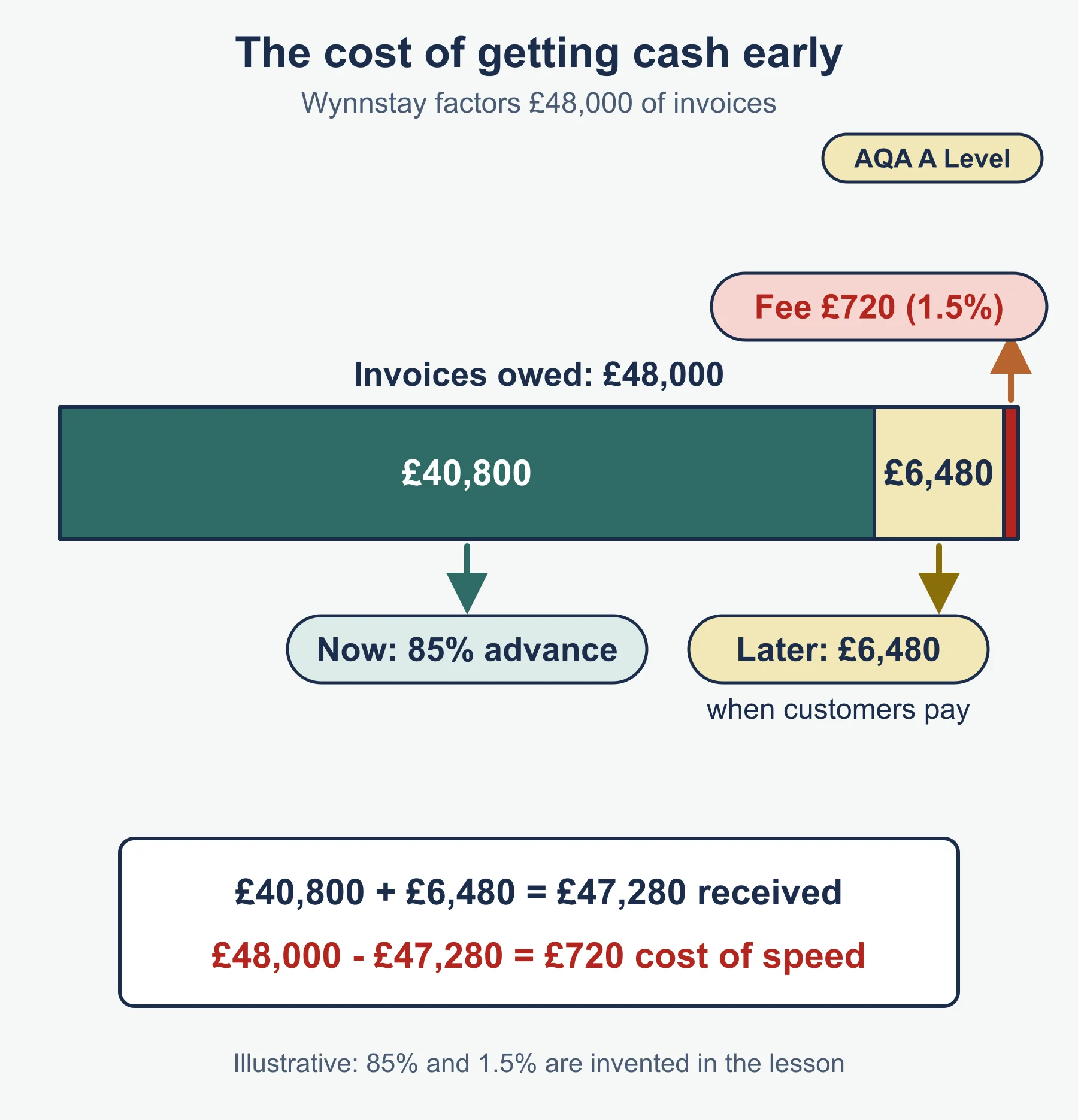
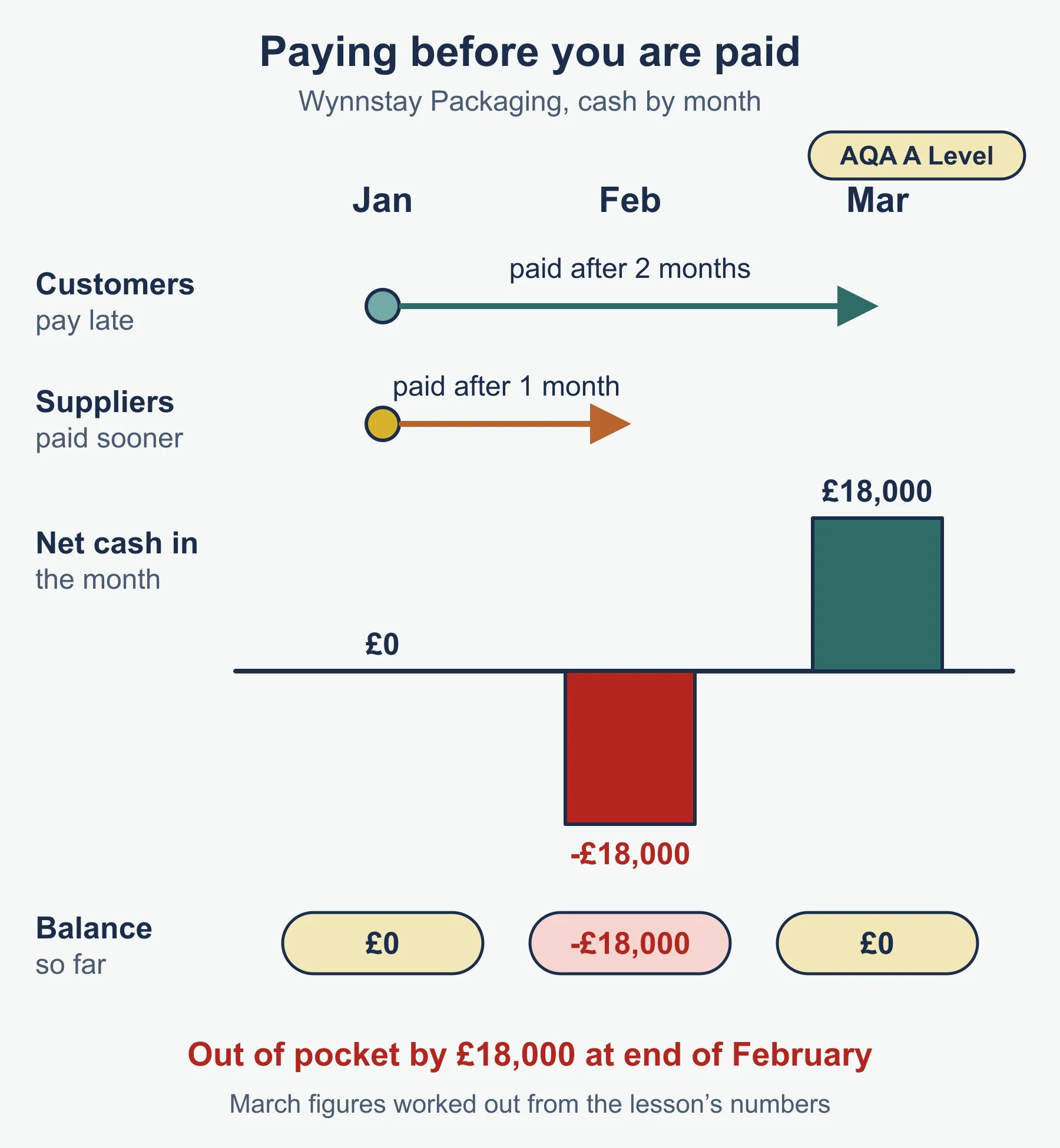
Debt factoring reminder. Invoices of £20,000, 90% advanced, 2% fee: advance £18,000, fee £400, total received £19,600. The figures are invented for practice.
Improving cash flow and profit
- Cash flow: chase receivables, early-payment discount, factoring, longer supplier terms, lower stock, delay capital spending, overdraft, sell spare assets.
- Profit and profitability: raise price, raise volume, cut variable or fixed costs, change supplier, improve productivity, change product mix.
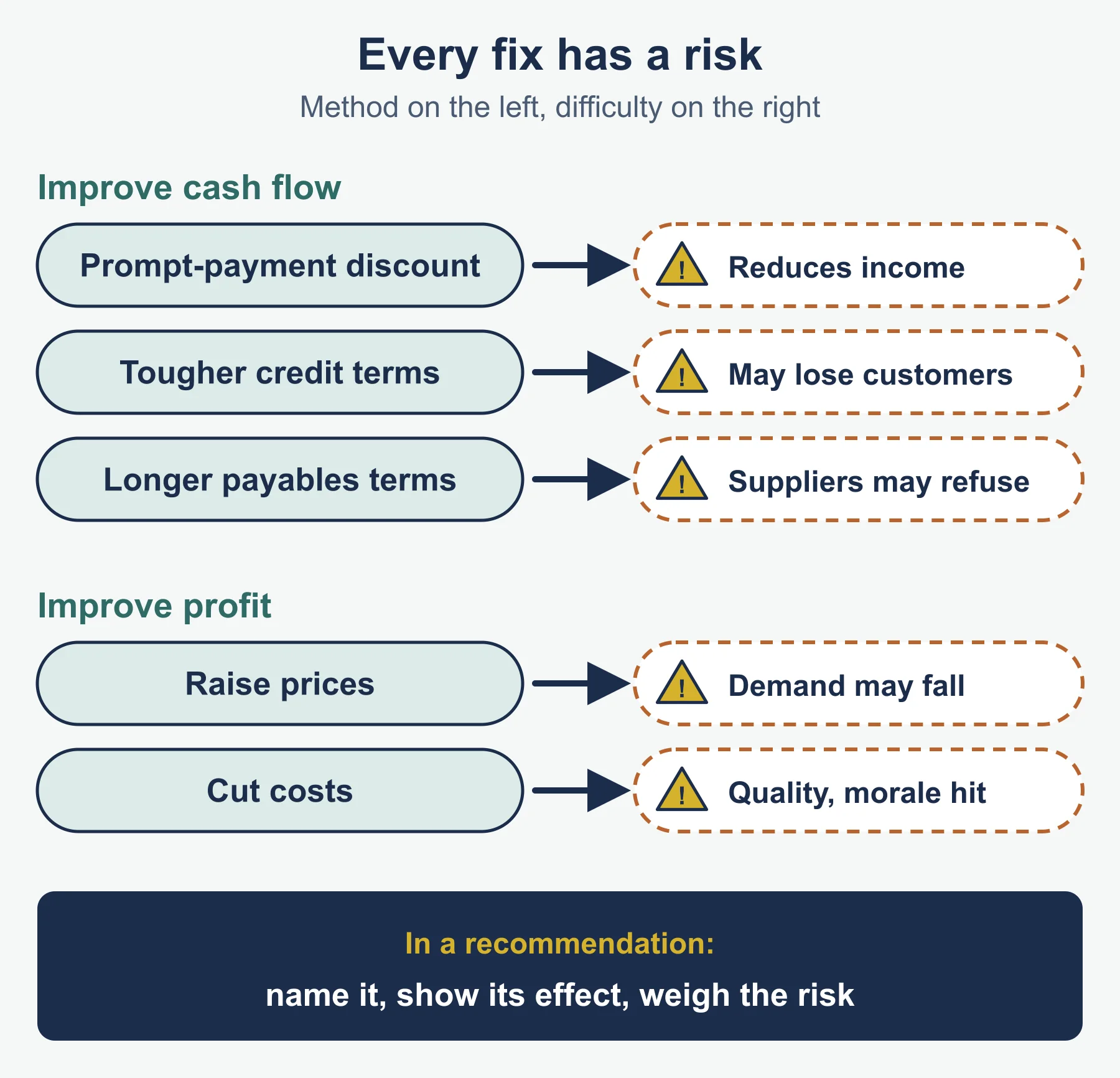
- Difficulties: discounts cut income; tighter credit loses customers; price rises can cut demand; cost cuts can harm quality; suppliers may refuse terms; profit and cash can pull in opposite directions.
Must-know distinctions
- Cash flow versus profit: cash is timing of money; profit is earned income less costs. A profitable firm can run out of cash.
- Gross profit versus profit from operations versus profit for the year: each deducts a further layer of cost.
- Adverse versus favourable: judged by the effect on profit, not by whether the number is bigger or smaller.
- Receivables versus payables: owed to you versus owed by you.
- Internal versus external finance: inside versus outside the business.
- Profit versus profitability: profit is an amount; profitability compares profit with revenue or investment.
Wider influences to weave into answers
- Technology: crowd funding, forecasting software.
- Market conditions and competition: price pressure, slow-paying customers in a downturn.
- Ethical and environmental influences: costs of greener choices, treatment of debtors.
- Competitiveness: finance that allows investment and flexible pricing.
- Other functions: marketing, operations and human resources spending.
Quick self-test
- Distinguish cash flow from profit.
- Write the formula for profit for the year.
- A £120,000 investment adds £18,000 a year to profit. Calculate ROI.
- A firm has £80,000 of loans and £120,000 of equity. What proportion of long-term funding is debt?
- Fixed costs are £12,000 and contribution per unit is £4. Calculate break-even output.
- Planned output is 3,500 and break-even is 3,000. Calculate the margin of safety.
- Wages were £2,000 under budget. Is the variance favourable or adverse?
- Define receivables.
- Invoices of £20,000 are factored with a 90% advance and a 2% fee. How much is advanced now?
- Name one internal and one external source of finance.
- Opening balance is £1,000, cash in £9,000 and cash out £11,500. What is the closing balance?
Answers
- Cash flow is money moving in and out; profit is revenue minus costs whether or not the cash has moved.
- Profit from operations − finance costs − tax.
- 18,000 ÷ 120,000 × 100 = 15%.
- 80 ÷ 200 × 100 = 40%.
- 12,000 ÷ 4 = 3,000 units.
- 3,500 − 3,000 = 500 units.
- Favourable, because lower costs raise profit.
- Money owed to the business by customers for goods or services already supplied.
- 0.9 × 20,000 = £18,000.
- Internal: retained profits. External: any of overdraft, debt factoring, loans, share capital or venture capital.
- 1,000 + 9,000 − 11,500 = −£1,500 (an overdrawn position).
Where marks are usually lost
- Writing profit when the question asks about cash flow, or the reverse.
- Mixing up the three profit measures, or skipping a deduction.
- Dividing by total variable cost, not per-unit, in contribution.
- Not rounding break-even up to a whole unit when units cannot be split.
- Labelling variances by direction of the number, not effect on profit.
- Forgetting units: pounds, units, percentages.
- Describing a finance source without saying why it fits this firm’s need and time span.
- Evaluating with a list and no judgement or recommendation.
- Ignoring the case data on size, competition and timing.
Frequently asked questions
How do you calculate contribution per unit? Contribution per unit = selling price − variable cost per unit. Dividing by total variable cost rather than cost per unit is a common mistake.
How do changes in price and costs affect a break-even chart? A higher price makes the revenue line steeper and break-even falls. A higher variable cost makes the total cost line steeper and break-even rises. Higher fixed costs start the total cost line higher with the same slope, so break-even rises.
What is the difference between profit and profitability? Profit is an amount of money, while profitability compares profit with revenue or with the investment made, for example as a margin or return on investment.
What is debt factoring? Debt factoring means selling invoices to a factor, which advances most of their value straight away in return for a fee, so the business receives cash before its customers pay.
Official syllabus
AQA AS and A-level Business (7131/7132), section 3.5 Decision making to improve financial performance, subsections 3.5.1 to 3.5.4, published by AQA.
Get free revision emails (optional)
Occasional emails with practice questions, worked explanations and links to free resources for the qualification and subjects you choose. No spam, and you can unsubscribe from any email. The free tools on this site never need an email.
Related resources
-
Study guides
AQA A-Level Business: Financial management (7132)
Study guide to financial management for AQA A-Level Business (7132): objectives, budgets, break-even, profit ratios, cash timing and finance.
Business · AQA · A Level
Read guide -
Practice questions
AQA A-Level Business: Financial management (7132) – Practice Questions
Twelve original practice questions with worked answers on financial management for AQA A-Level Business (7132), mixing calculations and case studies.
Business · AQA · A Level
Try questions -
Study guides
AQA A-Level Business: Human resource management (7132)
Study guide to AQA A-level Business 7132 section 3.6: HR objectives, HR data, job and organisational design, motivation and employer-employee relations.
Business · AQA · A Level
Read guide
Related articles
-
teaching
A Level tuition in Dubai: Cambridge or Pearson Edexcel International A Level?
Schools in Dubai and Abu Dhabi teach either Cambridge International AS & A Level or Pearson Edexcel International A Level. How the two are structured, why it matters for tuition, and how online classes from Lahore work.
9 October 2026
-
curriculum guides
Choosing subjects at IGCSE and A Level
How subject choices at 14 and 16 affect university options later, and how to keep pathways open without overloading a timetable.
28 July 2026
Studying this with a teacher
Working through Business A LEVELS?
This page is free and stays free. If you would rather be taught it, Marlbridge runs Business classes one-to-one and in small groups of up to 15, online in your own time zone. The first trial class is free. WhatsApp replies within an hour (8am–11pm Pakistan time, every day); email the same day.
AQA Business teachers at Marlbridge
