
Revision Notes
AQA A-Level Business: Choosing strategic direction (7132) – Revision Notes
Condensed revision notes for AQA A-Level Business 7132 topic 8: Ansoff, Porter, Bowman's clock, competitive advantage, with a quick self-test.
- Subject
- Business
- Level
- A LEVELS
- Topic
- Choosing strategic direction
- Author
- Marlbridge Academic Team
- Updated
- Reviewed by
- Salman Ahmad (what this means)
Aligned to AQA A Level Business (7132), For first teaching from September 2023. Official specification .
Syllabus page (what it covers and how it is assessed): AQA A Level Business.
Syllabus points this page covers
7132
- 8 Choosing strategic direction (whole topic)
Found an error? Report a correction.
Need help with this topic? Request a free trial class for A Level Business (7132).
These notes condense topic 8, Choosing strategic direction, from the AQA A-level Business (7132) specification (A-level only, sections 3.8.1 and 3.8.2). Full explanations and worked examples are in the study guide. When you are ready, try the practice set, then tick items off the checklist. The course page is AQA A-level Business and the free 10-minute diagnostics show where to focus.
Topic map
- 3.8.1 Strategic direction: which markets to compete in, which products to offer. Factors, Ansoff matrix (market penetration, market development, new product development, diversification), reasons for choosing and value of each.
- 3.8.2 Strategic positioning: how to compete on benefits and price. Porter’s low cost, differentiation and focus strategies; Bowman’s strategic clock; influences on the choice; value of each; benefits of competitive advantage; difficulties of maintaining it.
One line to remember: direction is where, positioning is how.
Factors influencing markets and products
| Factor | Question to ask |
|---|---|
| Market size and growth | Is there room to expand? |
| Competition | How strong are rivals and barriers to entry? |
| Resources and finance | Can the business afford the move? |
| Core competencies | Does it use what the business is good at? |
| Attitude to risk | How much uncertainty will owners accept? |
| Objectives | Does it fit growth, profit or survival aims? |
| Information | Is there research and forecasting to support it? |
| Portfolio | Are current products ageing or strong? |
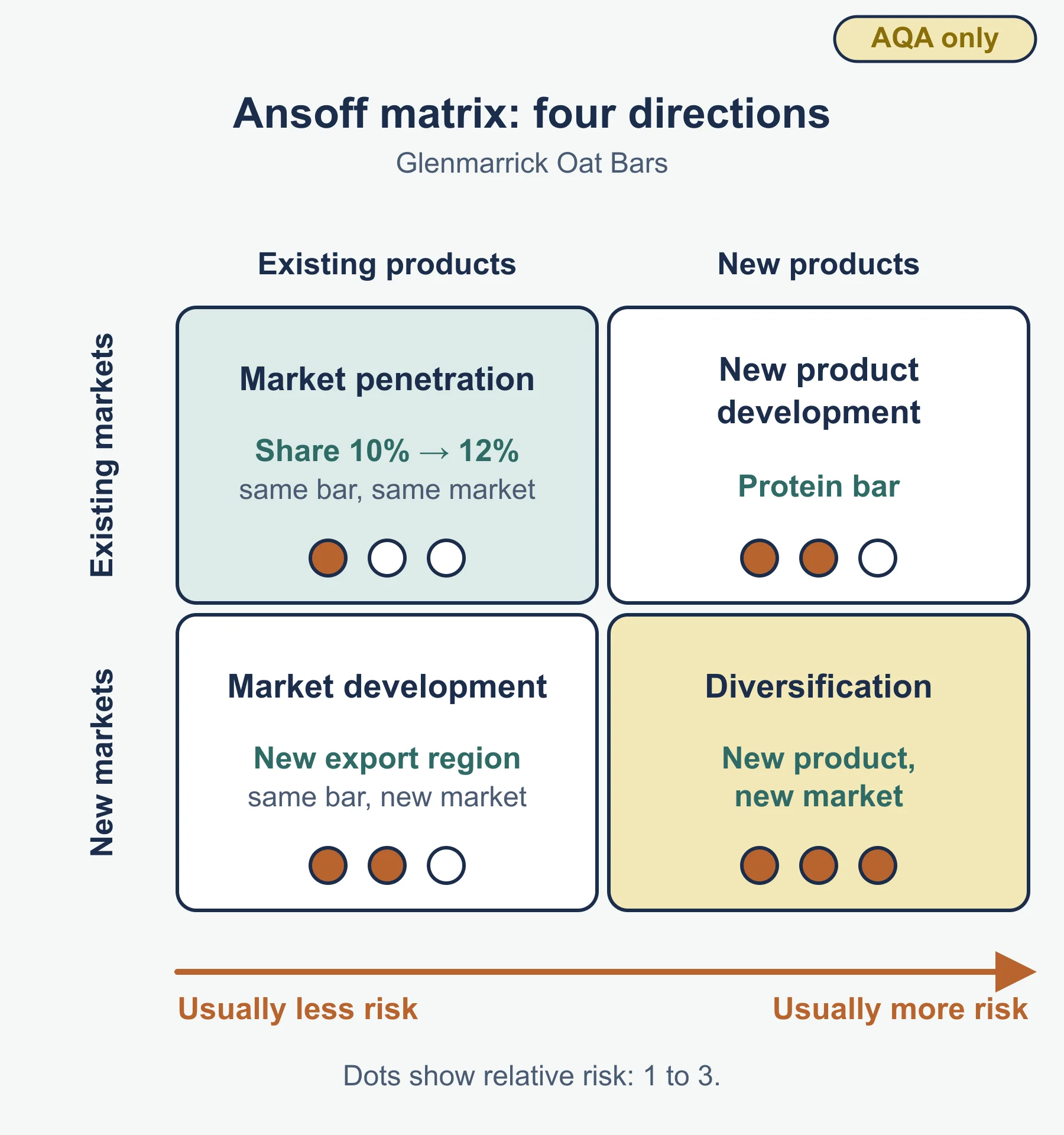
Ansoff matrix
| Existing products | New products | |
|---|---|---|
| Existing markets | Market penetration (lowest risk) | New product development |
| New markets | Market development | Diversification (highest risk) |
| Direction | Typical methods | Value | Limit |
|---|---|---|---|
| Market penetration | Promotion, price cuts, loyalty, wider distribution | Low risk, quick, builds on existing skills | Saturation, rival retaliation |
| Market development | New regions, countries, segments | New sales without redesign | Unfamiliar customers, regulation, set-up cost |
| New product development | Research and development, product extensions | Fresh portfolio, loyalty, premium prices | High cost, may fail |
| Diversification | Entering unrelated or new areas | Spreads risk, opens growth | Inexperience in both product and market |
Method: recommend an Ansoff direction
- Name the box and say what the product and market are in the case.
- Give the reason it fits (resources, objectives, market state).
- Give the main risk or cost.
- Compare with one alternative.
- Judge, with a condition (for example “if cash allows”).
Quick numbers
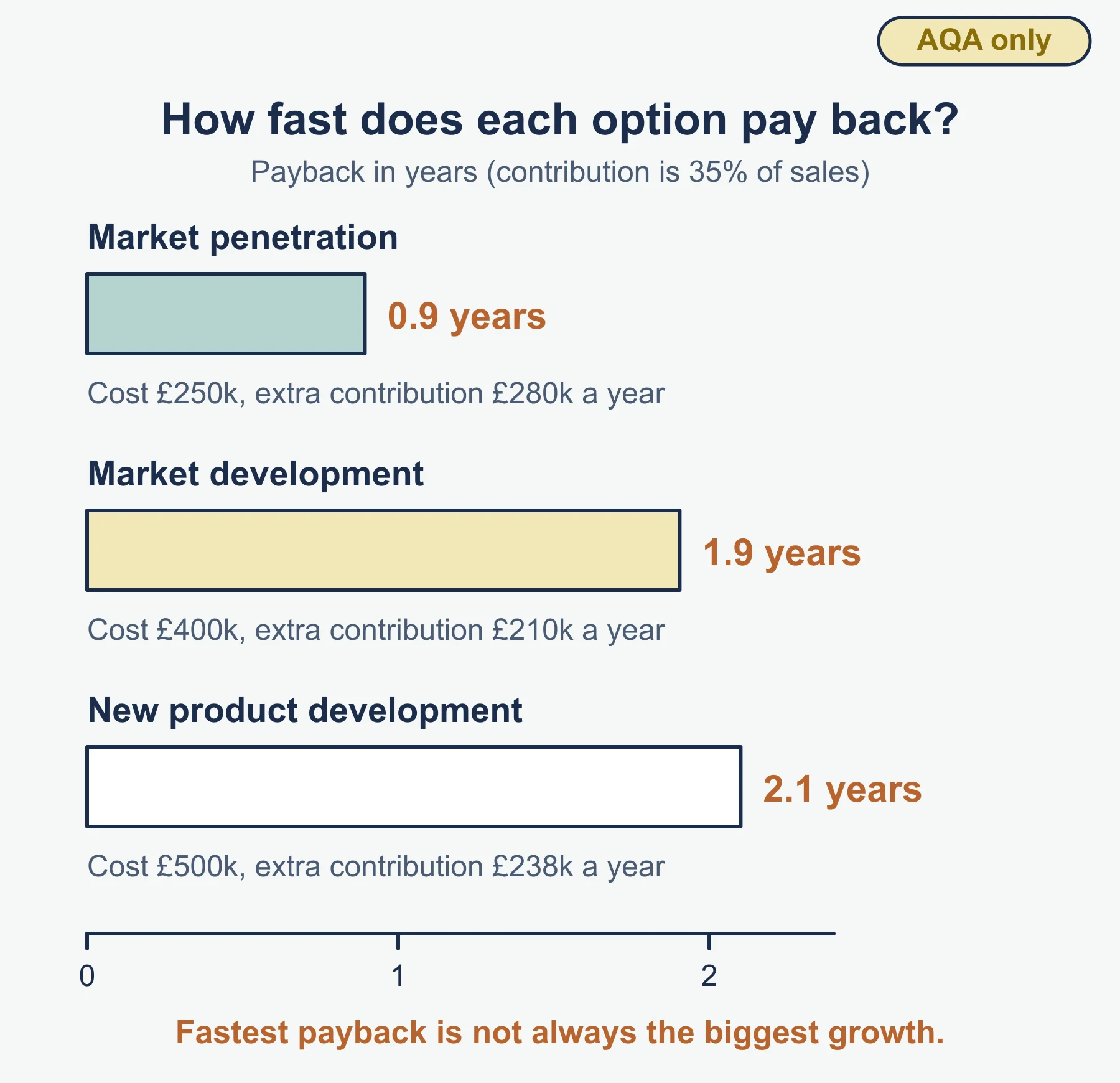
Market share = business sales / market sales × 100. Extra contribution = extra sales × contribution margin. Net gain = extra contribution - cost of the move. Payback (years) = cost / annual extra contribution. Expected sales = sum of probability × sales.
Worked reminder: Hollin Mills (a made-up firm) has sales of £3m in a £30m market, so share is 3 / 30 = 10%. A £120,000 campaign lifting share to 11% in a flat market adds £0.3m of sales. At a 40% margin that is £120,000, so the net gain is zero in year 1 and the move only pays off if the gain lasts longer.
Porter’s generic strategies
| Strategy | Scope | Means | Risk |
|---|---|---|---|
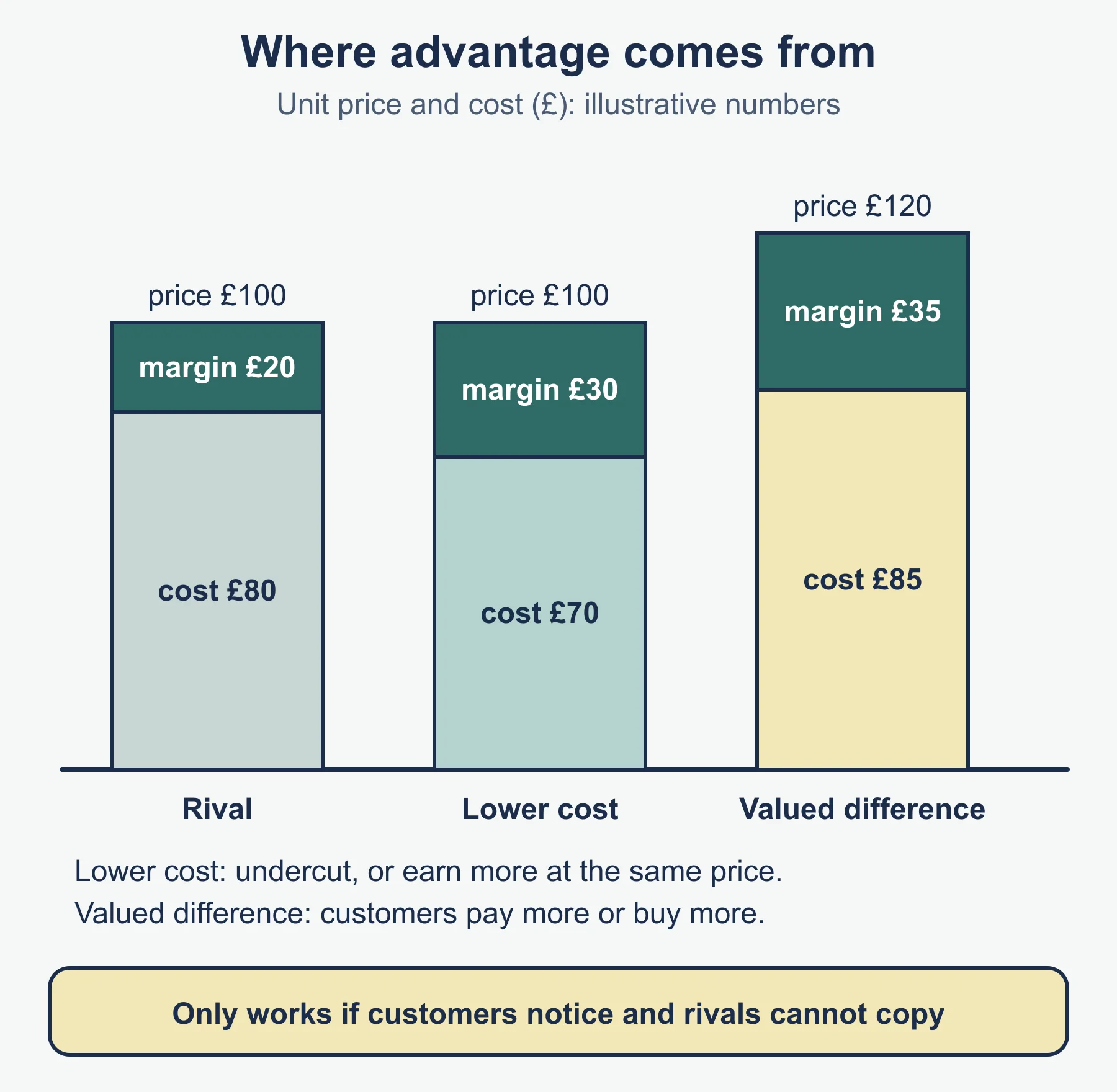
| Low cost | Broad | Lowest unit costs; price can still equal rivals’ | Rivals copy cost cuts; quality may suffer |
| Differentiation | Broad | Unique features, brand, service; price premium | Customers may not value the difference; high costs |
| Focus | Narrow niche | Low cost or differentiation inside one segment | Small demand; larger firms may enter |
Stuck in the middle: no cost advantage and no clear difference.
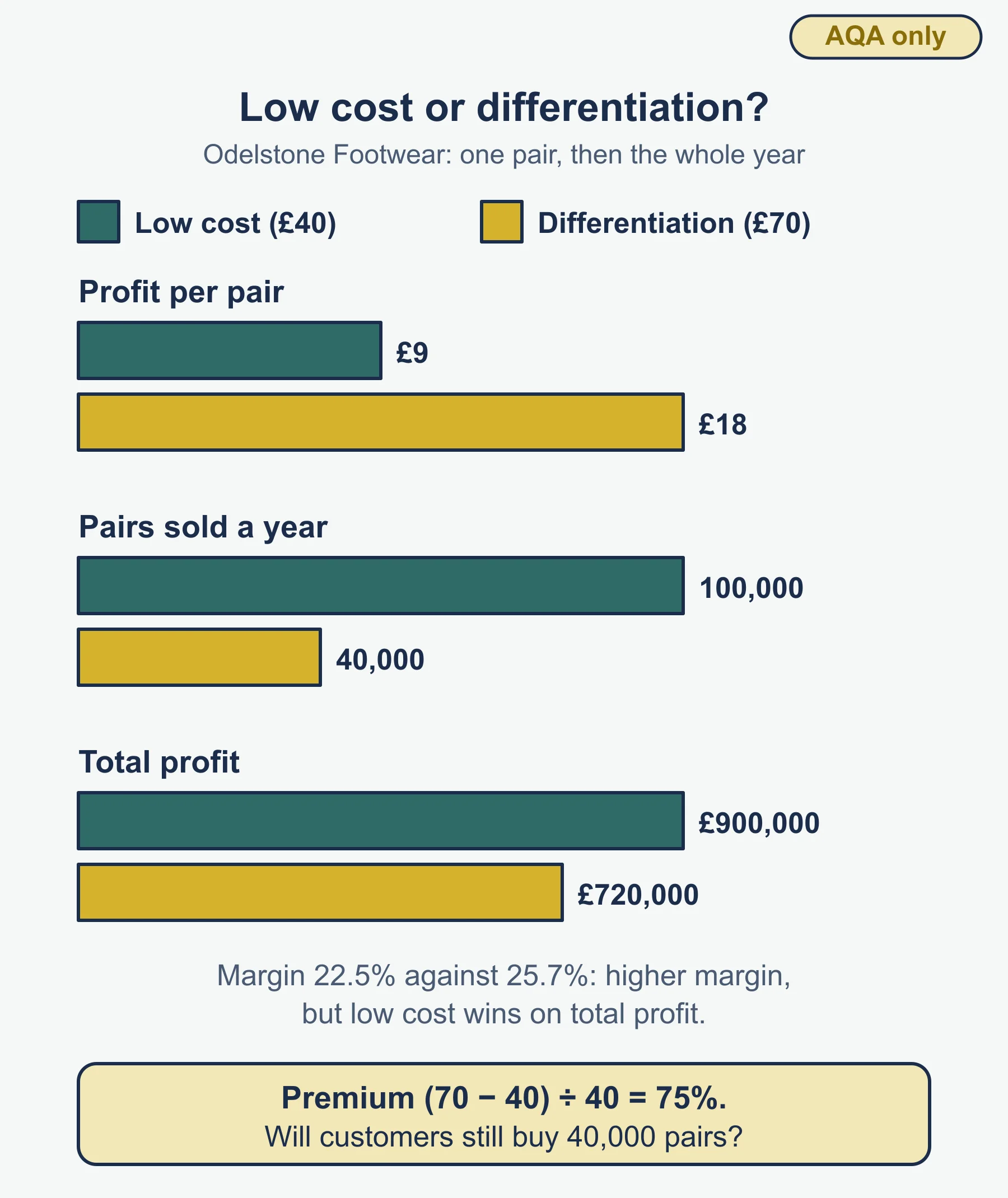
Margin comparison reminder: profit margin = profit per unit / price × 100. A higher margin does not guarantee higher total profit; volume matters. For example a £26 profit on a £60 price is 43.3%, but 1,000 sales give £26,000 while a 20% margin on £30 sold 6,000 times gives £36,000.
Bowman’s strategic clock (standard form)
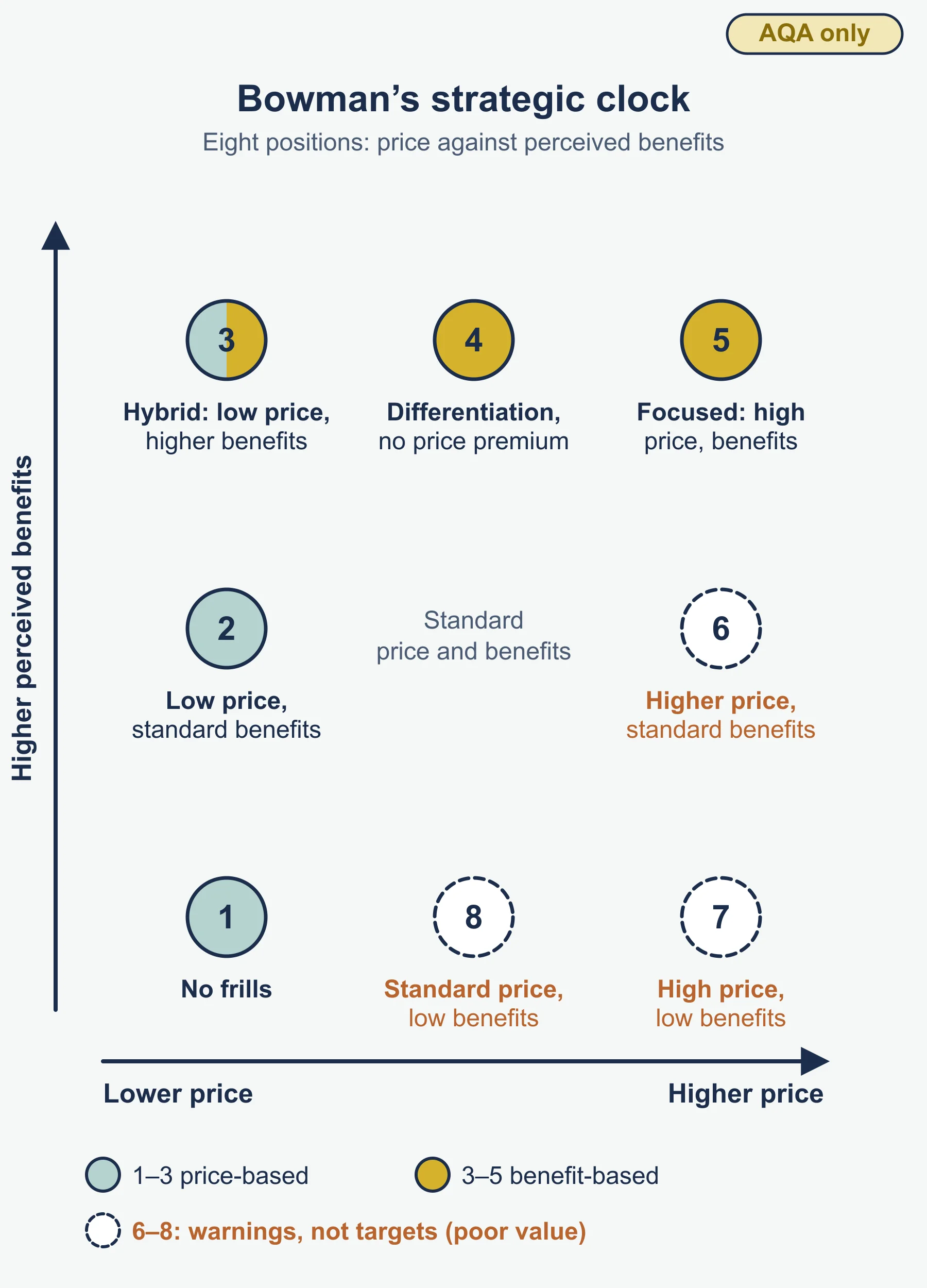
| Position | Price and benefits | Verdict |
|---|---|---|
| 1 | Low price, low benefits | Niche only |
| 2 | Low price, standard benefits | Price war risk |
| 3 | Hybrid: low price, higher benefits | Needs very low costs |
| 4 | Differentiation, standard price | Strong, wide appeal |
| 5 | Focused differentiation: high price, high benefits | Niche premium |
| 6 | Higher price, standard benefits | Needs market power |
| 7 | High price, low benefits | Likely to fail |
| 8 | Standard price, low benefits | Likely to fail |
Compare with Porter: the clock allows hybrid strategies and shows that moving price or benefits changes the position.
Influences on, and value of, positioning
- Influences: customers’ price sensitivity, size of the market, the business’s costs and resources, competitor positions, brand strength, technology, objectives.
- Low cost: volume and resilience in price wars; may need scale economies.
- Differentiation: loyalty and pricing power; needs spending on design and promotion.
- Focus: protection from large rivals; limited growth.
- Hybrid: wins share if sustained; difficult to maintain.
Competitive advantage
- Benefits: higher share, margins or premium prices; loyalty; resilience; attracts investors and staff.
- Difficulties of maintaining: imitation; technology change; shifting tastes; rising input costs; fading patents or brand appeal; the need for constant investment; dependence on a single supplier, product or person.
Must-know distinctions
- Direction (Ansoff) versus positioning (Porter, Bowman).
- Low cost versus low price.
- Differentiation versus focus: broad versus narrow scope.
- Market development (same product, new market) versus diversification (new product and new market).
- New product development (new product, same market) versus diversification.
- Margin versus total profit.
Applying the models in a case study
Models earn credit when they explain something in the case. A short chain of analysis often works well: identify the choice, link it to a case fact, show the effect on the business, then weigh it.
- Pick the model that matches the question. A question about where to sell points to Ansoff. A question about how to win customers points to Porter or Bowman.
- Quote one fact or figure from the case (market share, margin, cash balance, rival behaviour).
- Explain the consequence: for example, a low cash balance makes costly market development harder to fund.
- Weigh it against an alternative or a limit.
- Reach a judgement and say what it depends on.
Useful evaluation criteria for this topic are risk, cost, speed of return, fit with objectives, and how easily rivals can respond. The time period also matters: penetration may be best this year, while new product development may protect the business over five years.
Linking Ansoff and positioning
Direction and positioning interact. A business that moves into a new market (market development) must also decide how to compete there. A firm with a strong premium brand may keep a differentiation strategy abroad, or it may find overseas customers more price-sensitive and move towards a hybrid position. Diversification into a market where rivals already hold low-cost positions can be hard for a firm with no scale economies.
Worked reminder: Marrick Dairy (invented) wants to sell its premium yoghurt, priced at the high end with high perceived benefits (Bowman position 5), in a neighbouring country where shoppers buy mainly on price. This is market development. If it cuts its price to compete, its position slides towards the hybrid, and costs would have to fall to protect margins. If it keeps the premium price, it should target a narrow segment of affluent shoppers, which is a focus approach. Either way, the analysis names the Ansoff box and the positioning choice.
Quick self-test
- Name the four Ansoff directions.
- Which Ansoff direction is usually highest risk?
- Sales are £5m in a £50m market. State the market share.
- A campaign costs £90,000 and adds £200,000 of sales at a 35% contribution margin. Calculate the net gain.
- Define differentiation as a Porter strategy.
- What does “stuck in the middle” mean?
- Which Bowman positions are generally seen as unsustainable?
- Give two difficulties of maintaining a competitive advantage.
- A £48 product costs £36 to make. Calculate the profit margin.
- A project costing £300,000 returns £120,000 a year. Calculate payback.
- A firm sells 8,000 units at a profit of £4 per unit under strategy A and 3,000 units at £9 under strategy B. Which gives the higher total profit?
- Name one reason a business with weak cash flow might prefer market penetration.
Answers
- Market penetration, market development, new product development, diversification.
- Diversification.
- 5 / 50 = 10%.
- Extra contribution is 200,000 × 0.35 = £70,000. Net gain = 70,000 - 90,000 = -£20,000, a loss in year 1.
- Making the product seem unique to customers so they accept a higher price or buy more.
- Having neither the lowest costs nor a clear difference, so no advantage.
- Positions 6, 7 and 8 (higher price or low benefits).
- For example imitation by rivals and changing technology (also acceptable: shifting tastes, rising costs).
- Profit £12; 12 / 48 = 25%.
- 300 / 120 = 2.5 years.
- Strategy A: £32,000. Strategy B: £27,000. A is higher.
- It is the lowest-cost, lowest-risk direction and uses existing products and markets, so it needs less investment.
Where marks are usually lost
- Describing a model without linking it to the facts of the case.
- Calling a move “diversification” when only the product or only the market is new.
- Stating that cost leadership means charging the lowest price.
- Forgetting to subtract the cost of the strategy when calculating net gain.
- Quoting margin when the question asks for total profit, or the reverse.
- Treating Bowman positions 6 to 8 as acceptable choices.
- Evaluating with no judgement or no criterion such as risk, cost or time.
- Listing benefits of competitive advantage without saying why it might not last.
- Using the same example in both an Ansoff and a Porter answer without linking them.
Frequently asked questions
What are the four Ansoff directions? Market penetration, market development, new product development and diversification. Diversification, with a new product in a new market, is usually the highest risk.
What is the difference between strategic direction and strategic positioning? Direction is where a business competes: which markets and which products, analysed with Ansoff’s matrix. Positioning is how it competes on benefits and price, analysed with Porter’s strategies and Bowman’s clock.
What does “stuck in the middle” mean in Porter’s strategies? A business that is stuck in the middle has neither the lowest costs nor a clear difference from rivals, so it has no competitive advantage.
Which positions on Bowman’s strategic clock are unsustainable? Positions 6, 7 and 8 are generally seen as unsustainable because they combine a higher price with low benefits, so customers receive poor value.
Official syllabus
AQA AS and A-level Business specification (7131 and 7132), section 3.8 Choosing strategic direction (A-level only).
Get free revision emails (optional)
Occasional emails with practice questions, worked explanations and links to free resources for the qualification and subjects you choose. No spam, and you can unsubscribe from any email. The free tools on this site never need an email.
Related resources
-
Study guides
AQA A-Level Business: Choosing strategic direction (7132)
Study guide to AQA A-Level Business 7132 topic 8: Ansoff matrix, Porter's generic strategies, Bowman's strategic clock and competitive advantage.
Business · AQA · A Level
Read guide -
Practice questions
AQA A-Level Business: Choosing strategic direction (7132) – Practice Questions
Original practice questions with worked answers for AQA A-Level Business 7132 topic 8: Ansoff, Porter's strategies, Bowman's clock, competitive advantage.
Business · AQA · A Level
Try questions -
Study guides
AQA A-Level Business: Financial management (7132)
Study guide to financial management for AQA A-Level Business (7132): objectives, budgets, break-even, profit ratios, cash timing and finance.
Business · AQA · A Level
Read guide
Related articles
-
teaching
A Level tuition in Dubai: Cambridge or Pearson Edexcel International A Level?
Schools in Dubai and Abu Dhabi teach either Cambridge International AS & A Level or Pearson Edexcel International A Level. How the two are structured, why it matters for tuition, and how online classes from Lahore work.
9 October 2026
-
curriculum guides
Choosing subjects at IGCSE and A Level
How subject choices at 14 and 16 affect university options later, and how to keep pathways open without overloading a timetable.
28 July 2026
Studying this with a teacher
Working through Business A LEVELS?
This page is free and stays free. If you would rather be taught it, Marlbridge runs Business classes one-to-one and in small groups of up to 15, online in your own time zone. The first trial class is free. WhatsApp replies within an hour (8am–11pm Pakistan time, every day); email the same day.
AQA Business teachers at Marlbridge
