
Revision Notes
AQA A-Level Business: Operational management (7132) – Revision Notes
Condensed revision notes on AQA A-Level Business operational management: formulas, lean, quality, inventory and supply chains, with a self-test.
- Subject
- Business
- Level
- A LEVELS
- Topic
- Operational management
- Author
- Marlbridge Academic Team
- Updated
- Reviewed by
- Salman Ahmad (what this means)
Aligned to AQA A Level Business (7132), For first teaching from September 2023. Official specification .
Syllabus page (what it covers and how it is assessed): AQA A Level Business.
Syllabus points this page covers
7132
- 4 Operational management (whole topic)
Found an error? Report a correction.
Need help with this topic? Request a free trial class for A Level Business (7132).
These notes condense section 3.4 of the AQA A-level Business specification (7132), “Decision making to improve operational performance”, which Marlbridge numbers as topic 4. Read the full study guide for explanations. Test yourself with the practice questions, find the course hub and the printable checklist, and take a free diagnostic to find weak spots. The official text names the calculations without giving formulas, so the forms below are the standard ones.
The five themes to bring into every answer
Technology; ethical and environmental influences; market conditions and competition; competitiveness; links with other functions (marketing, finance, human resources). A strong evaluation point usually uses one of these.
3.4.1 Operational objectives
| Objective | Typical measure |
|---|---|
| Costs | Unit cost, waste as a percentage |
| Quality | Defect or return rate |
| Speed of response and flexibility | Order-to-delivery time; time to change product |
| Dependability | Percentage of orders on time and complete |
| Environmental (waste, emissions) | Emissions, waste, recycled content |
| Added value | Selling price minus cost of bought-in inputs |
- Value of objectives: direction, a yardstick for performance, consistency with corporate objectives.
- Internal influences: finance, workforce skills, technology, existing capacity, corporate objectives.
- External influences: customers, competitors, suppliers, law, the economy, technology.
- Conflicts: low cost against high quality; speed against environmental impact.
3.4.2 Operations data: formulas
| Measure | Standard form |
|---|---|
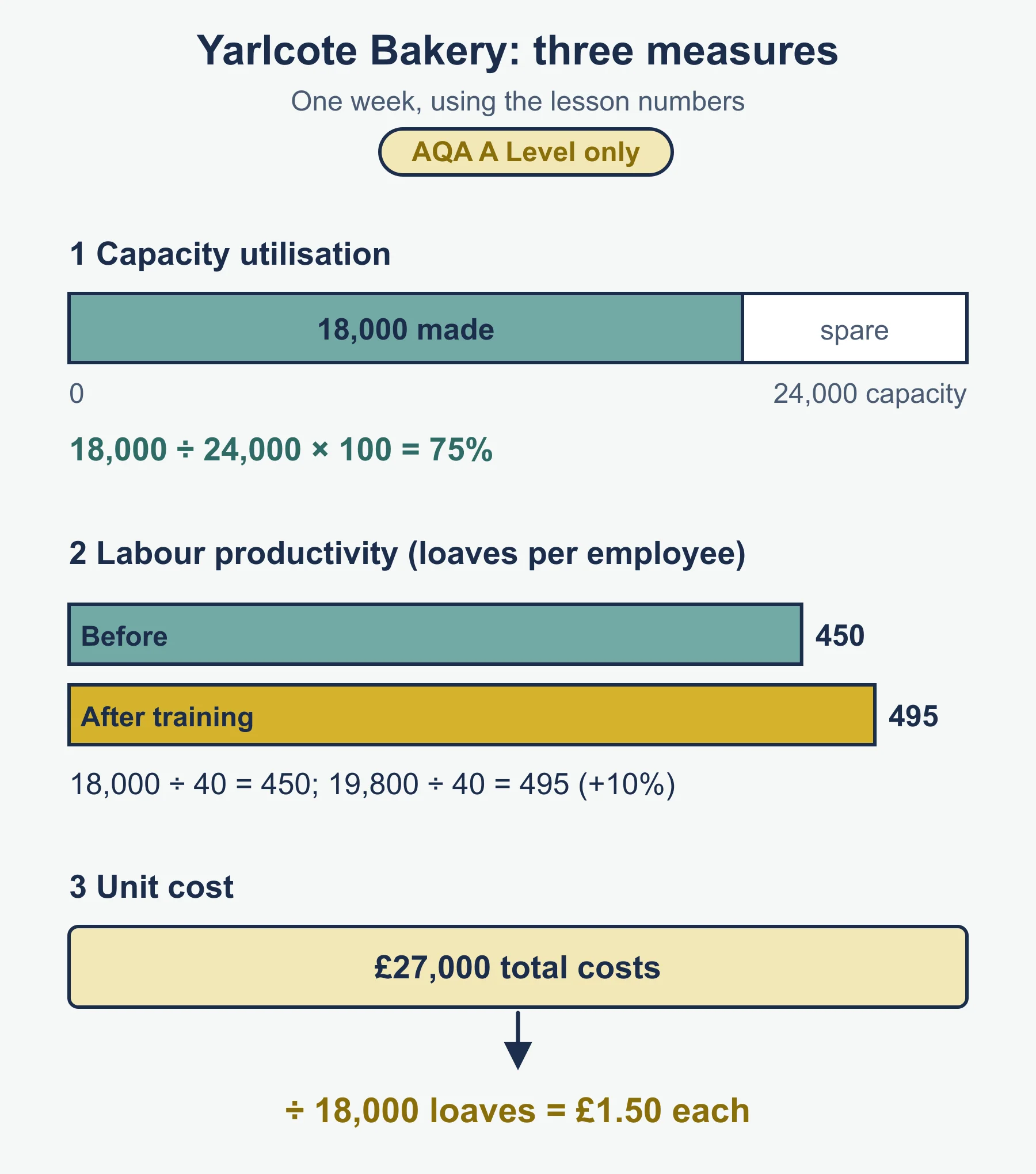
| Labour productivity | Output ÷ employees |
| Unit cost (average cost) | Total costs ÷ units produced |
| Capacity | Highest output the resources allow |
| Capacity utilisation | (Actual output ÷ capacity) × 100, as a percentage |
Worked reminder. Prestbury Textiles makes 9,600 scarves a month with 32 employees. Capacity is 12,000 and total costs are £36,480.
- Productivity = 9,600 ÷ 32 = 300 per employee.
- Unit cost = 36,480 ÷ 9,600 = £3.80.
- Utilisation = 9,600 ÷ 12,000 = 80%.
- If output rises to 10,400 with the same staff, productivity is 325, a rise of 25 or about 8.3%.
Method for a data question: state the formula, put in the figures, add units (per employee, £, %), then say what it means for the decision (spare capacity, falling efficiency, cost risk). Use the data to plan: compare actual with target, forecast demand against capacity, find where bottlenecks sit.
3.4.3 Efficiency and productivity
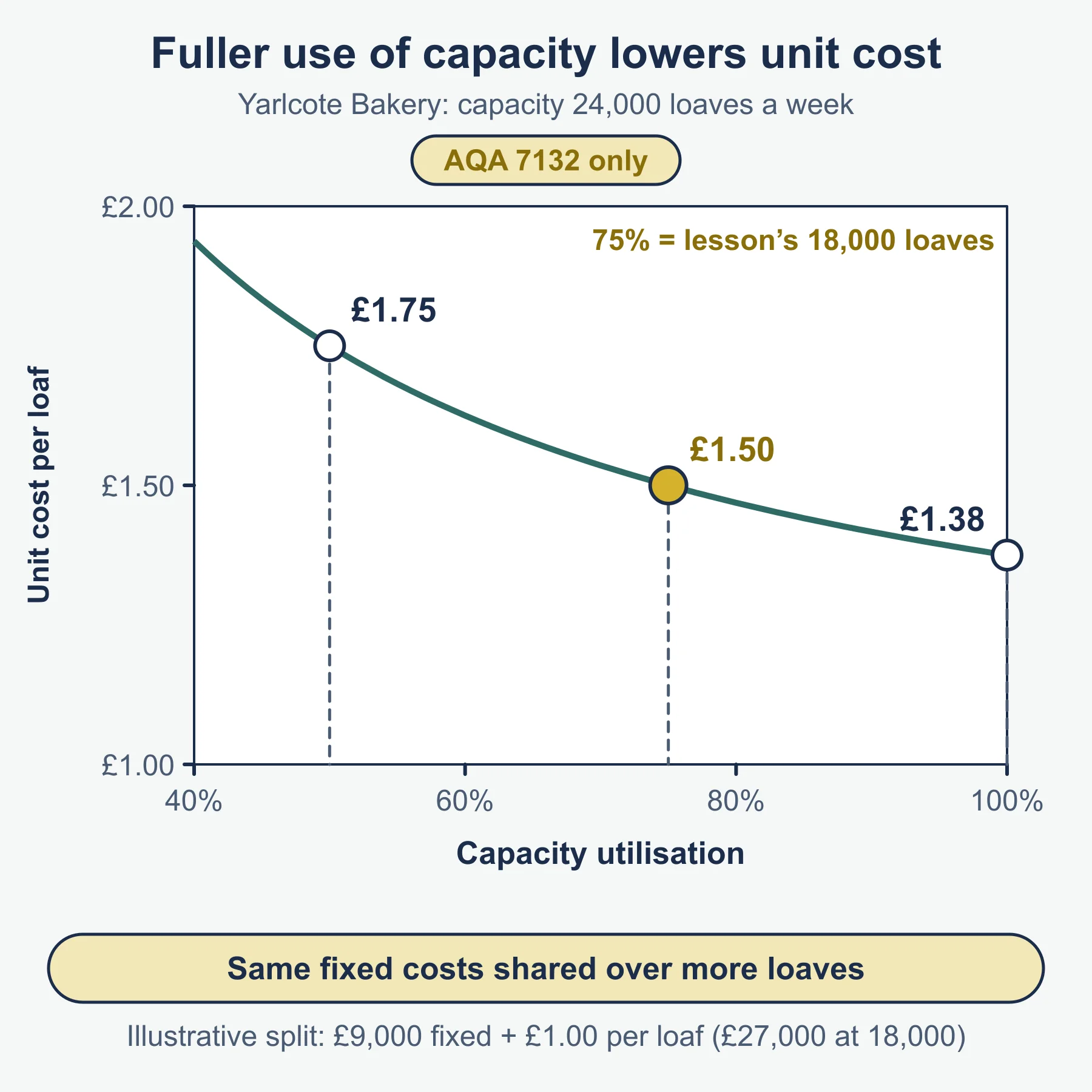
- Why capacity matters: too little means lost sales and late orders; too much means idle fixed costs. Higher utilisation spreads fixed costs, lowering unit cost.
- Why productivity matters: lower cost per unit, more competitive prices or higher margins.
- How to raise it: training, motivation, better methods, better layout, investment in machines, removing wasteful steps.
- Difficulties: cost and time of training, resistance to change, high investment, quality harmed by haste, hard to measure in services.
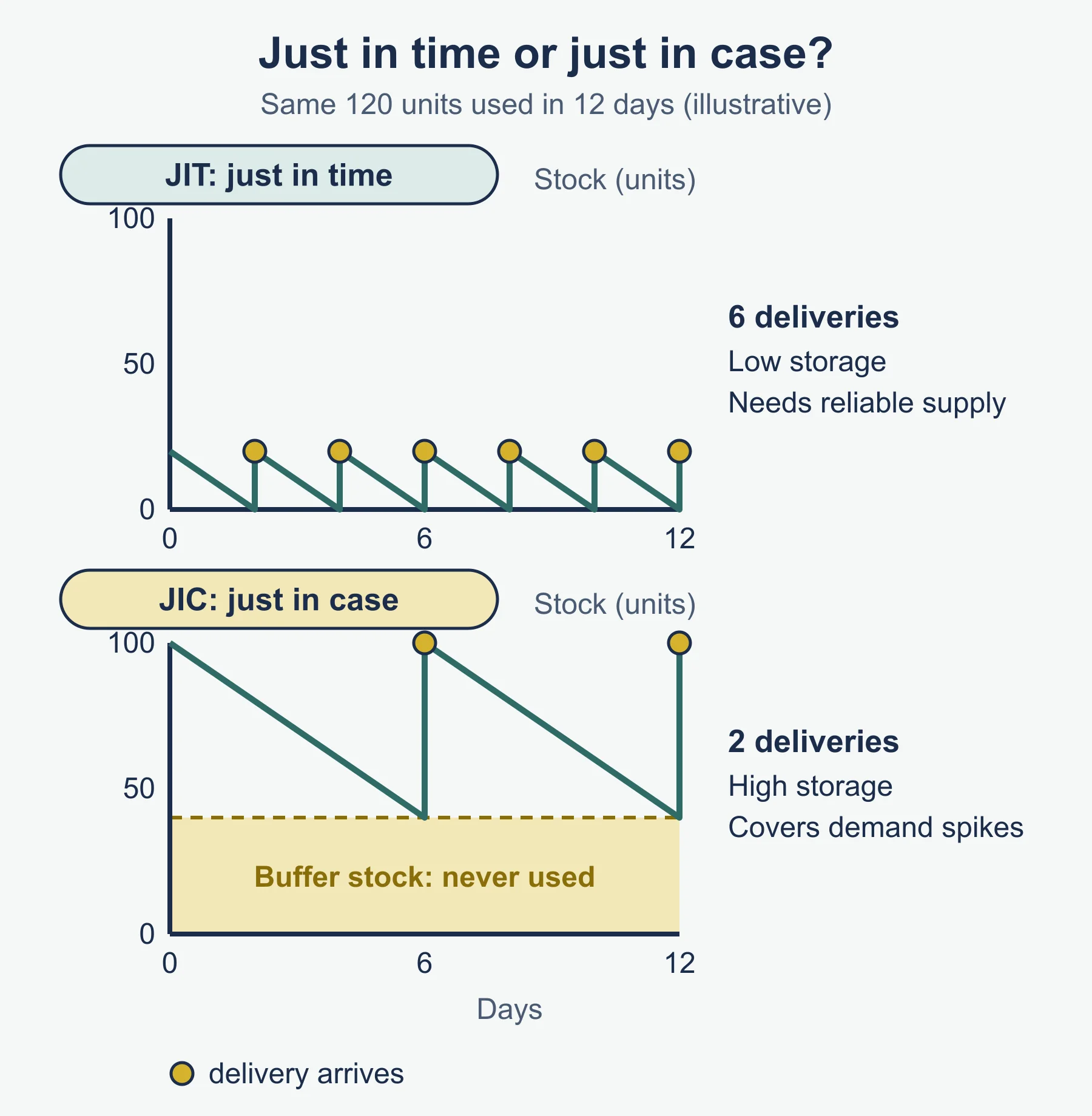
- Lean production: cut waste of every kind while meeting customer needs. Just in Time is part of lean: stock arrives as needed.
| Lean and JIT benefits | Lean and JIT difficulties |
|---|---|
| Lower storage and holding cost | Reliance on reliable suppliers |
| Less cash tied up, less waste | Little buffer if demand jumps |
| Quicker response to change | Costly small deliveries, more transport |
| Faults found quickly | Needs skilled flexible staff and good systems |
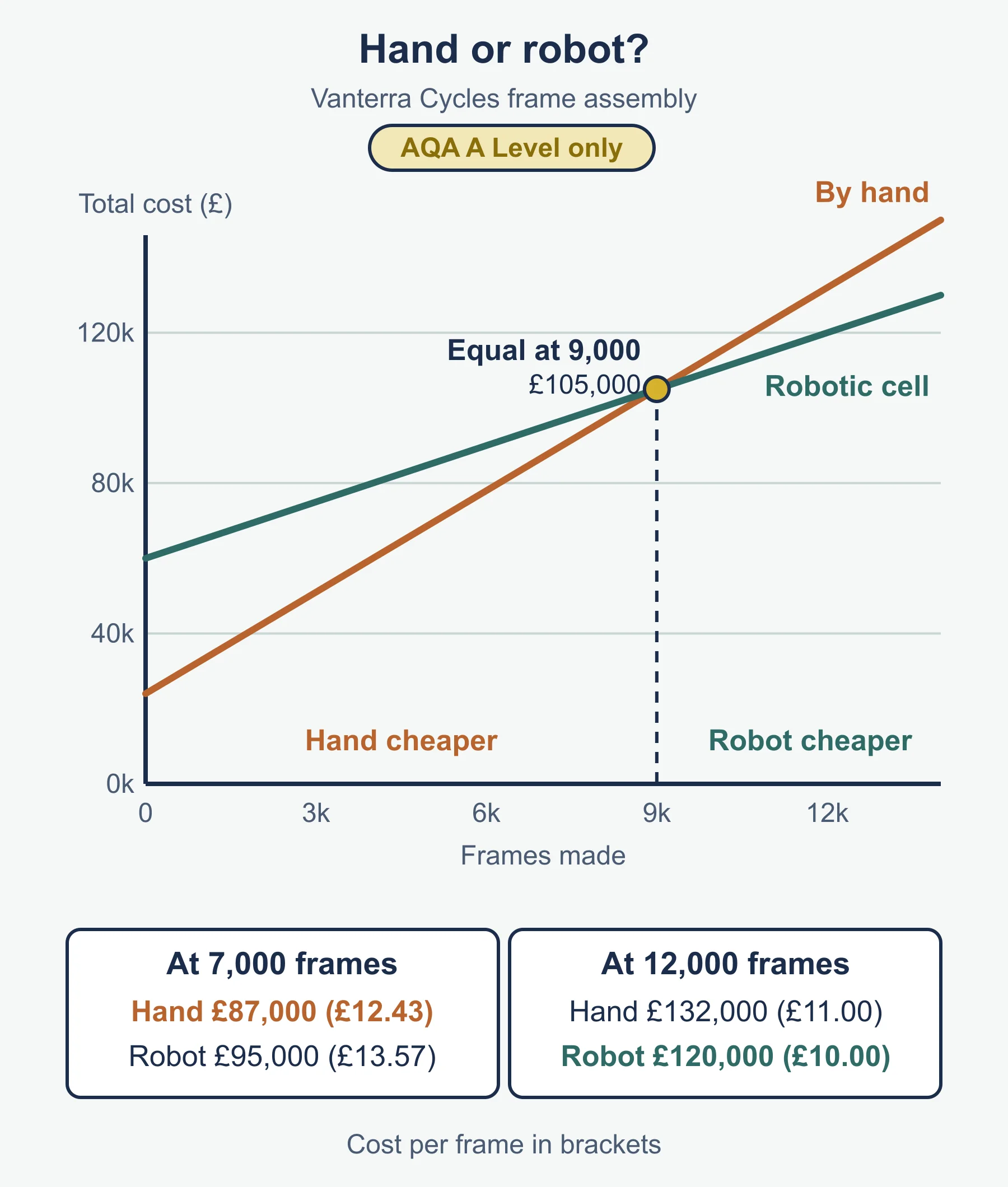
- Labour intensive: labour is the main input (low fixed cost, high variable cost, flexible, suits small or varied output, can signal craft quality).
- Capital intensive: machinery is the main input (high fixed cost, low variable cost, suits large steady output, consistent quality).
- Choosing the mix: expected volume, certainty of demand, wage and equipment costs, flexibility, quality, brand image.
- Using capacity efficiently: boost demand with promotion or off-peak pricing; accept subcontract work; sub-let spare space; time maintenance for quiet periods; cut capacity if low use persists.
- Technology: computer-aided design and manufacture, robots, automated stock control, production-planning software. Drawbacks: cost, retraining, breakdown and cyber risk.
3.4.4 Quality
- Importance: price, reputation, loyalty, fewer returns, lower waste.
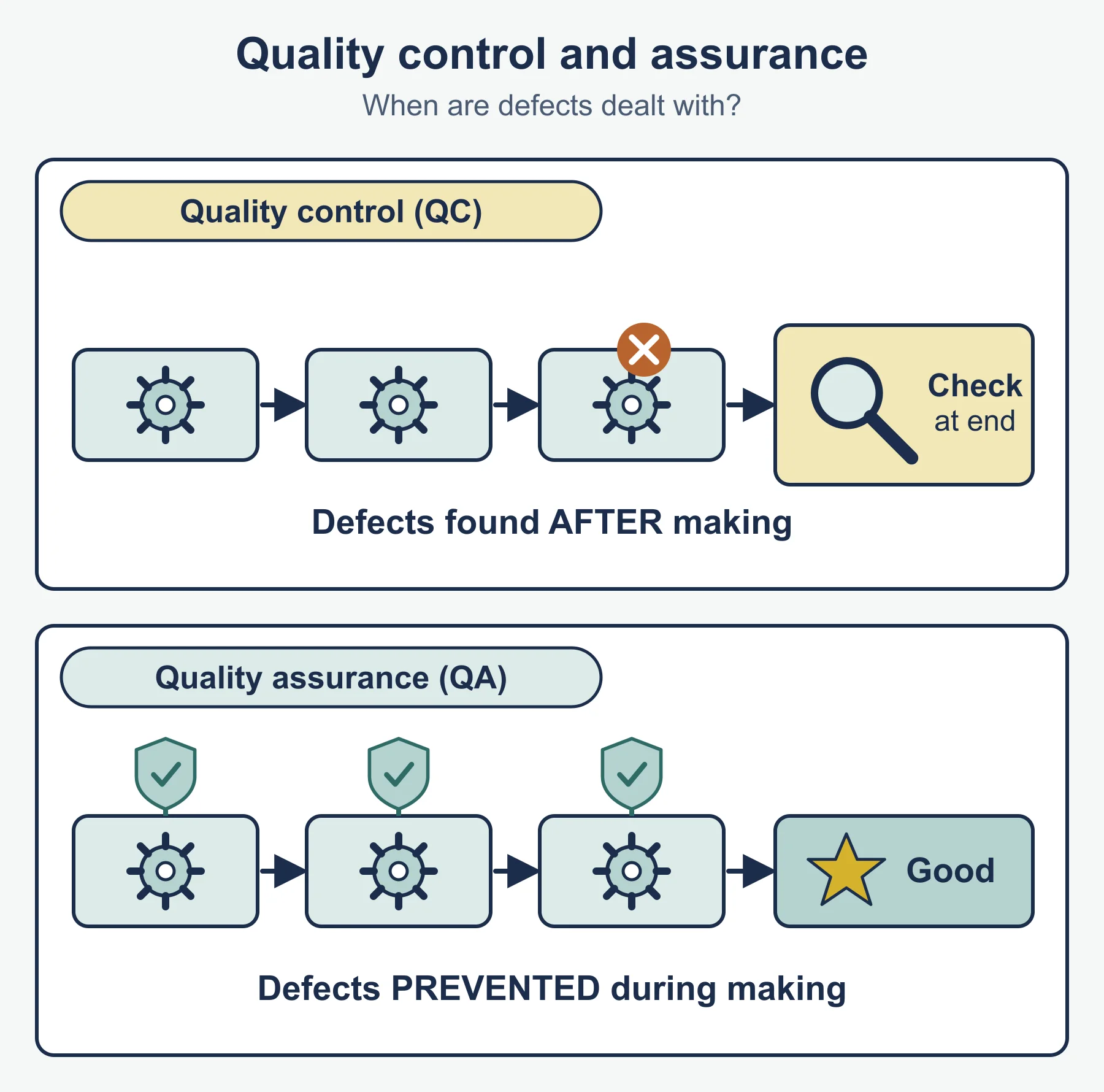
- Quality control: inspect output and remove faults (detects).
- Quality assurance: agreed standards at every stage, supplier checks, staff responsible for their own work (prevents). The specification requires it.
- Other methods: training, better materials and equipment, customer feedback, quality circles.
- Benefits: fewer defects, less rework, stronger brand, can support higher prices.
- Difficulties: cost of training and equipment, slower output if checks are heavy, standards set higher than customers value, slow payback.
- Consequences of poor quality: refunds and returns, rework and scrap, lost customers, damaged reputation, falling sales, complaint handling, possible legal claims, low staff morale.
3.4.5 Flexibility, inventory and supply chains
- Flexibility: ability to change product, volume or timing. Mass customisation: products made to individual wishes at close to mass-production cost.
- Speed of response: time to meet an order. Dependability: keeping promises on time, quality and quantity.
- Value of improving them: satisfaction, competitiveness, repeat business. Cost: extra capacity, skilled staff, stock.
- Matching supply to demand: outsourcing; temporary and part time employees; producing to order. Value: no lost sales in peaks, no idle resources in troughs.
Inventory control terms and standard forms
| Term | Meaning |
|---|---|
| Lead time | Wait between ordering and the goods arriving |
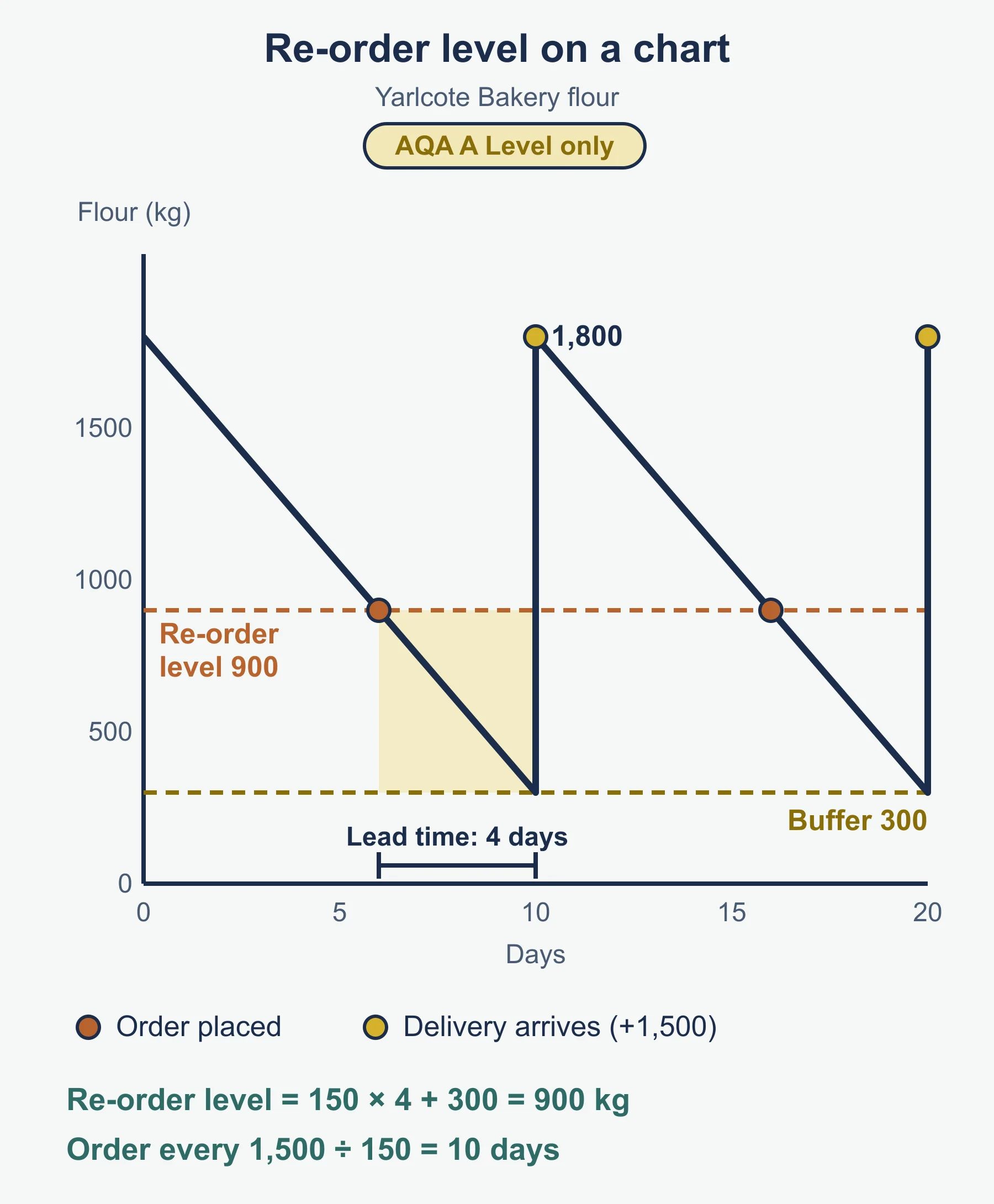
| Re-order level | Stock level at which an order is placed: buffer + (daily usage × lead time) |
| Buffer level | Minimum safety stock |
| Re-order quantity | Amount ordered each time |
| Maximum stock | Buffer + re-order quantity (when delivery arrives just as stock hits the buffer) |
Worked reminder. Prestbury Textiles uses 60 metres of cloth a day. Lead time is 6 days, buffer is 120 metres, re-order quantity is 900 metres.
- Re-order level = 60 × 6 + 120 = 480 metres.
- Maximum stock = 120 + 900 = 1,020 metres.
- Time between orders = 900 ÷ 60 = 15 days.
Reading an inventory control chart: a falling line for usage; a flat line for the re-order level; a flat line for the buffer; a vertical jump at each delivery; the horizontal gap between ordering and delivery is the lead time.
- Influences on inventory held: demand and its variability, lead time and supplier reliability, storage cost, shelf life, cash, cost of a stock-out.
- Choosing suppliers: price, quality, reliability, speed, flexibility, payment terms, ethics and environment, location, financial strength.
- Managing the supply chain: share forecasts, long-term relationships, tracking technology, fewer links, agreed standards. Value: lower cost, fewer shortages, faster delivery.
- Outsourcing: value is expertise, focus, variable instead of fixed costs. Risks: loss of control, dependence, confidentiality, reputational damage.
Must-know distinctions
| Pair | Difference |
|---|---|
| Productivity and efficiency | Productivity is output per input (per employee). Efficiency is using resources with little waste |
| Quality control and quality assurance | Control inspects and removes faults. Assurance prevents faults across the process |
| Lead time and re-order level | Lead time is a length of time. Re-order level is a quantity of stock |
| Labour and capital intensive | Labour intensive has high variable cost. Capital intensive has high fixed cost |
| Capacity and capacity utilisation | Capacity is a maximum. Utilisation is the percentage of it used |
Quick self-test
- Prestbury Textiles makes 9,600 scarves with 32 employees. Calculate labour productivity.
- Its total costs are £36,480. Calculate the unit cost.
- Capacity is 12,000 scarves. Calculate capacity utilisation.
- Output rises to 10,400 with 32 employees. What is the percentage change in productivity (1 d.p.)?
- Daily use 60, lead time 6 days, buffer 120. Calculate the re-order level.
- Buffer 120, re-order quantity 900. What is the maximum stock?
- If lead time rises to 9 days, what is the new re-order level?
- Define mass customisation.
- State one difference between quality control and quality assurance.
- Name the three ways of matching supply to demand in the specification.
- Give one difficulty of Just in Time.
- Which type of process has the higher fixed costs, labour or capital intensive?
Answers
- 300 per employee.
- £3.80.
- 80%.
- Productivity 325; (325 - 300) ÷ 300 = 8.3%.
- 480 metres.
- 1,020 metres.
- 60 × 9 + 120 = 660 metres.
- Making products to individual customer wishes at close to mass-production cost.
- Control inspects finished or part-finished output to remove faults; assurance builds agreed standards into every stage to prevent faults.
- Outsourcing; temporary and part time employees; producing to order.
- Any one: dependence on reliable suppliers, little buffer if demand jumps, costly frequent deliveries.
- Capital intensive.
Where marks are usually lost
- Giving a figure without units, or a percentage without the percent sign.
- Dividing the wrong way round in capacity utilisation.
- Forgetting the buffer when finding the re-order level.
- Writing about operations in general instead of the named business and its figures.
- Calling JIT only a benefit, with no mention of the supplier risk.
- Treating quality control and quality assurance as one method.
- Making a list of points with no analysis of why each matters for this business.
- Reaching no judgement in an evaluation, or a judgement that ignores the data.
- Not linking operations decisions to other functions, competitors or technology.
Frequently asked questions
What is the difference between quality control and quality assurance? Quality control inspects finished or part-finished output and removes faults, so it detects problems. Quality assurance builds agreed standards into every stage of production, so it prevents them.
What is the difference between labour-intensive and capital-intensive production? Labour-intensive production uses labour as the main input, with low fixed costs and high variable costs, and suits small or varied output. Capital-intensive production relies on machinery, with high fixed costs and low variable costs, and suits large, steady output.
What are the three ways of matching supply to demand in AQA 7132? Outsourcing, using temporary and part-time employees, and producing to order.
How do you calculate the maximum stock level? Maximum stock = buffer stock + re-order quantity, because stock is at the buffer level when a new delivery arrives.
Official syllabus
AQA AS and A-level Business specification (7131 and 7132), subject content section 3.4, published by AQA.
Get free revision emails (optional)
Occasional emails with practice questions, worked explanations and links to free resources for the qualification and subjects you choose. No spam, and you can unsubscribe from any email. The free tools on this site never need an email.
Related resources
-
Study guides
AQA A-Level Business: Operational management (7132)
Study guide to operational management for AQA A-Level Business: objectives, productivity, capacity, lean, quality, inventory and supply chains.
Business · AQA · A Level
Read guide -
Practice questions
AQA A-Level Business: Operational management (7132) – Practice Questions
Original short-answer, calculation and case-study practice for AQA A-Level Business operational management, with worked answers and examiner insights.
Business · AQA · A Level
Try questions -
Study guides
AQA A-Level Business: Strategic methods: how to pursue strategies (7132)
Study guide to growth and retrenchment, innovation, internationalisation and digital technology for AQA A-Level Business 7132, with worked examples.
Business · AQA · A Level
Read guide
Related articles
-
teaching
A Level tuition in Dubai: Cambridge or Pearson Edexcel International A Level?
Schools in Dubai and Abu Dhabi teach either Cambridge International AS & A Level or Pearson Edexcel International A Level. How the two are structured, why it matters for tuition, and how online classes from Lahore work.
9 October 2026
-
curriculum guides
Choosing subjects at IGCSE and A Level
How subject choices at 14 and 16 affect university options later, and how to keep pathways open without overloading a timetable.
28 July 2026
Studying this with a teacher
Working through Business A LEVELS?
This page is free and stays free. If you would rather be taught it, Marlbridge runs Business classes one-to-one and in small groups of up to 15, online in your own time zone. The first trial class is free. WhatsApp replies within an hour (8am–11pm Pakistan time, every day); email the same day.
AQA Business teachers at Marlbridge
