
Study Guides
AQA A-Level Business: Strategic methods: how to pursue strategies (7132)
Study guide to growth and retrenchment, innovation, internationalisation and digital technology for AQA A-Level Business 7132, with worked examples.
- Subject
- Business
- Level
- A LEVELS
- Topic
- Strategic methods: how to pursue strategies
- Author
- Marlbridge Academic Team
- Updated
- Reviewed by
- Salman Ahmad (what this means)
Aligned to AQA A Level Business (7132), For first teaching from September 2023. Official specification .
Syllabus page (what it covers and how it is assessed): AQA A Level Business.
Syllabus points this page covers
7132
- 9 Strategic methods: how to pursue strategies (whole topic)
Found an error? Report a correction.
Need help with this topic? Request a free trial class for A Level Business (7132).
This guide covers section 3.9 of the AQA AS and A-level Business specification (7132), “Strategic methods: how to pursue strategies”. The specification marks this section as A-level only. It has four parts: change in scale, innovation, internationalisation and digital technology. Use it with the A-level Business hub, the printable checklist, the revision notes and the practice questions. To find weak spots first, try the free diagnostics.
Map of the topic
| Section | Content points |
|---|---|
| 3.9.1 Change in scale | Growth or retrenchment; organic and external growth; scale, scope, experience, synergy, overtrading, Greiner; functional areas; mergers, takeovers, ventures, franchising; vertical, horizontal, conglomerate |
| 3.9.2 Innovation | Pressures; product and process innovation; value; Kaizen, R&D, intrapreneurship, benchmarking; patents and copyrights; functional areas |
| 3.9.3 Internationalisation | Reasons; attractiveness; off-shoring and re-shoring; export, licensing, alliances, direct investment; influences; Bartlett and Ghoshal; functional areas |
| 3.9.4 Digital technology | Pressures; value; e-commerce, big data, data mining, ERP; functional areas |
“Assessing” means every part ends in a judgement: is this method right for this business, now?
3.9.1 Assessing a change in scale
Growth and retrenchment
Businesses grow to gain sales revenue, market share, profit, lower unit costs, market power or protection from takeover. They may retrench (reduce scale) when demand falls, when a division loses money, when debt is too high, or when management decides to concentrate on what it does best. Retrenchment can mean closing sites, selling divisions or cutting staff.
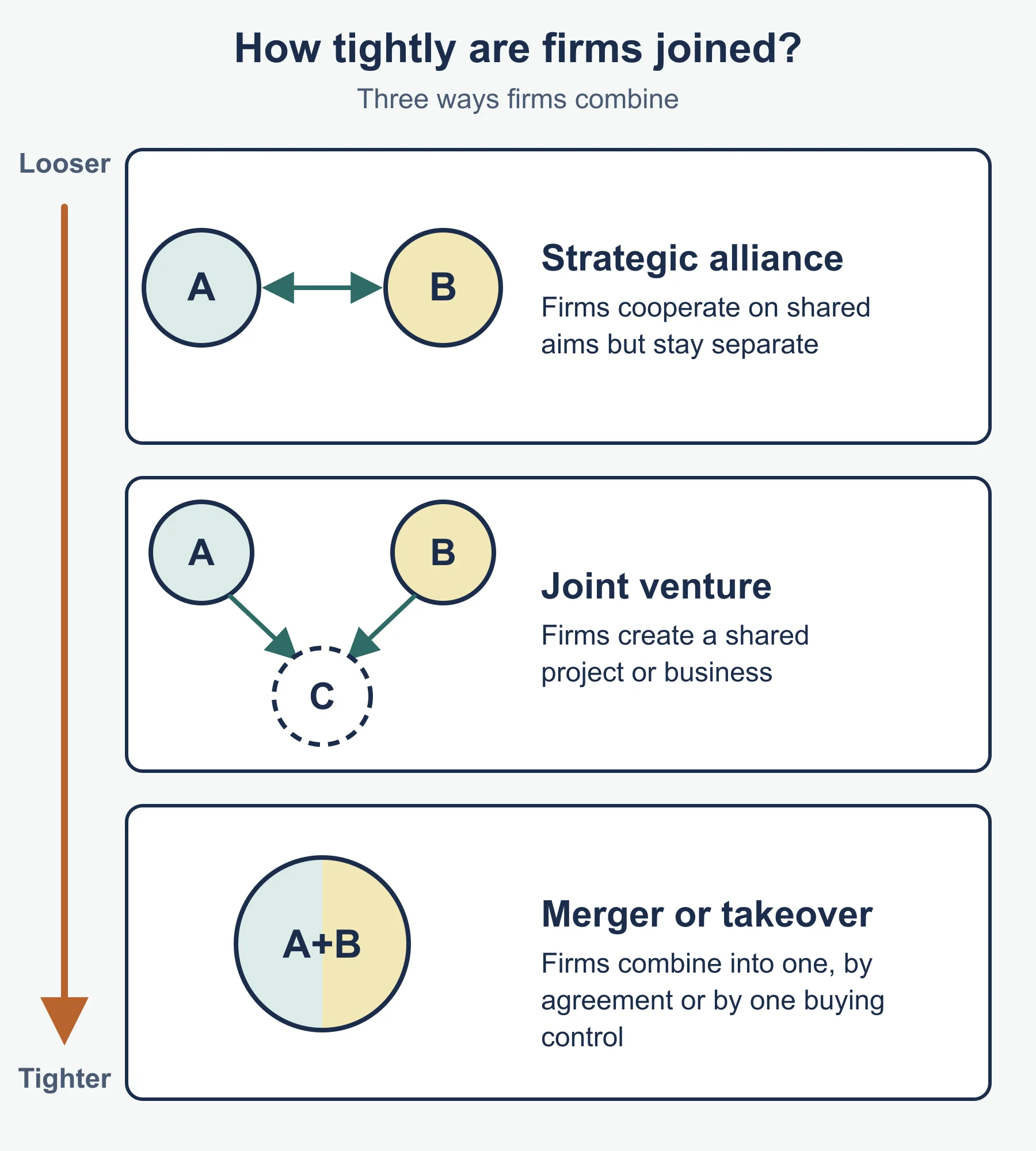
Organic (internal) growth comes from the business’s own resources: new products, new outlets, more customers. It is slower and lower-risk. External growth comes through other businesses: a merger (two firms agree to combine), a takeover (one firm buys control of another, which may be friendly or hostile), a venture (a joint venture or alliance with another firm) or franchising. It is faster but costlier, with a risk of culture clash.
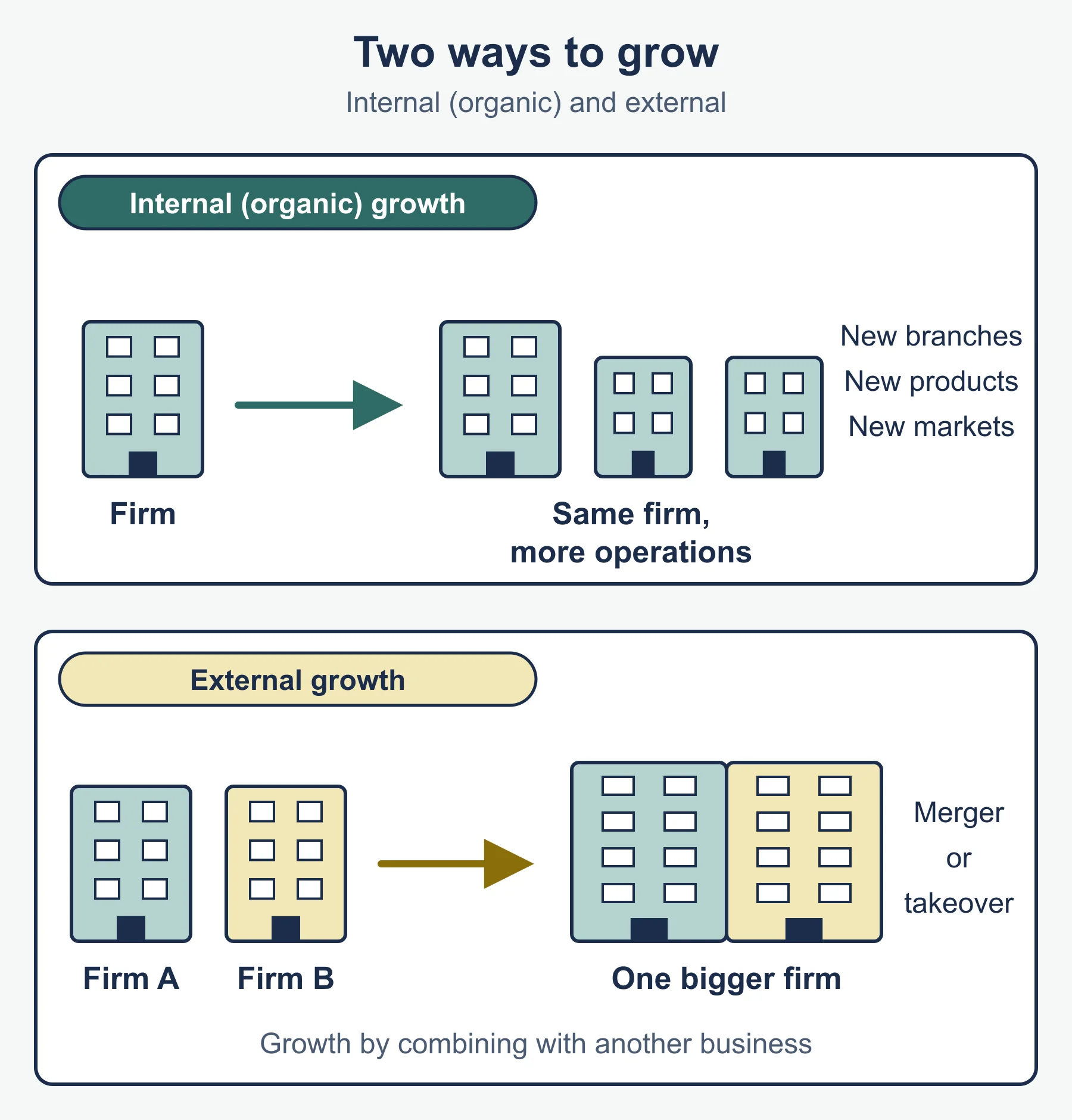
Methods of growth
- Merger: two businesses agree to combine. Costs are shared, but integration is hard.
- Takeover: the buyer gains control of the target; a hostile bid may be resisted.
- Venture: a joint venture shares cost, risk and knowledge, but also profit and control.
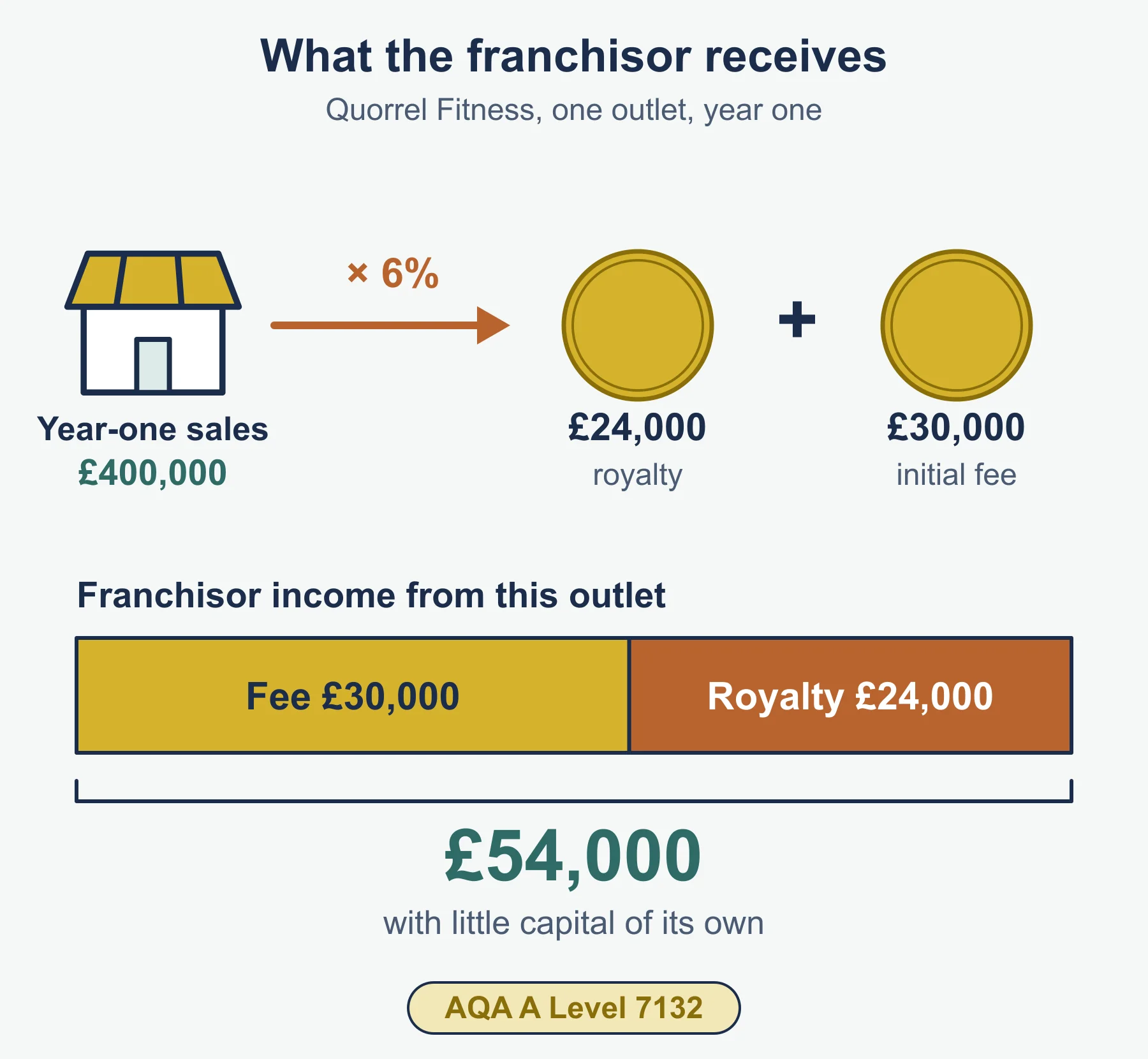
- Franchising: the franchisor sells the right to trade under its brand and system; the franchisee typically pays a fee and a royalty.
Worked example. Quorrel Fitness franchises a gym format. A new franchisee pays a £30,000 initial fee plus a royalty of 6% of sales. Sales in year one are £400,000.
- Royalty = 6% of £400,000 = £24,000.
- Franchisor income from this outlet in year one = £30,000 + £24,000 = £54,000.
Quorrel grows with little capital of its own, but one poor outlet can harm the brand.
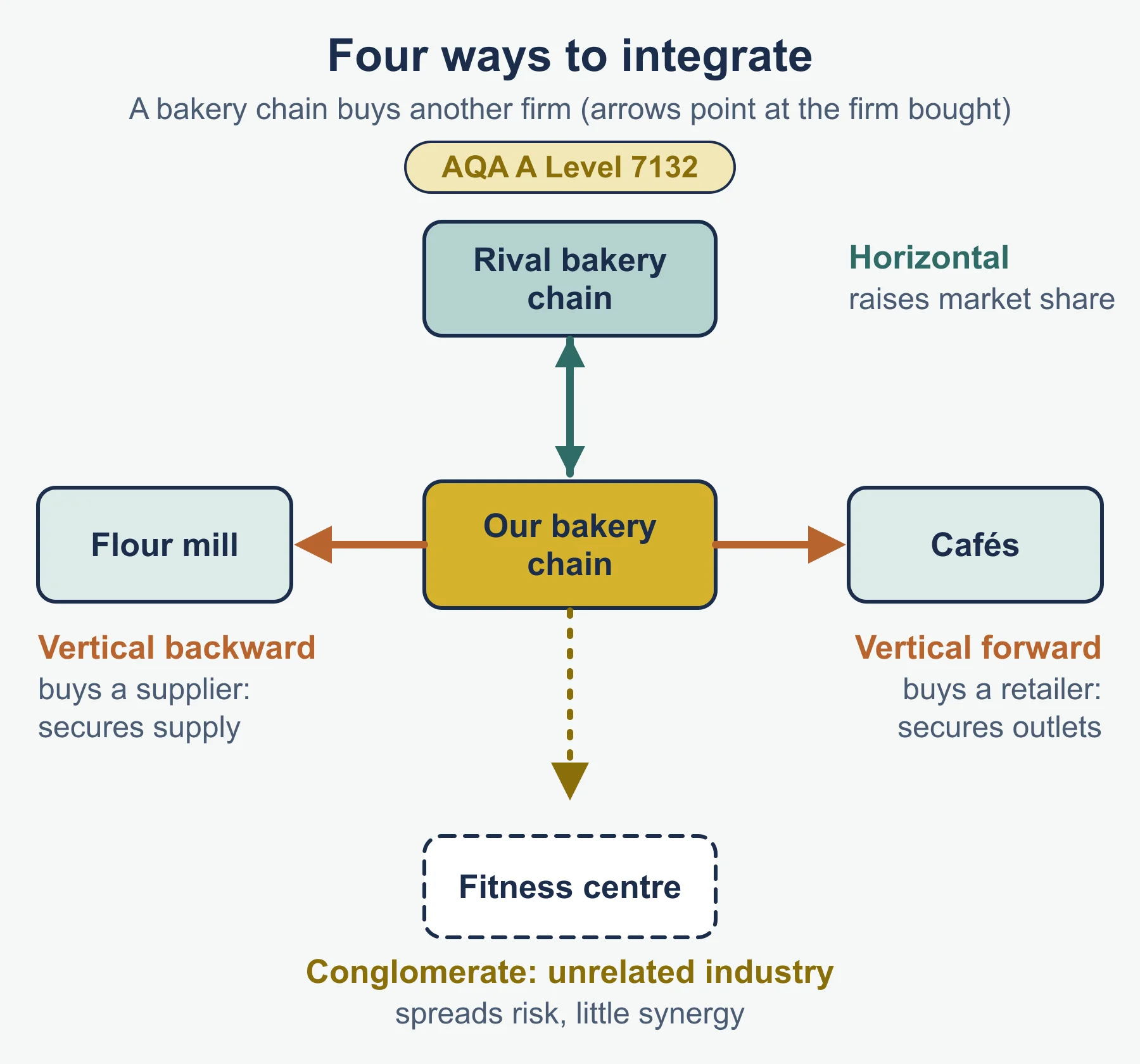
Types of growth (integration)
| Type | Meaning | Example direction |
|---|---|---|
| Horizontal | With a firm at the same stage of the same industry | A bakery chain buys another bakery chain |
| Vertical backward | With a supplier | The bakery buys a flour mill |
| Vertical forward | With a distributor or retailer | The bakery buys cafes to sell its bread |
| Conglomerate | With a firm in an unrelated industry | The bakery buys a fitness centre |
Horizontal integration raises market share; vertical integration secures supply or outlets; conglomerate integration spreads risk but offers little synergy.
The problems of growth, and how to manage them
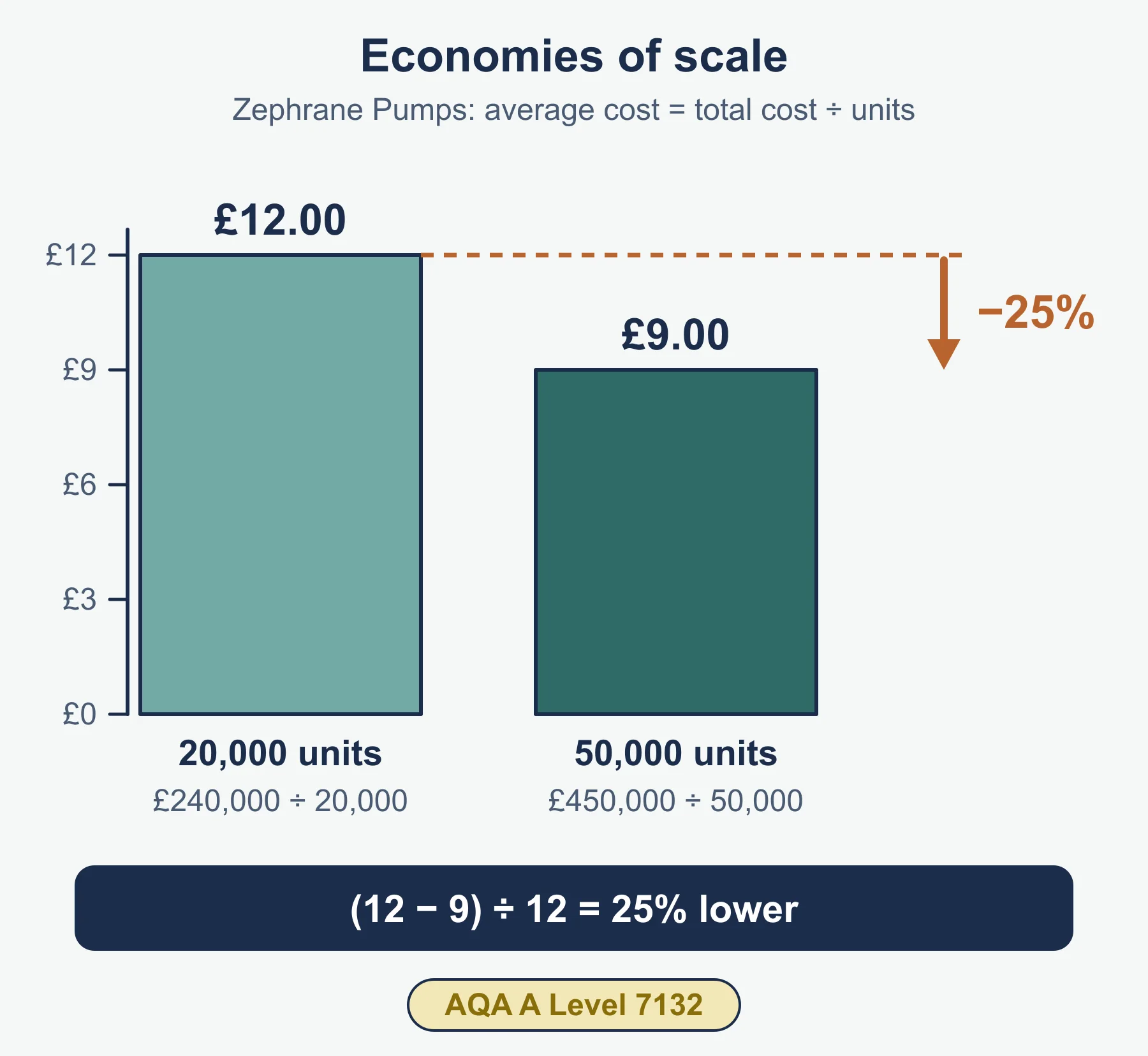
Economies of scale are falling average (unit) costs as output rises. The specification names three: technical (larger, more efficient machines and processes), purchasing (bulk discounts) and managerial (specialist managers spread over more output).
Worked example. Zephrane Pumps spends £240,000 to make 20,000 units a year, and £450,000 to make 50,000 units.
- Average cost at 20,000 = £240,000 / 20,000 = £12.00.
- Average cost at 50,000 = £450,000 / 50,000 = £9.00.
- Fall = (12 - 9) / 12 = 25%.
Economies of scope are lower average costs from making a range of related products with shared resources (one factory, one brand, one distribution network). Diseconomies of scale are rising average costs at large size, caused by slow communication, weak coordination and lower motivation as people feel distant from decisions.
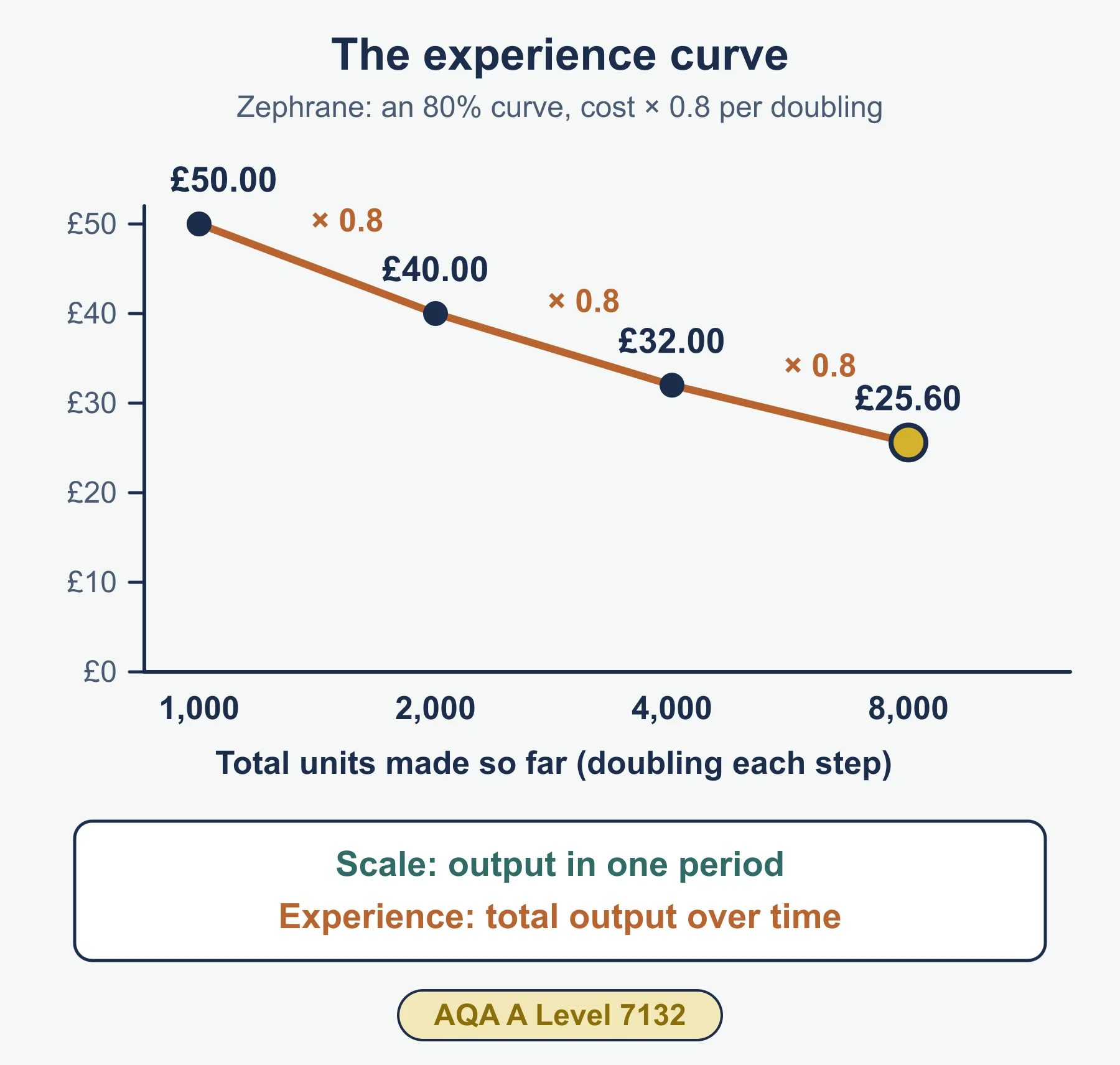
The experience curve says that unit cost falls as cumulative output rises, because workers learn, processes improve and purchasing power grows. It is often a percentage fall each time cumulative output doubles. Scale concerns output per period; experience concerns total output over time.
Worked example. Zephrane’s first 1,000 units cost £50 each. It sees an 80% curve: each doubling of cumulative output cuts unit cost to 80% of the previous level.
- 2,000 units: £50 x 0.8 = £40.00
- 4,000 units: £40 x 0.8 = £32.00
- 8,000 units: £32 x 0.8 = £25.60
Synergy means the combined business is worth more than the two separate ones (2 + 2 = 5). Gorsecombe Foods (market share 18%) merges with a rival (12%), giving a combined share of 30%. Their overheads were £2.4m and £1.6m. After integration the total is £3.3m: a saving of £0.7m, or 17.5% of the original £4.0m.
Overtrading happens when a business expands sales faster than its finance can support. It runs short of working capital, because stock and trade receivables absorb cash before customers pay. It is often shown by a falling current ratio (current assets divided by current liabilities; this is the standard form). Gorsecombe’s current assets are £120,000 and current liabilities £150,000, so the current ratio is 0.8. It may be profitable but unable to pay suppliers. Solutions: slower growth, longer-term finance, tighter credit control.
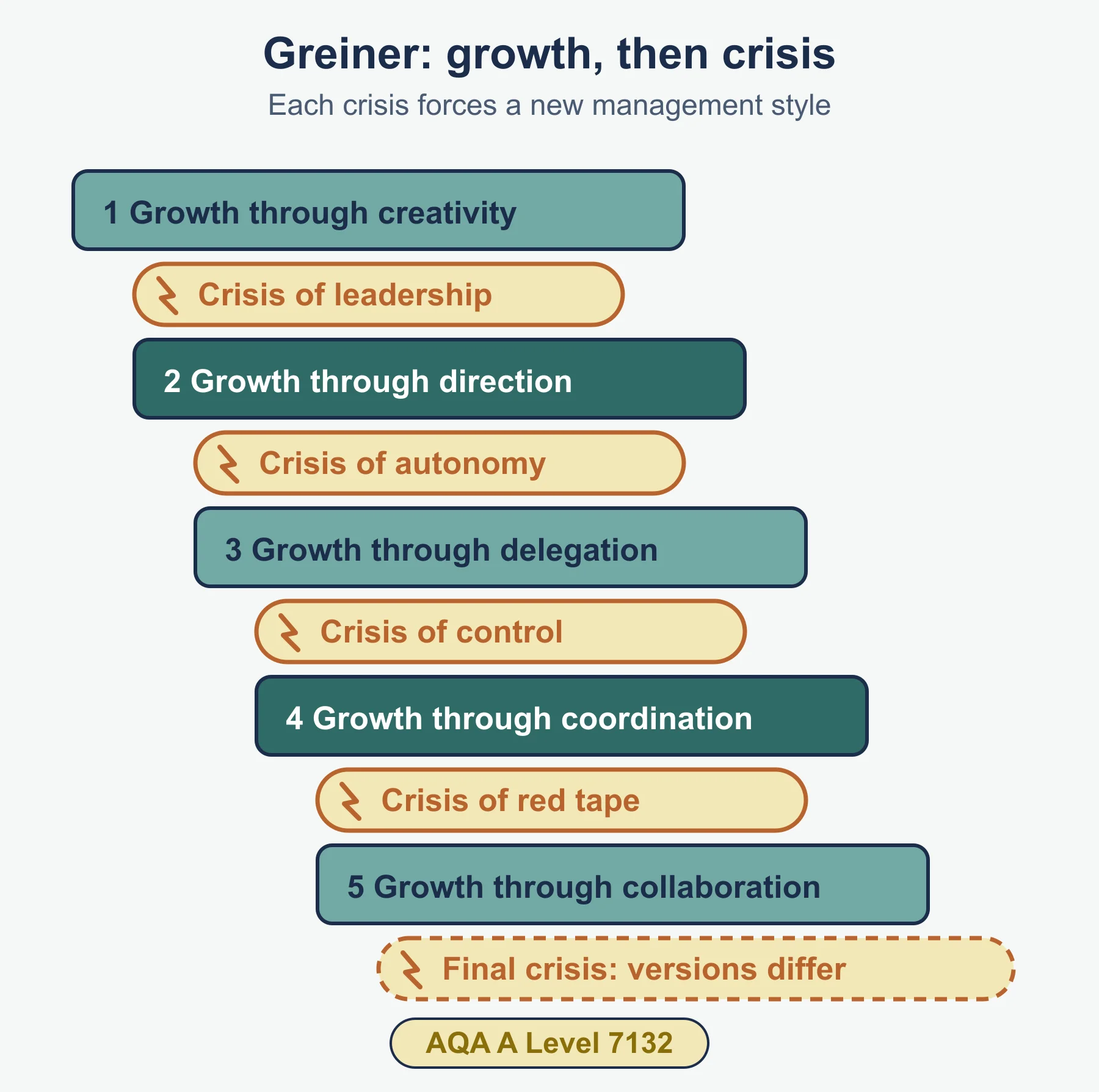
Greiner’s model of growth describes a business moving through phases of growth, each ending in a crisis that forces a change in management style before growth can resume:
- Growth through creativity, ending in a crisis of leadership.
- Growth through direction, ending in a crisis of autonomy.
- Growth through delegation, ending in a crisis of control.
- Growth through coordination, ending in a crisis of red tape.
- Growth through collaboration. Versions differ on the final crisis.
Cairnhill Bakery grew from one founder-run shop. At ten shops, managers wanted freedom (crisis of autonomy); delegating to area managers then raised the owner’s worry about control. The model suggests the business needs a new management approach, but real firms do not follow the phases neatly.
Impact on the functional areas
- Marketing: a bigger customer base, but a risk of a diluted brand.
- Operations: scale economies and capacity; quality control gets harder.
- Finance: greater need for funds and pressure on cash flow.
- Human resources: recruitment and new structures; redundancy and morale problems if retrenching.
3.9.2 Assessing innovation
Pressures for innovation include competitors’ new products, changing tastes, new technology, shorter product life cycles and the need to cut costs. Product innovation creates a new or improved good or service. Process innovation creates a new way of making or delivering it (automation, a new production method, a new booking system).
The value of innovation: a possible competitive advantage, premium pricing, a stronger brand, lower costs from process change, and new markets. Risks: cost, failure and imitation.
Becoming an innovative organisation
- Kaizen: continuous improvement through small, frequent changes suggested by all employees. Low cost, but gains are gradual.
- Research and development (R&D): deliberate investment in new knowledge and products. Sylvane Tea spends £1.8m on R&D with revenue of £24m, which is 7.5% of revenue (R&D intensity). Expensive and uncertain.
- Intrapreneurship: employees act like entrepreneurs inside the firm, with freedom, time and budget for new ideas.
- Benchmarking: comparing performance or methods with the best in the industry and copying the practices that work.
Protecting innovation and intellectual property
A patent gives the inventor the legal right for a limited period to stop others from making or selling the invention without permission. Copyright protects original creative work, such as written material, software code, images and music, from being copied. In general terms, both let the owner take action against copying. Protection costs money and is limited in time and place.
Impact on functional areas
- Marketing: launches and promotion spending.
- Operations: new equipment and retraining; output may dip at first.
- Finance: upfront cost and uncertain returns.
- Human resources: skilled staff, rewards for ideas, a culture that accepts risk.
3.9.3 Assessing internationalisation
Reasons for targeting, operating in and trading with international markets: saturated home market, faster growth overseas, spreading risk across markets, economies of scale from larger output. A multinational operates in more than one country, with production or services in several.
Factors influencing attractiveness: market size and growth, income levels, competitors, political stability, cultural and language fit, trade barriers, infrastructure, exchange rate stability and ease of doing business.
Producing and sourcing abroad. Reasons: lower labour costs, access to materials or skills, being close to customers, and avoiding trade barriers. Off-shoring moves production to another country. Re-shoring brings it back, usually because overseas wages rise, delivery is slow or unreliable, quality suffers or supply chains prove fragile.
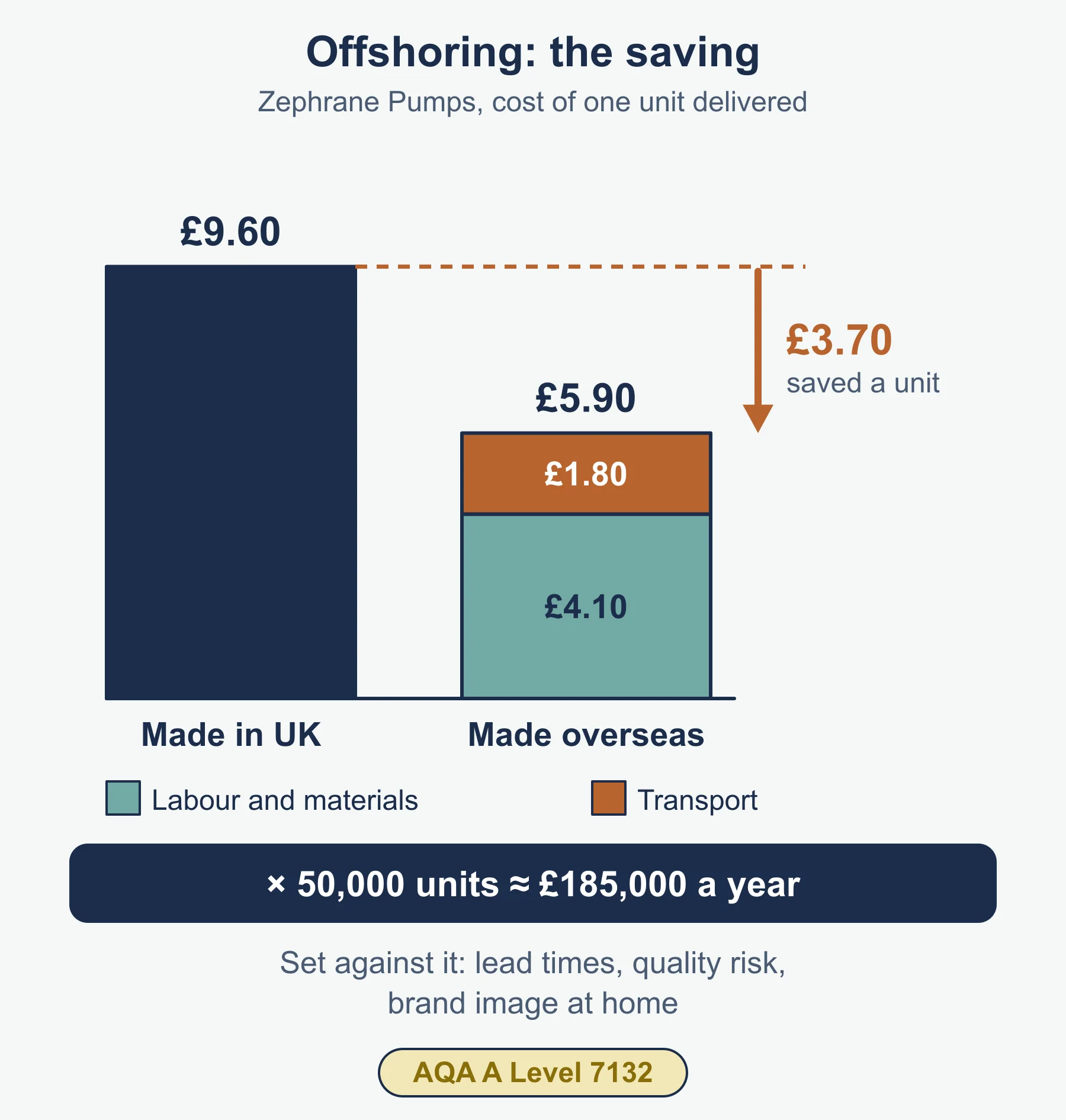
Worked example. Zephrane makes a unit in the UK for £9.60. Overseas, labour and materials cost £4.10 and transport £1.80, so the delivered cost is £5.90. The saving is £9.60 - £5.90 = £3.70 a unit, or about £185,000 on 50,000 units. Set against that: lead times, quality risk and brand image at home.
Entry methods
| Method | What it is | Value | Drawback |
|---|---|---|---|
| Export | Sell home-made goods abroad, directly or through an agent | Low cost and risk | Little local knowledge |
| Licensing | Another firm abroad pays to use the brand, design or technology | Little capital | Loss of control |
| Alliances | Cooperation, such as a joint venture, with a local partner | Local knowledge, shared risk | Shared profit |
| Direct investment | Own factory, shop or takeover abroad | Full control | Highest cost and risk |
Influences on buying, selling and producing abroad include exchange rates (a stronger home currency makes exports dearer), culture and language, legal and political differences, trade barriers and transport.
Bartlett and Ghoshal
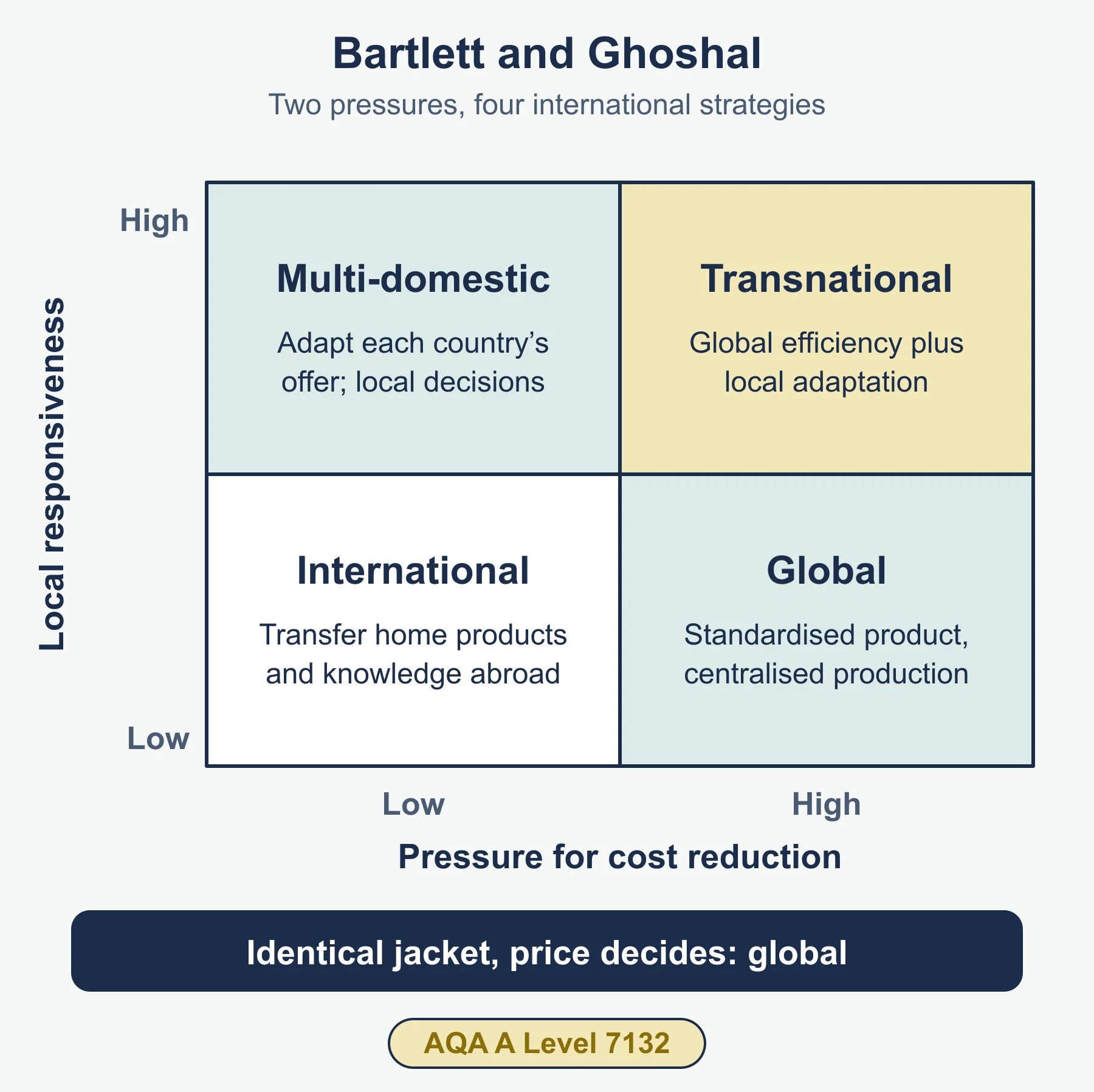
Bartlett and Ghoshal link a firm’s international approach to two pressures: pressure for local responsiveness (customers want products adapted) and pressure for cost reduction (customers want low prices).
| Strategy | Local responsiveness | Cost pressure | Approach |
|---|---|---|---|
| International | Low | Low | Transfer home products and knowledge abroad |
| Multi-domestic | High | Low | Adapt each country’s offer; local decisions |
| Global | Low | High | Standardised product, centralised production |
| Transnational | High | High | Global efficiency plus local adaptation, with knowledge shared across units |
Brackenwold Outdoor sells jackets in many countries. If tastes vary and price matters less, multi-domestic fits; if the product is identical and price decides, global fits. Transnational is attractive but hard to run.
Impact on functional areas: marketing (adaptation, language), operations (global supply chains, quality control), finance (currency risk, funding overseas operations) and human resources (managing staff across cultures and laws).
3.9.4 Assessing greater use of digital technology
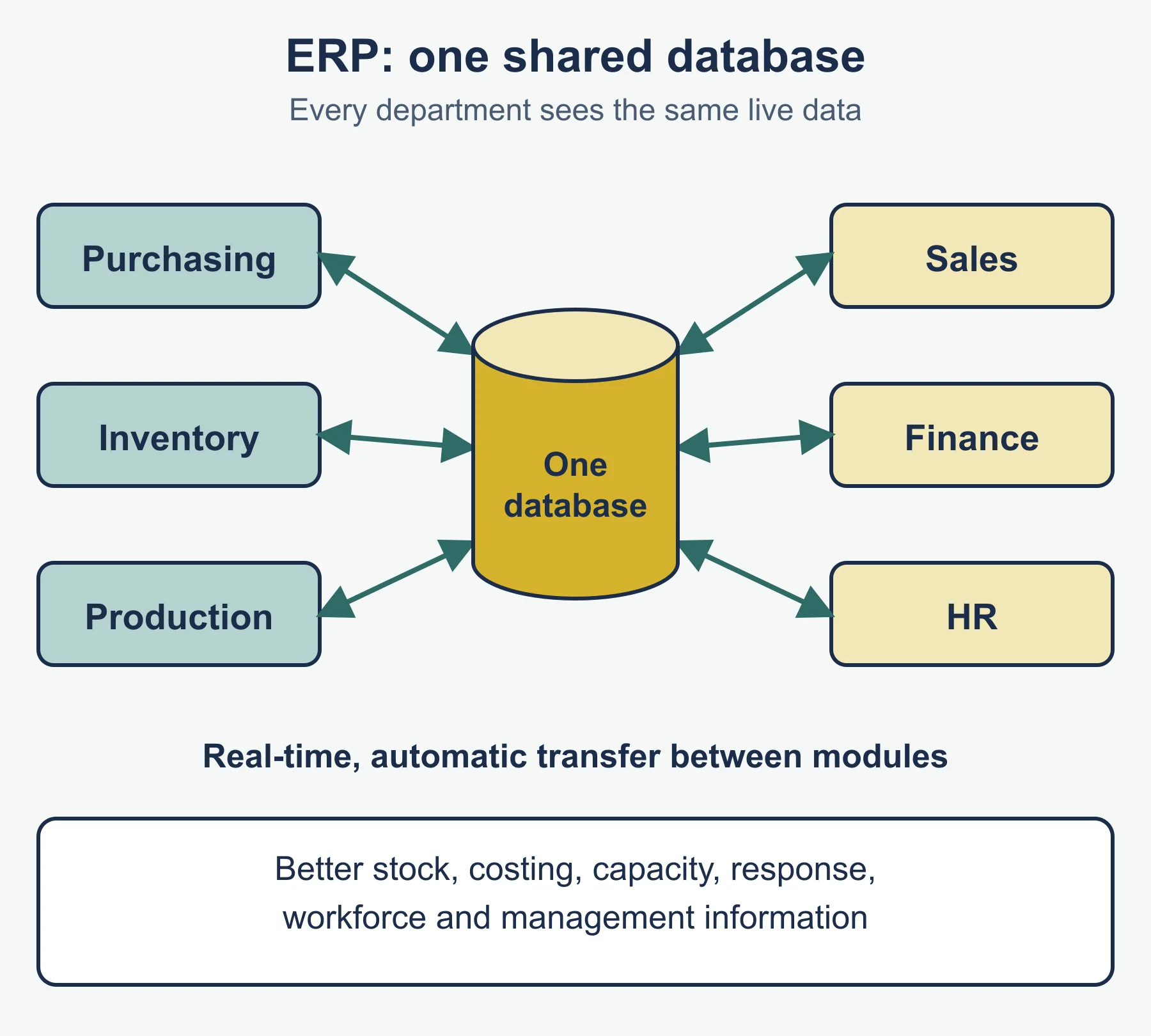
The specification names e-commerce (selling online), big data (very large, fast-growing sets of data), data mining (searching data for patterns, such as which customers buy together) and enterprise resource planning (ERP) (integrated software that links finance, stock, orders and HR in one system).
Pressures to adopt: competitors already online, customers expecting digital service, cost savings and supply chain demands.
Value: wider reach, 24-hour sales, personalised marketing, better forecasting and a single view of the business. Risks: setup cost, system failure, data security and staff resistance.
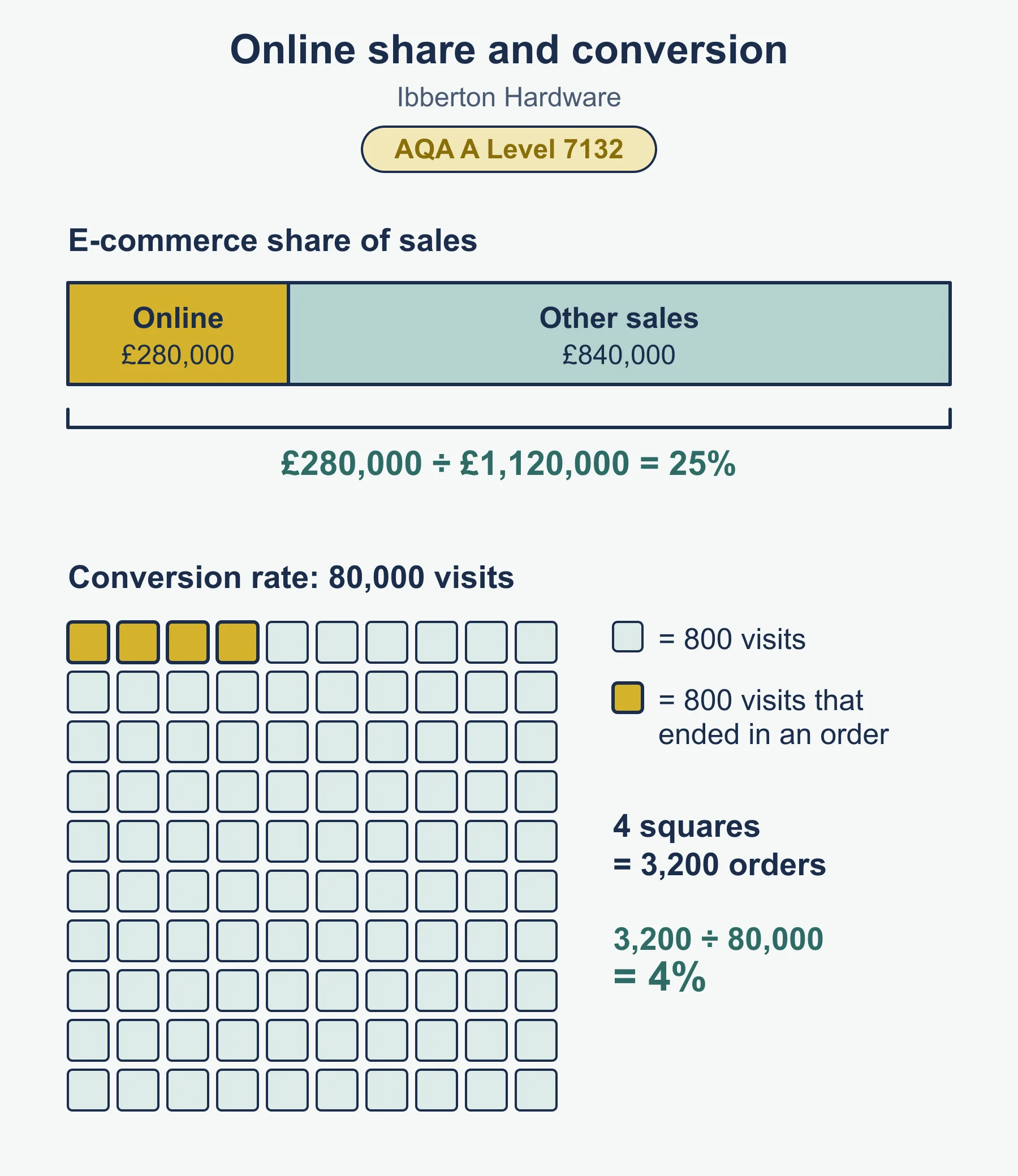
Worked example. Ibberton Hardware has online sales of £280,000 out of total sales of £1,120,000, so e-commerce is 25% of sales. Its site had 80,000 visits and 3,200 orders, a conversion rate of 3,200 / 80,000 = 4%. Data mining shows who buys paint with brushes, supporting bundled offers.
Impact on functional areas: marketing (targeting, online promotion), operations (ERP for stock and scheduling, automation), finance (real-time data, system cost) and human resources (retraining, redundancies, remote working).
Common errors
- Treating economies of scale and the experience curve as the same thing.
- Saying overtrading means making too much profit. It is a cash-flow problem caused by growth outpacing finance.
- Giving one-sided answers. Judgement needs a reason why the method may or may not suit this business.
Frequently asked questions
What is the difference between a merger and a takeover? In a merger two businesses agree to combine, sharing costs but facing difficult integration. In a takeover the buyer gains control of the target, and a hostile bid may be resisted.
What is synergy in business growth? Synergy means the combined business is worth more than the two separate businesses, often summed up as 2 + 2 = 5.
What are the four ways of becoming an innovative organisation in AQA 7132? Kaizen (continuous small improvements suggested by all employees), research and development, intrapreneurship (employees acting like entrepreneurs inside the firm) and benchmarking against the best in the industry.
What does the Bartlett and Ghoshal model compare? It links a firm’s international approach to two pressures: the pressure for local responsiveness and the pressure for cost reduction. The transnational strategy faces high pressure on both.
Which section of the AQA Business specification covers strategic methods? Section 3.9, Strategic methods: how to pursue strategies (A-level only), covering change in scale, innovation, internationalisation and digital technology.
Official syllabus
AQA AS and A-level Business (7131 and 7132), section 3.9, “Strategic methods: how to pursue strategies” (A-level only), AQA.
Get free revision emails (optional)
Occasional emails with practice questions, worked explanations and links to free resources for the qualification and subjects you choose. No spam, and you can unsubscribe from any email. The free tools on this site never need an email.
Related resources
-
Practice questions
AQA A-Level Business: Strategic methods: how to pursue strategies (7132) – Practice Questions
Original practice questions with worked answers on growth, innovation, internationalisation and digital technology for AQA A-Level Business 7132.
Business · AQA · A Level
Try questions -
Revision notes
AQA A-Level Business: Strategic methods: how to pursue strategies (7132) – Revision Notes
Condensed revision notes on growth, innovation, internationalisation and digital technology for AQA A-Level Business 7132, with a self-test.
Business · AQA · A Level
Revise topic -
Study guides
AQA A-Level Business: Understanding management decision making (7132)
Study guide to AQA A-Level Business 3.2.2: data versus intuition, decision trees, expected value, net gain, risk, opportunity cost and influences.
Business · AQA · A Level
Read guide
Related articles
-
teaching
A Level tuition in Dubai: Cambridge or Pearson Edexcel International A Level?
Schools in Dubai and Abu Dhabi teach either Cambridge International AS & A Level or Pearson Edexcel International A Level. How the two are structured, why it matters for tuition, and how online classes from Lahore work.
9 October 2026
-
curriculum guides
Choosing subjects at IGCSE and A Level
How subject choices at 14 and 16 affect university options later, and how to keep pathways open without overloading a timetable.
28 July 2026
Studying this with a teacher
Working through Business A LEVELS?
This page is free and stays free. If you would rather be taught it, Marlbridge runs Business classes one-to-one and in small groups of up to 15, online in your own time zone. The first trial class is free. WhatsApp replies within an hour (8am–11pm Pakistan time, every day); email the same day.
AQA Business teachers at Marlbridge
